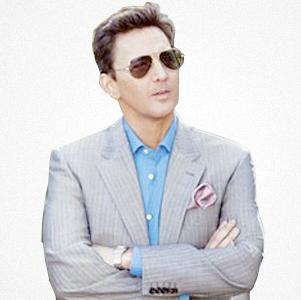
If, in the course of watching True Blood, you’ve found yourself thinking “damn, those vampires look hot,” — and, seriously, who hasn’t? — here’s (well, one reason) why. The stylist for the “postmodern” vampire series has been consistently dressing its characters in the sartorial creations of “post-apocalyptic couture” design house (and long-time homies): SkinGraft.
I’ve written about True Blood’s seriously brilliant “transmedia” marketing campaigns before (1, 2), created by Campfire Agency, which have sought to bring the fictional world of the show off the screen and into reality, and I’ll even admit I’ve done a double take seeing a guy wearing one of those subtly faded “Bon Temps Football” t-shirts out on the street. Now, I’m hearing there’s rumblings of a plan underway to sell not just show merchandise but some of the real-life designer clothes the characters wear — including SkinGraft’s, of course — through the show’s website. Pretty awesome!
If you can’t wait that long — and you really shouldn’t, even if you’ve got forever — you can find SkinGraft HERE.
And P.S., if you’re in LA, keep an eye out for the upcoming opening of Gather, a new boutique by Katie Kay, partner and former co-designer at SkinGraft, located at 630 S. Main St. in downtown.
I wrote a post recently about how Your Life Is A Transmedia Experience, which included the example of Bret Easton Ellis’s latest novel, Imperial Bedrooms, the 25-years-later sequel to his debut, Less Than Zero, which creates a sort of closed-circuit loop by bringing both the original novel as well as the 1987 movie based on it into existence within the world of the book. By detailing his characters’ reactions to the original, darkly disturbing novel depicting their lives, and then to its sanitized film adaptation, Ellis effectively creates a narrative world that extends, and can be experienced across these multiple media formats, each one adding its own element to the complete story. There is, currently, an emergence of popular entertainment specifically designed to be transmedia experiences, to jump from platform to platform, and, in the process, intertwine the real world with the fictional, but Ellis, who became a published author when he was still in college, has long maintained that, for him, a novel is just a novel, approached and developed according to the dictates of its own medium. Nevertheless, Ellis has always had a penchant for referencing actual pop culture — movies, music, fashion, celebrities, night clubs, etc. — within his stories. It’s pretty much his trademark. His work has, all along, incorporated multiple other media into its fictional world, and, in turn, become an indelible part of the popular culture on which it comments.
In this fantastic interview on BigThink.com, Ellis muses about the possibilities for the future of fiction in the digital age and touches on what is, essentially, transmedia storytelling. It could, he says, “even possibly re-energize my faith in fiction.”
Have a listen. It’s great stuff:
.
Bonus: a fun clip of Ellis talking about schooling his publisher on how to function in the “post-empire“… errr … in the social media age:
A year ago I wrote a piece called “Your Lifestyle Is An Alternate Reality Game.” An ARG, for short, is an interactive narrative that uses the real world as a platform, often involving multiple media and game elements, to tell a story that may be affected by participants’ ideas or actions. Lifestyle, I suggested, with its proscribed media content, its insider signifiers, its ever-evolving subcultural narrative, is the alternate reality game all of us in the modern world are already playing. Having grown up in the rave scene and then produced nightlife events and music festivals for a decade this similarity was instantly apparent. Since writing that post, I’ve actually seen pioneering ARG creators, Jordan Weisman and Sean Stewart, each, individually liken ARGs to a quintessential alternative culture / music festival experience: Woodstock. (Called it!)
This year, however, the new buzzword gaining popularity for this type of multi-platform narrative is “transmedia.” (On the schedule for the New York DIY Days conference a couple of months ago, the word “transmedia” appeared literally a dozen times in the descriptions for no less than 5 different sessions during the course of the 1-day event). And as the terminology becomes more encompassing — no longer strictly a gaming-specific thing — last year’s thesis needs an upgrade as well: In the digital age, transmedia isn’t just how we create lifestyle narratives, it’s how we experience the narrative of our lives. .
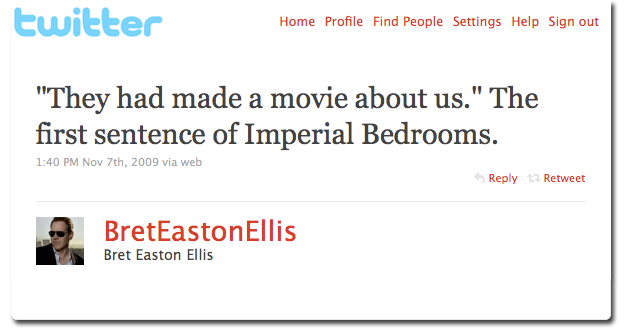
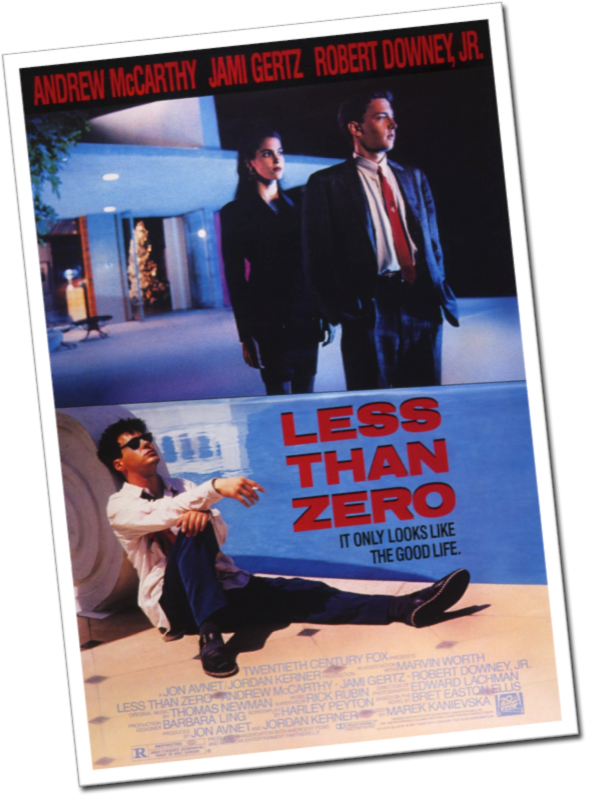
In 1985, a student at Bennington College named Bret Easton Ellis published what would become a best-selling debut novel called Less Than Zero. It’s a story told in first person by a narrator named Clay, home for Christmas break from a fictional New England liberal arts college, as he wafts through L.A.’s endlessly dissolute desert of affluence, parties, rampant drug use, meaningless sex, and progressively increasing depravity. The book was so insidious and disturbing that by 1987, just two years after its publication, it was turned into an inevitably much less insidious and disturbing movie starring Andrew McCarthy as Clay, Jami Gertz as his ex-girlfriend, Blair, and, notably, Robert Downey Jr. as Clay’s heroin-addicted best friend from high school, Julian, who’d turned to prostitution to pay off his drug debt. Now, 25 years and 5 novels (including The Rules of Attraction and American Psycho) later, Ellis’s newest book, Imperial Bedrooms, out June 15, catches up with Less Than Zero’s original cast of poster-children for morally vacant, excess-addled, existentially corrupted youth in present day, as they inhabit middle age. Once again, Clay is the narrator, once again, he’s just returned to Los Angeles after a semester-length absence, and the first thing Clay says — as classically laconic as his “People are afraid to merge on the freeways in Los Angeles” line that opened Less Than Zero two and a half decades earlier — is: “They had made a movie about us.”
The movie was based on a book written by someone we knew. The book was a simple thing about four weeks in the city we grew up in and for the most part was an accurate portrayal. It was labeled fiction but only a few details had been altered and our names weren’t changed and there was nothing in it that hadn’t happened….
[The author] wasn’t close to any of us… He was simply someone who floated through our lives and didn’t seem to care how flatly he perceived everyone or that he’d shared our secret failures with the world, showcasing the youthful indifference, the gleaming nihilism, glamorizing the horror of it all….
I remember my trepidation about the movie began on a warm October night three weeks prior to its theatrical release, in a screening room on the 20th Century Fox lot. I was sitting between Trent Burroughs and Julian, who wasn’t clean yet and kept biting his nails, squirming in the plush black chair with anticipation…. The movie was very different from the book in that there was nothing from the book in the movie. Despite everything — all the pain I felt, the betrayal — I couldn’t help but recognize a truth while sitting in that screening room. In the book everything about me had happened. The book was something I simply couldn’t disavow. The book was blunt and had an honesty about it, whereas the movie was just a beautiful lie. (It was also a bummer: very colorful and busy but also grim and expensive, and it didn’t recoup its cost when released that November.) In the movie I was played by an actor who actually looked more like me than the character the author portrayed in the book: I wasn’t blond, I wasn’t tan, and neither was the actor. I also suddenly became the movie’s moral compass, spouting AA jargon, castigating everyone’s drug use and trying to save Julian. (“I’ll sell my car,” I warn the actor playing Julian’s dealer. “Whatever it takes.”) This was slightly less true of the adaptation of Blair’s character, played by a girl who actually seemed like she belonged in our group — jittery, sexually available, easily wounded. Julian became the sentimentalized version of himself, acted by a talented, sad-faced clown, who has an affair with Blair and then realizes he has to let her go because I was his best bud. “Be good to her,” Julian tells Clay. “She really deserves it.” The sheer hypocrisy of this scene must have made the author blanch. Smiling secretly to myself with perverse satisfaction when the actor delivered that line, I then glanced at Blair in the darkness of the screening room.
As the movie glided across the giant screen, restlessness began to reverberate in the hushed auditorium. The audience — the book’s actual cast — quickly realized what had happened. The reason the movie dropped everything that made the novel real was because there was no way the parents who ran the studio would ever expose their children in the same black light the book did. The movie was begging for our sympathy whereas the book didn’t give a shit. And attitudes about drugs and sex had shifted quickly from 1985 to 1987 (and a regime change at the studio didn’t help) so the source material — surprisingly conservative despite its surface immorality — had to be reshaped. The best way to look at the movie was as modern eighties noir — the cinematography was breathtaking — and I sighed as it kept streaming forward…. But the thing I remember most about that screening in October twenty years ago was the moment Julian grasped my hand that had gone numb on the armrest separating our seats. He did this because in the book Julian Wells lived but in the movie’s new scenario he had to die. He had to be punished for all of his sins. That’s what the movie demanded. (Later, as a screenwriter, I learned it’s what all movies demanded.) When this scene occurred, in the last ten minutes, Julian looked at me in the darkness, stunned. “I died,” he whispered. “They killed me off.” I waited a beat before sighing, “But you’re still here.” Julian turned back to the screen and soon the movie ended, the credits rolling over the palm trees as I (improbably) take Blair back to my college while Roy Orbison wails a song about how life fades away.
The real Julian Wells didn’t die in a cherry-red convertible, overdosing on a highway in Joshua Tree while a choir soared over the sound track. The real Julian Wells was murdered over twenty years later….
I’d seen what had happened to him in another — and very different — movie.
Transmedia, as USC media studies professor Henry Jenkins describes in his book, Convergence Culture, is storytelling that spans across multiple forms of media, with each element expanding the viewer’s understanding of the story world and creating a new “entry point” through which to become immersed in it. Beyond Ellis’s sheer meta-mindfuckery (and the full, unabridged intro is even moreso), by incorporating the existence of the Less Than Zero movie into Imperial Bedrooms — even detailing the various characters’ reactions to its sanitized inconsistencies with the original novel — he’s effectively turned the film into something other than just the compromised adaptation it’s been for the past 23 years. It’s now a legitimate, if suitably ironic, “entry point” into the Less Than Zero world.
A couple of weeks ago, Jenkins wrote a post called “He-Man and the Masters of Transmedia,” about another fictional world spawned from the 80’s which may have had a lasting affect on my generation:
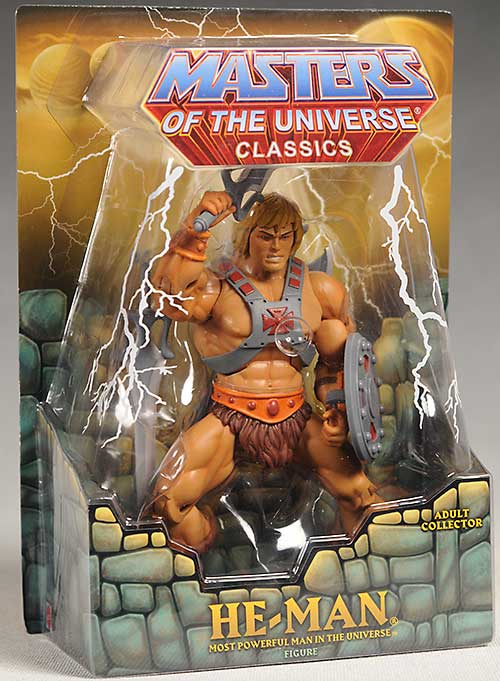
In many ways, Masters of the Universe was already a transmedia story, at least as much as the technology of the day would allow. He-Man not only appeared in the Filmation-produced cartoons but his story was extended into the mini comic books which came with each action figure, on the collector cards and sticker books and coloring books and kids books.
Once they were removed from their packages, these toys could be mixed and matched to create new kinds of stories….Kids would move from re-performing favorite stories or ritualizing conventional elements from the series to breaking with conventions and creating their own narratives.
I never understood the parents who feared such toys would stifle my son’s imagination because what I observed was very much the opposite – a child learning to appropriate and remix the materials of his culture.
When I speak to the 20 and 30 somethings who are leading the charge for transmedia storytelling, many of them have stories of childhood spent immersed in Dungeons and Dragons or Star Wars, playing with action figures or other franchise related toys, and my own suspicion has always been that such experiences shaped how they thought about stories.
From the beginning, they understood stories less in terms of plots than in terms of clusters of characters and in terms of world building. From the beginning they thought of stories as extending from the screen across platforms and into the physical realm.”
It’s why the website for Imperial Bedrooms has a playlist of songs “from the book” featuring tracks by Randy Newton, Bat for Lashes, Duran Duran, The Fray, Bruce Springsteen, and others — music has always been a key element in Ellis’s fiction: Less Than Zero got its title from an Elvis Costello track, as does its sequel, and there are constant references to songs throughout his novels, cueing a soundtrack in your mind as you’re reading the story. (In fact, all of Ellis’s books now have playlists.) It’s why the Los Angeles Magazine website has an interactive Google map of the locations featured in Imperial Bedrooms and it’s accompanied by Clay’s guide, in his own words, to these various haunts. It’s why Clay has ended up on Facebook and his profile photo — still bearing a decided resemblance to Andrew McCarthy — is also included with his city guide. Here, for instance, is Clay’s take on Hollywood Forever Cemetery:
The most beautiful cemetery in Los Angeles. It’s behind the Paramount lot and it can be disorienting to walk off Gower Avenue into this lush, paradisiacal place. I remember going to movies there during the summer; Psycho, The Muppet Movie, Carrie. I was there last for a funeral where the only person I talked to was Blair.
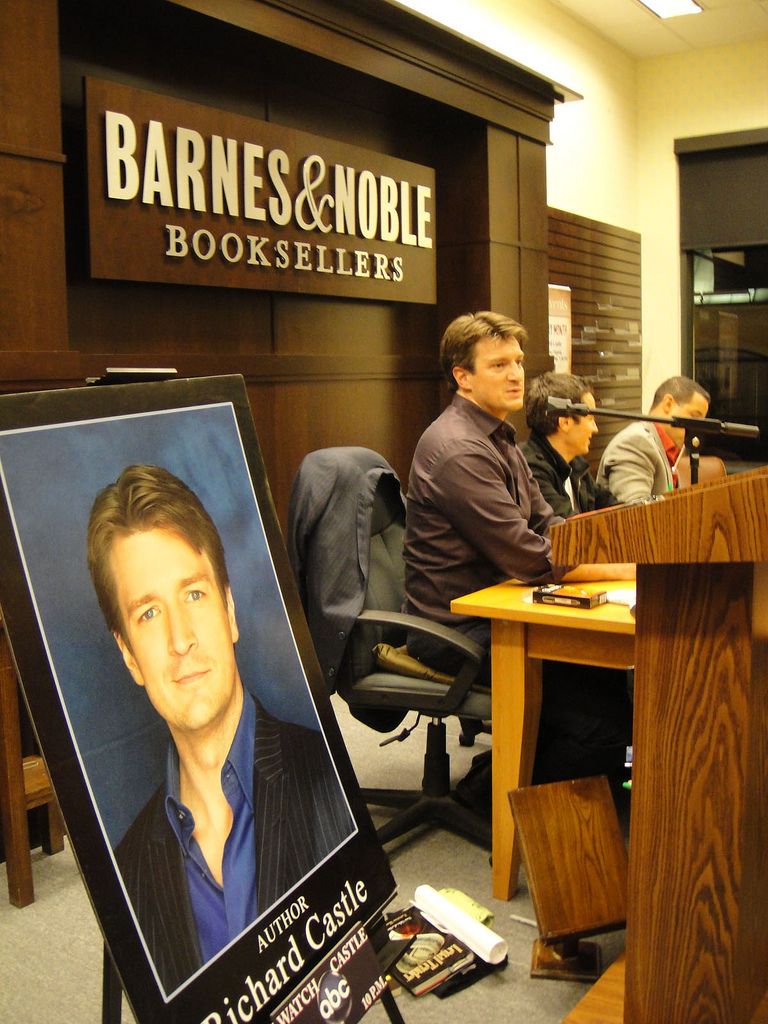
Meanwhile, in a different genre section of the bookstore, there’s yet another author blurring the lines between fiction, reality, media formats, you know, the ushe: Richard Castle.
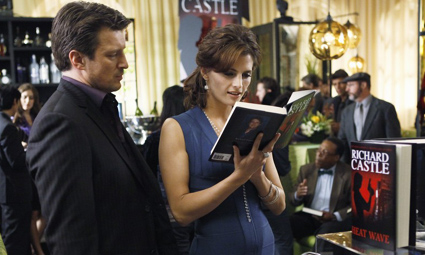
OK, so, technically he’s a TV character played by Nathan Fillion on the ABC show, Castle, which follows the best-selling mystery writer and his unlikely partner, a tough, sexy, NYPD detective named Kate Beckett, as they solve Manhattan murders. The show’s first season story-arc saw the release of Heat Wave, Castle’s new novel about (you know this) a tough, sexy, NYPD homicide detective named Nikki Heat, which also happens to be an actual Hyperion book.
Richard Castle is the author of numerous bestsellers, including the critically acclaimed Derrick Storm series. His first novel, In a Hail of Bullets, published while he was still in college, received the Nom DePlume Society’s prestigious Tom Straw Award for Mystery Literature. Castle currently lives in Manhattan with his daughter and mother, both of whom infuse his life with humor and inspiration.
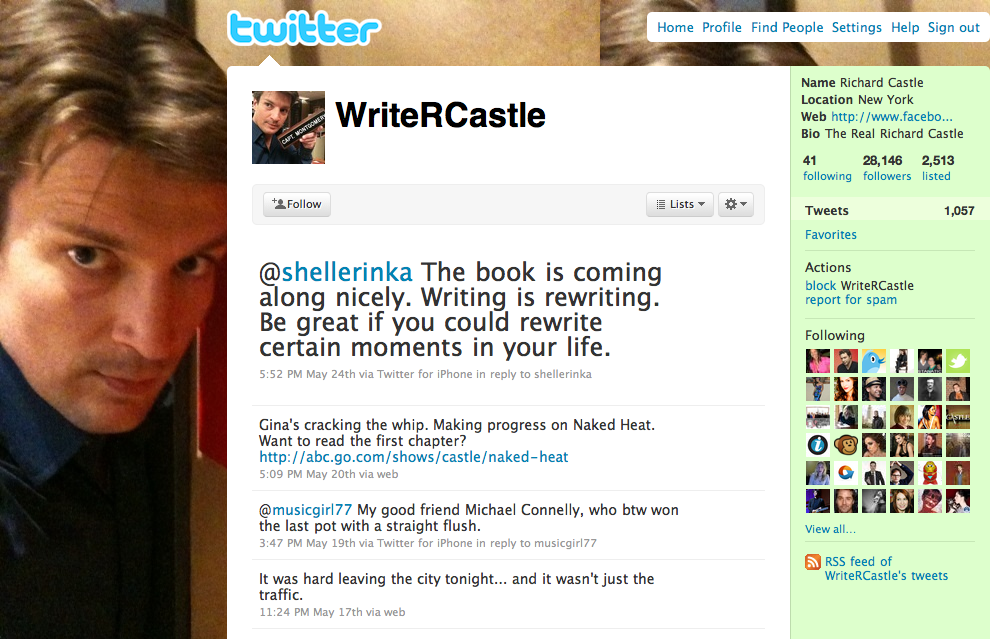
But Castle isn’t just on TV and bookshelves. Like any 21st century writer who knows what’s up, he’s also on Twitter —
Imperial Bedrooms wasn’t designed to deliberately be a “transmedia narrative” — it’s just a novel, after all — but that doesn’t matter. It’s inevitable. Our lives are inundated with the use of digital platforms and social applications. We move from medium to medium effortlessly, and we expect the content and narratives we consume to travel the same way. Any world or characters we find compelling already exist beyond their original medium. It’s 2010. All media is transmedia. Deal with it. Rock ‘n roll.
Castle has obviously been designed as a deliberate transmedia narrative, but Imperial Bedrooms wasn’t — it’s just a novel. Either way, it’s inevitable. The human brain has a natural affinity for narrative construction, and it’s incredibly channel agnostic. Once upon a time, the Ancient Greeks heard thunder and believed it to be the sound of Zeus’s thunderbolt. Today, our media formats are just more sophisticated. Our lives are inundated by digital technology, content platforms, network applications — it’s not narratives that travel trans-media: we do. And we bring the stories along for the ride. It’s 2010. All media is transmedia. Deal with it. Rock ‘n’ roll.
Your computer doesn’t care what the 19th century production mechanism for producing your entertainment was. Record, book, it doesn’t care. It’s all 1’s and 0’s to your computer. Video, music, pictures, text, and let’s not stop there, let’s include other things that you can now incorporate as part of your entertainment, like web-pages or searches or email or phone calls directly to your audience. Here’s a simple mnemonic: any way that human-kind has invented to lie to one another should be part of your storytelling toolkit.
But fictional narratives aren’t what this toolkit is strictly limited to. As tech blogger Robert Scoble writes in his recent post, “The ‘like, er, lie’ economy“:
The other day I found myself over at Yelp.com clicking “like” on a bunch of Half Moon Bay restaurants. After a while I noticed that I was only clicking “like” on restaurants that were cool, hip, high end, or had extraordinary experiences.
That’s cool. I’m sure you’re doing the same thing.
But then I started noticing that I wasn’t behaving with integrity. What I was presenting to you wasn’t reality.
See, I like McDonalds and Subway. But I wasn’t clicking like on those. Why not?
Because we want to present ourselves to other people the way we would like to have other people perceive us as.
I’d rather be seen as someone who eats salad at Pasta Moon than someone who eats a Big Mac at McDonalds.
This is the problem with likes and other explicit sharing systems. We lie and we lie our asses off.
We are all storytellers now, all the authors of our own life stories (no big surprise, we’re taking some “creative liberties”). The array of media tools through which to “present ourselves” is already ubiquitous, and constantly expanding. Social networks, personal blogs, microblogs, digital cameras, location-based social applications — for some reason Time Magazine singled out Foursquare as one of the 50 Worst Inventions for being “just another tool tapping into a generation of narcissism,” as if, inexplicably, it’s particularly worse than the cesspools of self-focus that are Facebook or Myspace. With every status update and photo upload and location check-in and “like” we click, we are producing an endless stream of new “entry points” into our personal narratives. And, in turn, like Ellis’s, aptly named, Clay, we are all shaped by the resultant media representations of our selves. In the digital age, transmedia isn’t simply the default for how we experience entertainment, it is how we experience the story of our lives.
Aerial shot of the Coachella Arts & Music Festival (photo: Jazmin Million)
.
“God is alone — but the devil, he is far from being alone; he sees a great deal of company;
he is legion.”
– Henry David Thoreau, “Solitude,” Walden, 1854
Standing on the field at Coachella 2008, the endless noise and heat like physical things pushing and shoving in a mosh pit, the blast clouds of music spilling out from monolithic stacks of speakers across four hundred acres, the polo field crawling like an ant-farm with a hundred thousand bodies, it suddenly occurred to me that the only historical precedent for this sort of massive concentration of people and resources and infrastructure in one place at one time had to have been… war.
I’d only slept a few hours the previous night, been up since early enough to hear Prince’s sound-check as the score to the start of my workday, and looking through the 100+ degree Palm Sprigs haze that afternoon under the sweltering sky, I imagined ancient Greek or Roman or Macedonian battlegrounds and thought they might not have looked too different.
In college I’d started throwing raves; at the turn of the millennium I was part of the promotions team at New York’s iconic Lunatarium, a 20-thousand square foot warehouse space in DUMBO dubbed “the studio 54 of the moveon.org crowd” by the New York Times; by the mid-aughties I’d been the Online marketing Coordinator for House of Blues Concerts in Southern California, led the social media strategy for Live Nation’s Street Scene Music Festival in San Diego, consulted on web strategy for the Bonnaroo Festival in Tennessee, and at the moment of that heat-stroked revelation on the Empire Polo Field was the Marketing Director for an independent event creations company which, in addition to Coachella, that summer would also work with the Rothbury Music Festival in Michigan, Optimus Alive Festival in Portugal, All Points West Festival in New York, the Virgin Music Festival in Baltimore, Electric Picnic in Ireland, and finish off the season with a stint at Burning Man.
Needless to say, this wild proliferation and growth of massive music festivals over the past decade was something I’d noticed. Yet at the same time that I was in the front row seat at the concert industry, my career also overlapped with the ascension of social technology. At the time, already anachronistic phrases like “new media,” and “electronic marketing” were still being tossed about to describe my inevitable department. Just the year before, at SXSW Interactive 2007, when Myspace was still king of the web and Facebook was just a college dorm and the newly-launched Twitter was yet to be anything but the geeks’ private playground, there were still panels called things like, “Why Marketers Need To Work With ‘People Media’“. Hard to imagine now that just a few years ago the term “Social Media” had barely entered the mainstream marketing lexicon. Witnessing the rise in demand for massive music festival experiences and the mass adoption of digital and social technologies, it occurred to me that these two seemingly disparate forces were not only gaining traction in tandem, they were, in fact, both part of a far lager and more meaningful societal shift.
More people than ever will be living large parts of their lives online in 2010. Yet, those same people will also mingle, meet up, and congregate more often with other ‘warm bodies’ in the offline world. In fact, social media and mobile communications are fueling a MASS MINGLING that defies virtually every cliché about diminished human interaction in our ‘online era’.
So, forget (for now) a future in which the majority of consumers lose themselves in virtual worlds. Ironically the same technology that was once seen to be—and condemned for—turning entire generations into homebound gaming zombies and avatars, is now deployed to get people out of their homes.
Basically, the more people can get their hands on the right info, at home and on the go; the more they date and network and twitter and socialize online, the more likely they are to eventually meet up with friends and followers in the real world. Why? Because people actually enjoy interacting with other warm bodies, and will do so forever.
At SXSW Interactive 2010, convincing marketers that they need social media would have been about as necessary as convincing them they live on a round planet. Attendance for Interactive grew by 40% in the past year alone, and for the first time surpassed that of both the film and music portions of the festival. This year, the hot new thing getting everyone’s panties in a twist was location-based social technologies like Foursquare and G0walla, which add a real-time, real-place dimension to social media. You’re not just keeping up with your friends’ status updates or photo uploads anymore, you’re now actually aware of where they are in relation to you geographically — and perhaps it’s at the bar next door, which you may never have known otherwise, but now that you do, you can all meet up. Much of the appeal of these new location-based social applications is the alleviation — or perhaps the compulsive exacerbation — of FOMO (“fear of missing out”) on ever more potential social opportunities.
But what’s interesting to me in all this isn’t that, social creatures such as we are, we’re using yet more new technology to enable evolutionary imperatives — so, we’re using new gadgets to scratch the itch of 200,000-year-old human desires, and this is a new trend for 2010 why? — but rather that, much like music festivals themselves, our new social experiences seem to be happening at a consistently unprecedented scale. We are no longer content to have social experiences, we want bigger, faster, louder, immediate, MASSIVE social experiences. The kind of resources that thousands of years ago would have been summoned for the purpose of defending an empire, and decades ago for a singular moment in the Summer of Love, are now routinely assembled every weekend of the annual music festival season that is summer.
In his essay in The Chronicle of Higher Education entitled “The End of Solitude,” former Yale professor William Deresiewicz writes:
Technology is taking away our privacy and our concentration, but it is also taking away our ability to be alone. Though I shouldn’t say taking away. We are doing this to ourselves; we are discarding these riches as fast as we can. I was told by one of her older relatives that a teenager I know had sent 3,000 text messages one recent month. That’s 100 a day, or about one every 10 waking minutes, morning, noon, and night, weekdays and weekends, class time, lunch time, homework time, and toothbrushing time. So on average, she’s never alone for more than 10 minutes at once. Which means, she’s never alone.
I once asked my students about the place that solitude has in their lives. One of them admitted that she finds the prospect of being alone so unsettling that she’ll sit with a friend even when she has a paper to write. Another said, why would anyone want to be alone?
There is an analogy, it seems to me, with the previous generation’s experience of boredom. The two emotions, loneliness and boredom, are closely allied. They are also both characteristically modern. The Oxford English Dictionary’s earliest citations of either word, at least in the contemporary sense, date from the 19th century. But the great age of boredom, I believe, came in with television, precisely because television was designed to palliate that feeling. Boredom is not a necessary consequence of having nothing to do, it is only the negative experience of that state. Television, by obviating the need to learn how to make use of one’s lack of occupation, precludes one from ever discovering how to enjoy it. In fact, it renders that condition fearsome, its prospect intolerable. You are terrified of being bored — so you turn on the television.
So it is with the current generation’s experience of being alone. That is precisely the recognition implicit in the idea of solitude, which is to loneliness what idleness is to boredom. Loneliness is not the absence of company, it is grief over that absence. If boredom is the great emotion of the TV generation, loneliness is the great emotion of the Web generation.
Young people today seem to have no desire for solitude, have never heard of it, can’t imagine why it would be worth having. In fact, their use of technology — or to be fair, our use of technology — seems to involve a constant effort to stave off the possibility of solitude. As long ago as 1952, Trilling wrote about “the modern fear of being cut off from the social group even for a moment.” Now we have equipped ourselves with the means to prevent that fear from ever being realized. Which does not mean that we have put it to rest. Quite the contrary. Remember my student, who couldn’t even write a paper by herself. The more we keep aloneness at bay, the less are we able to deal with it and the more terrifying it gets.
Which is why massive festivals have exploded like manic Murakami mushrooms after a radioactive rain. Having produced and marketed music festivals I am keenly aware that it’s not just the lineup that sells the ticket. “The Internet is as powerful a machine for the production of loneliness,” adds Deresiewicz, “as television is for the manufacture of boredom.” The same technology that allows us to be more connected than ever before, on its flip side, perhaps even simply through contrast, has increased our capacity for loneliness. We have built up a new tolerance level, and all we do is want more, more, more. Hence the compulsive need to feel a part of something, something massive, surrounded by hundreds of thousands of other people, all experiencing the same trending topic together as it scrolls by. Of course, it helps that adding music to the cocktail lends a self-transcending aspect to the experience — as does rolling or tripping or being stoned or drunk, which, lets face it, you probably are if you’re at a festival. Taking part in these massive social experiences has become a default rite of passage, an almost religious annual ceremony, and, perhaps, an addiction like any other, demanding we keep upping the dose at every tinge of the creeping withdrawal that is loneliness.
So, as the legions prepare to head to the desert this weekend to score a fix at the kickoff to the annual music festival season (the first of the 2010’s) that is Coachella, and as the rest of us, too, keep tap tap taping our QWERTY keys and touchscreens like pushing the air-bubbles out of a syringe, Deresiewicz reminds us: “We are not merely social beings. We are each also separate, each solitary, each alone in our own room, each miraculously our unique selves and mysteriously enclosed in that selfhood. No real excellence, personal or social, artistic, philosophical, scientific or moral, can arise without solitude. To remember this, to hold oneself apart from society, is to begin to think one’s way beyond it.”
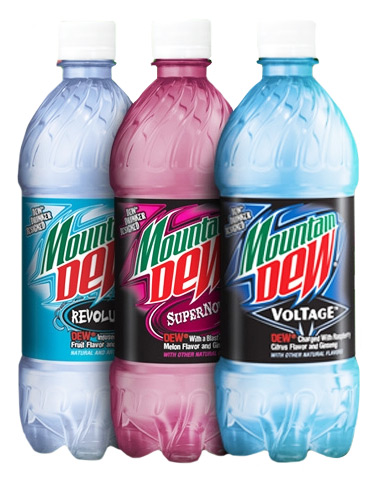
Writing about the aftermath of the public outcry against Tropicana’s packaging redesign earlier this year, which ultimately led to the OJ cartons reverting back to the original art, I mentioned Mountain Dew’s “Dewmocracy” campaign — an interactive, story-based online game which resulted in 3 new Dew flavors designed and developed virtually entirely by fans.
Now that there’s a buzz about Tropicana’s openness to fan-feedback in general, and about its packaging design in particular, why not create a platform for people to submit their design ideas? How might Tropicana lovers re-envision what that OJ carton could look like given the chance? In fact, why pick just one new design? How about different winning carton designs printed in “limited editions”? Why not deliberately set out to discover and promote emerging artists, giving them their first break of mass exposure through orange juice cartons in grocery stores across the country? If it’s art, suddenly there’s a whole new reason for choosing one OJ brand over another. It’s not just about a “campaign,” it’s an opportunity to create culture.
Mountain Dew, it seems, has already been putting this exact idea to work, (of course). Similar to Evian’s partnership with famed designers like Christian Lacroix, Jean Paul Gaultier, and Paul Smith, Mountain Dew has rolled out the third installment of their limited edition artist bottles under the Green Label Art series.
With these aluminum canvases, Mountain Dew not only taps into the urban indie art culture by supporting artists Claw Money (NY), Jeff McMillan (LBC), Nathan Cabrera (LA), Pushead (SF), Stephen Bliss (NY), UPSO (Toledo!), and Evan Coburn (LA), it also moves the Pepsi beverage deeper into lifestyle brand territory. There is also more artwork to check out, as well as computer wallpapers from each artist to download on the Green Label Art site. Plus, I’ve seen these new bottles over the weekend, and they’re pretty damn cool-looking, for only slightly (less than a dollar) more than a regular soda bottle. Super smart.

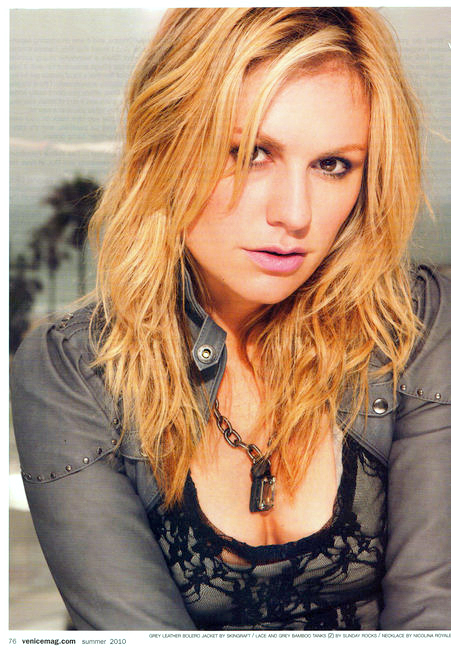
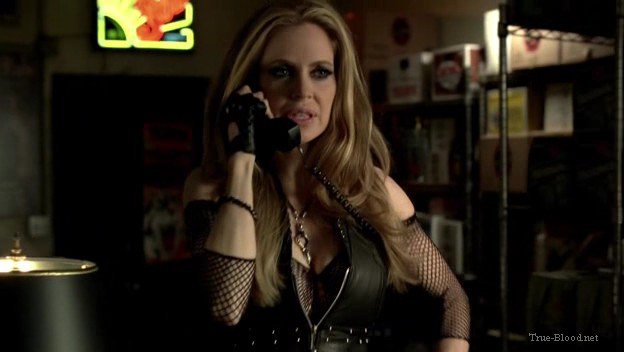
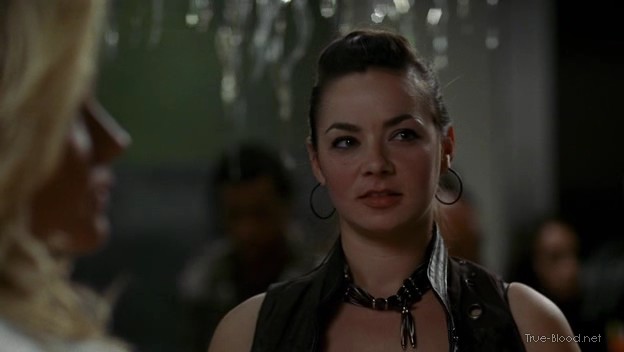
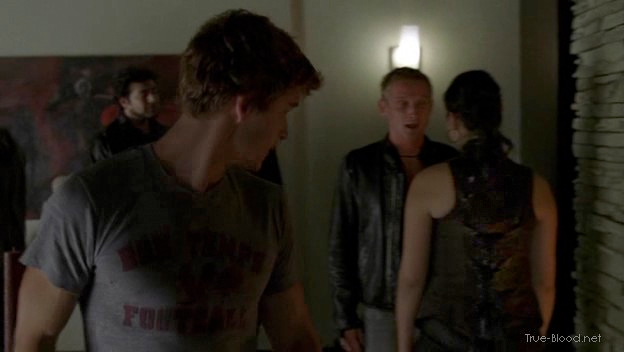
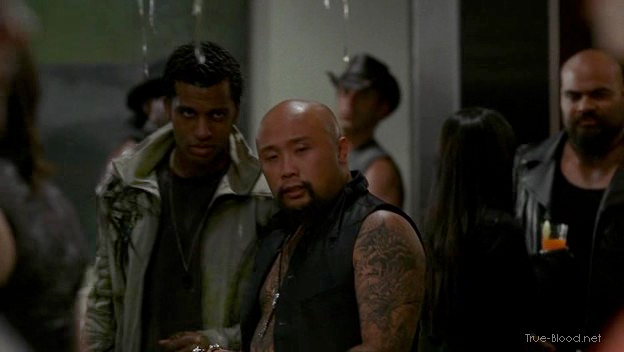
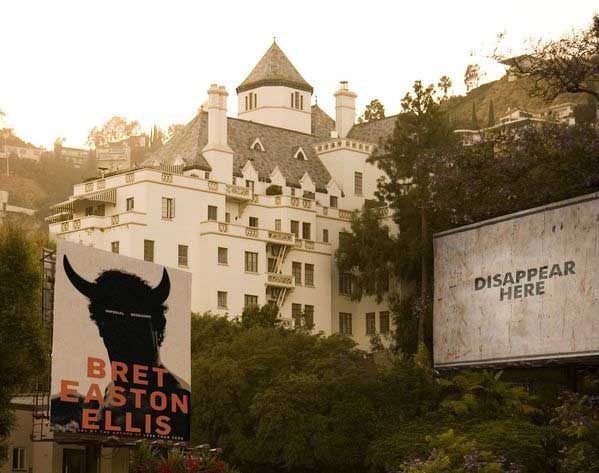 Image: Jordan Chesney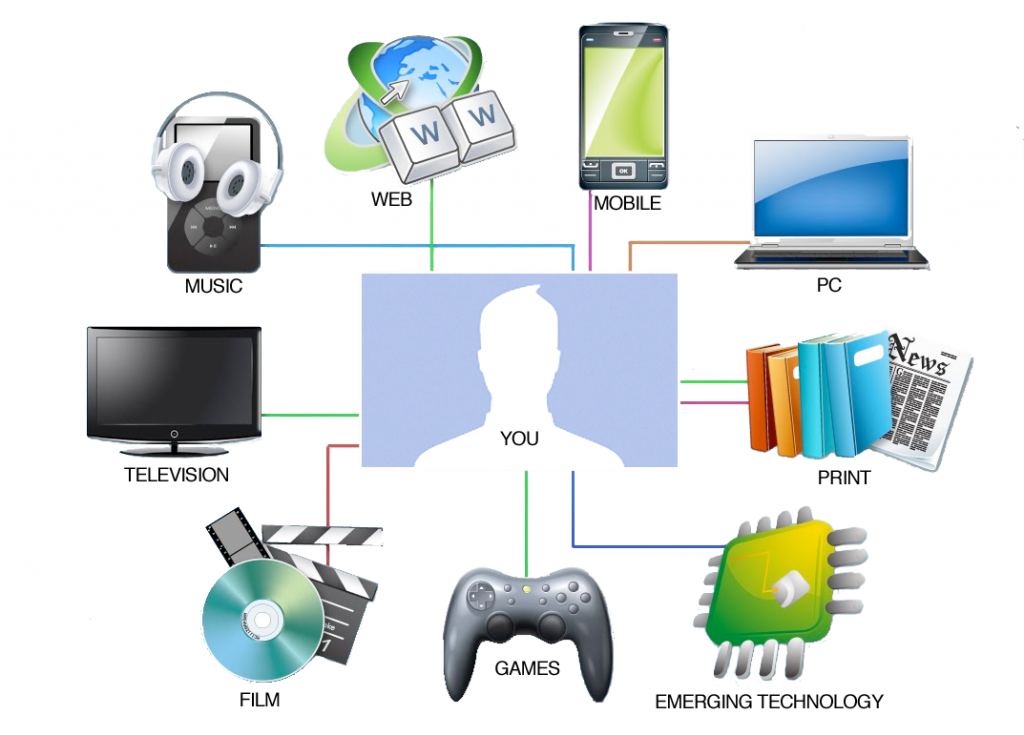
 Once they were removed from their packages, these toys could be mixed and matched to create new kinds of stories….Kids would move from re-performing favorite stories or ritualizing conventional elements from the series to breaking with conventions and creating their own narratives.