The venerable Estee Lauder cosmetics brand has found a seemingly natural way to connect with social media: offering free makeovers and photo shoots at its department-store cosmetics counters coast-to-coast to produce shots women can use for their online profiles.
The promotion, which kicks off Oct. 16 at Bloomingdale’s in New York and will extend initially to Macy’s, Saks and other Bloomingdale’s stores in Southern California, Miami and Chicago, also includes a giveaway of a 10-day supply of foundation.
Defying convention in a prestige cosmetics industry that has buried consumers under piles of makeup totes and other “gifts with purchase” for decades, no purchase is required for these gifts. The gift that the brand hopes will keep on giving is that the profile photos include the Estee Lauder logo in the background, which, assuming they aren’t Photoshopped into oblivion, could give the brand lasting presence on Facebook beyond its own 27,000-member plus fan page. The promotion is being plugged on that page, as well as on Estee Lauder’s website, and the company is also using PR to spread the word.
With a target age of 35 to 55, Estee Lauder consumers aren’t necessarily prototypical social-media mavens. But the promotion has a dual strategy, said spokeswoman Tara Eisenberg: helping contemporize the brand for younger women while recognizing that somewhat older women have rapidly embraced social media, too.
The session started with snapping a “before” pic at the Estee Lauder cosmetics counter’s newly installed computer kiosk, which salespeople tell me will stay around even after the promotion ends. Sitting in front of the kiosk, a webcam grabbed a picture of the not-yet-glamorous me, and a staff makeup specialist started to test out a range of shades on a pixilated palette version of my face. But instead of waiting for the Photoshop-esque makeover, I opted to scoot right over for the real thing. I sat down with an artist who started by rubbing some creams and gels into my cheeks. She very sweetly informed me I could use some hydration, and Estee had just the thing for me.
Layers of foundation, liners, shadows and powders later, I emerged a new woman. While I had asked for a toned-down, professional look, my new plum pout had me feeling more like a mobile upload to Facebook on Saturday night. Freshly done up, I headed over to the brand’s photo-shoot station, where the face of Estee Lauder, model Hilary Rhoda, offered to teach me how to pose for the camera. My pink oxford paled in comparison to her magenta mini dress and stilettos, so I politely offered to brave the lights and photographer on my own. A couple of smiles and flashes later and I was ready to go.
Behind the scenes, a retoucher hid the blemishes the makeup artist couldn’t, and by the time I got back to the office, my before-and-after pics were waiting in my inbox.
While Estee’s social-media service could use more subtle dials to get at those looks between off-the-street and super-vamp, a makeover is a makeover. It was fun, and the whole experience was a lot more glamorous than my previous experience with the brand, which was a dull tube of mascara and neutral eyeshadow in my mom’s bathroom cabinet. Though a couple other women getting makeovers were older than me, a good number of the salespeople weren’t. They were young and made-up but classy — a lot different than the rainbow, slightly gothic Mac Cosmetics people I usually buy eyeshadow from.
So, am I going to post my made-over pic to my LinkedIn profile? I would, if I were a news anchor. But I’m sure my Facebook friends will get a kick out of it, and I’m betting the Estee and Bloomie’s branding in the background won’t be lost on them.
Been meaning to post about this for a while, but been mad busy.
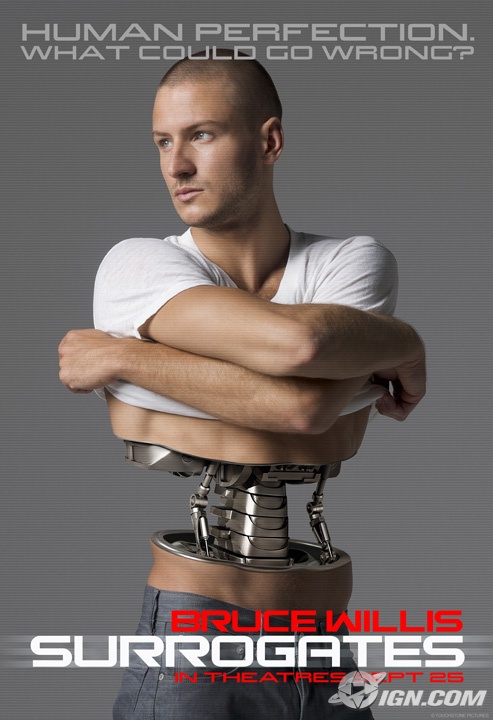
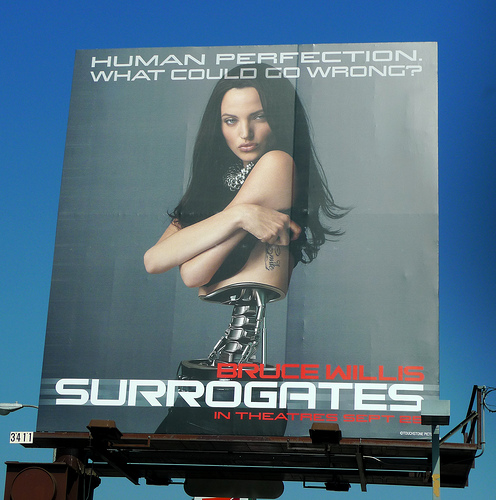
I’m super digging the ad campaign for the The Surrogates, due out September 25th. Based on the graphic novel of the same name by Robert Venditti, the world of the Surrogates is a future in which direct human interaction has all but ceased. Instead, people interact via surrogate androids, which they can design to manifest their most idealized form. If you’re balding you can have a surrogate with a full head of hair, f0r instance, or if you so desire, your surrogate could even be a different gender. It’s Second Life come to life: your perfect avatar, but in the flesh. Or ate least, flesh-like. These surrogate robots (which are owned much in the same way we own cars, with insurance and VIN numbers and whatnot) go out into the world to indulge in experiences without consequences, and through a sci-fi assortment of sensory inputs, their operators get to feel it all from the safety and privacy of their secluded homes. The movie stars Bruce Willis, but the ad campaign gives the star only a passing mention. Instead, the really clever thing about the Surrogates ads is how deftly they transpose the movie’s alternate reality into ours:
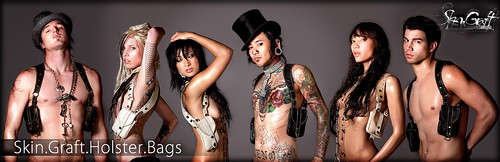
At first, glance, driving by, you think, from the poses of the models that the billboards they’re on are probably advertising some sort of industrial-themed new jeans brand or something. But after a few moments you begin to realize there’s something off here:
And the question the billboards keep asking starts to sink in:
The ads succeed not by ADVERTISING the movie, but by projecting the very vision of the future portrayed in the movie –beautiful, doomed– seamlessly onto our daily reality.
I had already joined the Circusscene when, in early 2006, I was consulting at Wong Doody and heard about a clothing company client they were working with called Edoc Laundry. The clothes had an intriguing concept: there were secret codes in the garments, which, if deciphered, would reveal clues to a mystery story. The wearers of Edoc Laundry clothing would thus become players in an “Alternate Reality Game” — a new form of interactive entertainment that uses the real world as a platform for creating an ever-evolving narrative. Now, I had grown up in subculture, gone on to produce nightlife events and music festivals, and ultimately ended up in marketing. So the concept of a secret “code” embedded in clothes — of hidden meanings conveyed in the way people dressed — it all made perfect sense to me. This was already a game all of us in the modern world were playing. It was called Lifestyle.
Years earlier, Reznor had heard about a complex game played out over many months, both online and in the real world, in which millions of people across the planet had collectively solved a cascading series of puzzles, riddles, and treasure hunts that ultimately tied into the Steven Spielberg movie AI: Artificial Intelligence. Developed by Jordan Weisman, then a Microsoft exec, it was the first of what came to be called alternate reality games — ARGs for short. After leaving Redmond, Weisman founded a company called 42 Entertainment, which made ARGs for products ranging from Windows Vista to Pirates of the Caribbean:Dead Man’s Chest. Reznor wanted to give his fans a taste of life in a massively dysfunctional theocratic police state, and he decided that a game involving millions of players worldwide would help him do that in a big way.
Reznor was stepping into a new kind of interactive fiction. These narratives unfold in fragments, in all sorts of media, from Web sites to phone calls to live events, and the audience pieces together the story from shards of information. The task is too complicated for any one person, but the Web enables a collective intelligence to emerge to assemble the pieces, solve the mysteries, and in the process, tell and retell the story online. The narrative is shaped — and ultimately owned — by the audience in ways that other forms of storytelling cannot match. No longer passive consumers, the players live out the story.Eight years ago, this kind of entertainment didn’t exist; now dozens of such games are launched every year, many of them attracting millions of followers on every continent.
When I was in high school I started going to raves. This was way before anyone would say the words “social” and “media” next to one another, when us kids still did shit like go to the library, and AOL was the only way to instant message. But if you were, let’s say, looking for an underground party to dance at all night, where no one was gonna care if you weren’t 21, you could definitely find it online. In Boston, where I grew up, there was NE-Raves, an online mailing list for electronic music events in the Northeast, originally hosted out of MIT. According to the “Cobbled-Together History of Hyperreal,” as far back as 1992, NE-Raves was one of the very first rave email lists in the US, along with SFraves on the West Coast. By the time I got into the Rave Scene (ahem *ARG*), both of these regional lists, and others, had been subsumed into hyperreal.org. In fact, by that point there were actually various other newsgroups and listservs and websites and whatnot created by and for the rave community, but in a sense, all roads would lead back to Hyperreal, which had become a kind of online clearinghouse of information on “Rave Culture, Chemistry, and Music.” In ARG parlance, Hyperreal could be considered the “Rabbithole” — the trailhead that marks the first website, contact, or puzzle that starts off the ARG. When Hyperreal first began, now almost two decades ago, as creator Mike Brown writes:
The majority of people with internet access back then were college students involved in computer-oriented studies, employees of well-funded technology companies like AT&T, and a smattering of U.S. government and military agencies. Consumer-oriented services like Compuserve, Genie, Prodigy and AOL, as well as most dialup bbs ‘networks’ were not on the internet, or had very limited gateways for mail and news that no one knew about. There was no spam, and since you weren’t interacting with a true cross-section of the general public, the entire net had a different character than it does today, socially.
So as the rave scene started to blow up nationwide, we’d tell each other online about the flyers we found and the records we bought and the parties we went to. You’d have people in the Midwest who were driving 9-12 hours to get to raves in New York and D.C., and to hang out with the friends we made through these online forums. A lot of information sharing was going on in this subculture’s subculture.
They are collective and talking and engaged, both with the project and with each other. They’re having a collective experience in which they literally bring different pieces, one to the next, swap them back and forth, gossip about them. They have an element of cocreation and a collaborative nature that doesn’t really have an analog that I’ve been able to think of in the arts, although it does in another place. This behavior—this sort of creative, collaborative, enthusiastic scavengering behavior—is something that we call by another name when we direct it, not to entertainment, but to the physical world. We call it science, as it’s been constructed since Newton and the Royal Society, and that’s worked out pretty well for us as a species.
I would argue it has a direct analog in culture as well. The term “Alternate Reality Game,” after all, was never actually what the creators of The Beast used to describe what they were doing. It was a phrase that came from the players themselves, to refer to this idea of a self-styled world that proposed an alternative vision of reality hidden under the “mainstream” surface. In Tara Mcall’s book This Is Not A Rave (“This Is Not A Game” anyone?) she writes about the way early ravers deliberately positioned themselves against the status quo and the mainstream club crowd:
They saw a need to maintain their scene’s underground status. To be part of an underground culture meant that you stood apart from the norm. It indicated that you belonged to a secret community. If you were part of the underground you were part of a chosen group. Set apart from the mainstream, these early ravers bonded with one another by exhibiting small signs such as specific articles of clothing that could be “read” by those in the know, signaling that they belonged.
Signals embedded in attire, containing meaningful (cultural) codes decipherable by others in the know? Sounds pretty much like what Edoc Laundry had in mind. While the expression of identity — whether alternative or not — is a function of all lifestyle apparel, there are numerous other rave/ARG parallels that come to mind. For instance, back in the day the actual location of a party (especially if it was unpermitted) would be kept under wraps until the very last minute, with only an “info line” phone number disseminated. To find out where to go you’d have to call the number on the night of the event, and oftentimes the directions you’d get wouldn’t lead you directly to the location but to a designated “map point” where you’d either receive further instructions on where to go, or park your car and be shuttled to the event location. At the time all of this was done in order to avoid “outside” attention — after all, it’s harder for law enforcement to bust up a party if they don’t exactly know where it is — but now it’s par for the course in ARG “experience design.” From Wired’s description of the Year Zero ARG culmination:
On April 13 [2007], all the players who had signed up at a subversive site called Open Source Resistance were invited to gather beneath a mural in Hollywood. Some of those who showed up were given cell phones and told to keep them on at all times. Five days later, the phones rang. The players were told to report to a parking lot, where they were loaded onto a ram-shackle bus with blacked-out windows.
The bus delivered them at twilight to what appeared to be an abandoned warehouse near some railroad tracks. Armed men patrolled the roof. The 50-odd players were led up a ramp and into a large, dark room where the leader of Open Source Resistance (actually an actor) gave a speech about the importance of making themselves heard. Then they were led through a maze of rooms and deposited in front of — a row of amps?
With the sudden crack of a drumbeat, Nine Inch Nails materialized onstage and broke into “The Beginning of the End,” a song they had never before played in the US. “This is the beginning,” Reznor intoned, as guitar chords strafed the room. He got out one, two, three, four more songs before the SWAT team arrived. Then, as flashing lights and flash bombs filled the room, men in riot gear stormed the stage. “Run for the bus!” someone yelled, and the players started sprinting. The bus sped them back to the parking lot and the cars that would take them safely home. But before they drove away, they were told they’d be contacted again.
If you were a party kid in the 90’s, there’s no way that this doesn’t sound like an exaggerated version of something straight out of the old raver playbook, but I’m not suggesting that the ARG form takes its cues strictly from rave culture. Whereas in a deliberately produced ARG the key elements of the game’s narrative are painstakingly planned out and scripted, the narrative of any Lifestyle ARG becomes the evolving story that its own culture tells about itself. Hip Hop, for instance, originally defined the foundation of its culture (it’s “narrative”) through The Four Elements of Hip Hop: MCing (rapping), DJing, graffiti, and breakdancing — though later there evolved as many as 9 elements, including beatboxing, hip hop fashion, and slang. Not every lifestyle necessarily outlines the elements of its narrative as explicitly, but every lifestyle indeed has them. Whether it’s a certain type of music, a fashion aesthetic, an ethos or set of values, specific kinds of community-reinforcing events and experiences, or a particular cultural mythology, these all become indelible components of any Lifestyle ARG “narrative.”
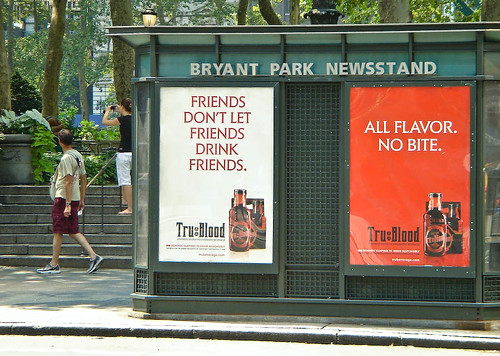
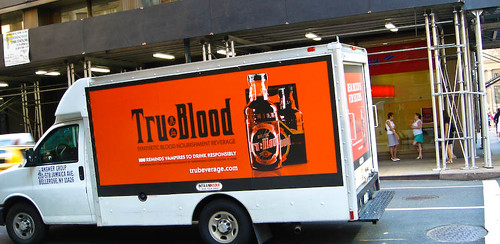
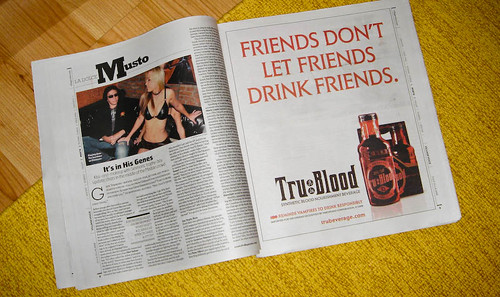
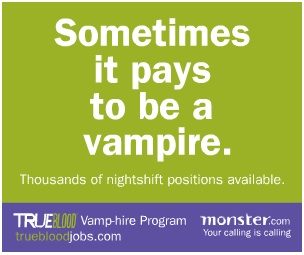
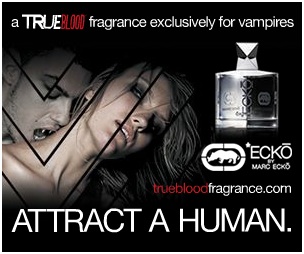
Having been the Marketing Director for a Lifestyle-driven music festival over the past three years, I’ve thought about Alternate Reality Games in this framework for a while, but the idea resurfaced when I heard about the recent tumult caused by the True Blood campaign. Originally developed last year by Campfire Agency to promote the premiere of HBO’s True Blood series, the ARG, which won ad:tech’s Best Integrated Campaign award for 2008, hinges on the same premise as the show — that Vampires are real, and thanks to the development of a synthetic blood beverage they are now finally able to ascend from the “underground,” as it were, and become functioning members of society, albeit still a uniquely particular minority within society, with their own “Alternative Lifestyle.” Initially, a network of online destinations had emerged addressing the various inevitabilities of True Blood’s parallel universe. For instance, there’s the Human/Vampire dating site, Lovebitten, there’s the American Vampire League advocacy group (“Because Vampires were people too”), and there’s also Blood Copy: “Once a human’s attempt to understand the vampire phenomenon, now the leading source for vampire news (and proud member of The Gawker Media Network).” It’s that parenthetical which has generated quite a brouhaha.
Yesterday morning, we reported that Gawker Media had acquired a blog called BloodCopy. This “news” turned out to be false, part of a viral ad campaign for an HBO show called “True Blood.”
We apologize for the error. We’d also like to explain how it happened, because we imagine others came to the same conclusion we did. We also think that HBO, Gawker, and the marketing agency crossed a line, and we’re not surprised that they are now withdrawing parts of the campaign.
First, we received an email from a marketing firm announcing that “BloodCopy has joined the Gawker Media Network.” The email was an invitation to a party to celebrate this event.
Here’s the email:
At the time, the front page of Bloodcopy.com read:
Last week Gawker Media realized they simply could not live (so to speak) without having BloodCopy.com on their roster of websites. As of next week, we will officially be under the Gawker umbrella, joining sites such as Gakwer, Gizmodo, Kotaku, Jalopnik, Lifehacker, Deadspin, Jezebel and io9. Hope they can handle us.
I’ve said it before, and I’ll say it again, there are more things about vampires than are dreamt of in your philosophy. But I know a lot of them. And I’m finding out about more. And I’m willing to share with the class. So stick to BloodCopy – and Gawker – and we’ll bring you all the news that’s fit to print (and some that’s not) about vampires.
There has been discussion in the fallout, of Gawker’s advertising department “Undermin[ing] the credibility of Gawker Editorial to promote an ad campaign,” and while, by that same token, I think there hasn’t been quite as much discussion on the subject of reporters actually checking facts before simply rehashing press releases…. I’ll leave that particular debate to the journalists. What’s interesting to me in this whole situation is that despite Blood Copy’s open proclamation that it is A BLOG ABOUT VAMPIRES, the idea that Gawker Media would have bought it, seemed, somehow….. plausible enough to publish!
Why?
Well, consider the other properties under the Gawker Media umbrella:
Essentially, Gawker owns a network of Lifestyle Blogs. If, let’s say, Vampires were real (which they’re not) but if they were, and there was a news blog for that Lifestyle… it’s completely plausible Gawker would, indeed, buy it. Playing with the idea of superimposing True Blood’s reality onto actual reality has been a goal of the ARG all along. Last year it was about how reality might look if a new synthetic-blood beverage brand had, in fact, just been introduced to the market:
This time around, it’s about what reality might look like if the Vampire Lifestyle indeed became, as Blood Copy proposes, “a more visible and influential part of the mainstream:”
In the era of the Long Tail we have an ever-expanding array of choices for defining our identities, and brands now play an integral part in expressing these definitions. We may not all necessarily consider ourselves to be members of an alternative subculture, but we are all aware of making deliberate “Lifestyle” choices in how we dress, what we drive, the music we listen to, what we do for fun, and on and on. Even between relatively mainstream choices there are always conscious decisions being made. Whether we’re buying American Apparel or American Eagle, the choice of one vs the other is not accidental. By deliberately making these different Lifestyle choices we are all defining own particular realities — we are ALL participating in a Lifestyle ARG.
Rian Johnson, the writer/director of Brick, has a new movie out called The Brothers Bloom, and it comes with a pretty neat idea:
I’ve never heard of anyone doing this before, and Johnson admits the same at the beginning of the commentary. But for the man who came up with the idea to make a movie cocktail out of mixing film noir with a high school flick in his first feature, doing something new is the name of the game. In fact, at Brick’s opening night screening, at the Arclight in 2005, Johnson gave out little “Brick Talk” booklets that provided a glossary to guide viewers through the movie’s particular slang world:
Also something I’ve never seen done before, or since.
The director’s audio commentary for The Brother’s Bloom is essentially the sort of thing you’d expect to find as a DVD bonus feature, and the idea is, of course, that you’re not listening to it the first time you watch the movie. Johnson jokes that it’s all just a ploy to get you to pay your admission a second time, but really, this idea has the potential for something much more. After all, interesting though it may be to listen to the director divulge all the subliminal symbolism and literary allusions embedded in the movie (hey, what can I say, I was a film student), it’s just a starting-off point for what this sort of audio “bonus track” could really be.
Think of it like 3-D (which is, in its 21-century digital reincarnation, once again all the rage) an extra “dimension” to how a movie can be experienced. It could be a supplemental soundtrack, or a character’s voice-over adding new meaning to the action, or even a layer of hidden clues — or puzzles — in a larger Alternate Reality Game around the movie. Who knows?
In the commentary, Johnson even toys with a social experiment: to see who else in the theater might be listening to the commentary track, as you are, he suggests all listeners cough on his cue.
Ok, so it’s probably smart to keep the encouragements for vocal “outbursts” in the theater setting to minimum, but this idea certainly presents a lot of possibilities in terms of how the traditional movie experience — which has more or less been the same for the past, like, 80 years — can be expanded and reimagined.
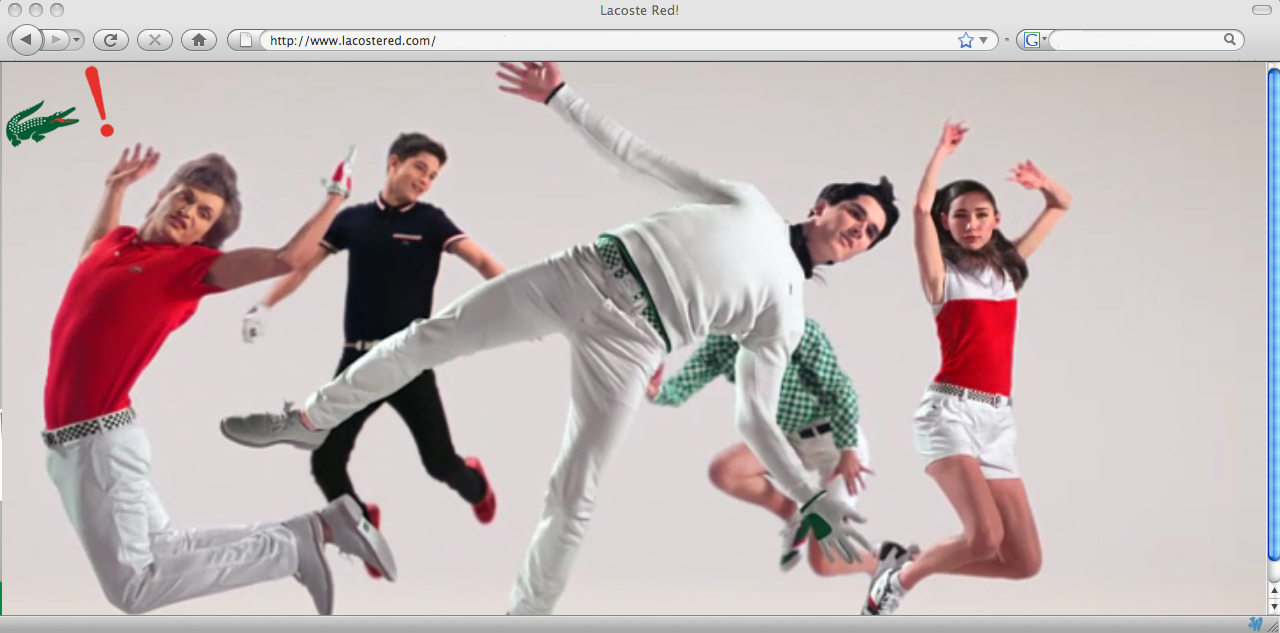
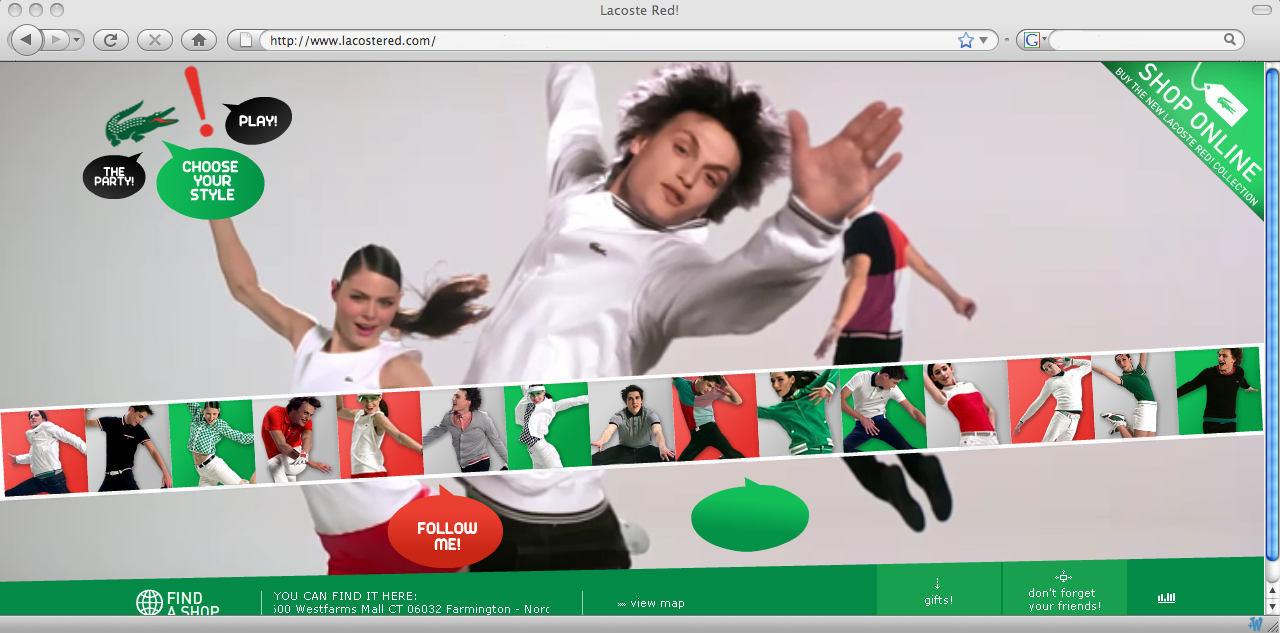
Just checked out the new Lacoste Red site today, at the recommendation of John Drake. In theory, this is the kind of website that gives me nightmares. All flash, long intro before you actually get to the navigation of the site itself, loud music playing at you without warning–all the kind of stuff that I’ve considered a crime to do to a website for years.
But amazingly, I actually really dig this site. I get what it’s trying to do, and I think it’s pretty darn cool. It’s playing with the way you’re accustomed to a website behaving; reimagining the typical experience you’ve come to expect in your browser:
Part website, part music video, part special effects sequence, part fashion editorial, part video game, it definitely doesn’t feel like a standard website experience. I think in so much of “interactive” development we have become stuck in this mobius loop where we continue to create website experiences that conform to what website experiences are expected to conform to. The internet is full of this kind of boring but navigable (blogs) or pretty but useless (flash) tract housing. Which is why there’s really something to be said for experience design that can reimagine the way we expect to navigate the inside of a browser window, and create new and unexpected yet effective and compelling experiences there. Hope we may start to see more of it.



![[surrogates-jeans1.jpg]](http://social-creature.com/wp-content/uploads/2009/09/surrogates-jeans1.jpg)
![[surrogates-booots.jpg]](http://social-creature.com/wp-content/uploads/2009/09/surrogates-booots.jpg)
![[surrogates-skirt.jpg]](http://social-creature.com/wp-content/uploads/2009/09/surrogates-skirt.jpg)