while the rest of the do lab spent the last week preparing to syndicate our show for japan, i spent it putting together a powerpoint presentation. slide number 17, the one titled:
i figure, depending on how well the presentation has been going in the preceding 16 slides, i might point out that this particular moment was going on in a confession booth:
“expanding brands into experience platforms”…. you know?
the church obviously got the memo about that one. they’ve been using that tactic in their “engagement strategy” and it seems to be working out pretty well for them. (ok, well, maybe not that EXACT tactic–kissing in the confessional at st. vibiana’s cathedral was only made possible by the pope first signing a note establishing that “God has left this building.”–not kidding–but you get what i’m sayin.)
anyway, 2000 years of catholic church case study aside, modern day ad agencies want to know how to measure the success of such a strategy. which got me thinking, well, how does scion measure the success of throwing a party at alcatraz? or how does red bull measure the success of their underground ascension extravaganzas? and furthermore, how do we? at the do lab, how do we evaluate the success of an event?
well….
did you have fun?
did you meet new friends?
did you hook up with someone?
did you get your mind blown away?
…experience itself has the capacity to be a broadcast channel. a much more powerful, much more visceral, much more immersive channel than any without the prospect of making out–or, i mean, just connecting to other human beings (and sometimes god) in exciting ways in general, really. if you had the time of your life with us (tho we have yet to implement any real exit polls….if you were there, you did. believe me) then this experience is now part of who you are. and since people buy the brands that represent their identity, this whole brand-experience approach is like getting a brand in on the consumer psyche VIP-list, while all the other brands are standing in line waiting to get in the club.
oh my god, all my analogies are even party related.
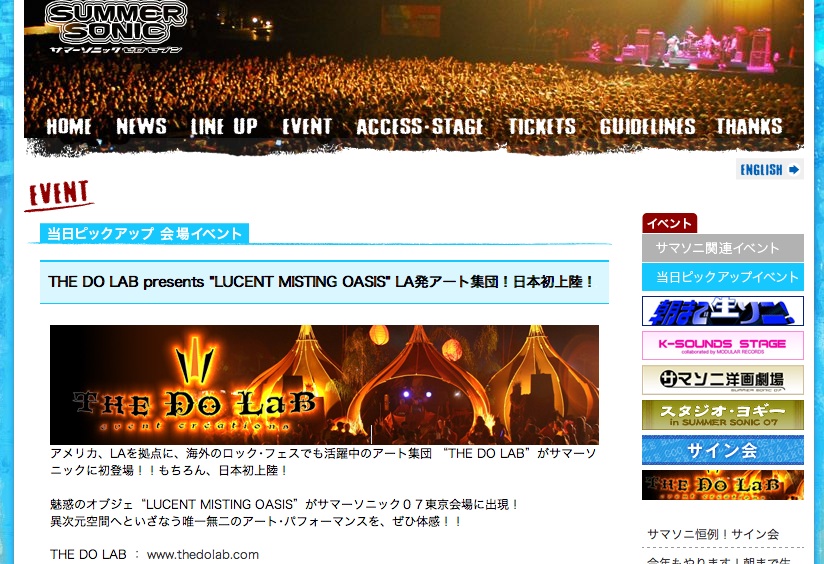
i don’t have a clue what it says, but they used SIX exclamation points in the space of two little paragraphs, so i think that means they’re pretty excited about us!! !
One of usability’s most hard-earned lessons is that “you are not the user.” If you work on a development project, you’re atypical by definition. Design to optimize the user experience for outsiders, not insiders.
– jakob nielsen
much the same way that the developer is not the user, the marketer is not the demo. being a marketer does not actually make you so atypical, (anyone who has given thought to what they put up on their social network profile, and why, suddenly understands the concept of “branding”), but being who you ARE does. to a certain extent marketers address the fact that not all markets are made in their own image, but at the end of the day, despite all the demographic research, despite all the focus groups, and everything that the nielsen ratings have to say, it is, inevitably, still individuals who design the ad and its messaging. individuals whose natural tendency is to take for granted that their own identity defaults are relevant to other people. the tricky thing, of course, is that since they’re defaults, it’s quite hard to recognize their personal and non-universal nature. and since we generally tend to hang out with the kinds of folks that reinforce our own identity and worldview back to us (our “community”) we often end up viewing the people who don’t agree with us as “wrong”–just think about people with political leanings or musical tastes that are incompatible with yours….
well, it’s those same people thinking about your political leanings and musical tastes right now, and comparing how incompatible they are with their own, that are designing the marketing message that’s gonna speak to you.
as humans we define our modern identities by our cultural affiliations and lifestyle choices, and the more we are identified with them the more it can get in the way of understanding what resonates with the people who do not share our community’s language and values. as marketers–who still happen to be human–this poses a particular problem.
unlike, say, the perspective of danah boyd, i don’t subscribe to the worldview that american society is so easily split up between the “hegemony” (dominant class) and the “subaltern” (subordinate, lower class). perhaps it’s like that among high school kids, since that’s whom danah studies, but i still doubt it. if this simple split between the popular kids and the burnouts castes was a hugely relevant definition of identity then all marketers would need to do is keep cranking out hegemonic “aspirational” ad messages, go home, and call it day. the reality of ad messaging, however, seems to have gotten a bit more complicated than that since the 1950’s, and then even exponentially MORE complicated since the 1980’s. there is no universal influencer anymore. there are instead tribal market segments, and the tricky part is translating between, and even within them.
ok, i don’t know about you, but if i have to slog through reading a lot of abstract theory i tend to zone out and go skipping stones across my mozilla tabs, so how about a practical example?
The Web’s chattering classes tend to be overly engaged in the “Internet elite experience.” They actually care about the ‘Net for its own sake, and go gaga over new ways of showing maps. In contrast, average users just want to complete tasks online. They don’t particularly like the Web, and they’d like to get back to their jobs or families as quickly as possible.
i’d add that they want to get back to their own identities as quickly as possible. the “elite internet user” is a kind of identity/lifestyle/community unto itself, and it’s not that the “average” user is just a wannabe tourist in this clique, it’s that the average user isn’t even INTERESTED in being part of the clique. the average user probably has interests and ways of defining their identity that the “elite internet user” couldn’t even care about, much like an “elite soccer mom” probably doesn’t give a shit about the “Net for its own sake”–except for the times when it’s in any way involved with sex offenders, maybe.
that photo at the top of this post is for a spanish-speaking morning radio show in l.a. hosted by piolin, and i think it’s absolutely hilarious. this message, which proclaims in a broken english that “we espeekinglish tu!” is in no way aimed at convincing any native english speaker to listen to the program. this is, of course, a more dramatic example of translating between market segments since it actually involves a product and a message that, literally, speaks to a demo in a different language–but it’s not spanish. it’s spanglish.
these billboards are all over l.a. (including an even funnier one that involves the phrase “free toes free hole es” smack dab over hollywood blvd.) these are not messages relegated to some “subaltern” niche corner, they are actually pretty brazen displays of a very inside joke that is only supposed to resonate with a particular kind of identity.
even though markets are increasingly defined by their individuals’ identities, it is impossible for any one individual marketer to be able to understand and speak the language of EVERY identity out there. the first step to learning anything new, however, is to simply accept that you don’t know it. accept that you are not the demo. EVER. even if you fit the profile, it doesn’t matter. it’s not the point. it’s just luck. (like it’s lucky that you, reader, happen to be part of the 35% of internet users who are familiar with “blogs”… if you’re from the west coast, 18-34, college educated and male, you’re also likely to be a part of the paltry 16% familiar with “wikis”…. and if you happen to be surprised that those percentages are so low, considering how much impact you might feel these channels/tools carry, then it’s even more proof of why taking your personal self out of the equation when developing a strategy is crucial.)
nielsen says that the antidote to the elite “bubble vapor” problem is user testing:
Find out what representative users need. It’s tempting to work on what’s hot, but to make money, focus on the basics that customers value.
in marketing it’s not specifically about what the “user needs” but what they “relate to.” it’s not about what you think is “hot,” it’s about distilling a message and an approach that resonates with a particular identity.
i don’t have much time to write here at the moment (and there’s a very good reason for that, which should be ready by next week) but i just saw something in a business week blog that begged to be mentioned.
at a very interesting meeting with ignited earlier this week, when i presented my perspective that real life events are just as much “social media” as anything online, jason turner, the VP of interactive, called me a “channel agnostic.” i instantly loved this phrase.
Bottom line here is that many big ad agencies are making a huge mistake. They are pushing their corporate clients to chase technology, not their consumers…. For example, sending big b2b companies who sell to 45-year-old men and women to FaceBook or Second Life is just nutty.
Different demographic groups participate in vastly different ways across the spectrum of social media. And they are constantly moving through it as they age, change careers, have families, etc. You just can’t send everyone to “social networking sites.” Companies and their ad agencies have to identify their consumers and locate their communities. Then they have to understand the culture and rules of these communities because they differ dramatically.
What you have to do is get to know their customer culture…. A different way of connecting to the consumer.
What ad agencies need to learn is how to do this. They have to connect their clients to their customers, not the latest technology. And if they do their job right, they might even discover, heaven help us, that some of them belong in print. Because that is where most 40 and 50 year old managers in the US, Europe and Asia spend their time. Still.
connecting clients to customers, not the latest technology…. this channel agnostic couldn’t have said it better.
this weekend, at a do lab birthday dinner, the other half of the do’s community management team started giving me shit about removing a particular video from the LIB youtube group.
it was this weirdly psychedelic video that didn’t even really show much of the festival (i think most of it was a strange, imovie effects-laden loop of a girl in a tutu) and the reason i took it out was because the soundtrack was a song (also totally unrelated to the LIB music style) with the words “cunt” and “fuck” repeated over and over. since LIB happens to be very much an all-ages, family friendly event, this video seemed sorta…uhh… inappropriate. it’s not like i told the creator that he had to remove the video from youtube entirely, and i also didn’t just X his video out of the group in silence. i sent a message to the creator and explained that the video wasn’t actually all that appropriate for the group, and that if he had any other videos that were more palatable we’d totally love to have those included.
apparently, the other half of the team thinks this makes me a prude. i think it’s just effective image management, and it’s an integral part of what’s ENTAILED in the community management process.
the thing about a real community is that it is a group of people who understand each other in a way that people NOT in the community do not. inside jokes get reinterpreted literally by those not in on them, inside norms are judged by the mores of the outside world, and all these things bear the potential for an untold number of misconceptions about your brand and your product, just waiting to create controversy. any significant community management then isn’t JUST about “getting people involved” (if your product is relevant, people will get involved, believe me), it is to a huge extent, about image management.
think about it like this… when you’re 17 your myspace profile isn’t all about the fact that you got a perfect score on the verbal SAT, that you’re the editor of the school’s lit mag, and that you’re a state champion sax player. no. your page has a photo slideshow of you playing beer pong at a party with your friends last weekend, and it’s covered in a million inside joke comments that in no way bolster your college recommendation letters. let’s say this 17 year old is a “brand” that you are trying to sell to a potential university (as many a 17 year old brand is), if any admissions officer happens to check up on the myspace profiles of applicants, then what you’re facing is a case of tragically BAD image management. however if this 17 year old brand is trying to be popular in high school, then you’re doing a fantastic job; keep it up. (also, congratulations, facebook: i just used myspace in an analogy and felt stale.)
the truth, of course, is that you (the 17 year old) are actually responsible for managing both these conflicting images of yourself simultaneously. and likewise, managing a community is very much about navigating the balance between outside and internal expectations while staying true to BOTH! if your approach to “radical transparency” is entirely negligent of the vital impact of context, then you’re just gonna piss a lot of people off (not the least of which will be your community for approaching their representation quite so carelessly), and screw your brand over. this is not to say you can’t ever break the rules of cultural context–in fact, in the cases when adhering to these rules is a detriment i’d actually say that breaking them is definitely a direction to consider, (if you do, however, you have to understand what that means, and all of the repercussions that it entails) but this post is not about breaking the rules of context. that happens all too easily on its own. this is about the much more complicated, much more sensitive, and much more precarious process of balancing them.
the reason i took that video down is because of the impact i felt it could have in a very particular context: potential LIB08 attendees checking out the youtube group, who’ve never come to a do lab event before, and are considering bringing their kids. while we don’t have any hard statistics, i think the amount of families with little kids present at LIB this year can be adequately reflected by the word: shitload. even though the video in question wasn’t adding anything particularly enhancing to the overall community its general irrelevance could simply be dismissed, but it’s off-putting choice of soundtrack, however, was too close to being a detriment for comfort. had such a video been added to a group for lucent delirium, for instance, the do lab’s “twisted tribal affair,” or any of our other late-night, dance-till-it-hurts events, i probably wouldn’t have cared. not, however, a weekend camping festival taking place during mother’s day. (even though the words fuck and cunt are indispensable to motherhood, they’re just totally not gonna go in a video group for the festival. sorry.) and for the record: that sentiment does not make me a prude, it makes america a prude. i’m just here makin sure we’re keepin’ things in context, yo.
the deeper conflict in this situation, of course, is that our particular community is comprised of some VERY uninhibited, counter-cultural artists and all their freaky friends–i mean, we’re a circus for god’s sake! and while even just up until 2006 the dolab’s events were all underground, and the community that has nurtured and supported us is used to this outlaw mentality, we no longer have the luxury nor, frankly, the interest in producing unpermitted, below-the-radar events. the scale is too big, and so are the stakes. this means we now not only have to take permits and fire codes and laws in general seriously, but it also means we have event publicists and work to deliberately cultivate relationships with the mainstream press. yet at the same time there is absolutely no way we will risk jeopardizing the free and bohemian vibe that we are known for, and which our community expects us to deliver… if you happen to think the juxtaposition of these conflicting cultural contexts and expectations might be complicated to manage…. yeah, i’d agree.
the week leading up to LIB was a hardcore community management vs. publicist smackdown battle in which we all struggled to find some kind of balance between what was best for our community, our brand, and for our overall image in the glare of the growing exposure which we are very much courting. amazingly, after a bit of initial fumbling, in the end it all went off without a hitch, and i’d say in no small part due to the very fact that these kinds of issues were critically considered and addressed.
you know… as much as dealing with publicists (even when they’re OUR publicists) really is NOT the highlight of my day, i think that it’s pretty critical that the people in charge of the inward-facing image and the outward-facing image know what the other side is up to. the message may not be different, but the translation most likely needs to be, and if there is not a direct line of communication between the community dept. and the PR dept., and if either side is not conscious of the considerations required by its context, then your brand is setting itself up for a potentially very messy spill in the image management aisle.
i wonder if anyone else out there has any stories or experiences dealing with similar kinds of dilemmas… how did you handle them? what were the results? what’d you learn in the process? i’d be very curious to hear.