right after i’d written the cult of the gate-crasher post i found an op-ed video of sorts made for the wall street journal by scott karp, responding to the question of whether bloggers can be journalists, and i’ve been following him since.
“The word “blog” has way too much baggage — it’s too often equated with opinion. But a blog is just a content management system, and you can use it to publish shrill opinion, or you can use it to publish traditional journalism…or you can use it to publish journalistic reporting with a bit more point of view.”
he’s totally right. the word blog does have a lot of baggage, and i personally refuse to carry it even though i actually even have… you know… one of those things. i practically never say the word, and i certainly don’t think of myself as a “blogger.” (don’t take it personally, i went to burningman when i was 18, and am inextricably enmeshed in the burningman community in l.a., yet i refuse to say i’m a “burner” either. i’m equal opportunity when it comes to defining the difference between something i do, and who i am.)
what i am is a writer. and there happen to be quite a few other writers out there, with the same sort of approach to articulating a combination of insight and opinion, and publishing their writing using the same kind of content management system that i do. a blog IS just a content management system, and lumping all the people who use the same system into one category, rather than actually examining the difference in the content being produced, is kind of ridiculous.
in a lot of instances a blogger (that is, the content creator, not the system user in this case) is nothing different from what has traditionally been called a “columnist.” you know… opinionated and personal, yet creating something informative and entertaining enough to get to see the light of print. i mean… look at the layout of a blog! they all even LOOK like a column. there may be a nation of blogges out there who all use the same sort of content management system, but i think i’ll claim my allegiance to the nation of columnists.
ok… i’m going to confess: i didn’t read the cult of the amateur (and i’ve read enough reviews of it at this point to be fairly certain that i will never want to) but i’m sure whatever the book is trying to say, it’s got it wrong.
wait, no, that’s not right… we can’t begin this way…
this isn’t even about the book. the book is just a a timely incarnation of a widely-held perspective that there is, and needs to be, a set dividing line to separate creative expression of worth from that which is worthless. and without this line there would be no way to distinguish between that which is moving culture forward, and that which is, as andrew keen says, “killing culture.” what the book is wrong about is this perspective in the first place.
i’m going to give the majority of the credit for why i’m not going to read the book to this fantastically insightful customer review of it on amazon. (i actually can’t think of a more amazingly ironic sort of fate for a book that’s a polemic decrying the worthlessness of the web’s content! can you?):
Although The Cult of the Amateur is highly thought provoking, it is marred by sloppy thinking. For one thing: “Amateur” is never defined. Professionalism is a complicated concept in the fields of literature, music, visual arts, and dance (the last is a field this book does not cover, but it is one I am familiar with as a performer and teacher). Professionalism is often not defined by whether the person makes his or her living as a writer, musician, etc. Most people in most arts fields, including some highly skilled and well-known artists, simply cannot earn a living working in the arts full time because the pay is typically too low. Professionalism is sometimes defined by whether the artist has passed “gatekeepers,” in the form of publishers or producers, or by winning contests.
yes… this is where we should begin.
right there.
artistic expression of worth, i.e. “professional-quality,” as defined by whether the artist has passed “gatekeepers.”
see this is where the cult of the amateur is wrong. in the very concept of its title! there is certainly no lack of amateurs out there–those that haven’t passed through the gate–but the cult isn’t about them. no, all they get is a club. and they’re quite happy with it.
the cult…is about the gate-CRASHERS! these are the people who don’t give a shit about the gate.
see, despite whatever the book is (i’m told) trying to assert, it’s not REALLY about how web 2.0’s proliferation of “amateur content” threatens “our cultural standards and moral values.” it’s not really about how a static volume of books edited by a bunch of white guys who determined what was and was not worthy of inclusion is “better” than a universal wiki-encyclopedia. it’s not REALLY about how news written by a professional journalist working for a publicly-traded corporate-owned media outlet is better than a blog. it’s probably not even about concepts for determining the merit of creative expression in a more complex way than “created by someone who has passed through the gate” vs. “not.” no, it’s not about any of that nonsense…. what it’s really about is a huge degree of fear and anxiety from the cultural conservatives within the gates, who will pay money to read a book that might allay these fears by discrediting the unwashed barbarian insurgents outside threatening to undermine the very foundation of the elite’s worth as artists, not to mention their authority.
hold up a second…. let’s pause for a brief history lesson on “degenerate art“:
Entartete Kunst-
In 1927, the National Socialist Society for German Culture was formed. The aim of this organization was to halt the “corruption of art” and inform the people about the relationship between race and art. By 1933, the terms “Jewish,” “Degenerate,” and “Bolshevik” were in common use to describe almost all modern art.
In 1937, Nazi officials purged German museums of works the Party considered to be degenerate. From the thousands of works removed, 650 were chosen for a special exhibit of Entartete Kunst. The exhibit opened in Munich and then traveled to eleven other cities in Germany and Austria. In each installation, the works were poorly hung and surrounded by graffiti and hand written labels mocking the artists and their creations. Over three million visitors attended making it the first “blockbuster” exhibition. Many of the artists included in the Entartete Kunst exhibition are now considered masters of the twentieth century. The following are some of the better known artists whose works were ridiculed in the exhibit. Marc Chagall, Max Ernst, Kandinsky, Die Brücke….
woops. looks like someone messed up on their art history final. oh wait…. hitler was never accepted to art school in the first place…
“All my life I have wanted to be a great painter in oils … As soon as I have carried out my program for Germany, I shall take up painting. I feel that I have it in my soul to become one of the great artists of the age and that future historians will remember me not for what I have done for Germany, but for my art.… As for the degenerate artists, I forbid them to force their so-called experiences upon the public. If they do see fields blue, they are deranged, and should go to an asylum. If they only pretend to see them blue, they are criminals, and should go to prison. I will purge the nation of them.”
– Adolf Hitler
he really really tried to feature picasso’s work in the entartete kunst exhibit too, unfortunately picasso could never be proven to be jewish enough to fit with the theme.
ok, you know what?…. that was a pretty extreme example. don’t lets get carried away, aight? alls i’m sayin’ is…. it ain’t like discrediting gate-crashing artists out of fear is a new thang. it’s got quite a robust history. ironically, angstily revenging your rejection by the gatekeepers by wiping them out isn’t really what gate-crashers care about. really, more often gate-crashers don’t even care whether they are accepted or not.
that’s part of what makes them so dangerous. see, whereas some “amateurs” really might get all despondent (and in very rare cases…genocidally psychotic) if a gatekeeper won’t let their art through, to a gate-crasher the idea of getting discouraged if they didn’t make it is like getting discouraged from sneezing in the future just because you didn’t get a “god bless you.” they’re going to create art no matter what. it’s a disorder. they generally can’t help it. and i’m not talking about all those poor tone-deaf souls with pop-star delusions that american idol relishes for its gag reel. that’s not about compulsive creative expression, that’s about feeding the fantasies of narcissism. and while the two very often come hand in hand, they are very easily distinguishable.
the self-identified “professionals” inside the gate, however, like to lump all the people on the outside into this one big tragic wannabe “amateur” category. it’s a lot less threatening that way. call them all pestilent “amateurs” and it helps delay the need to critically address any revolutionizing impact of the gate-crashers among them. generally the rule is to scoff at the barbarians with spray cans overtly tagging the walls of the hallowed gate until such time as the side facing out has itself turned into a new kind of canvas, and the gatekeepers have figured out how to move the gate to a more accommodating locati–i mean, monetize the new art.
even arguably the most impenetrable gate on earth (i’m not counting heaven) moved when hollywood was financially forced to stop staring at its on celluloid navel. once upon a time hollywood was adamant that there was no way that any entity but an established studio could produce quality movies. after all, how could they? beyond the impossible hurdles of the huge amounts of money and all sorts of other resources required, producing movies that the public would be interested in seeing was a craft, requiring years of professional training and dues paying. this just wasn’t the kind of thing any amateur could do. that is, until miramax’s independently-produced, $1.1 million sex lies and videotape performed better on a cost-to-earnings ratio than the $50 million batman. four years later disney bought miramax, and now now, over a decade later, the concept of an “independent” film is basically an anachronism. (seriously, like when was the last time you went to see an “independent”?) hollywood’s totally cool with good (profitable) movies coming from wherever it is that they come from now–it’s too busy just scrambling to figure out how it’s going to continue to make money on distributing them to care about defending it’s Ahhht gate anymore.
as the auter’s (not amateurs) of the 1990’s independent film industry attest, “outsider artists” are not necessarily all that interested in paying their dues and waiting in line for the chance to get their shot. nor are they particularly resourceless when it comes to finding innovative ways to create and distribute the fruits of their creativity on their own terms. these things hold true for gate-crashers in all creative fields. from film, to music, fashion, entertainment, to business, and even to the creative expression of lifestyle itself.
this is all a great opportunity to reevaluate the question: is creative expression worthless unless it has prestige? does it have to have “superiority” (i.e. better than the stuff outside the gate) to have value? both the “polish” of industry and “ingenuity” of independence lend their respective expressions different kinds of caché, but is there perhaps a way to decipher the inherent value in creative expression regardless of origin? can expression be judged on how insightful it is? how entertaining it is? how relevant? provocative? fresh? without that measure necessarily being a reflection of how many gates it did or did no pass?cuz see, the funny thing about the gate, is that the gate doesn’t actually CARE about the art. well, it sort of does. but mostly, it just cares about perpetuating itself. this is why it’s so difficult for people on the inside side of it to break out once they’ve gotten too far in. (oh, so you want to be a political essayist but your major success is in illustrated children’s books? roiiiight.) this is also why true gate-crashers are defined not by having been able to do so from the outside in, but rather by continuing to crash through the gate, no matter which side they’re on. see: paul simon’s foray into mbaqanga music of south africa on the Graceland album, 1986. According to allmusic.com, “Graceland became the standard against which subsequent musical experiments by major artists were measured.” totally a gate-crasher move.
i’m not saying that traditional training is unnecessary, i’m just saying that it’s not a consistent enough determinant of quality to rely on too heavily for the judging. “self-taught” is not a separate art category. and i’m not saying that gates don’t matter, they are, in fact, crucial. without them, the gate-crasher could not exist. what i am saying is it’s time to give the gate-crashers their due recognition. the experimenting, the visionary, the curious… these qualities that are ignored, denied and discredited by the word “amateur,” these are the qualities that fuel the innovators that are not only not killing culture, but in fact, have always been the ones reincarnating it.
you know… sometimes the point isn’t about how many people see your ad, it’s about actually changing people’s behavior.
if it’s a matter of getting them to drink diet pepsi vs. diet coke, or getting them to shop at target vs. walmart… no one’s gonna die.
it’s not really a matter of life or death.
however, when the ad is for an hiv-awareness campaign…. it actually IS.
i have no idea if this was just a spec or if the spot actually ran, but if it did, i think it’s pretty fucking tragic:
“you have no idea what a difference that makes” …. they may as well have added “and hey, ignorance is bliss, right?” at the end, cuz it’s not like that ad conveys ANYTHING about the difference that DOES make.
so…. just keep having no idea.
don’t get me wrong, it’s hot, and you want to watch it…but is it really something that’s going to change people’s behavior?
since i’m not actually the target audience for this, a couple of gay friends later the consensus to that question is:
“not so sure.”
exactly what good does a sensational and even popular ad do, if the message isn’t effective? priority #1 should be to make an message that works, not a video that gets passed around.
the idea that some ad agency is actually thinking that it’s more important that a lot of people see their ad than that anyone is actually motivated to use a condom…. is kind of sick.
the point isn’t about making an ad viral… it’s about making a message that might actually help STOP the virus.
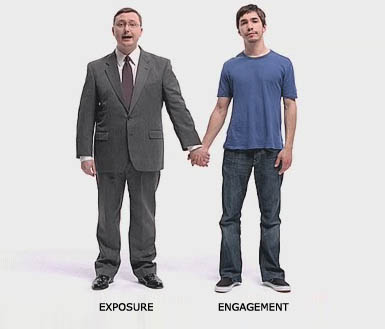
myth #2: ENGAGEMENT MEANS NEVER HAVING TO SAY EXPOSURE
it’s funny that as much time as i’ve spent explaining the differences between the effects of engagement vs. exposure, it seems i spend just as much time explaining the value of combining engagement AND exposure. it’s as if battle lines were drawn somewhere between the two and everyone decided it was imperative to pick a side about which one is more important. like you’re either a cat person or a dog person. carpets or hardwood. mac or pc. advertising or community.
each one’s got their defenses and excuses, right? advertising is all like, we’ve been doing it this way forever, and we’ll listen to what community’s got to say, but we’ll still play it by our rules. and community’s all like, obviously advertising’s just a dinosaur; they just don’t get it. and so it goes, with advertising trying to spray over its bald spot with engagement concessions while community tries to beef up its resume with ROI success metrics.
but maybe… couldn’t it make sense to consider that dog and cat people are both pet people? and even if you’re down with the wall-to-wall you’ve still got tile in your kitchen, and the folks with the parquet have rugs and bathmats for strategic purposes. and as for mac vs. pc… that might hint at the root of the fissure issue.
for 10 years i used a pc. and then 2 years ago, when my old toshiba fell and couldn’t get up, i decided to buy a mac. i can chalk it up to some practical and financial reasons if you ask me to, but the truth is those reasons weren’t really so much deciding factors as justifications for the decision that had pretty much already been made. the truth is that if you’re young and hip and need a new computer, buying a mac is just the thing you’re supposed to do. (hey man, identity marketing wouldn’t be so effective if it didn’t work on EVERYONE.) and that’s kind of the same way that the division between advertising and community seems to go down.
you know, while i’m here, i may as well point out that when i say advertising i’m including PR too. i’m including ANY kind of marketing technique focused on exposure vs. on engagement. the team you go to bat for is determined by which side represents YOUR identity.
yeah, YOU.
your years of experience, your industry awards, or your tech savviness, your youth and hipness. and, sure, whichever side of the tracks you come from has a whole lot of other folks there who fit that identity profile, and your approach translates for them, but… what good does YOUR professional identity expression actually do, you know, like, the campaign? or…the USER? or the consumer….
whoever.
my point is that an engagement strategy is not an upgraded substitute for a promotional campaign. and the measurement of the value of engagement if evaluated independent of the influence of exposure strategies is ridiculous. there’s a reason why the phrase “to work in concert” exists. imagine an orchestra insisting on making the violins compete with the percussion section to demonstrate which one is more worthy. marketing is a strategy symphony, and not the kind of strategy that’s about figuring out how to kick all the other instruments off the island, yo.
so how do we move beyond simply defending our particular tribal affiliations? how do we shift the focus from the segregation between exposure and engagement, to methods for integrating the two processes and, ideally, to creating ways for each to be enhanced by the other?
do 11 year olds really talk like sitcom writers now? i mean, it’s kinda funny… in a mildly disturbing sort of way. like one-liners are the next evolution of jr.’s “first words”…an eventually unmanageably annoying evolution, but, like the kids say… whatever.
check out these little Red “characters” (such as chill, grumpy, whatever, flirty) that were developed for beRed.com (now teens.aol.com) by ATTIK.
how to step up to the challenge of creating campaign elements that let kids know RED is the place for them?
when you show up at teens.aol.com, by the way, you’re greeted with a paparazzi shot of britney in a car with some guy obscured by the rear view mirror and big sunglasses, with the caption, “who’s that guy?run, guy we don’t know. run!”
so it’s nice at least that the messaging tone is consistent.
oh, chill also has a different aspect to his personality in other settings, like “why should i worry when my parents do it for me?” it’s like that fairy tale… you know, be Red and the seven obnoxious tween dwarfs? classic. originally these were developed as door hangers too:
now you can also find them as banners at profgilzot.com. (and while you’re doing that, check out the stunningly rock and roll SAT prep tutor illustrated there. seriously, like straight outta williamsburg.)
it’s undoubtedly great identity marketing: gotta speak to the audience on their own terms if you want to get across that your product is for them. unfortunately, why are those the terms? anyone remember all those post 9/11 predictions about “the death of irony”? yeah…. THERE was a trend forecast that was spot on, evidently.
tho… i guess i’m not helping any. but i mean, irony’s ok for adults, right? so maybe you should have to be over a certain age for us to allow ourselves to subject you to it?


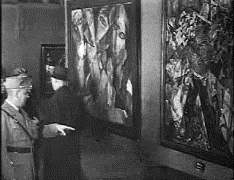 In 1937, Nazi officials purged German museums of works the Party considered to be degenerate. From the thousands of works removed, 650 were chosen for a special exhibit of Entartete Kunst. The exhibit opened in Munich and then traveled to eleven other cities in Germany and Austria. In each installation, the works were poorly hung and surrounded by graffiti and hand written labels mocking the artists and their creations. Over three million visitors attended making it the first “blockbuster” exhibition. Many of the artists included in the Entartete Kunst exhibition are now considered masters of the twentieth century. The following are some of the better known artists whose works were ridiculed in the exhibit. Marc Chagall, Max Ernst, Kandinsky, Die Brücke….