
even more queer once you’re used to it

image

this weekend was the 27th annual sunset junction music festival, a kind of cross between oldskool urban summertime carnival and indie rock block party. think: stale cotton candy and amusement park rides, local shops and art galleries trapped in the warpath shelling beer, dancing in the streets to mobile soundsystems, and the major stages blaring serenades by such haircut stalwarts as she wants revenge, autolux, blonde redhead, hot hot heat and so on.

sunset junction is the most fun you can have at a locally nurtured street festival tradition south of pink saturday in san francisco, which, if you haven’t been, is a complete free-for-all of music madness and making out that takes place the saturday night before san francisco’s gay pride parade every year. which is kind of a good segue to where i’m heading with this entry. because what struck me the most about this year’s sunset junction had nothing to do with the music (at least not directly). about half an hour in, i thought i saw something that no former san francisco resident has any right to get confused about: two straight guys holding hands.

this wasn’t some 4 am e-puddle at a rave cir. 1998. this was around 6 pm on a sunday afternoon in 2007, and while queer eye for the straight guy had mainstreamized the revolution in gay-straight male relations, metrosexual had become a house-hold word, and looking stylish was now par for the course for any sophisticated urban male, there’s still one thing that straight guys simply do not do as a fashion statement, and that’s hold hands.

yet “straight guys holding hands” was the first thing that instinctively passed through my mind. followed immediately, of course, by knee-jerk confusion: that’s not….right…. so then…. what the fuck?

the problem was that they didn’t look gay. not that there’s a certain kind of way that gay guys look that straight guys do not, but rather there are definitely certain ways that straight guys look that gay ones wouldn’t–or at least… there used to be.

what threw me off was that this seemingly-straight hand-holding couple were wearing plaid shorts that looked like swimming trunks found in a florida retirement home, and were sporting sloppy 60’s style columbia-university protester haircuts–the kind that 40 years ago just sort of grew out on their own, but today are no doubt cultivated under the careful attention of a hairdresser to look appropriately “period” vs. “politically active.” essentially, they were dressed like guys dressed before any kind of particularly gay aesthetic EXISTED, when less than 25% of men’s apparel was bought by men anyway. women used to buy 75% of it. (and you can imagine who was buying that other 25, right?)

for the rest of the night i kept seeing the same story repeated: all kinds of gay couples that didn’t look gay aside from the the fact that they were hardcore making out. (true story: at one point, towards the end of the night, when the real minority at sunset junction had become the sober people, one of a trio of guys walking in formation with their arms around each other’s waists backed up into me, and hiccuped, “oh! a girl! where’d they come from?” and i realized i was indeed hard-pressed to find an answer.) there were even mexican dudes in big white t-shirts and shaved heads going at it, that you know blast the radio when down’s “lean like a cholo” comes on. on a sidenote: do people outside of calexico even know what reggaeton is? after a while you start to go a bit blind to the contours of local culture’s idiosyncrasies when they are so prevalent….perhaps this is what has also been going on in the expression of gay identity as well.

one of the things that virtually all my gay friends have in common is a professed dislike of other “gay guys.” which is pretty telling of a major generational rift in the gay community.

the generation coming of age in the 70’s, in the wake of stonewall fought first and foremost for the rights of their community. the chant was “we’re here. we’re queer. get used to it.” the assertion of an individual gay identity, one that has the luxury to be vague, and even profess distance from the rest the gay community, is one that was only achieved through decades of pre-will and grace civil rights struggles.

in a 2005 article from the NYTimes style section, sensibly titled “Gay or Straight? Hard to Tell” bruce pask, the style director of cargo magazine, talked about why especially younger gay men don’t want to feel or look that different: “They didn’t need to assert their place in society, their right to be who they are. They’re not fighting for visibility. We got it; they don’t need it.”

perhaps that’s the issue my gay friends have with the established gay community: they do not feel that this community which is primarily defined by sexual preference is a viable forum for expressing their individual identity.

“if you can hang out with your straight buddies and be part of the group,” said brendan lemon, the editor of out, in the NYTimes article, “why would you feel the need to look different as an assertion of identity?” lemon suggested that for a generation that grew up watching “The Real World” on MTV, in which the gay and lesbian characters were no more or less flamboyant in dress or persona than their straight counterparts, being gay carries neither the stigma nor the specialness it once did. that, he said, has also altered the landscape of men’s style.

“it’s easier for gay men to come out of the closet as slobs, just as it’s easier for straight men to be dandies.” said lemon. “one of the things that’s breaking down how gay guys are seen is that people know more kinds of men who are gay.” but this dissolution of any one gay sensibility seems to be developing not just from the way in which the outside world sees gay men, but from the way gay men themselves want to be seen. as individual as any straight people would consider themselves from the rest of the “straight community.”

in a certain sense, even the breeders have been affected by the coming out of a whole generation. claims that the gay agenda to turn even the straightest of the straight gay by using the media to subliminally refashion their very notions of what they find attractive in women to resemble a male figure aside for the moment, this is the lifestyle that invented the CONCEPT of an “alternative” lifestyle (as opposed to simply a “counter-cultural” rebellion). it set the precedent. as all the rest of us participating in the greater culture now likewise face the burden of defining our own identities (whether we’re conscious of it or not), we all sorta ended up becoming queer…

and wouldn’t you know it, as soon as we did, they just turn around start lookin’ straight.

bastards.


Subscribe for more like this.


rebranding enlightenment

in light of the previous post, a friend suggested i redevelop the ad for the enlightenment card to make it more relevant to a consumer identity that would actually find the product appealing.

i only had five minutes tho, so here’s the best i can do:

enlightened.jpg


Subscribe for more like this.


the new and improved enlightenment lifestyle

as a marketer you realize that it’s not so much that you’re really setting anything up for sale, it’s that everything already IS for sale, and you’re just helping it along. so it’s not so much that i’m bothered by the selling of “enlightenment,” (there’s been buddha statues on-sale for millennia, and what are THOSE selling?) but rather it’s that i find the whole “enlightenment lifestyle,” kinda… icky.

today on the website for the san francisco green festival conference i discovered a publication called what is enlightenment magazine, published by enligntennext, which is “defining the contours of a new revolution in human consciousness and culture.” (it’s essentially not doing anything different than any punk band or public enemy-era hiphop act professed to be doing. it’s just targeting a different audience.)

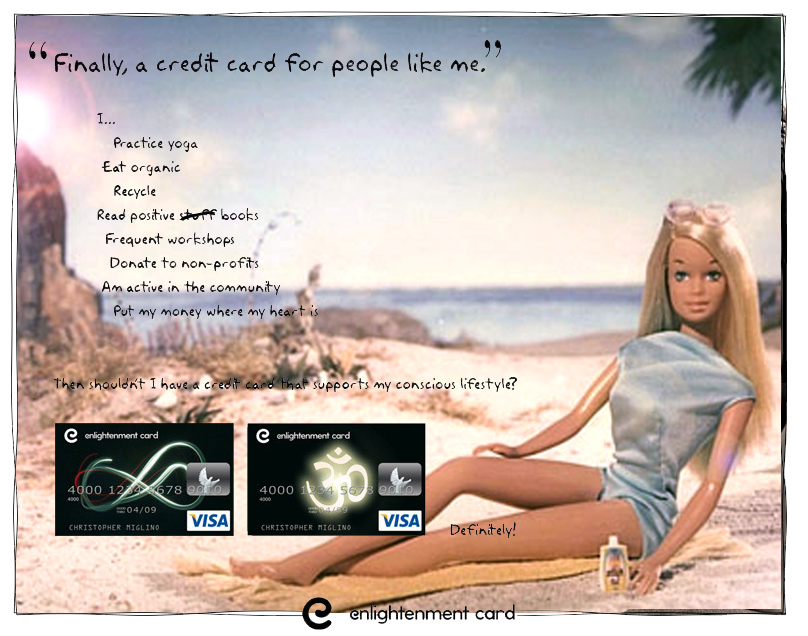
my first encounter with companies targeting this demo was when we were soliciting sponsors for LIB and were approached by the “enlightenment card”:

http://www.enlightenmentcard.com/images/splash.jpg

(in case you’re wondering, yes, the card IS real, no that ad is NOT a joke, and we said “no, thank you” to the offer.)

while on the one hand, i’m trying to think of where else do sheltered caucasian people get to evangelize a brand of appropriated cultural imperialism with such tactless self-righteousness and get away with it, on the other hand, from a technical standpoint, i’m completely impressed.

this is everything i preach about identity marketing in action.

in robotics, there is a theory of the “uncanny valley“:

The hypothesis states that as a robot is made more humanlike in its appearance and motion, the emotional response from a human being to the robot will become increasingly positive and empathic, until a point is reached beyond which the response quickly becomes that of strong repulsion. However, as the appearance and motion continue to become less distinguishable from a human being’s, the emotional response becomes positive once more and approaches human-to-human empathy levels.

This area of repulsive response aroused by a robot with appearance and motion between a “barely-human” and “fully human” entity is called the Uncanny Valley. The name captures the idea that a robot which is “almost human” will seem overly “strange” to a human being and thus will fail to evoke the empathetic response required for productive human-robot interaction.

maybe there is an uncanny valley in the process of identity expression as well. the more a brand or a product makes it easier for people to express their identity the more palatable it is, until maybe it hits a certain point where it becomes so blatant that its appeal suddenly drops off. however, as this brand’s identity-expressing qualities continue to become more innate and nuanced, and less overt it once again becomes appealing. maybe it could be called the uncanny “wannabe valley,” the place in brand authenticity/relevance that will likewise “fail to evoke the empathetic response required for productive human-brand interaction.” (cuz brands are robo–i mean, people too.)

one of the explanations for the uncanny valley phenomenon is that the robots stuck in no-man’s land elicit revulsion because they look “dead,” and biologically we’re wired to have an aversion to corpses, cuz stickin around doesn’t bode so well for the immune system. (makes you wonder tho if necrophiliacs collect weird lookin robots). but when it comes to identity, the brands (and people) stuck in the uncanny wannabe valley turn us off because they’re “fake.” in a similar sort of way, biology may have led us to respond with distaste to “fake” people (and by proxy brands now) because they are untrustworthy. from a social selection standpoint, they may even be community saboteurs.

the funny thing in all of this is that there’s nothing actually WRONG with the enlightenment card except its name. if you have to have a credit card, why NOT get one that’s gonna let you earn points towards, like, trips to spas in costa rican rain forests, right?

while no doubt one person’s fake is another person’s orgasm, it just feels like confusing a lifestyle for an expression of “enlightenment,” is kinda, um, you know…. BOGUS!


Subscribe for more like this.


today’s awesome ad award goes to:

today’s awesome ad award is dedicated to the spirit of teamwork and collaboration. (i’m feeling particularly grateful for it today, as without it my blog would still probably be trapped in an international hostage situation).

think about the people without whom even the greatest accomplishments would mean so little

…and enjoy:


ps…oh and if you happen to have missed the previous post, as my site got all bustified right after i hit “publish,” it’s about the mating habits of the birds of paradise, the evolution of religion, the history of branding, and some philosophy about identity. there, now you’re fully caught up.


Subscribe for more like this.


trappings of paradise

there’s a funny story about these birds once.

nature decided to run an experiment in its whimsical way, and cast a bunch of birds adrift on an island called new guinea, essentially without any predators to worry about and a perpetual abundance of food, and then sat around for several million years to see what might happen.

what did happen is the evolution of an obscenely flamboyant species of birds called the birds of paradise.

from national geographic:

No other birds on Earth go about the business of breeding quite like these. To dazzle choosy females, males strut in costumes worthy of the stage: cropped capes, shiny breast shields, head ribbons, bonnets, beards, neck wattles, and wiry feathers that curl like handlebar mustaches. Their vivid reds, yellows, and blues blaze against the relentless green of the rain forest. What makes for the sexiest mix of costume and choreography is a mystery, but it seems the more extreme the better.

unlike their less exotic distant cousins with actual problems to worry about, the 38 species of birds of paradise had no need to waste their time protecting resources or camouflagely avoiding predators. the lack of struggle for sheer survival having made natural selection a non-issue, the new standard of ‘fitness” became style.

cut to 1st-world post-industrial human society. unlike birds, of course, we have more issues to deal with than just courting rituals–tho they are inevitably involved. our obsession with style is not soley about, as the kottonmouth kings say, “something to poke on,” but also very much about somewhere to fit in. the desire to belong to a community may be hardwired in, but then so, it seems, is our need to express that belonging in our identity–our lifestyle.

Adaptations that help an individual survive can sometimes play themselves out through the group. Consider religious rituals.

Rituals are a way of signaling a sincere commitment to the religion’s core beliefs, thereby earning loyalty from others in the group. “By donning several layers of clothing and standing out in the midday sun,” Sosis wrote, “ultraorthodox Jewish men are signaling to others: ‘Hey! Look, I’m a haredi’ — or extremely pious — ‘Jew. If you are also a member of this group, you can trust me because why else would I be dressed like this?’ ”

These “signaling” rituals can grant the individual a sense of belonging and grant the group some freedom from constant and costly monitoring to ensure that their members are loyal and committed. The rituals are harsh enough to weed out the infidels, and both the group and the individual believers benefit.

that quote above comes from a really fascinating new york times article about the evolution of religion (as in, sociobiology stylie) which proposes a set of key psychological factors that could combine to create an intrinsic, biological human predisposition to believe in a higher power. but while spiritual belief may be inherent, if nature is all there was to it we’d be content to experience these beliefs in a personal way. for the truly religious, however, a personal relationship with god isn’t really enough. nurture puts the pressure on to show up at church every sunday so that all the other religious folks can witness this expression of our identity in our attendance.

there is some kind of security we crave that is just as much a drive as anything spiritual, a security that comes from feeling we are being seen for “who we are.” cuz identity without expression is consciousness. it’s the stuff you know about the world and yourself that it’s ok if no one else knows you know. you know. and that’s enough. identity is the shit you feel the need to for the world to see, the stuff you hang a billboard for around your neck.

…and speaking of brands. oh, what? you thought we weren’t? “branding” as we know it today, came from consumer goods factories realizing that they needed a way for their generically-packaged mass-produced products to compete for a market base familiar only with local goods. what initially was just a matter of packaging and insignias then evolved past image, past hype, past essence, past the product itself, to a point where a “brand” is now its consumer identity.

when my purse was stolen my credit card company knew before i did. still under the impression that it had just been misplaced at a friend’s party, and would be discovered after the post-party cleanup, i got a call from mbna about some unusual charges: at jack in the box. i joke that had the thieves gone to whole foods no one would have been the wiser, since the last time i purchased fast food i think i was in high school. it’s beyond just that it’s “unhealthy” and all the other things, it’s that, as my credit card company so effectively pointed out, it’s “not me.”

that’s an essential part of what brands are now: signifiers of what is or is not us. and to a greater extent than ever we are now constantly looking for ways to get “ourselves” across..

it’s like the story about those funny birds, you know…. self-obsession becomes the tradeoff for paradise.

http://www.thisnext.com/media/230x230/peacock-feather-earrings_9B1E3584.jpg


Subscribe for more like this.