the medium of stories

p1220200.JPG

“We read to know we are not alone.”
– C.S. Lewis

in retrospect, it’s not so surprising that while i was studying film in college i was also producing art and music events as an extra-curricular activity. i joke that producing a movie and producing an event are pretty much exactly the same process, except with events you only get one take. in both cases what you’re producing is a story and an experience, so the transition, post-college, from film to festivals was, in a sense, really just the transition between one medium of story/experience creation to another.

whether written, filmed, experiential, or any other kind, i think stories in general appeal to us for the same reasons, yet we experience and appreciate them in different ways depending on the medium. just because the book might have been better than the movie, doesn’t mean it would make a better movie to film the pages of the book, dig?

which is the kind of analogy i think about as i read the NYTimes’ recent bit on Quarterlife, “Can NBC Do for ‘Quarterlife’ What YouTube Could Not?”:

Scripts by Marshall Herskovitz, the Emmy award-winning writer and producer, have drawn millions of viewers to movie theaters and television sets over the past two decades.

But on the Internet, where his 36-part series “Quarterlife” is unfolding on social networking sites like MySpace, the audience metrics are starkly different.

Some episodes of “Quarterlife,” a drama about a group of good-looking people in their 20s, have yet to attract 100,000 video views, according to combined view counts from MySpace’s video site and YouTube.

The low traffic numbers are significant because the series has been touted as the first television-quality production for the Web, as well as the first to be introduced online as a warm-up for its network debut. NBC will broadcast “Quarterlife” in one-hour increments beginning in February, and the Web-to-broadcast process is being closely watched as a potential business model for television on the Internet.

i wrote about quarterlife a few months back, before any of the episodes had come out. the prospect of what an “online series” could mean in terms of a new format for creating stories was really exciting to me. i even thought it was pretty neat that the show came with an accompanying online social network app aimed at being a resource for those going through their quarterlife crisis. (at least in theory. i’m not a member on quarterlife.com so i don’t really know for sure, but the impression i got is that the site seeks to facilitate collaborations among the nascent members of the creative class, and if that goal is actually being fulfilled then i sincerely applaud the effort.) that there was no indication at the time about the online series simply being a “warm-up” to a network debut is an interesting aspect unto itself, but there are more interesting things i’d like to talk about, in particular:

The Folly of a “Web-To-Broadcast” Model,
and the Tragically Misguided Concept of “Television on the Internet”

according to the NYTimes article, quarterlife’s sponsors, which include toyota, paid well above standard rates to appear with the series on the web. and perhaps the folks involved with quarterlife may want to consider why it is that they might have been willing to do that.

the same day as the NYTimes asked, “Can Web ventures like “Quarterlife” turn a profit? The answer is unclear,” online media daily reported:

CONSUMERS ARE 47% MORE ENGAGED in ads that run with television programs that they view online than those watched on a TV set, according to new research findings. A cross-media study by Simmons, a unit of Experian Research Services, also found that viewers are 25% more engaged in the content of TV shows that they watch online than on a TV.

what are the chances that toyota, what with their experience with integrating the scion brand into whyville’s online tween world, would have some understanding of the benefits of being on a medium with a much more elevated engagement rate?

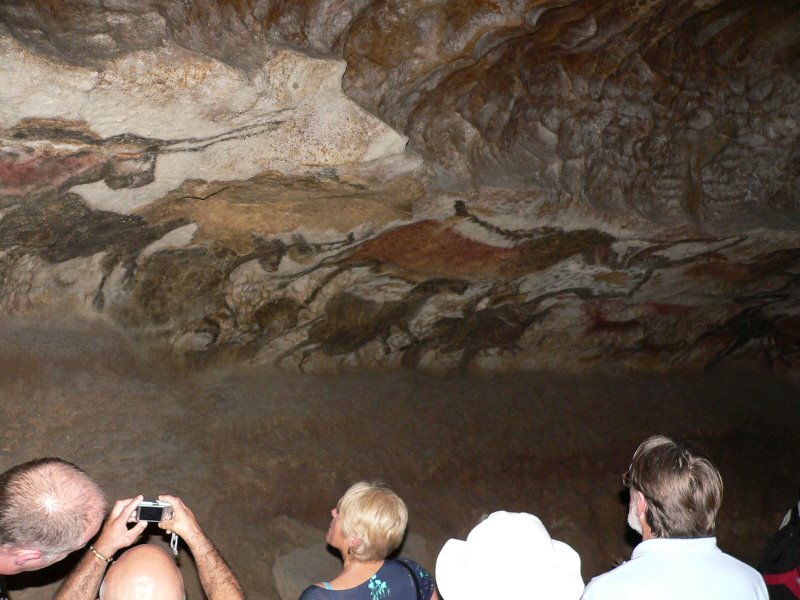
as a marketer, one of my favorite things about quarterlife is that the brand integration is so seamless it makes the traditional concept of “product placement” look like cave drawings in comparison. two of the characters on quarterlife, aspiring filmmakers–the pragmatic producer and the visionary director, of course–pitch a local toyota dealership to shoot a commercial for the business. of course when they deliver the ad to the client, the owner of the dealership, says he can’t see his cars enough in the ad. how are people supposed to buy his cars if they can’t see them? so the duo then has to recut the ad to make it less high concept and more car-y, they screen the revised version for their friends, after which one of the other characters–the typically self-righteous activist stereotype who’s being positioned to become the lead character’s love interest–gives them shit for selling out and making a commercial in the first place, and bashes the “corporate hegemony” in the second. after which they deliver the revised ad only to be told it’s STILL not car-y enough, and then get scolded by the dealership owner for not being serious about their business–which is supposed to be helping HIS business sell cars. oh he also tells them that they don’t know what they’re talking about when they insist that the ad is supposed to be selling “the experience” of the car, which i thought was a particularly interesting touch. then after that other things happen, but my point is that this whole time that you’re watching several key plot points and delving into various bits of character and theme development–and this stretches out over several episodes–you’re watching toyota in the show.

it may not be subtle, but then neither was carrie bradshaw’s love for manolo blahniks. that’s the thing about authentic character development now, you and i express ourselves through the brands we buy, so why should it be different for the characters on our favorite shows? in fact, can we even identify with a completely brandless persona in a character-driven series enough to keep watching week after week?

well, to be honest, i don’t know. i haven’t really watched TV since i started college, (except for netflixing the whole run of sex and the city, and going on a 24 bender last year, and 2005 when i lived with some roommates who had a TV set, and i got all into the sopranos) but, i HAVE watched all 14 episodes of quarterlife out as of now. and if i was watching this on TV (well, if i owned a TV and was watching this on it) i think i would love it. i’d be telling my friends to watch it too, it would be significant that a television network had had the vision (or nerve) to create a show about our generation–a generation which is watching less and less TV though, and hence less and less incentive to make content for it, but regardless–if this was on TV, it’d be great!

except it’s not on TV, is it? while we allow a certain suspension of disbelief for the contrived nature of scripted programming on TV we have a dramatically different relationship with online content. we may not expect it to be TRUE, but we don’t expect it to feel artificial either. here TV’s forced quality feels almost…invasive, like getting a friend request from your mom or dad on facebook (or if you prefer: walking into your room to discover your mom or dad already in it). like, TV! what are you DOING in here?

the whole time i was watching those 14 episodes i felt like i was waiting for something to happen. some subtle yet hugely important aspect in the very nature of the show to change. i mean, great, it’s “television-quality” production for the web, but who exactly was lamenting its lack here in the first place? i’ve seen ipod billboards that felt more real and compelling than quarterlife. (and that’s coming from someone who really wanted to like the show!)

to be fair, i think the internet community too is just barely scratching the surface of the possibilities for online video content, but writing a TV script for the web is about as powerful a use of these possibilities as writing a TV script for a feature film, and given the results of that Simmons report, a “web-to-broadcast” strategy seems rather pointless considering that consumers are practically 50% more engaged with content the medium you’re starting out on. we’re by no means all looking for the same kind of content on the web, but we are not looking for the same old same old, either. i can’t wait for something to really take advantage of all the medium’s potential and uncover whole new ways of creating stories.

what do i think looks like it could be one such possibility?


Subscribe for more like this.


“cake or death?” and other user experience design options to consider

after mentioning him in the previous post, i ended up going on what can only be described as an eddie izzard bender.

a self-identified “male lesbian,” and “action transvestite” (you know… “running, jumping, climbing trees… putting on makeup while you’re up there”: action transvestite), izzard is also fluent enough in english and french to do standup in both. so clearly the man understands a thing or two about the intricacies of hybridity and cross-cultural communication–phenomena that likewise are pretty fascinating for me.

i first saw dress to kill in 2002, and what forever earned my respect for izzard’s genius is when, during the encore, he actually performs a bit in french and manages to get everyone in the audience–and me watching–laughing hysterically. i don’t know french. neither does most of the rest of the english-speaking, san francisco audience where the show was recorded. yet in a feat of linguistic alchemy he somehow is able to completely pull it off. we’re watching him in a different language, and we totally get it. it’s such a bewildering display of how little a language barrier might actually matter in the process of understanding people who are unlike us that it feels like you’ve just witnessed a magician perform rather than a comic.

so somewhere in the course of the haze induced by binge consumption of every glorious, sexie, eddie izzard clip on youtube last weekend, i stumbled onto his website. i’m not entirely sure i remember how i got there, but i do remember flashes of what happened after. (note: this will be way funnier if you’ve actually seen eddie’s shows. since i had just watched several years of them before i arrived at the site, it was completely hilarious to me.)

when i went to sign up for eddie’s email list, i was faced with the following options:

Send me news and info about Eddie via Email

Only send me gig & appearance emails for my chosen country
Cake OR Death

when was the last time you were asked THAT before joining a mailing list?

and furthermore, what’s a nav. section called Thingie Things gonna lead you to?

click on it and an audio clip of izzard’s voice admits, “well, it was the pressy-makey-doey-things page…but that didn’t really fit it.”

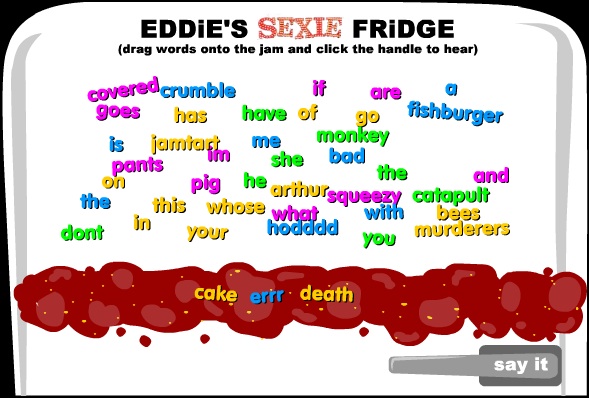
maybe you might want to pressy-makey-doey up on eddie’s sexie fridge

eddiesfridge.jpg

…where you drag words eddie utters during his show onto the jam smear on the fridge and then play them back to hear him say customized nonsense. (“jamtart arthur squeezy fishburger murderers catapult” is a good one).

but let’s back up for a second. maybe you’ve never seen eddie’s standup. maybe you came here because you’ve seen eddie in a movie, or on his TV show, the riches, and you’re trying to find out more about that. then you want the Eddie's ACTiNG page. and when you click on it, eddie’s relentless, adlibbing audio which follows you around–as in real life so on the internet–announces in a tone of sophistication, “this is the acting page. it is a very serious page.” it, in fact, does look very serious. with a vogue-y black and white glamour shot of izzard. but when you look in the corner there’s a little purple beehive just below eddie’s face with bees buzzing all around it. drag your cursor over to it to find out what the hell that’s all about, and your mouse gets covered in bees!

you may have seen glorious. you may not. you may think that’s hilarious. you may not. but either way, at least there’s something different going on here. something unexpected. and it’s not some kind of slick design-gasm. it’s not trying to wow you with unprecedented feats of programming. no. the site actually comes off as a pretty uncomplicated bit of online real estate, but with these absurd little pressy makey doey game-y bits. and it’s great!

i think the most important question for anyone creating a website to answer has to be “what do you want the website to do?” and at the basic level this question is pretty easy to answer. sure you want it to provide information, to sell something, to connect people, to encourage participation, whatever. all that’s well and good, but as soon as it gets beyond the level of “what do you want it to do beyond simply function,” the vision for what’s possible becomes kind of polarized and discordant.

on one side of this mania there’s:

make more features!
make it slicker!
make it cleaner!
make it cooler!
make it bigger…


and on the other side is something my friend jesse shannon calls the “myspacification of websites,” where content management systems are churning out the online equivalent of cookie-cutter suburban tract homes. sure it might be super intuitive and user-friendly, and you might know where your neighbor’s bathroom is located when you come to visit without anyone ever having to tell you, but….isn’t there anything else to an online experience beyond features or navigability? beyond flash or content management?

how about “i want the website to entertain people.” or “i want it to make people laugh.” creating a FUN experience is just as valid as an easily-navigable, informative one, but between the designer, the developer, the information architect, and everyone else…. whose job is it to make sure a site is FUN?

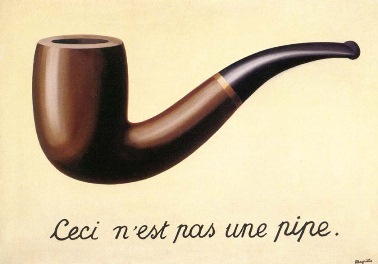
i once got asked if the “this is not a trend” in masthead image on this site is supposed to be a reference to magritte’s “this is not a pipe.”

Image:MagrittePipe.jpg

and while we may not all be looking for subliminal surrealist messages in our online experience, i think we are definitely looking for that kind of element of surprise, for unexpected juxtapositions, and even for non sequiturs sometimes, the same qualities that made the surrealist movement’s artistic expression so different from what had come before it. check out whateverlife.com on that note. the whole thing was originally created by a teenage girl who taught herself all the necessary design skills. not surprisingly, since there was no formal training which could instill upon her what a website SHOULD look or operate like, it looks completely different from any typical site.

perhaps it’s because we’ve always thought of the online experience as “browsing” that all we’ve been doing so far has just been making different versions of that one experience. maybe it’s time to re-imagine the whole thing. to integrate fun into its very functioning (as opposed to relying solely on the content), to reclaim it from its current humorless condition–and i mean, beyond just with LOLcats or cute hipster tech geek colloquialisms in dialogue boxes and error messages. if you’re looking at whateverlife and thinking, oh, so does this signify the next stage of a website experience?

instead think: maybe it just seemed like it would be fun.

http://lukaret.com/kusina/images/chocolate-cake.jpg


Subscribe for more like this.


user generated promotion

i keep being pressed to come up with alternatives for the word “viral.” since people are supposed to stop saying it, what are they supposed to say in its place, right? (virus-like? virusy? air-borne?)

the point here isn’t really about how to refer to the germ so much as it is identifying that contagion spreads through sneezing. and myspace bulletins don’t just magically repost themselves. they require people to take an action. (gazoonheit).

hence the phrase i keep coming back to is “user generated promotion.”

if you made it past the word “generated” without immediately assuming the inevitable next syllables sounded like “content”…. word!

some people seem to get stuck, and think the last word can only ever be content. (but not you. you totally got it.)

so to mark the release of boreta‘s new single here’s some viral content.

NOTE: everything below the doohiky is part of a “viral campaign” HERE.

ALSO NOTE: you’ll probably want to have some kind protective gear on when listening to bubblin’. it’s that good.

BORETA
“BUBBLIN’ IN THE CUT / LOBEGRINDER”

Digital SingleRelease Date: December 4, 2007
Catalog: GMU-002
Label: Glitch Mob Unlimited / Alpha Pup


* Last week, “Bubblin’ In The Cut / Lobegrinder” was the #2 Most Added Record to CMJ Hip-Hop and the #4 Most Added to CMJ RPM (Electronic) Charts
* Boreta’s first release on Glitch Mob Unlimited
* If you’re feeling edIT and Ooah, you will LOVE these tracks!


Cop it now on iTunes and Addictech


Special Note: This release is the second in an infinite series of digital-only singles on the newly-minted Glitch Mob Unlimited label. And now, more than ever, we need your HELP in getting the word out. So if you’ve been slayed by the Glitch Mob, we humbly ask that you repost this bulletin. Easily copy-and-paste the code from: alphapupdigital.com/boreta.html


Subscribe for more like this.


controlled randomness

“the biggest problem americans have is what cereal to buy in the cereal aisle.”
-my dad (who spent the first 56 years of his life in the USSR)

i’ve been watching my friend sarah write about her adventures in crazyblinddate land, and it’s gotten me thinking.

sarah explains:

CrazyBlindDate.com was started by the folks who brought us OkCupid — the free social networking / test-taking / dating site that’s given the pay sites like Match.com and eHarmony a run for their money. And so far, I’m impressed.

The premise is simple: you tell them a few things about yourself, who you’re looking to meet, where you’re willing to travel, and when you’re willing to do that. Meanwhile, other people are on the site doing the same thing. The Internet Brain lines you up, makes a match where requirements coincide, and asks both parties to confirm the date after showing basic information about the other person. This includes very blurry pictures of each other, as a teaser. Once you say yes, you’re committed to it.

….Why I’m excited about this site: they’re taking something that has massive screw-up potential, and handling it well.

sarah then decided to test out exactly how well this screw-up potential is indeed being handled by subjecting herself to some first-person “Field Research in Extreme Social Media Sports.”

in case you’re wondering, that crazyblinddate ended up going something like this:

cbd-after2.jpg

and here’s where it gets interesting. despite the lame-o first foray, and despite the fact that she herself admits that, “Blind dates are inherently sketchy-sounding,” she decided to do it again!

cbd.jpg

see, what’s happened is that we all (well, most of us, anyway) seem to have ended up in some scene. ethan watters coined it as “urban tribes” in 2003, but this kind of thing has been going on for ages, really. it’s hard to escape noticing how many times the word “scene” is uttered in the course of i’m not there, todd haynes’s recent movie about the live(s) of bob dylan. evidently “folk music” was a kind of “anti the pop tastelessness” scene going on in greenwich village in the 60’s.

what’s happened since then, however, is that social network apps have come along. which, in retrospect is barely even an appropriate way to think about them because we (generally) use them to connect to people we already know rather than to random strangers. what these sites have really become are “friend management systems,” which is an important tool for the maintenance and enhancement of any social scene, if you think about it. it’s preceisely what’s great about those kinds of sites: we can now assert our place in our scene even without leaving the house. true to form, bob dylan’s myspace page has been viewed 2,983,449 times.

so what’s interesting is that crazyblinddate is the anti all of this. we’ve become so obsessed with needing to control our choices, our lives–or lifestyles, our destinies, that we’ve become insulated against chance. and despite what facebook’s aggressively chance-destroying mini-feed has to say about it, with its relentless broadcast of all the activities of all your friends all the time ever, i think, really, we LOVE chance.

it’s what makes something like last.fm so great, for instance. the possibility of an unexpected, fantastic music discovery that we do not have to actively seek out. it finds us. by chance. if there was a service that i’d say CBD offers–aside from the “matchmaking” service–it’s that deliberate creation of chance.

even though we love chance despite our neurotic compulsion to set up barriers against it, we are also simultaneously overwhelmed by the amount of choices we have to make. a few weeks ago a friend of mine took me to this famous ice cream parlor in berkeley, and the amount of choices of ice cream flavors was suddenly paralyzing. even after the samples, i really was not adequately prepared to have any idea if i wanted raspberry cheesecake flavor ice cream or apple cobbler flavor ice cream. all i wanted was ice cream.

yes, we want as many options as we can get so as to have the opportunity to find the thing that fits US the best, but sometimes having to slog our way through the trenches of the long tail is just fucking taxing. i think, horrified as we are to admit it, we kind of want something randomizing. we don’t always want to have to think about it. we want the perfect ice cream flavor to find us. by chance.

i think the creators of CBD definitely realize this. the whole site is about the sudden, emphatic, click-first-ask-questions-later push into the pool of chance:

Welcome to Crazy Blind Date! We like to keep things simple. That’s why on very short notice we can set you up on quick dates with total strangers at public places like bars and coffee shops. You’re not allowed to see their picture or even communicate. Choose your city:

when i was in NY a couple of weeks ago i heard ads for CBD on the radio, evidently it’s been featured on the monrning show too. the intention here is definitely not about being a service for a niche kind of demographic. EVERYONE likes chance in some form. that’s the point. and even while the promotion for this thing is certainly not flying below the mainstream radar, the chance inherent in the site’s service still makes it feel like you FOUND it by chance. it’s amazing that mystery as an aspect of the service can be self-fulfilling in terms of the “discovery strategy.”

the way CBD works, you don’t get to see what the person you’re meeting even looks like beyond just this blurry kind of photo:

you don’t get the option to stalk them on myspace first, you don’t get to find out anything about who their friends are. it’s the opposite of what so many social-network sites, or even dating sites offer, and i bet there’s going to be a lot more stuff coming like this. whether it’s with music, dating, or ice cream, i think we’re all looking for opportunities–and sites–that plug a “controlled randomness” feature back in.


Subscribe for more like this.