everyday there’s some kind of new technology hoopla vying for my attention with the sordid insidiousness of a tabloid magazine at the checkout counter. and i don’t even buy that shit, but for some reason i can never resist trying to get the latest download on what’s going on in brad and angelina’s relationship while i’m waiting to ring up my groceries.
like this crazy story about a 17 year old girl from a working-class chicago suburb with no business background or any kind of investment backing accidentally striking it rich with her site that creates custom myspace layouts: www.whateverlife.com. (i feel like i may as well be reading about the state of britney’s deteriorating mental health.)
or getting sent links to stuff like dapper.net–which i don’t even understand what the hell it means half the time and that just fills me with this kind anxiety that’s on par with the dread of an “orange”national security alert. (are you feeling it yet?)
but that, of course, just begs the question: why is google so scared? what’s facebook really trying to do?
it’s like lindsey lohan. it’s insidious. it’s a giant nebula of crowd-sourced user-generated conspiratorial terror. i don’t want to think about the internet anymore. i’m over it. i just want a break.
i’m doing that thinking about the internet thing again.
fucking QUIT IT, internet. i don’t even care about this defeating, demoralizing tabloid trashstuff.
this is why i try to stay on the people side. with humans it might take like millennia to create any kind of significant change. it’s like…. all you have to do is look backwards at a relatively finite amount of information. (we may be discovering more of it as we go along, but it’s not like more of it’s being created.) so you just figure that stuff out, and you’re good to go. the basic programming idea behind the way we think, why want what we want, why we buy what we buy, why we behave the way we do, it’s all right there….. it’s like a swiss watch. it’s complicated, but you’re not expected to put it together differently every morning.
the internet, however is a different story. makes you want to just stick your fingers in your ears and go “lalalalala” (it’s working out well for the music industry, i hear).
ugh….
the whole thing’s just a big ol’ mess.
the post about the whateverlife.com story says:
The name came to Ashley in a moment of frustration. After losing a video game to [her friend] Bre, she dropped the controller and blurted out, “Whatever, life.” She liked it instantly. She thought it would be a great name for a Web site.
well…..
at least i’m not the only one tired of this stuff. even fifty’s got technolofatigue:
last week i was on the marketing 101 panel at the startupLA conference. it was
actually a lot of fun, and there were some great questions afterwards. here’s some of my favorites, and my answers:
Q. what’s the fastest way for a new company to get exposure?
A. look for existing communities that are comprised of your target demographic and approach them. if there’s already a connected group of folks that you feel will be interested in what you’ve got it’s a lot faster to generate authentic exposure through that network than trying to aggregate a community from scratch. from a completely different perspective, cliff allen of suretomeet.com who was on the panel with me, said the fastest way for a new company to get exposure is spam. so there you go. choose your own adventure.
Q. is social media, like facebook, going to be the future of advertising?
A. its impact on the process is hugely important. i think it’s certainly something that now needs to be factored into any kind of advertising plan. but i also think it’s completely foolish to altogether write off exposure media (which is what advertising has been primarily dependent on up until like yesterday). it’s not a battle between whether engagement or exposure media is better adapted to the natural selection of marketing, it’s about pursuing a symbiotic relationship between the two, and developing integrated strategies that are overall more effective. that’s the future…. or at least it ought to be.
Q. what’s one piece of marketing advice that is most important for a new company?
A. know your audience. really really understand who you’re talking to. or who you should be talking to. the danger in making a message that isn’t relevant or that isn’t approaching your audience on their own terms is not just that we, as consumers, “tune it out,” it’s that unconsciously we translate messages we don’t relate to as being “not for us.” that’s the #1 thing to avoid.
(and my #1 favorite…) Q. if you had $10,000 to spend on advertising and you couldn’t use any of it on the internet, what would you do?
A. throw an event. and if you’re targeting people over 50, buy some print.
first, you need to watch the trailer for sony pictures’ across the universe: here. if you cannot be trusted to come back here afterwards, however, you can just watch the shittier-quality youtube version:
ok then. now that you have been adequately briefed, we can begin.
i first saw the trailer for across the universe on quicktime.com in march and was not only blown away by how stunningly imaginative the visuals looked, but actually–i swear!–brought to tears by the drama of 60’s-era youth struggle depicted in just 2.5 minutes of preview footage! needless to say, i saw the movie opening weekend, six months later, and left the theater feeling beyond satisfied. the movie was so visually innovative and different it was like i’d just witnessed julie taymor–the director-slash-visionary best known for broadway’s “the lion king”– reinvent the very concept of movie a little bit.
i then proceeded to tell all my friends they should check it out, and even posted the preview on facebook. i was somewhat startled to discover the incongruent presence on the movie’s otherwise fairly unimaginative site of a special link that allows for easy one-stop posting of the preview directly to facebook. either this was incredibly nuanced forethought, or obviously tacked-on afterthought, i figured.
last friday, the LATimes weighed in on that debate, asking: Is this the next cult sensation? as you may have noticed, across the universe is a musical about teenagers. and while the plot-line is punctuated by beatles’ tunes, the fact that this coming-of-age movie didn’t find an audience with middle-aged boomers, who were part of the original “beatlemania,” apparently came as a marketing newsfalsh:
To judge by “Universe’s” trailer, which began screening in front of “Spider-Man 3” in May, it wasn’t immediately clear which genre “Universe” belongs to. Is it a coming-of-age story? A rock opera á la “Moulin Rouge”? A surrealistic period piece? (Answer: all the above.) Worse for marketers at Sony, the film’s distributor, contractual obligations bound them from hitting home with “Universe’s” primary selling point.
“Yoko Ono, Paul [McCartney], Ringo [Starr] and [George’s widow] Olivia Harrison were all supportive of the film, but I couldn’t use the Beatles name in any advertising,” Taymor recalled. “That didn’t make things easy. And you can’t advertise that you have Bono, Eddie Izzard and Joe Cocker in cameo roles. We didn’t have a real big push from Sony; they were stumped by it. So nobody was really sure who the film’s audience was.”
i’m ten years older than the median teen-movie demo–but on the tail end of recovery from the quarterlife crisis the concept of trying to figure out life in a conflicted, confusing, “changing world” still feels totally relevant–and that’s, i think, the cutoff point for the audience to be marketing coming-of-age tales to.
After an uninspiring opening last month… help arrived in the form of an audience whose parents were their age when the first wave of Beatlemania hit. After three weeks in theaters, the PG-13 movie finally penetrated the top 10 by connecting with a zealous core constituency: teenage girls.
….According to Paul Dergarabedian, president of the box-office tracking firm Media by Numbers, audiences are now finding their way to “Universe” thanks to Sony’s textbook execution of what is known in the industry as a “platform release.”
“Expectations were unknown. But Sony has handled it perfectly. They got big initial interest in limited release, then they’ve been capitalizing on that every week.”
“They’re taking their time. On a movie like this, that’s what you have to do.”
so… like, besides the fact that the movie’s supercute cast is totally perfect bedroom-wall poster material, and that this “60’s story” is retold with acutely contemporary (and boomer-anachronistic) sensibilities…. did, um, no one at sony bother to check if maybe teenagers might not actually totally dig the beatles, at some point before they released the movie?
three and a half years ago (maybe somewhere around the time taymor got this funny idea for a musical) USA today reported:
Beatles historian Martin Lewis began spotting a young wave of Fab Four fanaticism as emcee of Beatlefan conventions the past 14 years. Boomers constituted half of the audience in 1990. Now 75% of attendees are under 30, and many barely in their teens.
As marketing consultant for The Beatles Anthology, he met with label execs plotting campaigns targeting fans 45 and up. “I’ve got news for you,” Lewis told them. “I’m the oldest guy at Beatlefan conventions.”
Sure enough, a marketing survey showed that the under-30 constituency scooped up 40% of the first Anthology run. “I’ve interviewed those kids,” Lewis says. “I’ve said, ‘Surely you’d rather listen to Justin Timberlake. Why are you here? Were you forced by your parents?’ But they chose to be there.”
the relative “drought” in contemporary rock (“Kids don’t come in and say, ‘I want to play like John Mayer,'” says a manhattan producer and guitar teacher quoted in a feb. 2006 article in rolling stone called “teens save classic rock“), multiplied by the internet’s universal ease of access to music of all decades, means you better do your homework about whom to target with your alleged “primary selling point,” yo. (even hiphop’s got love for the fab four as evidenced by wu-tang’s becoming the very first group EVER to legally sample the Beatles (!!?!)–sooooo… THAT happened.)
…anyway:
While Dergarabedian heaps praise on the marketing plan, Taymor feels the movie has benefited from a kind of benign studio neglect. “In a funny way, young people found the movie because it wasn’t marketed huge,” she said. “Young people don’t want to be dictated to about what’s the new cool thing.”
…. “We gave people the sense that they’d discovered it for themselves,” said Valerie Van Galder [the division’s president of domestic marketing].
i am sure that beyond classic rock’s sheer novelty or vintage cred, for the current crop of teenagers, its appeal likewise stems from the satisfaction in the personal discovery. this is a sense that is simply not possible to generate through mainstream teen-targeted music options. (wait… did classic rock just turn into alternative rock? wow. bizarre.)
i’ve written before about how valuable sustaining a sense of mystery can be for a brand, and it applies to the process of its initial discovery as well. whether sony was just hedging their marketing dollars on this weirdo bet of a movie, or whether they actually had the temperamental teen psyche aaaaall figured out reverse-psychology stylie when they eschewed spending money on any TV commercials, billboards, or PR, i think there’s something to be learned from across the universe’s model–accidental or not–that can be applied to a more deliberate kind of “discovery strategy”:
start with something unique. you can’t really capitalize on a “discovery strategy” if the product won’t actually FEEL new or unexpected. (of course, a “discovery strategy” isn’t really the kind of thing that well-established fare needs to pursue in the first place, so it’s the unproven stuff to which this sort of option is most applicable anyway.)
understand who the appropriate audience is and the communication / media channels they use that are particular to them. even if what you’re marketing is not a pop property but its message is disseminated through one-size-fits-all media, it invalidates the personal intimacy of discovery. a caveat in this case is using mass media to broadcast a message that will only really be meaningful to a particular community, but why do that when instead you can…
provide the tools for people to be able to easily distribute the message themselves. a handy little “post to facebook” button helps, but so would have the option to get the embed code for the preview so that people could post the video to myspace and their blogs and wherever else that wasn’t just facebook. (nuanced forethought, or obviously tacked-on afterthought, right?)
and in case you’re wondering, this is NOT a “viral campaign.” the difference is between a ploy to abuse some unfortunate loophole inherent in ADD for an attention-spike, and a strategy to enable the creation of a meaningful, personally-compelling discovery that leads to a lasting (consumer) relationship.
from the LATimes:
Nicole Sacharow, 15, from Culver City, for one, ranks “Universe” among her “favorite movies ever.” She’s seen it twice and would already have notched up several more viewings were it not for scheduling conflicts with her friends.
“You go up to a group of people and say, ‘Who wants to see “Across the Universe” this weekend?’ ” Sacharow explained. “The songs are addicting. Everyone who goes to see it has the soundtrack. I listen to it every day. I hear people singing the songs around school.”
i’d say the movie has the potential to become this decade’s RENT (the war allegory standing in for the 90’s AIDS nemesis.) with wu-tang paving the way on beatle’s rights clearance, i could easily see a broadway version of across the universe in the future. but where could they find a visionary, multi-Tony award-winning director to–oh!
yesterday a new client pointed me in the direction of reverbnation.com, and while i don’t usually write about websites, this is different–i can’t even help it. launched just under a year ago, “ReverbNation.com is a Music 2.0 company that is responding to the changing music business paradigm.” except, when they say it, this isn’t just nonsense hippie talk. they mean it:
We believe:
• Nothing is more important to Artists than the relationship with their Fans….We call the total value of these relationships an artist’s Band Equity™, and it is our mission to help artists maximize this.
• Active Fans are the best promoters of music on the web. Fan attention has become fragmented across the web in a way that mass marketing no longer makes financial sense (see the demise of radio, music TV). Today is the age of social networks. Artists cannot be everywhere they need to be at once, so they need to focus on activating their most rabid fans to promote them in every corner of the web.
• A Music Community is more valuable if includes all of the members of the community. We believe that fans, labels, venues, and other folks all deserve a voice in the community if it is going to be representative of the entire music ecosystem. At ReverbNation, we invite all members of the community to take part.
at first glance you notice a slick design, and an interface that makes, as the client said, myspace look like fisher price. but 10 seconds later the extent of the sophistication going on here begins to dawn, and as you continue to discover what reverbnation is actually set up to do, you understand that this is way beyond just another community site, this is an incredibly powerful broadcast tool. one developed with an impressive understanding that the new channel is now a fragmented channel. this, by the way, does not mean it’s a broken channel, but rather it is a new kind of channel. one that broadcasts like a prism rather than a laser beam, and exists, as the reverbnation mission statement points out, “everywhere at once,” rather than being confined to any one particular medium.
if you are a musician, or if you are responsible for developing the strategy for how brands spend their advertising money, you really ought to check what reverbation is doing, as it is a model for how to approach the business of message dissemination in the future–and by that, i mean now:
ReverbNation provides innovative marketing solutions that musicians need to compete, cooperate, and differentiate in an increasingly noisy online environment. Unlike typical “closed” communities, artists use ReverbNation as their home base for approaching marketing and promotion across the Internet as a whole — be it via social networks, blogs, or the artist’s homepage. Tools like TunePaks, FanReach, and Widgets give the artist the power to spread their music and information virtually anywhere. Real-time stats then provide a 360-degree view of how the music is spreading, who is listening, and which fans are actually passing it on to their friends and posting it on their pages.
the most impressive offering for artists through reverbnation, isn’t even the array of features, but the way all the tools are enhanced through a seamless integration into the rest of the social media world. a strategy that can be summed up in one word: widgets.
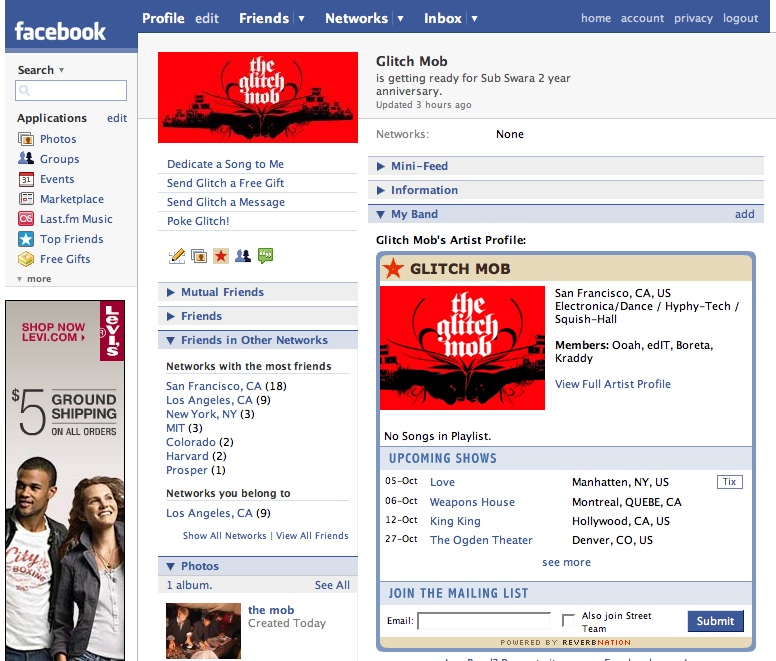
here’s an example of a widget in action on a facebook profile:
in one slick little box you get:
the band’s upcoming show schedule–which is incredibly easy to create since reverbnation also has venue profiles, allowing you to add ten shows in about 2 minutes.
direct links to buy tickets to upcoming shows
an email list signup form– reverbnation’s free FanReach email service allows artists to create targeted messages to fans based on age, gender, and location which is more sophisticated than the offerings of many email list service providers, and their service also lets you include music and a show schedule automatically in every email.
the widget even has a freakin “Also join Street Team” option for people signing up!
to get all these features before you would have had to go running around to a bunch of different service providers, and then work to continually integrate all the features individually into every online location where your band had a presence–and that’s all resting on the assumption that all those features were compatible with each other, and most importantly, that a bunch of musicians had the necessary marketing acumen to even understand all the features they needed in the first place.
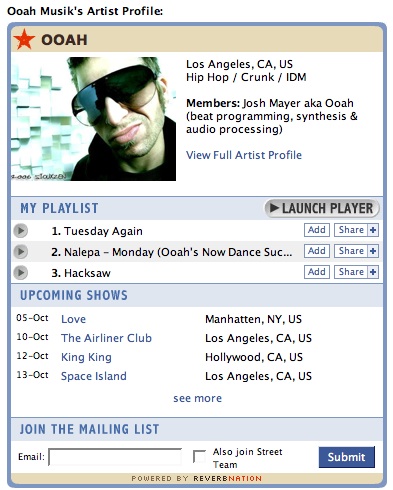
of course, it doesn’t stop there, this widget slices and dices and plays music too. here’s another example from one of the glitch mob’s member’s profile:
it doesn’t just let you embed a playlist, it lets you create portable online music player! this means that folks don’t HAVE to stay on your profile page to listen to your music. they can be doing anything else on the internet and still listening to your serenade.
the fragmented channel, remember? it’s everywhere all at once.
there are sooo many more features that reverbnation offers that to even get a grasp on all of them would take me the rest of the day, and then i’d have to spend more time tomorrow writing about them, but i should think you get the idea at this point.
i can imagine part of the hindrance in reverbnation’s adoption is the sheer complexity, and wide array of their offerings. it’s been confused for a myspace competitor, but in reality that is a complete misconstruction of what it looks like reverbnation is setting out to do. during the many company-wide conference calls that took place in the process of House of Blues’ acquisition by LiveNation, michael rapino, livenation’s CEO, continually stressed the importance of the consumer relationship to the future of the concert promotion industry–about which, as the largest concert promoter in the world, livenation has a right to claim to know a thing or two. (if “reverbnation” picked its name in complete ignorance of “livenation” i would be tremendously surprised).
the big difference, of course is that livenation owns the venues. but in reverbnation’s case, they are setting up to own a channel. one that is deftly suited to broadcast to a fragmented audience. and if you were paying attention then you’ve also realized that it is a model for the future of message-distribution itself, also known as advertising. connecting the needs of artist, fan, and venue into a symbiotic “ecosystem” is the same as connecting the consumer, the brand, and the “venue” for a brand experience into one constant feedback loop.
it’s kind of hard to write a post advocating a sense of balance. it’s easy to get all riled up and energized on preaching some kind of extreme; is it even possible to create a polemic for moderation? i’ve been sitting on this particular post for weeks, unable to summon up the oomph to do it justice, but i’m gonna try, cuz i think it’ll be useful.
there’s a lot of push for “radical transparency” in this social media culture of ours. from the free-sharing ethos of the open source community that’s defining a good deal of the new medium’s structure, to the rampant open-bookiness of the random user’s social network profile, total “openness” is being heavily bandied as a requisite for the new media era.
a few months ago wired dedicated it’s cover story to this issue, with the see-through CEO article:
Radical forms of transparency are now the norm at startups – and even some Fortune 500 companies. It is a strange and abrupt reversal of corporate values. Not long ago, the only public statements a company ever made were professionally written press releases and the rare, stage-managed speech by the CEO. Now firms spill information in torrents, posting internal memos and strategy goals, letting everyone from the top dog to shop-floor workers blog publicly about what their firm is doing right – and wrong….
of course, when considered in contrast to the long legacy of empty hype, manipulation, and even straight up coercion that we have become fed up with in mainstream media and big business it’s understandable that there would be such a resounding grito for “radical transparency” now that media has, for the first time, truly become interactive. “secrecy is dying.” the article proclaimed. “it’s probably already dead.”
but before we go get it taxidermied and hang its stuffed, antlered head up in social media’s hunting lodge, what i am proposing is that there is room for an intermediate option between the overt and the covert, one that emphasizes a sustainable (vs. radical) approach to maintaining the delicate balance between the blatant and the intriguing.
but wait…
Your customers are going to poke around in your business anyway, and your workers are going to blab about internal info – so why not make it work for you by turning everyone into a partner in the process and inviting them to do so?….Some of this isn’t even about business; it’s a cultural shift, a redrawing of the lines between what’s private and what’s public. A generation has grown up blogging, posting a daily phonecam picture on Flickr and listing its geographic position in real time on Dodgeball and Google Maps. For them, authenticity comes from online exposure. It’s hard to trust anyone who doesn’t list their dreams and fears on Facebook.
ok. i’ll tell you something else about what i and some of the rest of this generation grew up doing. we grew up going to–and some of us, producing–“outlaw” parties. you can check out groove or go or kids even, if you weren’t there for yourself, but suffice it to say these were unpermitted, unfireproofed, underground all-night events that routinely broke a whole lot of safety codes, property laws, and a slew of other legislative regulations. there was a tremendous sense of community and trust that developed within this scene which was at once superlocal and hyperglobal, and we all relied on each other to be good at keeping a secret. because if we weren’t, we would all be saving the 3 am dance for members of law enforcement. and once the cops came there was no more fun for anyone.
which is not to say that i am advocating illegal activity in business practices, but rather to point out that this generation that now publicizes its dreams and fears for the world to see may yet be able to appreciate the value in keeping certain things–as the kids say–on the DL.
the wired article does point out that, ok, perhaps:
Secrecy can be necessary – CEOs are often required by law to keep mum, and many creative endeavors benefit from being closed: Steve Jobs came up with a terrific iPhone precisely because he acts like an artist and doesn’t consult everyone. In fact, secrecy is sometimes part of the fun. Who wants to know how this season of 24 is going to end? It’s not secrets that are dying but lies.
the article tosses in this dynamic concept that secrets can be fun, and then moves right along on its radical transparency proselytizing way without giving it any more thought. it’s this kind of secret that i’m interested in. the secret that is not a lie, the secret that’s enjoyable: the mystery.
because you know why? because mystery is infinitely engaging. mystery bestows specialness. mystery can create bonds within a community, and oh, hell, mystery is sexy!
i mean, full disclosure certainly can be sexy too, but it all depends. we don’t fantasize about what EVERYONE looks like naked, dig? and that goes for companies too. sometimes we don’t NEED to know. sometimes it’s a lot more boring or disappointing if we do. sometimes it ruins the magic. sometimes it could be more captivating if you maybe put your clothes back on and sought to seduce us. think of it like a strip tease. in fact, i think we can all learn a thing or two on the subject from cabaret. but not the outdated oldskool kind. no, i’m talking about punk rock cabaret.
n 2004 the dresden dolls were just this odd little cult duo from boston on their first US tour. at their L.A. show matt hickey, the dolls’ booking agent, said to me: you know, no matter how big they may ever get, it’s really important that you should still be able to feel like you are just discovering them. that idea has stuck with me ever after, and i think it’s immensely valuable advice to anyone responsible for the development of a lifestyle brand.
in the years since that conversation, the dolls have gone on to tour the world with panic! at the disco, nine inch nails, and many other major acts. the last time i saw them perform was about a year ago at the orpheum theatre in LA and i’d say that that sense of intimate discovery remained intact even when thousands of people now knew the words to all their songs.
how do you cultivate this intimacy? you keep things mysterious.
the lore around the relationship between the duo is the stuff of cult-rock mythology at this point, rife with tensions and speculation. but sustained mystery is not the exclusive territory of celebrity, where it is, in fact, more often than not mismanaged. it’s also the very same sort of element that induces alternate reality game enthusiasts to willingly participate in an obscure adventure, trusting that each discovery will lead them to an even greater enigma. in a certain sense our whole fetishized infatuation with celebrity can itself be thought of as one giant pop culture ARG–but that’s enough philosophy for one post, i think.
instead lets head over to psychology land. after all, this whole mystery thing is how people fall in love, and the result of eliminating its terrific tension can ruin an otherwise great relationship. (think brand-consumer relationship too!)
in her excellent book, mating in captivity, esther perel, a couples and family therapist and self-identified “cultural hybrid,” offers some refreshingly counter-intuitive (to american intuition, that is–perel was raised in europe, educated in israel, and now practices in NY) insight on how to “reconcile the erotic and the domestic.”
Intimacy has become the sovereign antidote for lives of increasing isolation…. but I am not convinced that unrestrained disclosure–the ability to speak the truth and not hide anything–necessarily fosters a harmonious and robust intimacy.
The mandate of intimacy, when taken too far, can resemble coercion. Deprived of enigma, intimacy becomes cruel when it excludes any possibility of discovery. Where there is nothing left to hide, there is nothing left to seek.
It’s been my experience as a therapist that the breakdown of desire appears to be an unintentional consequence of the creation of intimacy. Our ability to tolerate our separateness is a precondition for maintaining interest and desire in a relationship….Desire thrives on the mysterious, the novel, and the unexpected. It is energized by it.
An expression of longing, desire requires ongoing elusiveness.
we appreciate mystery not for the end goal of its destruction, but for the enjoyment of its process–its revelatory discovery, its furtive sharing. mystery isn’t about being shady, it’s not about deception, nor is it mutually exclusive with making things more accessible, safer, or better explained. there probably isn’t even one right way to sustain it–do too good a job of it and you run the risk of ending up in the dangerous territory of exclusivity. but mystery is incredibly powerful, and has the capacity to engage and captivate us all like nothing else. we shouldn’t ever discount it or think that complete transparency is really a viable substitute. sustained mystery, when pursued consciously and wielded carefully is an effective strategic approach in its own right.