
community management IS image management


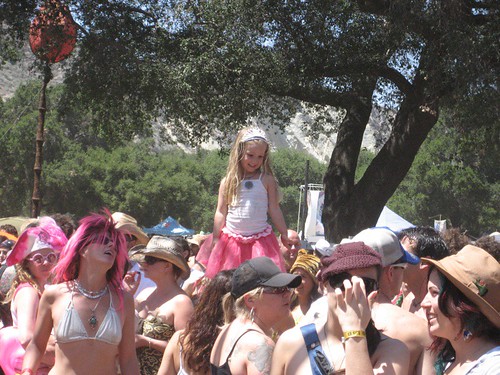
crowd at LIB07
photo by: fightingwords

this weekend, at a do lab birthday dinner, the other half of the do’s community management team started giving me shit about removing a particular video from the LIB youtube group.

it was this weirdly psychedelic video that didn’t even really show much of the festival (i think most of it was a strange, imovie effects-laden loop of a girl in a tutu) and the reason i took it out was because the soundtrack was a song (also totally unrelated to the LIB music style) with the words “cunt” and “fuck” repeated over and over. since LIB happens to be very much an all-ages, family friendly event, this video seemed sorta…uhh… inappropriate. it’s not like i told the creator that he had to remove the video from youtube entirely, and i also didn’t just X his video out of the group in silence. i sent a message to the creator and explained that the video wasn’t actually all that appropriate for the group, and that if he had any other videos that were more palatable we’d totally love to have those included.

apparently, the other half of the team thinks this makes me a prude. i think it’s just effective image management, and it’s an integral part of what’s ENTAILED in the community management process.

the thing about a real community is that it is a group of people who understand each other in a way that people NOT in the community do not. inside jokes get reinterpreted literally by those not in on them, inside norms are judged by the mores of the outside world, and all these things bear the potential for an untold number of misconceptions about your brand and your product, just waiting to create controversy. any significant community management then isn’t JUST about “getting people involved” (if your product is relevant, people will get involved, believe me), it is to a huge extent, about image management.

think about it like this… when you’re 17 your myspace profile isn’t all about the fact that you got a perfect score on the verbal SAT, that you’re the editor of the school’s lit mag, and that you’re a state champion sax player. no. your page has a photo slideshow of you playing beer pong at a party with your friends last weekend, and it’s covered in a million inside joke comments that in no way bolster your college recommendation letters. let’s say this 17 year old is a “brand” that you are trying to sell to a potential university (as many a 17 year old brand is), if any admissions officer happens to check up on the myspace profiles of applicants, then what you’re facing is a case of tragically BAD image management. however if this 17 year old brand is trying to be popular in high school, then you’re doing a fantastic job; keep it up. (also, congratulations, facebook: i just used myspace in an analogy and felt stale.)

the truth, of course, is that you (the 17 year old) are actually responsible for managing both these conflicting images of yourself simultaneously. and likewise, managing a community is very much about navigating the balance between outside and internal expectations while staying true to BOTH! if your approach to “radical transparency” is entirely negligent of the vital impact of context, then you’re just gonna piss a lot of people off (not the least of which will be your community for approaching their representation quite so carelessly), and screw your brand over. this is not to say you can’t ever break the rules of cultural context–in fact, in the cases when adhering to these rules is a detriment i’d actually say that breaking them is definitely a direction to consider, (if you do, however, you have to understand what that means, and all of the repercussions that it entails) but this post is not about breaking the rules of context. that happens all too easily on its own. this is about the much more complicated, much more sensitive, and much more precarious process of balancing them.

the reason i took that video down is because of the impact i felt it could have in a very particular context: potential LIB08 attendees checking out the youtube group, who’ve never come to a do lab event before, and are considering bringing their kids. while we don’t have any hard statistics, i think the amount of families with little kids present at LIB this year can be adequately reflected by the word: shitload. even though the video in question wasn’t adding anything particularly enhancing to the overall community its general irrelevance could simply be dismissed, but it’s off-putting choice of soundtrack, however, was too close to being a detriment for comfort. had such a video been added to a group for lucent delirium, for instance, the do lab’s “twisted tribal affair,” or any of our other late-night, dance-till-it-hurts events, i probably wouldn’t have cared. not, however, a weekend camping festival taking place during mother’s day. (even though the words fuck and cunt are indispensable to motherhood, they’re just totally not gonna go in a video group for the festival. sorry.) and for the record: that sentiment does not make me a prude, it makes america a prude. i’m just here makin sure we’re keepin’ things in context, yo.

the deeper conflict in this situation, of course, is that our particular community is comprised of some VERY uninhibited, counter-cultural artists and all their freaky friends–i mean, we’re a circus for god’s sake! and while even just up until 2006 the dolab’s events were all underground, and the community that has nurtured and supported us is used to this outlaw mentality, we no longer have the luxury nor, frankly, the interest in producing unpermitted, below-the-radar events. the scale is too big, and so are the stakes. this means we now not only have to take permits and fire codes and laws in general seriously, but it also means we have event publicists and work to deliberately cultivate relationships with the mainstream press. yet at the same time there is absolutely no way we will risk jeopardizing the free and bohemian vibe that we are known for, and which our community expects us to deliver… if you happen to think the juxtaposition of these conflicting cultural contexts and expectations might be complicated to manage…. yeah, i’d agree.

the week leading up to LIB was a hardcore community management vs. publicist smackdown battle in which we all struggled to find some kind of balance between what was best for our community, our brand, and for our overall image in the glare of the growing exposure which we are very much courting. amazingly, after a bit of initial fumbling, in the end it all went off without a hitch, and i’d say in no small part due to the very fact that these kinds of issues were critically considered and addressed.

you know… as much as dealing with publicists (even when they’re OUR publicists) really is NOT the highlight of my day, i think that it’s pretty critical that the people in charge of the inward-facing image and the outward-facing image know what the other side is up to. the message may not be different, but the translation most likely needs to be, and if there is not a direct line of communication between the community dept. and the PR dept., and if either side is not conscious of the considerations required by its context, then your brand is setting itself up for a potentially very messy spill in the image management aisle.

i wonder if anyone else out there has any stories or experiences dealing with similar kinds of dilemmas… how did you handle them? what were the results? what’d you learn in the process? i’d be very curious to hear.


Subscribe for more like this.


rated for irony

do 11 year olds really talk like sitcom writers now? i mean, it’s kinda funny… in a mildly disturbing sort of way. like one-liners are the next evolution of jr.’s “first words”…an eventually unmanageably annoying evolution, but, like the kids say… whatever.

check out these little Red “characters” (such as chill, grumpy, whatever, flirty) that were developed for beRed.com (now teens.aol.com) by ATTIK.

how to step up to the challenge of creating campaign elements that let kids know RED is the place for them?

http://www.darnellworks.com/attik/images/br-wp1m.jpg

when you show up at teens.aol.com, by the way, you’re greeted with a paparazzi shot of britney in a car with some guy obscured by the rear view mirror and big sunglasses, with the caption, “who’s that guy? run, guy we don’t know. run!”

so it’s nice at least that the messaging tone is consistent.

http://www.darnellworks.com/attik/images/br-wp2m.jpg

oh, chill also has a different aspect to his personality in other settings, like “why should i worry when my parents do it for me?” it’s like that fairy tale… you know, be Red and the seven obnoxious tween dwarfs? classic. originally these were developed as door hangers too:

now you can also find them as banners at profgilzot.com. (and while you’re doing that, check out the stunningly rock and roll SAT prep tutor illustrated there. seriously, like straight outta williamsburg.)

it’s undoubtedly great identity marketing: gotta speak to the audience on their own terms if you want to get across that your product is for them. unfortunately, why are those the terms? anyone remember all those post 9/11 predictions about “the death of irony”? yeah…. THERE was a trend forecast that was spot on, evidently.

tho… i guess i’m not helping any. but i mean, irony’s ok for adults, right? so maybe you should have to be over a certain age for us to allow ourselves to subject you to it?

irony: like violence and sexual content.


Subscribe for more like this.


a momentary lapse in being original

burning_man.03.jpgperhaps it’s just typical to find SOMETHING to dislike about the business 2.0 article about how “burningman grows up” but i can’t help it!

i bet there’s probably even distinct camps of dislike about it, in fact.

camp #1 are the people who dislike that their special countercultural identity-defining ritual is being profiled somewhere so mainstream, and involves words like “brand” and “leverage.” you know it can’t be good for the “rebel” self-image to be confronted with the consideration of who might be reading about the mecca of the “radically self-expressed” alternative lifestyle when it’s written about glowingly on a url like money.cnn.com…

camp #2 might maybe be able to make an allowance for the market-speak as being superimposed by the writer vs. the being the normal vocabulary of the event’s organizers themselves, but this group is pissed that the strict ideology of anti-commercialism at all costs is being at all fucked with by the high priests themselves. how the hell are we supposed to follow the path to salvation from the “default world” if the compass arrow won’t stay pointed firmly in one direction? i mean, yeah, it’s just green businesses now, but this isn’t about green, goddamnit! it’s about black and white!

(yup: camp #1, and camp #2 link to the same place, curiously enough, and no: i didn’t make the reference “default world” up.)

ok, i take it back, not everyone’s irate. camp #3 actually probably doesn’t give a shit. camp #3 is just full of members of the creative class who’ve been using burningman as a giant dynamic gallery in which to get to exhibit their art and a great source of highly fun creative inspiration for years, and they’ll probably raise an eyebrow, sigh whatever, not even finish reading it to the end, and then get back to doing whatever it was they were doing before they got forwarded the article.

but i dislike it for different reasons. you know… i always get flack from my friends for paying attention to language too closely. like, one of the most annoying parts of any argument is when someone goes, “ok, you’re just picking on my word choice.” JUST picking on word choice! like as if words choose themselves, and mouths hiccup them up without any input on the process.

uh..yeah! i pick on fucking words alright, cuz you picked them. which makes us even. and the most irritating part about the whole article is marian goodell’s (one of the event’s main organizers) word choice when she says:

“This community is a dream for anyone looking at demographics. We have kids who work in coffee shops and we have billionaires. To ignore the value of our brand, the buying power it has, is silly. But it’s a ritual for these people, which is why it’s going to be hard for them seeing businesses out there.”

eeeuuchh!

i’ve written sponsorship proposals for LIB, and can very much sympathize with the trickiness of navigating the space between brand enticement (for the record, we’ve been targeting green companies to participate in our festival since ’06) and the management of non-commercial community expectations, but referring to the community that has sustained and nurtured your event, and that defines the buying power of your brand as “these people” or even as “them” is just…disingenuous, tacky, and… just…ugh, bad form!

Burning Man’s customers keep coming back to Black Rock precisely because it’s so far outside the scope of the corporate culture – and its incessant marketing – that most of them live with the other 51 weeks of the year.

i guess that’s the thing that gets camp #4 all up in arms–camp #4 is where i’m camped, at the intersection of “7:30” and “annoyed”– when there are corporate brands that treat their community with less distance, and more dignity (i by no means read that whole long discussion thread about the article, but the fact that it came as a total shock to the community is unmistakable) than this kind of language and closed-off attitude belie, then just what exactly is so special about the authenticity of an authentically disdainful counterculture “brand”? the article makes a big deal about how burningman has come back from the brink of bankruptcy like four times or something because the only way the event sustains itself is through selling admission tickets, and essentially nothing else to its communi–uh, i’m sorry, i mean, to “these people”–but in the end, you gotta wonder, is that (much like the anecdote that larry harvey, the event’s originator, didn’t have a bank account until like last year or whatever) actually part of a desire to make room for more intimate interactions than commercial transactions….

or just a bad business strategy?


Subscribe for more like this.


we reserve the right to refuse service to marginal subcultures

even funnier on the heels of the post about the nature of subconscious cultural aesthetic values, is this bit from ikea perfectly exemplifying what i like to call a “lifestyle slur“:

“Brightens up your grad’s dorm. Unlike a creepy gothic roommate, who can be a bad influence.”

….. all it takes to ward off the influence of bad poetry and clove cravings is funky colored scandinavian pillows?

this is amazing! djarum isn’t gonna know what hit it.

really, ikea! what are you thinking? even the goth students need cute pre-fab dorm room furniture, and instead of trying to figure out how you can get in on that sort of demand (hint: modified decor color palette) you deliberately hang a “no blacks” sign in your ad?

now you’ve gone and done it, ikea. there’s apparently already a tempest brewing in the goth online teacup, with folks sending out emails to their community mailing lists and including the contact info for ikea’s customer relations and social responsibility contacts. (maybe this could be a useful political activism strategy? just tie policy into lifestyle as opposed to social justice and people will get all caring about your shit and everything?)

anyway, ikea, let this be a lesson to you:

you don’t have to agree to EVERY snarky idea some hipster jr. advertising associate pulls out of his butt.


Subscribe for more like this.


how to correctly appropriate a media controversy

completely hilarious!

it actually made me want to buy dr. bronner’s soap! and i NEVER wanted to buy it before, cuz the packaging is so personality-less, and spouts those weird quasi-culty hippie messages.

but hey, anything punk-rock endorsed can’t possibly be as hippie as i thought, right? and their great sense of humor totally absolves them of their merchandising sins as far as i’m concerned.

they had me at: “driving while weird.”

i’m absolutely stealing that phrase from now on.


Subscribe for more like this.