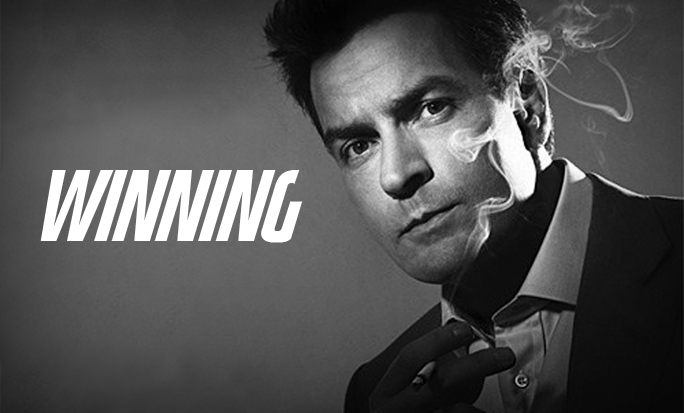
Charlie Sheen Is Not Crazy

Image: Culture Wins

Charlie Sheen is not crazy. Or, at least, he’s not crazy the way you think he is. Charlie Sheen may finally be admitting that he’s lost his mind — exclusively to Life&Style, of all places, if we are to believe it — but that’s something that would have already been a long, long time in the making. What’s been happening over the past few weeks is not Charlie Sheen going crazy. Although it’s certainly easy to get confused. No doubt, Charlie Sheen wants you to think he’s crazy. After all, the boring recovering-addict Charlie Sheen Show — or the boring functioning-addict Charlie Sheen Show, depending on your preference — is much less interesting to watch than the “Crazy” one. And we are still watching….

In the course of this production it’s hard not to think about the film I’m Still Here, the cinéma vérité chronicling of Joaquin Phoenix’s “retirement from acting.”


.

For a year and a half, the twice Oscar-nominated Phoenix gained weight, stopped shaving, and tried to start a career as a rapper while his brother-in-law and fledgling filmmaker, Casey Affleck, came along for the ride to document this seeming descent into madness. Phoenix even famously came on Letterman in the course of I’m Still Here‘s production, disheveled and incoherent — an appearance that, by the end, prompted Letterman to say he owes an apology to Farrah Fawcett, til then considered his most disastrous guest of all time.

Of course, in the end it turned out this was not just another overindulged celebrity losing his mind. Nor, even after it was revealed that Phoenix’s “retirement” and subsequent actions weren’t exactly the plot of a straight “documentary,” was it all just simply a hoax. Back on the Late Show a year and a half later, now clean-shaven, and charming as usual, Phoenix explained:

We wanted to do a film that explored celebrity, and explored the relationship between the media and the consumers and the celebrities themselves. We wanted something that would feel really authentic. I’d started watching a lot of reality shows and I was amazed that people believed them; that they called them, like, ‘reality.’ I thought the only reason why is because it’s billed as being ‘real’ and the people use their real names. But the acting is terrible. I thought I could handle that. Because you don’t have to be very good. You just use your name, and people think that it’s real.
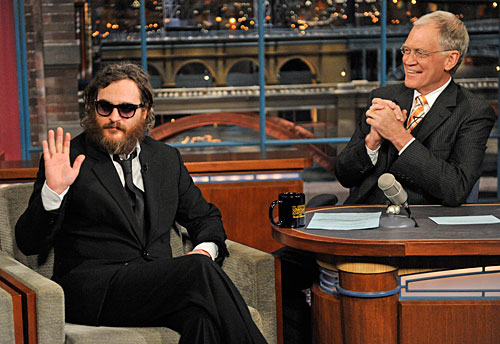
For a year and a half, Joaquin Phoenix lived the life of a character who shared his name and history and circumstances, both in private scenes and in the public eye. What then, truly, is the difference between what’s “real” and what isn’t? What does “hoax” even mean in the age of “reality TV?” I’m Still Here, along with the context around it, is a philosophical exploration of these questions.

It’s a very similar postmodern paradox that is at the heart of Banksy’s Exit Through The Gift Shop:


.

“The world’s first street art disaster movie” tells the story of Thierry Guetta, an eccentric French-born shop-keeper living in L.A. whose compulsive need to record every waking moment, and a cousin who happens to be the street artist Space Invader, combined to lead Guetta to become the de facto documentarian of the street art scene, tagging along on late-night art missions with its luminaries, including L.A.’s Shepard Fairey and, ultimately, the elusive reigning godfather of street art himself, Banksy. About two thirds of the way through the movie, Guetta, who had never previously edited any of the mountains of footage he’d been obsessively recording, goes to the U.K. to present a first draft of his “street art documentary” to Banksy for feedback. Deflecting his true opinion of the unwatchable film, Banksy suggests that perhaps Guetta should consider becoming a street artist himself and sends him back to L.A. with the idea of putting on a small show. Banksy also requests Guetta send him his raw video footage so that he can reedit it himself. And this is where the movie becomes something like an Andy Warhol adaptation of the Blair Witch Project.

A few months before Joaquin Phoenix would be announcing his acting “retirement,” Guetta’s artist persona, Mr. Brainwash, or MBW, had moved from plastering L.A. with his own likeness — an image of a guy holding a video camera — straight to mounting a massive “street art” show, called “Life Is Beautiful,” in a 15,000 square-foot venue. Seemingly overnight, Mr. Brainwash was being positioned as an up-and-comer with the oeuvre of a Shepard Fairey or a Banksy — by then both artists, as well as many other leading names in the street art world, had begun having their art on display inside galleries as opposed to on the exterior of walls — except unlike these artists with years, even decades of creative evolution and refinement, Guetta had no experience. He’d hired an army of sculptors and designers to manufacture the pieces for his show, ripped straight from bookmarks in art books — even the illustration of Guetta holding the camera had been created by someone else.
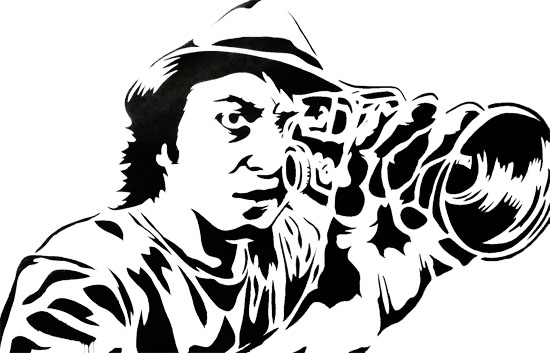
The day of the show the line to get in stretched for blocks. Four thousand people attended the opening. By the end of the day nearly a million dollars worth of Mr. Brainwash art had been sold.

The story, at face value, seems so preposterous that the question of whether it could truly be real has dogged the film, as well as created the suspense that’s made it even more of a phenomenon. Could an amateur who’d never actually made art himself succeed at pulling off a show that so blatantly counterfeited and so quickly eclipsed those of the art form’s recognized heavyweights? And would they really release a movie about it happening? Or is all of it — the movie, Life is Beautiful, Mr. Brainwash — simply Banksy’s greatest prank yet? Theories abound. The New York Times labeled it as a harbinger of a new cinematic subgenre: The Prankumentary. “The whole thing, it’s clear now,” Fast Company insisted, “Was an intricate prank being pulled on all of us by Banksy, who has never publicly revealed his identity, with Fairey as his accomplice.” Their conjecture about what really happened: “Banksy… convinced Guetta to pose as a budding graffiti artist wannabe so he and Fairey could ‘direct’ him in real life — manufacturing a brand new persona.” Yet when asked at the end of the film how he feels knowing that he is in part responsible for Mr. Brainwash, Shepard Fairey laughs ruefully, “I had the best intentions. But sometimes even when you have the best intentions things can go awry…. The phenomenon of Thierry becoming a street artist, and a lot of suckers buying into his show and him selling a lot of expensive art very quickly, anthropologically, sociologically, it’s a fascinating thing to observe. And maybe there’s some things to be learned from it.” For his part, Banksy, even as his voice is scrambled beyond recognition, conveys unmistakable melancholy as he says, “I used to encourage everyone I met to make art. I used to think that everyone should do it….. I don’t really do that so much anymore.”

This brutal and revealing account of what happens when fame, money and vandalism collide” could just be an L.A. story simply too bizarre to have been made up, and just as easily, it could all be a fabricated fable about what happens to an artistic movement when it becomes commercialized. From “selling out” to “cashing in” the concept is so mundane it’s a cliché, but Exit Through The Gift Shop‘s treatment is primarily to emphasize the absurdity of the progression of events rather than to make any concrete statement about them. As Banksy’s art dealer says at the end of the film, “I think the joke is on… I don’t know who the joke is on, really. I don’t even know if there is a joke.”

Which brings us back to Charlie Sheen. Not that what Sheen’s doing is any kind of joke or “prank.” This is all very much for real for him. And it is also a very deliberate performance. How did we get here? February 28, Charlie Sheen goes on Good Morning America, The Today Show, TMZ, Radar, Piers Morgan on CNN, 20/20 — basically, every celebrity interview news show he possibly can, and attracts a tsunami of flabbergasted attention for bein’ all ka-raaaazy. The next day he launches a social media empire.

Suddenly sounding not so crazy. Hell, as a digital strategist, I’d say it’s a pretty smart move. Within 25 hours and 17 minutes, Charlie Sheen had broken the world record for amassing 1 million Twitter followers faster than anyone else. Less than a week after his first tweet, he’d reached 2 million. “Another record shattered,” he tweeted, “We gobbled the soft target that was 2.0 mil, like a bag of troll-house zombie chow.” By then, he’d also launched a social media intern search:

which received over 74 THOUSAND! submissions in 5 days. Arguably no other celebrity has “gotten” the way social media works as fast. Even Conan had a slower uptake, though he’s undeniably provided a template for Sheen to work off of. (After getting canned from his TV job, Sheen did like MBW to Conan’s Banksy and announced he’s going on tour — the “Violent Torpedo of Truth/Defeat is Not An Option” Tour — just like Conan’s Banned From Television Tour last year in the wake of his own network debacle.) And, obviously, Sheen’s not doing it all on his own.

In Sheen’s 11-minute livestream episode, titled, “Torpedeos of Truth Part 2,” recorded on March 7th, 2011 — a week after his “old media” blitzkrieg — a terribly lit, grossly contrasted video in which a curmudgeonly, borderline belligerent Sheen looks like he might not have showered for days prior then rolled out of bed that morning, turned on his lap top, and started recording through the built-in camera above the screen, at 6 minutes, 40 seconds, when he ducks “below the frame line,” the camera moves. This is a recording made to look like it’s being done through a shitty built-in computer camera, but when it moves to follow Sheen as he ducks it’s suddenly clear there may be a camera person involved. If there is someone behind the camera, there could just as easily have been a lighting guy, a makeup person, but No! “Make me look as crazy as possible,” was clearly the direction here. By episode four it’d been announced that Sheen had officially been fired from his sitcom. The ante was upped. Suddenly Sheen, well-lit, made-up, looking as healthy as a marathoner — if not for the chain-smoking — in his sweat-wicking Nike shirt, was performing a soliloquy sounding like some misplaced Hunter S. Thompson diatribe. Clearly some writing talent may have been called in — if it hadn’t been already: consider that basically everything coming out of Charlie Sheen’s mouth becomes a meme — it’s been impossible to escape hearing someone say #winning (a hashtag in Charlie Sheen’s very first tweet) for weeks; then there’s #tigerblood, which is so meme-able it can’t even be summarized properly:


Tiger Blood Energy Potion
found in a hotel lobby at SXSW Interactive. Photo: Danny Newman
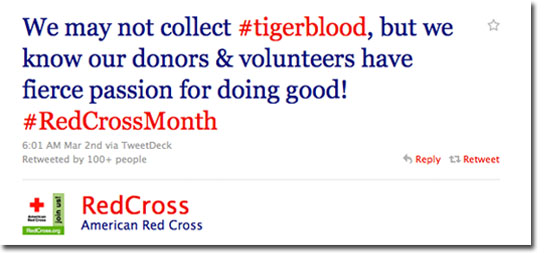
Right now 4Chan, the primordial ooze that has spawned everything from lolcats to Rickrolling to SadKeanu to every other Internet meme you’ve ever heard of, is looking at Charlie Sheen like Woh. The last guy anywhere near this unstoppably memetastic was the Old Spice Guy–
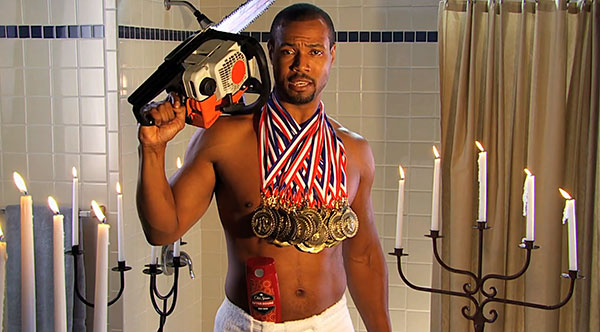
and that guy was created by an AD AGENCY!

Something else you might notice — Charlie Sheen almost never swears. You have never heard him bleeped in any of the interviews he’s done on TV. There are no R-rated words on his Twitter stream. Every so often there’s some sprinkled in his livestreams, but for the most part The Charlie Sheen Show is all-ages. Where he could say “assholes” or “douchebags,” he says “silly fools” or “trolls.” These Playskool insults are unexpected, amusing, almost benign, yet nostalgically cruel. This is not the syntax of a man out of control.

“Where do these words come from, Charlie,” 20/20’s Andrea Canning asked.

“I don’t know,” he rolled his eyes, “They’re just words that sound cool together. Stuff just comes out and it’s entertaining and it’s fun and it sounds different from all the other garbage people are spewing, you know?”

Charlie Sheen doesn’t have Tourettes. He is deliberately saying these things to entertain and be funny and unique. And he’s good at it. Bret Easton Ellis — the author of Less Than Zero and American Psycho, as well as Lunar Park, a haunted house story in which the main character is a writer named Bret Easton Ellis who’s lived the same history as his eponymous creator (“It was always the A booth. It was always the front seat of the roller coaster. It was never ‘Let’s not get the bottle of Cristal’ … It was the beginning of a time when it was almost as if the novel itself didn’t matter anymore — publishing a shiny booklike object was simply an excuse for parties and glamour.”) or is it, rather, the life he was expected to have been leading? (“What was I doing hanging out with gangbangers and diamond smugglers? What was I doing buying kilos? My apartment reeked of marijuana and freebase. One afternoon I woke up and realized I didn’t know how anything worked anymore. Which button turned the espresso machine on? Who was paying my mortgage? Where did the stars come from? After a while you learn that everything stops.“) — writing in an article titled, “Notes on Charlie Sheen and the End of Empire,” calls Sheen, “the most fascinating person wandering through the culture:”

You’re completely missing the point if you think the Charlie Sheen moment is really a story about drugs. Yeah, they play a part, but they aren’t at the core of what’s happening—or why this particular Sheen moment is so fascinating…. This privileged child of the media’s sprawling entertainment Empire has now become its most gifted ridiculer. Sheen has embraced post-Empire, making his bid to explain to all of us what celebrity now means. Whether you like it or not is beside the point. It’s where we are, babe. We’re learning something. Rock and roll. Deal with it.

Post-Empire isn’t just about admitting doing “illicit” things publicly and coming clean—it’s a (for now) radical attitude that says the Empire lie doesn’t exist anymore, you friggin’ Empire trolls. For my younger friends, it’s no longer rare; it’s now the norm. To Empire gatekeepers, Charlie Sheen seems dangerous and in need of help because he’s destroying (and confirming) illusions about the nature of celebrity.

It’s thrilling watching someone call out the solemnity of the celebrity interview, and Sheen is loudly calling it out as the sham it is. He’s raw and lucid and intense…. We’re not used to these kinds of interviews. It’s coming off almost as performance art and we’ve never seen anything like it—because he’s not apologizing. It’s an irresistible spectacle. We’ve never seen a celebrity more nakedly revealing.

It’s the contradiction we could never quite reconcile in I’m Still Here or Exit Through The Gift Shop; one we can accept in Lady Gaga because she’s not using her real name and we’re sort of OK with it when it’s just a “character.” Charlie Sheen is real and not real at once: a spectacle and a revelation. It’s meta-postmodernism. It’s existential performance art. Minutes before Charlie Sheen’s first livestream was set to start, the audio feed came on. You could hear Sheen rehearsing the rant he would perform that night, prompting the question: is this all an act? Of course it is! He’s an acTOR. From a family of actors, who’s spent his entire life performing. There’s no way he’d go on camera ever without rehearsing. Charlie Sheen’s whole life has been a performance, and this now is not so much different, just with a bigger audience and, as we say in the 21st century music business, cutting out the middleman. As far as Charlie Sheen knows, this is what real is. And as far a we know that’s what it is, too.

Ellis writes:

If you can’t accept the fact that we’re at the height of an exhibitionistic display culture and that you’re going to be blindsided by TMZ (and humiliated by Harvey Levin, or Chelsea Handler—princess of post-Empire) while stumbling out of a club on Sunset Boulevard at 2 in the morning, then you should be a travel agent instead of a movie star. Being publicly mocked is part of the game, and you’re a fool if you don’t play along. This is why Sheen seems saner and funnier than any other celebrity right now. He also makes better jokes about his situation than most worried editorialists or late-night comedians.

What does shame mean anymore? my friends in their 20s ask. Why in the hell did your boyfriend post a song called “Suck My Ballz” on Facebook last night? my mom asks. But nothing yet compares to the transparency that Sheen has unleashed in the past two weeks—contempt about celebrity, his profession, the old Empire world order.

Ellis’s “Empire” is a reference to Gore Vidal’s definition of global American hegemony, which Ellis dates from 1945 until 2005: the era that defined the 20th century. Post-Empire is where we are now. For Ellis, Empire is the lie, the having to hide who you really are, the keeping up appearances; post-Empire, on the other hand, is what Ellis calls, “aggressive transparency.” But his perspective has one flaw: for Ellis, both Empire and post-Empire are binary. It’s one or the other. It’s true or it’s a lie; it’s real or its counterfeit. The post-Empire reality, however, is not the end of the lie, it’s the end of the binary. Sure, “radical transparency” has become a 21st century marketing buzzword. Sure, Mark Zuckerberg believes that Privacy is Dead and has remade Facebook in that image. Sure, I wrote last year, what makes Iron Man the first 21st century superhero? His lack of alter ego; his unconflicted, absolute identity. But that all is only part of the Millennial story.

Social media researcher danah boyd writes:

There’s an assumption that teens don’t care about privacy but this is completely inaccurate. Teens care deeply about privacy, but their conceptualization of what this means may not make sense in a setting where privacy settings are a binary. What teens care about is the ability to control information as it flows and to have the information necessary to adjust to a situation when information flows too far or in unexpected ways.

Just because teens choose to share some content widely does not mean that they wish all content could be universally accessible. What they want is a sense of control.

I’d argue this is, in fact, true of all of us now in the post-Empire. Not just teens. “What Sheen has exemplified and has clarified,” writes Ellis, “Is the moment in the culture when not caring what the public thinks about you or your personal life is what matters most—and what makes the public love you even more (if not exactly CBS or the creator of the show that has made you so wealthy).” Except that Charlie Sheen still very much DOES care. And so do all the rest of us in the 21st century. It’s there in every Facebook photo you’ve untagged yourself from. You had your reasons. It’s there in every location you pulled out your phone to check in at, and then decided not to. It’s there every time you hovered over, and then didn’t click the “Like” button. As tech blogger, Robert Scoble, writes:

The other day I found myself over at Yelp.com clicking “like” on a bunch of Half Moon Bay restaurants. After a while I noticed that I was only clicking “like” on restaurants that were cool, hip, high end, or had extraordinary experiences.

That’s cool. I’m sure you’re doing the same thing.

But then I started noticing that…. What I was presenting to you wasn’t reality.

See, I like McDonalds and Subway. But I wasn’t clicking like on those. Why not?

Because we want to present ourselves to other people the way we would like to have other people perceive us as.

I’d rather be seen as someone who eats salad at Pasta Moon than someone who eats a Big Mac at McDonalds.

This is the problem with likes and other explicit sharing systems. We lie and we lie our asses off.

Not only do we still care what other people think about us, we now curate it more obsessively. Trent Reznor calls it “A hyper-real version of yourself.”

This is the hyper-real version of Charlie Sheen. It is a role that Charlie Sheen is performing. And it is also who he actually is. Because how could he not be? Whatever Charlie Sheen does, that is who he is. This is the only way he has to take control over the flow of his information. For a celebrity in particular, as Ellis points out, that control is virtually non-existent. So how did Charlie Sheen wrest it back? By outdoing TMZ and the news shows and the magazines at their own game. He is no longer just a commodity of the tabloid industrial complex. He is the creator and star of his own show, the Crazy Charlie Sheen Show, and all the press is simply promotion.

Then again, it could be something much more simple. At Coachella 2008, Prince, headlining, kept demanding over and over, “Say my name, Coachella! Say my name, Coachella! Say my name, Coachella!” And like some epic call-and-response an ocean of 150,000 voices roared back: “Prince! Prince! Prince!” And I realized that if you’re Prince, there’s probably no way you can even get off anymore without 150,000 people screaming your name. Perhaps, if you’re Charlie Sheen, you can’t stay sober unless two million people are following your every move — just over two weeks after his first Tweet, it’s now closing in on 3 million.

“We’ve come a long way in the last two weeks,” Ellis concludes. “Sheen is the new reality, bitch, and anyone who’s a hater can go back and hang out with the rest of the trolls in the graveyard of Empire.” Like I’m Still Here and Exit Through The Gift Shop, what Charlie Sheen is doing is part of a continuum exposing the now inherent unreliability of the markers we’d previously depended on to tell the difference between what’s real and what isn’t. In some ways it’s as basic as the shift from the 20th century to the 21st; from analog to digital, from binary to exponential complexity. What, truly, does reality mean when it’s photoshopable? Or just another marketing campaign for some new movie? Not that reality doesn’t exist. Things are, out in the world; you can touch them. Earthquakes happen; nuclear reactors break; nations perch perilously on the verge of catastrophe. Reality exists, but it is no different from not reality. From the inscrutably contradictory government statements about radiation levels, from the fake Nuclear Fallout maps that spread like wildfire. Reality and not reality exist in the same plane now. It’s enough to make you go crazy. Unless you’re Charlie Sheen. In which case you’re not crazy. You simply are as your world is.

.


Subscribe for more like this.


Sex, Drugs, & The Internet – Inspired By A True Story

background

You know those movies about characters trail-blazing the business of some terrible vice? They’re always set in a not-too-distant past, have trailers full of period-specific songs, and include the words “inspired by a true story” on the poster. There’s the initial meteoric rise to power and wealth, followed by a period of unbridled excess — generally involving use of montage — and, ultimately, the inevitable downfall which was doomed to happen from the start, with, possibly, an epilogue of redemption. It’s a very specific film archetype, wherein the traditional bad guy is, instead, the quintessential American hero: the visionary entrepreneur who possesses the ingenuity and tenacity and just plain balls to seize an opportunity only he can see, and achieve a feat so stupendous — inventing the American cocaine trade, for instance, becoming the first black man to rise above the Italian mafia in the New York heroin business — you’re at once inspired and horrified by his success.

In 2001, Blow kicked off this trend of movies where you’re rooting for the drug dealer. The movie’s based on the life of George Jung, played by Johnny Depp, a Boston guy living in California, who starts off smuggling pot cross-country in the 60’s, and ends up becoming the American connection to Pablo Escobar’s Medellín Cartel, which, with Jung’s help, would go on to own 85% share of the U.S. cocaine market by the late 70’s / early 80’s:

.
Then came 2005’s Lord of War, in which the illicit contraband is weaponry, and Nicolas Cage plays Ukranian-American gun trafficker, Yuri Orlov — a fictional character based on a composite of a number of actual post-soviet arms dealers — whose big break comes as he watches Mikhail Gorbachev give his resignation speech on television, Christmas Day 1991. Like a prospector who’s just struck oil (See also: There Will Be Blood, for a variation on this cinematic theme), he envisions, in this moment, the future of his business expanding with the gush of weapons — even tanks! — he’ll now be able to buy (illegally) from the just-dissolved Soviet Union’s stockpile in the Ukraine:

.
2005 was also the year Weeds premiered on Showtime, in which Mary-Louise Parker plays a widowed housewife who becomes a suburban pot dealer, and a few seasons later ends up married to the head of a Mexican drug cartel.

By 2008, when American Gangster came out — which tells the story of Frank Lucas, played by Denzel Washington, who bypassed the entire Italian mafia to become the heroin king-pin of New York in the early 70’s by establishing his own direct supply connection in Asia during the Vietnam war and smuggling the drugs into the U.S. in the coffins of dead U.S. soldiers — rooting for the vice-peddling, psychotically enterprising, imminently doomed outlaw businessman — even though, good god! he’s a fucking heroin drug lord turning all of Harlem into addicted zombies!! — had become a familiar experience:

.
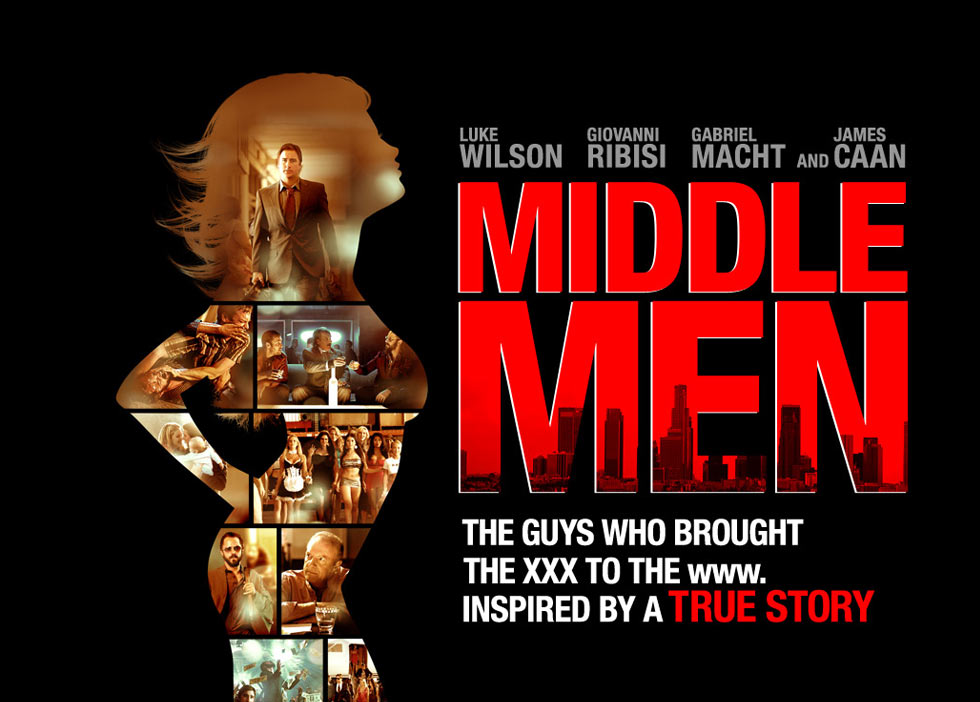
Which is how we arrive at Middle Men, due out later this year, a based-on-reality story in which Luke Wilson plays Jack Harris, a mainstream businessman who partners with a pair of porn content providers (played by Gabriel Macht and Giovanni Ribisi) to form the first online adult billing company in the mid 1990’s:

.

The drug dealer used to ALWAYS be the bad guy. You weren’t supposed to sympathize with him. Now it’s every fuckin’ movie like this. But the story isn’t just about the clever bastard with an idea for a supply to human nature’s demand, it’s about the vice itself. It’s not just George Jung’s story, it’s the history of blow we’re fascinated by — how a chance cell-mate pairing between a California pot smuggler and a member of the Medellín cartel would pave the way for the U.S. cocaine highway. How the Vietnam war became the camouflage for the heroin epidemic Frank Lucas created. How the Soviet Union’s collapse helped the business of illegal arms dealers. Each of these stories has this moment where entrepreneur and zeitgeist collide, and — for better or worse; mostly for worse — it changes the world. In Middle Men the focus of the story could have easily been the porn industry — but it isn’t. Porn is just the side effect. Like the preview voice-over announcer says, it’s the story of the worldwide web.

Finally.

It’s 2010. 20 years since the first web browser, 15 years since the first adult materials became commercially available online, 10 years since the dot com bubble burst, 5 years since MySpace was getting more page-views than Google, a year since Facebook overtook MySpace in unique visitors, and meanwhile, Americans now spend, on average, about as much time on the Internet as watching TV. In fact, if you’re under the age of 45, you spend considerably more time on the Internet than watching TV. Amid a global financial crisis, US online retail managed to grow 11% in 2009 to reach $155.2 billion. Overall online sales are projected to increase almost 200% between 2008 and 2012. 75% of us use social network sites. And the time we spend there is growing at 3 times the overall Internet rate, accounting for 10% of all Internet time — every second of which, by the way, 28,258 internet users are viewing porn.

Hollywood is finally catching on. Up next after Middle Men is the film adaptation of Ben Mezrich’s 2009 book, The Accidental Billionaires: The Founding Of Facebook, A Tale of Sex, Money, Genius, and Betrayal. It comes out just a couple of weeks after Wall Street 2:

article_image-image-article

Here’s an excerpt from the book:

What neither he nor Mark [Zuckerberg, Facebook founder] had known when they started the damn thing was how addictive Facebook was. You didn’t just visit the site once. You vsited it every day. You came back gain and again, adding to your site, your profile, changing your pictures, your interestes, and most of all, updating your friends.

… Most kids who tried out [Facebook] once tended to come back  — 67 percent every day.

The Internet: It might not be illegal, but it’s unquestionably addictive.

Once considered the province of geeks, the Internet is now where all of us live. It is a huge, enormous thing that is changing how we do practically everything and permeating the very experience of our lives. It is now all of our’s vice. And it’s breeding a whole new generation of vice entrepreneurs. Drug dealers and gunrunners have new company.

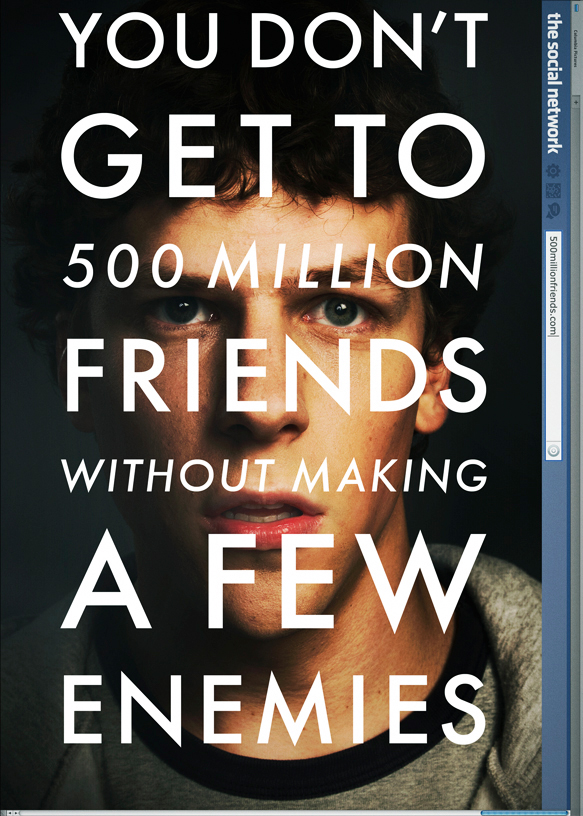
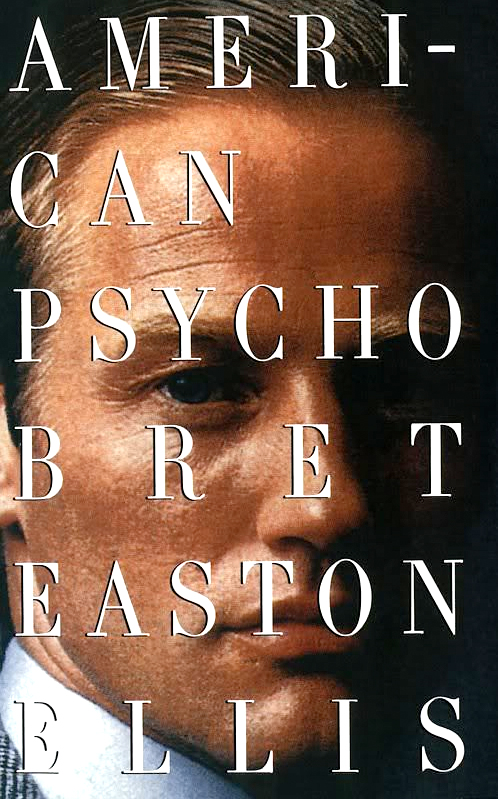
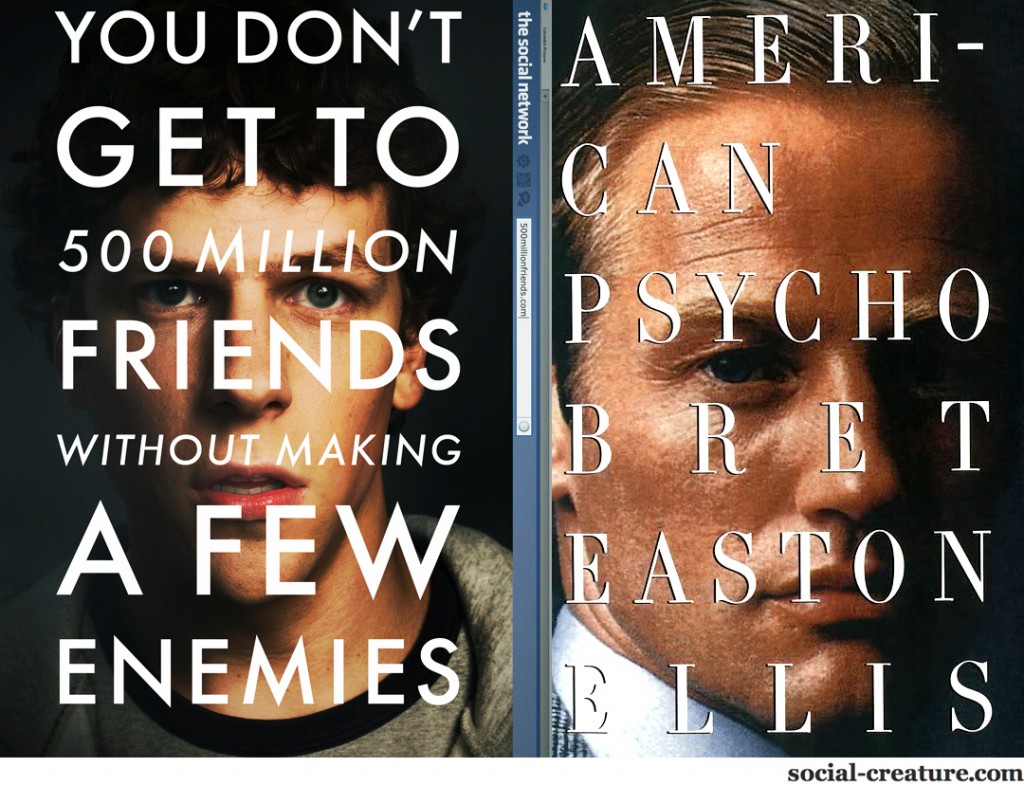
In related news, is it just me or does the new poster for The Social Network seem, like, awfully familiar?

http://social-creature.com/wp-content/uploads/2010/06/socialnetwork.jpg

.

http://social-creature.com/wp-content/uploads/2010/06/americapsycho.jpg

.

Just sayin’.

socialnetwork-americanpsycho


Subscribe for more like this.


Why Iron Man Is The First 21st Century Superhero

iron-man-downey-jr

In 1938, on the eve of the Second World War, a relatively new medium called the comic book unleashed a new kind of character into the consciousness of American youth. Created by writer Jerry Siegel and illustrator Joe Shuster, this character possessed superhuman powers and a dedication to using those powers for the benefit of humanity. Often battling and defeating evil as hyperbolic as his own goodness, his iconic name would become the source of the term for this all-American archetype, the “superhero.” In the decades since Superman‘s arrival, innumerable variations on this theme have emerged, but always these characters have struggled under the weight of a concept about who they must be that was invented before television. For the past 70 years we have been living with a 20th century version of the superhero. Until now. Though the Iron Man character was originally created in the early 60s, his most recent incarnation, as played by Robert Downey Jr., and directed by Jon Favreau in the just released Iron Man 2, is really the first Millennial superhero.

The original Superman prototype possessed a key characteristic, one that his creators, first generation American sons of Eastern European Jewish immigrants, would have known something about, one that this “Man of Tomorrow” would pass on as part of his legacy to future generations of masked heroes: a secret identity. This trait would become an intractable part of the very definition of a superhero, as much a prerequisite for his mythology as extraordinary powers, or at least a flamboyant getup. And yet, in a press conference at the end of 2008’s first installment of the Iron Man franchise, Tony Stark announces to the world that he is Iron Man. This is where the sequel starts off. The need for a secret identity is gone. The entire world knows — and not because some tabloid uncovered the mystery man behind the mask, but because he just straight up told everyone. In the comic books, it took Stark 40 years to make this move. For Superman or Spiderman or Batman or virtually any other superhero from the prior century (save some like the X-Men) their secret identities were their most sacred possessions, the keys to their undoings, and they fought as hard to protect them as to save humanity itself. But in the 21st century, Tony Stark’s approach to privacy reflects how Millennials now think of the concept.

These days, the kind of stuff kids choose to reveal about themselves online is almost beyond comprehension. The latest social platform eroding the boundary between what was once strictly private and is now exposed to the world is Formspring.me, which the New York Times calls, “the online version of the bathroom wall in school“:

While Formspring is still under the radar of many parents and guidance counselors, over the last two months it has become an obsession for thousands of teenagers nationwide, a place to trade comments and questions like: Are you still friends with julia? Why wasn’t sam invited to lauren’s party? You’re not as hot as u think u are. Do you wear a d cup? You talk too much. You look stupid when you laugh.

Comments and questions go into a private mailbox, where the user can ignore, delete or answer them. Only the answered ones are posted publicly — leading parents and guidance counselors to wonder why so many young people make public so many nasty comments about their looks, friends and sexual habits.

Social media researcher danah boyd asked a similar question a couple of weeks ago:

This [behavior] has become so pervasive on Formspring so as to define what participation there means.  More startlingly, teens are answering self-humiliating questions and posting their answers to a publicly visible page that is commonly associated with their real name. Why? What’s going on?

While this particular trend is definitely a bit baffling, those of us that have grown up in the digital age have pretty much come to expect that the privacy arc of the internet is perpetually bending more and more towards greater disclosure. Privacy, as Facebook’s Millennial founder Mark Zuckerberg insists, is dead:

People have really gotten comfortable not only sharing more information and different kinds, but more openly and with more people. That social norm is just something that has evolved over time… But we viewed that as a really important thing, to always keep a beginner’s mind and what would we do if we were starting [Facebook] now and we decided that these would be the social norms now and we just went for it.

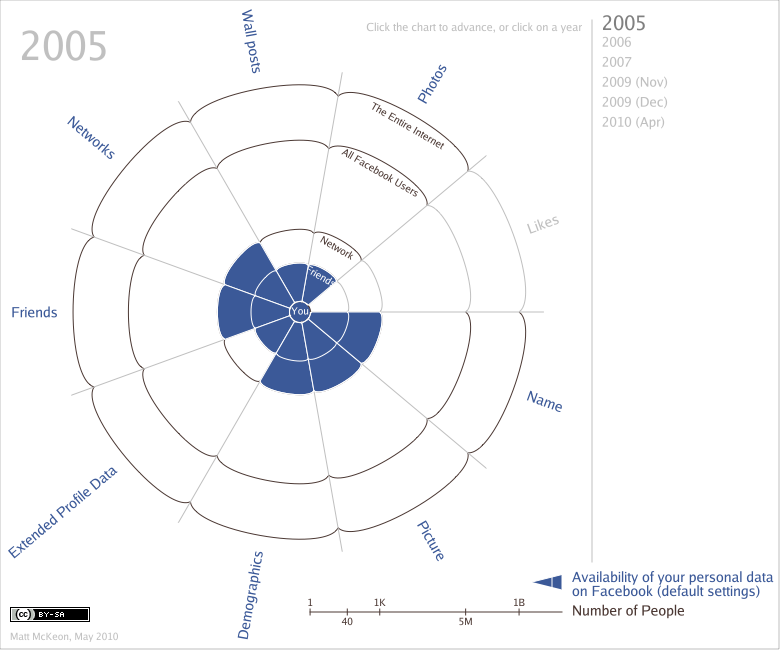
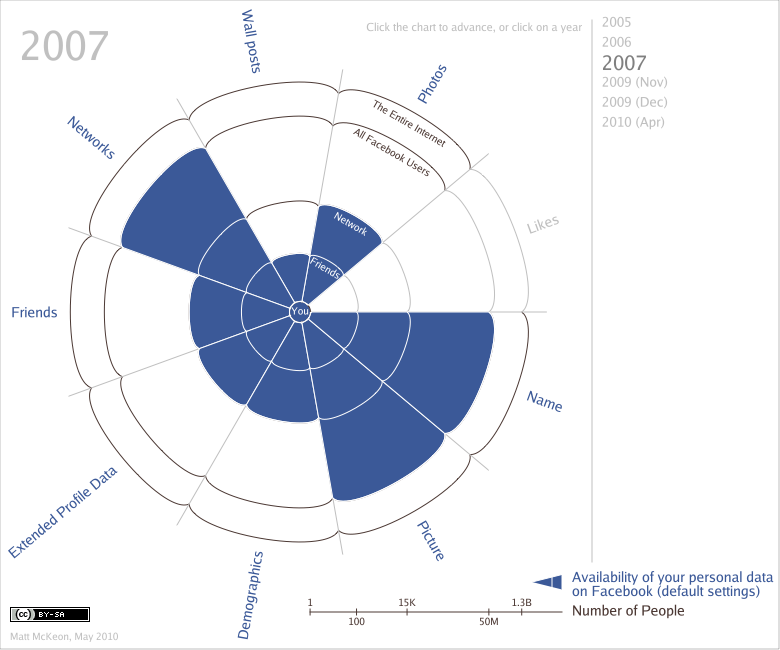
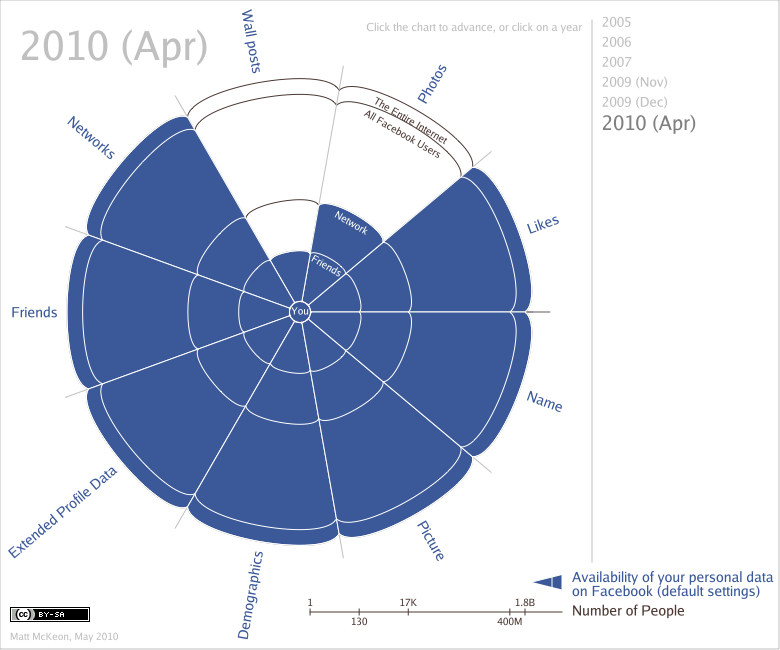
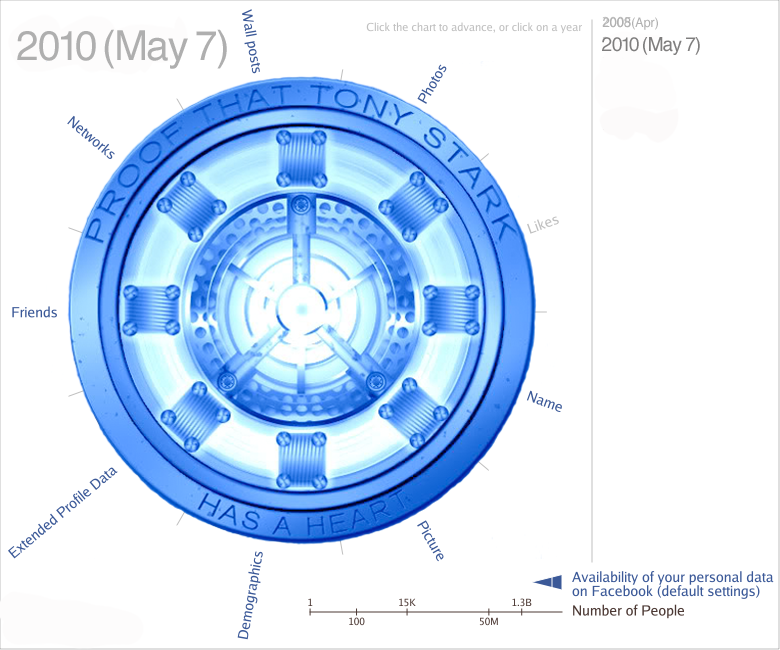
Here’s an interesting visualization of the Evolution of Privacy on Facebook, indicating how the website has let ever more of our information become increasingly public over the years:

bf05

fb07

fb10

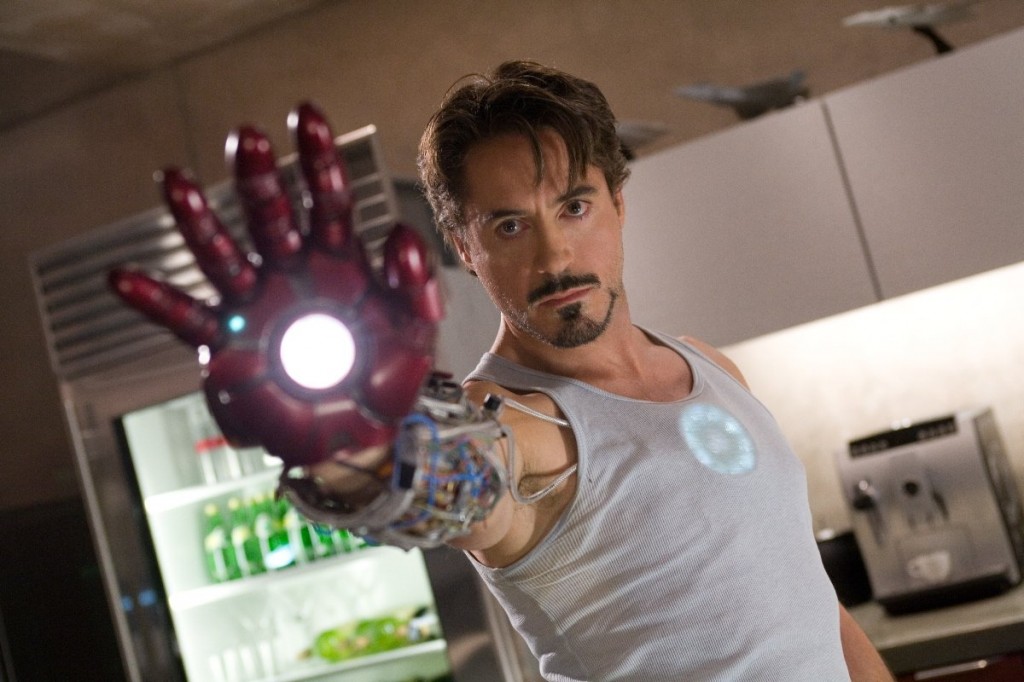
starkarc

Oh… wait a second, no, that last one is actually the arc reactor implant that’s keeping Tony Stark alive. But, no doubt, Skynet… err.. Facebook is intent on catching up to the full-pie version of the chart soon.

Anyway, Bruce Wayne, Clark Kent, Peter Parker, they were never prepared for this brave new networked world. Their entire way of being simply doesn’t fit anymore. Neither with Facebook and its social network platform ilk, nor the (*cough* relative) sensibilities of the Millennial youth who use it. For Tony Stark, transparency isn’t just relegated to the subject of his super-powered “alter ego,” it’s a pervasive part of his total personality, his way of being in the world. Stark is as blatant as his id, his mobile touch-screen device is actually, literally, transparent, allowing others to see everything he’s doing on it, every surface in his house seems to be equipped with touch-screen capabilities, his browsing activities public to anyone sitting nearby who cares to look. Zuckerberg himself likely couldn’t have dreamed up a more post-Privacy kind of superhero, one less conflicted about the disparate parts of his identity. With the death of privacy, you cannot be one thing in one context, and something different in another. You cannot be Clark Kent at the Daily Planet desk job, and then Superman on the night shift. You are exactly who you are to everyone at all times. Like no other superhero, Tony Stark’s identity isn’t conflicted. It’s absolute.

In her book Generation Me: Why Today’s Young Americans Are More Confident, Assertive, Entitled–and More Miserable Than Ever Before, psychology professor Jean Twenge writes:

It has always been normal for kids to have big dreams, but the dreams of kids today are bigger than ever. By the time kids figure out they’re not going to be celebrities or sports figures, they’re well into adolescence, or even their twenties.

High expectations can be the stuff of inspiration, but more often they set GenMe up for bitter disappointment. [The book] Quarterlife Crisis concludes that twenty-somethings often take a while to realize that the “be whatever you want to be, do whatever you want to do,” mantra of their childhoods is not attainable.

In the late 90’s, Tyler Durden, himself a sort of Gen X superhero — a transitional alpha version precursor to the Gen Y launch model, if you will — said it like:

We have no Great War. No Great Depression. Our Great War’s a spiritual war… our Great Depression is our lives. We’ve all been raised on television to believe that one day we’d all be millionaires, and movie gods, and rock stars. But we won’t. And we’re slowly learning that fact. And we’re very, very pissed off.”

Even in the throes of the economic crisis, my generation hasn’t really had a Great Depression either — though we did come this close. And even after 9/11 my generation hasn’t had a Great War. The world is now far too mind-numbingly complicated and complex to even have a clear concept of a single, monolithic Evil to fight. The “heroes” of my generation, the ideals that kids look up to and wish to be like, haven’t been men of steel battling evil for a long time, they are now, like Durden says, millionaires and rock stars. And that is precisely what 21st Century Tony Stark is. After he comes out of the closet (or, more accurately, the basement science lab) as Iron Man, he becomes a worldwide celebrity, a household name. Even the migrant worker he stops to buy strawberries from on the Pacific Coast Highway asks, “Are you Iron Man?” like he’s recognized a movie star.

And unlike Superman or SpiderMan or Batman or any other major superhero before him whose truth the world was not yet ready to handle, Tony Stark answers casually, “Sometimes.”

Perhaps that’s the other side of what allows a 21st century superhero to be transparent. The modern world can accept him as such. Gen Y is a lot more tolerant of lifestyle differences than prior generations, after all. The X-Men didn’t hide that they were different, either, but then again, they COULDN’T hide it — looking like Beast or Nightcrawler, or having Rogue or Cycolps’ particular mutations, you couldn’t just “pass” in normal society — and the humans the X-Men fought to protect could never accept them for being what they are. Not so in the world of Tony Stark. He’s no mutant. No outcast. He’s the most popular kid in school. The late DJ AM even spins at his birthday bash. The 21st century Tony Stark reveals to the world he is Iron Man, and the 21st century world says…. Awesome!

In the past, being a tech entrepreneur-slash-engineer, as Tony Stark is, would have made him a nerd, or otherwise Bruce Wayne, still stuck in the previous millennium, putting on a show of  irresponsible playboy-ness to deflect attention from both his morbidly serious crime-fighting alter ego and his humorless tech geek underbelly. Like, remember when no one would have wanted to sit at the lunch table with kids who talked about stuff like “augmented reality”?

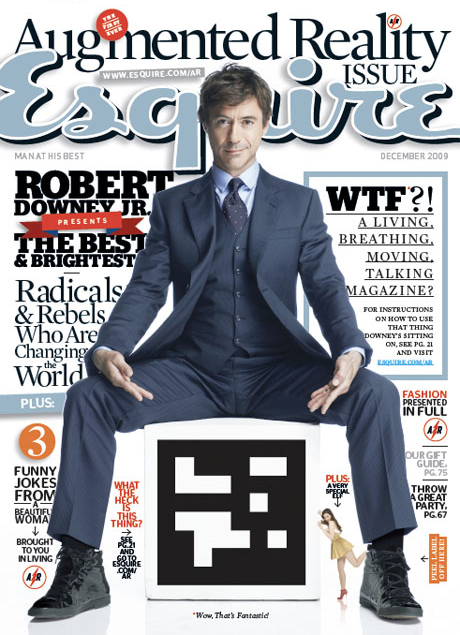
esquire-augmented-reality-cover-robert-downey-1209-lg

Yeah, not so much, anymore. In the  21st century, being a tech geek no longer detracts from the image of a bad-ass or a dilettante. James Bond and Q have combined into one seamless character. It’s 2010, and geeks are cool! Hell, we’ve even got one as President.

While both Wayne and Stark are surrounded by high tech everything, for the 20th century hero all the gadgetry is just a means to an end. Even the Batmobile is ultimately just a flashy tool. Same could technically be said about the iPhone, but who would? In the post-iPod era we have a very different relationship with our technology. Our favorite tech objects aren’t just for utilitarian application, they’re obsessed over, fetishized, loved. It’s why Gizmodo would pay $10,000 for an exclusive scoop on an in-production, “lost” 4g iPhone, and why an enormous global audience would give a crap. When Stark says in the movie that the Iron Man suit is a part of him, that he and it are one, we all intimately understand exactly what he means even if the rest of us don’t actually literally plug our gadgets into our chest cavities.

After a raucous birthday party in which we see Stark, in full Iron Man gear, getting shitfaced and acting the fool, (he’s dying at the time, and feeling a bit of the nothing-really-matters mortality blues — being dissolute and apathetic, itself, unusually postmodern behavior for a superhero), S.H.I.E.L.D. agency director Nick Fury (played by Samuel L. Jackson) “grounds” the hungover superhero by sequestering him in his house with all access to communication with the outside world cut off until he solves a theoretical physics problem. This superhero’s punishment is having his phone and internet privileges revoked and being sent up to his room to finish his math homework. There isn’t a single one of the 60 million American Millennials that doesn’t relate to this.

When Favreau was looking for a 21st century industrialist corporate executive to use as a model for his and Robert Downey Jr’s interpretation of Tony Stark, he sought out Elon Musk, co-founder of paypal. Musk even has a cameo in the movie, chatting Tony up about an electric rocket, a concept referencing Musk’s current endeavors, Tesla Motors, which produces fully electric sports cars that rival Porsche in performance, and SpaceX, a private aerospace company working to invent the first reusable rockets, which would dramatically reduce costs and eventually lead to affordable space-travel. This dude is the inspiration for the 21st century version of Stark.

So what’s Tony Stak’s inspiration? Why does he do what he does? There was no childhood trauma that drove him to caped crusading. He wasn’t raised by adoptive Earth parents who imbued him with a strong moral compass during his formative years on a farm in the American Heartland. Sure, ok, he underwent a certain crisis of conscience in his 40s after escaping from a terrorist hostage situation in Afghanistan, shutting down the weapons manufacturing division of Stark Industries and all, but still, why does he take it so much further, going so far as to “privatize world peace.” …. For the thrill of it! As he himself says, he keeps up the good fight at his own pleasure, adding, “and I like to pleasure myself often.” Unlike the prior century’s superhero, this new version saves the world not out of any overwhelming sense of obligation or indentured servitude to duty, but because he can do what he wants, when he wants, because he wants to, and most importantly, he GETS what he wants. Sure he has to work for it, but unlike with, say, Peter Parker and Mary Jane or Clark Kent and Lois Lane or even Buffy and Angel, what he wants isn’t perpetually out of his grasp just because he is who he is. Being Iron Man isn’t a burden, it’s an epic thrill-ride.

The first 21st century superhero is a hedonistic, narcissistic, even nihilistic, adrenaline junkie, billionaire entrepreneur do-gooder. If Peter Parker’s life lesson is that “with great power comes great responsibility,” Tony Stark’s is that with great power comes a shit-ton of fun.

You can’t get any more Gen Y than that.

Welcome, 21st Century superhero, my generation has been waiting for you.


Subscribe for more like this.


The Right to Empathy

Oh boy.

This is not typically the kind of stuff I write about here, but it is something I feel quite strongly about, and, if nothing else, it makes for a case study in cross-cultural communication — not to mention some interesting neuroscience.

Last week, as the New York Times reported, French President Nicolas Sarkozy addressed the Parliament at Versailles with a withering critique of the burqa as an unacceptable symbol of “enslavement.”

“The issue of the burqa is not a religious issue. It is a question of freedom and of women’s dignity,” Mr. Sarkozy said. “The burqa is not a religious sign. It is a sign of the subjugation, of the submission, of women…. I want to say solemnly that it will not be welcome on our territory.”

Now, I got the link to this article from my cousin, who, it should be pointed out, shares the same history I do. We were not born in the United States, and growing up as first-generation immigrants in America we have spent our whole lives reconciling mixed, often contradictory, cultures. The fact that our families were able to leave the giant labor camp / prison that was the Soviet Union at all, is the result of one of the most successful human rights campaigns in history. So it’s no surprise that our reactions to the news of this French move were resoundingly positive. It was, however, quite surprising (though it retrospect, it shouldn’t have been) to discover many of my American-born friends expressing outright disapproval. I heard everything from straight up calling Sarkozy a “moron,” to the derisive cynicism that “Nothing says freedom like banning the burqa.”

I should hasten to point out here, it’s not that my American-born (liberal) friends are burqa-lovers, by any means, it’s just that freedom of religious expression is a sacrosanct American principle — as well it should be — and messing with it immediately inspires a profound distaste. It would, no doubt, be easier to have the issue of religious expressions be capable of being so black and white, so absolute, so all or nothing. It would certainly be much simpler, clearer, less offensive or culturally insensitive, if the idea that banning anything could actually bolster freedom wasn’t so contradictory. The reality, however, is that pretty much all freedom depends on the banning of something, and that something is the myriad efforts to deny human rights.

Which is precisely the spectrum that the burqa finds itself on. To clear up any confusion — since, in the predisposition for pursuing starkly-defined edges between black and white, it might seem effective to assume I’m just roundly including ALL kinds of modesty coverings, like headscarves, for instance, in this indictment, I’d like to state that I’m definitely not. A headscarf isn’t anywhere in the same vicinity as this:

File:Woman walking in Afghanistan.jpg

The burqa is a full-body ghost-like sheet that covers a woman from head to toe, which Sarkozy, in no way inaccurately, likened to an “imprisonment.” The International Society For Human Rights seems to have drawn the very same analogy in the PSA at the top of this post. There is a good deal that has already been said about the legitimate impediments to health and physical safety that come along with these trappings (apt word, indeed, in this instance), but what makes the burqa an outright violation of human rights in my view is the fact that when a group of people is denied the freedom simply have their face be visible, they are deprived of the most fundamental, basic, human capacity to elicit empathy.

In his book, Social Intelligence: The New Science of Human Relationships, Daniel Goleman writes, “Suppressing our natural inclination to feel with another allows us to treat the other as an It…. Empathy is the prime inhibitor of human cruelty.”

Conveniently for us, then, human brains are actually hard-wired for empathy. In fact, damage or malfunction in the neural systems instrumental in allowing us to understand and resonate with someone else’s emotional state happens to be a basic requirement for psychopathic behavior. Clinical psychopaths are actually incapable of reading emotions; their brains simply do not register the meaning of expressions of fear or anguish, for example. Normal, healthy, functioning brains not only understand others’ emotions, they are actually designed in such a way as to induce the witness to internally experience the same emotional state that he or she is witnessing.

For instance, take a look at this face for, like, two-hundredth of a second:

http://newsimg.bbc.co.uk/media/images/44173000/jpg/_44173138_fearmale.jpg

As you do, Goleman explains:

The amygdala instantly reacts, and the stronger the emotion displayed, the more intense the amygdala’s reaction. When people looked at such pictures while undergoing an fMRI, their own brains looked like they were the frightened ones, though in a more muted range.

When two people interact face to face, [emotional] contagion spreads via multiple neural circuits operating in parallel within each other’s brains. These systems for emotional contagion traffic in the entire range of feeling, from sadness to joy.

Moments of [emotional] contagion represent a remarkable event: the formation between two brains of a functional link, a feedback loop that crosses the skin-and-skull barrier between bodies. In systems terms, during this linkup brains “couple,” with the output of one becoming the input to drive the workings of the other, forming what amounts to an interbrain circuit.

Brains loop outside of our awareness, with no special attention or intention demanded. [This] automaticity allows for rapidity. For instance, the amygdala spots signs of fear in someone’s face with remarkable speed, picking it up in a glimpse as quick as 22 milliseconds, and in some people in a mere 17 milliseconds (less than two-hundredth of a second). This [happens] so fast that the conscious mind remains oblivious to that perception.

We may not consciously realize how we are syncrhonizing, yet we mesh with remarkable ease.

Giacomo Rizzolatti, the Italian neuroscientist who discovered mirror neurons, the special class of neurons responsible for this kind of social duet, explains that our innate capacity for empathy allows us “to grasp the minds of others not through conceptual reasoning but through direct simulation; by feeling, not thinking.”

If you really stop to consider the significance of this, it’s pretty astounding. Our capacity to communicate through emotions happens entirely outside the realm of conceptual communication i.e. words. We don’t even need to speak the same language, or be able to TALK at all, for that matter, in order to simply look at someone’s face and personally understand what that person is feeling. As Goleman writes, “Mirror neurons ensure that the moment someone sees an emotion expressed on your face, they will at once sense that same feeling within themselves.” Through seeing another person’s face we experience, as instantly as a reflex, a mutually reverberating state that neuroscientists call “empathic resonance.” And empathy, I’ll write it again: is the prime inhibitor of human cruelty.

Sarkozy talked about the burqa as a tool for “depriv[ing women] of identity.” I see it as something more profoundly sinister. It deprives them not just of individual identity, but of shared Humanity. Our fundamental, human neurobiology depends on others to be able to see our face in order to elicit empathy. It is not the only way, of course, and it’s obviously not tamper-resistant, but it is the most instinctive, moreso even than language. Making someone hide their face is, literally, the oldest trick in the book for denying them empathy. When you can’t empathize, as any psychopath case study will show, you quite literally can’t recognize the other person’s Humanity. When you can’t recognize another person’s Humanity, it becomes a lot easier to be cruel. And when an entire population (oh, say, you know, women) is systematically denied their Humanity, their widespread oppression is inevitable. Thus whether or not your cultural sensitivity allows you to consider the burqa a means of oppression unto itself, it is absolutely part of the cycle that breeds it.

Human rights and religious freedom don’t always go hand in hand as neatly as we would like. Perhaps we might all live in a much better world if the two would just coordinate their priorities, but all too often religion seems to like endorsing things like female genital mutilation or child brides (notice a trend here on whom religion likes to shit on?) When the two don’t go hand in hand, the question that comes up for each of us is, how will we navigate the ensuing grayness? From my own experience, as a beneficiary of people around the world having fought against the oppression of others, there is nothing “moronic” or cynical about standing up for those who are being denied a basic human right, especially when it’s the right to empathy.


Subscribe for more like this.


Boldly Going Where…. Culture Would Eventually Follow

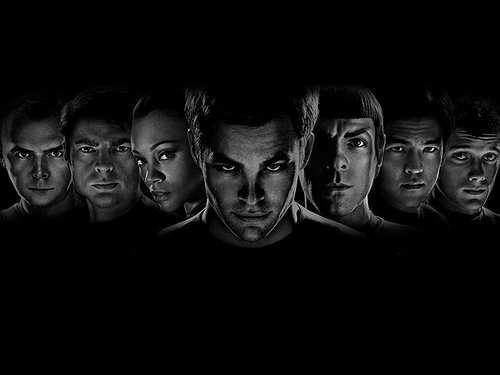
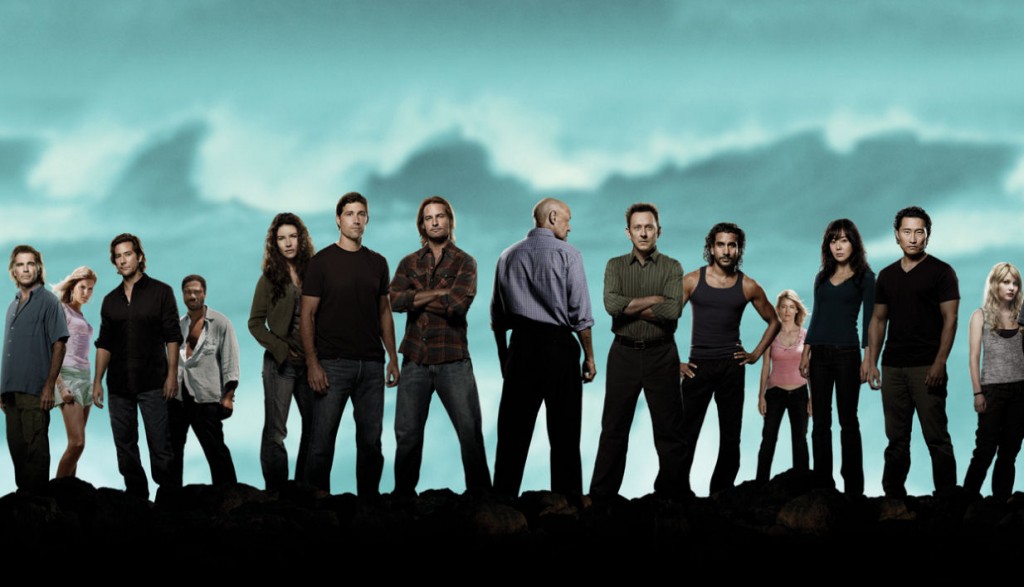
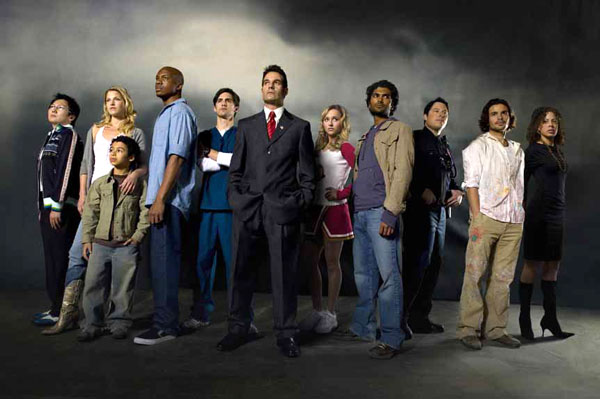
It first occurred to me as I was watching the trailer for Star Trek: First Contact, back in March. The cast seemed so typical of the racial and ethnic diversity reflected in the TV shows we’ve all been watching for years now, like Lost…

and Heroes…

It seemed completely natural for 2009, and yet what occurred to me was that this movie was based on a TV show that  was decades old–I wasn’t even entirely sure how many. Thirty? Forty? When I looked it up, I discovered that the original Star Trek series had first aired in 1966!

This seemed utterly amazing.

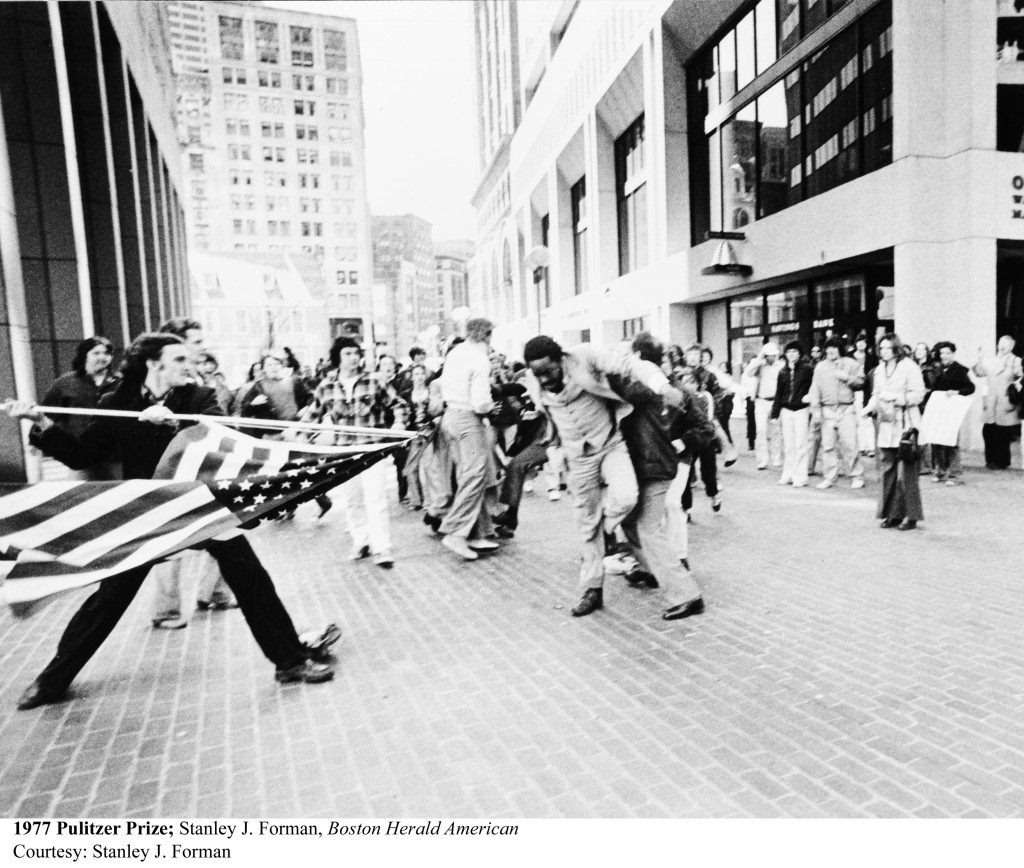
The Civil Rights Act of 1964, which outlawed racial segregation in schools, public places, and employment, had passed just TWO YEARS prior. Bussing (to desegregate schools in reality vs. just in legislation) wouldn’t even begin until 1971. Had it lasted, Star Trek would have been in its 5th season by then. More than a decade after the show premiered, the reality of the social response to racial desegregation all too often still looked like this:

soling of old glory

The cultural conflicts that raged in the 1960’s extended beyond racial divides, beyond even national boundaries, into outer space itself. When Star Trek first aired–nine years after the Russians had been the first to launch human beings outside of the Earth’s atmosphere, and still three years before Americans would first land on the moon–the Space Race between the Americans and the Soviets was an integral part of the cultural, technological, and ideological rivalry that defined the Cold War. After all, advanced space technology was more than simply a pissing contest, it had blatant military applications for the two adversarial nations, should the Cold War actually heat up.

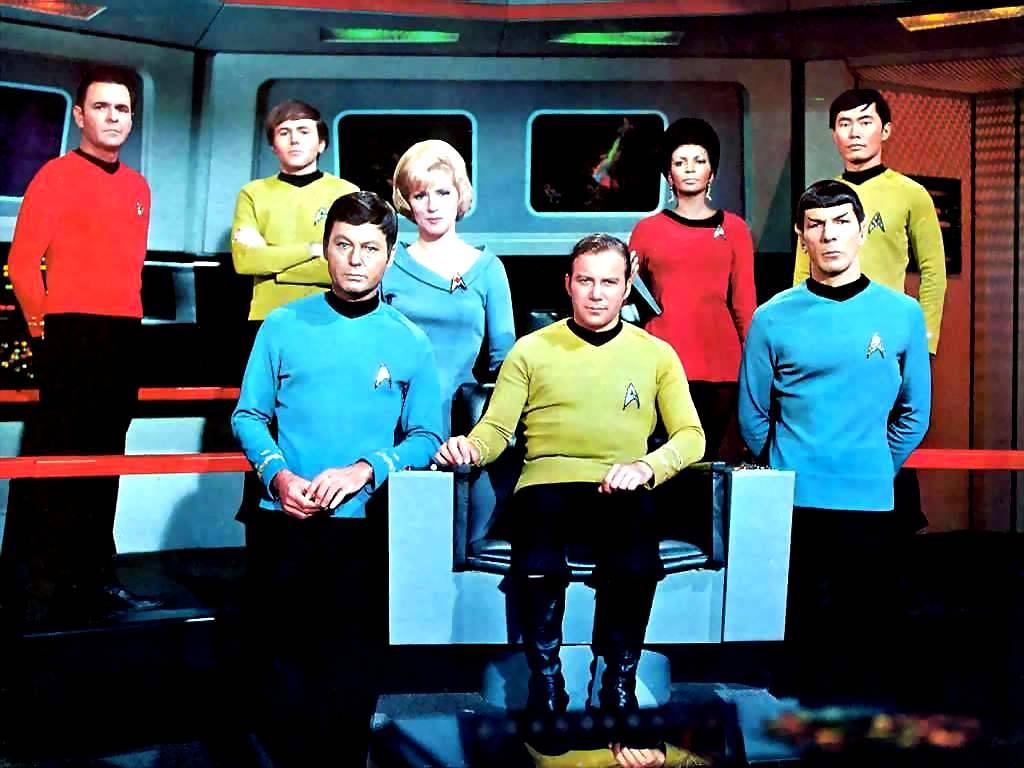
But just three years after Martin Luther King had described his dream of a future where blacks and whites, and all races, could coexist harmoniously as equals, Gene Roddenberry’s futuristic vision, that beamed into living rooms all across America, looked like this:

…and it included an American, a Russian, an Asian, a Black woman, and even a biracial (bi-special?) alien all working together for the purpose of scientific exploration and peacekeeping efforts.

To put how insanely revolutionary this really was in 1966 into more perspective–since I’d only seen the episodes as reruns when I was a kid in the 90’s–Nichelle Nichols, who played Uhura, was one of the first black women featured in a major television series who was not playing a servant EVER. Her prominent supporting role as a female black bridge officer was unprecedented in the history of television at the time. In a recent interview in Hyphen Magazine, John Cho, who plays Sulu in the new Star Trek movie, described the experience of watching George Takei embody the role in the original series: “It was stunning. He was just alone on television as an Asian American.” And as for the idea of a half-human/half-Vulcan hyphenate…. when Star Trek first aired, interracial marriage was still illegal in 16 states! It wouldn’t be until a year later, in 1967, that these “Anti-Miscegenation” laws would be declared unconstitutional.

At the end of Star Trek’s first season, Nichelle Nichols says she’d wanted to leave the show. Gene Roddenberry urged her to reconsider, but she told him she was planning to return to theater. That same weekend, at an NAACP event Nichols was introduced to Martin Luther King, Jr. He told her he was a fan, and praised the importance of her role in the show as it was part of the first fully integrated cast that portrayed men and women as equals. Star Trek, it turned out, was one of the only shows his children were allowed to watch. When she told him she was planning to leave, he replied, “You can’t do that! Your character is the first non-stereotypical [Black] role on television, and is in a position of authority. People who don’t look like us, see us for the first time as we should be seen: As equals. Don’t you see? Star Trek has changed the face of Television.” Needless to say, Nichols told Roddenberry she would stay on the show.

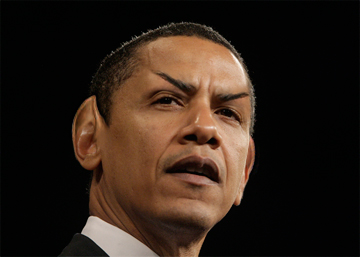
What’s fascinating to me is that what Star Trek did, with its deliberate emphasis on diversity and equality, was not only change the face of Television, but, in fact, shape a cultural vision of what the future would be expected to look like, in its own image. “I am a first-generation ‘Star Trek’ fan,” declared Henry Jenkins, author of Convergence Culture, and co-director of the MIT comparative media studies program, in a recent Salon article entitled, Obama Is Spock: It’s Quite Logical. “And I’ve long argued that many of my deepest political convictions emerged from my experience of watching the program as a young man growing up in Atlanta during the civil rights era. In many ways, my commitment to social justice was shaped in reality by Martin Luther King and in fantasy by ‘Star Trek.’”

Premiering five years before the first pocket calculator, the Star Trek world wasn’t simply a glittering science fiction, it actually primed a whole generation to demand that the future keep its promises.

obama_is_spock_its_quite_logical


Subscribe for more like this.