
The Cyberpunk Future of… Now

The 7.0 peak from the Haiti earthquake indicated by a seismic analyst at the Caltech Seismological Laboratory. (AP Photo/Damian Dovarganes)

On Tuesday, January 12, I went into a meeting at 3:00pm PST, and when I came out, about an hour and a half later I quickly discovered that something had happened in Haiti during those 90 minutes of radio internet silence. As everyone in the connected world now knows, a 7.0 magnitude earthquake (the worst in 200 years) hit Port-au-Prince, the capital of the small Caribbean country. Twelve aftershocks greater than magnitude 5.0 followed, destroying basically a third of the entire city, displacing millions, and killing possibly thousands more.

From the Boston Globe photo essay on the aftermath of the quake:


(Tequila Minsky for The New York Times)


(
LISANDRO SUERO/AFP/Getty Images)


The badly damaged presidential palace – the center portion formerly 3 stories tall. (REUTERS/Eduardo Munoz)


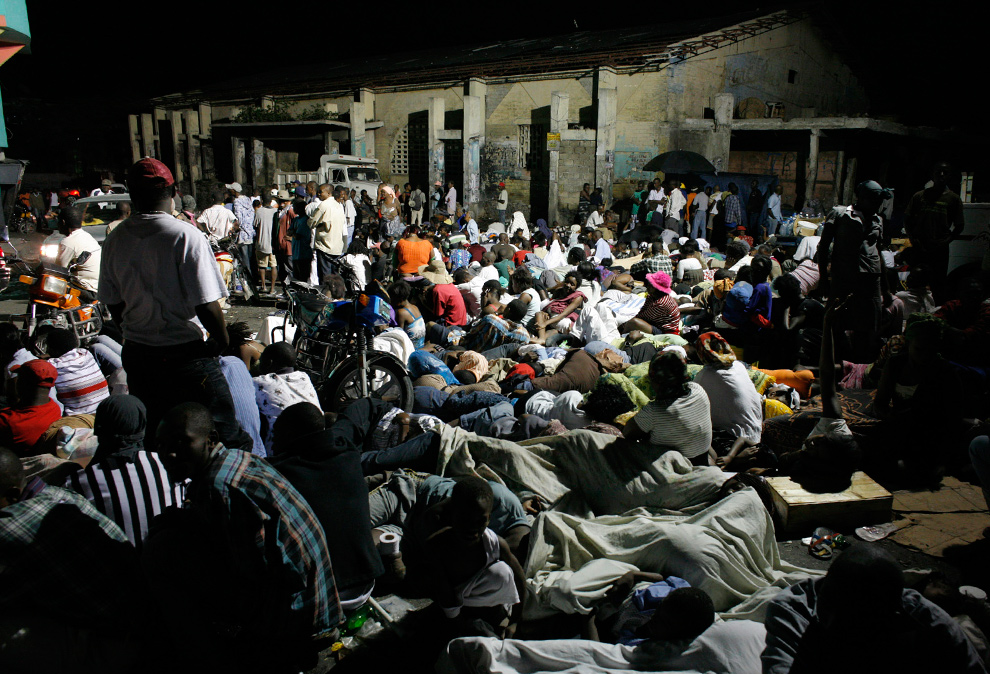
Displaced residents sleeping in the street after the earthquake.
(REUTERS/Eduardo Munoz)


People looking at earthquake victims lying on the street, Wednesday, Jan. 13, 2010. (AP Photo/Lynne Sladky)


And those are some of the less disturbing images of what’s going on.

Scrolling through the photo essay I know I got just a small inkling of the immense devastation in the already impoverished country, but then came shots of something that struck me as even more profound:


Venezuelan rescuers loading medical equipment onto a plane heading to Port-au-Prince, on January 13, 2010 at the Simon Bolivar international airport in Caracas. (JUAN BARRETO/AFP/Getty Images)


British Search and Rescue teams preparing to leave Gatwick airport, West Sussex to provide assistance to relief and rescue teams in Haiti. (CARL DE SOUZA/AFP/Getty Images).


Taiwan rescue teams standing by at the fire department in Taipei as they prepare to head to Haiti. (SAM YEH/AFP/Getty Images)


Los Angeles County Fire Department urban search and rescue team loading equipment before traveling to Haiti to help with rescue efforts (REUTERS/Gus Ruelas)


Rescue dogs awaiting departure for Haiti at the Torrejon military airbase in Torrejon de Ardoz, Spain. (AP Photo/Daniel Ochoa de Olza)


It’s like stills from the third act of a Roland Emmerich movie, except it’s not. This is the future, now. Decry globalization all you want, but to me this is the true significance of the word. A tragedy in a place of no real political or economic interest, can literally overnight mobilize the aid and compassion of the entire world. According to TechCrunch, within just a few hours of the earthquake the Obama administration set up a special number and got the major U.S. carriers on board to allow people to very easily donate $10 to the Red Cross to help with the relief effort. By January 14th, 2 days after the earthquake, the program had raised over $5 million from over a half million different mobile phone users, with donations said to be coming in at the rate of $200,000 each hour. Haitian-born musician Wyclef Jean’s Yele Haiti Foundation has also been running its own text donation drive, and by Thursday had raised another $1 million, According to ABC News. Albe Angel, founder and CEO of Give On the Go, the company helping process the Yele Haiti donations, said, “Never has so much money been raised for relief so soon after a disaster. This is a watershed moment. It’s historic.”

It’s also intensely futuristic. Six years ago, when natural disaster struck Indonesia, what’s happening in 2010, in the support effort for Haiti simply did not exist. Even by 2008, text donations raised by charities only amounted to $1 million total. Yele Haiti got that in one day.

If what’s happening in the Haiti relief effort is accelerated, then the current situation between Google and China is basically prophetic. At almost the same time as the earthquake struck, the following was posted on the Official Google Blog:

A new approach to China

Like many other well-known organizations, we face cyber attacks of varying degrees on a regular basis. In mid-December, we detected a highly sophisticated and targeted attack on our corporate infrastructure originating from China that resulted in the theft of intellectual property from Google. However, it soon became clear that what at first appeared to be solely a security incident–albeit a significant one–was something quite different.

First, this attack was not just on Google. As part of our investigation we have discovered that at least twenty other large companies from a wide range of businesses–including the Internet, finance, technology, media and chemical sectors–have been similarly targeted. We are currently in the process of notifying those companies, and we are also working with the relevant U.S. authorities.

Second, we have evidence to suggest that a primary goal of the attackers was accessing the Gmail accounts of Chinese human rights activists. Based on our investigation to date we believe their attack did not achieve that objective. Only two Gmail accounts appear to have been accessed, and that activity was limited to account information (such as the date the account was created) and subject line, rather than the content of emails themselves.

Third, as part of this investigation but independent of the attack on Google, we have discovered that the accounts of dozens of U.S.-, China- and Europe-based Gmail users who are advocates of human rights in China appear to have been routinely accessed by third parties. These accounts have not been accessed through any security breach at Google, but most likely via phishing scams or malware placed on the users’ computers.

We have already used information gained from this attack to make infrastructure and architectural improvements that enhance security for Google and for our users.

We have taken the unusual step of sharing information about these attacks with a broad audience not just because of the security and human rights implications of what we have unearthed, but also because this information goes to the heart of a much bigger global debate about freedom of speech. In the last two decades, China’s economic reform programs and its citizens’ entrepreneurial flair have lifted hundreds of millions of Chinese people out of poverty. Indeed, this great nation is at the heart of much economic progress and development in the world today.

We launched Google.cn in January 2006 in the belief that the benefits of increased access to information for people in China and a more open Internet outweighed our discomfort in agreeing to censor some results. At the time we made clear that “we will carefully monitor conditions in China, including new laws and other restrictions on our services. If we determine that we are unable to achieve the objectives outlined we will not hesitate to reconsider our approach to China.”

These attacks and the surveillance they have uncovered–combined with the attempts over the past year to further limit free speech on the web–have led us to conclude that we should review the feasibility of our business operations in China. We have decided we are no longer willing to continue censoring our results on Google.cn, and so over the next few weeks we will be discussing with the Chinese government the basis on which we could operate an unfiltered search engine within the law, if at all. We recognize that this may well mean having to shut down Google.cn, and potentially our offices in China.

The decision to review our business operations in China has been incredibly hard, and we know that it will have potentially far-reaching consequences. We want to make clear that this move was driven by our executives in the United States, without the knowledge or involvement of our employees in China who have worked incredibly hard to make Google.cn the success it is today. We are committed to working responsibly to resolve the very difficult issues raised.

So basically, after discovering a Chinese security breach, Google, a multinational corporation, is now essentially sanctioning the Chinese government either with the threat of uncensored access to information for its citizenry, or otherwise, with a withdrawal from the market altogether. Not to be left behind, the Secretary of State of an actual government, Hillary Rodham Clinton, has issued the following statement:

We have been briefed by Google on these allegations, which raise very serious concerns and questions. We look to the Chinese government for an explanation. The ability to operate with confidence in cyberspace is critical in a modern society and economy. I will be giving an address next week on the centrality of internet freedom in the 21st century, and we will have further comment on this matter as the facts become clear.

Once again, Cyberpunk predicts the future, one in which multinational corporations replace governments as centers of political and economic power. Though in this case, in a particularly literary twist of cyberpunk fate, the multinational corporation in question (which is, itself, actually made up of hackers — the erstwhile anti-establishment protagonists of the genre), whose informal corporate motto is “don’t be evil,” is wielding its might by imposing a threat of increased access to information against a totalitarian regime. It’s enough to make William Gibson suddenly seem like a contemporary satirist rather than a science fiction writer. But, then again, Cyberpunk stories have also been seen as fictional forecasts of the evolution of the Internet, describing a global communications network long before the World Wide Web entered popular awareness, and that hasn’t necessarily led us into a dark dystopia…. yet.

In the meantime, though, what it has done, is allow us to become more united as humans, on a global scale. Jay Smooth articulated the underlying sentiment driving the response behind the Haiti relief effort on his Illdoctrine vlog: “We, as human beings, have a responsibility to act.” A century ago, the situation in Haiti would have been considered a Haitian crisis. A decade ago it would have been an “international” crisis. Now, it is simply, immediately, instinctively a human crisis.

Welcome to the future.

Ways to help Haiti:

Donate $5 to Wyclef’s Yele Foundation by texting YELE to the number 501501

Donate $10 to the American Red Cross by texting HAITI to the number 90999

Or donate online to:

UNICEF

Doctors Without Borders

UN Foundation

Partners In Health


Subscribe for more like this.


Agrosexual

http://fc03.deviantart.net/fs48/f/2009/222/d/a/The_Icecreamists_ad_2_by_andreaperrybevan.jpg

During their New Moon promo tour a couple of months back, the Twilight Trio was on Jimmy Kimmel Live, and at the end of the show Kimmel let a few people from the audience ask questions of the cast. A girl came up to the mic with a question for Taylor Lautner. “I really like your shirt,” she said. “I was wondering, can I have it?” The running joke about New Moon, of course, is the extent of the shirtlessness perpetrated by Lautner’s character and his werewolf brethren. (It’s gone so far, in fact, that Lautner, who beefed up special for the role, has vowed to never appear shirtless in a movie ever again.) As Lautner struggled in response to keep from losing his shirt and his dignity, Kimmel, possibly the oldest person in the entire studio at that moment, interjected, “You know, I think people would look down on men for demanding the shirt off a woman.” Yet that this interaction seemed totally acceptable and par for the course to the otherwise teenage audience struck me as an indication of a potentially far lager trend a few days later, when I saw “The Christian Side Hug” video.

If you’re wondering what on earth is that?? The “Christian Side Hug” is a rap performed by a group of white kids at a Christian youth gathering, about a way of hugging while standing side by side with someone as opposed to facing one another and putting your arm around their shoulders or waist, because, “front hugs be too sinful.” Despite ultimately turning out to have been intended as insider “satire” (though not before passing very convincingly as both 1. A typically “ass-backwards” — to employ a Palin-ism — move from the abstinence movement of promoting celibacy while sexualizing even mundane forms of human contact, as well as, 2. A reason to weep quietly for the final, ignominious death — like a sad toothless crack-addict in an abandoned alley — of hip hop), I happened to see the Christian Side Hug video on the same day as the fallout from Adam Lambert’s American Music Awards performance, and to me there was a certain similarity between the two.

In case you happened to have missed it, or hearing about it, Lambert put on a rather racy, sexually scandalizing live performance at the awards show.

http://media.thestar.topscms.com/images/b6/68/3368c59c46f69ba79aa50a2519c9.jpeg

Perhaps confusing the AMA’s with the MTV Movie Awards, which have no problem rewarding male makeouts, or, more likely, shrewdly pushing the envelope hard on the night before his debut album release, in his first televised performance since the finale of American Idol, Lambert “shocked” the audience at Los Angeles’ Nokia Theatre and the millions watching live on ABC by closing the show with a risqué rendition of “For Your Entertainment,” the first single of his album of the same name. Highlights from the controversial performance included simulated oral sex from a male backup dancer, a make-out session with his male keyboardist, and a giant mirrored prop set up on the stage so the audience could see the looks on their own shocked faces.

According to Rolling Stone, the producers of the show weren’t informed about the guy-on-guy kiss in advance, and after the show, Lambert told the magazine the musician he kissed is a straight man. In the aftermath, ABC canceled Lambert’s Good Morning America appearance slated for the next day, which of course only helped generate even more attention and fanfare for the artist, who has clearly become an expert at navigating the myriad controversies he’s racked up. To me, what connects Lambert’s performance and the Christian Side Hug and the Kimmel incident, as well as endless other examples from our current pop culture, extends beyond any particular sexual orientation and includes even abstinence itself. It’s an underlying aggressiveness to sexuality in general: agro-sexuality.

To be clear, I’m not talking about aggression enacted through sex, but rather about a militancy in the display of one’s approach to sexuality. The past decade’s proliferation of online profiles, digital cameras, and all manner of social technologies has demanded we approach basically every other aspect of our modern identities as a performative display. It only makes sense that sexuality wouldn’t be exempt.

When I was a teenager in the late 90’s the general approach to sexuality could easily have been described as “come as you are.” Kurt Cobain had died the year before I started high school, Britney Spears’ first album wouldn’t come out until I was halfway through, and in between there was a lot of Green Day, Jewel, Fugees, and REM. Rap was still busy beefing between the coasts to have gotten fully pornified yet. Heroin Chic, an aesthetic glamorizing a drug that destroys sex drive, was all the rage. Even Madonna was, by this time, more interested in acting and electronica than vogueing or kink. And AIDS was huge. People were still dying of AIDS then. As opposed to now, when people are living with it. Kids were obviously still having sex, but since there was some semblance of sex education going on under the Clinton administration they were getting pregnant a lot less than in the “abstinence-only” Bush era. Basically, aside from the effort pushing the word “safe” in front of it, sex in the 90’s was not something to get particularly militant about.

Of course, there was the gay rights movement, but by the time Ellen Degeneres was making the cover of Time for admitting, yep, she’s gay, it had already long been transmogrified from Activism to Pride. And perhaps it’s this shift from social justice to self-expression that is the root of Agrosexuality in general. After all, what are purity rings if not emblems of Abstinence Pride? And in some basic way, even the demand for the shirt off Lautner’s back was as much a performance of sexuality as was Lambert’s on the AMA’s.

In a 2006 New York Magazine article called “The Cuddle Puddle of Stuyvesant High School” Alex Morris wrote:

Go to the schools, talk to the kids, and you’ll see that somewhere along the line this generation has started to conceive of sexuality differently. Ten years ago in the halls of Stuyvesant you might have found a few goth girls kissing goth girls, kids on the fringes defiantly bucking the system. Now you find a group of vaguely progressive but generally mainstream kids for whom same-sex intimacy is standard operating procedure. These teenagers don’t feel as though their sexuality has to define them, or that they have to define it, which has led some psychologists and child-development specialists to label them the “post-gay” generation. But kids like Alair and her friends are in the process of working up their own language to describe their behavior. Along with gay, straight, and bisexual, they’ll drop in new words, some of which they’ve coined themselves: polysexual, ambisexual, pansexual, pansensual, polyfide, bi-curious, bi-queer, fluid, metroflexible, heteroflexible, heterosexual with lesbian tendencies—or, as Alair puts it, “just sexual.”

Even the nouveau-celibacy of the abstinence movement is an option on this spectrum, its appeal (if not necessarily its effectiveness) one kind of response to all these overwhelming new choices. As alternative sexuality has become more mainstream, and sexuality moves from self definition to self expression, what has emerged is a new agrosexual attitude that really wasn’t there 10 years ago. There’s an expectancy of an in-your-face show of sexuality — whatever yours may be — as part OF sexuality itself. It’s by no means anything new, but it used to be employed by those who’d followed alternative sexual paths, flying their freak flags as a social statement, or for deliberate shock value, now, however, as the sexual mainstream is fragmenting along with the cultural one being agrosexual is par for everyone’s course.

In her LA Times article on Lady Gaga — likely as close to the embodiment of agrosexuality as a generation could hope for — Ann Powers writes:

Having gotten her start in the bohemian enclaves of downtown New York City, Gaga is deeply indebted to Warhol’s “Superstar”-oriented Factory scene and its aftermath, which produced drag performers like Candy Darling, artists such as Robert Mapplethorpe and streetwise rock stars including Lou Reed and Patti Smith.

“The idea is, you are your image, you are who you see yourself to be,” she said. “It’s iconography.”

Warhol supported and exploited a coterie of outsiders who likely would never have emerged from their corners without his help. Gaga takes control but also shows herself losing it; she blurs the lines between self-realization and self-objectification, courting the dangers of full exposure for a generation of kids born with camcorders in their hands.

Though she talks nonstop about liberation, Gaga’s work abounds with images of violation and entrapment. In the 1980s, Madonna employed bondage imagery, and it felt sexual. Gaga does it, and it looks like it hurts.

She says she wants her fans to feel safe in expressing their imperfections. “I want women — and men — to feel empowered by a deeper and more psychotic part of themselves. The part they’re always trying desperately to hide. I want that to become something that they cherish.”

Trendwatching.com calls this “Maturialism,” one of its “10 Crucial Consumer Trends for 2010:”

Let’s face it: this year will be rawer, more opinionated, more risqué, more in your face than ever before. Your audiences (who are by now thoroughly exposed to, well, anything, for which you can thank first and foremost the anything-goes online universe) can handle much more quirkiness, more daring innovations, more risqué communications and conversations, more exotic flavors and so on than traditional marketers could have ever dreamed of….We’ve dubbed this MATURIALISM (mature materialism),

In fact, the image at the top of this post is an ad for UK ice cream brand The Ice Creamists, mentioned in the Trendwatching post as an example of Maturialism in action:

http://trendwatching.com/img/briefing/2009-11/image21.jpg

Trendwatching suggests that if they want to keep up with culture, brands need to mirror the current societal norms that are “about anything but being meek.” In other words, this isn’t just for teenagers and pop stars; brands need to get in on the agrosexual action, too.


Subscribe for more like this.


Lady Gaga Is the New Marilyn Manson

Can’t believe I didn’t realize this before.

Lady Gaga’s “Bad Romance” (2009):

Marilyn Manson’s “The Beautiful People” (1996):

Well, she ain’t no Britney when it comes to the dancing, so…. Also, people have kept making the Madonna connection, but I just don’t think that’s accurate. Madonna was never trying for creepy. Shocking, sensational, yes, but not creepy. Marilyn Manson is really what’s going on here.


Subscribe for more like this.


T.V. Killed The Movies’ Star

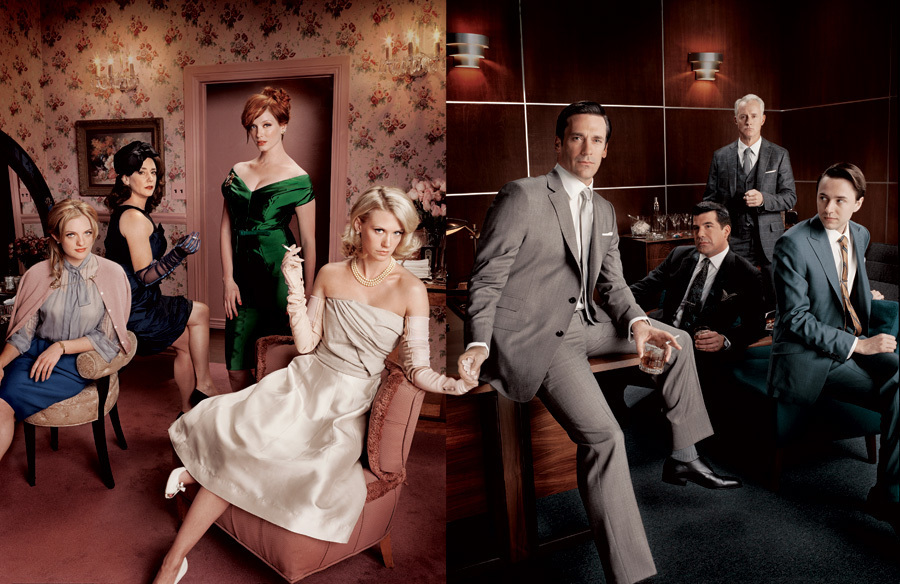
Vanity-Fair-shoot-mad-men-1257702_900_584

In college, we film students had a certain sense of disdain and smug superiority towards our TV-major classmates. Miramax, along with the whole independent film movement it was spearheading, had just hit it’s apex while we’d been in high school, and the late 90’s / early 2000’s saw the releases of such epics as The Matrix, American Beauty, Fight Club, Requiem For A Dream, and many, many more. Meanwhile the most relevant cultural content TV had managed to produce at the time were shows like Seinfeld, Friends, and Survivor. I remember being simply dumbfounded that anyone would want to major in TV at all. I mean, like, what for? The big screen is where the REALLY cutting-edge, fascinating, intelligent, and just plain COOL stuff was at.

Was at.

Slowly, over the course of the decade, in sync with another major trend that has been gradually, and then suddenly, taking over our world, TV has changed. These days, there is such a slew of phenomenal output coming off the small screen, and conversely, a big fat quagmire of mediocrity projecting in theaters. TV is killing the movies.

In a recent Vanity Fair article on Mad Men, Bruce Handy offers this thumbnail history of Hollywood:

Once upon a time, the studios reigned supreme. They bulldozed geniuses and turned out dreck, but in applying Henry Ford discipline and efficiencies to filmmaking they also gave us The Lady Eve, Casablanca, and Singin’ in the Rain. By the 1960s, however, the factory system began to give way, power shifted to directors and stars, and a new generation of independent-minded auteurs crafted sometimes indulgent but often original and even brilliant films such as Bonnie and Clyde, Midnight Cowboy, Taxi Driver, and Apocalypse Now. Then, another turn: studios got the upper hand back, or learned to share it grudgingly with a handful of superstars and A-list directors. But without the old assembly-line rigor the result has too often been big, bloated dreck, like the films of Michael Bay, or the gaseous Oscar bait that bubbles up every fall—the worst of all movie worlds.

But, ah, television. Its great accomplishment over the past decade has been to give us the best of all movie worlds, to meld personal filmmaking, or series-making, with something like the craft and discipline, the crank-’em-out urgency, of the old studio system. I’m thinking first and foremost of The Sopranos, which debuted in 1999 and sadly departed in 2007. This strange and entertaining series, as individual a work as anything by Hitchcock or Scorsese, was the creation of David Chase, and it paved the way for The Wire, Deadwood, Rescue Me, Damages, and its successor as the best drama on television, the equally strange and entertaining Mad Men, which launch[ed] its third season on AMC August 16.

I’ve got my own theory, tho, and it goes something like this: digital technology saved television. Not that it meant to. It just happened by accident. See, the shows of the 90’s and before were, by and large, episodic. Things basically stayed the same from episode to episode. The characters didn’t really change much. The storyline didn’t really go anywhere unexpected, and if it did, it would always manage to resolve the issue, and find its way back to the beginning by the end of each episode. Things like Ross and Rachel  getting together or breaking up or getting back together were EVENTS, reserved for seasonal ratings sweeps.

The new shows we all watch and love, however, are not episodic, they are serial. They typically start with a “previously on” montage. Episodes build on one another in a series, relationships grow, change happens — or perhaps it doesn’t, and that’s exactly where the tension comes from — characters makes life-altering decisions, or maybe we simply find out more about their back-stories, which lets us see their current predicament in a totally new light. Serial shows evolve. And up until this decade that used to scare the shit out of TV networks. Cuz that narrative evolution can quickly become confusing. Lost, as its name would suggest, is perhaps the extreme example of this kind of narrative disorientation. If you miss one episode, shit’s changed and you just have no  idea what’s going on anymore, which is off-putting, and might make you likely to switch the channel to something more familiar. Since greater audience retention means more commercial watchers and higher prices for ad slots, this sort of confusion-induced channel surfing is why TV execs generally wanted to avoid complicated serial content as much as possible.

And then digital technology came along. Technically, HBO was first, with its seminally serial Sporanos, as Handy mentioned, which they could get away with for the same reason they could get away with all their other controversial programming — on premium cable, the shows aren’t at the mercy of advertisers. Nowadays, between Hulu, Tivo, and DVDs, not to mention all the torrent sites for downloading shows, if you’re so inclined, it’s virtually impossible NOT to keep up with a show you really dig, on whatever schedule you prefer. It is absolutely no overstatement to say that these new digital tools have not only had a profound impact on the actual content of television, they’ve helped  release the latent art-form in the medium itself.

As Handy writes:

At its core Mad Men is a moving and sometimes profound meditation on the deceptive allure of surface, and on the deeper mysteries of identity. The dialogue is almost invariably witty, but the silences, of which there are many, speak loudest: Mad Men is a series in which an episode’s most memorable scene can be a single shot of a woman at the end of her day, rubbing the sore shoulder where a bra strap has been digging in. There’s really nothing else like it on television.

There isn’t even anything else like it in the theaters! And this leads me to another change that the new technologies have enabled in television. Because of the new, truly serial format (unlike, even, shows like Buffy, or the X-Files, that came before, which were still a mix of episodic and serial episodes per season), the new TV series story-arc has been extended exponentially. Every episode ends on a cliff-hanger. Nothing is settled. The through-line isn’t just 45 minutes (the duration of a typical hour-long episode, allowing for commercials), it’s now a full season long.

Handy goes on:

I asked David Carbonara, the show’s composer, about a lovely piece of music he used to score a small but key scene in the second-season opener (Episode 201, by the production’s accounting), in which Don, intoxicated for once by his wife, watches a mink-clad Betty descend a hotel’s grand staircase as she arrives for a night out in the city. This was Carbonara’s answer, by e-mail: “It’s a piece written by Nikolai Rimsky-Korsakov called ‘Song of India’ from his opera Sadko. Tommy Dorsey had a hit with an up-tempo version in 1937. Matthew Weiner [Mad Men’s meticulous creator and executive producer] wanted a harp in the hotel lobby to be playing the song, then have the arrangement become larger for scoring Betty’s entrance.… But my favorite use of ‘Song of India,’ and sadly I don’t think anyone noticed, was in episode 211, ‘The Jet Set.’ This time it’s played as a jazz samba in yet another hotel bar as Don thinks he sees Betty! It’s played as source music with a bit of score overlaid on top hopefully calling us back to the previous hotel lobby in episode 201 [which had aired 11 weeks earlier in the series’ initial run], when they were very much in love. I admit it was a bit subtle, but maybe (hopefully!) it had an effect in the viewer’s subconscious.”

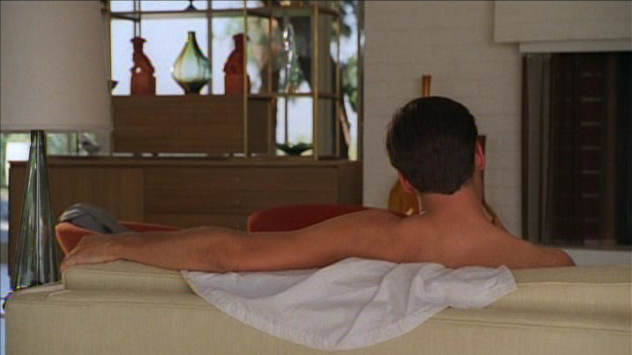
There’s just no way a 90-minute movie can compete with something like this. There’s simply no opportunity for this kind of subtlety and nuance and atmosphere in the timing. It’s incomparable. Watching The Jet Set episode Carbonara mentions, in fact, at the very end, when the camera pulls back from Don’s arm, naked, outstretched over the back of the couch in a strange house in Palm Springs, I had a kind of epiphany about the show….

11doncouch-1

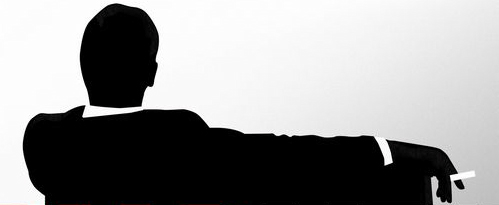
This shot is a direct mirror to the iconic Mad Men silhouette, from over Don’s other arm, shirt-clad, stretched over a couch in his New York, Sterling Cooper office….

mad2

With just this single, slow, meditative stroke the shot silently articulates everything you need to understand about the strangeness of this Californian mirrorland that our hero has found himself in, his own strangeness at being there, and how far removed and flipped around everything there is in contrast to his New York reality. Watching this almost subliminal storytelling layer that I’d previously known solely as an achievement of cinema, I suddenly realized that Mad Men had left TV show territory entirely. It had become almost mathematically perfect, a number multiplied by its reciprocal, always equaling 1. It had become a kind of poetry, where every single word and punctuation mark is critical to maintaining the meaning and integrity of the overall structure, which would otherwise collapse if even a single element were removed.

Sure, not every TV show is Mad Men, but there’s more and more shows edging closer. Some of my personal favorites:

  • Sons of Anarchy: Hamlet, set in the world of a central coast Harley gang club. As in, “Something is rotten in the state of California.” I kid you not, the Shakespearean tragedy was a deliberate plot basis. And especially after last year’s Mongols bust, it’s an endlessly fascinating glimpse into a truly subversive culture that’s as much an alternate reality as the world of the Irish Traveller gypsies in the now sadly defunct The Riches.
  • True Blood: the grown-up antidote to the hormonal immaturity and teenybopper banality of Twilight’s vampires. Thank you, Alan Ball (writer of American Beauty, no less), for the sophistication and wit to portray immortality as an existential boredom. There is something absolutely hilarious about an ancient viking vampire complaining, “I texted you three times. Why didn’t you reply?” And a Civil War veteran vampire responding irritated, “Ah hate using the number keys to tah-ype.” Twilight couldn’t summon this much humor from its characters in a million years… literally.
  • Californication: If it’s tortured, satirical, manic celebration of hedonistic nihilism doesn’t feel  familiar to you, you’ve probably never been alive in the 21st-century… or lived in Los Angeles. Also, not since Buffy have I wished for occasion to use the quips and one-liners from a show more.
  • Weeds: The concept alone is fantastic, plus there’s the razor sharp commentary on race and class relations, but it’s the tight structure of the writing that takes it over the edge. With every episode the rule is: Nancy gets something big; Nancy has something bigger taken away. It’s a narcotically addictive formula.
  • I’d mention Lost, too, since people still seem to like it, I guess, and at one point I was among them, until everyone went BACK to the goddamn island last season (are you fucking kidding me?!) and the show became a narrative jerkoff. (For context: Mad Men = narrative sex).

Think about the last movie that you really loved. Was there even one this year? More than one?

Probably not. The economic downturn has screwed the movie industry. Studios’ profits have plummeted. DVD buying, which might have once helped salvage theatrical-release turds, is way down in North America, and in other markets is basically nonexistent due to piracy. With a lot less money coming in, and with production costs continuing to rise, studios are pouring more money into “branded entertainment”—movies based on franchises that have strong brand recognition and can, theoretically, provide a decent opening weekend, a la G.I. Joe. According to the LA Times, an adaptation of the board game Battleship is scheduled for release July 2011, the same month as a third “Transformers” film. Studios have even recently announced the development of new movies based on Monopoly, Clue, and Candy Land. Meanwhile, as traditional movie stars’ are becoming less and less reliable for drawing an audience, major studios are producing far fewer adult dramas, and the independent film world is slowly collapsing under the weight of the recession as well. Last year alone saw the dissolution of three major independent film companies. Time Warner closed Warner Independent Pictures (Little Miss Sunshine, Good Night and Good Luck), and Picturehouse Entertainment (The Women, Mongol), and Viacom closed Paramount Vantage (No Country For Old Men, There Will Be Blood). Things have gotten so whack, Paramount has even had to delay the Martin Scorsese-Leonardo DiCaprio thriller, Shutter Island, from October to February of next year because it couldn’t afford the necessary marketing budget that kind of vehicle requires.

It’s no surprise, then, that so many movie actors are working on the small screen. Once considered a fatal oblivion for movie stars, TV shows these days include titles like Alec Baldwin, Tim Roth, Lawrence Fishburne, Ron Perlman, Anna Paquin, Minnie Driver Eddie Izzard, Jonathan Rhys Myers, Keifer Sutherland, and those are just off the top of my head, but clearly, you’ve noticed this trend yourself. It’s pretty unmistakable. So this is where we find ourselves. Hulu is developing more of a brand online than the big broadcast networks that own shares of it, overtaking ABC, NBC and Fox in web traffic for the first time in June. 1 in 3 households owns a DVR (Digital Video Recorder), 33% in fact, up from 28% a year ago, adding significant numbers of time-shifted viewers to shows’ ratings — 36 shows now add 1 million or more viewers one to seven days after the original air-date. And as movies have sunk to the new low of board game franchise tie-ins, television has woken up out of its reality-TV coma and become the far more innovative, dynamic, and risk-taking medium.

Charlie Collier, president of AMC, quoted in the Vanity Fair article describes Matthew Weiner’s vision for Mad Men, which can be as easily applied to the current state of the tube in general:It’s not television; it’s a world.”


Subscribe for more like this.