i keep being pressed to come up with alternatives for the word “viral.” since people are supposed to stop saying it, what are they supposed to say in its place, right? (virus-like? virusy? air-borne?)
the point here isn’t really about how to refer to the germ so much as it is identifying that contagion spreads through sneezing. and myspace bulletins don’t just magically repost themselves. they require people to take an action. (gazoonheit).
hence the phrase i keep coming back to is “user generated promotion.”
if you made it past the word “generated” without immediately assuming the inevitable next syllables sounded like “content”…. word!
some people seem to get stuck, and think the last word can only ever be content. (but not you. you totally got it.)
so to mark the release of boreta‘s new single here’s some viral content.
NOTE: everything below the doohiky is part of a “viral campaign” HERE.
ALSO NOTE: you’ll probably want to have some kind protective gear on when listening to bubblin’. it’s that good.
BORETA
“BUBBLIN’ IN THE CUT / LOBEGRINDER”
Digital SingleRelease Date: December 4, 2007
Catalog: GMU-002
Label: Glitch Mob Unlimited / Alpha Pup
* Last week, “Bubblin’ In The Cut / Lobegrinder” was the #2 Most Added Record to CMJ Hip-Hop and the #4 Most Added to CMJ RPM (Electronic) Charts
* Boreta’s first release on Glitch Mob Unlimited
* If you’re feeling edIT and Ooah, you will LOVE these tracks!
Special Note: This release is the second in an infinite series of digital-only singles on the newly-minted Glitch Mob Unlimited label. And now, more than ever, we need your HELP in getting the word out. So if you’ve been slayed by the Glitch Mob, we humbly ask that you repost this bulletin. Easily copy-and-paste the code from: alphapupdigital.com/boreta.html
i’ll admit right now that this is not what i ought to be writing about.
i’ve been travelling for more of the past month than i’ve been at home, and just coming up with things to write about that i had no time to follow through on. so now that i’ve finally gotten to shower in my own shower, and sleep in my own bed, and the chance to unwind, there’s really so much else that i’d like to write about other than this.
while i’m at it, i’d like to write about how “cool-hunting” ought to be stopped too. and not the thing where brands support emerging artists and underground communities to develop relevant, authentic consumer relationships, but that whole ridiculous concept that “cool” can exist out of context, like some kind creme to be skimmed off the top of one homogenized, pasteurized mass culture.
i’d like to write a post each for like a dozen different sound-bytes that come out of alex bogusky’s mouth during the course of these interviews: 1 + 2 (it’s like a full semester of jedi grad school in the course of an hour.) i’d like to thank john drake for turning me on the existence of these videos–thanks john!
i’d like to write alex bogusky an email asking if it’s by choice or by chance that he doesn’t have a wikipedia entry to hyperlink his name to. (altho i could maybe think of a couple of other questions i’d like to ask too.)
instead what i’m writing about now is NONE of that. i’m writing about the funniest thing i saw yesterday, which happens to have been on a party flyer:
“$15 at the door. 30 in costume. leave the playa in nevada.”
since apparel is one of the easiest mediums through which to fulfil burningman’s “radical self expression” tenet, it’s been a big deal among parties in the burningman scene to encourage attendees to dress up. for years party flyers have advertised that if you were down with costumery you’d get a discount, and if you arrived in “street clothes” you’d have to pay an exacerbated fee at the door. “playa” by the way, is the term used to refer to the dried up lake-bed in the nevada desert on which burningman is held.
the initial idea in encouraging “playa-wear,” i suppose, was about developing a certain immersive atmosphere at the events. it’s kind of like if you’re into society for creative anachronism type stuff, where you recreate medieval battles on the weekend or whatever, then it kind of kills the whole point if people don’t show up wearing period garb, wandering onto the battlefield in track suits or something. the (re)creation of that other time and place is what everyone is there for, and it only works if everyone participates in the process.
of course burningman, like any other subculture, has its own dress codes and aesthetic mores, and after a while what all those flyers were actually saying was that the admission was $15 higher if you weren’t wearing the UNIFORM rather than if you weren’t wearing a “costume.” to people that didn’t get the memo about what the burningman uniform is supposed to consist of, or for whom costumery is not really their mode of expression, the insistent empahsis on it is incredibly alienating, and to people that aren’t interested in uniforms in general (or this one in particular), it’s pretty frustrating.
the joke on this flyer is that it’s turned the whole thing around, and even come up with a brilliantly catchy slogan for the resistance.
which, of course, reminds me of something alex bogusky talked about in that interview….
(oh, if you’d watched those videos you’d know there’s no way i could just spend a whole post not talking about anything he says in there.)
so at one point he talks about this mini cooper campaign that cpb did for the car’s US launch. they bought a bunch of billboards announcing, “the suv backlash officially starts now.”
except that this was 2002, this was pre-inconvenient truth, and there WAS no SUV backlash. they needed it in order to have a way to market a small car for being exactly what it was, a small car, so they created it!
and the crazy part is that then it became real!
whether it was sheer luck, or intense prescience, or some kind of more formal consumer insight investigation, that the message worked–and by “worked” i mean, that it really DID herald the start of the SUV backlash in addition to making mini coopers sell–is because there was indeed an anti gass-guzzler movement brewing. before al gore pushed “green” over the tipping point, however, even a relatively small message like this could speak for an audience that was ready for the backlash to start.
in the interview alex mentions that advertising, and, hey, lets be real, ad agencies, have the capacity to influence pop culture through brands. or…. wait, is it brands have the capacity to influence pop culture through advertising? or is it through ad agencies? well, whichever way it is, the bottom line is that the most powerful influence comes from the capacity to articulate something that is already brewing below the surface. it’s like how quantum particles can be affected through simply being observed, so pop culture movements can be influenced by being given expression…..
wow:
“quantum marketing.” (there’s a concept).
perhaps that flyer for the party on friday will herald the start of the costume-mandate backlash? i’ve been repeating “leave the playa in nevada” to everyone since i saw it. the wait for a clever slogan officially ends now (thanks, mike).
everyday there’s some kind of new technology hoopla vying for my attention with the sordid insidiousness of a tabloid magazine at the checkout counter. and i don’t even buy that shit, but for some reason i can never resist trying to get the latest download on what’s going on in brad and angelina’s relationship while i’m waiting to ring up my groceries.
like this crazy story about a 17 year old girl from a working-class chicago suburb with no business background or any kind of investment backing accidentally striking it rich with her site that creates custom myspace layouts: www.whateverlife.com. (i feel like i may as well be reading about the state of britney’s deteriorating mental health.)
or getting sent links to stuff like dapper.net–which i don’t even understand what the hell it means half the time and that just fills me with this kind anxiety that’s on par with the dread of an “orange”national security alert. (are you feeling it yet?)
but that, of course, just begs the question: why is google so scared? what’s facebook really trying to do?
it’s like lindsey lohan. it’s insidious. it’s a giant nebula of crowd-sourced user-generated conspiratorial terror. i don’t want to think about the internet anymore. i’m over it. i just want a break.
i’m doing that thinking about the internet thing again.
fucking QUIT IT, internet. i don’t even care about this defeating, demoralizing tabloid trashstuff.
this is why i try to stay on the people side. with humans it might take like millennia to create any kind of significant change. it’s like…. all you have to do is look backwards at a relatively finite amount of information. (we may be discovering more of it as we go along, but it’s not like more of it’s being created.) so you just figure that stuff out, and you’re good to go. the basic programming idea behind the way we think, why want what we want, why we buy what we buy, why we behave the way we do, it’s all right there….. it’s like a swiss watch. it’s complicated, but you’re not expected to put it together differently every morning.
the internet, however is a different story. makes you want to just stick your fingers in your ears and go “lalalalala” (it’s working out well for the music industry, i hear).
ugh….
the whole thing’s just a big ol’ mess.
the post about the whateverlife.com story says:
The name came to Ashley in a moment of frustration. After losing a video game to [her friend] Bre, she dropped the controller and blurted out, “Whatever, life.” She liked it instantly. She thought it would be a great name for a Web site.
well…..
at least i’m not the only one tired of this stuff. even fifty’s got technolofatigue:
worst case scenario, who would lose out if the music industry disappeared?
the fans and musicians would still be able to connect now that they have the internet to act as matchmaker. in fact, even huge acts such as Radiohead and NIN are starting to ditch their labels , cutting out the despotic middleman to regain more control over the relationship with their fans. so they would always have each other.
sure, the record *industry people* would lose out, but no one seems to really like them that much anyway, so that’s not really enough to rally around.
and then there’s the third element of this music ecosystem: brands. beyond being simply sensory crack, music is a significant community-creating, identity-defining force. often, it has been the primordial ooze from which new cultural shifts evolve. for brands (and hence the advertising/marketing industry) that need to speak to specific communities, facilitate the expression of specific identities, and that are affected by changing cultural tides, there is ALOT invested in this industry. and conveniently, the investment isn’t dependent on selling music.
from NPR’s on the beat:
Honda announced this week an online-advertising initiative that would generate $500,000 to $1 million for Sony/BMG. The advertising plans will include interactive video exposure for Avril Lavigne, Dido, Christina Aguilera, and Alicia Keyes.
For decades, artists and record labels scoffed at the notion that Madison Avenue would one day own the record business, but those days are over. Advertising agencies are now doing significant business with all the major labels, generating millions of dollars in income. This seismic philosophical shift was inevitable. As music sales began to recede, the market had to change.
so if you’re wondering about what’s going to “save” the music industry (and no, it’s not gonna be rick rubin’s ridiculous “subscription model” idea— i got mad love for rick as a producer, but give me a break), it can ONLY be a model that does not depend on the desperate idea of trying to sell something which can easily be copied for free.
it’s not fucking rocket science. after all, advertising figured it out. and now music has something that advertisers are in desperate search of: people’s attention. in a consumer landscape where all the standard channels for disseminating a message are fracturing, music still compels people’s attention and sustains that relationship like nothing else. music itself has become a channel. obviously one that needs to be treated differently than some kind of affiliate TV network, but a channel nonetheless.
and at the end of the day, artists stand to gain from this model too. according to on the beat:
While some bands would rather quit music than sell their songs to a commercial advertiser, many have made the transition with great ease. Money, of course, is a great motivator, but the secondary benefits of a strong advertising campaign can be equally important to an artist’s career. Consider this: In the past, hit songs got repeated commercial radio airplay in America, but with programming so tight, many artists will never achieve a hit record that way. Commercial radio programming is just too narrowcast.
So, artists have to look elsewhere for their exposure and TV advertising is the most effective way to generate mass awareness.
Putting a song in a car commercial still won’t get an artist a hit single, but millions will be exposed to their music.
As the Norwegian band Royksopp knows, selling the rights to a strong song can be enormously effective. Their track, Remind Me, has been used on many of the Geico “Caveman” commercials. Royksopp is not alone. The list of recent bands who sold their music for ad campaigns is amazing. Critical darlings like Postal Service, Bloc Party, Of Montreal, the Flaming Lips, MIA and Badly Drawn Boy are all on that list. And legacy artists can really cash in. Songs like Queen’s You’re my Best Friend to AT&T and the Rolling Stones‘ I’m Free to Chase have earned a pretty penny for these bands.
When done right, the advertisers add credibility to their brand in selecting the right songs. Target, Apple, Budweiser, Volkswagen and Motorola have all demonstrated excellent A&R sensibilities with their choice in song selections on TV ads.
For those naysayers, it’s important to remember that the artist makes the final decision whether to associate with a product or service.
And given that it’s impossible to watch more than a few minutes of ads, without a contemporary song cutting in, the artists are clearly comfortable with this change in the business marketplace.
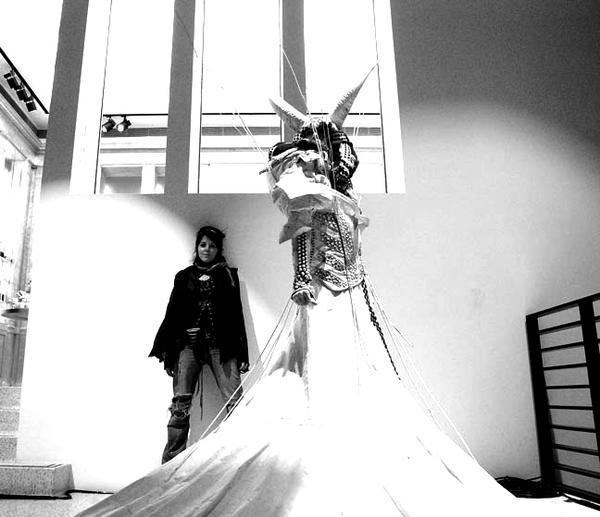
tiffa (née tiffany ann snead) was not just a fashion designer, she invented an entire aesthetic style. she was not just one of the founding members of a notorious performance troupe, she helped to create an entire subculture. she wasn’t just a visionary artist, she was a force of nature whose ripple effects inspired, and will continue to inspire, her closest friends and countless, thousands, of people who are likely not even aware that this is the woman responsible for their inspiration.
i barely knew tiffa, and i can easily say that she affected the course of my life.
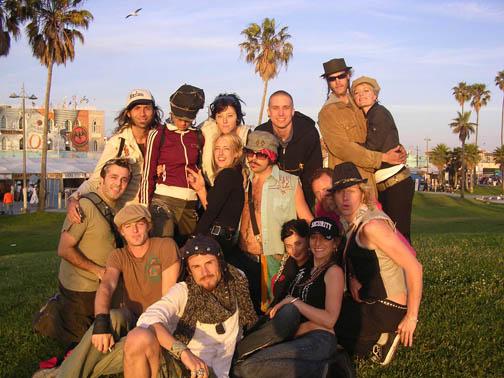
in the spring of 2004 i ran into an unusual-looking group of folks walking around venice beach. later i would describe the way this posse appeared at the time as superheroes in street clothes–from a street on a different planet. having previously worked with the dresden dolls in boston before moving out to LA, i had only one idea of what this gang could be. i went up to them and asked, “what are you guys? are you a band?”
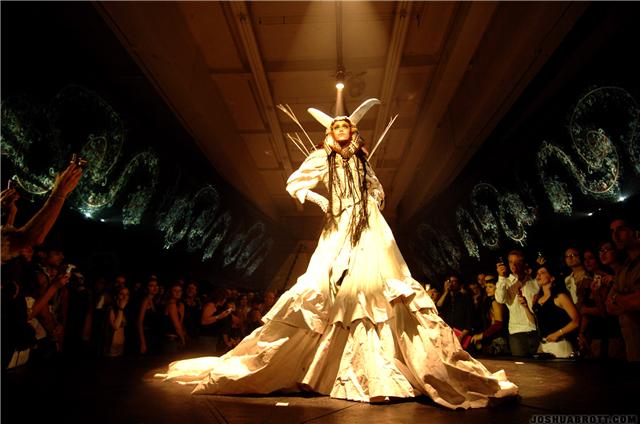
two months later i found myself at a seminal event in the los angeles underground. it was a fashion show for onda designs at a downtown warehouse. the fashions were tiffa’s, though i had no idea who she was at the time, and the people i met that night, and would meet in the years after who had been involved with the production of that night, would become some of my dearest friends and colleagues. the name of the party was “VITAL.”
in the scrapbook i have from that year, full of flyers and other mementos, i still have a flyer for VITAL, and underneath it, in a bout of prescience that completely astonished me when i rediscovered it looking through the scrapbook a few months ago, i had written the words:
“THIS CHANGED EVERYTHING.”
so i had known even then.
i had known immediately.
seven months after VITAL i became the production manager for an LA-based circus troupe called lucent dossier, which was just two months old at the time. five months after that i was working with lucent and the do lab on redbull’s ascension event, getting a hands-on, crash-course education in culture marketing from the experts in the field. (that event was also the first time i actually worked with el circo, 1 year after meeting them on venice beach.)
the night that 2005 became 2006 i was at the new year’s eve party put on by madison house and anon salon where i watched the dresden dolls and el circo perform on the same stage.
a year and a half later i was developing the marketing strategy for the do lab’s lightning in a bottle music festival, on which el circo were very significant collaborators. and now, six months after that, i’m writing this post on my marketing website, getting so nostalgically lost in the mystical, cyclical serendipity of all these events, that it actually made me manage to forget for a moment why i sat down to write this post in the first place.
by the time i’d become involved in this whole circus, tiffa had moved on to a new design label, ernte fashion systems, moved to bali where the production was based, and become a significant couture force from paris to tokyo.
i know this because many of my friends who have themselves become designers and gone on to start fashion labels are her friends, her artistic progeny, and have been inspired by the path she blazed and the creative visions she wrought.
in a 2005 SF-Bay Guardian article on the effect that the various groups within the burningman community have had on san francisco nightlife, and west coast underground dance culture in general, the writer paid particular attention to the legacy of el circo:
El Circo has fused a musical style and a fashion sense that are major departures from the old rave scene.
El Circo [is credited] with creating the postapocalyptic fashions that many now associate with Burning Man. Most of the original El Circo fashions, which convey both tribalism and a sense of whimsy, were designed by member Tiffa Novoa, who has since hit it big with her Onda Designs.
….That fashion sense has carried over onto the streets and into the clubs of San Francisco, giving an open and otherworldly feel to many parties.
….It can also be a personally transformative experience. “At first, this was all costuming, but now it’s who I am,” says Matty Dowlen, who manages El Circo’s operations and looks like a cross between a carny, a hippie, and a trapper.
…. “A lot of the women in El Circo were some of the most beautiful in the world, and [Novoa] dressed them up to look even more beautiful,” [Electronic musician Random] Rab says, noting that it changed how the denizens of El Circo conceived of themselves. “One day everyone was all hippied out, and then they were all tribal and tattooed.”
…. El Circo strives to cultivate a new kind of culture and communal ethos.
she was one hell of a powerful being. powerful enough to create a vision of the world that was so mesmerizing it enchanted a whole subculture and even managed to redefine people’s sense of self.
my love goes out to all my friends who are mourning her loss. she will be greatly missed. what she has created will continue to inspire countless others to pursue their creative dreams. it is bigger than life–or death.
this changed everything.
update:
“Tiffa Novoa, whose legendary creative and artistic impact will be forever felt, will be honored in a public memorial next week. All who knew her or were impacted by her life are invited to come and share space and memory. If you have a piece of her clothing, please feel encouraged to wear it. Also, in order to relieve her family and close friends of the necessary finances of this event, there is a suggested donation of $10. After the reception there will be a potluck gathering at a near-by park in the Oakland Hills.”
Memorial Service:
Monday, Oct. 29th
1:00 to 2:30pm
Chapel of the Chimes
4499 Piedmont Ave
Oakland, CA 94611
(510)654-0123