nobody but yourself

To be nobody but yourself in a world which is doing its best day and night to make you like everybody else means to fight the hardest battle which any human being can fight and never stop fighting.
— e.e. cummings

which is all quite noble and good, but the thing of it is, e.e., is that it’s very difficult, not to mention psychologically debilitating, to exist entirely out of cultural context. not only do human beings (and enough sad, shaky little monkeys that we don’t need to conduct this experiment anymore, please) suffer severe emotional and no doubt neurological damage when left in isolation, but in practical reality, whether it’s cultural heritage, gender, skin color, family education level, economic class, or whatever, the sum influence on “who we are” of certain variables of culture-caste is a bit tricky to evade. and in the end, even those that do manage to escape this influence in its entirety still don’t earn their own individual place in society anyway, cuz we just lump them into one big group called “crazy.”

that’s not to say that the rest of us aren’t, in fact, embroiled in a kind of nonstop battle like what e.e. was refering to, but it’s not exactly about the struggle to be nobody but ourselves in a world that is trying to make us like everyone else. rather it is about the anxiety of having to figure out how to EXPRESS who we want to be seen as in a world where the options keep expanding.

which is why “THE OFFICIAL GUIDE TO OFFICIAL HANDBOOKS” by andy selsberg, is a great bit of humorous salve on the battle wounds of that anxiety. by pitting the various Official This-Or-That (Preppy, Yuppie, JAP, BAP, Bobo Hipster–it’s like the star wars cantina, but real) handbooks against one another, it exposes, for a moment, the inevitable ridiculousness of the entire “we’re all different… in the same way” con game.

We tend to think our standards for the beautiful and good are natural and eternal. They aren’t. And you know who needs this analysis?…. Marketers. If business is about knowing how your customer thinks, then [these are] business book[s]. [They] tell you exactly how to jack all those fat baby-boomer wallets—whether you’re selling ice cream, a university, a book, a religion, or a company. When I see suits on planes reading business best sellers, I think: Wrong! Get some books that explain how groups try to reconcile their dreams of who they want to be with the social and economic realities of their world through the stuff they buy. Then get down to business. That’s what J. Crew did.

….dude! that’s what i’m talking about! i mean…like, literally.

you should totally check out selsberg’s fucking awesome article (and you may never take the cultural significance of a disproportionate use of such superlatives as “fucking awesome” for granted ever again once you do, dear reader).

here’s a fun timeline of all the Official handbooks referenced in his article.
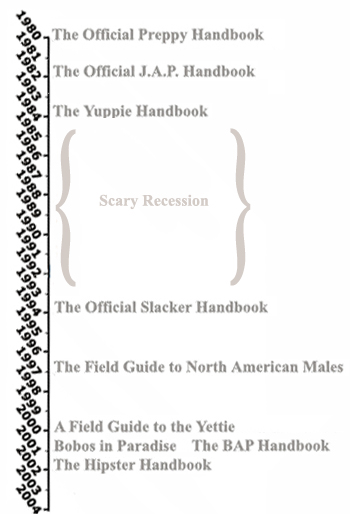
timeline2.jpg

1980 – The Official Preppy Handbook
“Prep Sex: A Contradiction in Terms”

1982 – The Official J.A.P. Handbook
(that stands for Jewish American Princess, by the way)
“At the very core of the female Born JAP aesthetic are two guiding principles: 1) I am terrific; 2) Daddy will pay.”

1984 – The Yuppie Handbook
“Thou shalt have no other gods before thyself.”

1994 – The Official Slacker Handbook
“Part old-fashioned bohemianism and part fin de siècle exhaustion, placed against the backdrop of a crappy recession and intolerable suburban irony.”

1997 – The Field Guide to North American Males
“Wanna come over and watch The Simpsons?”

2000 – A Field Guide to the Yettie
Yettie = Young Entrepreneurial Technocrat

2001 – Bobos in Paradise
Bobo = BOurgeois BOhemian.

2001 – The BAP Handbook
(BAP = Black American Princess)
“Any name beginning with ‘La’ or ‘Sh’ and ending in -ima, -ika, -isha, and -ita is never considered by BAParents.”

2002 – The Hipster Handbook
This old vocabulary? I’ve had it since I was twelve.

and while you and i wonder what’s up with the delay on the Official G Handbook, the Official Cholo Handbook, and the Official ABC handbook, we can at least entertain ourselves with the hipster olympics in the meantime:




Subscribe for more like this.


“getting” web 2.0


(not everyone’s a great photographer. da’s ok.)

one of the projects i’m currently working on involves cleaning some wreckage from a web 2.0-style mess that was never resolved, and is coming back to haunt the client. it’s not huge, but it’s a template, i think, for ways in which web 2.0 messes get made in general, and may point to helpful tips in avoiding even bigger spills.

1. NOT EVERYONE GETS / WILL GET / SHOULD BE EXPECTED TO GET WEB 2.0
it’s easy to hallucinate that once we outgrow the infancy of this whole online community development/management process, everyone will just intuitively “get it,” but that’s about as likely as all of us who have never known a universe without cameras being born innately expert photographers. unlikely. community management is a skill. everyone complaining about how all those old geezers don’t “get” web 2.0–what’s going to be the excuse when there are people younger than you coming up not getting it? ok, by “get it” i mean, “trained in it.” specifically how it works from the back end. obviously everyone wants more participation and interaction, but that’s the “front end” of web 2.0. that’s like in the front end of photography everyone does, in fact, now understand what to do when there’s a camera pointed at them. that part’s pretty simple. “getting” the back end of web 2.0 is about understanding how to enable, manage, and not accidentally carelessly wreck these delicate processes. that’s the kind of thing that takes training, much like any other SKILL. are there 700-level college courses on “community management” required for that marketing degree yet?

2. YOU DON’T HAVE TO GET IT. IT’S OK.
ok, there may also be a little bit more to it than just training. one of my best friends jokes that i’m so right-brained i lean. if you and i ever go out to dinner with a lot of our friends i am the last person, literally, you’d want to be asking to figure out who owes how much and how much each person needs to put in for a tip. i don’t get math, and despite what all my high school math teachers insisted, that’s OK. see? now you know, and you will never expect to rely on me to calculate anything for you. it’s ok.

3. IF YOU DON’T GET IT, DON’T MAKE DECISIONS ABOUT IT.
you wouldn’t send out a press release without a publicist’s involvement, so why the fuck would you make decisions about web 2.0-related issues without first consulting an expert? it’s probably because you’re not aware that there is an “IT” to it that you don’t “get,” i guess. i’ve heard that saying “i didn’t know what the speed limit was” is a great approach to take when getting pulled over. this is perhaps the point we’ll get to after the infancy is over. people will at least recognize that there is a concrete, specific “IT” that they may or may not be getting.

4. NOT EVERYONE IS GOING TO KNOW THAT YOU DON’T GET IT
if the receptionist screws up and accidentally transfers someone over to you who was supposed to have gotten connected to the sales dept., and you happen to be a graphic designer, are you going to pretend like you know anything about pitching? probably not! you’re probably going to let the person know you’re not quite the right dept. to be talking to, and as quickly as humanly possible, i’d imagine, get that call away from you to one of those sales people who’s actually equipped to handle it. i hope you see where i’m going with this. just because you’re approached to make a decision about something that you don’t “get” doesn’t mean you ought to. you wouldn’t want the sales folk mucking around with your design.

5. WHOEVER YOU HIRE TO “GET IT” OUGHT TO UNDERSTAND HOW TO FIX IT
this one deserves a whole other post unto itself. maybe a whole other blog. maybe a whole other graduate-level college course, and to be honest, i’m actually pretty exhausted from this day, and from this entry…. but i’ll say this: the web seems to be  almost catholic in its obsession with sin and repentance. so if you done sinned, finding yourself a good priest is the way to go.


Subscribe for more like this.


rebranding enlightenment

in light of the previous post, a friend suggested i redevelop the ad for the enlightenment card to make it more relevant to a consumer identity that would actually find the product appealing.

i only had five minutes tho, so here’s the best i can do:

enlightened.jpg


Subscribe for more like this.


the new and improved enlightenment lifestyle

as a marketer you realize that it’s not so much that you’re really setting anything up for sale, it’s that everything already IS for sale, and you’re just helping it along. so it’s not so much that i’m bothered by the selling of “enlightenment,” (there’s been buddha statues on-sale for millennia, and what are THOSE selling?) but rather it’s that i find the whole “enlightenment lifestyle,” kinda… icky.

today on the website for the san francisco green festival conference i discovered a publication called what is enlightenment magazine, published by enligntennext, which is “defining the contours of a new revolution in human consciousness and culture.” (it’s essentially not doing anything different than any punk band or public enemy-era hiphop act professed to be doing. it’s just targeting a different audience.)

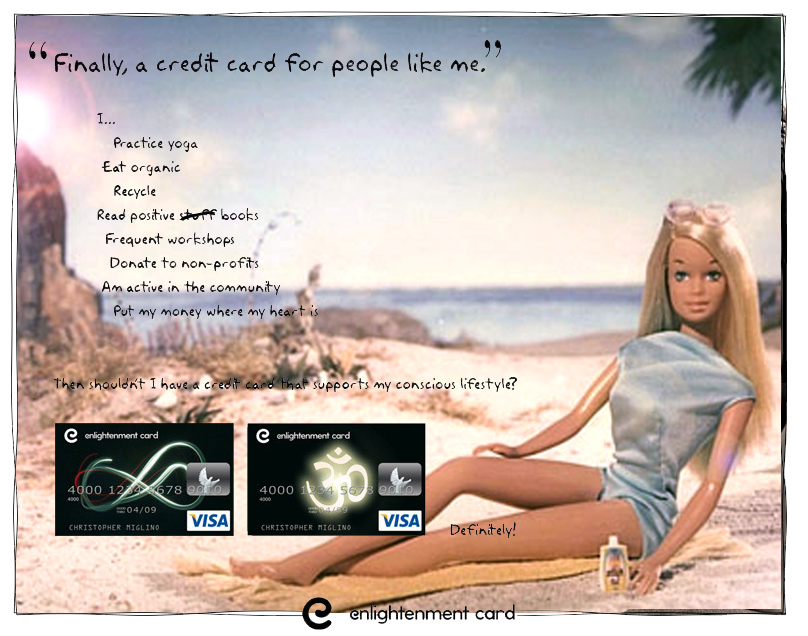
my first encounter with companies targeting this demo was when we were soliciting sponsors for LIB and were approached by the “enlightenment card”:

http://www.enlightenmentcard.com/images/splash.jpg

(in case you’re wondering, yes, the card IS real, no that ad is NOT a joke, and we said “no, thank you” to the offer.)

while on the one hand, i’m trying to think of where else do sheltered caucasian people get to evangelize a brand of appropriated cultural imperialism with such tactless self-righteousness and get away with it, on the other hand, from a technical standpoint, i’m completely impressed.

this is everything i preach about identity marketing in action.

in robotics, there is a theory of the “uncanny valley“:

The hypothesis states that as a robot is made more humanlike in its appearance and motion, the emotional response from a human being to the robot will become increasingly positive and empathic, until a point is reached beyond which the response quickly becomes that of strong repulsion. However, as the appearance and motion continue to become less distinguishable from a human being’s, the emotional response becomes positive once more and approaches human-to-human empathy levels.

This area of repulsive response aroused by a robot with appearance and motion between a “barely-human” and “fully human” entity is called the Uncanny Valley. The name captures the idea that a robot which is “almost human” will seem overly “strange” to a human being and thus will fail to evoke the empathetic response required for productive human-robot interaction.

maybe there is an uncanny valley in the process of identity expression as well. the more a brand or a product makes it easier for people to express their identity the more palatable it is, until maybe it hits a certain point where it becomes so blatant that its appeal suddenly drops off. however, as this brand’s identity-expressing qualities continue to become more innate and nuanced, and less overt it once again becomes appealing. maybe it could be called the uncanny “wannabe valley,” the place in brand authenticity/relevance that will likewise “fail to evoke the empathetic response required for productive human-brand interaction.” (cuz brands are robo–i mean, people too.)

one of the explanations for the uncanny valley phenomenon is that the robots stuck in no-man’s land elicit revulsion because they look “dead,” and biologically we’re wired to have an aversion to corpses, cuz stickin around doesn’t bode so well for the immune system. (makes you wonder tho if necrophiliacs collect weird lookin robots). but when it comes to identity, the brands (and people) stuck in the uncanny wannabe valley turn us off because they’re “fake.” in a similar sort of way, biology may have led us to respond with distaste to “fake” people (and by proxy brands now) because they are untrustworthy. from a social selection standpoint, they may even be community saboteurs.

the funny thing in all of this is that there’s nothing actually WRONG with the enlightenment card except its name. if you have to have a credit card, why NOT get one that’s gonna let you earn points towards, like, trips to spas in costa rican rain forests, right?

while no doubt one person’s fake is another person’s orgasm, it just feels like confusing a lifestyle for an expression of “enlightenment,” is kinda, um, you know…. BOGUS!


Subscribe for more like this.