Having worked in the music industry for the better part of my career, with concert promoters, music festivals, and musicians, this is a topic very near to my heart — you may even recognize a few passages in the deck from my recent All Your Music Are Belong To Us post — but the trends and ideas presented below are as relevant to the biggest consumer brands, or the indiest creative capital producers as they are to music acts. So without further ado, here’s how you Connect or Die:
.
“They say the music business is in trouble. No! The business of selling CDs is in trouble; this is a religion.”
– Michael Rapino, CEO, Live Nation
I was in the weekly Southern California marketing meeting at House of Blues the morning it was announced that Tower Records was going out of business. It was a Friday in 2006, and the marketing departments from LA, Anaheim, and San Diego were all on the conference line. The moment I heard the news I wanted to get up and cheer, but as I looked around I saw only fallen faces. The other cities on the call were silent. A mourning pall had fallen over the rest of the room, but all I felt was a complete excitement. I was the youngest person there.
When I was in high school my friends started burning CDs with mp3s. In June of 1999, same time as I was walking up in my cap and gown to accept my high school diploma, a kid at Northeastern University unleashed Napster into the world. It was a few months later, when I got to college at Boston University, just a few miles up the road from Northeastern, when I first heard about this program everyone was using to find and share music. College has always been the setting for waves of new discoveries, from drugs, to new perspectives. At the fin de siècle, what most of us encountered for the first time in the dorms was high-speed internet, the gateway drug to more hardcore file downloading. Napster spread like wildfire across Boston campuses, and then beyond. At first it never occurred to us that there could be anything wrong about using it. The arrival and adoption of Shawn Fanning’s creation was so inextricably linked with my and my cohort’s transition from high school to college, it seemed like just another new thing that being 18 gave you access to, like nightclubs, or cigarettes. It felt like such a natural technological progression that when Napster was ultimately forced to shut down in 2001 it was hard not to see it as a devolution. That a fellow student’s invention had been deliberately destroyed was a lot easier to understand than the reasoning of the faraway, suddenly ominous music industry. It had the feeling of repression, an attack on innovation itself, let alone on the access it offered, and it left a bad aftertaste.
By the time I was out of college and working in the concert industry it had long become clear that shutting down the iceberg had not saved the Titanic. Things had vastly deteriorated. In the depths of the music industry’s despair, the October 2006 issue of Wired Magazine dared boldly proclaim that “The Rebirth of Music” was nigh:
Record labels have always been the center of gravity in the industry – the locus of power, ideas, and money. Labels discovered the talent, pushed the songs, and got the product on the air and into stores. The goal: move records, and later, CDs. “The labels were never in the business of selling music,” says David Kusek, vice president of Boston’s Berklee College of Music and coauthor of The Future of Music. “They were in the business of selling plastic discs.”
The articulation of this concept of music that could exist on its own, liberated from CDs, or any other physical medium, expressed how I, and my generation, had already understood music to be. When Tower Records announced it was going out of business that Friday morning, the first thing I could think was:
The Future is here!
It was the same month as the “Rebirth of Music” issue came out.
Of course, my desire to celebrate upon discovering music was, indeed, about to be reborn out of the ashes of CD stores was completely out of sync. For everyone else in the room — even though we, ourselves, were in the business of selling something that didn’t come on a plastic disc — it was like the day the music died.
But wait, let’s back up a few months. In the Summer of 2006 Live Nation bought House of Blues. After separating from parent company Clear Channel the year before, the concerts division was rebranded Live Nation, and went on a shopping spree like it was Google. From fan club operator Musictoday, to music merchandising company Trunk LTD, to, seriously, countless concert promotion companies and music festivals around the world, if you were sitting still for too long, Live Nation would buy you. Towards the end of the year, on the eve of the House of Blues merger approval, we gathered for a series of company-wide conference calls with Michael Rapino, the CEO steering the company in this new direction, and it was on these calls that I heard, for the first time, someone in our business who not only saw the same future that I (and Wired) expected, he understood exactly what it meant.
In October 2007, a year after Wired’s augury, and after 25 years at Warner Brothers Records, which had release all of her albums up till then, Madonna left the label to sign a $120 million “360 degree” deal with Live Nation. In addition to operating the world’s highest-earning female singer’s tours, which it had already been doing, Live Nation would now also be handling her albums, merchandising, film and TV projects, DVD releases, music-licensing agreements and more, and getting a cut of all of it, hence “360.” This move was so revolutionary that most people didn’t even get it. According to a Fortune article, in November 2007, Live Nation’s stock sagged 30% after news of the Madonna deal. The myopic reaction — based on an understanding of the music industry as defined solely by the already broken record label model in which dumping dollars into artists was nothing but a sure loss — prompted an emergency presentation to analysts and investors, with Rapino having to actually explain how this was an entirely different approach, and why it made sense. “Of course [analysts] have to go out and tell the world we overpaid,” Rapino said in the article, “And we did overpay, if you’re just buying the record. But when you’re buying all those rights, it’s a beautiful deal.” If Madonna does four tours and three albums with revenues comparable to her recent output, it was projected the contract would pay for itself in 10 years with profits from merchandise, sponsorships, DVDs, and on and on.
In a statement issued at the time of the deal, Madonna said: “The paradigm in the music business has shifted and as an artist and a business woman, I have to move with that shift. For the first time in my career, the way that my music can reach my fans is unlimited. I’ve never wanted to think in a limited way and with this new partnership, the possibilities are endless. Who knows how my albums will be distributed in the future?”
But you know what? Who cares how? How had stopped mattering anymore. Under this model, every downloaded song would become not an act of theft, but a process of promotion for all the other things that couldn’t be copied online. As Madonna’s manager, Guy Oseary said in the Wall Street Journal, “In the past, people would tour to promote their albums; today they put out albums to promote their tours. The pendulum has swung, and Live Nation is at the forefront of touring.”
Unlike so much else in the music industry, this arrangement actually works in both the suits’ and the artists’ favor. To a large extent, the interests of artists and their concert promoters are already far more closely aligned than with their labels, and to drive this point home, as part of the deal, Madonna got equity in Live Nation to the tune of 1.7 million shares. A mutual investment between artist and industry is a complete turnaround from the label relationship, which has generally consisted of record companies tossing artists onto the sacrificial fire, hoping to gain favor with the gods. By now, three years later, U2, Jay-Z, Shakira, and Nickelback have also eschewed the traditional record label route for similar kinds of deals with Live Nation, and no doubt more are to come.
But record labels aren’t the only middlemen Live Nation has sought to remove from the equation. On those company-wide calls in 2006, Rapino talked about the importance of owning the relationship with music fans directly, which included the ticket purchase process itself. The contracts with Ticketmaster for both Live Nation and House of Blues were to be up within a couple of years at the time of the merge, and they would not be renewed. The idea was for concertgoers to start buying tickets directly from livenation.com, but from the very beginning there was a much greater goal as well. In 2007, Live Nation began experimenting with a program called OPEL — Open Platform Event Listings. Promoters for venues not operated by Live Nation, i.e. its competitors, were invited to have their events listed on livenation.com as well. The program never got too far off the ground (no doubt, for reasons that will become obvious below), but by the time the contract with Ticketmaster finally expired last year, it was already clear that Live Nation’s moves were about far more than even just owning its own vertical ecosystem.
The schism between Ticketmaster’s largest account by far, and Live Nation’s relationship with a company that already had the massive ticketing infrastructure it needed, made it a no-brainer that within just two months of this trial separation Live Nation would seek to buy Ticketmaster outright. Last week, the Department of Justice finally approved, with some concessions, the first big merger of the Obama administration.
In the wake of the Department of Justice giving the green light to a merger between promoter/venue owner Live Nation and ticketing agency/management firm Ticketmaster Entertainment, Mitchell Frank, [owner of Spaceland Productions, which promotes events at three independent LA venues] suddenly finds himself in the unenviable position of making money for the competitor.
Spaceland Productions has 15 months, Frank said, remaining on an exclusive contract with TicketWeb, the once-indie ticket seller now owned by Ticketmaster. “To make money for that behemoth, it turns my stomach,” Frank said. “I’m an indie promoter, and that’s what I do. So it’s kind of tough to give money to the mother ship.”
Frank was interviewed by the Justice Department and expressed concerns that he said appear to have gone unheard, largely that an approved partnership would have him working — and potentially providing information for — his competitor.
The newly formed Live Nation Entertainment… has the ability to book concerts, sell tickets and merchandise, and, with management company Front Line, direct access to such name acts as the Eagles, Jimmy Buffett, Neil Diamond, Van Halen, Fleetwood Mac, Christina Aguilera and more.
“That’s where the concern is,” said Jordan Kurland, whose Zeitgeist Management represents Death Cab for Cutie, She & Him, Grizzly Bear and more. “When you look at the intersection of Ticketmaster, Live Nation and Front Line? Information is power, and they will have a lot of it.”
Addressing the company’s vertical integration powers would have been a near impossibility, said one Washington, D.C.-based antitrust expert familiar with the proceedings. Many, including Mickelson in the Tribune, have cited the 1948 U.S. Supreme Court antitrust decision against Paramount Pictures, which essentially stated that Hollywood studios could not also own the theaters that had exclusive rights to show their films.
“The courts have been very favorable to vertical integration for 40 years,” said the antitrust expert, who agreed to speak only on condition of anonymity. “I like going back to Paramount vs. U.S. also, but that’s a very old case, and there have not been any vertical mergers blocked in about 40 years.”
In 2008, Ticketmaster had a market share of more than 83% for major venues, according to concert-industry tracking publication Pollstar. Its nearest competitor’s share was just under 4%. The Department of Justice said that breaking up prior contracts with Ticketmaster and TicketWeb would have done little to preserve competition in the ticketing space, adding that “a lot of the [venues] would not have wanted that.” The department estimates that 20% of Ticketmaster’s exclusive arrangements will expire each year and intends for venues and promoters to have more options when they do. In the meantime, however, Ticketmaster already retains information such as emails used to make purchases. Many of those emails came in through tickets bought to Live Nation events, but, then again, others did not. Now that Live Nation and Ticketmaster are one, who do all those ticket-buyer emails belong to? Live Nation Entertainment now has access to an enormous share of not only the concert industry, but of the actual concert-going population. Perhaps not 83%, when all is said and done, but still, through its competitors, it’s inevitably larger than what it actually even owns itself.
In the olden days, when labels dominated the system, they still had to share power with one another. The upheaval in the music business over the past decade, however, as the recording industry more or less tried to stick their fingers in their ears and go lalalalaalalalala hoping to ignore it into going away — oh, wait, they DID try experimenting with suing their own fans to see if that might be a viable way to make money — left the industry vulnerable to someone, anyone, with a clear understanding of changing consumer behavior, and the unclouded vision to see where the game was going. Not that it’s exactly the same, but after the Soviet system collapsed in the 1990’s, Russian organized crime exploded because basic government functions — such as social security, the pension system, some electrical grids, dispute settlement and the distribution and protection of property — either disappeared or were hopelessly inefficient. Organized crime had the impunity to take advantage of the general chaos, but just as importantly, if not more so, in the void left behind by the state, it had the actual organization.
Though, thankfully, this isn’t post-collapse Russia. The Justice Department said in legal filings that the merger, as initially proposed, would eliminate competition in the market for ticket sales, creating less pressure on the fees charged and potentially less innovation. No existing player, they said, would have the resources to compete. So in order for the $889-million deal to proceed, the two companies had to agree to make room for a couple of rivals. Under the agreement, Ticketmaster will give Anschutz Entertainment Group access to its technology so that AEG — which owns and manages nearly 100 venues including Staples Center — can create its own ticketing service. Additionally, Ticketmaster agreed to divest a subsidiary that provides software for venue operators to sell their own tickets. But for Live Nation, ticket sales are just the tip of the iceberg. Even as tour revenues are rising, the margins in the concert industry are, as they have always been, anemic. According to Fortune, Live Nation’s cash-flow margins were 4.3% in 2007. Which is why what Live Nation is really after isn’t just being the iTunes of tickets but something that the other players in the music industry never understood they should have been after all along — or at least not until it was too late.
If you were to remove selling plastic discs from the entire music equation, the most profitable thing on the table becomes not just concerts, but the larger relationship between artists and fans. It’s why labels are pushing their own “360 degree” deals now (not that they really had any other choice, seeing as their primary revenue stream dried up like a fossil fuel) but inevitably, since labels don’t own or operate their own venues, it’s a smaller circumference. The Wall Street Journal recently wrote about the notable example of Lady Gaga, whose merchandise, touring, and Polaroid, Estée Lauder, and MAC contracts revenue is basically the tent-pole holding up all of Interscope. It’s the relationship artists have with their fans that drives the sales for everything else their brand is connected with, and owning that relationship is what the rebirth of music…. of the music business is really about. Right now, with the ability to book its own concerts, sell its own tickets and merchandise, and manage its exclusive artists all under one roof, Live Nation Entertainment has an entirely unprecedented model for owning the complete fan relationship from tickets to trinkets. A decade after Napster, the relationship with music fans IS the music business, and Live Nation is after owning that business on a massive scale. After the B.C. / AD digital changeover, control of the music business has shifted from the recording to the performing side of the industry, and Live Nation isn’t so much a monopoly in the music industry as it actually IS the music industry. If not yet fully in application, then in its model.
During their New Moon promo tour a couple of months back, the Twilight Trio was on Jimmy Kimmel Live, and at the end of the show Kimmel let a few people from the audience ask questions of the cast. A girl came up to the mic with a question for Taylor Lautner. “I really like your shirt,” she said. “I was wondering, can I have it?” The running joke about New Moon, of course, is the extent of the shirtlessness perpetrated by Lautner’s character and his werewolf brethren. (It’s gone so far, in fact, that Lautner, who beefed up special for the role, has vowed to never appear shirtless in a movie ever again.) As Lautner struggled in response to keep from losing his shirt and his dignity, Kimmel, possibly the oldest person in the entire studio at that moment, interjected, “You know, I think people would look down on men for demanding the shirt off a woman.” Yet that this interaction seemed totally acceptable and par for the course to the otherwise teenage audience struck me as an indication of a potentially far lager trend a few days later, when I saw “The Christian Side Hug” video.
If you’re wondering what on earth is that?? The “Christian Side Hug” is a rap performed by a group of white kids at a Christian youth gathering, about a way of hugging while standing side by side with someone as opposed to facing one another and putting your arm around their shoulders or waist, because, “front hugs be too sinful.” Despite ultimately turning out to have been intended as insider “satire” (though not before passing very convincingly as both 1. A typically “ass-backwards” — to employ a Palin-ism — move from the abstinence movement of promoting celibacy while sexualizing even mundane forms of human contact, as well as, 2. A reason to weep quietly for the final, ignominious death — like a sad toothless crack-addict in an abandoned alley — of hip hop), I happened to see the Christian Side Hug video on the same day as the fallout from Adam Lambert’s American Music Awards performance, and to me there was a certain similarity between the two.
In case you happened to have missed it, or hearing about it, Lambert put on a rather racy, sexually scandalizing live performance at the awards show.
Perhaps confusing the AMA’s with the MTV Movie Awards, which have no problem rewarding male makeouts, or, more likely, shrewdly pushing the envelope hard on the night before his debut album release, in his first televised performance since the finale of American Idol, Lambert “shocked” the audience at Los Angeles’ Nokia Theatre and the millions watching live on ABC by closing the show with a risqué rendition of “For Your Entertainment,” the first single of his album of the same name. Highlights from the controversial performance included simulated oral sex from a male backup dancer, a make-out session with his male keyboardist, and a giant mirrored prop set up on the stage so the audience could see the looks on their own shocked faces.
According to Rolling Stone, the producers of the show weren’t informed about the guy-on-guy kiss in advance, and after the show, Lambert told the magazine the musician he kissed is a straight man. In the aftermath, ABC canceled Lambert’s Good Morning America appearance slated for the next day, which of course only helped generate even more attention and fanfare for the artist, who has clearly become an expert at navigating the myriad controversies he’s racked up. To me, what connects Lambert’s performance and the Christian Side Hug and the Kimmel incident, as well as endless other examples from our current pop culture, extends beyond any particular sexual orientation and includes even abstinence itself. It’s an underlying aggressiveness to sexuality in general: agro-sexuality.
To be clear, I’m not talking about aggression enacted through sex, but rather about a militancy in the display of one’s approach to sexuality. The past decade’s proliferation of online profiles, digital cameras, and all manner of social technologies has demanded we approach basically every other aspect of our modern identities as a performative display. It only makes sense that sexuality wouldn’t be exempt.
When I was a teenager in the late 90’s the general approach to sexuality could easily have been described as “come as you are.” Kurt Cobain had died the year before I started high school, Britney Spears’ first album wouldn’t come out until I was halfway through, and in between there was a lot of Green Day, Jewel, Fugees, and REM. Rap was still busy beefing between the coasts to have gotten fully pornified yet. Heroin Chic, an aesthetic glamorizing a drug that destroys sex drive, was all the rage. Even Madonna was, by this time, more interested in acting and electronica than vogueing or kink. And AIDS was huge. People were still dying of AIDS then. As opposed to now, when people are living with it. Kids were obviously still having sex, but since there was some semblance of sex education going on under the Clinton administration they were getting pregnant a lot less than in the “abstinence-only” Bush era. Basically, aside from the effort pushing the word “safe” in front of it, sex in the 90’s was not something to get particularly militant about.
Of course, there was the gay rights movement, but by the time Ellen Degeneres was making the cover of Time for admitting, yep, she’s gay, it had already long been transmogrified from Activism to Pride. And perhaps it’s this shift from social justice to self-expression that is the root of Agrosexuality in general. After all, what are purity rings if not emblems of Abstinence Pride? And in some basic way, even the demand for the shirt off Lautner’s back was as much a performance of sexuality as was Lambert’s on the AMA’s.
Go to the schools, talk to the kids, and you’ll see that somewhere along the line this generation has started to conceive of sexuality differently. Ten years ago in the halls of Stuyvesant you might have found a few goth girls kissing goth girls, kids on the fringes defiantly bucking the system. Now you find a group of vaguely progressive but generally mainstream kids for whom same-sex intimacy is standard operating procedure. These teenagers don’t feel as though their sexuality has to define them, or that they have to define it, which has led some psychologists and child-development specialists to label them the “post-gay” generation. But kids like Alair and her friends are in the process of working up their own language to describe their behavior. Along with gay, straight, and bisexual, they’ll drop in new words, some of which they’ve coined themselves: polysexual, ambisexual, pansexual, pansensual, polyfide, bi-curious, bi-queer, fluid, metroflexible, heteroflexible, heterosexual with lesbian tendencies—or, as Alair puts it, “just sexual.”
Even the nouveau-celibacy of the abstinence movement is an option on this spectrum, its appeal (if not necessarily its effectiveness) one kind of response to all these overwhelming new choices. As alternative sexuality has become more mainstream, and sexuality moves from self definition to self expression, what has emerged is a new agrosexual attitude that really wasn’t there 10 years ago. There’s an expectancy of an in-your-face show of sexuality — whatever yours may be — as part OF sexuality itself. It’s by no means anything new, but it used to be employed by those who’d followed alternative sexual paths, flying their freak flags as a social statement, or for deliberate shock value, now, however, as the sexual mainstream is fragmenting along with the cultural one being agrosexual is par for everyone’s course.
In her LA Times article on Lady Gaga — likely as close to the embodiment of agrosexuality as a generation could hope for — Ann Powers writes:
Having gotten her start in the bohemian enclaves of downtown New York City, Gaga is deeply indebted to Warhol’s “Superstar”-oriented Factory scene and its aftermath, which produced drag performers like Candy Darling, artists such as Robert Mapplethorpe and streetwise rock stars including Lou Reed and Patti Smith.
“The idea is, you are your image, you are who you see yourself to be,” she said. “It’s iconography.”
Warhol supported and exploited a coterie of outsiders who likely would never have emerged from their corners without his help. Gaga takes control but also shows herself losing it; she blurs the lines between self-realization and self-objectification, courting the dangers of full exposure for a generation of kids born with camcorders in their hands.
Though she talks nonstop about liberation, Gaga’s work abounds with images of violation and entrapment. In the 1980s, Madonna employed bondage imagery, and it felt sexual. Gaga does it, and it looks like it hurts.
She says she wants her fans to feel safe in expressing their imperfections. “I want women — and men — to feel empowered by a deeper and more psychotic part of themselves. The part they’re always trying desperately to hide. I want that to become something that they cherish.”
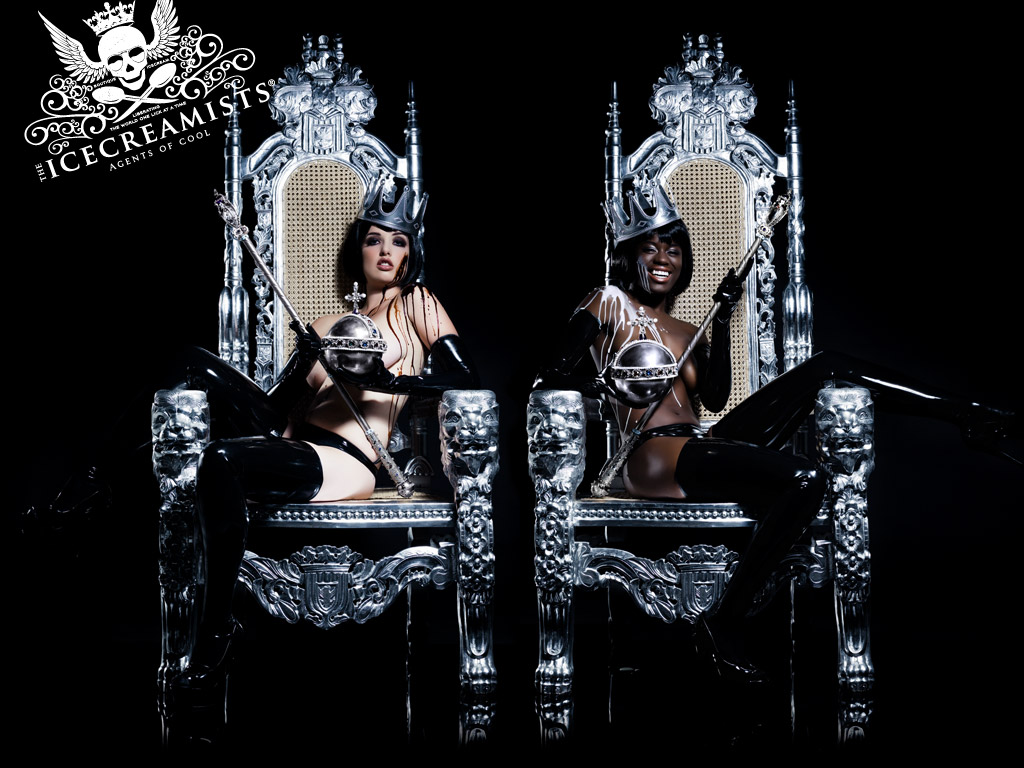
Let’s face it: this year will be rawer, more opinionated, more risqué, more in your face than ever before. Your audiences (who are by now thoroughly exposed to, well, anything, for which you can thank first and foremost the anything-goes online universe) can handle much more quirkiness, more daring innovations, more risqué communications and conversations, more exotic flavors and so on than traditional marketers could have ever dreamed of….We’ve dubbed this MATURIALISM (mature materialism),
In fact, the image at the top of this post is an ad for UK ice cream brand The Ice Creamists, mentioned in the Trendwatching post as an example of Maturialism in action:
Trendwatching suggests that if they want to keep up with culture, brands need to mirror the current societal norms that are “about anything but being meek.” In other words, this isn’t just for teenagers and pop stars; brands need to get in on the agrosexual action, too.
Note: This is actually way better if you’re first seeing it during a Dollhouse commercial break on Hulu, without the spoilers of the youtube video title and static screen (below) giving away what you’re about to see.
In the course of just 30 seconds the ad takes you on a ride of intrigue and suspense that manages to tell a whole epic saga (literally) in a highly entertaining, insightfully modern way. No wonder the campaign is called “Search Stories.” It’s like “Hamlet: (Facebook News Feed Edition)” meets The Usual Suspects. And just as you’ve put the pieces together, and it’s dawning on you who the Kaiser Soze behind these searches is, it’s over.
.
Makes you want to watch it a second time.
Search Stories is such a smart response to the Microsoft’s “It’s time to Bing and decide” campaign earlier this year for their new search engine. Because the truth about how we search for things online, is the truth about how we think about and live our lives — as exemplified here by Bruce Wayne’s. Life is an ongoing story we create. It’s not simply a string of isolated queries and decisions, it’s a series of searches and discoveries.
To the extent that any advertising works, the model in place at websites like Hulu and Fancast, that offer commercial-supported streaming video of TV shows and movies, is pretty damn effective. Unlike the 3-minute average TV commercial break, which most people Tivo past or click away for or simply go to the bathroom during, the 30-second “limited commercial interruption” on your online machine gets you to pay attention. 30 seconds isn’t enough to walk away for, after all. Sure, you can pause to answer nature’s call or email’s or SMS’s or whatever, but the remainder of the ad will play when you unpause. You can, at most, surf over to another browser tab, but nevertheless you’re still listening to the ad’s audio, and on several occasions I’ve gotta admit this was intriguing enough unto itself to get me to tab back. (The lazer-bassy sounding Asics ad with the Asian male model dude running through psychedelic milk formations is coming to mind).
At the same time, because the commercial interruption really IS limited — one ad per break — and often Hulu even offers a choice as to which ad you’d prefer to see and in what sort of format (a long-form ad before the program starts, with no breaks later on is also an option), it doesn’t feel nearly as offensive and imposing as the ads that you DO have time to walk away from on the teevee. The one thing that’s missing is a feature to click to see the ad directly, replay it, and embed or share it. Right now you still have to go over to youtube or elsewhere if you want to find the ad you just saw on Hulu (counter intuitive, no?) and sometimes you can’t even find the ad anywhere (the Timberland Earthkeepers ad where the sole of the shoe keeps morphing into all sorts of things like an eagle and a tire, etc, is coming to mind. I STILL can’t find that shit, and it was hella cool.)
As Hulu’s brand keeps growing — it overtook the big broadcast networks that own shares of it (ABC, NBC and Fox) in web traffic for the first time this past June — less, it turns out, really is more, paricularly when it comes to commercials. Now, how long until Hulu starts producing its own original content, you think? Let’s just hope Netflix (whose Red Envelope Entertainment division, responsible for licensing and distributing films such as Born into Brothels and Sherrybaby expanded to produce its own original content in 2006 only to close down just 2 years later in part to avoid competition with its studio partners) isn’t necessarily a permanent precedent.



 Record labels have always been the center of gravity in the industry – the locus of power, ideas, and money. Labels discovered the talent, pushed the songs, and got the product on the air and into stores. The goal: move records, and later, CDs. “The labels were never in the business of selling music,” says David Kusek, vice president of Boston’s Berklee College of Music and coauthor of The Future of Music. “They were in the business of selling plastic discs.”