Been meaning to post about this for a while, but been mad busy.
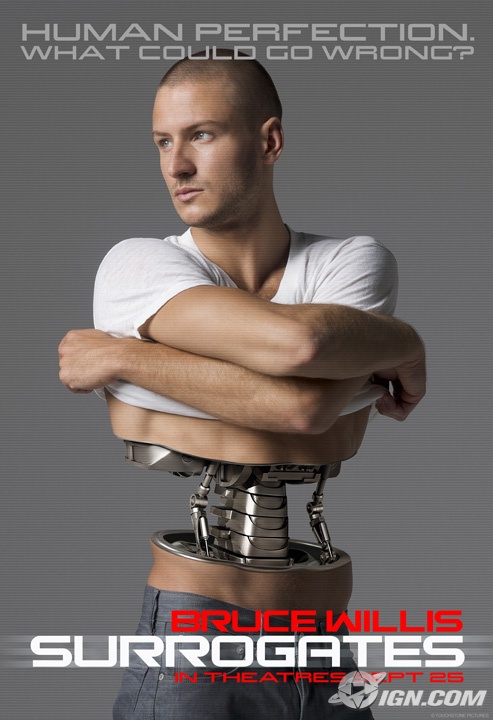
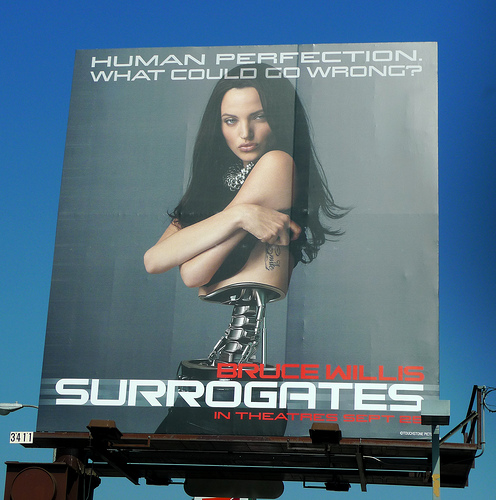
I’m super digging the ad campaign for the The Surrogates, due out September 25th. Based on the graphic novel of the same name by Robert Venditti, the world of the Surrogates is a future in which direct human interaction has all but ceased. Instead, people interact via surrogate androids, which they can design to manifest their most idealized form. If you’re balding you can have a surrogate with a full head of hair, f0r instance, or if you so desire, your surrogate could even be a different gender. It’s Second Life come to life: your perfect avatar, but in the flesh. Or ate least, flesh-like. These surrogate robots (which are owned much in the same way we own cars, with insurance and VIN numbers and whatnot) go out into the world to indulge in experiences without consequences, and through a sci-fi assortment of sensory inputs, their operators get to feel it all from the safety and privacy of their secluded homes. The movie stars Bruce Willis, but the ad campaign gives the star only a passing mention. Instead, the really clever thing about the Surrogates ads is how deftly they transpose the movie’s alternate reality into ours:
At first, glance, driving by, you think, from the poses of the models that the billboards they’re on are probably advertising some sort of industrial-themed new jeans brand or something. But after a few moments you begin to realize there’s something off here:
And the question the billboards keep asking starts to sink in:
The ads succeed not by ADVERTISING the movie, but by projecting the very vision of the future portrayed in the movie –beautiful, doomed– seamlessly onto our daily reality.
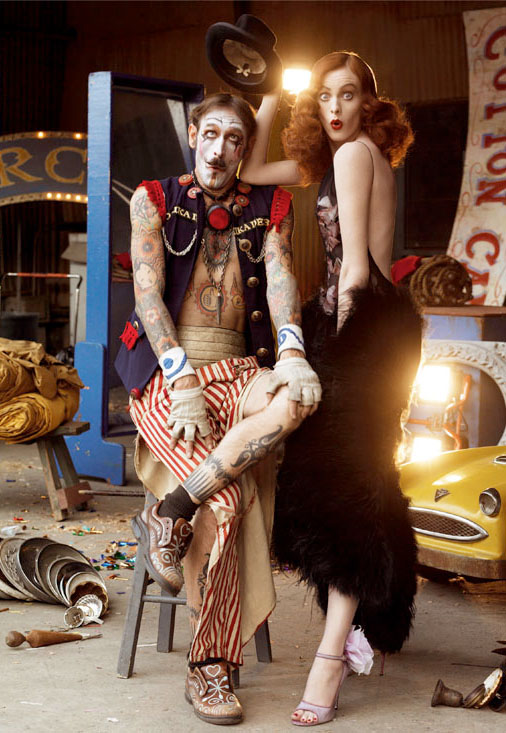
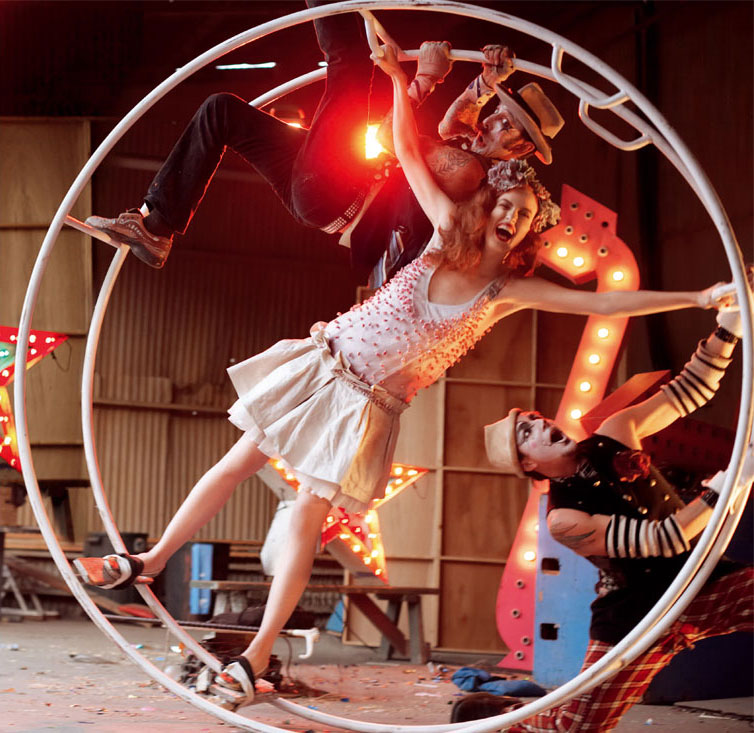
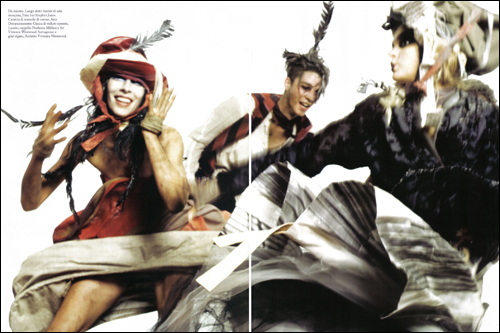
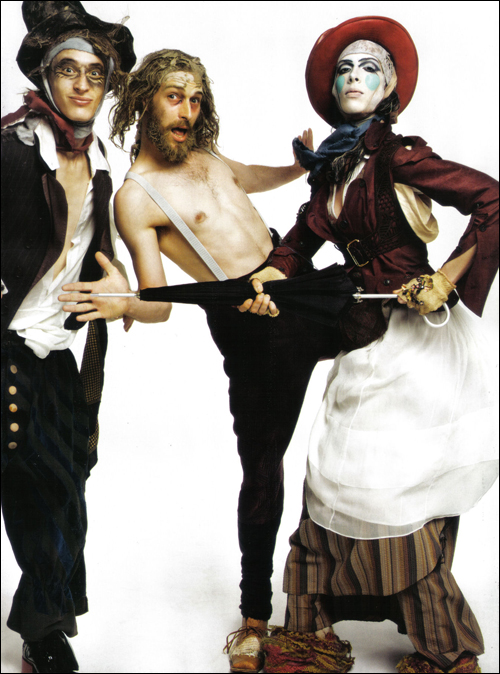
In April 2007, Italian Vogue featured an editorial spread by photographer Steven Meisel, entitled “The Greatest Show On Earth,” which featured members of L.A. circus troupe, Lucent Dossier:
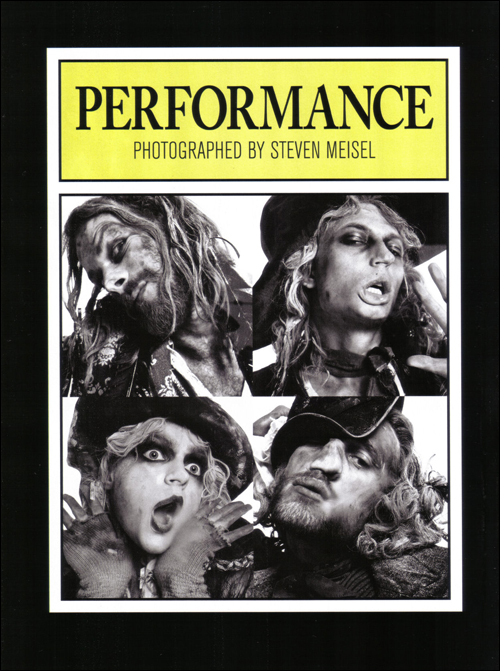
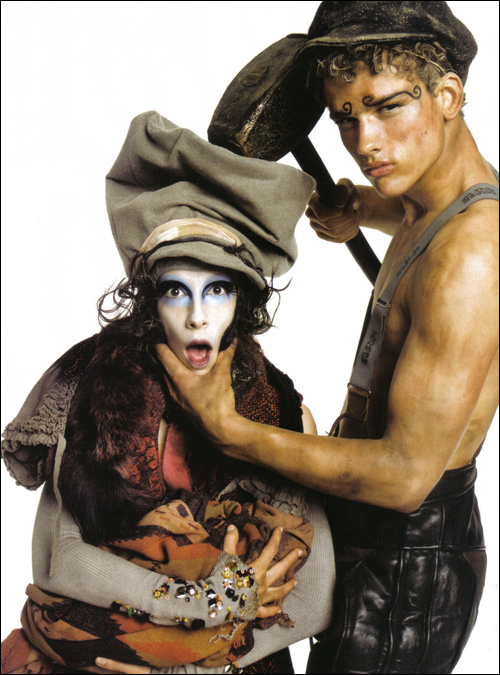
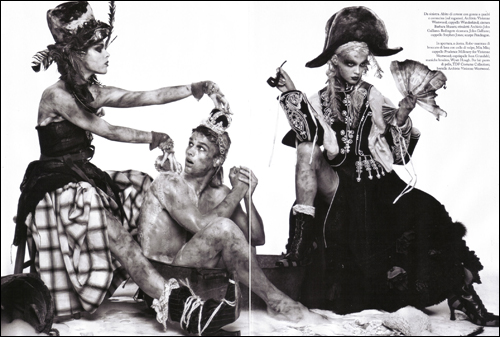
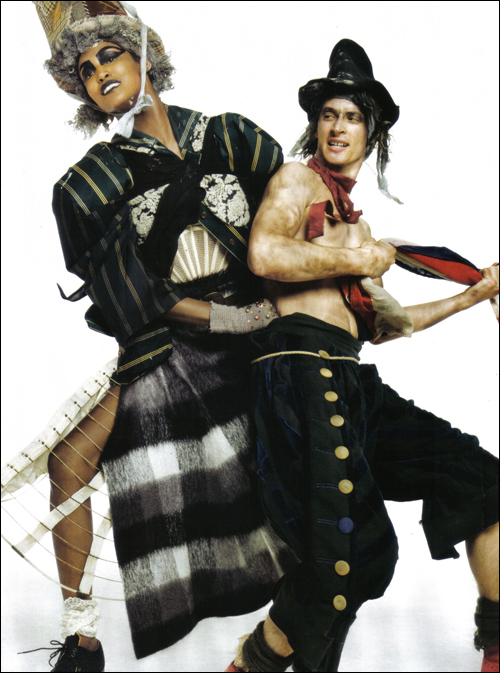
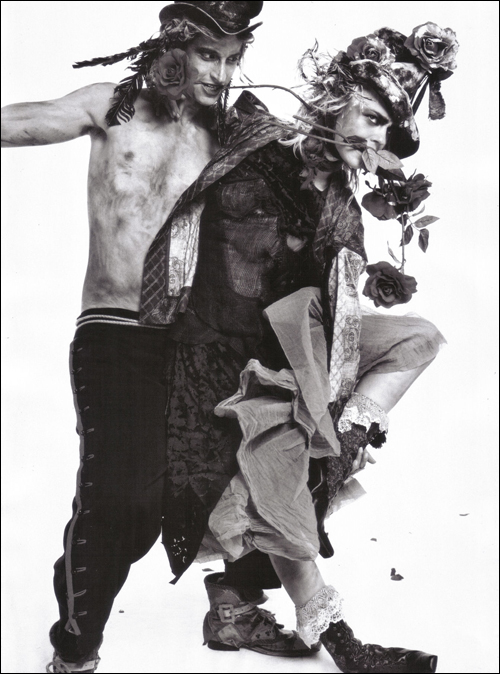
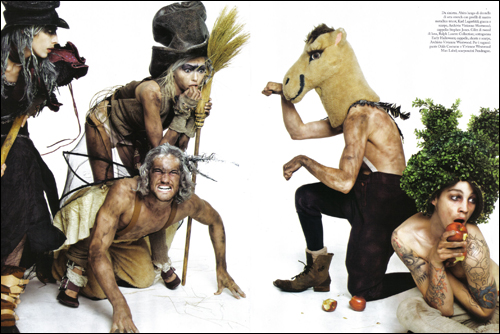
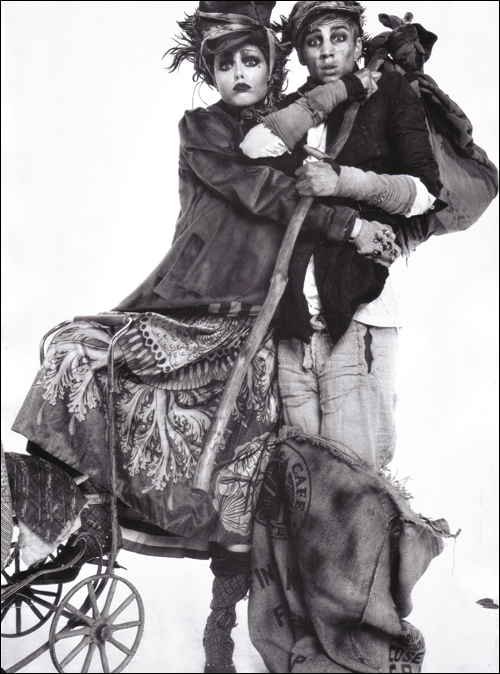
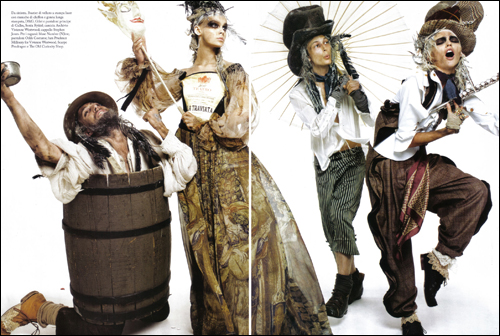
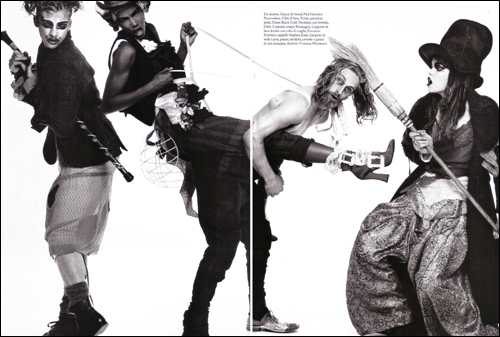
The current, September 2009, issue of Italian Vogue features an editorial spread by Steven Meisel entitled “Performance,” and involving a gaggle of cross-dressed models done up in decidedly Circus, and dare I say Lucent-like, styles and poses:
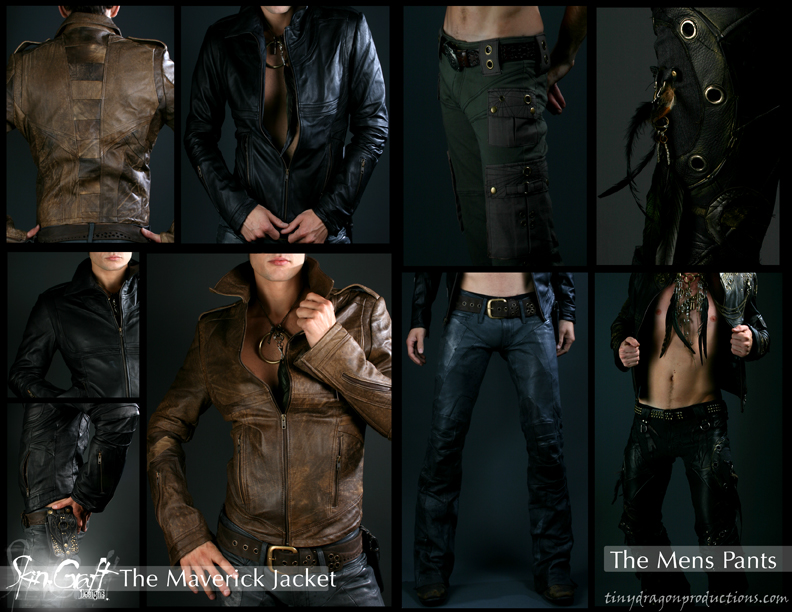
If, sometime circa 2004, you were out and about at certain underground parties in the Los Angeles Circus scene, and saw someone wearing a particularly striking pair of pants (male or female), created from asymmetrical strips of leather sewn in a twisted, impeccably tailored way, like the trappings of some Mad Max forest nymph biker gang escapee, and were compelled by this post-apocalyptic hipness to inquire of the wearer as to where these pants had come from, the answer you would inevitably receive is that they were made by someone named Cassidy. This would happen so often, in fact, that by the time I finally met Cassidy, out one night at a club on the shady side of La Brea, I actually recognized him by his trousers.
At the time, Cassidy was part of the Ernte design team, but soon thereafter co-founded SkinGraft Designs with partner Jonny Cota, and later Katie Kay. Even as the SkinGraft operation was growing with each year, headlining LA fashion week, opening the doors to a flagship store in Downtown LA this spring (no small feat for an indie fashion label in a recession!), and getting their sartorial grafts onto an ever-expanding assortment of celebrity skins, what Cassidy kept yearning to do was sing.
I discovered very quickly after we met that in addition to his fashion career, Cassidy is also a songwriter and performer. At one point, there were even a couple of production meetings held at my house for a show he was thinking of putting together around his music, and involving various performance-oriented friends. That show never came to pass, but after years of false starts, Cassidy finally revived his music focus from back-burner exile and 10 days ago self-released his debut album, Little Boys and Dinosaurs. What happened next is straight out of the viral phenomenon playbook.
On Sunday afternoon, August 15th, Adam Lambert, longtime SkinGraft friend (he’s currently wearing a custom SkinGraft jacket on the American Idol tour, and sported numerous other SG pieces during the show’s run) tweeted to his followers: “My friend Cassidy just shot this great video… http://bit.ly/18FvaM.” Within days, the video shot up to over 36,000 views, and Little Boys and Dinosaurs, sans label, marketing push, or pr strategy, rose to #3 on the iTunes electronic chart, between LMFAO’s “Party Rock” and Imogen Heap’s “Ellipse.” It didn’t hurt that the video was glam-rock pretty and sexually controversial, featuring some simulated sexual behavior, and a pair of undies slung Sports Illustrated-low. Within hours of Lambert’s tweet, a bonafide minor scandal had erupted over his linking the video, which was, by some contingent, considered inappropriate for his underage following. If you’re thinking this sort of outrage over music video explicitness seems strangely anachronistic in the post-Lil’ Kim / Britney Spears / Lady Gaga era, it should probably be mentioned that the dirty dancing in question here is exclusively male. In any case, the controversy only helped to generate further attention for the music, and by Thursday, Lyndsey Parker, was writing for Yahoo! Music’s The New Now blog:
At this point, Adam Lambert is pretty much like Oprah, in terms of his all-encompassing influence over his devoted fanbase. Just like any Oprah Book Club selection is certain to become a New York Times best-seller, in the pop music world there is perhaps no more ringing endorsement these days than a black-fingernailed thumbs up from the tastemaking Glamerican Idol.
So far the public response to Cassidy’s music, at least among diehard and very vocal Adam Lambert fans, has been hugely enthusiastic. Will record labels take notice? That remains to be seen, but if so, then Cassidy Haley may be the first artist to get signed out of American Idol without ever having appeared on the show.
If you’re a social media strategist, and your friend just so happens to become an overnight internet phenomenon, you’ve basically got no choice but to find the whole thing incredibly fascinating. On Tuesday, as Little Boys and Dinosaurs was climbing the chart, I got a call from Cassidy, and the question on his mind was, “What do I do now? What next?”
Which is a great question for any marketer in the digital age to think about as well. All too often I think marketers have blinders on, criminally overusing the word “viral” (still!) in the frenzy for buzz and fans and word of mouth and all that. But what if you could get all of it overnight? What if all the promotional initiatives and exposure efforts paid off just like they were supposed to? Is that the extent of your strategy? Or would you be prepared for What Next?
My advice to Cassidy was to take his questions straight to his new-found fans; involve them directly in helping to shape and define the answers together, and keep the momentum going. And he did. The outpouring of ideas that came back to him from this nascent, yet incredibly dedicated, army included everything from ad hoc twitterstorms that got the attention of various media folks, to online community resources created by fans to connect to one another, and to Cassidy’s music. The troops even came up with a seriously cute name for themselves, Comets, (as in Haley’s).
Overnight, Cassidy was handed the sort of opportunity that many marketers and brands are tirelessly chasing after, and yet the most powerful move he made was the one AFTER that happened. He opened up to his fans and offered them the opportunity to be directly involved with him in the creation of what comes next.
“I think Andy Warhol got it wrong: in the future, so many people are going to become famous that one day everybody will end up being anonymous for 15 minutes.”
– Banksy
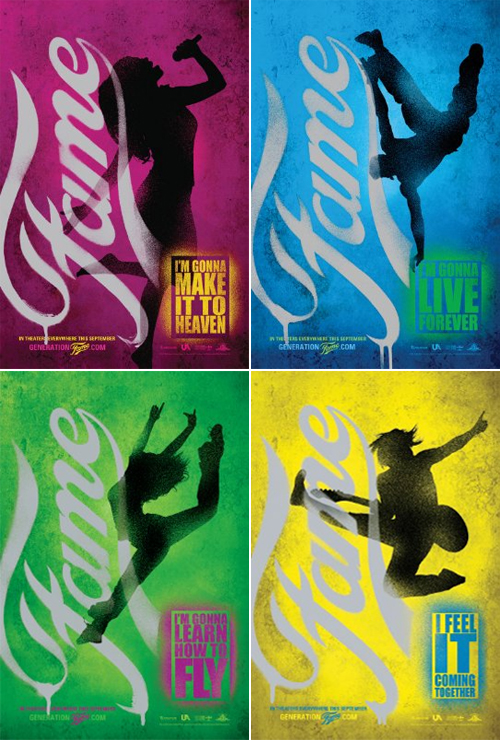
Well, it’s the future, and fame has propagated apace with Moore’s law. Thus, it only makes sense that 30 years since the release of Fame, the original High School Musical, the story of a group of students at a New York City high school for performing arts would be getting an iPod ad campaign-style makeover for the Youtube generation. Of course, you can’t tell an authentic story about youth culture, performance arts, and celebrity fetishism relying just on singing and dancing and acting and rapping and music producing and whatnot. In 2009, you gotta have Circus! And judging from the trailer, the makers of the remake know das whas up:
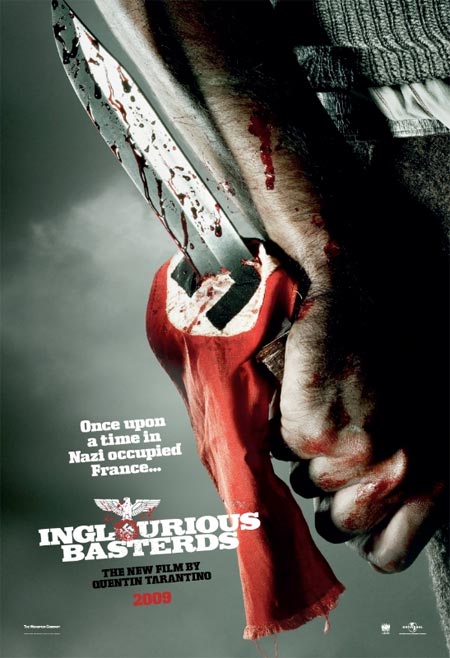
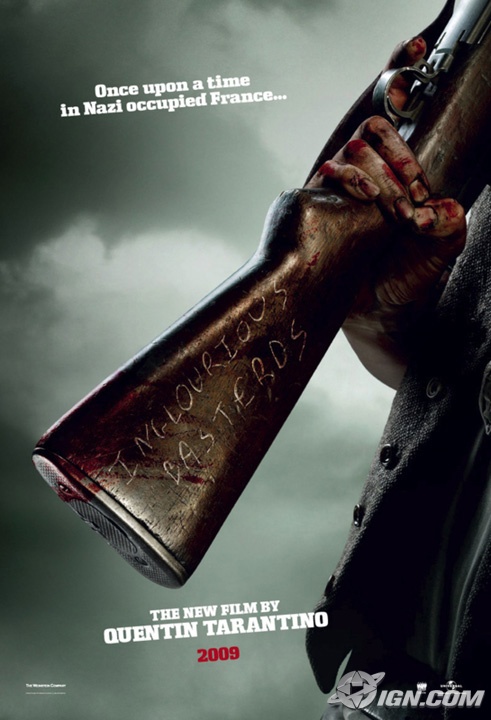
Have you noticed the slate of WWII resistance movies lately? There’s last year’s Valkyrie, starring Tom Cruise, which depicts the actual attempted plot devised by a cadre of senior German officers to assassinate Hitler. Earlier this year saw the release of Defiance, also based on a true story, with Daniel Craig and Liev Schriber portraying the Bielski brothers, who formed a Jewish resistance otryad in Nazi-occupied Eastern Europe and helped over 1,000 people survive in the Belorussian forest. Not to be outdone by American productions, Europe is getting in on its own action with the Danish film, Flame & Citron, which came out a few weeks ago, an ultra-stylized spy noir based, once again, on a true story of two resistance fighters, nicknamed, as one might expect, Flame and Citron, who became heroes of the underground through their violent dealings. And finally (or perhaps not?) there’s Inglourious Basterds, due out this Friday, starring Brad Pitt, and directed by Quentin Tarantino.
For the majority of onscreen depictions of WWII warfare, the script has been about specifically military combat (Saving Private Ryan, Band of Brothers, Flags of our Fathers, etc.) What’s striking about this current slew of films, however, is that the focus has shifted to stories of renegade insurgence. One could postulate all sorts of hypotheses about why that shift might have gained traction recently, but regardless, obviously there really were a lot of resistance movements going on during WWII, and there are a lot of incredible stories of heroism and courage to be told. Yet the particular cultural territory the Inglorious Basterds are invading I find rather dangerous and troubling.
Of all the recent resistance-themed movies, Basterds is the only one that does not appear to be based, as far as I can tell, on any sort of actual events, and from what I can gather from the movie’s trailer the whole premise basically just seems like an excuse for Tarantino, the Auteur of American Violence Porn to do a 1940’s period flick — altho, allegedly there is some sort of plot, also. After the trailer’s initial 50 seconds of banter, when we’re watching a Nazi getting his head glibly bashed in with that All-American weapon, the baseball bat, like it’s a Wiemar Goodfellas, it seems the huffing, gleaming black trend train, trailing more than a half century’s smoke behind it, might have arrived at its ultimate cinematic destination. Though not before — and this is perhaps reflective of what Tarantino does with his down time — video games got there first.
Wolfenstein, Call of Duty: World at War, Medal of Honor, Mortyr, ÜberSoldier, Commandos: Strike Force — these are all first-person shooter games (and doubtless there’s others I’m missing on this list) wherein players are, as Pitt puts it in the trailer, “in the killin’ Nazi bidness.” In fact, the the film is so seamlessly aligned with this game genre that much of the promotion for it is happening through online gamer destinations like IGN and GGL. Even the movie’s iconography might as well be for an Inglourious Basterds video game, (which, I’m sort of surprised it isn’t):
Not that I am against the killin’ Nazi bidness, it’s just that I find the progressive reduction of the Third Reich to a cartoon, to be rather tasteless — also, a little bit queasily horrifying.
65 years after the defeat of Nazi Germany, our concept of Nazisms seems to be losing its reality. More and more we are turning a cancerous pathology of human behavior into a fantasy of evil. Their atrocious actuality wiped away by time, Nazis have become almost too perfectly evil to be have been true. They have come to serve now as a broad cultural shorthand for the ultimate, rottenest badness, or otherwise, for just whatever we happen to find personally distasteful. (See: Bill O’reilly expounding in all seriousness on why the Huffington Post are a bunch of Nazis for an example of just how utterly degenerated the cultural understanding of the term’s meaning has become.) Nazis have evolved into mythical, timeless, uncomplaining boogiemen, always on call to play the supreme Hollywood villains or video game baddies now that the idea of Soviets as arch enemies is an anachronism and Arab villains still feel way too real to be fantasy.
But there is a hugely real and present danger in treating Nazis like the occupied-Europe equivalent of Ninja adversaries in Revenge / Action flicks, or like human-looking-yet-conveniently-not human alien monsters. It is at our own peril that we think of the absolute, explicit worst that humanity is capable of doing, as if it were a supernatural, science-fiction evil, safely beyond human achievement. It’s very much not. Nazis are not Hollywood creations. They were REAL. And the fact of their existence is STILL real. And there is no fantasy for any of us in forgetting.

![[surrogates-jeans1.jpg]](http://social-creature.com/wp-content/uploads/2009/09/surrogates-jeans1.jpg)
![[surrogates-booots.jpg]](http://social-creature.com/wp-content/uploads/2009/09/surrogates-booots.jpg)
![[surrogates-skirt.jpg]](http://social-creature.com/wp-content/uploads/2009/09/surrogates-skirt.jpg)