
and it goes a little something like this:
countercuture
the speed of culture
1 2 3
That’s the speed of the seed
A B C
That’s the speed of the need
You can dream a little dream
Or you can live a little dream
I’d rather live it
Cuz dreamers always chase
But never get it
– Aesop Rock: “No Regrets”

there is some kind of undeniable human fascination with child prodigies. is it perhaps because it’s the most exact way we have of cutting out all the middling aspects of “training,” and being able to see skill condensed into its purest form–talent? that freaky supernatural phenomenon that at its most intense is on par with, like, massive natural disasters for the sheer humbling awe and dread it manages to elicit? an unbridled, unsolvable riddle of nature as brute and mysterious as an earthquake, and as morbidly compelling as its aftermath.
…it’s one guess, anyway.
one possible explanation for why we find superhuman precociousness quite so captivating. for reference, go to youtube and just type “connie” in the search field. just see what happens. there’s also a documentary coming out called My Kid Could Paint That about marla, a 4-year old abstract painter genius, and the resultant controversy that such a feat arouses in our adult sensibilities–unable as we are to conceive of the preternatural just as much as of the nature of the universe itself.
so, of course, the first thing i could think to say when i watched this video my friend siouxzen sent me of two little kids scratching records was:
“is this real?”
as it is, undoubtedly, the first thing you’ll wonder once you watch it as well.
the second thing you have to wonder at though, is that these kids, at 8 and 5 years old didn’t just achieve an astonishing level of proficiency over their singing voice, or the wielding of a paintbrush, or even the mastery of a piano. they just showed a pair of turntables what’s up in a way that’d make afrika bambaataa himself blush.
so what’s the difference?
the difference is that the very act of putting two turntables together side by side–originally to mix the end of one track into the beginning of another to create a seamless uninterrupted beat–was a critical component of the very origin of hiphop. hiphop, a genre of music and an subculture aesthetic that eventually went on to become a global cultural movement that has perhaps only ever been superceded in the breadth of its reach by jesus and the internet. hiphop, one of whose four defining elements is DJing.
a five year old just managed to master this element to a degree that most people who ARE old enough to read spend the rest of their lives chasing. and while, of course, these kids are no doubt astonishing anomalies, it does make you wonder about the degree to which the waves of cultural transmissions and innovations are speeding up in general.
in sociobiology there is a theory that the lifespan of the members of a particular species is determined in part by how mature they are at the time they are born. horses, for instance, who pop out ready to gallop more or less, are a lot more mature at birth than human babies, who are completely helpless. horses thus have shorter lifespans in comparison, and so it goes for the rest of animal kingdom. the reason for this is that the longer it takes an organism to mature, the longer it takes it to senesce (to get old, or, put another way: to die).
the piano’s been churning out prodigies since mozart, but 300 years later, how much more rapid is the turnover rate of culture now? how long can a movement be sustained before it’s run its course and been reinvented by the next species of mutant five year olds? in our accelerated global culture, do we end up shortening the lifespans of cultural movements themselves?
the significance of the man burning early
a play about cross-cultural communication:
burner – played by someone who is part of the burningman community.
non-burner: played by someone who is not.
– – –
burner: OMG! the man burnt early!
non-burner: what?
burner: have you ever heard of burningman?
non-burner: hmm… looks like some crazy festival in the desert?
B: yeah. they also burn a statue of a man. that’s why they call it burningman.
NB: well, i don’t really get the point of that but…ok….
B: so someone set it on fire last night. and now everyone’s all upset.
NB: i thought you said they’re supposed to burn it.
B: no… this was arson!
NB: what’s the difference?
B: well, first of all, it’s not supposed to get burnt until saturday night.
NB: what do you do with it before then?
B: nothing, really, you look at it, and ride by it and stuff.
NB: can you climb on it?
B: not recently.
NB: so it’s just a decoration basically?
B: well, i mean, it’s someoen’s ART.
NB: oh damn! who’s the artist?
B: the burningman organization.
NB: so it’s kinda like… corporate art? dude, i don’t know… there’s some tacky shit up in the lobby i wouldn’t mind…
B: hey! just because it’s produced by the burningman organization doesn’t mean it’s not someone’s creation.
NB: you’re right… that’s true. it is pretty crummy that someone burnt it.
B: yeah at least they caught the guy… you wanna see a mugshot?
NB: oh my god! that guy looks CRAZY!
B: well….
NB: what?
B: well, he kind of… a lot of people wear crazy outfits and makeup and stuff there.
NB: so this guy, he… fits in there?
B: well…i mean… yeah….
NB: i dunno…. if there’s a bunch of crazy tattooed people all running around in war paint and stuff–
B: hey! this whole thing is ABOUT “radical self expression!” that’s the whole idea…
NB: but… doesn’t what he did then… doesn’t that kinda count as pretty radical expression?
B: what? NO! look, radically self expressing means like… like… i spend the whole time there wearing a tutu and a cowboy hat simultaneously. ok? i don’t take away something from everybody who comes to the event just to see the man burn. that waits for this all year long.
NB: but they destroy the thing anyway!
B: you can’t destroy it until they say so!
NB: you know… all these rules sound really complicated and confusing.
B: it’s really not. it’s really all just about art. you know, people spend so much time and energy creating amazing art to bring out there and share with everyone, and this guy just–
NB: wait…you think maybe this was his art?
B: what?
NB: well, i bet this took a good deal of planning beforehand, and it’s certainly a statement–
B: what the hell kind of statement does it have?
NB: i don’t know… maybe something like, about culture jamming or somethig? it seems like there’s a message it’s trying to get across maybe, and it–
B: that is ridiculous. that isn’t art with a message! THIS is art with a message:
NB: oh. hm…. how much fuel you think it took to trasnport and construct atll tha?
B: ok. you know what…. i have to go finish packing now.
NB: ok. see ya. have fun!
B: thanks!
the new and improved enlightenment lifestyle
as a marketer you realize that it’s not so much that you’re really setting anything up for sale, it’s that everything already IS for sale, and you’re just helping it along. so it’s not so much that i’m bothered by the selling of “enlightenment,” (there’s been buddha statues on-sale for millennia, and what are THOSE selling?) but rather it’s that i find the whole “enlightenment lifestyle,” kinda… icky.
today on the website for the san francisco green festival conference i discovered a publication called what is enlightenment magazine, published by enligntennext, which is “defining the contours of a new revolution in human consciousness and culture.” (it’s essentially not doing anything different than any punk band or public enemy-era hiphop act professed to be doing. it’s just targeting a different audience.)
my first encounter with companies targeting this demo was when we were soliciting sponsors for LIB and were approached by the “enlightenment card”:

(in case you’re wondering, yes, the card IS real, no that ad is NOT a joke, and we said “no, thank you” to the offer.)
while on the one hand, i’m trying to think of where else do sheltered caucasian people get to evangelize a brand of appropriated cultural imperialism with such tactless self-righteousness and get away with it, on the other hand, from a technical standpoint, i’m completely impressed.
this is everything i preach about identity marketing in action.
in robotics, there is a theory of the “uncanny valley“:
The hypothesis states that as a robot is made more humanlike in its appearance and motion, the emotional response from a human being to the robot will become increasingly positive and empathic, until a point is reached beyond which the response quickly becomes that of strong repulsion. However, as the appearance and motion continue to become less distinguishable from a human being’s, the emotional response becomes positive once more and approaches human-to-human empathy levels.
This area of repulsive response aroused by a robot with appearance and motion between a “barely-human” and “fully human” entity is called the Uncanny Valley. The name captures the idea that a robot which is “almost human” will seem overly “strange” to a human being and thus will fail to evoke the empathetic response required for productive human-robot interaction.
maybe there is an uncanny valley in the process of identity expression as well. the more a brand or a product makes it easier for people to express their identity the more palatable it is, until maybe it hits a certain point where it becomes so blatant that its appeal suddenly drops off. however, as this brand’s identity-expressing qualities continue to become more innate and nuanced, and less overt it once again becomes appealing. maybe it could be called the uncanny “wannabe valley,” the place in brand authenticity/relevance that will likewise “fail to evoke the empathetic response required for productive human-brand interaction.” (cuz brands are robo–i mean, people too.)
one of the explanations for the uncanny valley phenomenon is that the robots stuck in no-man’s land elicit revulsion because they look “dead,” and biologically we’re wired to have an aversion to corpses, cuz stickin around doesn’t bode so well for the immune system. (makes you wonder tho if necrophiliacs collect weird lookin robots). but when it comes to identity, the brands (and people) stuck in the uncanny wannabe valley turn us off because they’re “fake.” in a similar sort of way, biology may have led us to respond with distaste to “fake” people (and by proxy brands now) because they are untrustworthy. from a social selection standpoint, they may even be community saboteurs.
the funny thing in all of this is that there’s nothing actually WRONG with the enlightenment card except its name. if you have to have a credit card, why NOT get one that’s gonna let you earn points towards, like, trips to spas in costa rican rain forests, right?
while no doubt one person’s fake is another person’s orgasm, it just feels like confusing a lifestyle for an expression of “enlightenment,” is kinda, um, you know…. BOGUS!
community management IS image management
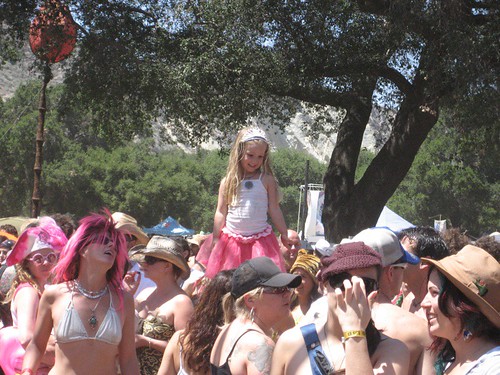
crowd at LIB07
photo by: fightingwords
this weekend, at a do lab birthday dinner, the other half of the do’s community management team started giving me shit about removing a particular video from the LIB youtube group.
it was this weirdly psychedelic video that didn’t even really show much of the festival (i think most of it was a strange, imovie effects-laden loop of a girl in a tutu) and the reason i took it out was because the soundtrack was a song (also totally unrelated to the LIB music style) with the words “cunt” and “fuck” repeated over and over. since LIB happens to be very much an all-ages, family friendly event, this video seemed sorta…uhh… inappropriate. it’s not like i told the creator that he had to remove the video from youtube entirely, and i also didn’t just X his video out of the group in silence. i sent a message to the creator and explained that the video wasn’t actually all that appropriate for the group, and that if he had any other videos that were more palatable we’d totally love to have those included.
apparently, the other half of the team thinks this makes me a prude. i think it’s just effective image management, and it’s an integral part of what’s ENTAILED in the community management process.
the thing about a real community is that it is a group of people who understand each other in a way that people NOT in the community do not. inside jokes get reinterpreted literally by those not in on them, inside norms are judged by the mores of the outside world, and all these things bear the potential for an untold number of misconceptions about your brand and your product, just waiting to create controversy. any significant community management then isn’t JUST about “getting people involved” (if your product is relevant, people will get involved, believe me), it is to a huge extent, about image management.
think about it like this… when you’re 17 your myspace profile isn’t all about the fact that you got a perfect score on the verbal SAT, that you’re the editor of the school’s lit mag, and that you’re a state champion sax player. no. your page has a photo slideshow of you playing beer pong at a party with your friends last weekend, and it’s covered in a million inside joke comments that in no way bolster your college recommendation letters. let’s say this 17 year old is a “brand” that you are trying to sell to a potential university (as many a 17 year old brand is), if any admissions officer happens to check up on the myspace profiles of applicants, then what you’re facing is a case of tragically BAD image management. however if this 17 year old brand is trying to be popular in high school, then you’re doing a fantastic job; keep it up. (also, congratulations, facebook: i just used myspace in an analogy and felt stale.)
the truth, of course, is that you (the 17 year old) are actually responsible for managing both these conflicting images of yourself simultaneously. and likewise, managing a community is very much about navigating the balance between outside and internal expectations while staying true to BOTH! if your approach to “radical transparency” is entirely negligent of the vital impact of context, then you’re just gonna piss a lot of people off (not the least of which will be your community for approaching their representation quite so carelessly), and screw your brand over. this is not to say you can’t ever break the rules of cultural context–in fact, in the cases when adhering to these rules is a detriment i’d actually say that breaking them is definitely a direction to consider, (if you do, however, you have to understand what that means, and all of the repercussions that it entails) but this post is not about breaking the rules of context. that happens all too easily on its own. this is about the much more complicated, much more sensitive, and much more precarious process of balancing them.
the reason i took that video down is because of the impact i felt it could have in a very particular context: potential LIB08 attendees checking out the youtube group, who’ve never come to a do lab event before, and are considering bringing their kids. while we don’t have any hard statistics, i think the amount of families with little kids present at LIB this year can be adequately reflected by the word: shitload. even though the video in question wasn’t adding anything particularly enhancing to the overall community its general irrelevance could simply be dismissed, but it’s off-putting choice of soundtrack, however, was too close to being a detriment for comfort. had such a video been added to a group for lucent delirium, for instance, the do lab’s “twisted tribal affair,” or any of our other late-night, dance-till-it-hurts events, i probably wouldn’t have cared. not, however, a weekend camping festival taking place during mother’s day. (even though the words fuck and cunt are indispensable to motherhood, they’re just totally not gonna go in a video group for the festival. sorry.) and for the record: that sentiment does not make me a prude, it makes america a prude. i’m just here makin sure we’re keepin’ things in context, yo.
the deeper conflict in this situation, of course, is that our particular community is comprised of some VERY uninhibited, counter-cultural artists and all their freaky friends–i mean, we’re a circus for god’s sake! and while even just up until 2006 the dolab’s events were all underground, and the community that has nurtured and supported us is used to this outlaw mentality, we no longer have the luxury nor, frankly, the interest in producing unpermitted, below-the-radar events. the scale is too big, and so are the stakes. this means we now not only have to take permits and fire codes and laws in general seriously, but it also means we have event publicists and work to deliberately cultivate relationships with the mainstream press. yet at the same time there is absolutely no way we will risk jeopardizing the free and bohemian vibe that we are known for, and which our community expects us to deliver… if you happen to think the juxtaposition of these conflicting cultural contexts and expectations might be complicated to manage…. yeah, i’d agree.
the week leading up to LIB was a hardcore community management vs. publicist smackdown battle in which we all struggled to find some kind of balance between what was best for our community, our brand, and for our overall image in the glare of the growing exposure which we are very much courting. amazingly, after a bit of initial fumbling, in the end it all went off without a hitch, and i’d say in no small part due to the very fact that these kinds of issues were critically considered and addressed.
you know… as much as dealing with publicists (even when they’re OUR publicists) really is NOT the highlight of my day, i think that it’s pretty critical that the people in charge of the inward-facing image and the outward-facing image know what the other side is up to. the message may not be different, but the translation most likely needs to be, and if there is not a direct line of communication between the community dept. and the PR dept., and if either side is not conscious of the considerations required by its context, then your brand is setting itself up for a potentially very messy spill in the image management aisle.
i wonder if anyone else out there has any stories or experiences dealing with similar kinds of dilemmas… how did you handle them? what were the results? what’d you learn in the process? i’d be very curious to hear.