it’s hard to comprehend this now, but before hiphop there was no such thing as a racially integrated culture. when hiphop came down from the bronx and created the roxy in downtown NYC it brought with it not just a fad, but a complete cultural shift that was ushering with it a racially integrated lifestyle. and the first culture that brought white kids and black kids hanging out together started less than thirty years ago!
FAB 5 FREDDY recalls the turning point as a July night…. “And everybody kinda bugged out looking at each other. You had these ill b-boys with the poses and shit, checking out these [punk & new wave] kids with the crazy haircuts and that whole vibe. And everybody kinda got into each other, so to speak. That’s when it really kinda took off as the first really major downtown club that had like a legitimately mixed scene.”
David Hershkovits, a music journalist who would go on to publish PAPER magazine: “The crowds were very diverse. That was why I was so excited to be there. Suddenly this racially mixed group was having a good time partying in a room together, which was a very rare thing. On the level of music and art, people were able to bridge all these boundaries.”
Dante Ross, who would become a key hip-hop A&R exec during the late ’80s, remembers: “The word ‘alternative’ didn’t exist. It was this great moment man, the ‘Grafffiti Rock’ moment. Everything was all mixed up, it was cool to be eclectic.”
this was not just some studio-54 remix, however. in 1982 afrika bambaataa had released “planet rock.” arguably just as influential as “rapper’s delight“–whose lasting testimony is as the first hip-hop shout that was hear round the world–planet rock defined a “grand statement” for what afrika was calling the hip-hop movement.
Planet Rock was hip hop’s universal invitation, a hypnotic vision of one world under a groove, beyond race, poverty, sociology and geography. [The lyrics] shouted, “No work or play, our world is free. Be what you be, just be!”
Bambaataa says, “I really made it for the Blacks, Latinos, and the punk rockers, but I didn’t know the next day that everybody was all into it and dancing. I said, ‘Whoa! This is interesting.'”
That was the move that proclaimed that this wasn’t just an “urban” thing, it made it inclusive, it took hiphop global.
which is making me wonder: what’s next?
all throughout history the art of miscegenation has been the art of creating cultural change itself. it seems like it’s an essential component for the achievement of a significant cultural shift that it empower inclusivity and integration. on a much smaller scale, i’ve already touched upon the ways in which i see the inclusivity trend playing out in the world of social network app sites, but really, in the grand scheme of large-scale global culture shifts… what’s next?
what sort of social divisions still apply so universally that the act of demolishing them becomes universal?
culture is like the water temperature of a pool: you don’t even notice it once you’re really acclimated. bursting a ubiquitous cultural taboo is like saying, ‘hey, i want a pool with a totally different temperature,’ climbing out, going to get a hose, and pumping new water in. so who’s going to climb out of the pool and usher in the next great cultural revolution?
and what’s the water going to be like once they do?
– – –
more reaction to can’t stop won’t stop: a history of the hip hop generation: HERE
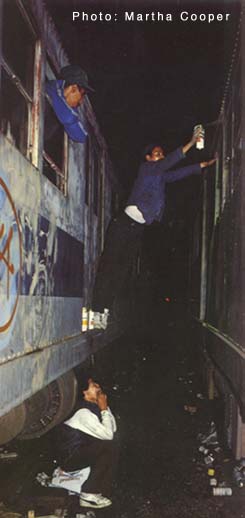
according to Can’t Stop Won’t Stop: A History of the Hip Hop Generation, afrika bambaataa defined the four elements of hip hop as djing, emceeing, breakdancing, and graffiti. of the four, only graffiti makes a case that its conception was a little more immaculate. in truth, it’s the only element that can actually even pursue any kind of truth with such a claim, as the origin of modern graffiti can be traced back not to the bronx, but to philly, as far back as 1965.
Aerosolist and activist Steve “Espo” Powers says that the Black teenager, CORNBREAD, who is credited with popularizing the tagging of the Philly subways was only trying to attract the attention of a beauty named Cynthia. by 1968 the movement had spread to New York City.
but destiny is forged not of details, but from convergences:
….When a Greek American named TAKI 183 told the New York Times in the summer of 1971 why he tagged his name on ice cream trucks and subway cars–“I don’t feel like a celebrity normally, but the guys make me feel like one when they introduce me to someone”–thousands of New York youngsters picked up fat markers and spray paint to make their own name.
….Writing your name was like locating the edge of civil society and planting a flag there. In Greg Tate’s words, it was “reverse colonization.”
…. But these writers weren’t like the revolutionaries, or even the philosopher-activist wall-writers in Lima, Mexico City, Paris, and Algiers. Theirs were not political statements. They were just what they were, a strike against their generation’s invisibility…
They held no illusions about power. No graffiti writer ever hoped to run for mayor. And unlike the gang bangers, none would submerge his of her name to the collective. They were doing it to be known amongst their peers, to be recognized….
Normal Mailer, one of the first to write seriously about graffiti, got it instantly: the writers were composing advertisements for themselves.
graffiti was the megaphone that amplified the identities of those who knew they could never expect any other kind of recognition. a kleptomania of attention by those suffering from the original sort of attention deficit. by the time graffiti evolved from simply tagging, to “piecing” train-big creations, it was like stealing “rolling billboards for the self.”
but this kind of exposure came at a price. first of all, it was illegal. then after that it was time-consuming, a huge health hazard, incredibly dangerous, and of course, fiercely competitive. that was how much it cost to earn that moment of recognition. these kids were not raised on any illusion that they would ever be famous, be recognized, even be noticed. graffiti thus became a weapon with which to fend off the extreme alienation experienced by a generation of neglect victims.
thirty years later, here we are:
the most well known graffiti artists have either become corporate brands (obey, ecko) or are icons of anonymity (banksy). and everyone else has become, as the colloquialism goes, an attention whore.
to the invisible, writes jeff chang, fame itself was wealth.
funny that the same currency should be the lucre for those indulged with access to the fastest and easier methods for widespread expression ever developed. myspace and facebook and twitter and flickr and on and on, all mean that there’s no longer need to risk running from the police, inhaling noxious aerosol fumes, or life and limb to get your name out. “tagging” has literally never been easier. thirty years ago tagging was an illicit activity, branding one an outlaw for branding their name upon the gaze of others. now all of social media has become a “tagging-approved” zone. like a giant graffiti skate-park: a designated safe area where anyone can perform what was once a struggle to express.
modern society’s indulgence of its youngest children has led us to more craving, as shows like american idol inflict an even more profound deficit between the attention we want and the attention we get. the tools and opportunities we seem to seek are no longer an offense against society’s neglect, but a defense against our own narcissism’s resentment.
the old way at least made the commute more colofrul.
i find the synchronicity of elements that shape the development of culture as fascinating as its effects. like the random mutations of evolution that become brilliant adaptive advantages, there’s almost a kind of magic to these whimsical convergences of what retrospect makes appear like fate. a butterfly flaps its wings in the concrete jungle, and eventually the world world shifts on its axis.
but it’s not the bith of the hiphop industry that’s the exciting part. hiphop, the music meme of global dominating proportions, was incubated within the confines of a seven mile stretch of the bronx ghetto, and you best believe there wadn’t no tentalce of the recording industry naturally springing up in that desolate radius.
by the time rapper’s delight was recorded it was just a natural progression of the amplification of this butterfly’s roar that had already been underway. what’s really fascinating is what happened JUST before that step, what facilitated that next step, the first moves that hiphop rocked to break out of the gangland dance floor.
the fortunate cultural phenomenon that happened to have ended up at the right place at the right time, hiphop came of age parallel to the casette tape.
before that there was simply no way to record, redistribute, and replay recorded music as easily and cheaply ( waaait a second… that… sounds familiar for some reason?)
the first way that anyone outside of the bronx EVER discovered hiphop was, according to jeff chang, through:
“The live bootleg caseette tapes of Kool Herc, Afrika Bambaataa, Flash, etc….. [that] were the sound of the OJ Cabs that took folks accross the city. The tapes passed hand-to-hand in the Black and Latino neighborhoods of Brooklyn, the Lower East Side, Queens and Long Island’s Black Belt. Kids in the boroughs were building sound systems and holding rap battles with the same fervor the Bronx one possessed all to itself.”
makes you wonder how many other musical and cultural styles must have come and gone, disappearing forever into the dust of disintegrating, discontinued vinyl, the momentum to expand them never able to get fulfilled, held back by the constraints of antiquated music technology, don’t it?
* * *
more reaction to can’t stop won’t stop: HERE
i joke that “circus is the next hip hop,” i joke that there’s anything could be the next hip hop, but let me make one thing clear: it’s a joke.
it’s referring to the kind of “hip hop” that’s a trend. the kind of “hip hop” that’s a marketing buzzword that’s been abused since vanity fair, in all seriousness, labeled paris and nicky hilton, the hip hop debutantes.
that “hip hop” is a farce.
but there is another kind of hip hop. a hip hop that cannot be replicated, cannot be commodified, and cannot ever be rebranded, and it is hiphop as a force.
a force concieved in a mess of poverty, devastation, neglect, and chaos. a force that grew out of racism, plagiarism, jimcrowism, indifference, censorship, white kids burning black records proudly declaring that “disco sucks,” denial, globalization and in the end, appropriation. it grew where nothing else would grow. like the rose that grew from concrete, hip hop grew.
and this force became big. this force just would not get along. it refused to fit in, refused to be discounted, refused to be ignored. hiphop refused to sit in the back of the bus, and left its mark as big as metro train bombs, because it would not go unseen.
hiphop was mad! it roared with anger! it was angry of envy, angry of hunger, angry of despair, degredation, angry of all the other voices that got to sing. hiphop raged until it could not be ignored! destroyed itself over and over with the madness of the surf, and spread as far accross the world as the oceans. there is no “next” for a force like that.
if you grew up in the projects, went to a public, urban high school in the 90’s, and liked to dance, it didn’t matter what color your skin was, hiphop would be the music you listened to. hip hop would be the frequency you vibrated to. hip hop would be the history that spoke to your present, and if you started to develop a curiosity about this history, then you’d hope that one day, a hip hop journalist like jeff chang would write a book like “can’t stop won’t stop,” and it would start like this:
“Generations are fictions.
The act of determining a group of people by placing a beginning and ending date around them is a way to impose a narrative. They are interesting and necessary fictions because they allow claims to be staked around ideas. But generations are fictions nonetheless, often created simply to suit the needs of demographers, journalists, futurists, and marketers.
In 1990, Neil Howe and William Strauss–both baby boomers and self-described social forecasters–set forth a neatly parsed theory of American generations in their book, Generations: The History of America’s Future, 1584 to 22069. They named their own generation “Prophets,” idealists who came of age during a period of “Awakening,” and their children’s generation “Heroes, who, nurtured by their spiritually attuned parents, would restore America to a “High” era. In between were “Nomads” inhabiting a present they described as an “Unraveling.” What Howe and Strauss’s self-flattering theory lacked in explanatory power, it made up for with the luck of good timing. The release of Generations intersected with the media’s discovery of “Generation X,” a name taken from the title of a book by Douglas Coupland that seemed to sum up for boomers the mystery of the emerging cohort.
Howe and Strauss’s book was pitched as a peek into the future. Cycles of history, they argued, proceed from generational cycles, giving them the power to prophesize the future. Certainly history loops. But generations are fictions used in larger struggles over power.
There is nothing more ancient than telling stories about generational difference. A generation is usually named and framed first by the one immediately preceding it. The story is written in the words of shock and outrage that accompany two revelations: “Whoa, I’m getting old,” and “Damn, who are these kids?”
Boomers seem to have great difficulty imagining what could come after themselves. It was a boomer who invented the unfortunate formulation: “the end of history.” By comparison, everything that came after would appear as a decline, a simplification, a corruption.
Up until recently, our generation has mainly been defined by the prefix “post-.” We have been post-civil rights, postmodern, poststructural, postfeminist, post-Black, post-soul. We’re the poster children of “post-,” the leftovers in the dirty kitchen of yesterday’s feast. We have been the Baby Boom Echo. (Is Baby Boom Narcissus in the house?) We have been Generation X. Now they even talk about Generation Y. And why? Probably because Y comes after X.
And so, by the mid-1990’s, many young writers–sick of what Howe and Strauss and their peers had wrought–took to calling themselves “the Hip-Hop Generation.” In 2002, in an important book, The Hip-Hop Generation: Young Blacks and the Crisis in African American Culture, Bakari Kitwana forged a narrow definition–African Americans born between 1965 and 1984–a period bracketed by the passage of the Civil Rights Act and the assasination of Malcolm X on one end and hip-hop’s global takeover during the peak of the Reagan/Bush era at the other.
Kitwana grappled with the implications of the gap between Blacks who came of age during the Civil Rights and Black Power movements and those who came of age with hip-hop. His point was simple: a community cannot have a useful discussion about racial progress without first taking account of the facts of change.
Folks got bogged down once again in the details. How could one accept a definition of a Hip-Hop Generation which excluded the culture’s pioneers, like Kool Herc, and Afrika Banbaataa, for being born too early? Or one that excluded those who had come to claim and transform hip-hop culture, but were not Black of born in America? Exactly when a Hip-Hop Generation began and whom it includes remains, quite appropriately, a contested question.
My own feeling is that the idea of the Hip-Hop generation brings together time and race, place and polyculturalism, hot beats and hybridity. It describes the turn from politics to culture, the process of entropy and reconstruction. It captures the collective hopes and nightmares, ambitions and failures of those who would otherwise be described as “post-this” or “post-that.”
So, you ask, when does the Hip-Hop generation begin? After DJ Kool Herc and Afrika Bambaataa. Whom does it include? Anyone who is down. When does it end? When the next generation tells us it’s over.
This is a nonfiction history of a fiction–a history, some mystery, and certainly no prophecy. It’s but one version, this dub history–a gift from those who have illuminated and inspired, all defects of which are my own.
There are many more versions to be heard. May they all be.
Jeff Chang
Brooklyn and Berkeley
January 1998 to March 2004
i’m sure i’ll be writing more about this book as i tackle everything that comes after these first 3 pages…
while being too sick to get out of bed for the majority of the past week, i read Generation Me by jean twenge. i found out about the book via danah boyd’s post several weeks ago, and beyond my long-standing general infatuation with teenagers, it was the aspect that dealt with the rise of narcissism in the current culture specifically that made me really curious to read it.
as someone whose professional and recreational interest is directly based in people fetishizing the self (a curious pratfall of identity expression) i find the implications of a culture’s self-obsessive compulsive tendencies to be beyond fascinating.
after danah’s enthusiastic review of the book, i was eager to spend my hours of sniffling and sneezing incapacitation at least getting to delve into an analysis of the social psychology of the latest generation of teenagers and 20-somethings.
but a 120-tissue box of kleenex later, and i was suddenly aware that the book was bothering me more than my severe sinus congestion.
it’s got a promising start. hey, i can dig the whole, the self-esteem education approach has developed a generation with a heightened predisposition for narcissism bit. as the daughter of a moscowconservatory-trained violist, i have been hearing my mother complaining for the past two decades about how american students (as opposed to european and asian ones) are totally incapable of dealing with criticism. with a music instrument there is no “A for Effort.” you either hit the right note, or you didn’t. so it would definitely seem like a valid observation that america’s particular ego-insulating take on child development could yield a lot of egotistic children.
there’s even a semi-astute extension of this theory into an explanation for the civic cynicism in the recent generation of once would be “rebels.” all this focus on the self, i.e, “you gotta believe in yourself, and then you can achieve anything,” or “you have to love yourself before you can love anyone else” could logically translate to a widespread political apathy. after all, if shit’s fucked up, you’re supposed to be able to take care of it simply by believing in yourself more… right? not by joining with the other people who are in the same boat as you and working towards affecting larger institutional change together, certainly. while prior generations of youth were protesting, and organizing towards making an impact in social justice and civil liberties, we can’t even be bothered to vote. the promotion of a rampant, definitively american style of radical individualism (hellooo, Ego, how YOU doin‘?) certainly could be a suspect to bring in for questioning on that charge.
however, beyond these two points the book is a mess of contradiction, anecdotal “proof,” and some mind-bogglingly trite answers to the narcissism epidemic (how did the editor okay “watch less MTV, and get your daily dose of essential fatty acids, kids” a valid “solution”…. seriously?)
the biggest disappointment of the book is that it actually fails to present any kind of sufficient analysis for the implications and applications of this elevated cultural narcissism. don’t get me wrong, i think the diagnosis is dead-on. i just don’t think the symptom chart is all that accurate.
perhaps the most glaring oversight in the book is the complete ignorance or denial of two very significant books on the future of life for the coming generation, resulting in statements that end up being glaring contradictions of prior trend-forecasts.
1. published in 2003, urban tribes, by ethanwatters, details how this generation is “redefining friendship, family, and commitment.” watters presents a cultural shift wherein this generation of transplanted young folks making their way out on their own–removed from the traditional support system of extended family/close-knit community–is creating its replacement through the formation of what he labels “urban tribes.” these friend groups function as surrogate family/support systems helping the individuals within them to handle the kind of trials that they wouldn’t be able to solely on their own. twenge fears we are becoming a nation of isolated workaholics, (and some of us are, certainly) but watters argues that just as significant a segment of us are instead finding new ways of extending the social “clique” dynamic we got used to in high school. we may be politically apathetic, but we’re pretty savvy when it comes to naturally gravitating towards a social arrangement of tight and loose friendships formed around some basic bonding activities or affinities. (watters mentions his friend group planning their burningman theme camp, for instance). a semi-conscious method of delaying adulthood (i.e. marriage, children, etc.) / prolonging adolescence isn’t a move that in any way negates the escalating narcissism prognosis, thus by completely not taking it into account twenge’s assertion on narcissism’s effects is glaringly incomplete.
2. published in 2002, the rise of the creative class, by richardflorida, investigates the development of a demographic shift that is “transforming the nature of work, leisure, community and everyday life.” florida, a renowned urban planner now turned cultural trend guru asserts that much like the previous eras whose industry was defined by “organization” (50’s) or “information” (80’s/90’s), today’s defining occupational movement is “creativity.” the result is a whole “class” of individuals who work in new fields such as graphic design, audio engineering, web development, etc. in Generation Me, twenge asserts that much of what makes today’s “confident, assertive, and entitled” young americans so miserable is the crushing disappointment that results from their impossible mantras of “believe in yourself, and never give up on your dreams.” what pop culture is leading this generation to expect (i.e. the lifestyle on MTV’sCribs that they’ll access as soon as they win American Idol) is just setting young people up for anxiety and depression once they are forced to face the harsh reality that they’ll barely be able to afford buying a house or raising a family. not everyone is going to be able to reach their delusional dreams of fame and wealth, says twenge, so we need to make sure today’s youth are adequately prepared for that truth. twenge’s position is that one of the best ways to help youth today deal with reality is by making sure they understand that they cannot expect that work is going to be satisfying, and should find ways to cope with that asap. “no one at my company is following their dreams,” says a friend of twenge’s quoted in the book, who works in marketing.
this struck me personally as particularly tragic as i’d actually be someone whose dream, in fact, DOES involve working in marketing. according to florida, there are not only quite a few people out there whose dreams involve some kind of creative pursuit, but, in fact, enough occupational need for such individuals to warrant calling it a whole “class” of work. after all, one thing that you gotta hand to self-esteem education is that in making all the hard and fast “rules” a lot more flexible, it’s provided a whole generation with the kind of space for “creativity” (for better or worse) that hasn’t been accommodated in education ever before.
creativity has always been a competitive advantage in business, andflorida asserts that there is now a widespread transformation happening in the nature of work in order to facilitate and foster this competitive advantage. this shift involves the kinds of considerations business has never needed to face before, and, a good deal of them involve allowing people the ability to gain a sense of fulfillment from their work. (they may still end up being workaholics anyway, but when work’s fulfilling, you may as well, right?)
dreams of fame may be ridiculous and end only in frustration and disappointment, but then again, so will the idea that fame is going to bring you fulfillment anyway. demand for fulfilling work by a whole generation of “creatives,” is what has fueled the very shift happening in the nature of work in the first place. (now, if they could all just get organized and demand better pay!)
finally, even laying the full blame on self-esteem based education doesn’t quite add up. twenge’s main recommendation for addressing the escalation of narcissism, which for the record is, indeed, unhealthy in a number of social and psychological ways, is putting an end to the self-esteem education movement. but if giving kids trophies just for participating was really considered sufficient education then why are kids’ schedules overbooked with a ton of extra curricular and AP add-ons? the robustness of the SAT prep industry alone is testament to the fact that just because certain schools may attempt to obfuscate the competition inherent in education, it doesn’t mean anyone’sreally falling for it.
this of course leaves me now, further on my way to regaining my health, going through fewer and fewer tissues with each day, and still my curiosity about all those narcissism questions left unanswered. for instance:
… a generation constantly faced with the requirement of thinking about and defining themselves and their identities with each bio they fill out, and each photo they upload, on every social networking app emerging from the primordial web 2.0 ooze… how’s THAT affect narcissism?
… a generation with more occasion to pose for cameras than probably even most movie stars ever needed to endure in the pre-digital age… how’s THAT gonna affect narcissism?
… a generation where anyone can create a show out of their daily lives on youtube or blip.tv, and turn their very existence into a “performance” on a level once only really experienced by sideshow freaks…well, how’s THAT gonna affect narcissism?
and what does all of this mean for the state of the next generation’s mental health?
i’m feeling incredibly entitled to a book about THAT.