sustained mystery vs. radical transparency

it’s kind of hard to write a post advocating a sense of balance. it’s easy to get all riled up and energized on preaching some kind of extreme; is it even possible to create a polemic for moderation? i’ve been sitting on this particular post for weeks, unable to summon up the oomph to do it justice, but i’m gonna try, cuz i think it’ll be useful.

there’s a lot of push for “radical transparency” in this social media culture of ours. from the free-sharing ethos of the open source community that’s defining a good deal of the new medium’s structure, to the rampant open-bookiness of the random user’s social network profile, total “openness” is being heavily bandied as a requisite for the new media era.

a few months ago wired dedicated it’s cover story to this issue, with the see-through CEO article:

Radical forms of transparency are now the norm at startups – and even some Fortune 500 companies. It is a strange and abrupt reversal of corporate values. Not long ago, the only public statements a company ever made were professionally written press releases and the rare, stage-managed speech by the CEO. Now firms spill information in torrents, posting internal memos and strategy goals, letting everyone from the top dog to shop-floor workers blog publicly about what their firm is doing right – and wrong….

of course, when considered in contrast to the long legacy of empty hype, manipulation, and even straight up coercion that we have become fed up with in mainstream media and big business it’s understandable that there would be such a resounding grito for “radical transparency” now that media has, for the first time, truly become interactive. “secrecy is dying.” the article proclaimed. “it’s probably already dead.”

but before we go get it taxidermied and hang its stuffed, antlered head up in social media’s hunting lodge, what i am proposing is that there is room for an intermediate option between the overt and the covert, one that emphasizes a sustainable (vs. radical) approach to maintaining the delicate balance between the blatant and the intriguing.

but wait…

Your customers are going to poke around in your business anyway, and your workers are going to blab about internal info – so why not make it work for you by turning everyone into a partner in the process and inviting them to do so?….Some of this isn’t even about business; it’s a cultural shift, a redrawing of the lines between what’s private and what’s public. A generation has grown up blogging, posting a daily phonecam picture on Flickr and listing its geographic position in real time on Dodgeball and Google Maps. For them, authenticity comes from online exposure. It’s hard to trust anyone who doesn’t list their dreams and fears on Facebook.

ok. i’ll tell you something else about what i and some of the rest of this generation grew up doing. we grew up going to–and some of us, producing–“outlaw” parties. you can check out groove or go or kids even, if you weren’t there for yourself, but suffice it to say these were unpermitted, unfireproofed, underground all-night events that routinely broke a whole lot of safety codes, property laws, and a slew of other legislative regulations. there was a tremendous sense of community and trust that developed within this scene which was at once superlocal and hyperglobal, and we all relied on each other to be good at keeping a secret. because if we weren’t, we would all be saving the 3 am dance for members of law enforcement. and once the cops came there was no more fun for anyone.

which is not to say that i am advocating illegal activity in business practices, but rather to point out that this generation that now publicizes its dreams and fears for the world to see may yet be able to appreciate the value in keeping certain things–as the kids say–on the DL.

the wired article does point out that, ok, perhaps:

Secrecy can be necessary – CEOs are often required by law to keep mum, and many creative endeavors benefit from being closed: Steve Jobs came up with a terrific iPhone precisely because he acts like an artist and doesn’t consult everyone. In fact, secrecy is sometimes part of the fun. Who wants to know how this season of 24 is going to end? It’s not secrets that are dying but lies.

the article tosses in this dynamic concept that secrets can be fun, and then moves right along on its radical transparency proselytizing way without giving it any more thought. it’s this kind of secret that i’m interested in. the secret that is not a lie, the secret that’s enjoyable: the mystery.

because you know why? because mystery is infinitely engaging. mystery bestows specialness. mystery can create bonds within a community, and oh, hell, mystery is sexy!

i mean, full disclosure certainly can be sexy too, but it all depends. we don’t fantasize about what EVERYONE looks like naked, dig? and that goes for companies too. sometimes we don’t NEED to know. sometimes it’s a lot more boring or disappointing if we do. sometimes it ruins the magic. sometimes it could be more captivating if you maybe put your clothes back on and sought to seduce us. think of it like a strip tease. in fact, i think we can all learn a thing or two on the subject from cabaret. but not the outdated oldskool kind. no, i’m talking about punk rock cabaret.

n 2004 the dresden dolls were just this odd little cult duo from boston on their first US tour. at their L.A. show matt hickey, the dolls’ booking agent, said to me: you know, no matter how big they may ever get, it’s really important that you should still be able to feel like you are just discovering them. that idea has stuck with me ever after, and i think it’s immensely valuable advice to anyone responsible for the development of a lifestyle brand.

in the years since that conversation, the dolls have gone on to tour the world with panic! at the disco, nine inch nails, and many other major acts. the last time i saw them perform was about a year ago at the orpheum theatre in LA and i’d say that that sense of intimate discovery remained intact even when thousands of people now knew the words to all their songs.

how do you cultivate this intimacy? you keep things mysterious.

the lore around the relationship between the duo is the stuff of cult-rock mythology at this point, rife with tensions and speculation. but sustained mystery is not the exclusive territory of celebrity, where it is, in fact, more often than not mismanaged. it’s also the very same sort of element that induces alternate reality game enthusiasts to willingly participate in an obscure adventure, trusting that each discovery will lead them to an even greater enigma. in a certain sense our whole fetishized infatuation with celebrity can itself be thought of as one giant pop culture ARG–but that’s enough philosophy for one post, i think.

instead lets head over to psychology land. after all, this whole mystery thing is how people fall in love, and the result of eliminating its terrific tension can ruin an otherwise great relationship. (think brand-consumer relationship too!)

in her excellent book, mating in captivity, esther perel, a couples and family therapist and self-identified “cultural hybrid,” offers some refreshingly counter-intuitive (to american intuition, that is–perel was raised in europe, educated in israel, and now practices in NY) insight on how to “reconcile the erotic and the domestic.”

Intimacy has become the sovereign antidote for lives of increasing isolation…. but I am not convinced that unrestrained disclosure–the ability to speak the truth and not hide anything–necessarily fosters a harmonious and robust intimacy.

The mandate of intimacy, when taken too far, can resemble coercion. Deprived of enigma, intimacy becomes cruel when it excludes any possibility of discovery. Where there is nothing left to hide, there is nothing left to seek.

It’s been my experience as a therapist that the breakdown of desire appears to be an unintentional consequence of the creation of intimacy. Our ability to tolerate our separateness is a precondition for maintaining interest and desire in a relationship….Desire thrives on the mysterious, the novel, and the unexpected. It is energized by it.

An expression of longing, desire requires ongoing elusiveness.

we appreciate mystery not for the end goal of its destruction, but for the enjoyment of its process–its revelatory discovery, its furtive sharing. mystery isn’t about being shady, it’s not about deception, nor is it mutually exclusive with making things more accessible, safer, or better explained. there probably isn’t even one right way to sustain it–do too good a job of it and you run the risk of ending up in the dangerous territory of exclusivity. but mystery is incredibly powerful, and has the capacity to engage and captivate us all like nothing else. we shouldn’t ever discount it or think that complete transparency is really a viable substitute. sustained mystery, when pursued consciously and wielded carefully is an effective strategic approach in its own right.


Subscribe for more like this.


nobody but yourself

To be nobody but yourself in a world which is doing its best day and night to make you like everybody else means to fight the hardest battle which any human being can fight and never stop fighting.
— e.e. cummings

which is all quite noble and good, but the thing of it is, e.e., is that it’s very difficult, not to mention psychologically debilitating, to exist entirely out of cultural context. not only do human beings (and enough sad, shaky little monkeys that we don’t need to conduct this experiment anymore, please) suffer severe emotional and no doubt neurological damage when left in isolation, but in practical reality, whether it’s cultural heritage, gender, skin color, family education level, economic class, or whatever, the sum influence on “who we are” of certain variables of culture-caste is a bit tricky to evade. and in the end, even those that do manage to escape this influence in its entirety still don’t earn their own individual place in society anyway, cuz we just lump them into one big group called “crazy.”

that’s not to say that the rest of us aren’t, in fact, embroiled in a kind of nonstop battle like what e.e. was refering to, but it’s not exactly about the struggle to be nobody but ourselves in a world that is trying to make us like everyone else. rather it is about the anxiety of having to figure out how to EXPRESS who we want to be seen as in a world where the options keep expanding.

which is why “THE OFFICIAL GUIDE TO OFFICIAL HANDBOOKS” by andy selsberg, is a great bit of humorous salve on the battle wounds of that anxiety. by pitting the various Official This-Or-That (Preppy, Yuppie, JAP, BAP, Bobo Hipster–it’s like the star wars cantina, but real) handbooks against one another, it exposes, for a moment, the inevitable ridiculousness of the entire “we’re all different… in the same way” con game.

We tend to think our standards for the beautiful and good are natural and eternal. They aren’t. And you know who needs this analysis?…. Marketers. If business is about knowing how your customer thinks, then [these are] business book[s]. [They] tell you exactly how to jack all those fat baby-boomer wallets—whether you’re selling ice cream, a university, a book, a religion, or a company. When I see suits on planes reading business best sellers, I think: Wrong! Get some books that explain how groups try to reconcile their dreams of who they want to be with the social and economic realities of their world through the stuff they buy. Then get down to business. That’s what J. Crew did.

….dude! that’s what i’m talking about! i mean…like, literally.

you should totally check out selsberg’s fucking awesome article (and you may never take the cultural significance of a disproportionate use of such superlatives as “fucking awesome” for granted ever again once you do, dear reader).

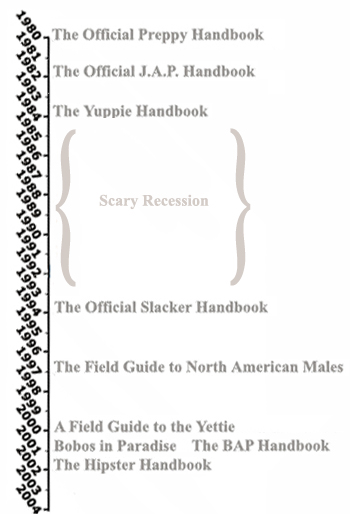
here’s a fun timeline of all the Official handbooks referenced in his article.

timeline2.jpg

1980 – The Official Preppy Handbook
“Prep Sex: A Contradiction in Terms”

1982 – The Official J.A.P. Handbook
(that stands for Jewish American Princess, by the way)
“At the very core of the female Born JAP aesthetic are two guiding principles: 1) I am terrific; 2) Daddy will pay.”

1984 – The Yuppie Handbook
“Thou shalt have no other gods before thyself.”

1994 – The Official Slacker Handbook
“Part old-fashioned bohemianism and part fin de siècle exhaustion, placed against the backdrop of a crappy recession and intolerable suburban irony.”

1997 – The Field Guide to North American Males
“Wanna come over and watch The Simpsons?”

2000 – A Field Guide to the Yettie
Yettie = Young Entrepreneurial Technocrat

2001 – Bobos in Paradise
Bobo = BOurgeois BOhemian.

2001 – The BAP Handbook
(BAP = Black American Princess)
“Any name beginning with ‘La’ or ‘Sh’ and ending in -ima, -ika, -isha, and -ita is never considered by BAParents.”

2002 – The Hipster Handbook
This old vocabulary? I’ve had it since I was twelve.

and while you and i wonder what’s up with the delay on the Official G Handbook, the Official Cholo Handbook, and the Official ABC handbook, we can at least entertain ourselves with the hipster olympics in the meantime:


Subscribe for more like this.


what does a web entrepreneur have in common with a fashion designer?

http://www.smejtese.cz/smejtese/images/obrazky/reklama/Benetton5.jpg

when i worked at house of blues, every so often we’d have social events with all the other people working in l.a.’s concert marketing industry. people from goldenvoice, livenation (at the time this was a separate company from house of blues), nederlander, etc. lots of people in attendance had even worked at one of the other companies prior to their current position, so to a great extent the people showing up already knew one another well anyway. the real benefit of attending such an event thus wasn’t even really to meet people from whom to gain new insight so much as to validate your own membership in the industry. i think this quintessential misunderstanding leads a great deal of “networking events” to confuse the goals they are trying to fulfill by focusing their outreach inward vs. extending it out. (intra-industry vs. intER-industry).

last week i went to twiistup, an event for “mingling with other techies in a lively atmosphere of tunes, videos and inspiration.” i am not a techie by any stretch of the imagination, and i actually hate mingling (mingling is like the thing cows do in the holding pens on the way to the slaughterhouse. they… mingle.) so mostly i was going for the “inspiration.”

in an interview with entrepreneur.com, john c. head III dean of MIT’s sloan school of management, and david s. evans, vice chairman of LECG europe and visiting professor at the university college in london, co-authors of the Catalyst Code, talk about one of the most profitable business models in today’s economy, the “catalyst business”:

You ask yourself, Are there two groups you can profit from getting together? A catalyst business serves two or more distinct groups of people who benefit from interacting with each other, but need help to do so efficiently.

this kind of perspective for hybridity and creative collaborations speaks very much to the kinds of opportunities that all the inward-focused networking events are missing. as a marketer, what piqued my interest in twiistup wasn’t about the latest, most obscure, soon to be hip, “underground” apps or widgets or whatevers, but rather the reasoning behind their creation. what, exactly, about this particular app or widget or whatever did the creator consider relevant enough to the current social climate to warrant all the time invested into its creation? you don’t need to be a techie to appreciate that question, but what i discovered is that unlike “what does this do?” or “how does this work?” in an environment teeming with people creating products that beg the question, the answers are in notoriously short supply to “why does it matter?”

schmalensee says:

I don’t want to put down technology guys, because somebody has to make the idea work, but at the end of the day, the creativity comes not in writing the code, it comes in seeing the business model and thinking it through from a business point of view.

The key is not that you have to be an expert in the technology, but you have to not be afraid of it. You have to not say “Oh, I’ll never understand that”….Where you make the money [is] not in the new “gee whiz,” but what the new “gee whiz” can do for people.

part of the problem is that it’s not always so simple to see the forest in the context of an outside perspective when you’re in the thick of the overgrowth. being so mired in the details makes articulating the thing’s overall relevance much more difficult. this is then ever more reason why “networking” events should reach out to a broader range of industries. it’s not simply that non-technologists can benefit from overcoming the tech-phobia, it’s that everyone can benefit–that is, catalyst strategies are born—from overcoming industry xenophobia.

evans says there are probably more opportunities to start catalyst businesses now than ever before and proposes the reason for this is that many of the elements that you need to start a catalyst business (i.e. communications technology) have become easier to get. but i would argue there is another, just as powerful force involved here: culture.

in the rise of the creative class richard florida presents the idea that there is a distinct demographic segment, comprised of knowledge workers, intellectuals and various types of artists, with its own particular predispositions and proclivities. beyond just the nature of their occupations, this “creative class” is also defined through commonalities in many of its members’ lifestyles and values. i think there are two particular ways in which the attributes of this expanding cohort relate–not coincidentally–to the kind of business model evans and schmalensee see expanding as well:

1. the creative class grows through the very processes that catalyst-businesses enable. the creative field of technology merged with the creative field of music, develops whole new fields within music/audio technology. likewise with technology and art, and so on.

2. this group (which fills about 12% of all U.S. jobs) is disproportionately responsible for the development of the contemporary cultural landscape, passing on the very values of hybridity that fuel the catalyst-business model to industries and fields beyond just the creative class itself.

evans and schmalensee might say that what connects a fashion designer and a web entrepreneur, is that, for instance, the former would need the latter to stay competitive in their online presence, but that’s just scratching the tip of the iceberg.

what industries of all creative flavors have in common is the necessity to take the significance of cultural trends into consideration. whether you are working in technology, music, design, marketing, entertainment, business, or really anything else where what’s going on in the greater culture matters, then being able to accurately distill, develop, and disseminate cultural relevance can mean the difference between success and failure. literally. is there anything successful that WASN’T relevant to its time?

(….ok, van gogh is coming to mind…. but i’m telling you: it’s a short–posthumous–list.)

it seems then that a good way to avoid a fate of irrelevance would be to explore the directions that the industries driving culture in tandem with yours are leading culture. a great forum for jus such an exploration (on any scale) is a “networking” event.

for the creative class, culture is the raw material ALL of us work with, and all of us have a hand in shaping different aspects of it. it’s why the answers to the “why does it matter?” question are so important to me, and should probably be to you too. one of the goals for any significant networking event aiming to provide value to this particular yet disparate demographic segment then, should be to apply this approach towards a greater industry hybridity.


Subscribe for more like this.


the cult of the gate-crasher


“We’re the most permeable membrane in show-business. Anyone who thinks they’re part of Mystic Family Circus probably is.”

Mystic Family Circus in Freaks & Fire: The Underground Reinvention of the Circus

ok… i’m going to confess: i didn’t read the cult of the amateur (and i’ve read enough reviews of it at this point to be fairly certain that i will never want to) but i’m sure whatever the book is trying to say, it’s got it wrong.

wait, no, that’s not right… we can’t begin this way…

this isn’t even about the book. the book is just a a timely incarnation of a widely-held perspective that there is, and needs to be, a set dividing line to separate creative expression of worth from that which is worthless. and without this line there would be no way to distinguish between that which is moving culture forward, and that which is, as andrew keen says, “killing culture.” what the book is wrong about is this perspective in the first place.

i’m going to give the majority of the credit for why i’m not going to read the book to this fantastically insightful customer review of it on amazon. (i actually can’t think of a more amazingly ironic sort of fate for a book that’s a polemic decrying the worthlessness of the web’s content! can you?):

Although The Cult of the Amateur is highly thought provoking, it is marred by sloppy thinking. For one thing: “Amateur” is never defined. Professionalism is a complicated concept in the fields of literature, music, visual arts, and dance (the last is a field this book does not cover, but it is one I am familiar with as a performer and teacher). Professionalism is often not defined by whether the person makes his or her living as a writer, musician, etc. Most people in most arts fields, including some highly skilled and well-known artists, simply cannot earn a living working in the arts full time because the pay is typically too low. Professionalism is sometimes defined by whether the artist has passed “gatekeepers,” in the form of publishers or producers, or by winning contests.

yes… this is where we should begin.

right there.

artistic expression of worth, i.e. “professional-quality,” as defined by whether the artist has passed “gatekeepers.”

see this is where the cult of the amateur is wrong. in the very concept of its title! there is certainly no lack of amateurs out there–those that haven’t passed through the gate–but the cult isn’t about them. no, all they get is a club. and they’re quite happy with it.

the cult…is about the gate-CRASHERS! these are the people who don’t give a shit about the gate.

see, despite whatever the book is (i’m told) trying to assert, it’s not REALLY about how web 2.0’s proliferation of “amateur content” threatens “our cultural standards and moral values.” it’s not really about how a static volume of books edited by a bunch of white guys who determined what was and was not worthy of inclusion is “better” than a universal wiki-encyclopedia. it’s not REALLY about how news written by a professional journalist working for a publicly-traded corporate-owned media outlet is better than a blog. it’s probably not even about concepts for determining the merit of creative expression in a more complex way than “created by someone who has passed through the gate” vs. “not.” no, it’s not about any of that nonsense…. what it’s really about is a huge degree of fear and anxiety from the cultural conservatives within the gates, who will pay money to read a book that might allay these fears by discrediting the unwashed barbarian insurgents outside threatening to undermine the very foundation of the elite’s worth as artists, not to mention their authority.

hold up a second…. let’s pause for a brief history lesson on “degenerate art“:

Entartete Kunst-

In 1927, the National Socialist Society for German Culture was formed. The aim of this organization was to halt the “corruption of art” and inform the people about the relationship between race and art. By 1933, the terms “Jewish,” “Degenerate,” and “Bolshevik” were in common use to describe almost all modern art.

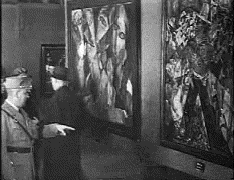
Viewers of Degenerate Art Exhibit In 1937, Nazi officials purged German museums of works the Party considered to be degenerate. From the thousands of works removed, 650 were chosen for a special exhibit of Entartete Kunst. The exhibit opened in Munich and then traveled to eleven other cities in Germany and Austria. In each installation, the works were poorly hung and surrounded by graffiti and hand written labels mocking the artists and their creations. Over three million visitors attended making it the first “blockbuster” exhibition. Many of the artists included in the Entartete Kunst exhibition are now considered masters of the twentieth century. The following are some of the better known artists whose works were ridiculed in the exhibit. Marc Chagall, Max Ernst, Kandinsky, Die Brücke….

woops. looks like someone messed up on their art history final. oh wait…. hitler was never accepted to art school in the first place…

“All my life I have wanted to be a great painter in oils … As soon as I have carried out my program for Germany, I shall take up painting. I feel that I have it in my soul to become one of the great artists of the age and that future historians will remember me not for what I have done for Germany, but for my art.… As for the degenerate artists, I forbid them to force their so-called experiences upon the public. If they do see fields blue, they are deranged, and should go to an asylum. If they only pretend to see them blue, they are criminals, and should go to prison. I will purge the nation of them.”
– Adolf Hitler

he really really tried to feature picasso’s work in the entartete kunst exhibit too, unfortunately picasso could never be proven to be jewish enough to fit with the theme.

ok, you know what?…. that was a pretty extreme example. don’t lets get carried away, aight? alls i’m sayin’ is…. it ain’t like discrediting gate-crashing artists out of fear is a new thang. it’s got quite a robust history. ironically, angstily revenging your rejection by the gatekeepers by wiping them out isn’t really what gate-crashers care about. really, more often gate-crashers don’t even care whether they are accepted or not.

that’s part of what makes them so dangerous. see, whereas some “amateurs” really might get all despondent (and in very rare cases…genocidally psychotic) if a gatekeeper won’t let their art through, to a gate-crasher the idea of getting discouraged if they didn’t make it is like getting discouraged from sneezing in the future just because you didn’t get a “god bless you.” they’re going to create art no matter what. it’s a disorder. they generally can’t help it. and i’m not talking about all those poor tone-deaf souls with pop-star delusions that american idol relishes for its gag reel. that’s not about compulsive creative expression, that’s about feeding the fantasies of narcissism. and while the two very often come hand in hand, they are very easily distinguishable.

the self-identified “professionals” inside the gate, however, like to lump all the people on the outside into this one big tragic wannabe “amateur” category. it’s a lot less threatening that way. call them all pestilent “amateurs” and it helps delay the need to critically address any revolutionizing impact of the gate-crashers among them. generally the rule is to scoff at the barbarians with spray cans overtly tagging the walls of the hallowed gate until such time as the side facing out has itself turned into a new kind of canvas, and the gatekeepers have figured out how to move the gate to a more accommodating locati–i mean, monetize the new art.

even arguably the most impenetrable gate on earth (i’m not counting heaven) moved when hollywood was financially forced to stop staring at its on celluloid navel. once upon a time hollywood was adamant that there was no way that any entity but an established studio could produce quality movies. after all, how could they? beyond the impossible hurdles of the huge amounts of money and all sorts of other resources required, producing movies that the public would be interested in seeing was a craft, requiring years of professional training and dues paying. this just wasn’t the kind of thing any amateur could do. that is, until miramax’s independently-produced, $1.1 million sex lies and videotape performed better on a cost-to-earnings ratio than the $50 million batman. four years later disney bought miramax, and now now, over a decade later, the concept of an “independent” film is basically an anachronism. (seriously, like when was the last time you went to see an “independent”?) hollywood’s totally cool with good (profitable) movies coming from wherever it is that they come from now–it’s too busy just scrambling to figure out how it’s going to continue to make money on distributing them to care about defending it’s Ahhht gate anymore.

as the auter’s (not amateurs) of the 1990’s independent film industry attest, “outsider artists” are not necessarily all that interested in paying their dues and waiting in line for the chance to get their shot. nor are they particularly resourceless when it comes to finding innovative ways to create and distribute the fruits of their creativity on their own terms. these things hold true for gate-crashers in all creative fields. from film, to music, fashion, entertainment, to business, and even to the creative expression of lifestyle itself.

this is all a great opportunity to reevaluate the question: is creative expression worthless unless it has prestige? does it have to have “superiority” (i.e. better than the stuff outside the gate) to have value? both the “polish” of industry and “ingenuity” of independence lend their respective expressions different kinds of caché, but is there perhaps a way to decipher the inherent value in creative expression regardless of origin? can expression be judged on how insightful it is? how entertaining it is? how relevant? provocative? fresh? without that measure necessarily being a reflection of how many gates it did or did no pass?cuz see, the funny thing about the gate, is that the gate doesn’t actually CARE about the art. well, it sort of does. but mostly, it just cares about perpetuating itself. this is why it’s so difficult for people on the inside side of it to break out once they’ve gotten too far in. (oh, so you want to be a political essayist but your major success is in illustrated children’s books? roiiiight.) this is also why true gate-crashers are defined not by having been able to do so from the outside in, but rather by continuing to crash through the gate, no matter which side they’re on. see: paul simon’s foray into mbaqanga music of south africa on the Graceland album, 1986. According to allmusic.com, “Graceland became the standard against which subsequent musical experiments by major artists were measured.” totally a gate-crasher move.

i’m not saying that traditional training is unnecessary, i’m just saying that it’s not a consistent enough determinant of quality to rely on too heavily for the judging. “self-taught” is not a separate art category. and i’m not saying that gates don’t matter, they are, in fact, crucial. without them, the gate-crasher could not exist. what i am saying is it’s time to give the gate-crashers their due recognition. the experimenting, the visionary, the curious… these qualities that are ignored, denied and discredited by the word “amateur,” these are the qualities that fuel the innovators that are not only not killing culture, but in fact, have always been the ones reincarnating it.


Subscribe for more like this.


where is everyone?

i moved my blog and everyone disappeared! i’m really missing the three people who used to read this blog. where you at? if you come back, i’ll get you on the list. (bring a friend, and i’ll put you down +1).

in my previous post i wrote about how hip hop culture offered the first really racially desegregated lifestyle choice, and while in the primordial culture ooze of hip hop nightlife this hybridity was the result of a sort of fortunate accident, in the world of hip hop industry this was a very deliberate strategy. wrought, perhaps most famously, by the combined pioneering forces of russell simmons and rick rubin–you may have heard of this little record label the two started together called def jam if you haven’t been deaf for the past two and a half decades.

from Can’t Stop Won’t Stop: A History of the Hip Hop Generation:

Russell was a Black executive able to bridge Black and white tastes like no one since Berry Gordy. He hired Adler. Rick was a Jewish music producer who understood how profoundly Herc, Bam, and Flahs’s insights could reshape all of pop music. He hired Bill Stephney. The staff for Def Jam was uniquely suited and highly motivated to pull off a racial crossover of historic proportions.

Stephney convinced his friends at rock radio to stay on Run DMC’s cover of Aerosmith’s “Walk This Way,” even when the call-out research showed racist, “get the niggers off the air” feedback. He then succeeded in propelling the Beastie Boys onto rap radio, a feat no less difficult. By the end of 1986, their strategy had been perfectly executed. The Black group crossed over to white audiences with Raising Hell, then the white group crossed over to Black audiences with Licensed to Ill.

Forget busing, Adler thought. Hip-hop was offering a much more radical, much more successful voluntary integration plan. It was bleeding-edge music with vast social implications. “Rap reintegrated American culture,” Adler declared. Not only was hip-hop not a passing novelty, [he] told journalists, it was culturally monumental.

once upon a time, hiphop represented the next-stage in the evolution of a modern identity (consider that even madonna emerged from the hiphop scene incubated at the roxy), yet the promise of hiphop’s diversity was instead crushed under the genre’s globalization of, essentially, third-world values. hiphop became not the messenger of the polycultural future, but the harbinger of the blinged-out apocalypse.

you know… when MTV first launched, with it slate of rock and new wave programming, black artist were so systematically excluded that it was only after columbia university reportedly threatened to boycott the station that MTV finally relented and started playing michael jackson videos in 1983. at the time, michael jackson was considered the mainstream symbol of what was “black, urban, and dangerous.” 20 years later, michael jackson (the michael jackson of 20 years ago, i mean) is STILL the cross-genre, cross-race, cross-cultural ambassador to “everybody let’s dance.”

what the hell happened?! this was supposed to be hiphop’s birthright!

from the very beginning there were two ways this cultural expression could have gone. one direction was a bridge–like exactly what you’d expect from the first-generation american progeny of bob marley’s music being raised by kool herc and afrika bambaataa; as innate as the drive that propelled grafitti, as human as the beat that compelled people to dance. the other direction was as a flag. the loud proclamation of the marginalized and oppressed experience which had up till then been treated politically and culturally with a policy of “benign neglect,” and it was mad as hell and it wasn’t going to take it anymore. a voice that could speak for all who had had theirs stolen, with the sharpness of chuck d’s tongue or rakim’s rhyme. for both of these directions of hiphop the undercurrent of unification was an inherent component all along.

and then somewhere along the way hiphop exited too fast off the freeway and got itself twisted on a roundabout that sent it hurtling back into the complete opposite direction.

i’m not interested in discussing the polarizations that have gripped hiphop since, the violence, sexism, materialism, the east coast, the west coast, the gangsta rap, the conscious hiphop, the whatever, who cares. there’s a lot of talk about this already, and the bottom line is that the industry of culture is selling people what they want–whether it be kanye or lil john, or lil kim or lauryn hill, akon or talib. to deny consumers of something they’d pay money for would be bad business.

the real mystery at the intersection of culture and commerce is now this: in the age of the long tail of both demand and supply can we ever again expect an emergence of any kind of real, integrated culture? or is our destiny really just an endless assortment of choices that will turn our histories and mythologies into an ever more niche experience? will the accessibility of greater diversity lead to greater desegregation, or will it simply turn us into connoisseurs? content with the second-string substitute of globalization as a consolation prize for the cultural integration that never really arrived?

the spark that lit hiphop’s beginnings has been turned into hi-def dvd of a gas-powered fireplace crackling on a plasma-screen display.

but will the glimmer of hybridity that inspired it, ever be reincarnated in any other form?

– – –

more reaction to can’t stop won’t stop: a history of the hip hop generation:
HERE


Subscribe for more like this.