
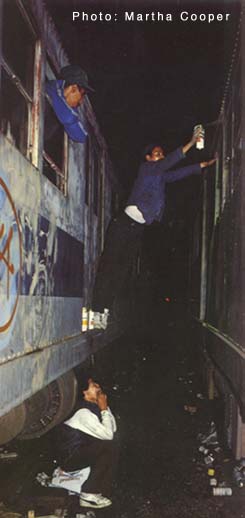
according to Can’t Stop Won’t Stop: A History of the Hip Hop Generation, afrika bambaataa defined the four elements of hip hop as djing, emceeing, breakdancing, and graffiti. of the four, only graffiti makes a case that its conception was a little more immaculate. in truth, it’s the only element that can actually even pursue any kind of truth with such a claim, as the origin of modern graffiti can be traced back not to the bronx, but to philly, as far back as 1965.
from Can’t Stop Won’t Stop:
Aerosolist and activist Steve “Espo” Powers says that the Black teenager, CORNBREAD, who is credited with popularizing the tagging of the Philly subways was only trying to attract the attention of a beauty named Cynthia. by 1968 the movement had spread to New York City.
but destiny is forged not of details, but from convergences:
….When a Greek American named TAKI 183 told the New York Times in the summer of 1971 why he tagged his name on ice cream trucks and subway cars–“I don’t feel like a celebrity normally, but the guys make me feel like one when they introduce me to someone”–thousands of New York youngsters picked up fat markers and spray paint to make their own name.
….Writing your name was like locating the edge of civil society and planting a flag there. In Greg Tate’s words, it was “reverse colonization.”
…. But these writers weren’t like the revolutionaries, or even the philosopher-activist wall-writers in Lima, Mexico City, Paris, and Algiers. Theirs were not political statements. They were just what they were, a strike against their generation’s invisibility…
They held no illusions about power. No graffiti writer ever hoped to run for mayor. And unlike the gang bangers, none would submerge his of her name to the collective. They were doing it to be known amongst their peers, to be recognized….
Normal Mailer, one of the first to write seriously about graffiti, got it instantly: the writers were composing advertisements for themselves.
graffiti was the megaphone that amplified the identities of those who knew they could never expect any other kind of recognition. a kleptomania of attention by those suffering from the original sort of attention deficit. by the time graffiti evolved from simply tagging, to “piecing” train-big creations, it was like stealing “rolling billboards for the self.”
but this kind of exposure came at a price. first of all, it was illegal. then after that it was time-consuming, a huge health hazard, incredibly dangerous, and of course, fiercely competitive. that was how much it cost to earn that moment of recognition. these kids were not raised on any illusion that they would ever be famous, be recognized, even be noticed. graffiti thus became a weapon with which to fend off the extreme alienation experienced by a generation of neglect victims.

thirty years later, here we are:
the most well known graffiti artists have either become corporate brands (obey, ecko) or are icons of anonymity (banksy). and everyone else has become, as the colloquialism goes, an attention whore.
to the invisible, writes jeff chang, fame itself was wealth.
funny that the same currency should be the lucre for those indulged with access to the fastest and easier methods for widespread expression ever developed. myspace and facebook and twitter and flickr and on and on, all mean that there’s no longer need to risk running from the police, inhaling noxious aerosol fumes, or life and limb to get your name out. “tagging” has literally never been easier. thirty years ago tagging was an illicit activity, branding one an outlaw for branding their name upon the gaze of others. now all of social media has become a “tagging-approved” zone. like a giant graffiti skate-park: a designated safe area where anyone can perform what was once a struggle to express.
modern society’s indulgence of its youngest children has led us to more craving, as shows like american idol inflict an even more profound deficit between the attention we want and the attention we get. the tools and opportunities we seem to seek are no longer an offense against society’s neglect, but a defense against our own narcissism’s resentment.
the old way at least made the commute more colofrul.

 campaign announcing their community site