when i started bugging micki with my thoughts and questions on the topic of the value of social engagement as a marketing strategy (thaaat whole diatribe is currently gestating in the social.creature incubator, and will hopefully hatch before too long) she turned me onto this blog, by a dude named jeremiah. today i found a post there that led to a comically succinct visualization of the breakdown between the (heretofore) 4 tribes of marketing: marketing, pr, advertising, and branding…
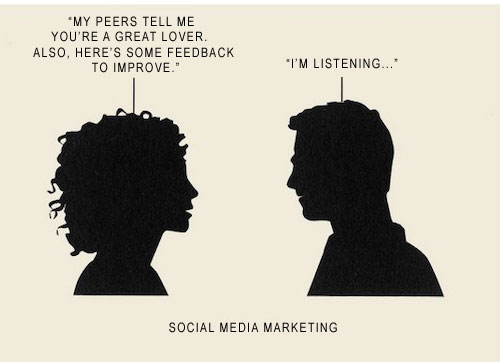
jeremiah’s response for social media marketing (the nascent fifth tribe) is represented in this diagram:
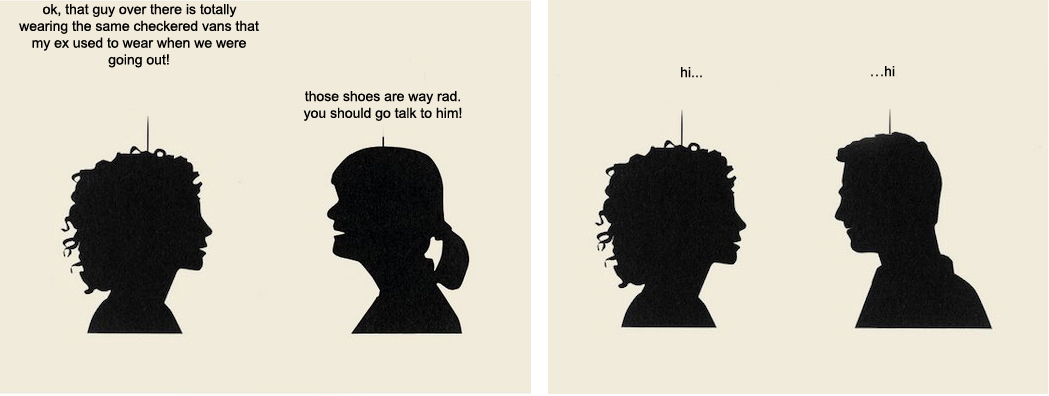
so, here’s my take on how something that i like to call identity marketing fits in.
** (bonus points: can you correctly identify the actual “marketer” in this picture?) **
For a Marketer who doesn’t identify as a Geek, going to SXSW Interactive is pretty similar to getting sucked into a passing acquaintance’s personal blog. It’s full of curious information, titillating details, and makes you feel an undeniably voyeuristic amusement in the certainty that the author wasn’t really prepared for you to be reading any of it quite so out of the context within which it was written.
This may sound like a sort of far-fetched analogy at first. After all, half the premise for interactive media is exposure. You’d expect those most deeply involved in its development would be aware that their industry isn’t a filtered post. And you’d be quite surprised at what you’d inadvertently discover.
– – –
SXSW is a conglomeration of festivals. There’s the Music one, which everyone knows. There’s the Film one, which heard that music was throwing a party while its parents were out of town and showed up too. And then there’s interactive. The little orange kid on the right, waving his hand, going, “Hey! Me too!”
People get really passionate about movies, and people get really hardcore passionate about music, but “Interactive” refers to a kind of tool that enables a process. For most people, it’s not the tool or the process of Interactive that gets them all hot and bothered. It’s the experience!
And yet it’s the experience of interactive that seemed to go almost unnoticed at SXSW-Interactive. Your favorite movie is not a choose-your-own-adventure, and your favorite band is not going to let you sit in on gigs. Interactive holds the promise of precisely that kind of meaningful, resonating, participatory experience you’re craving with all that has previously been inaccessible, but all it wants to talk about is the application.
At the event’s opening remarks speech, the audience was split up into key populations. First the designers in the room were asked to stand up. Then they sat down and the programmers were asked to represent for their team. Next, the “money people” were asked to stand. They got to stand up for longer than the other two groups so that everyone could remember who they are better.
And that was it.
That’s apparently all there is to interactivity. There’s the design of the tool, there’s the development of the tool, there’s the funding of the tool, of course, but as far as an understanding of the people who use the tool and the impact of how they’re using it and what they’re using it for–what would that have to do with a conference about interactivity?
It’s kind of like a camera festival with movies thrown in for bullet points. Or an amp festival with rock and roll as a liner-note afterthought. I mean, hey–there’s absolutely nothing wrong with getting excited about cameras and amps, but if you were actually interested in creating an opportunity for a lot of forward-thinking, curious, innovative individuals to converge (“convergence” is the new “2.0”), wouldn’t it make sense to develop the focus of this meeting ground into more than just about… uh… equipment?
You don’t need to be a filmmaker or a musician to appreciate movies and music. Why should you be expected to be a technologist to appreciate interactive media?
Ok, ok, you get it. Fine. Enough bashing Interactive for missing the point while busily staring into the source code of its navel. There’s another culprit here as well that’s just as guilty.
That’s right, Marketing, I’m talking to you!
Watching the panelists on “How to Build an Online Fanbase” describe their personal discoveries of promotional strategies as if they had individually invented the wheel of marketing, it was difficult not to feel frustrated by the evident segregation keeping the two industries apart.
John Batelle, of Federated Media, hit the nail on the head during the panel on “Why Marketers Need Conversational Media,” when he said, “Marketers are scared of not being in control.” Considering that this interactive tool and the process it enables seem to accomplish something that is completely anathema to the industry that invented “Spin Control,” of course Marketing would be reluctant to play nice with Interactive.
Well….Deal with it, Marketing. Interactive’s not going away, so why don’t you go and hang out with it? Maybe go check out a festival or something. Get drunk together on free booze, and make out with it in some dark corner of a crowded club. Might even be fun!
And that way maybe next year Interactive will even consider asking the marketers to stand after the “money people” sit down.
Sure, you’re hiring an agency to direct it, but YOU are paying for it. It belongs to you. Or even more precisely, it belongs to your brand. The ad agency is like the au pair you hire to make sure your baby gets the best care. It also happens to be an au pair that hopes to win awards for its stellar child-rearing, so it’s your job to understand the difference between sheer showmanship and actual skillfulness. It’s the difference between a successful campaign and sabotage.
Sometimes an ad fails because it’s simply irrelevant. Because it didn’t find the right audience, because it missed the mark on how to communicate its message, or because it didn’t really understand who it was talking to in the first place. A bad advertising strategy won’t make national headlines, but this subtle failure will discredit your brand’s reputation, and it will convince an audience that your message or brand isn’t for them.
You’re counting on your agency to get you exposure; you’re not expecting it’ll make your brand lame in the process!
So what can you do to avoid this silent sabotage?
Well, to start, here are a few things you should understand about what matters in the process of choosing an agency, assessing its work, and understanding the measurements of your campaign’s effectiveness.
1. The ‘Creative’ shouldn’t happen before the Research
Before there’s a contract, all the agency wants is to convince you that they will deliver the most creative, most original campaign. They may even go to astounding lengths to prove theirunparalleled creativity, but how many of their unbillable hours go into research? Enough to be certain that the message they are developing is going to be relevant and effective? It may be a creative concept like no other, but does the agency know the campaign they’re pitching is going to actually speak to your audience in their own language? Will it approach them on their terms? It may resonate with the hipster designers coming up with the creative, but not all consumers are made the same….So do they understand who yours are? Does your ad agency know what drives their culture, and how they express their identities? Can their pitch impress you with non-speculative revelations about your brand’s audience that you may not have even considered before?
It should.
The greatest disservice an agency can do to your campaign is sell you on creative without doing their homework first, because they are then bound to deliver what you bought even if its efficacy is questionable, at best. Worse still, any data will need to be skewed to corroborate the agency’s efforts. By selling the creative ahead of the research they are not only doing a disservice to your audience, they are doing a disservice to your understanding of your own audience.
2. There’s gotta be some ‘Creative’ left over for the Media Plan
Half the joke is in the delivery. And it’s half the ad too. Relying on a generic media plan belies a lack of understanding about, or even indifference to your users’ identity, and exposure without a targeted strategy should only even be considered by a very particular kind of brand–unless you’re buying Super Bowl ads, it’s not your brand.
Does your agency understand how and where to access your target audience, and the various subtleties and patterns inherent in the ways your target audience interacts with different marketing channels? Developing relevant and originalcommunications strategies within the current marketing landscape is not about whether you buy ad-space in Filter vs. Vapors, whether you should build a microsite, which keywords to buy, and it’s certainly not about trying to make some video go “viral.” A campaign is no longer limited to being simply printed, broadcast, or even forwarded, it should be embedded. From Red Bull partnering with sub-culture creatives to produce a platform for Ascension from the underground, to Scion planting its car as the coolest item one can “buy” on the popular Tween online community Whyville, an authentic, relevant strategy plays an integral part in defining the message’s form and function.
The niche-ing of all media, multiplied exponentially by the variety of interactive opportunities makes the process of disseminating the message a lot trickier, but the payoff is that it can also make the message itself a whole lot stickier. Knowing how your consumers’ identities shape their interactions with your marketing approaches can be leveraged towards navigating the most important emergent medium: Culture. (Were you expecting the Internet?)
3. The Great User-Generated Content Divide
The average cost of a 30-second TV ad, including production and airtime costs, can run $500,000 to $1 million. Consumer-generated campaigns can cost just a few thousand dollars. So which amount do you think your Agency’s hoping you’ll write a check for?
User-generated content means audience engagement, message relevancy (if it’s not you’ll hear about it right away), authentic endorsement, and even the enablement of culture and identity expression. You should be excited. This is all pretty awesome stuff! But if consumers are making the “ads” for free, then how does the agency validate its cost? There’s a bit of a conflict of interest going on, for sure. Conveniently for you, a cottage industry of startups has emerged to help companies create and manage user-generated content for consumer contests and community input.
Your agency’s validation should lie in precisely this kind of interaction creation and management service. If the campaign concept does not include a function as a framework for enabling user engagement, it is effectively turning your audience away at the door when they arrive.
4. Traffic is not a useful Success Metric
If your site or ad was an art exhibit it would matter how many people were coming by to take a look. Manipulating an audience towards your site for a traffic spike is not that complicated, and it’ll let your agency produce some acceptable statistics for progress reports, but if the audience isn’t getting involved then the traffic doesn’t mean all that much.
Engagement does. From click-thrus, to subscription rates, to form submissions, the measures of a campaign’s success are revealed through audience interaction patterns. Integrated analytics are even better. For example, integrating analytis from an email campaign with site statistics allows not only for a much better indication of a campaign’s success, but grants greater insight into user behavior, which, in turn, will help develop more relevant communication.
Success metrics should be established in advance, but need to remain flexible enough to accomodate change as the campaign evolves. One of the greatest advantages of maintaining this kind of malleability is that it will allow your campaign to “self-correct.” Your community will tell you when you’re missing the mark if empowered with the tools to do so. At the end of the day the more positive the customer experience, the better a return rate you’re going to see.
– – –
Employing a meaningful, integrated strategy that allows you to measure and capitalize on the interplay between all the various marketing channels at your disposal is like playing pinball with a highly developed understanding of physics. The way that the ball reacts and moves from one side to another is the same way a consumer traverses your promotional terrain from interaction to interaction. What you don’t want is for your agency to show up, pull the plunger, and bang mercilessly on the side of the machine hoping to thwart the laws of physics by sheer force.
Agencies know they need to change, they just can’t figure out how. Half the problem is they’re so stuck in doing things the way they always have that their approach to new options is still, unfortunately, through the same old processes (uploading a TV spot to You-Tube, anyone?) The other half of the problem is that somehow along the way they’ve become convinced the campaign is theirs, and this sense of entitlement is keeping them from being curious or diligent enough to develop the kind of relevant and original communications solutions that are called for not only by today’s media realities, but by your brand.

 jeremiah’s response for social media marketing (the nascent fifth tribe) is represented in this diagram: