
culture seeks its level

The image “http://z.about.com/d/altreligion/1/0/W/N/2/ouroboros.jpg” cannot be displayed, because it contains errors.

In Nation of Rebels: Why Counterculture Became Consumer Culture, Joseph Heath and Andrew Potter explain that really, there was never any conflict between the two to begin with. Counterculture hinges on, and consumer culture consists of, the expression of your lifestyle/identity. Whether you’re choosing to wear Nikes, Doc Martens, or some crazy obscure Japanese brand that doesn’t even exist in the US, you’re deliberately saying something about yourself with the fashion choice. And regardless of how “counter” whatever culture you think you are, getting to express that about yourself requires buying something.

Yet the concept of a strict divide between the “mainstream” and “counter”–or “alternative”–cultures persists, and the distinction between these “affiliations” is now defined not by whether we consume, but by what. Identities hinge on particular expressions and symbols, such as music or fashion for instance. In a very simple sense, you are “mainstream” or “alternative” based on whether the way you choose to express your identity, your taste, is shared by a big group/culture, or a small one. Yet the trouble is that these expressions are given meaning precisely through their common significance within a group, if the group size changes, then so too does the meaning.

Last summer Danah Boyd wrote about the idea of “Pointer Remix“:

One way to think about remix is as the production of a new artifact through the artistic interweaving of other artifacts…. With this in mind, think about an average MySpace profile. What should come to mind is a multimedia collage: music, videos, images, text, etc. This collage is created through a practice known as “copy/paste” where teens (and adults) copy layout codes that they find on the web and paste it into the right place in the right forms to produce a profile collage. One can easily argue that this is remix: a remix of multimedia to produce a digital representation of self. Yet, the difference between this and say a hip-hop track is that the producer of a MySpace typically does not “hold” the content that they are using. Inevitably, the “img src=” code points to an image hosted by someone somewhere on the web; rarely is that owner the person posting said code to MySpace. The profile artist is remixing pointers, not content.

I kind of think of all culture creation/expression as a process of “Pointer Remix”— and when I say culture creation, I mean brand creation too. There’s a paragraph in Pattern Recognition where William Gibson lapses into fashion historian momentarily:

My God, don’t they know? This stuff is simulacra of simulacra of simulacra. A diluted tincture of Ralph Lauren, who had himself diluted the glory days of Brooks Brothers, who themselves had stepped on the product of Jermyn Street and Savile Row, flavoring their ready-to-wear with liberal lashings of polo knit and regimental stripes. But Tommy surely is the null point, the black hole. There must be some Tommy Hilfiger event horizon, beyond which it is impossible to be more derivative, more removed from the source, more devoid of soul.

And just as much as all labels are creating pointers, that’s exactly what we are buying. In fact, looking TO buy. Now, more than ever before, the possession of an “original” source is either impossible, pointless, or even irrelevant. In postmodernism’s revenge, even an “original” becomes a reference. A vintage dress is all about what it “points” to.

Yet as Boyd points out:

If the content to which s/he is pointing changes, the remix changes…. Say that my profile is filled with pictures of cats from all over the world. The owners of said cat pictures get cranky that I’m using up their bandwidth (or thieving) so they decide to replace the pictures of cats with pictures of cat shit. Thus, my profile is now comprised of pictures of cat shit (not exactly the image I’m trying to convey). This is what happened to Steve-O.

One of the most high profile cases of such content replacement came from John McCain’s run-in with MySpace profile creation. His staff failed to use images from their own servers. When the owner of the image McCain used realized that the bandwidth hog was McCain, he decided to replace the image. All of a sudden, McCain’s MySpace profile informed supporters that he was going to support gay marriage. Needless to say, this got cleaned up pretty fast.

Cleaning it up on myspace is easy. You can just go and find another image and use that, or, of course, you can host your own images, and that way be sure that the content being pointed to will not change without you knowing about it–but that defeats this metaphor, so pretend you didn’t just read it.

Cause what’s interesting to me is when this same phenomenon happens in a non-html-based context. Like, for example, if a priest gets outed as a pedophile. This kind of “content change” happens to real-life “pointers” all the time. Pointers that happen to be used as elements in the construction of identity.

Check this out, below is the ad campaign for the 2008 season of America’s Next Top Model:
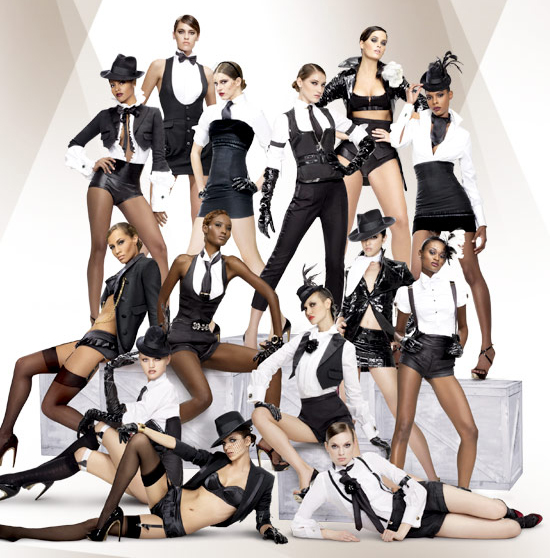
(For the record, seeing this billboard is what inspired this whole post.)

There’s a few particular aesthetic elements to note here for the purpose at hand, and I’ll tell you what they are. The hats with the feathers, the general 1920’s and 40’s infusion with the high waists and cropped tops, and the whole cabaret/vaudeville overtone.

These are all elements of a style that’s been rocked in the scene around me for years.

If you’re interested in some history you might want to click here, but the quick version is it became a part of the aesthetic expression of a particular subculture with a significant presence all up along the West Coast. And then last week, at the intersection of Sunset and Vine a bus rolls past me carrying a whole tableau along its side of girls sporting this style. It was pretty startling to see it so out of context, since up until then I hadn’t seen this look used in any mainstream media or setting–anyone who can find links to other examples, post it in the comments, I’d love to see it.

While I personally have no idea exactly how the stylist team for ANTM got the idea for the particular creative direction in the ad, I think the possibility that this burgeoning aesthetic, with a major base of operations in LA, might have somehow made it directly onto their radar is hardly a long shot.

Boyd asks, “What happens when a culture exists that rests on pointer remix for identity construction?” Well, at least one side effect is that meanings of cultural expressions–and hence what they say about our identities–change.

One pretty consistent way this “content change” in the meaning of a cultural expression happens is in the process of becoming more exposed. It’s been going on ever since the first small local band blew up and became huge. Everything else about the music and the act might have stayed the same but the obscurity, and it’s the very “alternative”-ness itself that was a part of its meaning all along. The difference between being a fan of something intimate and distinctive vs. something mainstream and egalitarian could be kinda like waking up to discover your kitten pictures have turned into kitten poo.

Here’s another approach. In October of 2007, Sasha Frere-Jones wrote an article in the New Yorker about “How Indie Rock Lost Its Soul.” The premise of the piece is that in the 1990’s rock and roll, a genre that evolved out of a tremendous black musical influence on white performers, and became the most miscegenated popular music ever to have existed, underwent a kind of racial re-segregation in its style:

Why did so many white rock bands retreat from the ecstatic singing and intense, voicelike guitar tones of the blues, the heavy African downbeat, and the elaborate showmanship that characterized black music of the mid-twentieth century? These are the volatile elements that launched rock and roll, in the nineteen-fifties, when Elvis Presley stole the world away from Pat Boone and moved popular music from the head to the hips.

…It’s difficult to talk about the racial pedigree of American pop music without being accused of reductionism, essentialism, or worse, and such suspicion is often warranted. In the case of many popular genres, the respective contributions of white and black musical traditions are nearly impossible to measure. In the nineteen-twenties, folk music was being recorded for the first time, and it was not always clear where the songs—passed from generation to generation and place to place—had come from.

…Yet there are also moments in the history of pop music when it’s not difficult to figure out whose chocolate got in whose peanut butter. In 1960, on a train between Dartford and London, Mick Jagger and Keith Richards, then teen-agers, bonded over a shared affinity for obscure blues records. (Jagger lent Richards an LP by Muddy Waters.) “Twist and Shout,” a song that will forever be associated with the Beatles, is in fact a fairly faithful rendition of a 1962 R. & B. cover by the Isley Brothers. In sum, as has been widely noted, the music that inspired some of the most commercially successful rock bands of the sixties and seventies—among them Led Zeppelin, Cream, and Grand Funk Railroad—was American blues and soul.

… In the mid- and late eighties, as MTV began granting equal airtime to videos by black musicians, academia was developing a doctrine of racial sensitivity that also had a sobering effect on white musicians: political correctness. Dabbling in black song forms, new or old, could now be seen as an act of appropriation, minstrelsy, or co-optation. A political reading of art took root, ending an age of innocent—or, at least, guilt-free—pilfering.

Himself a white musician/vocalist, Frere-Jones notes that adopting a black singing style even in his own band “seemed insulting.”

By the mid-nineties black influences had begun to recede, sometimes drastically, and the term “indie rock” came implicitly to mean white rock.

….How did rhythm come to be discounted in an art form that was born as a celebration of rhythm’s possibilities? Where is the impulse to reach out to an audience—to entertain? I can imagine James Brown writing dull material. I can even imagine the Meters wearing out their fans by playing a little too long. But I can’t imagine any of these musicians retreating inward and settling for the lassitude and monotony that so many indie acts seem to confuse with authenticity and significance.

While the article is specifically focused on the indie rock side, he readily admits that the segregation went both ways. Just as indie rock became “white rock,” “Black” music too began to occupy a space that may be more inaccessible and irrelevant to an outside audience now than it was during the 50’s. In an audio interview accompanying the article, Frere-Jones talks more about the results of the musical re-segregation from both angles. “Why is this a hit?” He jokes, about the absurdity of “Soulja Boy’s” success. “It’s just rapping over a ring-tone.”

Social and (after a series of lawsuits involving sampling) legislative forces gradually changed the sound of the music itself, and also of the “content” in the meaning of these musical pointers. As in: what does liking Indie Rock or Rock and Roll, and even Hip Hop at this point, convey about your identity now vs. what it would have 20 year ago? 40 years ago? Lose miscegenation and something that could once be relevant to a mixed audience becomes divisive.

Just as “Nation of Rebels” points out that there is no conflict between the counter and over-the-counter culture, I likewise see alternative and mainstream culture as just parts of a greater continuum, which ultimately, despite all the obstacles that societies, politics, economics, religions, and even individual personalities may put in its path, seeks its level at the greatest hybridity. “Content change” in the meaning of its expressions is as inevitable as the remixing of the expressions themselves.

In the meantime though, I’m gonna enjoy this kitten while it lasts.


Subscribe for more like this.


“this above all else…

…to thine own self be true.”
– William Shakespeare as Polonius

YOU MUST READ THIS STORY FROM THE NEW YORKER:

Something in me had snapped, was broken beyond repair. My taste had been central to my identity. I’d cultivated it, kept it fed and watered like an exotic flowering plant. Now I realized that what I thought had been an expression of my innermost humanity was nothing but a cloud of life-style signals, available to anyone at the click of a mouse. How had this happened?

I couldn’t understand. There had to be something else. What was a personality if it wasn’t a drop-down menu, a collection of likes and dislikes? Who was I without my private pressings, my limited editions, my vintage one-offs? How could I signal to potential allies across the vast black reaches of interpersonal space?

READ THE WHOLE STORY!


Subscribe for more like this.


“Every day is another day starring you.”

“The idea that whoever appeared onstage would play not me but a character was central to imagining how to make the narrative: I would need to see myself from outside.”
~ Joan Didion

In the midst of the quicksand hazard posed by every single episode of Lost available online, and in high def, I saw an ad for Celebrity Cruise lines with a slogan at the end that i thought was fantastic:

according to a NYTimes article published last spring, “This Is Your Life (and How You Tell It),” research shows that the human brain apparently has a natural affinity for narrative construction, which not only explains why Lost is so amazingly addictive, but why but we are continually updating a treatment of our own life in our heads.

Short of offering “run from the paparazzi” adventure travel excursions and rehab amusement parks, the cruise line has taken a very resonant approach with the “every day is another day starring you” slogan. “Seeing oneself as acting in a movie or a play is not merely fantasy or indulgence;” according the the NYTimes, “it is fundamental to how people work out who it is they are, and may become.” In the era of TMZ, thinking about that personal narrative in the format of a celebrity tabloid seems only natural.

For further commentary on the subject, here’s Rolling Stone’s top celebrity for representing “America in Decline”:


Subscribe for more like this.


consumer insight is funny

“You’re just perpetuating the stereotype by acting all stereotypical.”
– deleted line from tony scott’s domino

The image “http://stuffwhitepeoplelike.files.wordpress.com/2008/02/banner1.jpg” cannot be displayed, because it contains errors.

i have no idea about the racial background of the individual(s) that publish stuff white people like, but does it even matter?

as lenny bruce said, it’s not the word itself, but the censorship of the word that gives it its power, so it’s not necessarily the people that buy a brand or product, but the perceived people who buy it that defines its identity.

as in, you may happen to LOVE rocking out to justin timberlake on your ipod, but would NEVER under ANY circumstances go to his concert (and subject yourself to dealing with the kind of people that would buy tickets to a justin timberlake concert.) i think this kind of disconnect is also what undermines a whole lot of consumer insight research. expecting people to consciously recognize what influences their purchase decisions is like expecting them to recognize, admit to, deny, not deny, accept, not accept, a whole lot of pressures and social expectations that masquerade as personal preference. as far as most people are concerned, all they’re really aware of is looking for a way to express themselves, not of the incessant negotiation of their compliance with and/or rebellion against barrage of cultural stereotypes.

we may buy the products or brands that express aspects of who we are, but in most cases the options we’re choosing from in the fist place have already been pre-selected for us by the purchase decisions of other people like ourselves. the question then isn’t, why did i make the choice to buy this or that, but rather does this or that seem like the kind of thing that someone like me would buy? the “why” is: because people like me buy it.

after all, god knows i love sushi, irony, and sarah silverman, and apparently, that’s no accident.


Subscribe for more like this.


a trend’s success

Is The Tipping Point Toast?” asks the recent FastCompany article in which researcher duncan watts talks about his findings (and their less than exuberant reception) that expose the billion dollars a year marketers spend targeting “influentials” as a waste of money.

i am constantly repeating the phrase that “we buy the brands and products that we feel express aspects of our identity,” and this applies to ideas as well. we buy into and espouse the ideas that express aspects of who we are. our “intuition” in that sense, could be seen not so much a kind of internal tuning fork dinging to the tone of the universe, but rather an insidiously partial filter which evaluates the validity of information based on its compliance with our ingrained personal predispositions. for marketers–an avocation that calls for a particular breed of identity, of course–it’s no doubt easy to latch on to the idea that a select few influential individuals wield the capacity to push trends over the tipping point simply by their involvement in the process. after all, considering what we do it’s pretty “intuitive” for us, isn’t it?

from the fastcompany article:

Marketing has always relied heavily on instinct and intuition. Admen like to believe they’re creative geniuses, gifted at truffling out social trends (which is why, they hasten to point out, they’re irreplaceable). Joe Pilotta, research VP for a firm called Big Research, suspects marketers cling to their belief in Influentials partly because they’re lazy. They love the idea of needing to reach only a small group of people to “tip” a product, he says with a laugh. Plus, it strokes their egos: “Think about it. You’re saying, ‘I am in control–I am the biggest influencer, because I am going to influence the influencers!’ It’s an arrogance that only the corporate world could enjoy.”

which certainly makes ME wonder to what extent what we know–or believe we know–about the nature of how marketing is supposed to work is actually based on the the egos of CMOs as opposed to on actual social theory. how about you?

see, i think all of coolhunting is a ridiculous waste of time. there is no universal “cool” that exists out of context, and while i do believe strongly that marketers themselves are NEVER the demo, i also think that all of us are subject to the context of the cultures or communities of which we are a part. translation: cool matters not because it’s “cool” but because–and only if–it’s culturally relevant. and while relevance sounds a lot less sexy than its mistaken-identity doppelganger, cool, it’s relevance that “trends” are really about.

Watts decided to put the whole idea to the test by building another Sims-like computer simulation. He programmed a group of 10,000 people, all governed by a few simple interpersonal rules. Each was able to communicate with anyone nearby. With every contact, each had a small probability of “infecting” another. And each person also paid attention to what was happening around him: If lots of other people were adopting a trend, he would be more likely to join, and vice versa. The “people” in the virtual society had varying amounts of sociability–some were more connected than others. Watts designated the top 10% most-connected as Influentials; they could affect four times as many people as the average Joe. In essence, it was a virtual society run–in a very crude fashion–according to the rules laid out by thinkers like Gladwell and Keller.

Watts set the test in motion by randomly picking one person as a trendsetter, then sat back to see if the trend would spread. He did so thousands of times in a row.

The results were deeply counterintuitive. The experiment did produce several hundred societywide infections. But in the large majority of cases, the cascade began with an average Joe (although in cases where an Influential touched off the trend, it spread much further). To stack the deck in favor of Influentials, Watts changed the simulation, making them 10 times more connected. Now they could infect 40 times more people than the average citizen (and again, when they kicked off a cascade, it was substantially larger). But the rank-and-file citizen was still far more likely to start a contagion.

Why didn’t the Influentials wield more power? With 40 times the reach of a normal person, why couldn’t they kick-start a trend every time? Watts believes this is because a trend’s success depends not on the person who starts it, but on how susceptible the society is overall to the trend–not how persuasive the early adopter is, but whether everyone else is easily persuaded. And in fact, when Watts tweaked his model to increase everyone’s odds of being infected, the number of trends skyrocketed.

i really like that phrase, so i’ll write it again: A trend’s success depends not on the person who starts it, but on how susceptible the society is overall to the trend–not how persuasive the early adopter is, but whether everyone else is easily persuaded.

we buy the brands, products, ideas, political candidates, etc., etc., we feel express aspects of our identities. a trend’s success depends not on how COOL it is, but on how effectively it manages to express a common-enough identity aspect. in other words, one way to look at the success of the trend that is “The Tipping Point” itself is that it has managed to express an identity aspect shared by a whole lot of marketers. not because it was cool, perhaps not even because it was RIGHT, but simply because it resonated with a particular–and particularly widespread–identity.

perhaps instead of building databases of “trend-spotters,” “brand evangelists,” “influencers” or whatever else those agencies that are so proud of themselves for getting to sit at the “cool kids” table want to call them, a more useful application of money would be to research the dynamics of our ability to BE influenced. and when i say “our” i mean all of us, marketers included. because, after all, being human helps in the process of figuring out how to communicate to other humans.

and maybe i read it wrong, but to me gladwell’s book wasn’t ever really about some people being blessed with the ability to start trends better than others, but rather some people being more curious, and thereby simply ending up in the way of more trends. consider how many more things an “early adopter” tries out that NEVER take off than the average person? they don’t necessarily help more stuff tip, they just try more shit out. what? were you expecting a different model? if so, maybe you should stop saying the word “viral” so much. that might aid a perspective shift:

Perhaps the problem with viral marketing is that the disease metaphor is misleading. Watts thinks trends are more like forest fires: There are thousands a year, but only a few become roaring monsters. That’s because in those rare situations, the landscape was ripe: sparse rain, dry woods, badly equipped fire departments. If these conditions exist, any old match will do. “And nobody,” Watts says wryly, “will go around talking about the exceptional properties of the spark that started the fire.”

so… “If influentials cannot tip a trend into existence–and if success in a networked society is quite random–what’s a poor marketer to do?” The article suggests that, “Since you can never know which person is going to spark the fire, you should aim the ad at as broad a market as possible–and not waste money chasing “important” people.” and while i agree with this, I think the “ultimate irony” proposed at the end of the article is misleading:

“If you really buy [Watts’s research], the most effective way to pitch your idea is … mass marketing. And that is precisely what the wizards of Madison Avenue, presiding over our zillion-channel microniche market, have rejected as obsolete. “

cultural relevance–especially in a networked society–is not entirely as random as watts’s algorithmic computer simulations, and simply broadcasting a message doesn’t make it more relevant, but there is no special group of cultural gate-keepers that get to decide what’s going to be relevant and what’s not.

“I think that all books like The Tipping Point or articles by academics can ever do is uncover a little piece of the bigger picture, and one day–when we put all those pieces together–maybe we’ll have a shot at the truth.”
– Malcom Gladwell


Subscribe for more like this.