One of the most annoying things about people in advertising is it’s like they stop being human when they come to work. As soon as they walk through the office door they forget about examining what drives their own purchasing decisions when planning the process for others and start talking about “consumers” and “demographics” like test subjects in some experimental medication test — as though they aren’t consumers themselves!
It’s the communications industry, and yet so many of the “communicators” forget whatever it is they may have learned in that immersive language course they’ve been taking all their lives, and opt instead for an online translator. Which is what drives the point home in this great article from San Francisco Magazine about Goodby, Silverstein & Partners — an agency that obviously takes the process of being human along with them on their travels into advertising land — when their media strategist, Hashem Bajwa, says, “This is about brands releasing some control to the consumer, and that’s really cool. Brands that won’t start a relationship with us aren’t going to be as successful.” It’s not about those “consumers;” it’s about “us.”
Plus, the article is filled with both articulate insights:
The change involves no less than a fundamental shift in the relationship between advertiser and audience. No longer at the mercy of what a network beams into their TVs, people have morphed from passive watchers into active agents with the power to seek out and view whatever they want, whenever they want. As a result, the very notion of what makes an ad appealing has changed. Now that people are choosing to hang out with an ad the same way they choose to watch a show or play a video game, pushing a product—or at least pushing it explicitly—has become less important than creating an experience that’s fun, addictive, helpful, and even communal (since people pass word of these ads to their friends). In many respects, advertisers—and hence the agencies they hire—are becoming more like content providers whose main goal is to entertain.
And fascinating predictions:
Goodby and Silverstein predict that brands will become the new networks, making advertising agencies more like Hollywood producers.
How many directors of traditional agencies have you heard lately proclaiming that the internet’s making them feel younger? “Are you kidding?” Silverstien says, “I love this stuff. It’s even better than television.”
…. As smart as Goodby and Silverstein are, they come off more as artists than tech geeks. Silverstein still loves to draw. Goodby paints and writes poetry in his spare time. Hanging out with them, you wonder how they keep up with hyperspeed technological changes. “We hire freaks,” says Goodby, laughing.
Bonus track: one of my favorite freaks in general, Zach Canfield, is also a Goodby Silverstien freak–as their creative recruiter, and part of the team responsible for, among other things, the most amazing spoof of R. Kelly’s “Trapped In The Closet” saga EVER:
(You MUST watch!)
Trapped in the Clauset pt. 1:
Trapped in the Clauset pt. 2:
Trapped in the Clauset pt. 3:
Being human helps, but being a freak don’t hurt none either.
working on music festivals has gotten me to thinking about the kind of presence that these events develop online.
p.t. barnum pretty much laid the template for the concert promotion industry, and in that process also invented the advertising industry. thereafter events and promotions have been inextricably linked, like a codependent couple stuck in a mutually-enabling relationship.
which is not to say that that relationship hasn’t become totally dysfunctional in the past century. after so long getting completely ignored by concerts, which has no passion for anything but venues, promotion turned what was once an innocent flirtation with media into a full-on, often illicit, always exhilarating love affair.
see, because concerts makes its money at the venue door, it doesn’t really see why it oughtta give a crap about “engagement” since “the draw”–that is, the band–changes every night. and so in this precariously maintained way, the concert industry gets away with more or less letting the bands have engagement be their cross to bear.
which is why the music festival website is such a bizarre little anomaly. it’s the rare occasion when a concert promotion company must use its own brand as an element of the “draw,” and thus needs (whether it understands it or not) to deal with engagement media.
that’s like…. imagine having to work with your partner’s secret lover on a big work project that you’re not really feeling that confident about, and you might start to get an inkling of the sort of awkwardness with which the concert industry approaches this whole process.
essentially there are three things that a festival is selling:
1. the event lineup
2. the event brand
3. the event community
like toilet paper, tissues, and paper towels, they’re all made up of the same stuff, and to a certain degree serve an interchangeable function, but at the end of the day, you do buy each for different reasons.
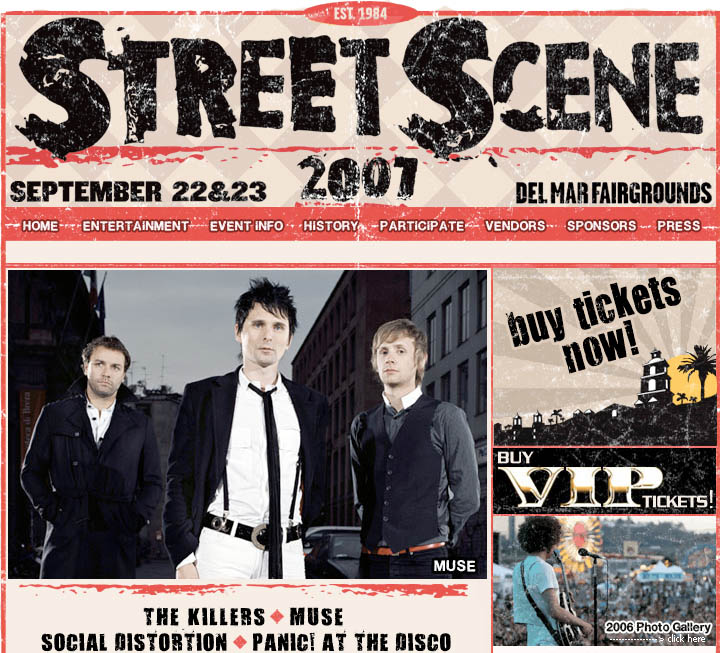
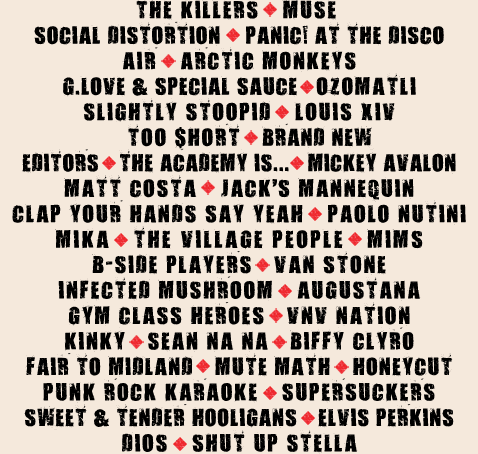
after lightning in a bottle, the do lab’s coachella installation, now working on the street scene music festival, and with all the various other festivals around the world the do’s negotiating with right now, i’ve been looking at more festival websites than i can even recall. but what keeps catching my eye is the way that they all address the above three selling points:
Lineup: HOLY SHIT!
the smashing pumpkins AND the police! M.I.A.!? how the hell did they get M.I.A. i thought the dept. of homeland security wasn’t even letting her in the country?! WU TANG? i’m sorry… WU TANG FUCKING CLAN? wait…. a third time… WU?! (ok, how many members of wu tang do you need to book to be able to put them on the bill? i guess now that ODB’s out for the count it’s easier to get the full mishpucha, but… still, really?)
brand: what else would you expect from virgin?
they’ve been doing the festival thing in europe for a decade now, and while i have never heard of the venue, and i’ve never even heard of baltimore insofar as any music festival conversation is concerned…and i don’t care! i trust virgin’s gonna do me right. way to put the east coast back on the music festival map in a big way.
community: the what now?
ok, granted they’re only a year old, so it’s not like they’ve got a huge community legacy to capitalize on, but really, just getting the chance to vote for a band to get booked to the lineup via mobile text voting is not a legitimate substitute for even so much as a token myspace page link so far as “getting people involved” goes.
* bonus points: motherfuckin KILLER site.
2. Vans Warped Tour – all fuckin summer – all the fuck over the place
lineup: does it matter?
with 45 shows in the space of three months, there’s single bands that can’t even handle that kind of touring schedule, but somehow warped, the pop-punk travelling circus makes it happen. each date has a different lineup, so in a buddhist sort of way, there’s no constant, solid, separate, unchanging, lineup there. but even if you look at the roster for a random showdate all the bands are just listed in alphabetical order, and there isn’t even any kind of top billing to be had here. clearly for warped, it’s not about the bands.
brand: keepin it real.
the 07 site’s few creative elements hearken back to traditional punk tattoo designs. that intimate kind of “we know you know, and we know you know we know” insinuation gets a 10 on the identity marketing meter.
community: THAT is fuckin brilliant.
check it out! warped turned their whole site into a COMMUNITY site. any given showdate’s page gives you pictures of the people who have made profiles for it. the login is actually ABOVE the purchase link! imagine that! having to scroll down to buy tickets! it doesn’t even say “buy tickets” it just says “onsale now” (cuz we know you know to buy them). there are soooo many reasons this whole approach is just genius, i’m not even going to go into it. (if you’re really interested, send me an email: jenka@social-creature.com). suuuper smart long-term strategy thinking.
* bonus points: i’d just like to reiterate again how incredibly brilliant turning a festival website into a community site is.
crap! i’ve run out of time gotta get back to work, so i’ll just rush through a few more, but you get the gist…
* bonus points: that scrolling lineup banner plus the green mission are just like LIB! if only al was running for president! a movie, a book, a music festival?! he’s like a branding empire… it’d be like p diddy running for president.
electric picnic – ireland
with nav. sections like, “comedy and spoken word,” “theatrics,” and “body and soul” in addition to “the music,” it’s evident that this event is all about the experience.
* bonus points for addressing the silent fourth element in addition to lineup, brand, and community: experience.
* negative points for a stupid useless splash page! come on, i get that this year’s festival is sold out, but seriously, having a splash page on a music festival site is like dousing it in bird flu. just… GROSS!
summer sonic – tokyo & osaka
aahhh! the site’s in japanese, i don’t understand anything but that lineup, which actually ALSO doesn’t make sense: black eyed peas, avril lavigne, gwen stefani, googoo dolls? SUGAR RAY? this is like the anti-virginfestival. (does that make it the whore festival?) god you could NOT sell this lineup to a cohesive enough demo in the US to get away with it being a massive festival AT ALL. foreign people are weirdos.
eventually are we heading towards an understand that any platform which facilitates interaction, community (and identity) development, and experience creation is a social medium?
just saw a great bit by sarah dopp about the trend of an established company’s new community site campaign that involves an outdoor advertising strategy to drive traffic–case in point: reebok’s goruneasy.com that i already wrote about glowingly HERE.
what i find particularly interesting about this approach that’s being adopted not just by reebok, but starbucks as well (letsmeetatstarbucks.com), among what’s sure to be a coming slew of others, are the kind of pre-web 2.0 strategies–and their benefits–that are getting incorporated in this technique.
Billboard-to-web community-oriented marketing is being adapted with high visibility.
By sending people to a campaign-specific website, they can monitor their campaign’s site traffic ROI without any confusion.
we’ve been employing this tactic in concert promotion for ages. the simplest way to determine the effectiveness of any ad is to isolate an offer, for example, letting radio station X promote a particular kind of discount offer that no other outlet is pushing.
it’s incredibly interesting also to consider the significance of using outdoor media to promote a web 2.0 site of a consumer goods brand. this is the multi-platform kind of “meta-strategy” that i think is going to become the standard for a new kind of campaign. one that fuses the best of the old (it don’t get much older than billboards, yo) with the new, and in the processfuses engagement WITH awareness instead of relegating the two to their own separate ghettos.