
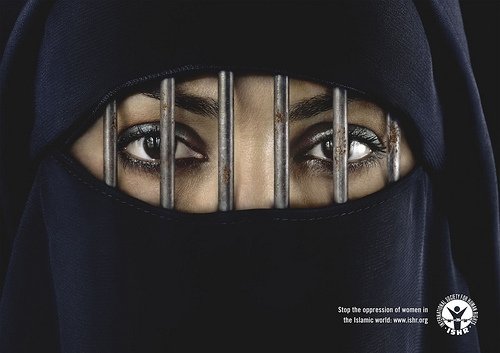
Oh boy.
This is not typically the kind of stuff I write about here, but it is something I feel quite strongly about, and, if nothing else, it makes for a case study in cross-cultural communication — not to mention some interesting neuroscience.
Last week, as the New York Times reported, French President Nicolas Sarkozy addressed the Parliament at Versailles with a withering critique of the burqa as an unacceptable symbol of “enslavement.”
“The issue of the burqa is not a religious issue. It is a question of freedom and of women’s dignity,” Mr. Sarkozy said. “The burqa is not a religious sign. It is a sign of the subjugation, of the submission, of women…. I want to say solemnly that it will not be welcome on our territory.”
Now, I got the link to this article from my cousin, who, it should be pointed out, shares the same history I do. We were not born in the United States, and growing up as first-generation immigrants in America we have spent our whole lives reconciling mixed, often contradictory, cultures. The fact that our families were able to leave the giant labor camp / prison that was the Soviet Union at all, is the result of one of the most successful human rights campaigns in history. So it’s no surprise that our reactions to the news of this French move were resoundingly positive. It was, however, quite surprising (though it retrospect, it shouldn’t have been) to discover many of my American-born friends expressing outright disapproval. I heard everything from straight up calling Sarkozy a “moron,” to the derisive cynicism that “Nothing says freedom like banning the burqa.”
I should hasten to point out here, it’s not that my American-born (liberal) friends are burqa-lovers, by any means, it’s just that freedom of religious expression is a sacrosanct American principle — as well it should be — and messing with it immediately inspires a profound distaste. It would, no doubt, be easier to have the issue of religious expressions be capable of being so black and white, so absolute, so all or nothing. It would certainly be much simpler, clearer, less offensive or culturally insensitive, if the idea that banning anything could actually bolster freedom wasn’t so contradictory. The reality, however, is that pretty much all freedom depends on the banning of something, and that something is the myriad efforts to deny human rights.
Which is precisely the spectrum that the burqa finds itself on. To clear up any confusion — since, in the predisposition for pursuing starkly-defined edges between black and white, it might seem effective to assume I’m just roundly including ALL kinds of modesty coverings, like headscarves, for instance, in this indictment, I’d like to state that I’m definitely not. A headscarf isn’t anywhere in the same vicinity as this:

The burqa is a full-body ghost-like sheet that covers a woman from head to toe, which Sarkozy, in no way inaccurately, likened to an “imprisonment.” The International Society For Human Rights seems to have drawn the very same analogy in the PSA at the top of this post. There is a good deal that has already been said about the legitimate impediments to health and physical safety that come along with these trappings (apt word, indeed, in this instance), but what makes the burqa an outright violation of human rights in my view is the fact that when a group of people is denied the freedom simply have their face be visible, they are deprived of the most fundamental, basic, human capacity to elicit empathy.
In his book, Social Intelligence: The New Science of Human Relationships, Daniel Goleman writes, “Suppressing our natural inclination to feel with another allows us to treat the other as an It…. Empathy is the prime inhibitor of human cruelty.”
Conveniently for us, then, human brains are actually hard-wired for empathy. In fact, damage or malfunction in the neural systems instrumental in allowing us to understand and resonate with someone else’s emotional state happens to be a basic requirement for psychopathic behavior. Clinical psychopaths are actually incapable of reading emotions; their brains simply do not register the meaning of expressions of fear or anguish, for example. Normal, healthy, functioning brains not only understand others’ emotions, they are actually designed in such a way as to induce the witness to internally experience the same emotional state that he or she is witnessing.
For instance, take a look at this face for, like, two-hundredth of a second:

As you do, Goleman explains:
The amygdala instantly reacts, and the stronger the emotion displayed, the more intense the amygdala’s reaction. When people looked at such pictures while undergoing an fMRI, their own brains looked like they were the frightened ones, though in a more muted range.
When two people interact face to face, [emotional] contagion spreads via multiple neural circuits operating in parallel within each other’s brains. These systems for emotional contagion traffic in the entire range of feeling, from sadness to joy.
Moments of [emotional] contagion represent a remarkable event: the formation between two brains of a functional link, a feedback loop that crosses the skin-and-skull barrier between bodies. In systems terms, during this linkup brains “couple,” with the output of one becoming the input to drive the workings of the other, forming what amounts to an interbrain circuit.
Brains loop outside of our awareness, with no special attention or intention demanded. [This] automaticity allows for rapidity. For instance, the amygdala spots signs of fear in someone’s face with remarkable speed, picking it up in a glimpse as quick as 22 milliseconds, and in some people in a mere 17 milliseconds (less than two-hundredth of a second). This [happens] so fast that the conscious mind remains oblivious to that perception.
We may not consciously realize how we are syncrhonizing, yet we mesh with remarkable ease.
Giacomo Rizzolatti, the Italian neuroscientist who discovered mirror neurons, the special class of neurons responsible for this kind of social duet, explains that our innate capacity for empathy allows us “to grasp the minds of others not through conceptual reasoning but through direct simulation; by feeling, not thinking.”
If you really stop to consider the significance of this, it’s pretty astounding. Our capacity to communicate through emotions happens entirely outside the realm of conceptual communication i.e. words. We don’t even need to speak the same language, or be able to TALK at all, for that matter, in order to simply look at someone’s face and personally understand what that person is feeling. As Goleman writes, “Mirror neurons ensure that the moment someone sees an emotion expressed on your face, they will at once sense that same feeling within themselves.” Through seeing another person’s face we experience, as instantly as a reflex, a mutually reverberating state that neuroscientists call “empathic resonance.” And empathy, I’ll write it again: is the prime inhibitor of human cruelty.
Sarkozy talked about the burqa as a tool for “depriv[ing women] of identity.” I see it as something more profoundly sinister. It deprives them not just of individual identity, but of shared Humanity. Our fundamental, human neurobiology depends on others to be able to see our face in order to elicit empathy. It is not the only way, of course, and it’s obviously not tamper-resistant, but it is the most instinctive, moreso even than language. Making someone hide their face is, literally, the oldest trick in the book for denying them empathy. When you can’t empathize, as any psychopath case study will show, you quite literally can’t recognize the other person’s Humanity. When you can’t recognize another person’s Humanity, it becomes a lot easier to be cruel. And when an entire population (oh, say, you know, women) is systematically denied their Humanity, their widespread oppression is inevitable. Thus whether or not your cultural sensitivity allows you to consider the burqa a means of oppression unto itself, it is absolutely part of the cycle that breeds it.
Human rights and religious freedom don’t always go hand in hand as neatly as we would like. Perhaps we might all live in a much better world if the two would just coordinate their priorities, but all too often religion seems to like endorsing things like female genital mutilation or child brides (notice a trend here on whom religion likes to shit on?) When the two don’t go hand in hand, the question that comes up for each of us is, how will we navigate the ensuing grayness? From my own experience, as a beneficiary of people around the world having fought against the oppression of others, there is nothing “moronic” or cynical about standing up for those who are being denied a basic human right, especially when it’s the right to empathy.
