Boston Latin School, my alma mater, is the oldest (and longest existing) public school in the country. 141 years older than the country, in fact. Ben Franklin went there before he moved to Philly. Alumni include Sam Adams, John Hancock, Joseph Kennedy, Ralph Waldo Emerson, Charles Bullfinch, you get the idea. There’s an admission test, but it’s free to attend for Boston resident teens. All students at are still required to study Latin for three or four years, and many study Greek as well. It’s a school that consistently ranks among the top in the country, bringing a Classics education into the 21st century.
Last night I saw the video below, made by current BLS students, making the rounds on Facebook through fellow alumni, and it’s just so totally epic I had to post it here. Never mind the sense of nostalgia seeing the old hallways in the background, these kids have done a better job of branding the iconography of my alma mater than my class ever considered. Watch out, marketers, the next generation will soon be doing a better job at our jobs than we are.
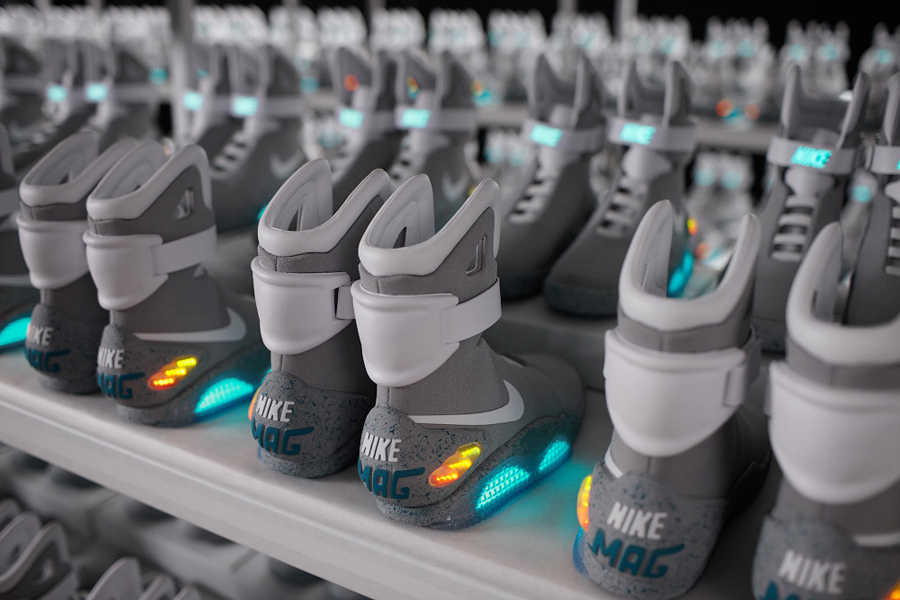
On September 8,2011, Nike announced they would be releasing a limited number of pairs of a new product. As the shoe’s official site explains:
In 1989, Nike designer Tinker Hatfield was asked to design a shoe for the second chapter in the Back to the Future series. He created the power-lacing, self-illuminating, Nike MAG. Riding on a pink hoverboard, Michael J. Fox made them the most famous shoe never made.
Over 15 years later in 2005, Tinker’s attention was caught by an online petition asking that the shoes come back. With no mold and nothing but an original prop shoe from the film, Tinker and footwear innovator Tiffany Beers began rebuilding the MAG from scratch. It would take six years, three restarts and many thousands of hours. But when it was all said and done, the shoe was a perfect replication of the original and the true predecessor to the 2015 power-lacing Nike MAG.
It would only make sense that the shoes be auctioned to benefit the foundation of the man who made them famous.
And with your help, the proceeds of these shoes will help erase Parkinson’s from existence.”
As Fox himself adds:
That something which has previously only existed in the realm of fiction is becoming real, that Nike is actually making a shoe it predicted would exist in the future, that a franchise about a time traveler is being leveraged towards changing the future both by and for the actor who embodied him, as well as for others who suffer from Parkinson’s disease…. basically everything about this is totally fucking awesome in a uniquely 21st century kind of way.
Back in March I wrote about another celebrity who came up in the 80’s and has recently been doing his part to blur the lines between “real” and “not real.” Charlie Sheen has gone a long way towards making that distinction irrelevant by transforming his life into an existential performance. In a Daily Beast article titled, “Notes on Charlie Sheen and the End of Empire,” author Bret Easton Ellis (also a pop culture staple spawned from the same decade as Sheen, Fox, and McFly), called Sheen, “The most fascinating person wandering through the culture.” Ellis’s concept of “Empire” and “Post-Empire,” is based on Gore Vidal’s definition of global American hegemony, a period Ellis dates from 1945 until 2005: the era that defined the 20th century. As Ellis sees it, Empire was a lie, a self delusion the global west lived for 60 years while it kept up appearances and didn’t think about the future; post-Empire, on the other hand, is where we are now, a world 10 years after 9/11, seeming to teeter perpetually on the verge of economic collapse and endless other global crises. If Empire was binary (truth vs. lie; real vs. counterfeit), then post-Empire is meta. As Sheen has shown, he is both real and not real at once. And so are the Nike MAGs, sneakerheads’ long unattainable holy grail, “the most famous shoes never made”…. until they were.
These kicks haven’t just crossed over from fiction, they’ve arrived from the future. Right on schedule.
“It’s like in Terminator when John Connor sends Kyle Reese back in time so that he can be his father,” says Simon, from the British TV show Misfits, a character who sends himself back in time to die so that he can live in the future. (Side note: Five years before Marty McFly, Kyle Reese also wore Nikes in 1984’s Terminator. Hopefully those don’t come back to the future.)
“In 1981, I was a futurist,” said William Gibson, author of the seminal cyberpunk novel, Neuromancer, in an interview with New York Magazine’s, The Vulture Blog last year, “Or at least I was a guy who put on a futurist hat occasionally and I wrote about the 21st century. Now I’m here in the 21st century and if I write about it, I think it makes me a literary naturalist.” Gibson’s three latest books have all been set not in a dystopic, sci-fi future world but contemporaneously with the one we all inhabit. A recurring character throughout this trilogy is Hubertus Bigend, the charismatic founder of an alternative marketing agency, whom Gibson describes like a 21st-century Cheshire Cat as CEO (“He smiles, a version of Tom Cruise with too many teeth, and longer, but still very white;” “An overly wealthy, dangerously curious fiddler with the world’s hidden architectures.”) So fitting is Bigend as an antihero for a post-binary, meta reality, this fictional character’s actual Wikipedia entry cites a passage from his fictional Wikipedia entry. (Your head hurt yet?)
I thought that writing about the world today as I perceive it would probably be more challenging, in the real sense of science fiction, than continuing just to make things up. And I found that to absolutely be the case. If I’m going to write fiction set in an imaginary future now, I’m going to need a yardstick that gives me some accurate sense of how weird things are now. ‘Cause I’m going to have to go beyond that. In the ’80s and ’90s–as strange as it may seem to say this–we had such luxury of stability. Things weren’t changing quite so quickly in the ’80s and ’90s. And when things are changing too quickly you don’t have any place to stand from which to imagine a very elaborate future.
Case in point: Gibson’s most recent book, Zero History, which came out last year, has characters using silent, hovering, iPhone-controlled surveillance drones. Less than a year after Gibson wrote it into his book, it’s a thing that’s now on the market. In fact, it’s a toy:
Pattern Recognition is the first of Gibson’s “present tense” trilogy, and the first of his books I ever read. It was given to me by an acquaintance in 2004. The book follows Cayce Pollard, a marketing consultant with an intuitive sensitivity for branding so acute its anaphylactic. Her clients hire her to research street culture in search of the next new trend. “She’s met the very Mexican who first wore his baseball cap backward,” Gibson writes. “She’s that good.” The person who gave me the book told me, “This is you.” At the time, barely a year out of college, where I’d been a film major, I’d never really considered I’d be working in marketing. And yet, it’s where I ended up. Two novels and seven years later, Cayce Pollard makes an anonymous cameo near the end of Zero History. Her name is never mentioned, but if you’ve been following along, you know it’s her even before she says, “I’d been a sort of coolhunter, before that had a name, but now it’s difficult to find anyone who isn’t.”
The Nike MAG exists now not because it’s where 21st century sneaker trends were naturally headed but because a vision of footwear future (which Nike itself created) 20 years ago predicted it would. If Charlie Sheen’s contribution to Post-Empire has been to embody the now indistinguishable nature of real and fictional, Nike has taken it one step further and shown us that the future is no longer strictly linear. In our new century the future is recursive. It is a future we have sent back in time, to become itself.
A few months ago I started noticing a proliferation of editorial content using data as the narrative foundation. The first place it occurred to me was on the OkTrends blog, which publishes research compiled from hundreds of millions of OkCupid user interactions. Their insight opuses on “The REAL ‘Stuff White People Like,’” and, “Gay Sex vs. Straight Sex,” for example, are some of the best reads on the internet. Then I began to see it in other places. Slate.com published an article on “What Rotten Tomatoes data tell us about the best, worst, and most bizarre Hollywood trajectories;” The New York Times teamed up with OkCupid to publish a story about “the sexual availability index” — aka, what’s the best night of the week to meet someone at a bar (spoiler: Wednesday). And on it went. Once I started paying attention, these stories were everywhere. And these weren’t simply infographics — statistics visualized in fun, creative layouts — which are, themselves, already ubiquitous, these were narratives; journalistic reportage…. driven by data.
In a June Media Shift article, Nicholas White, co-founder and CEO of The Daily Dot, which bills itself as “The hometown newspaper of the World Wide Web,” called data “a new kind of source.”
The news industry is built on the assumption that if you give a reporter a notebook and a few days to ramp up, he can write authoritatively on any subject. That’s not enough anymore. In today’s information-rich world, reporters need to bring more to the table.
The old skills still matter. In some sense they’re more precious than ever. But they aren’t enough. Data needs to be interpreted well, and we need people who can use technology in highly advanced ways to produce the insight readers crave. We need to ask the data the same tough questions we ask experts and other sources. We’ve enlisted sophisticated mathematicians in the cause of journalism. We’ve hired an editor that loves to geek out over data. There’s a lot of nuance and expertise in this process.
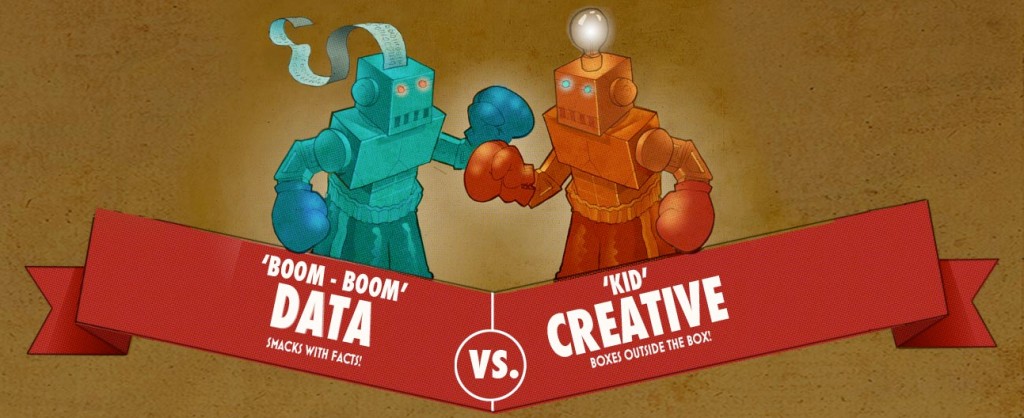
One night I dropped the bon mot, “the data is the story,” over wine with Hilary Read, co-founder of HUMAN, a live communications agency, and next thing I know she’s taken the idea and run with it, and I’m part of a proposed panel for SXSW Interactive 2012:
We’ve hit our tipping point. Where creative once was king, it now takes its marching orders from data. The question is–will it stick and where has all the good creative gone? Come join HUMAN as they take on two savvy digital strategists to debate the merits, the pitfalls and ultimately the humanity of data dominated creative. This session will be a mixture of theatrics, metrics and live data-generated artwork that is sure to entice even the most cynical enthusiasts. We won’t know how it will end until we get there. Come help us decide–Is data really the new creative?
You should vote for this panel at SXSW 2012: HERE.
And in the meantime, you can rep for your team — Data vs. Creative — HERE
In 2007 I wrote a post titled, Stop Saying The Word ‘Viral’, (“Seriously, just stop. It’s not hip; it just makes you sound antiquated. This is not the 90′s. It’s over. Deal with it.”) Last year I co-authored a presentation titled, The Ugly Truth About Viral Marketing (“Stop trying to spread viruses. In fact, go wash your hands right now.”) But comic as my crusade against the word may be, it belies a deep-seated distaste for a certain type of attitude that runs rampant among marketers: a penchant for referring to content as “viral” simply by virtue of it being on the internet at all, an inability to comprehend the fact that just because they make it share-able does not mean it will be shared, and a general arrogant disregard for the underlying mechanics of human behavior that drive sharing.
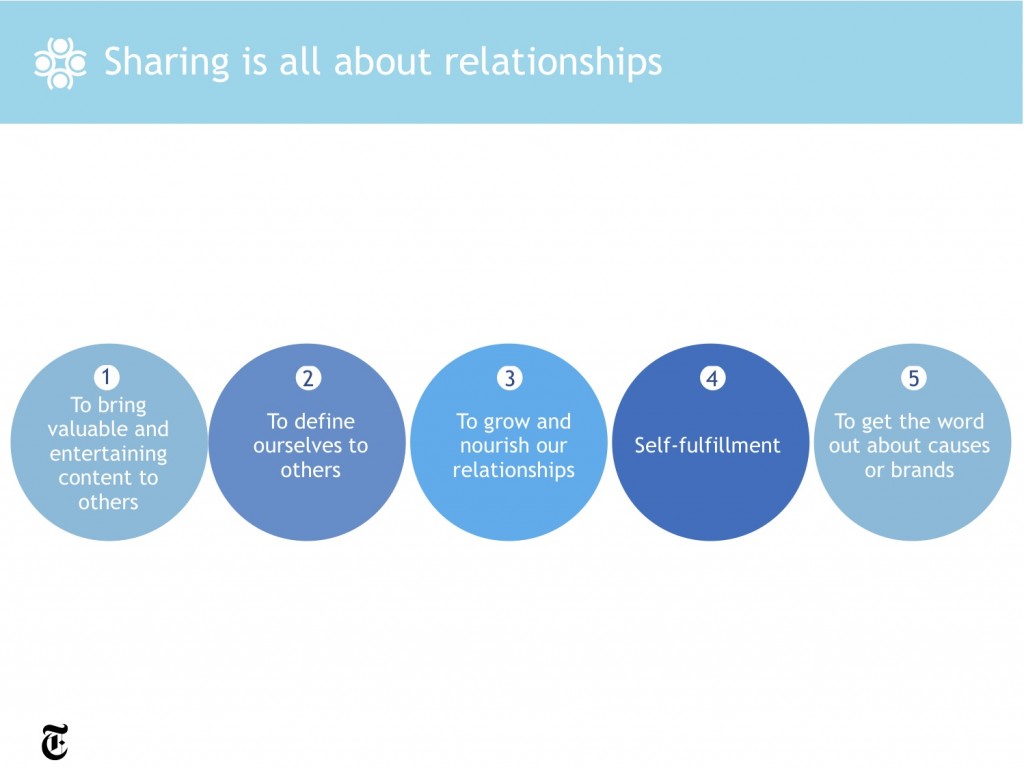
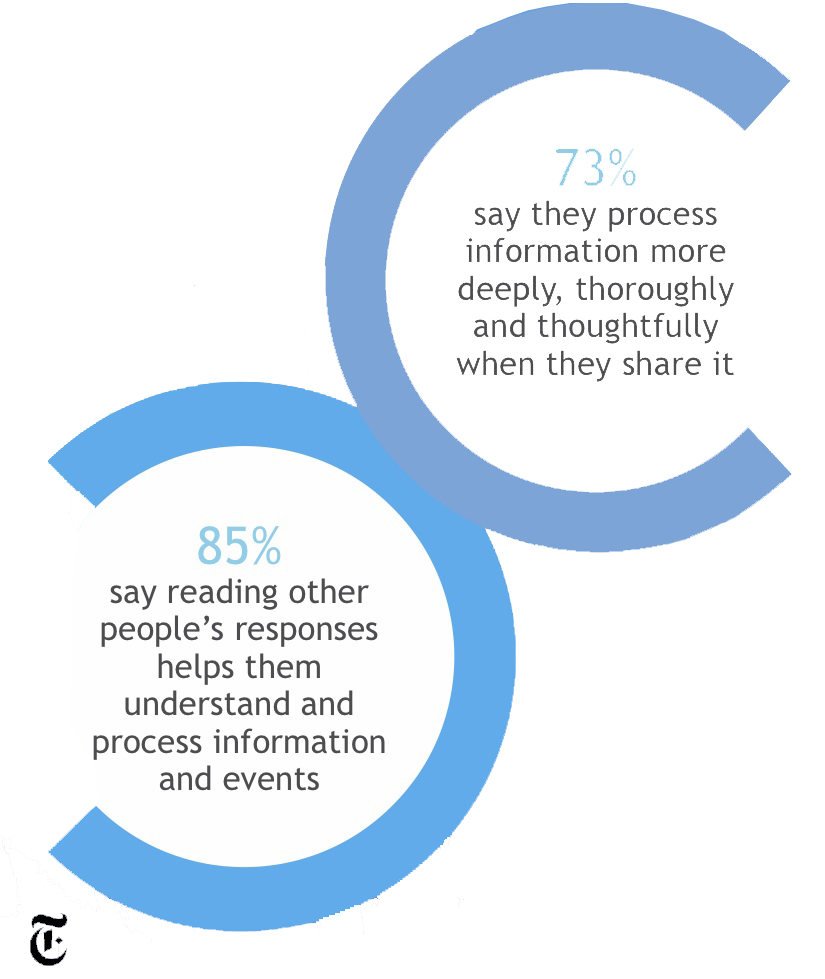
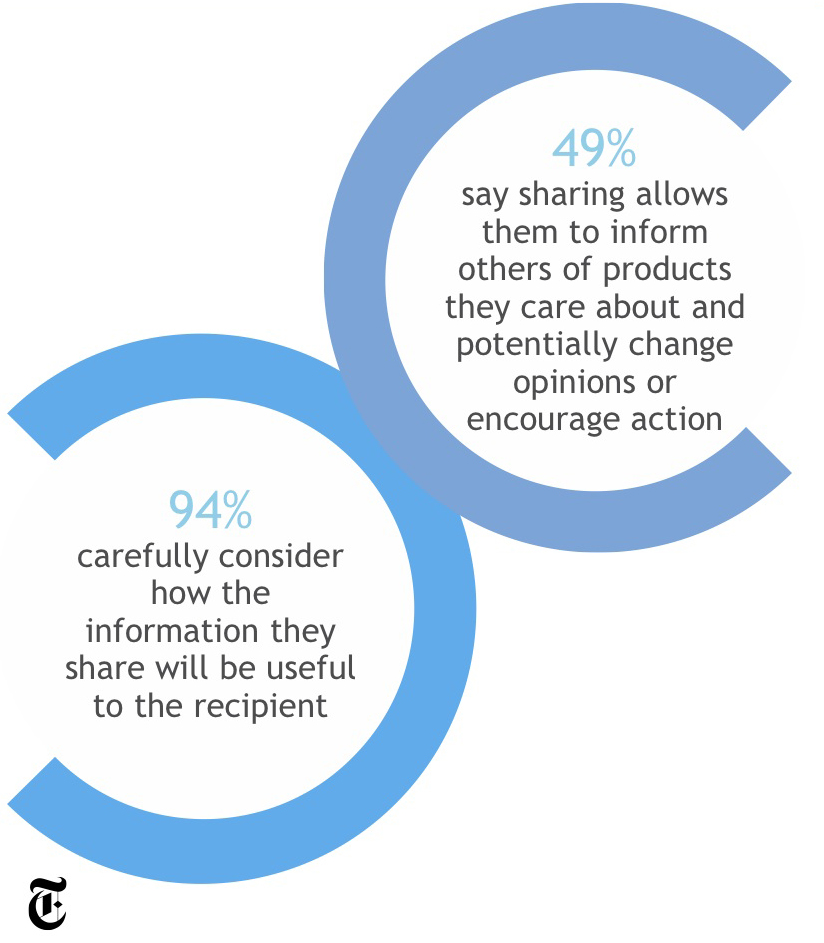
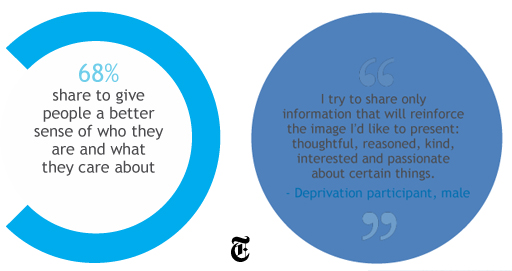
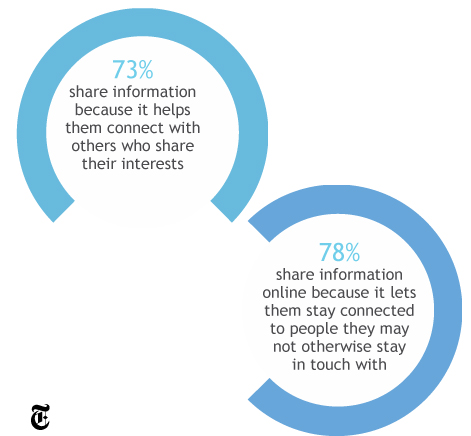
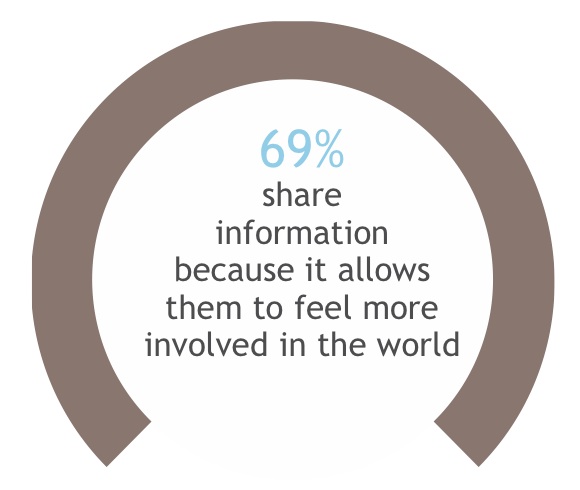
So you can imagine my joy when I discovered The New York Times Consumer Insight Group, in association with Latitude Research, had published the results of a study on The Psychology of Sharing. As the New York Times Insights Group writes:
There has been an abundance of research on social media, but to date, no one has asked in a comprehensive way: why do people share? The Psychology of Sharing reveals groundbreaking research that fills this knowledge gap.
Yahtzee!
So stick this in your “we have to make it go viral” pipe and smoke it:
When I was producing music festivals and nightlife events, Facebook changed its membership policy, opening up beyond just the collegiate community. Hundreds of people I didn’t know requested to add me as a friend. At first I balked at the idea of letting complete strangers into a space that had previously been the walled-garden escape from the mess Myspace had already become. Ultimately, however, I came to terms with the benefits of accepting friend requests from potential ticket buyers. Facebook became a sort of digital Grand Central Station that friends, colleagues, business acquaintances, vendors hawking their wares, strangers I couldn’t pick out of a lineup, and the inevitable crazy person talking to himself, all loudly traversed on their daily commutes through my online social world. It was really fucking noisy.
Then, at the end of 2007, Facebook introduced a feature to specifically address this noise issue, as they wrote on the Facebook blog:
Today Facebook lets us connect and communicate with people that we are connected to in all kinds of ways — friends from school, family members, long-lost high school sweethearts of yesteryear, and weird people. They’re all here.
This all begs the question… what does being friends with someone on Facebook mean today? We pondered this for a while, and then decided that there just wasn’t any single right answer.
So instead, we’ve built and launched Friend Lists. The new Friends page lets you create named lists of friends that you can use to organize your relationships whichever way works best for you. These private lists can be used to message people, send group or event invitations, and to filter updates from certain groups of friends.
Pretty much everyone I am connected to on Facebook has been assigned to one list or another depending on the context of the connection. In a previous incarnation, Facebook offered the option of setting a specific list feed to be the homepage view instead of the default friend feed. Later that option was removed, so I’ve created a workaround to simulate the functionality: I have the URL for my preferred Friend List set as a bookmark on my browser toolbar and when I want to go to Facebook, I just click the bookmarked link. Typing “facebook.com” into the address bar hasn’t been the way I access Facebook for years.
So when I heard that Google+, the web giant’s just-launched social network, was based on grouping connections into “Circles,” I was instantly curious. Ever since Friendster first appeared almost a decade ago, there have been certain disparities between being social online and being social offline that we have come to accept. We’ve become so accustomed to these differences, we hardly even recognize they ever seemed unfamiliar. The fetishistic, collectible-card type quality to online “friend acquisition,” for example. This is not at all how we understand the process of “making friends” to work offline — aside from high school, maybe. Online we have learned, sometimes the hard way, that what we do and say is “public by default,” private with effort, the direct opposite of how it works in the analog world. And we have come to accept, despite the paralyzing plethora of privacy options Facebook offers, that we can’t expect control over social context. Online we are in all contexts at once. Friends from school, family members, long-lost high school sweethearts of yesteryear, and weird people, as Facebook lists them, are not only all here, but who we are within each of these different social groups, our identities in each of their different contexts, all exist simultaneously. Online, we are contextless by default.
But what if online sharing worked more like your real-life relationships? That’s the question posed in the video introducing the Google+ Circles feature:
Of course, it’s not a new idea. As I mentioned, this is a functionality Facebook has offered for years. It’s just that the platform has never really cared about it. As Mark Zukerberg, Facebook’s founder, inisisted in a 2009 interview: “You have one identity. Having two identities for yourself is an example of a lack of integrity. The days of you having a different image for your work friends or co-workers and for the other people you know are probably coming to an end pretty quickly.” For Facebook, Lists are literally an add-on feature. For Google+, however, Circles appear to indicate an understanding that context is as important as connection.
Consider the case of an Iranian business-woman shaking hands with her Western male counterparts. In Iranian culture, shaking hands with a male colleague is neither customary nor appropriate. This situation entails behavior that is unfamiliar and also in conflict with deeply ingrained cultural values.
[Or] consider the case of a Chinese student attempting to participate in an American MBA classroom discussion. The norms for appropriate behavior within this setting in the United States encourage and require students to express themselves, as well as reward them, even when their opinions are controversial or conflict with those of another student or even with the professor. Norms for classroom participation in China are quite different. Having been socialized to respect the “wisdom, knowledge, and expertise of parents, teachers, and trainers,” Chinese students are discouraged from voicing personal opinions in class discussion. American norms for classroom participation, therefore, are quite discrepant from Chinese norms for the same situation; these norms demand a significantly different type of behavior than what the typical Chinese student is used to.
Cross-cultural code-switching is the act of purposefully modifying one’s behavior in an interaction in a foreign setting in order to accommodate different cultural norms for appropriate behavior.
But the setting doesn’t have to be as foreign as you think. For immigrants, or anyone of mixed racial or cultural heritage whose identity is inextricably linked to different communities, code-switching is an inherent part of navigating everyday life. To children of divorced parents this will likely sound familiar as well. We actively modulate our behavior even among the closest people in our lives. In writing about the tactics we use to maintain context control while engaging in a public online space like Facebook, social media researcher danah boyd describes “social steganography,” a practice of creating messages that communicate different meanings to different audiences simultaneously:
When Carmen broke up with her boyfriend, she “wasn’t in the happiest state.” The breakup happened while she was on a school trip and her mother was already nervous. Initially, Carmen was going to mark the breakup with lyrics from a song that she had been listening to, but then she realized that the lyrics were quite depressing and worried that if her mom read them, she’d “have a heart attack and think that something is wrong.” She decided not to post the lyrics. Instead, she posted lyrics from Monty Python’s “Always Look on the Bright Side of Life.” This strategy was effective. Her mother wrote her a note saying that she seemed happy which made her laugh. But her closest friends knew that this song appears in the movie when the characters are about to be killed. They reached out to her immediately to see how she was really feeling.
“We used to live in a world where space dictated context,” danah writes, “This is no longer the case. Digital technologies collapse social contexts all the time. The key to figuring out boundaries in a digital era is to focus on people, roles, relationships, and expectations.”
Relationships are all about context, but for Facebook, this nuance is something that has never quite made sense. All along, Facebook has staked its claim not by adapting to existing social behavior, but rather by insisting that we adapt to the behavior the platform defines for us. As Zuckerberg said in a TechCrunch interview last year, in regards to the assertion that privacy is dead, “We decided that these would be the social norms now and we just went for it.” As far as the platform is concerned, managing contexts is a nuisance for the user. With every “privacy” violation, what Facebook has actually been attempting to do is outsource managing context to software; to switch code-switching with code. At this point we’ve become so accustomed to the inevitable, resulting intrusion we don’t even make too much of a stink about it anymore. Case in point: Facebook’s new facial recognition functionality — which automates the photo-tagging process by suggesting the names of friends who appear in newly uploaded photos — has caused less of fuss for how uber-fucking-creepy it is, than….. wait, what was the previous fuss about? I forget already.
Facebook’s helpful way of nudging us towards this manifest, post-identity complexity destiny is to devise ever more features to destroy our control over social context. This has created a gap which Google+, with its aim to “make sharing on the web feel like sharing in real life,” seems squarely poised to fill. Not that Circles will be the panacea for online context collapse, but this is the first attempt by a mainstream web property to directly address this disparity between the online and offline social experiences, and offer a way to bring context back to our contacts.