“The idea that whoever appeared onstage would play not me but a character was central to imagining how to make the narrative: I would need to see myself from outside.”
~ Joan Didion
In the midst of the quicksand hazard posed by every single episode of Lost available online, and in high def, I saw an ad for Celebrity Cruise lines with a slogan at the end that i thought was fantastic:
according to a NYTimes article published last spring, “This Is Your Life (and How You Tell It),” research shows that the human brain apparently has a natural affinity for narrative construction, which not only explains why Lost is so amazingly addictive, but why but we are continually updating a treatment of our own life in our heads.
Short of offering “run from the paparazzi” adventure travel excursions and rehab amusement parks, the cruise line has taken a very resonant approach with the “every day is another day starring you” slogan. “Seeing oneself as acting in a movie or a play is not merely fantasy or indulgence;” according the the NYTimes, “it is fundamental to how people work out who it is they are, and may become.” In the era of TMZ, thinking about that personal narrative in the format of a celebrity tabloid seems only natural.
“Is The Tipping Point Toast?” asks the recent FastCompany article in which researcher duncan watts talks about his findings (and their less than exuberant reception) that expose the billion dollars a year marketers spend targeting “influentials” as a waste of money.
i am constantly repeating the phrase that “we buy the brands and products that we feel express aspects of our identity,” and this applies to ideas as well. we buy into and espouse the ideas that express aspects of who we are. our “intuition” in that sense, could be seen not so much a kind of internal tuning fork dinging to the tone of the universe, but rather an insidiously partial filter which evaluates the validity of information based on its compliance with our ingrained personal predispositions. for marketers–an avocation that calls for a particular breed of identity, of course–it’s no doubt easy to latch on to the idea that a select few influential individuals wield the capacity to push trends over the tipping point simply by their involvement in the process. after all, considering what we do it’s pretty “intuitive” for us, isn’t it?
from the fastcompany article:
Marketing has always relied heavily on instinct and intuition. Admen like to believe they’re creative geniuses, gifted at truffling out social trends (which is why, they hasten to point out, they’re irreplaceable). Joe Pilotta, research VP for a firm called Big Research, suspects marketers cling to their belief in Influentials partly because they’re lazy. They love the idea of needing to reach only a small group of people to “tip” a product, he says with a laugh. Plus, it strokes their egos: “Think about it. You’re saying, ‘I am in control–I am the biggest influencer, because I am going to influence the influencers!’ It’s an arrogance that only the corporate world could enjoy.”
which certainly makes ME wonder to what extent what we know–or believe we know–about the nature of how marketing is supposed to work is actually based on the the egos of CMOs as opposed to on actual social theory. how about you?
see, i think all of coolhunting is a ridiculous waste of time. there is no universal “cool” that exists out of context, and while i do believe strongly that marketers themselves are NEVER the demo, i also think that all of us are subject to the context of the cultures or communities of which we are a part. translation: cool matters not because it’s “cool” but because–and only if–it’s culturally relevant. and while relevance sounds a lot less sexy than its mistaken-identity doppelganger, cool, it’s relevance that “trends” are really about.
Watts decided to put the whole idea to the test by building another Sims-like computer simulation. He programmed a group of 10,000 people, all governed by a few simple interpersonal rules. Each was able to communicate with anyone nearby. With every contact, each had a small probability of “infecting” another. And each person also paid attention to what was happening around him: If lots of other people were adopting a trend, he would be more likely to join, and vice versa. The “people” in the virtual society had varying amounts of sociability–some were more connected than others. Watts designated the top 10% most-connected as Influentials; they could affect four times as many people as the average Joe. In essence, it was a virtual society run–in a very crude fashion–according to the rules laid out by thinkers like Gladwell and Keller.
Watts set the test in motion by randomly picking one person as a trendsetter, then sat back to see if the trend would spread. He did so thousands of times in a row.
The results were deeply counterintuitive. The experiment did produce several hundred societywide infections. But in the large majority of cases, the cascade began with an average Joe (although in cases where an Influential touched off the trend, it spread much further). To stack the deck in favor of Influentials, Watts changed the simulation, making them 10 times more connected. Now they could infect 40 times more people than the average citizen (and again, when they kicked off a cascade, it was substantially larger). But the rank-and-file citizen was still far more likely to start a contagion.
Why didn’t the Influentials wield more power? With 40 times the reach of a normal person, why couldn’t they kick-start a trend every time? Watts believes this is because a trend’s success depends not on the person who starts it, but on how susceptible the society is overall to the trend–not how persuasive the early adopter is, but whether everyone else is easily persuaded. And in fact, when Watts tweaked his model to increase everyone’s odds of being infected, the number of trends skyrocketed.
i really like that phrase, so i’ll write it again: A trend’s success depends not on the person who starts it, but on how susceptible the society is overall to the trend–not how persuasive the early adopter is, but whether everyone else is easily persuaded.
we buy the brands, products, ideas, political candidates, etc., etc., we feel express aspects of our identities. a trend’s success depends not on how COOL it is, but on how effectively it manages to express a common-enough identity aspect. in other words, one way to look at the success of the trend that is “The Tipping Point” itself is that it has managed to express an identity aspect shared by a whole lot of marketers. not because it was cool, perhaps not even because it was RIGHT, but simply because it resonated with a particular–and particularly widespread–identity.
perhaps instead of building databases of “trend-spotters,” “brand evangelists,” “influencers” or whatever else those agencies that are so proud of themselves for getting to sit at the “cool kids” table want to call them, a more useful application of money would be to research the dynamics of our ability to BE influenced. and when i say “our” i mean all of us, marketers included. because, after all, being human helps in the process of figuring out how to communicate to other humans.
and maybe i read it wrong, but to me gladwell’s book wasn’t ever really about some people being blessed with the ability to start trends better than others, but rather some people being more curious, and thereby simply ending up in the way of more trends. consider how many more things an “early adopter” tries out that NEVER take off than the average person? they don’t necessarily help more stuff tip, they just try more shit out. what? were you expecting a different model? if so, maybe you should stop saying the word “viral” so much. that might aid a perspective shift:
Perhaps the problem with viral marketing is that the disease metaphor is misleading. Watts thinks trends are more like forest fires: There are thousands a year, but only a few become roaring monsters. That’s because in those rare situations, the landscape was ripe: sparse rain, dry woods, badly equipped fire departments. If these conditions exist, any old match will do. “And nobody,” Watts says wryly, “will go around talking about the exceptional properties of the spark that started the fire.”
so… “If influentials cannot tip a trend into existence–and if success in a networked society is quite random–what’s a poor marketer to do?” The article suggests that, “Since you can never know which person is going to spark the fire, you should aim the ad at as broad a market as possible–and not waste money chasing “important” people.” and while i agree with this, I think the “ultimate irony” proposed at the end of the article is misleading:
“If you really buy [Watts’s research], the most effective way to pitch your idea is … mass marketing. And that is precisely what the wizards of Madison Avenue, presiding over our zillion-channel microniche market, have rejected as obsolete. “
cultural relevance–especially in a networked society–is not entirely as random as watts’s algorithmic computer simulations, and simply broadcasting a message doesn’t make it more relevant, but there is no special group of cultural gate-keepers that get to decide what’s going to be relevant and what’s not.
“I think that all books like The Tipping Point or articles by academics can ever do is uncover a little piece of the bigger picture, and one day–when we put all those pieces together–maybe we’ll have a shot at the truth.”
– Malcom Gladwell
“To be nobody but yourself in a world which is doing its best day and night to make you like everybody else means to fight the hardest battle which any human being can fight and never stop fighting.”
— e.e. cummings
which is all quite noble and good, but the thing of it is, e.e., is that it’s very difficult, not to mention psychologically debilitating, to exist entirely out of cultural context. not only do human beings (and enough sad, shaky little monkeys that we don’t need to conduct this experiment anymore, please) suffer severe emotional and no doubt neurological damage when left in isolation, but in practical reality, whether it’s cultural heritage, gender, skin color, family education level, economic class, or whatever, the sum influence on “who we are” of certain variables of culture-caste is a bit tricky to evade. and in the end, even those that do manage to escape this influence in its entirety still don’t earn their own individual place in society anyway, cuz we just lump them into one big group called “crazy.”
that’s not to say that the rest of us aren’t, in fact, embroiled in a kind of nonstop battle like what e.e. was refering to, but it’s not exactly about the struggle to be nobody but ourselves in a world that is trying to make us like everyone else. rather it is about the anxiety of having to figure out how to EXPRESS who we want to be seen as in a world where the options keep expanding.
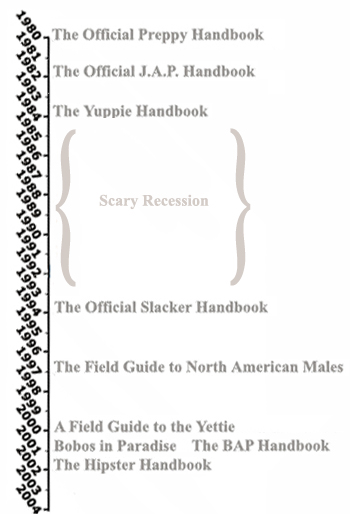
which is why “THE OFFICIAL GUIDE TO OFFICIAL HANDBOOKS” by andy selsberg, is a great bit of humorous salve on the battle wounds of that anxiety. by pitting the various Official This-Or-That (Preppy, Yuppie, JAP, BAP, Bobo Hipster–it’s like the star wars cantina, but real) handbooks against one another, it exposes, for a moment, the inevitable ridiculousness of the entire “we’re all different… in the same way” con game.
We tend to think our standards for the beautiful and good are natural and eternal. They aren’t. And you know who needs this analysis?…. Marketers. If business is about knowing how your customer thinks, then [these are] business book[s]. [They] tell you exactly how to jack all those fat baby-boomer wallets—whether you’re selling ice cream, a university, a book, a religion, or a company. When I see suits on planes reading business best sellers, I think: Wrong! Get some books that explain how groups try to reconcile their dreams of who they want to be with the social and economic realities of their world through the stuff they buy. Then get down to business. That’s what J. Crew did.
….dude! that’s what i’m talking about! i mean…like, literally.
you should totally check out selsberg’s fucking awesome article (and you may never take the cultural significance of a disproportionate use of such superlatives as “fucking awesome” for granted ever again once you do, dear reader).
here’s a fun timeline of all the Official handbooks referenced in his article.
1982 – The Official J.A.P. Handbook (that stands for Jewish American Princess, by the way)
“At the very core of the female Born JAP aesthetic are two guiding principles: 1) I am terrific; 2) Daddy will pay.”
1984 – The Yuppie Handbook “Thou shalt have no other gods before thyself.” 1994 – The Official Slacker Handbook
“Part old-fashioned bohemianism and part fin de siècle exhaustion, placed against the backdrop of a crappy recession and intolerable suburban irony.”
2001 – The BAP Handbook
(BAP = Black American Princess)
“Any name beginning with ‘La’ or ‘Sh’ and ending in -ima, -ika, -isha, and -ita is never considered by BAParents.”
2002 – The Hipster Handbook This old vocabulary? I’ve had it since I was twelve.
and while you and i wonder what’s up with the delay on the Official G Handbook, the Official Cholo Handbook, and the Official ABC handbook, we can at least entertain ourselves with the hipster olympics in the meantime:
nature decided to run an experiment in its whimsical way, and cast a bunch of birds adrift on an island called new guinea, essentially without any predators to worry about and a perpetual abundance of food, and then sat around for several million years to see what might happen.
what did happen is the evolution of an obscenely flamboyant species of birds called the birds of paradise.
No other birds on Earth go about the business of breeding quite like these. To dazzle choosy females, males strut in costumes worthy of the stage: cropped capes, shiny breast shields, head ribbons, bonnets, beards, neck wattles, and wiry feathers that curl like handlebar mustaches. Their vivid reds, yellows, and blues blaze against the relentless green of the rain forest. What makes for the sexiest mix of costume and choreography is a mystery, but it seems the more extreme the better.
unlike their less exotic distant cousins with actual problems to worry about, the 38 species of birds of paradise had no need to waste their time protecting resources or camouflagely avoiding predators. the lack of struggle for sheer survival having made natural selection a non-issue, the new standard of ‘fitness” became style.
cut to 1st-world post-industrial human society. unlike birds, of course, we have more issues to deal with than just courting rituals–tho they are inevitably involved. our obsession with style is not soley about, as the kottonmouth kings say, “something to poke on,” but also very much about somewhere to fit in. the desire to belong to a community may be hardwired in, but then so, it seems, is our need to express that belonging in our identity–our lifestyle.
Adaptations that help an individual survive can sometimes play themselves out through the group. Consider religious rituals.
Rituals are a way of signaling a sincere commitment to the religion’s core beliefs, thereby earning loyalty from others in the group. “By donning several layers of clothing and standing out in the midday sun,” Sosis wrote, “ultraorthodox Jewish men are signaling to others: ‘Hey! Look, I’m a haredi’ — or extremely pious — ‘Jew. If you are also a member of this group, you can trust me because why else would I be dressed like this?’ ”
These “signaling” rituals can grant the individual a sense of belonging and grant the group some freedom from constant and costly monitoring to ensure that their members are loyal and committed. The rituals are harsh enough to weed out the infidels, and both the group and the individual believers benefit.
that quote above comes from a really fascinating new york times article about the evolution of religion (as in, sociobiology stylie) which proposes a set of key psychological factors that could combine to create an intrinsic, biological human predisposition to believe in a higher power. but while spiritual belief may be inherent, if nature is all there was to it we’d be content to experience these beliefs in a personal way. for the truly religious, however, a personal relationship with god isn’t really enough. nurture puts the pressure on to show up at church every sunday so that all the other religious folks can witness this expression of our identity in our attendance.
there is some kind of security we crave that is just as much a drive as anything spiritual, a security that comes from feeling we are being seen for “who we are.” cuz identity without expression is consciousness. it’s the stuff you know about the world and yourself that it’s ok if no one else knows you know. you know. and that’s enough. identity is the shit you feel the need to for the world to see, the stuff you hang a billboard for around your neck.
…and speaking of brands. oh, what? you thought we weren’t? “branding” as we know it today, came from consumer goods factories realizing that they needed a way for their generically-packaged mass-produced products to compete for a market base familiar only with local goods. what initially was just a matter of packaging and insignias then evolved past image, past hype, past essence, past the product itself, to a point where a “brand” is now its consumer identity.
when my purse was stolen my credit card company knew before i did. still under the impression that it had just been misplaced at a friend’s party, and would be discovered after the post-party cleanup, i got a call from mbna about some unusual charges: at jack in the box. i joke that had the thieves gone to whole foods no one would have been the wiser, since the last time i purchased fast food i think i was in high school. it’s beyond just that it’s “unhealthy” and all the other things, it’s that, as my credit card company so effectively pointed out, it’s “not me.”
that’s an essential part of what brands are now: signifiers of what is or is not us. and to a greater extent than ever we are now constantly looking for ways to get “ourselves” across..
it’s like the story about those funny birds, you know…. self-obsession becomes the tradeoff for paradise.