four guys on keyboards does not a band make, but when they’re laptop keyboards it’s a whole new breed of musical act.
last night the glitch mob dutifully slayed the LA crowd at the kingking on hollywood blvd. it was the first time in a long time (too long) that all four members played together. with half the band based in san francisco and half in l.a., plus a highly modular performance aspect, getting to hear the whole ensemble together is a significant treat, and for reasons beyond simple logistics.
in a genre known for solitary performers (djs), or, at most, duos (daft punk, justice, juniorsenior) a dynamic team of performers creating the music experience is practically unheard of.
i’m betting this new incarnation of a “band” for digital age is a sign of things to come.
and since you’re curious, check out the mob’s mix on xlr8r.com.
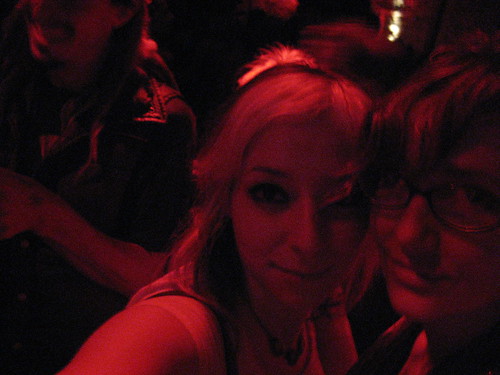
the mob’s girls friday–me with their booking agent, arin ingraham of lumineart:
The goal of all human activity can’t be reduced to the leaving of descendants. Once human culture was firmly in place it acquired new goals.
– Jared Diamond, The Third Chimpanzee
right as i was in the process of rereading the third chimpanzee (i had to read it in college for sociobiology, and recently realized i’d forgotten half of it), a friend of mine forwarded me this NYmagazine article, The Cuddle Puddle of Stuyvesant High School. “it’s very interesting in terms of trend ideas and stuff,” he told me. “i thought of you.”
the article follows a particular clique of kids (primarily girls) up at NYC’s stuyvesant high school, a magnet public school for some of the city’s créme de la créme teens (similar to my high school alma mater, boston latin). i read this piece in the same week as the NYTimes feature on the girls of newton north high (a suburb right outside of boston). the article was called For Girls, It’s Be Yourself, and Be Perfect, Too. it’s funny that i read these two articles in such proximity, because they actually came out within two months of each other and couldn’t be more divergent in what they present as the focus of the elite-educated, east coast, teenage girl experience.
the NYTimes says:
To spend several months in a pressure cooker like Newton North is to see what a girl can be — what any young person can be — when encouraged by committed teachers and by engaged parents who can give them wide-ranging opportunities.
It is also to see these girls struggle to navigate the conflicting messages they have been absorbing, if not from their parents then from the culture, since elementary school. The first message: Bring home A’s. Do everything. Get into a top college.
The second message: Be yourself. Have fun. Don’t work too hard.
….If you are free to be everything, you are also expected to be everything. What it comes down to, in this place and time, is that the eternal adolescent search for self is going on at the same time as the quest for the perfect résumé.
two months earlier the NYMagazine article presented the findings of its own investigation into the workings of the contemporary teen female search for self:
Alair is headed for the section of the second-floor hallway where her friends gather every day during their free tenth period for the “cuddle puddle,” as she calls it. There are girls petting girls and girls petting guys and guys petting guys. She dives into the undulating heap of backpacks and blue jeans and emerges between her two best friends, Jane and Elle, whose names have been changed at their request. They are all 16, juniors at Stuyvesant. Alair slips into Jane’s lap, and Elle reclines next to them, watching, cat-eyed. All three have hooked up with each other. All three have hooked up with boys—sometimes the same boys. But it’s not that they’re gay or bisexual, not exactly. Not always.
while the “amazing girls” of newton north (it’s what their teachers and classmates call them) talk about lives overwhelmed sometimes to the point of nervous breakdown by the amount of work all their accelerated classes and extra curriculars demand, education is put into a completely different context by the girls of stuy’s cuddle puddle: because of their school’s superior education, one of the girls says, the students are more open-minded.
just as the intense academic pressure that is the focus of the NYTimes article is barely assigned an impact in the after-school lives documented by the NYMagazine article (“Sure, they drink and smoke and party, but in a couple of years, they’ll be drinking and smoking and partying at Princeton or MIT. They had to be pretty serious students to even get into Stuyvesant, which accepts only about 3 percent of its applicants.”) sexual identity exploration is completely brushed aside in the lives of the newton north girls.
This year Esther has been trying life without a boyfriend. It was her mother’s idea. “She’d say, ‘I think it’s time for you to take a break and discover who you are,’” Esther said over lunch with Colby. “She was right. I feel better….. I never thought, ‘If I don’t have a boyfriend I’ll feel totally forlorn and lost.’ My girlfriends have consistently been more important than my boyfriends. I mean, girlfriends last longer.”
just to be clear, that’s “girlfriends” in a completely platonic sense, but the sentiment is at least the one bit of common ground between these two seemingly wholly divergent worlds. “Relationships are a bitch, dude,” says Alair, the 16-year old “punk-rock queen bee” of the NYMagazine piece. relationships also play a huge role in the process of defining one’s sexual identity, and they seem to be going out of style.
while the gauntlet of college acceptance is now more competitive than ever, i think the process of navigating sexual identity has now likewise become infinitely more complicated. and for the latter there is no standardized test prep-course.
from NYMagazine:
These teenagers don’t feel as though their sexuality has to define them, or that they have to define it, which has led some psychologists and child-development specialists to label them the “post-gay” generation. But kids like Alair and her friends are in the process of working up their own language to describe their behavior. Along with gay, straight, and bisexual, they’ll drop in new words, some of which they’ve coined themselves: polysexual, ambisexual, pansexual, pansensual, polyfide, bi-curious, bi-queer, fluid, metroflexible, heteroflexible, heterosexual with lesbian tendencies—or, as Alair puts it, “just sexual.” The terms are designed less to achieve specificity than to leave all options open.
the irony in this, of course, being that the very IDEA that “sexuality doesn’t have to define me” itself comes to define a particular identity. a particularly modern kind of identity that previous generations are ill-equipped to understand what the hell to do with.
“My mom’s like, ‘Alair, I don’t understand you. I want to be a parent to you but I have no control at all . . . As a person you’re awesome. You’re hilarious, you entertain me, you’re so cool. I would totally be your friend. But as your mother, I’m worried.’ ”
“To some it may sound like a sexual Utopia,” says the NYMagazine article. “Where labels have been banned and traditional gender roles surpassed, but it’s a complicated place to be.” it’s one thing to grow up in the suburbs, discover your personal non-status quo sexual identity, and move to some open-minded metropolitan place where you can create a community around this shared lifestyle-identity. it’s quite another to grow up in an environment where the very definition of sexual identity itself is the status quo you’re rebelling against. and though manhattan may be an island it is by no means isolated in this respect.
The Stuyvesant cuddle puddle is emblematic of the changing landscape of high-school sexuality across the country. This past September, when the National Center for Health Statistics released its first survey in which teens were questioned about their sexual behavior, 11 percent of American girls polled in the 15-to-19 demographic claimed to have had same-sex encounters—the same percentage of all women ages 15 to 44 who reported same-sex experiences, even though the teenagers have much shorter sexual histories.
….It practically takes a diagram to plot all the various hookups and connections within the cuddle puddle. Elle’s kissed Jane and Jane’s kissed Alair and Alair’s kissed Elle. And then from time to time Elle hooks up with Nathan, but really only at parties, and only when Bethany isn’t around, because Nathan really likes Bethany, who doesn’t have a thing for girls but doesn’t have a problem with girls who do, either. Alair’s hooking up with Jason (who “kind of” went out with Jane once), even though she sort of also has a thing for Hector, who Jane likes, too—though Jane thinks it’s totally boring when people date people of the same gender. Ilia has a serious girlfriend, but girls were hooking up at his last party, which was awesome. Molly has kissed Alair, and Jane’s ex-girlfriend first decided she was bi while staying at Molly’s beach house on Fire Island. Sarah sometimes kisses Elle, although she has a boyfriend—he doesn’t care if she hooks up with other girls, since she’s straight anyway. And so on.
the article asks the question, how will this teenage experimentation eventually affect the way they choose to live their adult lives?
and i’m wondering how will it affect the way marketers talk to them?
a couple of months ago there was a bit of talk going on about Levi’s “Innovative Gay Marketing Move,” where levis produced two different versions of the same ad, one for a straight male audience, and one for a gay one. while the gay version premiered exclusively on MTV’s Logo network, whose programming is aimed at the gay community, the actual “innovation” in this dual-ad strategy that everyone latched on to seems to be simply the fact that the gay community was acknowledged at all on their own terms side by side with an approach to the straight demo. (so that only took about 40 years). levis, essentially, letting everyone know that they’re hip to the differing desires of these two identities as defined by sexual orientation. congratulations.
the question now is: how do you approach an identity that is defined not by gay or straight or even bisexual, but by its shared distaste for defining its new hybridity in those binary terms at all?
yesterday a new client pointed me in the direction of reverbnation.com, and while i don’t usually write about websites, this is different–i can’t even help it. launched just under a year ago, “ReverbNation.com is a Music 2.0 company that is responding to the changing music business paradigm.” except, when they say it, this isn’t just nonsense hippie talk. they mean it:
We believe:
• Nothing is more important to Artists than the relationship with their Fans….We call the total value of these relationships an artist’s Band Equity™, and it is our mission to help artists maximize this.
• Active Fans are the best promoters of music on the web. Fan attention has become fragmented across the web in a way that mass marketing no longer makes financial sense (see the demise of radio, music TV). Today is the age of social networks. Artists cannot be everywhere they need to be at once, so they need to focus on activating their most rabid fans to promote them in every corner of the web.
• A Music Community is more valuable if includes all of the members of the community. We believe that fans, labels, venues, and other folks all deserve a voice in the community if it is going to be representative of the entire music ecosystem. At ReverbNation, we invite all members of the community to take part.
at first glance you notice a slick design, and an interface that makes, as the client said, myspace look like fisher price. but 10 seconds later the extent of the sophistication going on here begins to dawn, and as you continue to discover what reverbnation is actually set up to do, you understand that this is way beyond just another community site, this is an incredibly powerful broadcast tool. one developed with an impressive understanding that the new channel is now a fragmented channel. this, by the way, does not mean it’s a broken channel, but rather it is a new kind of channel. one that broadcasts like a prism rather than a laser beam, and exists, as the reverbnation mission statement points out, “everywhere at once,” rather than being confined to any one particular medium.
if you are a musician, or if you are responsible for developing the strategy for how brands spend their advertising money, you really ought to check what reverbation is doing, as it is a model for how to approach the business of message dissemination in the future–and by that, i mean now:
ReverbNation provides innovative marketing solutions that musicians need to compete, cooperate, and differentiate in an increasingly noisy online environment. Unlike typical “closed” communities, artists use ReverbNation as their home base for approaching marketing and promotion across the Internet as a whole — be it via social networks, blogs, or the artist’s homepage. Tools like TunePaks, FanReach, and Widgets give the artist the power to spread their music and information virtually anywhere. Real-time stats then provide a 360-degree view of how the music is spreading, who is listening, and which fans are actually passing it on to their friends and posting it on their pages.
the most impressive offering for artists through reverbnation, isn’t even the array of features, but the way all the tools are enhanced through a seamless integration into the rest of the social media world. a strategy that can be summed up in one word: widgets.
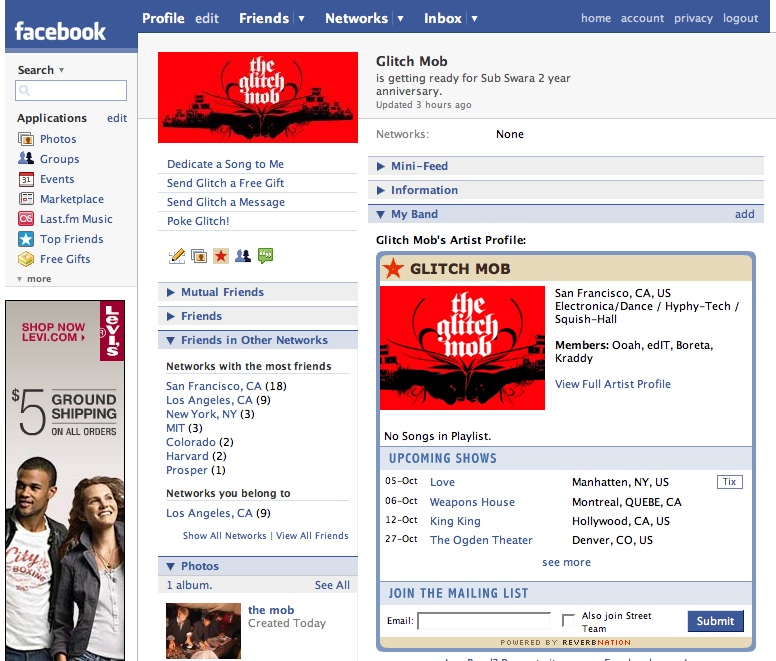
here’s an example of a widget in action on a facebook profile:
in one slick little box you get:
the band’s upcoming show schedule–which is incredibly easy to create since reverbnation also has venue profiles, allowing you to add ten shows in about 2 minutes.
direct links to buy tickets to upcoming shows
an email list signup form– reverbnation’s free FanReach email service allows artists to create targeted messages to fans based on age, gender, and location which is more sophisticated than the offerings of many email list service providers, and their service also lets you include music and a show schedule automatically in every email.
the widget even has a freakin “Also join Street Team” option for people signing up!
to get all these features before you would have had to go running around to a bunch of different service providers, and then work to continually integrate all the features individually into every online location where your band had a presence–and that’s all resting on the assumption that all those features were compatible with each other, and most importantly, that a bunch of musicians had the necessary marketing acumen to even understand all the features they needed in the first place.
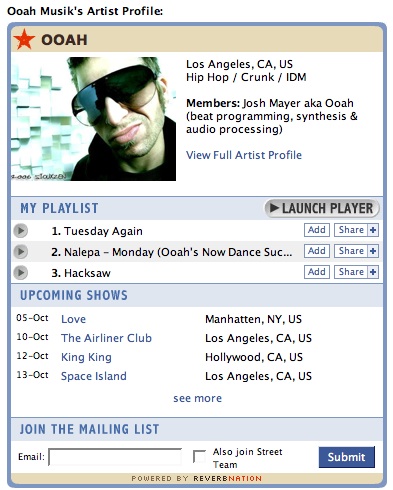
of course, it doesn’t stop there, this widget slices and dices and plays music too. here’s another example from one of the glitch mob’s member’s profile:
it doesn’t just let you embed a playlist, it lets you create portable online music player! this means that folks don’t HAVE to stay on your profile page to listen to your music. they can be doing anything else on the internet and still listening to your serenade.
the fragmented channel, remember? it’s everywhere all at once.
there are sooo many more features that reverbnation offers that to even get a grasp on all of them would take me the rest of the day, and then i’d have to spend more time tomorrow writing about them, but i should think you get the idea at this point.
i can imagine part of the hindrance in reverbnation’s adoption is the sheer complexity, and wide array of their offerings. it’s been confused for a myspace competitor, but in reality that is a complete misconstruction of what it looks like reverbnation is setting out to do. during the many company-wide conference calls that took place in the process of House of Blues’ acquisition by LiveNation, michael rapino, livenation’s CEO, continually stressed the importance of the consumer relationship to the future of the concert promotion industry–about which, as the largest concert promoter in the world, livenation has a right to claim to know a thing or two. (if “reverbnation” picked its name in complete ignorance of “livenation” i would be tremendously surprised).
the big difference, of course is that livenation owns the venues. but in reverbnation’s case, they are setting up to own a channel. one that is deftly suited to broadcast to a fragmented audience. and if you were paying attention then you’ve also realized that it is a model for the future of message-distribution itself, also known as advertising. connecting the needs of artist, fan, and venue into a symbiotic “ecosystem” is the same as connecting the consumer, the brand, and the “venue” for a brand experience into one constant feedback loop.
following up on the smash success of its award-winning “evolution” ad, dove unleashes “onslaught“:
much like the evolution ad, which shows the intense makeup and photoshop augmentation of an image of an average woman and at the end offers, “no wonder our perception of beauty is distorted,” while directing viewers to take part in dove’s Real Beauty workshop for girls, the new ad–aimed at the same north american audience–warns viewers (ostensibly parents, but perhaps every woman’s inner child) to “talk to your daughter before the beauty industry does.” the spot likewise ends with a plug for dove’s self esteem fund:
“The Dove Self-Esteem Fund is a national resource established as a link to Dove’s Campaign for Real Beauty, a program aimed at changing the current, narrow definition of beauty. We believe that to make a real difference, we must take action and contribute in ways that will help women and girls celebrate their individual beauty.”
uh-huh…
of course when dove claims to “change the current narrow definition of beauty” they only aim to do so….narrowly. unilever, which is responsible for dove, also sells the fair and lovely “skin whitening” product to areas of the world where a dark complexion means you’re not getting invited to the “individual beauty” celebration:
and see, what you think you’re seeing here is a contradiction….but the reality is you’re not. although, no doubt, it’s easy to get confused about how that could be.
the same way that light skin is now a beauty ideal in india, being–as the national youth anti-drug media campaign would call it–“above the influence” of the beauty industry is the new beauty ideal in north america. the new unattainable beauty standard is the transcendent personal victory over the distorted beauty ideal itself. as viable an achievement as a victory in the war on drugs or giselle’s body.
unilever is, in fact, selling just as equally an unrealistic standard in both messages. considering that dove is about as much a “beauty” (or is it “nonbeauty” now?) product as fair and lovey–which is essentially just sunscreen, more or less–is a “skin whitener” it makes perfect sense that the messaging likewise would actually be so consistent. and in the case of the north american version, unsettlingly prescient.
as someone who’s worked in fashion PR, i can verily attest that ain’t no one hates the folks in the fashion and beauty industry more than they hate themselves. will all that self-loathing one day be enough to launch a whole “war on beauty?”
if it is, i’m sure dove films will be winning awards for its PSAs.
it’s kind of hard to write a post advocating a sense of balance. it’s easy to get all riled up and energized on preaching some kind of extreme; is it even possible to create a polemic for moderation? i’ve been sitting on this particular post for weeks, unable to summon up the oomph to do it justice, but i’m gonna try, cuz i think it’ll be useful.
there’s a lot of push for “radical transparency” in this social media culture of ours. from the free-sharing ethos of the open source community that’s defining a good deal of the new medium’s structure, to the rampant open-bookiness of the random user’s social network profile, total “openness” is being heavily bandied as a requisite for the new media era.
a few months ago wired dedicated it’s cover story to this issue, with the see-through CEO article:
Radical forms of transparency are now the norm at startups – and even some Fortune 500 companies. It is a strange and abrupt reversal of corporate values. Not long ago, the only public statements a company ever made were professionally written press releases and the rare, stage-managed speech by the CEO. Now firms spill information in torrents, posting internal memos and strategy goals, letting everyone from the top dog to shop-floor workers blog publicly about what their firm is doing right – and wrong….
of course, when considered in contrast to the long legacy of empty hype, manipulation, and even straight up coercion that we have become fed up with in mainstream media and big business it’s understandable that there would be such a resounding grito for “radical transparency” now that media has, for the first time, truly become interactive. “secrecy is dying.” the article proclaimed. “it’s probably already dead.”
but before we go get it taxidermied and hang its stuffed, antlered head up in social media’s hunting lodge, what i am proposing is that there is room for an intermediate option between the overt and the covert, one that emphasizes a sustainable (vs. radical) approach to maintaining the delicate balance between the blatant and the intriguing.
but wait…
Your customers are going to poke around in your business anyway, and your workers are going to blab about internal info – so why not make it work for you by turning everyone into a partner in the process and inviting them to do so?….Some of this isn’t even about business; it’s a cultural shift, a redrawing of the lines between what’s private and what’s public. A generation has grown up blogging, posting a daily phonecam picture on Flickr and listing its geographic position in real time on Dodgeball and Google Maps. For them, authenticity comes from online exposure. It’s hard to trust anyone who doesn’t list their dreams and fears on Facebook.
ok. i’ll tell you something else about what i and some of the rest of this generation grew up doing. we grew up going to–and some of us, producing–“outlaw” parties. you can check out groove or go or kids even, if you weren’t there for yourself, but suffice it to say these were unpermitted, unfireproofed, underground all-night events that routinely broke a whole lot of safety codes, property laws, and a slew of other legislative regulations. there was a tremendous sense of community and trust that developed within this scene which was at once superlocal and hyperglobal, and we all relied on each other to be good at keeping a secret. because if we weren’t, we would all be saving the 3 am dance for members of law enforcement. and once the cops came there was no more fun for anyone.
which is not to say that i am advocating illegal activity in business practices, but rather to point out that this generation that now publicizes its dreams and fears for the world to see may yet be able to appreciate the value in keeping certain things–as the kids say–on the DL.
the wired article does point out that, ok, perhaps:
Secrecy can be necessary – CEOs are often required by law to keep mum, and many creative endeavors benefit from being closed: Steve Jobs came up with a terrific iPhone precisely because he acts like an artist and doesn’t consult everyone. In fact, secrecy is sometimes part of the fun. Who wants to know how this season of 24 is going to end? It’s not secrets that are dying but lies.
the article tosses in this dynamic concept that secrets can be fun, and then moves right along on its radical transparency proselytizing way without giving it any more thought. it’s this kind of secret that i’m interested in. the secret that is not a lie, the secret that’s enjoyable: the mystery.
because you know why? because mystery is infinitely engaging. mystery bestows specialness. mystery can create bonds within a community, and oh, hell, mystery is sexy!
i mean, full disclosure certainly can be sexy too, but it all depends. we don’t fantasize about what EVERYONE looks like naked, dig? and that goes for companies too. sometimes we don’t NEED to know. sometimes it’s a lot more boring or disappointing if we do. sometimes it ruins the magic. sometimes it could be more captivating if you maybe put your clothes back on and sought to seduce us. think of it like a strip tease. in fact, i think we can all learn a thing or two on the subject from cabaret. but not the outdated oldskool kind. no, i’m talking about punk rock cabaret.
n 2004 the dresden dolls were just this odd little cult duo from boston on their first US tour. at their L.A. show matt hickey, the dolls’ booking agent, said to me: you know, no matter how big they may ever get, it’s really important that you should still be able to feel like you are just discovering them. that idea has stuck with me ever after, and i think it’s immensely valuable advice to anyone responsible for the development of a lifestyle brand.
in the years since that conversation, the dolls have gone on to tour the world with panic! at the disco, nine inch nails, and many other major acts. the last time i saw them perform was about a year ago at the orpheum theatre in LA and i’d say that that sense of intimate discovery remained intact even when thousands of people now knew the words to all their songs.
how do you cultivate this intimacy? you keep things mysterious.
the lore around the relationship between the duo is the stuff of cult-rock mythology at this point, rife with tensions and speculation. but sustained mystery is not the exclusive territory of celebrity, where it is, in fact, more often than not mismanaged. it’s also the very same sort of element that induces alternate reality game enthusiasts to willingly participate in an obscure adventure, trusting that each discovery will lead them to an even greater enigma. in a certain sense our whole fetishized infatuation with celebrity can itself be thought of as one giant pop culture ARG–but that’s enough philosophy for one post, i think.
instead lets head over to psychology land. after all, this whole mystery thing is how people fall in love, and the result of eliminating its terrific tension can ruin an otherwise great relationship. (think brand-consumer relationship too!)
in her excellent book, mating in captivity, esther perel, a couples and family therapist and self-identified “cultural hybrid,” offers some refreshingly counter-intuitive (to american intuition, that is–perel was raised in europe, educated in israel, and now practices in NY) insight on how to “reconcile the erotic and the domestic.”
Intimacy has become the sovereign antidote for lives of increasing isolation…. but I am not convinced that unrestrained disclosure–the ability to speak the truth and not hide anything–necessarily fosters a harmonious and robust intimacy.
The mandate of intimacy, when taken too far, can resemble coercion. Deprived of enigma, intimacy becomes cruel when it excludes any possibility of discovery. Where there is nothing left to hide, there is nothing left to seek.
It’s been my experience as a therapist that the breakdown of desire appears to be an unintentional consequence of the creation of intimacy. Our ability to tolerate our separateness is a precondition for maintaining interest and desire in a relationship….Desire thrives on the mysterious, the novel, and the unexpected. It is energized by it.
An expression of longing, desire requires ongoing elusiveness.
we appreciate mystery not for the end goal of its destruction, but for the enjoyment of its process–its revelatory discovery, its furtive sharing. mystery isn’t about being shady, it’s not about deception, nor is it mutually exclusive with making things more accessible, safer, or better explained. there probably isn’t even one right way to sustain it–do too good a job of it and you run the risk of ending up in the dangerous territory of exclusivity. but mystery is incredibly powerful, and has the capacity to engage and captivate us all like nothing else. we shouldn’t ever discount it or think that complete transparency is really a viable substitute. sustained mystery, when pursued consciously and wielded carefully is an effective strategic approach in its own right.