A mashup of the Top 25 hits of 2008, according to Billboard, by DJ Earworm:
Track list:
Flo Rida Featuring T-Pain – Low
Leona Lewis – Bleeding Love
Alicia Keys – No One
Lil Wayne Featuring Static Major – Lollipop
Timbaland Featuring OneRepublic – Apologize
Jordin Sparks Duet With Chris Brown – No Air
Sara Bareilles – Love Song
Usher Featuring Young Jeezy – Love in This Club
Chris Brown – With You
Chris Brown – Forever
Ray J & Yung Berg – Sexy Can I
Rihanna – Take a Bow
Coldplay – Viva La Vida
Katy Perry – I Kissed a Girl
T.I. – Whatever You Like
Rihanna – Disturbia
Rihanna – Don’t Stop the Music
Natasha Bedingfield – Pocketful of Sunshine
Chris Brown Featuring T-Pain – Kiss Kiss
Ne-Yo – Closer
Colbie Caillat – Bubbly
Mariah Carey – Touch My Body
Madonna Featuring Justin Timberlake – 4 Minutes
Pink – So What
Finger Eleven – Paralyzer
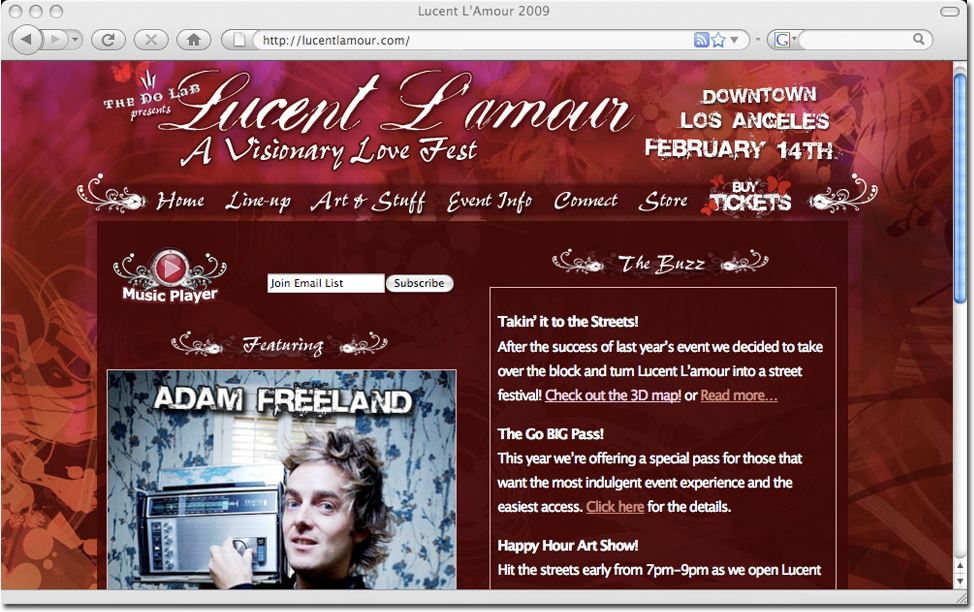
Been missing in action over here cuz I’ve been working on the site launch and onsale for The Do LaB’s first event of 2009:
I’m stoked on the event. It’s unlike anything the Do LaB has ever done before. We’re closing down a street and throwing a block party style music festival in Downtown L.A. It’s actually something we’ve been planning since Lucent L’amour 2008, when we realized we’d begun to outgrow indoor venues. So we’re taking over the street with three music and performance stages, a 100 ft. art gallery, and all kinds of other crazy stuff. Pretty much everything is going bigger. (And there’s quite the lineup addition in the works. Can’t say any more than that for a few more weeks, but we’re all suuuuper excited about it!)
And the other thing I’m excited about is that this is the first fully CMS-based website the Do LaB has made for an event!
Finally!
Oh, and here, help yourself to some sonic treats, courtesy of the Lucent L’amour music player:
(if you’re seeing this in a feedreader, click here for music.)
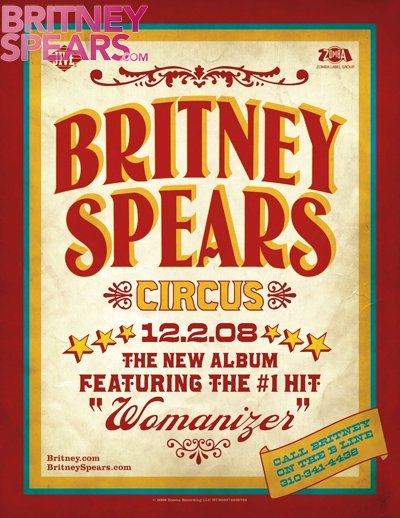
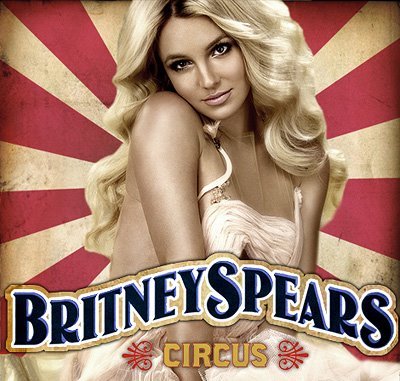
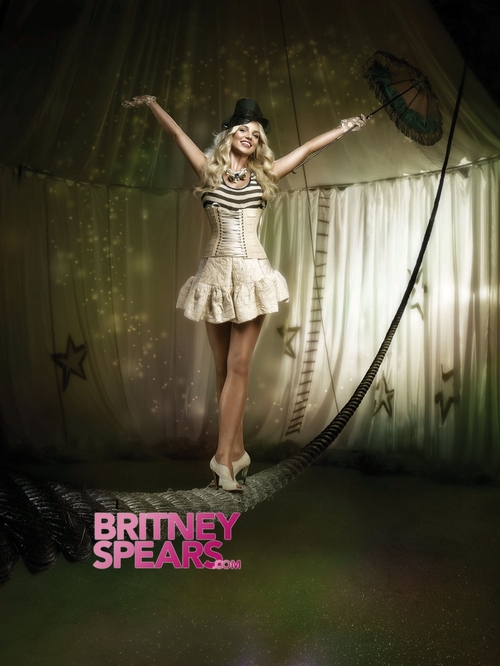
Britney Spears has a new album out today, and guess what it’s called:
That’s right!
Britney Spears’ new album is called Circus, and this is incredibly interesting to me.
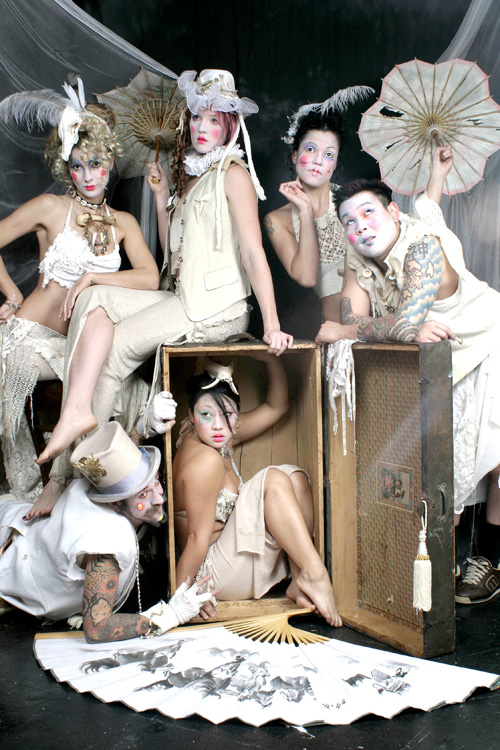
Once upon a time, I used to be the production manager for a circus called Lucent Dossier—
This troupe is actually part of a whole larger Circus performance subculture that has been growing on the West Coast for years. San Francisco’s The Yard Dogs Road Show, El Circo, and Vau De Vire Society, Santa Barbara’s Clan Destino, L.A.’s Mutaytor, Cirque Berzerk, and Lucent Dossier, these are just a few of the major acts that are coming to mind, but there are untold scores of others. With its own distinctive music, style, and nightlife, the Circus scene’s cultural influence has been steadily spilling over into mainstream fare for a while.
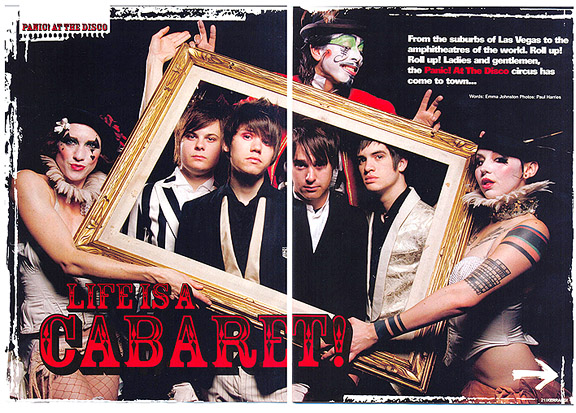
In 2006, Panic! at the Disco cast Lucent Dossier in the music video for their first big hit, I Write Sins Not Tragedies. When Panic! went on the road later that same year they brought Lucent along, and called it the “Nothing Rhymes With Circus,” Tour–
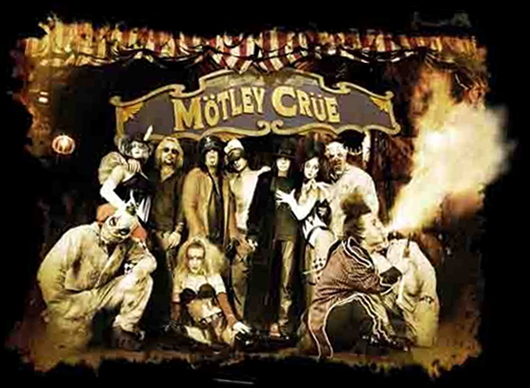
–which, according to the Washington Post, offered “a far superior take on the warped circus theme Motley Crüe was going for in its latest tour.”
Oh, yes…that’s right. A year prior, Motley Crüe–who would become no strangers to the stylings of Lucent Dossier, themselves–reunited, and you know what their comeback tour was about?
Here’s a hint:
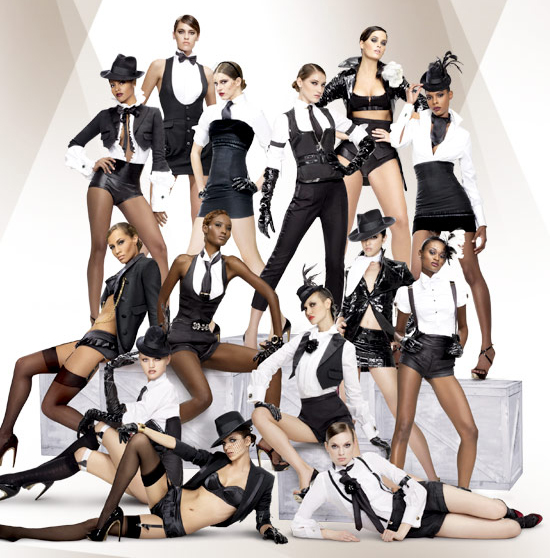
The Circus subculture infiltration, I should mention, has by no means been limited to music. With such proximity to the entertainment industry, it’s been showing up all over the place. Captivating gamers at E3, holding it down at Red Bull’s nightlife spectacle, Ascension, even America’s Next Top Model weighed in with an “homage” of sorts to the style earlier this year–
–but none of this is really comparable in scale to an endorsement from the Princess of Pop herself.
Despite the inescapable reality that it’s blatantly far from any kind of original album or tour concept, Britney Spears still chose to go with Circus anyway. Clearly there is something about Circus that continues to resonate with performers, but there is also something about our current culture, that the Circus theme persists in being so damn appealing. It should have long ago gotten played out, and yet here it is again, and again. It would be easy to contend that Circus is just an overly-tenacious current trend (and I know a few Circus professionals who do), but I see it is as the manifestation of a cultural response to a slew of far greater–and much less fickle–social trends.
Traditional forms of the tribe, like the village, have almost completely disappeared. Fewer and fewer people live in small communities where their daily interactions bring them in contact with the people they are deeply connected to, either spiritually or economically. Workers in modern corporations are replaceable and no longer bound to each other by the experience of a shared interdependence. The modern individual is preoccupied simultaneously by isolating, immediate concerns of personal survival and the larger, often intangible concerns of war, terror and economic change as transmitted by a now-seamless global media network. The intermediate space of community is not easily reached.
Not by accident, many of the newer, emergent forms of culture include a specifically tribal aspect. A return to tattooing, sacrification, fire performance and drumming, as well as a renewed interest in ritual, has occurred side-by-side with the formation of intentional (if temporary) communities such as the Rainbow Family gatherings and Burning Man festival, all of which focus on celebrating and integrating the peculiarities of their varied members.
It was at these kinds of festivals, in clubs and at underground raves, that alternative circus acts began appearing in the early 90’s. The performers were young, crazy “freaks” without any formal training who used circus costumes, skills or themes as performative means for expressing their own exaggerated personalities. Many went on to gain formal training or to study the history of the genre, but essentially their relationship to conventional circuses resembled that of outsider art to mainstream art circles. They didn’t really relate to the modern-day circus. They took their cues from something much, much older: the caravan-pulling gypsies.
The gypsies, shunned by society at large, but fiercely loyal to their own clan, were the most tribal group in all of Europe. It was these wanderers who first produced circus-like entertainment in the medieval townships, along with strolling players and minstrel shows. It wasn’t until the 1770’s that Englishman Philip Astley fused military equestrian drills with acrobatics and other entertainments to form the modern circus.
The phenomenon of alternative circus performance can be seen as the theatrical dimension to one generation’s wholesale rediscovery of the concept of tribe.
In other words, kids originally began forming Circus performance troupes as an extension of creating urban tribes:
According to French sociologist Michel Maffesoli, urban tribes are microgroups of people who share common interests in metropolitan areas. The members of these relatively small groups tend to have similar worldviews, dress styles and behavioral patterns. Maffesoli claims that punks are a typical example of an “urban tribe.”
20 Years later, instead of forming punk bands, party kids were forming circuses. And in an age where no one thinks twice of breakdancing or skateboarding, does circus art seem all that unexpected?
In the past decade we’ve also seen the arrival of social media, and “Performative means for expressing exaggerated personalities” as Hill put it, isn’t just for the Circus anymore. It’s what makes the social web go round, too. In Generation Me: Why Today’s Young Americans Are More Confident, Assertive, Entitled–and More Miserable Than Ever Before, Jean Twenge and her coauthors analyzed 15,324 responses to the Narcissistic Personality Inventory, completed by college students between 1987 and 2006. The survey is considered the most popular and valid measure of narcissism, and features statements such as “I think I am a special person,” “I can live my life anyway I want to,” “If I ruled the world, it would be better place,” etc. According to the results:
The trend was extremely clear: younger generations were significantly more narcissistic. The average college student in 2006 scored higher on narcissism than 65% of students just nineteen years before in 1987. In other words, the number of college students high in narcissism rose to two-thirds in the space of less than twenty years.
While Myspace, Youtube, blogs, and all the rest, aren’t responsible for the origins of this narcissism trend, they absolutely help enable its progress. “Narcissism is the darker side of the focus on the self,” writes Twenge, and our constant interaction with social media is an indulgence in self-focus. All of us have been affected by the process of maintaining our online presence. Even if we’re not all live-streaming our entire existence, we upload photos of our lunches or puppies for our network to see, we write blogs about experiences that we planned to blog about even as we were having them, we leave comments for friends just so other people will see them, we fill in our favorite movies and books and music in the appropriate boxes on various profiles, aware of what our choices say about us. In a sense, all of this is a performance. We are already constantly performing our selves, and Circus represents the ultimate performance platform.
Not surprisingly, we also crave attention. After all, what’s the point of being the spectacle if no one is watching? “Given the choice between fame and contentment,” writes Twenge, “29% of 1990s young people chose fame, compared to only 17% f Boomers.” No doubt, the 2000’s generation would score even higher.
When i ask teens about their desire to be famous, it all boils down to one thing: freedom. If you’re famous, you don’t have to work. If you’re famous, you can buy anything you want. If you’re famous, your parents can’t tell you what to do. If you’re famous, you can have interesting friends and go to interesting parties. If you’re famous, you’re free!… [However] Anyone who has worked with celebrities knows that fame comes with a price and that price is unimaginable to those who don’t have to pay it.
The idea of “freedom” is a huge aspect of the appeal embodied by the Circus since way before its modern “reinvention.” Circus has long represented freedom from normal society’s rules. The ultimate outlaw lifestyle. And like celebrity, it too has extolled its own price. No surprise then that celebrities from Motley Crüe to Britney spears should find this theme so relatable.
While I don’t doubt there will be much talk of shark-jumping going on within the Circus underground (after all, just how underground-y can it be if Britney’s fans get into it?), to me, both the alternative and the mainstream reincarnations of Circus are on the same continuum. More than just a subculture or a concert tour fad, Circus has come to articulate something about the nature of our relationship with various social trends shaping the modern experience.
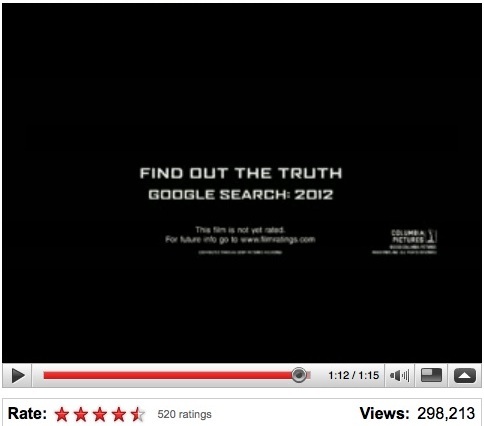
I noticed something interesting the other day in the trailer for the forthcoming 2012 movie. At the end of the trailer, (which–though the movie stars John Cusack, Chiwetel Ejiofor, Amanda Peet, Oliver Platt, and Thandie Newton–doesn’t include a single star, instead giving off a distinctly Baraka-like “documentary” feel, depicting only Buddhist monks and a typicallyEmmerich-ian, visual effects-heavy apocalypse sequence), in place of where you’d normally expect some URL to the effect of “www.2012themovie.com,” there appears, instead, a google search instruction:
Many esoteric sources interpret the completion of the thirteenth B’ak’tun cycle in the Long Count of the Maya calendar (which occurs on December 21 by the most widely held correlation) to mean there will be a major change in world order.
Astrologer John Jenkins has determined that on this date, there will be “an extremely close conjunction of the northern hemisphere winter solstice sun with the crossing point of the Galactic equator and the ecliptic”, an event that will not be repeated for thousands of years.
Several authors have published works which claim that a major, world-changing event will take place in 2012:
The 1997 book The Bible Code by Michael Drosnin claims that, according to certain algorithms of the Bible code, an asteroid or comet will collide with the Earth.
The 2006 book 2012: The Return of Quetzalcoatl by Daniel Pinchbeck discusses theories of a possible global awakening to psychic connection by the year 2012, creating a “noosphere.”
Riley Martin claims that Biaviian aliens will allow passage aboard their ‘Great Mother Ship’ when the Earth is ‘transformed’ in 2012.
Terence McKenna’s numerological novelty theory suggests a point of singularity in which humankind will go through a great shift in consciousness.
And so on.
Clearly, there’s quite a good deal of differing speculation going on, all of it perfect subject matter for the creator of such cinematic fare as 10,000 BC, The Day After Tomorrow, Independence Day, and Godzilla. By offering a google search instruction instead of a url, the film avoids narrowing such a broad, hot-button topic down into a typically useless movie website, and, instead, capitalizes on the full breadth of the phenomenon that is 2012.
For people who’ve never heard of 2012 before, this is a great way to add an unbeatable, real-world level of intrigue to the promotion of a Summer Action Disaster flick. For those that have, it’s a great way to leave all the contested options (Armageddon? Enlightenment? Close Encounter?) out on the table.
Creating a real-world narrative that can be used to expand the promotion for an entertainment property is what Alternate Reality Games are based on. What’s interesting in this case, though, is that the movie takes advantage of a back-story that already exists, and, furthermore, has been defined not by ARG designers, but by an open-source kind of process. The phenomenon behind the movie is whatever reality google says it is.
For context, imagine a remake of Waterwrold, where at the end of the preview, the instructions would read: “Google Search: Climate Crisis.”
“Our stories are singular, but our destiny is shared, and a new dawn of American leadership is at hand.”
President-Elect Barack Obama
516 Years since Columbus discovered America.
232 Years since the first democratic government was established in the United States of America.
143 Years since slavery was abolished.
138 Years since black people got the right to vote.
54 Years since it was agreed that “separate but equal” was bullshit.
26 Years since the coinage of the Bradley Effect.
3 Days since Barack Obama was elected the next president of the United States of America.
Those Obama posters proclaimed “Change,” but I don’t think it ever really occurred to anyone, not even to his most avid supporters, just how sudden, and overwhelmingly personal this change would feel. In the past three days the most profound change I have witnessed has been in people’s perceptions. Perceptions of their personal identities, of their cultural identities, of their national identities, and their perceptions about the very process of affecting social change, and personal opportunity.
These changes that happened, literally, overnight, are undeniably going to be important in shaping the future of this country, and the world. So as every trend forecaster and futurist gets down to the task of figuring out how the result of this election is going to impact our culture, I offer these three-day old observations.
What Obama’s victory means for:
1. Black People – As Sherri Shepherd summed it up on the View, “People of color, we’ve always had these limitations on us. I remember, somebody in my family said one time, when I said I want to be a comic, and an actor, they said, ‘No, you will get a job at the post office. They don’t let people like us do that.’ And so, to look at my son and say, ‘You don’t have to have limitations’… It is an extraordinary day for me.” Unlike too many examples of black achievement in the past, Obama’s win does not signify an exception, but rather a symbol of opportunity for all people of color. The idea that there is only so far you can go if you are black, or that you can only succeed up to a certain point, has been shattered, and I think it’s possible that something in the very sense of black identity itself has been affected here. This is such a huge deal that it’s pretty impossible to really grasp the full magnitude of what this will mean for the future of the Black community specifically, and race relations in the in the U.S. in general yet.
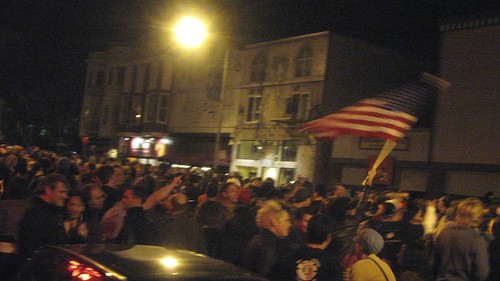
2. GEN Y – Much like black people, I know, from personal experience, that the general under-30 population is feeling something right now that they’ve never experienced before either. The picture below was taken in the Mission district in San Francisco on election night:
Sean Bonner, who took the photo, later wrote, “19th and Valencia. One of the last places in the country I would expect a crowd of people waving American flags. But sure enough it happened. I talked to people today who said for the first time in their lives they hung flags in and out of their houses and finally understood what patriotism is all about. That’s kind of a big deal if you think about it.” It’s a huge deal. Think about this: The first election that my generation was old enough to vote for was stolen. All the other elections we’ve ever known involved George Bush. Neocons aside, the general population born after 1981 has never known what it’s like to not feel resentment and embarrassment about our country. We’ve never felt like our country reflected US, until now. As with the Black community, I think the impact of Obama’s win on the future of the youth of this country, and the future of our affect ON this country that we can now feel is ours to care for, is still unimaginable.
3. America’s perception in the rest of the world – A friend of mine who’s leaving for a tour in Europe next week said to me, “It’s going to be SO different traveling abroad now.” At first I wasn’t completely convinced. My dad has a joke. He says, “Anywhere in the world, Russians and Americans walk into a bar the same way. Loud and obnoxious. Americans do it because they think they own the bar. Russians do it cuz they think they can beat up anyone in the bar.” And it’s not like the way Americans walk into a bar changed with Obama’s acceptance speech. But something definitely did change. “I travel a lot,” Sean Bonner also wrote, “And I’m constantly faced with people from other countries saying ‘Well, you are cool enough but obviously you are the exception, the rest of your country must be idiots to have voted for that Bush guy.’ When I try to tell people that not everyone voted for him, and even people who did vote for him aren’t 100% down with his actions over the last several years, they usually scoff and point out if the country didn’t like him he’d get kicked out, so clearly people are behind him. That’s not something I heard from one person in one country, it’s a feeling I got repeatedly all over the world. The US electing Obama over McCain is a clear message to everyone else on this planet that the US isn’t happy with the leadership we’ve had and we want something to change. This is good for all of us.”
4. Politics – Politics–and I do mean the political process itself, not simply “being political”–is not just for your conservative, older uncle-in-law anymore. Politics is YOURS. Something really remarkable about the Obama campaign is that it offered an outlet for channelling that political youth energy that since the 60’s has been expended on efforts “outside the system,” INTO the system. (Counterculture is dead, after all). I think having felt cheated and ignored by the political process for so long made the prospect of trying to affect institutional change seem impossible. The low-hanging fruit of “personal growth” has all but replaced institutional change as the means for solving society’s problems. But at the end of the day, institutional change, is, in fact, the change we need. So will this new experience of feeling that the political process CAN be ours to affect motivate more of the activists of my generation to give it a rest with the protests-slash-street festivals, and instead put on a suit and tie and do the work it takes to create institutional change? Man, I would really fucking like to hope so.
5. Government – Have you seen this www.change.gov?? Government has NEVER looked like this before. Not just American government. Not ANY government. Fucking amazing! Yesterday, in a cafe, I was watching as CNN announced that Barack Obama had appointed his chief of staff, and I was riveted! Everyone else in the cafe was watching it too. It was the kind of scene that makes you think something terrible is happening on TV, but it wasn’t terrible at all, it was just the new president forming the new government…and it was fascinating! Maybe it’s just cuz it was day 2, maybe this interest in our government that we all seem to suddenly be possessed by will wane, but I’ve gotta say, before, I NEVER used to be interested. Not on ANY day. I think the initiative to run the government in a more transparent, responsive, open way will help to sustain our feeling of personal connection to and investment in the government, and help prevent all of us from slipping back into the general detachment we’d had from it up till now. Consider how a focus on a shared, mutual government vs. on self-segregated communities might affect the dismayingly polarized American landscape we’ve come to know.
6. The American Dream – In Generation Me, Jean Twenge suggests that my generation is too full narcissism and entitlement, that we’ve got massively unrealistic expectations, and we need to be made to face reality, and realize that our dreams are just that. Even for many who did not vote for Obama, there is an undeniable sense of something profoundly impossible having been achieved in his victory. It’s the kind of profoundly impossible achievement that is, and has always been, the hallmark of America, and Obama himself said as much in his victory speech. For those whose dream has been to become Britney Spears, perhaps you might want to take a cue from Twenge’s book. But for those of us whose dream has been about succeeding at doing what we believe in, at doing things our own way, about succeeding at doing the thing that brings us joy and fulfillment, Barack Obama’s victory is a testament to its possibility. The “American Idols” we have had to look up to for too long have either been utterly disposable, recast every season to feed the celebrity tabloid industrial complex, or otherwise icons of unattainable privilege and luxury (think: Paris Hilton). Barack Obama has worked his whole life for everything he has accomplished, and what he’s earned now is the responsibility to do yet more work. I really cannot remember the last time someone like this was an icon of the American Dream, and I can’t wait for a generation of kids who will grow up wanting to become like Barack Obama.