
the end of counterculture

While I was in New York a couple of weeks ago, it came to my attention that hipsters had managed to really piss Adbusters off. In his article, Hipster: The Dead End of Western Civilization,” Dougals Haddow writes:

Take a stroll down the street in any major North American or European city and you’ll be sure to see a speckle of fashion-conscious twentysomethings hanging about and sporting a number of predictable stylistic trademarks: skinny jeans, cotton spandex leggings, fixed-gear bikes, vintage flannel, fake eyeglasses and a keffiyeh – initially sported by Jewish students and Western protesters to express solidarity with Palestinians, the keffiyeh has become a completely meaningless hipster cliché fashion accessory.

The American Apparel V-neck shirt, Pabst Blue Ribbon beer and Parliament cigarettes are symbols and icons of working or revolutionary classes that have been appropriated by hipsterdom and drained of meaning. Ten years ago, a man wearing a plain V-neck tee and drinking a Pabst would never be accused of being a trend-follower. But in 2008, such things have become shameless clichés of a class of individuals that seek to escape their own wealth and privilege by immersing themselves in the aesthetic of the working class.

Lovers of apathy and irony, hipsters are connected through a global network of blogs and shops that push forth a global vision of fashion-informed aesthetics. Loosely associated with some form of creative output, they attend art parties, take lo-fi pictures with analog cameras, ride their bikes to night clubs and sweat it up at nouveau disco-coke parties. The hipster tends to religiously blog about their daily exploits, usually while leafing through generation-defining magazines like Vice, Another Magazine and Wallpaper.

Ever since the Allies bombed the Axis into submission, Western civilization has had a succession of counter-culture movements that have energetically challenged the status quo. Each successive decade of the post-war era has seen it smash social standards, riot and fight to revolutionize every aspect of music, art, government and civil society.

But after punk was plasticized and hip hop lost its impetus for social change, all of the formerly dominant streams of “counter-culture” have merged together. Now, one mutating, trans-Atlantic melting pot of styles, tastes and behavior has come to define the generally indefinable idea of the “Hipster.”

Haddow’s thesis is that “We’ve reached a point in our civilization where counterculture has mutated into a self-obsessed aesthetic vacuum,” and hipsterdom, “the end product of all prior countercultures,” represents nothing short of “the end of Western civilization.”

In a certain way, he’s right.

In chapter 11 of The Long Tail, titled, “Niche Culture,” Chris Anderson quotes the writing of media analyst Vin Crosbie to help explain the origins of this phenomenon:

Each individual listener, viewer, or reader is, and has always been, a unique mix of generic interests and specific interests. Although many of these individuals might share some generic interest, such as the weather, most, if not all of them, have very different specific interests. And each individual is truly a unique mix of generic and specific interests.

As of 30 years ago, Crosbie writes, with the improvements in offset lithography that led to a boom in specialty magazines (the 1970s saw newsstand offerings explode from a couple dozen magazines to hundreds, and most about specific topics), media technologies began to evolve in ways that could satisfy individuals’ specific interests:

The result of this is that more and more individuals, who had been using only the (generic) mass medium because that’s all they had, have gravitated to specialty publications, channels, or websites. More and more use the mass media less and less. And more and more will soon be most. The individuals haven’t changed; they’ve always been fragmented. What’s changing is their media habits. They’re now simply satisfying the fragmented interests that they’ve always had.

Anderson adds: “The shift from the generic to the specific is a rebalancing of the equation, an evolution from an ‘Or’ era of hits or niches (mainstream culture vs. subcultures) to an ‘AND’ era. Mass culture will not fall, it will simply get less mass. And niche culture will get less obscure.”

What this means then is that “counterculture,” as the construct we, and Adbusters, have known it to be, is disappearing. Maybe gone. If mass and niche culture can meet each other in the middle and make room for both sides, what is there to be “counter” to?

This dead end of “mass culture” seems like a concept Adbusters should have been rejoicing, no? Unless they were confused as to what the end of “mass culture” might look like.

“When mass culture breaks apart,” Anderson writes, “it doesn’t re-form into a different mass. Instead it turns into millions of microcultures, which coexist and interact in a baffling array of ways.” In this landscape of, as Anderson calls it, “massively parallel culture,” there’s not really a place for “mass rebellion.” Instead, we have specific, niche rebellions.

Haddow writes: “This cursory and stylized lifestyle has made the hipster almost universally loathed.” So much so, in fact, that, “It is rare, if not impossible, to find an individual who will proclaim themself a proud hipster. It’s an odd dance of self-identity – adamantly denying your existence while wearing clearly defined symbols that proclaim it.” Perhaps one of the specific rebellions of niche culture might be against the labels of stereotypical identity definition themselves. No doubt, especially if that definition is being used as a lifestyle slur. In the article, Gavin McInnes, one of the founders of Vice Magazine explains: “I’ve always found that word [“hipster”] is used with such disdain. [It] always smell of an agenda.”

At the end of the Adbusters piece Haddow writes, “If only we carried rocks instead of cameras, we’d look like revolutionaries.” In the conclusion of The Pirate’s Dillema (which presents an exuberant, revolutionary potential for youth culture’s future that is in stark opposition to Adbusters’ depiction of its “dead-end” present by a journalist from, ironically the same publication Adbusters claims defines the doomed hipster generaion, Vice Magazine) Matt Mason writes: “Youth movements become successful when social change is desperately needed. They gain traction if they express society’s collective desire for change.”

Is this something that really applies to the West’s united niche culture so much these days?

On the other hand, as Mason writes:

The source of future youth movements will just as likely be the rage, desperation, and hope transmitted from the medinas, favelas, and shanty cities of the southern hemisphere. According to a 2005 report commissioned by the National Research Council and the Institute of Medicine on trends affecting youth in developing countries, there are currently 1.5 billion ten- to twenty-four-year-olds on Earth, and 86 percent of them live in a developing country. In many places in Asia and Africa, this generation is the first generation of teenagers their countries have known. As their economic and political power grows, new sounds, movements, and ideas will grow, too.

This is where the new youth cultures will be.


Subscribe for more like this.


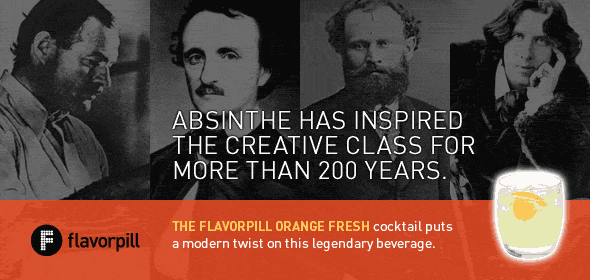
today’s awesome ad award goes to:

way to put the “trend” in perspective. (and way to go on knowing your audience, flavorpill).


Subscribe for more like this.


the empire’s new clothes

Once you ‘got’ Pop, you could never see a sign again the same way again. And once you thought Pop, you could never see America the same way again.

– Andy Warhol

It is totally disconcerting to discover a book that pretty much compiles your insights and articulates them back to you. Buying In: The Secret Dialogue Between What We Buy & Who We Are, by Rob Walker, delves into many of the exact same observations as I have witnessed amid the ecosystem of contemporary culture, marketing, and identity. Reading it feels something like discovering America’s Next Top Model is biting your personal fashion style, I would imagine. Sure, it’s incredibly validating to see your own insights coming at you from a New York Times Magazine writer, but it’s sorta frustrating to have to know that they’re not just yours anymore.

In social science there is probably nothing as revelatory as a contradiction exposed. That the emperor is not wearing any clothes is much more stunning a revelation than any critique of the fashion aesthetic. And it’s contradictions that Walker is interested in:

There was one specific incident that finally made me reconsider what I thought I knew about consumers, marketers, and even myself. This was the news that Nike had bought Converse.

To me, Nike’s famous swoosh logo had long been the mark of the manipulated, a symbol for suckers who take its “Just Do It” bullying at face value. It’s long been, in my view, a brand for followers. On the other hand, the Converse Chuck Taylor All Star had been a mainstay sneaker for me since I was a teenager back in the 1980’s, and I stuck with it well into my thirties. Converse was the no-bullshit yin to Nike’s all-style-and-image yang. It’s what my outsider heroes from Joey Ramone to Kurt Combain wore. So I found the buyout disheartening…. but why, really, did I feel so strongly about a brand of sneaker–any brand of sneaker?

As a consumer behavior columnist, Walker had observed as “the steady march of progress that had been reshaping media and technology for years broke into a sprint, through the rapid rise of devices and innovations like TiVo, the iPod, increasingly sophisticated cell phones, YouTube, Facebook, and so on.” He notes that according to many marketing experts and consumer-culture observers, this new landscape had created a “New Consumer:”

A clever creature armed with all kinds of dazzling technology, from ad-blocking gizmos to alternative, grassroots media. This added up to what professional zeitgeist watchers–

–and i’d like to add, none too few self-congratulatory alternative cultures–

like to call “a paradigm shift.” “Consumers don’t march in lockstep anymore,” one celebrated trend master declared. “We are immune to advertising,” other experts announced. The mindless “mass market” had been shouldered aside by thinking individuals: “Consumers are fleeing the mainstream.” Somehow we had all become more or less impervious to marketing and brands and logos; we could see through commercial persuasion.

The trade, business and mainstream press–

–as well as no shortage of idealistic social media folks–

have seconded this judgement. Thanks to “the explosion in information available to shoppers,” The New Yorker argued, “brand loyalty is in fast decline,” and “the customer is king.” The Economist, too, pointed to super-informed shoppers who have acquired “unprecedented strength” in their dealings with commercial persuaders and approvingly quoted a famous ad executive announcing: “For the first time the consumer is boss.” Advertising Age soberly informed its readers that because of “the power of the public,” consumers have lately obtained “increasing sway … over any product’s success”–in fact, the consumer is in control.

The only problem with this was that it did not match up particularly well with the realities of the marketplace that I was writing about every week in The Times Magazine.

It’s one thing to conclude that the advertising business is evolving with the new media landscape. But these giddy claims go well beyond that….

Meanwhile the number of brand messages we are exposed to goes up, and so does the amount of trash we produce. And on a more personal level: Have you noticed any decrease in the number of times you buy something you were sure you would love, only to regret it later or simply forget about in the back of a closet? There you are, contemplating the limitless and ever shifting choices in what to drink, what to wear, what to drive, what to buy. It is literally impossible to try everything for yourself. Be honest: As you navigate this brand-soaked world, do you feel in control?

Sure, we tell pollsters and friends that we’re sick of being bombarded with advertising, we’re indifferent to silly logos, we’re fed up with rampant materialism. In reality, one of the most significant changes I’ve observed over the years that consumer behavior has been my primary beat is something that goes well beyond the long-standing human tendency to enjoy acquiring things.

The change is particularly noticeable among many of the younger people I’ve met. Frequently, these smart and creative young people were quite happy to inform me that, yes, they were immune to commercial persuasion–that they saw right through it, as the experts liked to say. Meanwhile, they were playing key, active roles in helping certain products and brands succeed.

They were in the vanguard of what looks an awful lot like an increasingly widespread consumer embrace of branded, commercial, culture. The modern relationship between consumer and consumed is defined not by rejection at all, but rather by frank complicity.

This goes against what we’d want to think of ourselves, and of individuality. We want to think that our highly-attuned “seeing through”ness, and our distinctive tastes have set us apart, granted us superiority over the tastelessness of lowly label whores. We want to think that expressing our identities, and asserting our belonging within a particular cultural community is unrelated to, and, in fact, an escape from brand-consciousness. We want to think we are–as 77% of the respondents in a formal poll mentioned by Walker considered themselves to be–far smarter and savvier than most consumers. Which is a mathematical impossibility.

The truth of the matter is that actually we don’t really know ourselves that well at all. That’s the “Secret” in “The Secret Dialogue Between What We Buy and Who We Are.” We have come up with enough misconceptions about the relationship between, as Walker calls it, the consumer and the consumed, that the real mechanics of this interchange are happening beyond our consciousness. We’re not aware we’re naked beneath our fancy new clothes.

“Symbols matter to us,” Walker says:

Meaningful symbols (logos included) get created–and even when we claim to be immune from such things, we often participate in that meaning-creation ourselves….In the 21st century we still grapple with the eternal dilemma of wanting to feel like individuals and to feel as though we’re apart of something bigger than ourselves–and that, most of all we all seek ways to resolve this fundamental tension of modern life.

In Nation of Rebels: Why Counterculture Became Consumer Culture Joseph Heath and Andrew Potter delve into the social psychology history of individuality, excavating its modern beginnings from the wreckage of the post-WWII distrust of “mass culture.” They propose that witnessing how conformity had devastated Europe as enforced by the Nazis, plus the results of the Milgram experiment, which exposed some nasty realities about our human relationship to authority, “led conformity to become the new cardinal sin in our society.” By the time Walker gets around to weighing in on it, this manifest individualist destiny has become an American right.

Enter “The Pretty Good” problem, as Walker calls it. Or as Alex Bogusky says: “All products are excellent.” It’s no longer about what’s better than what, or what’s more reliable, or what’s more effective. It all works, it’s all really good. The way you choose between all this totally dependable functioning stuff is, essentially, based on what expresses you.

“Buying a $5,000 handbag just because it’s a status symbol is a sign of weakness,” Walker quotes a particular “keen observer of branded culture”: Miuccia Prada. “Presumably” Walker suggests, “buying a $5,000 Prada bag is okay, if you’re doing it for the right reasons–quality for instance.” But I don’t see anything ironic in Prada’s remark. It’s probably the way anorexics think about the eating habits of the obese. In between those extremes though, weakness or not, we all have to eat. And we all feel we have to express ourselves, define ourselves, locate ourselves, even, on the cultural spectrum. How do we do that in our modern world?

Well, like, take the gutterpunk bike messenger dude Walker comes across while investigating the resurgence of Pabst Blue Ribbon’s popularity, getting a PBR logo brand–that’s skin brand–the size of his back. This may seem a bit excessive, but “Pabst is part of my subculture,” he says. More specifically, it can function as a symbol of a subculture, and skin branding as a means of expressing both a personal commitment and community loyalty is actually not at all uncommon among fraternities. In the absence of a Greek letter, endorsing a brand–that’s logo brand–can, and often does, become adopted as a symbol of belonging to a culture or community. You might not have gotten a skin brand or bought a $5,000 handbag, but all of us have purchased things not just for our own “personal narrative,” as Walker suggest, but because they represented our culture, our context, where we belong.

This is actually the part in the book where Walker’s assessments start to fall apart, I think. Unlike his research on the consumer adoption of corporate brands, in chronicling “underground brands”–by which he means, essentially, lifestyle symbols developed by independent entrepreneurs–he doesn’t mention any research from talking directly to the adopters of these brands, and thus fails to convey that the adoption of both kinds of brands happens basically for the same reasons.

He gets part of it right. Many underground brand creators:

Clearly see what they are doing as not only non-corporate, but somehow anticorporate: making statements against the materlistic mainstream–but doing it with different forms of materialism.

Take a minute to get acclimated to the irony if you need to, but that’s not the real contradiction here. This is:

Perhaps the threat that brand-smart young people really pose to commercial persuaders is not that they have stopped buying symbols of rebellion. It is that they have figured out that they can sell those symbols, too.

What the exact definition of an “underground brand” is–beyond being created by “brand-smart young people”–is never actually defined, and that may be the root of the oversight. Walker’s case studies for underground brands are pretty much exclusively clothing, or even more precisely, t-shirt labels, but I’ve seen the same phenomenon play out with underground music brands bands, and events. A community, weather it’s mass or niche, Greek or gutterpunk, needs symbols, and the difference between how an “independent” maker of symbols behaves vs. a “corporate” one, is that the corporate one answers to Wall Street.

You can argue that size matters. That somewhere along the slippery slope a brand is either big or small, but I would imagine even small Wall Street-beholden brands would behave the same way big ones do. And conversely, as Walker himself talks about, though doesn’t quite process to it’s logical conclusion: to stay competitive, Wall-Street brands are starting to behave like indie ones. Scion’s success via alternative marketing, which Walker calls “murketing,” happened not because it invented its own grassroots community from scratch, but because it leveraged the communities around existing independent brands in much the same way a concert venue leverages the community around a music act.

Talking to independent brand creators, Walker says, “Made me realize that it wasn’t just commercial culture that the brand underground was co-opting–it was the most exclusive and elevated form of it.”

Which is kind of like saying that an indie-rock band “co-opts” Elton John. I think music fans are only too happy to have more options.

It’s not culture that’s being co-opted, it’s industry. An indie band “co-opts” the music industry, and indie brands “co-opt” the industry of commercial persuasion itself. This isn’t a “threat” to commercial persuasion, as Walker suggests, but an expansion, an upgrade. Commercial persuasion, v. 2.0.

Or whatever.

“It’s time to set aside the old conspicuous consumption argument that consumer behavior is all about status–all about badges,” Walker writes. “If the underground logo is a badge, it’s one that is most noteworthy for how few people can see it.”

Uh-huh…

The average underground logo–just like many corporate ones–may be more subdued than, say, the narcissistic in-your-face mania of Louis Vuitton’s logo, but the underground brand is a badge, and it’s one that is most notable for how meaningfully it expresses a community. (By the way, that requires visibility). It may not be all about “status” but it IS all about identity.

Suddenly, the book is not so disconcerting after all.


Subscribe for more like this.


taste the difference

…And I can make you wanna buy a product
Movers shakers and producers
Me and my friends understand the future
– The Flobots: “Handlebars”

I’ve been trying to get through Matt Mason’s The Pirate’s Dilemma for a while. It’s an easy read, but between digging up mind-blowing historical discoveries from the cultural strata–Did you know that a nun at the orphanage David Mancuso was raised at is pretty much responsible for modern dance culture? Dude, I know, it’s insane–And so many unconscious ironies and philosophical inconsistencies that I’m tempted to write a post after I finally do finish it called “The Pirate’s Contradiction”…. it’s difficult to read too much of it at a time.

There’s one very interesting section in it, however, that I think can be dealt with outside of the rest of the book. In keeping with the recent theme of musings on contemporary adulthood, here’s an excerpt from a section called “Parents Just Do Understand”:

The hip-hop generation was the first to grow up in a brand-saturated world. Before hip-hop, as Will Smith and DJ Jazzy Jeff once postulated, it was a given that parents just didn’t understand. But now parents who are the age of Smith have the same albums on their iPods as their kids, and the same reissued retro sneakers on their feet. This has serious ramifications for youth culture, commerce, and everything else.

…What does it mean now to “grow up” in a world where we all want a Nintendo Wii for Christmas?

BAM!

And while Mason presents the caveat that younger generations now find the outlet for rebellion through media and technology, that last bastion where parents and kids are still reliably segregated, in general his conclusion is that “The generation gap has become obsolete.”

But I wonder if perhaps it’s not quite that simple. Maybe the generation gap hasn’t gotten filled in and paved over, but has, in fact, gone deeper below the surface. From above, the divisions that would once define a generational cohort and distinguish it from its predecessors would appear to have eroded, but underneath, a different separation is very much intact.

A 2006 Rolling Stone article called “Teens Save Classic Rock” talks about how the genre of Hendrix, Floyd and Zeppelin is experiencing a resurgence among a whole new generation of kids. “We’re now seeing an audience that goes from sixteen to sixty,” said Allman Brothers manager Bert Holman.

The internet made this possible. iTunes means the music we can listen to is no longer determined solely by the offerings of an ever more homogenized radio, or limited to the finite selection of a physical record store. And while we can now instantly get to hear a bigger breadth of music from across genres and ages than was ever possible before, the question remains, as Rolling Stone points out, “Why would kids born in the Nineties turn to timeworn guitar anthems?”

One answer:

For all of the vibrant rock recorded in the past ten years — from pop punk to neogarage to dance rock — no new, dominant sound has emerged since grunge in the early Nineties. “I can’t think of a record recently that blew people’s minds,” says Jeff Peretz, a Manhattan producer and guitar teacher. “And there aren’t really any guitar heroes around anymore. Kids don’t come in and say, ‘I want to play like John Mayer.’”

“There is such a drought that kids are going back and rediscovering the Who and Sabbath,” says Paul Green, who runs the Paul Green School of Rock Music.

But I don’t think it’s a “drought” so much as a glut. Popular, contemporary music is so ominpresent and obvious there’s barely room for kids to even figure out if they like it. By default, it’s what they’re expected to be listening to. The hideaway of classic rock, where no doubt no one expected to find them, is a relished escape. The musical equivalent of disobeying your mom when she tells you “Just stay where I can see you.”

According to Rolling Stone, “9% of kids ages 12-17 listened to classic-rock radio in any given week in 2005 — marking a small but significant increase during the past three years, according to the radio-ratings company Arbitron.” It’s not just a sign of teen taste, it’s a sign of teen distinction. If you’re listening to classic rock in high school, you’re doing something the other 91% of the kids at your high school aren’t into, or onto yet. That’s some indisputable early adopter appeal there.

Which is perhaps the complete opposite of what appeals to adults about listening to the music of their own youth.

In a 2004 USA Today article about how Kids Are Listening To Their Parents’ Music, Jeremy Hammond, head of artist development at Sanctuary Records noted, “There’s not so much peer pressure to identify with a particular genre or even generation of music,” says “Back then, you had to choose a lifestyle associated with a genre. In England, you were in a gang of rockers or skinheads or Mods. Potheads wanted psychedelic music. Those boundaries are gone. [Now] It’s much more about defining one’s own unique tastes.”

The way a modern identity is constructed has changed. It’s no longer something as simple as how old we are that determines what is or is not “for us” to buy, or listen to, or dress like. The mechanics of taste is the next marketing frontier.

“I think the rebellion is that kids aren’t rebelling,” Says Rana Reeves, creative director of Shine Communications in The Pirate’s Dilemma. “They aren’t rebelling against the marketers; they want to be marketers.”


Subscribe for more like this.


growing up and the city

“I am real!” said Alice, and began to cry.
Through the Looking Glass, Lewis Carroll

I always find it fascinating when movies do things that executives didn’t expect. Entertainment, particularly the kind with narratives and characters, is like a Rorschach test where what we have to say about the inkblot and what the inkblot has to say about us are equally as meaningful. Thus when a movie manages to find an appeal beyond what was expected it can illuminate new cultural insight.

Here is the point at which I admit I love Sex And The City. And while I can’t say I’m a “huge” fan not because I don’t feel like I am one, but because I don’t think I am one in comparison to ACTUAL “huge” SATC fans, I will say I’m pretty excited to have a reason to be writing about it.

The series premiered on HBO in 1998, when I hadn’t even graduated high school yet, and at the time the show had absolutely no way to compete for relevance in my life against My So-Called Life. But then a couple of years ago an old friend of mine (who you should know is male, and straight, and works in real estate finance in NY) got me to watch a couple of episodes cuz he loved the show, and long before I went to see the Sex and the City movie this weekend, I’d actually managed to see every single episode of the show (thanks, Netflix).

It’s not just cuz the main character is a writer, and all the episodes were filtered through the perspective of a woman whose job was about observing and writing about social behavior (though, yeah, I did really dig that aspect). It’s because she was clever enough to make even cynicism charming, hopeful enough to still be curious, difficult enough to give her gravity beyond the frenetic giddy fashionableness. It’s because there’s not too many shows where four friends hanging out is consistently some of the funniest dialogue on a screen, and where decent, relatively normal people, dealing with lives complicated by emotions and nuance and relationships–rather than intrigue or crime or the paranormal–could continue to be genuinely interesting enough to be watchable for six years.

Of course, these decent, relatively normal people happen to be four urban, sassy, sexually uninhibited women, and the show happened to be on a cable network that blazed the trail on you-can’t-do-that-on-television television. So it’s no surprise that two weeks before the movie opened, the LA Times prophesied “Sex and the City” movie may lack wide appeal,” proclaiming:

Few films have polarized audiences more than May 30’s long-awaited cinematic adaptation of the influential HBO show. It’s easier to find $2-a-gallon gas than a straight man eager to see the movie. Older women (in Hollywood’s youth-obsessed view of the world, this means older than 30) hold a dramatically different view: When they are not posting online about their love of the series — “addicted” pops up with frightening frequency — they are organizing ladies’ night viewing parties around the film’s opening….

If “Sex and the City” can start attracting more teenage girls (and appeal to audiences in smaller cities), it just might have a shot at turning into a hit.”

The polarized reactions to Sex and the City–not just the movie, or the HBO series, but really the entire franchise–is not based just on gender, or even on age. When I asked a friend of mine if she wanted to go see the movie, she replied she didn’t think she could for “moral” reasons. Another texted back, “I never took you for that type.”

You’d think digging a show about smart, quick-witted, modern women, half hopelessly jaded half hopelessly romantic, talking about love, sex, and relationships over brunch, and reaping the sexual benefits and pitfalls of having happened to be post-feminist females wouldn’t be a bad type to be taken for. Especially by anyone else that fits that exact same profile. Yet that watching Sex and the City would seem somehow “immoral” even to another educated, liberal, sophisticated girl, speaks to a dramatic dissonance in the movie’s expected demographic.

LA Times movie critic, Carina Chocano, began her review of the film by admitting:

IT’S IMPOSSIBLE to talk about the new “Sex and the City” movie without first mentioning… the rabid fan devotion [the HBO series] enjoyed; or the equally fervent antipathy (female and male) it inspired on socio-political grounds (sort of like the late-’90s equivalent of not letting your daughter play with Barbies)….

Which is too bad, because Michael Patrick King, who executive produced the show (with series creator Darren Star) and wrote and directed the movie, has done some brave, surprising things with it, mining territory that’s been all but abandoned by Hollywood….

“Sex and the City” can’t rightly be called a romantic comedy in the dismal, contemporary sense, though it is at times romantic and is consistently very funny. It’s also emotionally realistic, even brutal….

Yet despite the fact that for the majority of it’s 2 1/2 hours this is not a happy story, yesterday morning Marketing Daily proclaimed, “Sex/City’ Poised To Become Era’s ‘Feel-Good’ Movie.” And I, and no doubt everyone else who cheered when the usher at the Arclight who’d introduced the movie yelled, “Let’s escape reality!” as the lights went down, would agree:

Brands looking to sweep consumers off their feet to escape the recession, global warming and the war in Iraq might want to take a closer look at Carrie Bradshaw and friends.

“Sex and the City” is poised to become the new Depression Era feel-good movie that makes cash registers ring in shopping malls and along Fifth Avenue and Rodeo Drive. Such films tend to make consumers feel upbeat and not overly cautious about spending, according to marketing experts.

…Faith Popcorn, a trend spotter and founder of marketing consultancy BrainReserve, believes the “Sex and the City” movie comes at the perfect time for a nation exhausted politically, emotionally and financially. Marketers can use the good feeling gained from the movie to their advantage, she says, helping consumers temporarily escape tough times. The movie joins “My Man Godfrey,” “The Women” and other Depression Era classics that provided weary audiences with high-style fantasy relief.

Of course, as Chocano says:

The clothes, the restaurants, the apartments, the shoes — they’re all there, but then, even on the show, they were always the fantasy element, the sugar that helped the sometimes harsh emotional reality go down….

For a film that delights in indulging in frivolity at every possible turn, it examines subjects that most movies don’t dare graze for their terrifying seriousness. [How should women live their lives in a society that constantly limits them while pretending not to? What is the function of forgiveness, and why is it necessary for living?] And when it does, the movie handles them with surprising grace, wit and maturity. In other words, it’s a movie for grown-ups of all ages.

The Marketing Daily piece mentions how, “During the run of “Sex and the City” on TV, even women who couldn’t afford Jimmy Choo shoes bonded to an image that had them skipping lunch for two months so they could buy them. In one TV show episode, Sarah Jessica Parker’s character is about to lose her apartment and she recognizes that $40,000 went into buying shoes.”

These anecdotes, of both real and dramatized women, speak not so much to a childish frivolousness as to a rudderless adulthood. Cuz it’s a funny thing, this idea of a contemporary “adult”–whatever that is. We are the generation that won the fight for our right to party, after all, did we not? So that we could stay boys and girls for longer than anyone ever before. And so we have!

Then perhaps that is what it looks like now, adulthood: It doesn’t always have its priorities straight. It makes some bad choices, it has to confront compromise and make sacrifices. It fucks up and has to face the consequ–

Wait a second….

Oh, god damn it! That sounds just like OLD version of adult! What the hell?!

Beyond the frosted fashion glaze, and the wonderfully fantasy ending we can only truly appreciate after having first been taken through some nasty emotional lows, what is, in fact, quite shocking about Sex and the City, is the apparent movie-going hunger it’s revealed for characters that can reflect maturity with a right to style and joi de vivre. And there is perhaps nothing more timelessly “feel-good” than a concept like that.

After just three days, the movie that by some estimates was only expected to make $20 million its opening weekend, whose appeal to anyone but 30+ year old women seemed incomprehensible, that unflinchingly staked its flag in that grown-up territory Hollywood had pretty much abandoned, now “Ranks as the biggest R-rated comedy opening of all time,” According to the LA Times. “Among all R-rated films, it ranks at No. 5 behind largely male-driven films like “The Matrix” and “300.”

Chocano concludes her review saying:

As far as big Hollywood movies go, the idea that we might watch movies to empathize with characters whose lives are different from ours but whose humanity links them to us is all but lost.

That’s why it feels unnatural to say that what feels most remarkable about the movie is its unapologetic embrace of middle-aged women…. The fact that Carrie et al. are allowed to be funny, independent, complicated, sexual, cynical and happy still comes across as a delightful surprise.

She adds that what really made the show so loved by its fans is that despite whatever moments of silliness or cliche, ultimately, the show reflected a vision of real life, “one which doesn’t require its characters being frozen in amber after a fairy tale ending and allows life to go on, happily and unconventionally.”

I think to have considered Sex and the City as having no greater appeal than merely a poshed up “chick flick,” is just as erroneous as to consider it to be some un-PC farce “immorally” portraying women as ludicrous cartoons.

All of us who went to high school in the late 90’s had to look a decade back to find the movies (Heathers, Pump Up the Volume, Sixteen Candles) that defined a generation’s adolescence. (American Pie, aside, of course). Now in the next decade, I wonder if Sex and The City might pave the way for new stories and characters that can fill the void in contemporary cinema for movies that can define a generation’s coming to terms with its adulthood.


Subscribe for more like this.
