
and it goes a little something like this:
rad!
The Do LaB Artist Network – Issue #3: Fall 2007

The Do LaB Artist Network – Issue #3: Fall 2007
NEW ISSUE UP NOW!
http://artistnetwork.thedolab

after months of work and an incredible team effort all around, the fall Artist Network is finally ready.
people without whose help this idea would not be a reality include: jesse shannon, arin ingraham, brian shaw, and albertico acosta. huge thank you to all of you for helping bring this vision to life.
inside/out culture
improv everywhere is a NY-based outfit dedicated to causing “scenes of chaos and joy in public places.” while similar to “flash mob” style escapades–large numbers of people appearing in a public place and then disappearing suddenly–improv everywhere’s goals for its “missions” extend beyond just organizing fun for the participants, but also focus deliberately outward to all the various bystanders caught along the way:
“We bring excitement to otherwise unexciting locales and give strangers a story they can tell for the rest of their lives. We’re out to prove that a prank doesn’t have to involve humiliation or embarrassment; it can simply be about making someone laugh, smile, or stop to notice the world around them.”
i just watched a video of their latest mission, the MP3 Experiment Four, in which participants all downloaded an MP3 of an “omniscient voice,” all convened in a park in lower manhattan, pressed play at the same time, and were all simultaneously guided through something like a cross between a game of simon says and a scavenger hunt.
what i found most fascinating about the whole process was the relationship that develops between the people “in” the game, and the unsuspecting random strangers who get caught up in it by accident. at one point everyone listening to the mp3 was instructed to point to the tallest building they could see. below is a picture from improveverywhere.com where someone not part of the experiment decided to join in and point as well, presumably without any idea as to why or at way exactly he was pointing, simply playing along with what everyone else around him was suddenly doing. (perhaps he wanted to see what the point of pointing was all about? maybe there would be a prize? or maybe it was just a case of monkey-see-monkey-do?)

during another part of the experiment participants were instructed to see if they could give a stranger a high five as the group walked from one location to another. anyone on an NYC-street knows what a high-five is all about, although it’s definitely not the kind of thing one expects to get from a random passerby. yet when so many people are doing it it becomes apparent that it’s not just some weird isolated incident, but that there is some kind of underlying code going on for this group that you are not aware of.
living in a polyglot, globalized world we’re prepared for the constant encounter with cultures and behaviors unlike our own, to the point that these different cultures around us have become almost like exhibits in a museum. vividly on display to us, but not to be touched by the tourists. in the same way we tend to just tune out the advertising that is not specifically directed at us and our culture. but is there a way for a message to manage to catch the attention and the interest of people outside of the group for whom it was specifically intended? like the way that the results of the instructions in this MP3 experiment swirled strangers up in a kind of cultural dust devil as it passed by. for a moment all the “tuning-out”–especially necessary in a place like new york–couldn’t stop an unexpected bit of strange behavior from compelling you to interact with it.
interesting stuff to consider especially in terms of how it applies to marketing messaging. how are the people on the “outside” interacting with a message targeted to a specific group? and even if they are passing it by without so much as a high-five, what are they hearing in it about the community for whom it is intended (and the brand)?
MP3 Experiment 4
Part 1:
Part 2:
the significance of the man burning early
a play about cross-cultural communication:
burner – played by someone who is part of the burningman community.
non-burner: played by someone who is not.
– – –
burner: OMG! the man burnt early!
non-burner: what?
burner: have you ever heard of burningman?
non-burner: hmm… looks like some crazy festival in the desert?
B: yeah. they also burn a statue of a man. that’s why they call it burningman.
NB: well, i don’t really get the point of that but…ok….
B: so someone set it on fire last night. and now everyone’s all upset.
NB: i thought you said they’re supposed to burn it.
B: no… this was arson!
NB: what’s the difference?
B: well, first of all, it’s not supposed to get burnt until saturday night.
NB: what do you do with it before then?
B: nothing, really, you look at it, and ride by it and stuff.
NB: can you climb on it?
B: not recently.
NB: so it’s just a decoration basically?
B: well, i mean, it’s someoen’s ART.
NB: oh damn! who’s the artist?
B: the burningman organization.
NB: so it’s kinda like… corporate art? dude, i don’t know… there’s some tacky shit up in the lobby i wouldn’t mind…
B: hey! just because it’s produced by the burningman organization doesn’t mean it’s not someone’s creation.
NB: you’re right… that’s true. it is pretty crummy that someone burnt it.
B: yeah at least they caught the guy… you wanna see a mugshot?
NB: oh my god! that guy looks CRAZY!
B: well….
NB: what?
B: well, he kind of… a lot of people wear crazy outfits and makeup and stuff there.
NB: so this guy, he… fits in there?
B: well…i mean… yeah….
NB: i dunno…. if there’s a bunch of crazy tattooed people all running around in war paint and stuff–
B: hey! this whole thing is ABOUT “radical self expression!” that’s the whole idea…
NB: but… doesn’t what he did then… doesn’t that kinda count as pretty radical expression?
B: what? NO! look, radically self expressing means like… like… i spend the whole time there wearing a tutu and a cowboy hat simultaneously. ok? i don’t take away something from everybody who comes to the event just to see the man burn. that waits for this all year long.
NB: but they destroy the thing anyway!
B: you can’t destroy it until they say so!
NB: you know… all these rules sound really complicated and confusing.
B: it’s really not. it’s really all just about art. you know, people spend so much time and energy creating amazing art to bring out there and share with everyone, and this guy just–
NB: wait…you think maybe this was his art?
B: what?
NB: well, i bet this took a good deal of planning beforehand, and it’s certainly a statement–
B: what the hell kind of statement does it have?
NB: i don’t know… maybe something like, about culture jamming or somethig? it seems like there’s a message it’s trying to get across maybe, and it–
B: that is ridiculous. that isn’t art with a message! THIS is art with a message:
NB: oh. hm…. how much fuel you think it took to trasnport and construct atll tha?
B: ok. you know what…. i have to go finish packing now.
NB: ok. see ya. have fun!
B: thanks!
nobody but yourself
“To be nobody but yourself in a world which is doing its best day and night to make you like everybody else means to fight the hardest battle which any human being can fight and never stop fighting.”
— e.e. cummings
which is all quite noble and good, but the thing of it is, e.e., is that it’s very difficult, not to mention psychologically debilitating, to exist entirely out of cultural context. not only do human beings (and enough sad, shaky little monkeys that we don’t need to conduct this experiment anymore, please) suffer severe emotional and no doubt neurological damage when left in isolation, but in practical reality, whether it’s cultural heritage, gender, skin color, family education level, economic class, or whatever, the sum influence on “who we are” of certain variables of culture-caste is a bit tricky to evade. and in the end, even those that do manage to escape this influence in its entirety still don’t earn their own individual place in society anyway, cuz we just lump them into one big group called “crazy.”
that’s not to say that the rest of us aren’t, in fact, embroiled in a kind of nonstop battle like what e.e. was refering to, but it’s not exactly about the struggle to be nobody but ourselves in a world that is trying to make us like everyone else. rather it is about the anxiety of having to figure out how to EXPRESS who we want to be seen as in a world where the options keep expanding.
which is why “THE OFFICIAL GUIDE TO OFFICIAL HANDBOOKS” by andy selsberg, is a great bit of humorous salve on the battle wounds of that anxiety. by pitting the various Official This-Or-That (Preppy, Yuppie, JAP, BAP, Bobo Hipster–it’s like the star wars cantina, but real) handbooks against one another, it exposes, for a moment, the inevitable ridiculousness of the entire “we’re all different… in the same way” con game.
We tend to think our standards for the beautiful and good are natural and eternal. They aren’t. And you know who needs this analysis?…. Marketers. If business is about knowing how your customer thinks, then [these are] business book[s]. [They] tell you exactly how to jack all those fat baby-boomer wallets—whether you’re selling ice cream, a university, a book, a religion, or a company. When I see suits on planes reading business best sellers, I think: Wrong! Get some books that explain how groups try to reconcile their dreams of who they want to be with the social and economic realities of their world through the stuff they buy. Then get down to business. That’s what J. Crew did.
….dude! that’s what i’m talking about! i mean…like, literally.
you should totally check out selsberg’s fucking awesome article (and you may never take the cultural significance of a disproportionate use of such superlatives as “fucking awesome” for granted ever again once you do, dear reader).
here’s a fun timeline of all the Official handbooks referenced in his article.
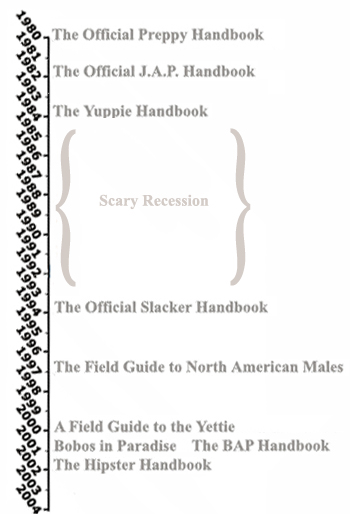
1980 – The Official Preppy Handbook
“Prep Sex: A Contradiction in Terms”
1982 – The Official J.A.P. Handbook
(that stands for Jewish American Princess, by the way)
“At the very core of the female Born JAP aesthetic are two guiding principles: 1) I am terrific; 2) Daddy will pay.”
1984 – The Yuppie Handbook
“Thou shalt have no other gods before thyself.”
1994 – The Official Slacker Handbook
“Part old-fashioned bohemianism and part fin de siècle exhaustion, placed against the backdrop of a crappy recession and intolerable suburban irony.”
1997 – The Field Guide to North American Males
“Wanna come over and watch The Simpsons?”
2000 – A Field Guide to the Yettie
Yettie = Young Entrepreneurial Technocrat
2001 – Bobos in Paradise
Bobo = BOurgeois BOhemian.
2001 – The BAP Handbook
(BAP = Black American Princess)
“Any name beginning with ‘La’ or ‘Sh’ and ending in -ima, -ika, -isha, and -ita is never considered by BAParents.”
2002 – The Hipster Handbook
This old vocabulary? I’ve had it since I was twelve.
and while you and i wonder what’s up with the delay on the Official G Handbook, the Official Cholo Handbook, and the Official ABC handbook, we can at least entertain ourselves with the hipster olympics in the meantime: