
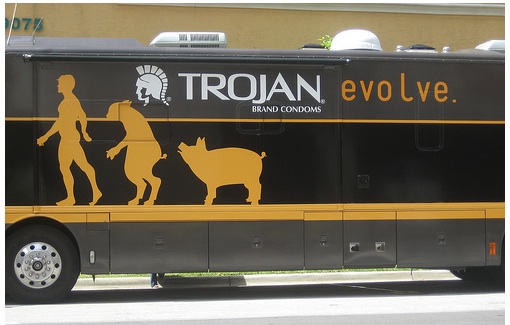
how not to use condoms

I know the Trojan “Evolve” Campaign has been going on for a while now, but just recently something occurred to me that I hadn’t quite realized about it before.

The campaign started out last June, with the premiere of a commercial featuring women being hit on by a bar full of anthropomorphized pigs. It’s only when one of the pigs finally shuffles off to the men’s room, and purchases a condom, that he is transformed into a hot guy, and returns to the girl he was chatting up to find that she’s now suddenly totally interested in him.

In addition to the ad, whose message at the end reads: “Evolve. Use a condom every time,” the campaign also includes a website, evolveoneevolveall.com, driven by celebrity and user-generated videos dealing with the subject of sexual health, the Trojan Evolve National Tour, a mobile, experiential campaign “Raising awareness and stimulating dialogue about America’s sexual health in towns and campuses across the country,” radio ads that deal with STDs as Christmas gifts (“How about Herpes? It’s the gift that keeps on giving.” / “Would you like Chlamydia wrapped?” / “No, I’ll give it to her unwrapped.”) and more. All of this, hinging on the word “Evolve.”

“Evolve is a wake-up call to change attitudes about using condoms and, on a larger scale, the way we think and talk about sexual health in this country,” said Jim Daniels, Trojan’s VP of marketing. As Andrew Adam Newman pointed out in the New York Times piece, “Pigs With Cellphones, but No Condoms,” the campaign is an evolution for Trojan itself:

While Mr. Daniels does not disparage the company’s double-entendre-heavy “Trojan Man” campaign from the 1990s or similar Trojan Tales Web site today, the tone of the company’s promotions is moving away from “Beavis and Butthead” and toward “Sex and the City.”

“The ‘Evolve’ ad does a nice job of being humorous, but it’s also a serious call to action,” Mr. Daniels said. “The pigs are a symbol of irresponsible sexual behavior, and are juxtaposed with the condom as a responsible symbol of respect for oneself and one’s partner.”

Newman suggest that “The perennial challenge for Trojan and its competitors is the perception that [condoms] are unpleasant to use.” But I think, for a company that, according to A. C. Nielsen Research, has 75 percent of the condom market (Durex is second with 15 percent, LifeStyles third with 9 percent), Trojan oughtta have really known better than that.

“Over the last few years conservative groups in President Bush’s support base have declared war on condoms,” wrote Nicholas D. Kristof, in an opinion piece, also in the New York Times:

I first noticed this campaign last year, when I began to get e-mails from evangelical Christians insisting that condoms have pores about 10 microns in diameter, while the AIDS virus measures only about 0.1 micron. This is junk science (electron microscopes haven’t found these pores), but the disinformation campaign turns out to be a far-reaching effort to discredit condoms, squelch any mention of them in schools and discourage their use abroad.

Then there are the radio spots in Texas: ”Condoms will not protect people from many sexually transmitted diseases.”

A report by Human Rights Watch quotes a Texas school official as saying: ”We don’t discuss condom use, except to say that condoms don’t work.”

Last month at an international conference in Bangkok, U.S. officials demanded the deletion of a recommendation for ”consistent condom use” to fight AIDS and sexual diseases. So what does this administration stand for? Inconsistent condom use?

Kristof was posing this question back in 2003, while he could still add, “So far President Bush has not fully signed on to the campaign against condoms, but there are alarming signs that he is clambering on board.”

In the now almost six years since, the very subject of contraception has become as politicized as abortion, and the emphasis on condoms’ ineffectiveness has become a standard component of Abstinence-Only sex education. (You knew about that, right?) It’s even begun to affect mass media. In a written response to Trojan about why they would not air the pigs-with-cell-phones ad, Fox (which had aired prior Trojan ads) said “Contraceptive advertising must stress health-related uses rather than the prevention of pregnancy.” CBS refused to air it, too, and didn’t even offer further comment. Meanwhile, as paid advertising for condoms is being turned away, in the past few months I’ve seen at least two TV shows where characters made a point of mentioning that condoms don’t work: Fringe, and The Practice–a show about DOCTORS for cryin’ out loud! (Clearly, “First do no harm” must not apply to the practice of TV medicine.)

As a teenager of the 90’s, I’ve never known a world where AIDS didn’t exist, and where condoms were anything but an unequivocal necessity for “safe sex” (also a 90’s-ism that seems to no longer be in use, replaced instead by the millennial “sexual health crisis”). Sure, no one was going around preaching that condoms are 100% fail-proof, but in the decade when Magic Johnson and Greg Louganis both came out as HIV-positive, I can’t imagine any TV program deliberately broadcasting (or being allowed to get away with it), the kind of message that says, “Condoms don’t work. So why bother using them at all?”

As of 2006 the birth rate among 15 to 19 year-olds in the United States has risen for the first time since 1991 (that was the year of Johnson’s announcement). While teenage sex rates have risen since 2001, condom use has dropped since 2003. In other words, more teenagers are having more sex, and using less and less condoms in the process. But then, Jamie Lynn Spears or Bristol Palin could have told you that.

And so it is we find ourselves in a situation where Church & Dwight—the consumer products company that owns Trojan—is taking on what should have been the responsibility of the Department of Health and Human Services. Teenage or not, the U.S. apparently has the highest rates of unintended pregnancy (three million per year) and sexually transmitted infections (19 million per year) of any Western nation. (What the fuck?!)

“Right now in the U.S. only one in four sex acts involves using a condom,” Says Daniels. “Our goal is to dramatically increase use.” Then what in God’s name convinced the Kaplan Thaler Group, the New York advertising agency that created the “Evolve” campaign, that aligning condoms with evolution was the way to go about achieving this?

Cuz here’s the thing: The majority of Americans do not believe in evolution!

http://graphics8.nytimes.com/images/2007/06/18/business/media/18adcol.600.jpg

(CRAP!)

In fact, according to 2006 research in Science Magazine, out of 33 European countries where peolpe were asked to respond “true”, “false”, or “whuuuu?” to the statement: “Human beings, as we know them, developed from earlier species of animals,” the only country that scored lower on belief in evolution than the US is Turkey (Also what the fuck?!)

Disturbing as this unfortunate reality may be, this is the contemporary American Landscape, and pushing Trojan as “Helping America evolve, one condom at a time,” in the face of it, seems ludicrous.

Hell, why not just call the campaign “Darwin’s theory of contraception,” while you’re at it?

The biggest threat to condoms is not the perception that they don’t feel good. It’s not even condom fatigue. The biggest threat to condoms is the Christian Right’s propaganda that they don’t work, and the government’s, and much of media’s, wholehearted complicity. And it’s the same people who are waging a war on contraception that don’t like Evolution either. I don’t know about the ultimate impact that the Evolve campaign is effecting (or not), but in my view, if, as Daniels says, Trojan’s focus is on growing the market beyond the–pardon the irony here–already converted, and getting more people to use condoms, I think a completely different slogan/campaign theme would be the way to go.




Subscribe for more like this.


what ad agencies can learn from indie brands

In Buying In: The Secret Dialogue Between Who We Are and What We Buy, Rob Walker talks about “underground brands”–lifestyle symbols created by independent entrepreneurs. In fact, I actually think it’s easier to think of underground brands as “independent brands,” (cuz what does “underground” really mean, anyway?) much like independent music:

In popular music, independent music, often abbreviated as indie, is a term used to describe independence from major commercial record labels and an autonomous, do-it-yourself approach to recording and publishing.

Similarly then, indie brands are independent from major publicly-traded companies, and reflective of a do-it-yourself approach to lifestyle symbol creation. Both indie and major brands appeal to consumers for the same reasons–as expressions of identity, and community belonging–but the indie side functions very differently. Indie brands can often take risks that the major ones wouldn’t know how to were they even interested, they are able to maneuver more deftly in a rapidly changing consumer landscape, take advantage of new opportunities more swiftly, and now more than ever before, they are blazing the trails and creating the models that many major brands are starting to emulate.

As someone who’s been intimately involved in the development of several independent brands I thought I would share some suggestions both from my own experience, as well as from insights synthesized with various examples from Buying In, of what ad agencies (and major brands) can learn from the indies about staying competitive in contemporary culture.

1. INTEGRATE DEPARTMENTS
Agencies talk of integration like it’s the latest buzzword since “viral,” (which, incidentally, before it was a buzzword, was also first tested by independent brands) but most are still set up to approach marketing in a compartmentalized, paint-by-numbers way that doesn’t fit with how any of us in the digital era actually interact with media and messaging. In a time when we update our facebook status while watching TV online, and google something we’ve just seen on a billboard we drove past, all media overlaps. As natives of this environment, indie brand creators don’t think “Print” vs. “New Media” or “Creative” vs. “Media Buying.” Of course, a variety of skill sets is necessary, but when a “media channel” can now basically exist anywhere that people are playing attention, it’s counterproductive to continue enforcing separation between all the various departments of messaging development and dissemination. Without the imposition of this bureaucratically segregated setup, indie brands approach marketing as an inherently integrated process, dealing with the way the different channels at their disposal feed into one another as part of an interconnected system.

2. HIRE DIFFERENTLY
None of the indie brand creators I’ve ever worked with majored in marketing–and that goes for me, too. Marketing majors end up at ad agencies, indie brand creators, on the other hand, end up creating culture. Music, fashion, publications, events, blogs, graffiti, whatever. If it’s a genre of DIY expression, that’s where indie brand creators can be found, and it’s where strategies that take on new marketing options are going to be developed. I’ll admit, I did take one Marketing 101 class, though, and it’s probably because marketing is taught as a segregated process that its students are primed to continue thinking within the same kind of box once they graduate. Indie brand creators think outside the marketing box because 1. They were never taught there was a box to begin with, and 2. They couldn’t afford to try out the box anyway, so developing “alternatives” is their default. This is who you want to be hiring to help develop progressive marketing strategies.

3. INVEST IN CULTURE NOT MEDIA
In a consumer landscape niched up into various lifestyles, “mass marketing” is becoming increasingly irrelevant. Indie brands have never had the luxury of a mass marketing budget, so they’ve instead focused on building and sustaining meaningful relationships with the communities that nurture them. In Buying In, Walker talks about Pabst Blue Ribbon’s strategy after discovering that their brand, whose history was essentially as a staid Midwestern working class beer, was experiencing an unexpected popularity surge among the pierced, tattooed, bike messenger alterna kids in Portland Oregon. Clearly this was not a demographic that PBR had sought deliberately (the brand just happened to become quite eagerly adopted by a young culture in need of a cheap beer), but once they noticed what was going on instead of buying up a ton of media targeting this demo, PBR began sponsoring community events such as “bike polo” matches. In fact, a particularly ardent PBR fan that Walker talks to specifically noted he appreciates that he’s never seen a PBR ad of any sort. It shows that “they’re not insulting you,” he says. If advertising AT a community can be perceived as an insult, supporting it can make a brand an integral part of the community’s culture.

4. A BLANK SLATE IS THE BIG IDEA
Ad folks think it’s their job to create advertising. Indie brand folks think it’s their job to make sure their product sells. The disconnect between these two perspectives is perhaps nowhere more blatant than in the ad agency reticence towards “user generated content.” This is not to say that ad agencies shouldn’t create branded content, by any means, but rather to point out, as Walker does, that some of the most potent brands are ones that have allowed people to project their own meanings onto them. His two biggest examples of this are Hello Kitty and the Live Strong bracelet. One benefited from an inscrutable expression, the other from a statement that allowed innumerable personal interpretations. Neither sought to define what specifically it was supposed to mean or stand for, and thereby each allowed people to cast their own relevance onto the brand. Unequivocally cementing a brand into a “big idea” couldn’t accommodate that. Creating a brand that functions as a “platform” for consumers to create their own meaning (whether it’s as literal as UGC or as ephemeral as a personal projection) is now just as crucial as messaging.

5. COMMUNITY FIRST, BRAND SECOND
It is tempting to think that a brand creates a community. In fact, many brands, realizing the power of community as a resource, strive to create their own, and brands such as Apple definitely have a cult-like following. But the reality is that brands do not create communities from scratch, they become symbols of communities. Brands can reflect a community’s values and lifestyle, but I don’t think it’s possible to brand a lifestyle before it actually already exists. Was Apple as hot before the rise of the creative class? (The trend itself, I mean, not just the book about it.) Of course, the Apple technology certainly helped facilitate the expansion of the creative class, but the bottom line is that the societal predisposition that can come to constitute a community has to be there, and a brand does not invent it, it reflects it. Indie brands are spawned out of the very communities that they represent, so it’s not like they need to conduct massive amounts of consumer insight research, and their understanding of this community first, brand second dynamic is deeply intimate. For many major brands, however, the focus shouldn’t be on fabricating their own “community” but on developing a more significant understanding of the needs of the communities that buy and endorse them. (Then, see #3).

6. THINK BEYOND THE QUARTER
The relationship between a culture and a brand, like any kind of relationship, takes time. That it can’t always be statistically documented after three months does not necessarily make the relationship unsuccessful. My favorite example of a brand thinking “beyond the quarter” is Scion integrating it’s cars into Whyville, an online community for tweens. Pretty much the coolest thing you can buy in Whyville is a Scion, and its added bonus is that then you can drive all your other friends around in it in the game. They start at 15,000 “clams” (Whyville dollars), but for 20,000 you can get it all customized. The most fascinating thing about this whole strategy, however, is that the Tween demographic is between 8-12 years old. It’s gonna be a while before they even have a driver’s license at all, let alone be in a position to be buying a car in the real world, but when they are, owning that virtual Scion will no doubt be an experience they draw on when making the purchase decision. This is thinking five, ten, fifteen years beyond the quarter, and it’s how indie brands think. Ok, maybe they don’t necessarily have the forethought to think that far ahead, but they do have the luxury to not have to think of success as based on proving something to shareholders every season. After all, just ask Starbucks about how rampant growth can even undermine success in the long-run.

The trend of more and more kinds of facilities cropping up to support DIY creative endeavors means that more and more kinds of indie brands are getting created. The evolution of marketing that doesn’t look anything like what it has before is only going to continue. Might as well take a cue or two from the side that’s plowing head-first into the changing the landscape.


Subscribe for more like this.


the medium of stories

p1220200.JPG

“We read to know we are not alone.”
– C.S. Lewis

in retrospect, it’s not so surprising that while i was studying film in college i was also producing art and music events as an extra-curricular activity. i joke that producing a movie and producing an event are pretty much exactly the same process, except with events you only get one take. in both cases what you’re producing is a story and an experience, so the transition, post-college, from film to festivals was, in a sense, really just the transition between one medium of story/experience creation to another.

whether written, filmed, experiential, or any other kind, i think stories in general appeal to us for the same reasons, yet we experience and appreciate them in different ways depending on the medium. just because the book might have been better than the movie, doesn’t mean it would make a better movie to film the pages of the book, dig?

which is the kind of analogy i think about as i read the NYTimes’ recent bit on Quarterlife, “Can NBC Do for ‘Quarterlife’ What YouTube Could Not?”:

Scripts by Marshall Herskovitz, the Emmy award-winning writer and producer, have drawn millions of viewers to movie theaters and television sets over the past two decades.

But on the Internet, where his 36-part series “Quarterlife” is unfolding on social networking sites like MySpace, the audience metrics are starkly different.

Some episodes of “Quarterlife,” a drama about a group of good-looking people in their 20s, have yet to attract 100,000 video views, according to combined view counts from MySpace’s video site and YouTube.

The low traffic numbers are significant because the series has been touted as the first television-quality production for the Web, as well as the first to be introduced online as a warm-up for its network debut. NBC will broadcast “Quarterlife” in one-hour increments beginning in February, and the Web-to-broadcast process is being closely watched as a potential business model for television on the Internet.

i wrote about quarterlife a few months back, before any of the episodes had come out. the prospect of what an “online series” could mean in terms of a new format for creating stories was really exciting to me. i even thought it was pretty neat that the show came with an accompanying online social network app aimed at being a resource for those going through their quarterlife crisis. (at least in theory. i’m not a member on quarterlife.com so i don’t really know for sure, but the impression i got is that the site seeks to facilitate collaborations among the nascent members of the creative class, and if that goal is actually being fulfilled then i sincerely applaud the effort.) that there was no indication at the time about the online series simply being a “warm-up” to a network debut is an interesting aspect unto itself, but there are more interesting things i’d like to talk about, in particular:

The Folly of a “Web-To-Broadcast” Model,
and the Tragically Misguided Concept of “Television on the Internet”

according to the NYTimes article, quarterlife’s sponsors, which include toyota, paid well above standard rates to appear with the series on the web. and perhaps the folks involved with quarterlife may want to consider why it is that they might have been willing to do that.

the same day as the NYTimes asked, “Can Web ventures like “Quarterlife” turn a profit? The answer is unclear,” online media daily reported:

CONSUMERS ARE 47% MORE ENGAGED in ads that run with television programs that they view online than those watched on a TV set, according to new research findings. A cross-media study by Simmons, a unit of Experian Research Services, also found that viewers are 25% more engaged in the content of TV shows that they watch online than on a TV.

what are the chances that toyota, what with their experience with integrating the scion brand into whyville’s online tween world, would have some understanding of the benefits of being on a medium with a much more elevated engagement rate?

as a marketer, one of my favorite things about quarterlife is that the brand integration is so seamless it makes the traditional concept of “product placement” look like cave drawings in comparison. two of the characters on quarterlife, aspiring filmmakers–the pragmatic producer and the visionary director, of course–pitch a local toyota dealership to shoot a commercial for the business. of course when they deliver the ad to the client, the owner of the dealership, says he can’t see his cars enough in the ad. how are people supposed to buy his cars if they can’t see them? so the duo then has to recut the ad to make it less high concept and more car-y, they screen the revised version for their friends, after which one of the other characters–the typically self-righteous activist stereotype who’s being positioned to become the lead character’s love interest–gives them shit for selling out and making a commercial in the first place, and bashes the “corporate hegemony” in the second. after which they deliver the revised ad only to be told it’s STILL not car-y enough, and then get scolded by the dealership owner for not being serious about their business–which is supposed to be helping HIS business sell cars. oh he also tells them that they don’t know what they’re talking about when they insist that the ad is supposed to be selling “the experience” of the car, which i thought was a particularly interesting touch. then after that other things happen, but my point is that this whole time that you’re watching several key plot points and delving into various bits of character and theme development–and this stretches out over several episodes–you’re watching toyota in the show.

it may not be subtle, but then neither was carrie bradshaw’s love for manolo blahniks. that’s the thing about authentic character development now, you and i express ourselves through the brands we buy, so why should it be different for the characters on our favorite shows? in fact, can we even identify with a completely brandless persona in a character-driven series enough to keep watching week after week?

well, to be honest, i don’t know. i haven’t really watched TV since i started college, (except for netflixing the whole run of sex and the city, and going on a 24 bender last year, and 2005 when i lived with some roommates who had a TV set, and i got all into the sopranos) but, i HAVE watched all 14 episodes of quarterlife out as of now. and if i was watching this on TV (well, if i owned a TV and was watching this on it) i think i would love it. i’d be telling my friends to watch it too, it would be significant that a television network had had the vision (or nerve) to create a show about our generation–a generation which is watching less and less TV though, and hence less and less incentive to make content for it, but regardless–if this was on TV, it’d be great!

except it’s not on TV, is it? while we allow a certain suspension of disbelief for the contrived nature of scripted programming on TV we have a dramatically different relationship with online content. we may not expect it to be TRUE, but we don’t expect it to feel artificial either. here TV’s forced quality feels almost…invasive, like getting a friend request from your mom or dad on facebook (or if you prefer: walking into your room to discover your mom or dad already in it). like, TV! what are you DOING in here?

the whole time i was watching those 14 episodes i felt like i was waiting for something to happen. some subtle yet hugely important aspect in the very nature of the show to change. i mean, great, it’s “television-quality” production for the web, but who exactly was lamenting its lack here in the first place? i’ve seen ipod billboards that felt more real and compelling than quarterlife. (and that’s coming from someone who really wanted to like the show!)

to be fair, i think the internet community too is just barely scratching the surface of the possibilities for online video content, but writing a TV script for the web is about as powerful a use of these possibilities as writing a TV script for a feature film, and given the results of that Simmons report, a “web-to-broadcast” strategy seems rather pointless considering that consumers are practically 50% more engaged with content the medium you’re starting out on. we’re by no means all looking for the same kind of content on the web, but we are not looking for the same old same old, either. i can’t wait for something to really take advantage of all the medium’s potential and uncover whole new ways of creating stories.

what do i think looks like it could be one such possibility?


Subscribe for more like this.