last week i was on the marketing 101 panel at the startupLA conference. it was
actually a lot of fun, and there were some great questions afterwards. here’s some of my favorites, and my answers:
Q. what’s the fastest way for a new company to get exposure?
A. look for existing communities that are comprised of your target demographic and approach them. if there’s already a connected group of folks that you feel will be interested in what you’ve got it’s a lot faster to generate authentic exposure through that network than trying to aggregate a community from scratch. from a completely different perspective, cliff allen of suretomeet.com who was on the panel with me, said the fastest way for a new company to get exposure is spam. so there you go. choose your own adventure.
Q. is social media, like facebook, going to be the future of advertising?
A. its impact on the process is hugely important. i think it’s certainly something that now needs to be factored into any kind of advertising plan. but i also think it’s completely foolish to altogether write off exposure media (which is what advertising has been primarily dependent on up until like yesterday). it’s not a battle between whether engagement or exposure media is better adapted to the natural selection of marketing, it’s about pursuing a symbiotic relationship between the two, and developing integrated strategies that are overall more effective. that’s the future…. or at least it ought to be.
Q. what’s one piece of marketing advice that is most important for a new company?
A. know your audience. really really understand who you’re talking to. or who you should be talking to. the danger in making a message that isn’t relevant or that isn’t approaching your audience on their own terms is not just that we, as consumers, “tune it out,” it’s that unconsciously we translate messages we don’t relate to as being “not for us.” that’s the #1 thing to avoid.
(and my #1 favorite…) Q. if you had $10,000 to spend on advertising and you couldn’t use any of it on the internet, what would you do?
A. throw an event. and if you’re targeting people over 50, buy some print.
first, you need to watch the trailer for sony pictures’ across the universe: here. if you cannot be trusted to come back here afterwards, however, you can just watch the shittier-quality youtube version:
ok then. now that you have been adequately briefed, we can begin.
i first saw the trailer for across the universe on quicktime.com in march and was not only blown away by how stunningly imaginative the visuals looked, but actually–i swear!–brought to tears by the drama of 60’s-era youth struggle depicted in just 2.5 minutes of preview footage! needless to say, i saw the movie opening weekend, six months later, and left the theater feeling beyond satisfied. the movie was so visually innovative and different it was like i’d just witnessed julie taymor–the director-slash-visionary best known for broadway’s “the lion king”– reinvent the very concept of movie a little bit.
i then proceeded to tell all my friends they should check it out, and even posted the preview on facebook. i was somewhat startled to discover the incongruent presence on the movie’s otherwise fairly unimaginative site of a special link that allows for easy one-stop posting of the preview directly to facebook. either this was incredibly nuanced forethought, or obviously tacked-on afterthought, i figured.
last friday, the LATimes weighed in on that debate, asking: Is this the next cult sensation? as you may have noticed, across the universe is a musical about teenagers. and while the plot-line is punctuated by beatles’ tunes, the fact that this coming-of-age movie didn’t find an audience with middle-aged boomers, who were part of the original “beatlemania,” apparently came as a marketing newsfalsh:
To judge by “Universe’s” trailer, which began screening in front of “Spider-Man 3” in May, it wasn’t immediately clear which genre “Universe” belongs to. Is it a coming-of-age story? A rock opera á la “Moulin Rouge”? A surrealistic period piece? (Answer: all the above.) Worse for marketers at Sony, the film’s distributor, contractual obligations bound them from hitting home with “Universe’s” primary selling point.
“Yoko Ono, Paul [McCartney], Ringo [Starr] and [George’s widow] Olivia Harrison were all supportive of the film, but I couldn’t use the Beatles name in any advertising,” Taymor recalled. “That didn’t make things easy. And you can’t advertise that you have Bono, Eddie Izzard and Joe Cocker in cameo roles. We didn’t have a real big push from Sony; they were stumped by it. So nobody was really sure who the film’s audience was.”
i’m ten years older than the median teen-movie demo–but on the tail end of recovery from the quarterlife crisis the concept of trying to figure out life in a conflicted, confusing, “changing world” still feels totally relevant–and that’s, i think, the cutoff point for the audience to be marketing coming-of-age tales to.
After an uninspiring opening last month… help arrived in the form of an audience whose parents were their age when the first wave of Beatlemania hit. After three weeks in theaters, the PG-13 movie finally penetrated the top 10 by connecting with a zealous core constituency: teenage girls.
….According to Paul Dergarabedian, president of the box-office tracking firm Media by Numbers, audiences are now finding their way to “Universe” thanks to Sony’s textbook execution of what is known in the industry as a “platform release.”
“Expectations were unknown. But Sony has handled it perfectly. They got big initial interest in limited release, then they’ve been capitalizing on that every week.”
“They’re taking their time. On a movie like this, that’s what you have to do.”
so… like, besides the fact that the movie’s supercute cast is totally perfect bedroom-wall poster material, and that this “60’s story” is retold with acutely contemporary (and boomer-anachronistic) sensibilities…. did, um, no one at sony bother to check if maybe teenagers might not actually totally dig the beatles, at some point before they released the movie?
three and a half years ago (maybe somewhere around the time taymor got this funny idea for a musical) USA today reported:
Beatles historian Martin Lewis began spotting a young wave of Fab Four fanaticism as emcee of Beatlefan conventions the past 14 years. Boomers constituted half of the audience in 1990. Now 75% of attendees are under 30, and many barely in their teens.
As marketing consultant for The Beatles Anthology, he met with label execs plotting campaigns targeting fans 45 and up. “I’ve got news for you,” Lewis told them. “I’m the oldest guy at Beatlefan conventions.”
Sure enough, a marketing survey showed that the under-30 constituency scooped up 40% of the first Anthology run. “I’ve interviewed those kids,” Lewis says. “I’ve said, ‘Surely you’d rather listen to Justin Timberlake. Why are you here? Were you forced by your parents?’ But they chose to be there.”
the relative “drought” in contemporary rock (“Kids don’t come in and say, ‘I want to play like John Mayer,'” says a manhattan producer and guitar teacher quoted in a feb. 2006 article in rolling stone called “teens save classic rock“), multiplied by the internet’s universal ease of access to music of all decades, means you better do your homework about whom to target with your alleged “primary selling point,” yo. (even hiphop’s got love for the fab four as evidenced by wu-tang’s becoming the very first group EVER to legally sample the Beatles (!!?!)–sooooo… THAT happened.)
…anyway:
While Dergarabedian heaps praise on the marketing plan, Taymor feels the movie has benefited from a kind of benign studio neglect. “In a funny way, young people found the movie because it wasn’t marketed huge,” she said. “Young people don’t want to be dictated to about what’s the new cool thing.”
…. “We gave people the sense that they’d discovered it for themselves,” said Valerie Van Galder [the division’s president of domestic marketing].
i am sure that beyond classic rock’s sheer novelty or vintage cred, for the current crop of teenagers, its appeal likewise stems from the satisfaction in the personal discovery. this is a sense that is simply not possible to generate through mainstream teen-targeted music options. (wait… did classic rock just turn into alternative rock? wow. bizarre.)
i’ve written before about how valuable sustaining a sense of mystery can be for a brand, and it applies to the process of its initial discovery as well. whether sony was just hedging their marketing dollars on this weirdo bet of a movie, or whether they actually had the temperamental teen psyche aaaaall figured out reverse-psychology stylie when they eschewed spending money on any TV commercials, billboards, or PR, i think there’s something to be learned from across the universe’s model–accidental or not–that can be applied to a more deliberate kind of “discovery strategy”:
start with something unique. you can’t really capitalize on a “discovery strategy” if the product won’t actually FEEL new or unexpected. (of course, a “discovery strategy” isn’t really the kind of thing that well-established fare needs to pursue in the first place, so it’s the unproven stuff to which this sort of option is most applicable anyway.)
understand who the appropriate audience is and the communication / media channels they use that are particular to them. even if what you’re marketing is not a pop property but its message is disseminated through one-size-fits-all media, it invalidates the personal intimacy of discovery. a caveat in this case is using mass media to broadcast a message that will only really be meaningful to a particular community, but why do that when instead you can…
provide the tools for people to be able to easily distribute the message themselves. a handy little “post to facebook” button helps, but so would have the option to get the embed code for the preview so that people could post the video to myspace and their blogs and wherever else that wasn’t just facebook. (nuanced forethought, or obviously tacked-on afterthought, right?)
and in case you’re wondering, this is NOT a “viral campaign.” the difference is between a ploy to abuse some unfortunate loophole inherent in ADD for an attention-spike, and a strategy to enable the creation of a meaningful, personally-compelling discovery that leads to a lasting (consumer) relationship.
from the LATimes:
Nicole Sacharow, 15, from Culver City, for one, ranks “Universe” among her “favorite movies ever.” She’s seen it twice and would already have notched up several more viewings were it not for scheduling conflicts with her friends.
“You go up to a group of people and say, ‘Who wants to see “Across the Universe” this weekend?’ ” Sacharow explained. “The songs are addicting. Everyone who goes to see it has the soundtrack. I listen to it every day. I hear people singing the songs around school.”
i’d say the movie has the potential to become this decade’s RENT (the war allegory standing in for the 90’s AIDS nemesis.) with wu-tang paving the way on beatle’s rights clearance, i could easily see a broadway version of across the universe in the future. but where could they find a visionary, multi-Tony award-winning director to–oh!
yesterday a new client pointed me in the direction of reverbnation.com, and while i don’t usually write about websites, this is different–i can’t even help it. launched just under a year ago, “ReverbNation.com is a Music 2.0 company that is responding to the changing music business paradigm.” except, when they say it, this isn’t just nonsense hippie talk. they mean it:
We believe:
• Nothing is more important to Artists than the relationship with their Fans….We call the total value of these relationships an artist’s Band Equity™, and it is our mission to help artists maximize this.
• Active Fans are the best promoters of music on the web. Fan attention has become fragmented across the web in a way that mass marketing no longer makes financial sense (see the demise of radio, music TV). Today is the age of social networks. Artists cannot be everywhere they need to be at once, so they need to focus on activating their most rabid fans to promote them in every corner of the web.
• A Music Community is more valuable if includes all of the members of the community. We believe that fans, labels, venues, and other folks all deserve a voice in the community if it is going to be representative of the entire music ecosystem. At ReverbNation, we invite all members of the community to take part.
at first glance you notice a slick design, and an interface that makes, as the client said, myspace look like fisher price. but 10 seconds later the extent of the sophistication going on here begins to dawn, and as you continue to discover what reverbnation is actually set up to do, you understand that this is way beyond just another community site, this is an incredibly powerful broadcast tool. one developed with an impressive understanding that the new channel is now a fragmented channel. this, by the way, does not mean it’s a broken channel, but rather it is a new kind of channel. one that broadcasts like a prism rather than a laser beam, and exists, as the reverbnation mission statement points out, “everywhere at once,” rather than being confined to any one particular medium.
if you are a musician, or if you are responsible for developing the strategy for how brands spend their advertising money, you really ought to check what reverbation is doing, as it is a model for how to approach the business of message dissemination in the future–and by that, i mean now:
ReverbNation provides innovative marketing solutions that musicians need to compete, cooperate, and differentiate in an increasingly noisy online environment. Unlike typical “closed” communities, artists use ReverbNation as their home base for approaching marketing and promotion across the Internet as a whole — be it via social networks, blogs, or the artist’s homepage. Tools like TunePaks, FanReach, and Widgets give the artist the power to spread their music and information virtually anywhere. Real-time stats then provide a 360-degree view of how the music is spreading, who is listening, and which fans are actually passing it on to their friends and posting it on their pages.
the most impressive offering for artists through reverbnation, isn’t even the array of features, but the way all the tools are enhanced through a seamless integration into the rest of the social media world. a strategy that can be summed up in one word: widgets.
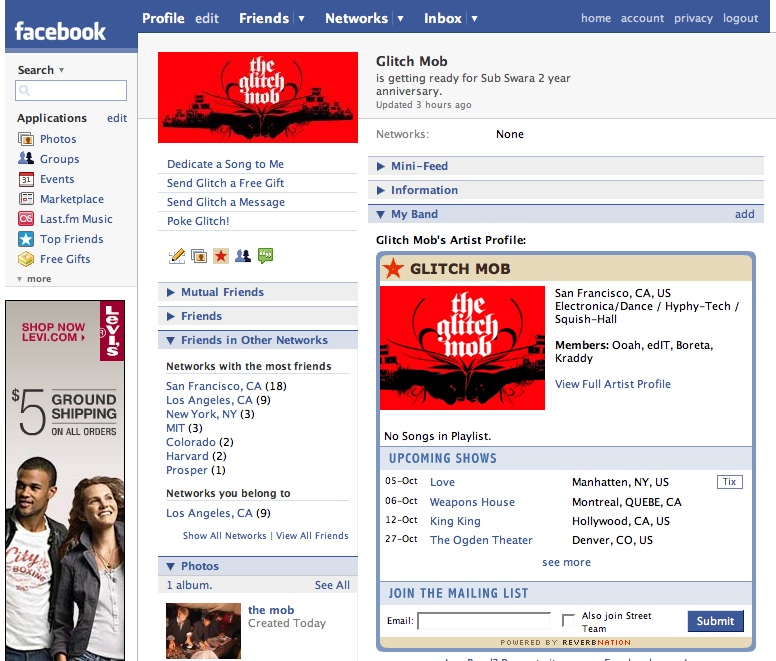
here’s an example of a widget in action on a facebook profile:
in one slick little box you get:
the band’s upcoming show schedule–which is incredibly easy to create since reverbnation also has venue profiles, allowing you to add ten shows in about 2 minutes.
direct links to buy tickets to upcoming shows
an email list signup form– reverbnation’s free FanReach email service allows artists to create targeted messages to fans based on age, gender, and location which is more sophisticated than the offerings of many email list service providers, and their service also lets you include music and a show schedule automatically in every email.
the widget even has a freakin “Also join Street Team” option for people signing up!
to get all these features before you would have had to go running around to a bunch of different service providers, and then work to continually integrate all the features individually into every online location where your band had a presence–and that’s all resting on the assumption that all those features were compatible with each other, and most importantly, that a bunch of musicians had the necessary marketing acumen to even understand all the features they needed in the first place.
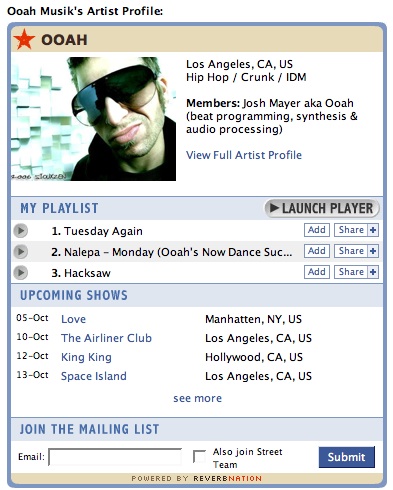
of course, it doesn’t stop there, this widget slices and dices and plays music too. here’s another example from one of the glitch mob’s member’s profile:
it doesn’t just let you embed a playlist, it lets you create portable online music player! this means that folks don’t HAVE to stay on your profile page to listen to your music. they can be doing anything else on the internet and still listening to your serenade.
the fragmented channel, remember? it’s everywhere all at once.
there are sooo many more features that reverbnation offers that to even get a grasp on all of them would take me the rest of the day, and then i’d have to spend more time tomorrow writing about them, but i should think you get the idea at this point.
i can imagine part of the hindrance in reverbnation’s adoption is the sheer complexity, and wide array of their offerings. it’s been confused for a myspace competitor, but in reality that is a complete misconstruction of what it looks like reverbnation is setting out to do. during the many company-wide conference calls that took place in the process of House of Blues’ acquisition by LiveNation, michael rapino, livenation’s CEO, continually stressed the importance of the consumer relationship to the future of the concert promotion industry–about which, as the largest concert promoter in the world, livenation has a right to claim to know a thing or two. (if “reverbnation” picked its name in complete ignorance of “livenation” i would be tremendously surprised).
the big difference, of course is that livenation owns the venues. but in reverbnation’s case, they are setting up to own a channel. one that is deftly suited to broadcast to a fragmented audience. and if you were paying attention then you’ve also realized that it is a model for the future of message-distribution itself, also known as advertising. connecting the needs of artist, fan, and venue into a symbiotic “ecosystem” is the same as connecting the consumer, the brand, and the “venue” for a brand experience into one constant feedback loop.
in her essay “Viewing American class divisions through Facebook and MySpace” a few months ago, danah boyd offered her observations on the dichotomy she was seeing emerge in user-demographic trends on myspace/facebook. a dichotomy that involves such ethnographic aspects as lifestyle, heritage, even aesthetics, for instance.
MySpace became popular through the bands and fans dynamic before the predator panic kicked in. Its popularity on the coasts and in the cities predated Facebook’s launch in high schools.
MySpace is still home for Latino/Hispanic teens, immigrant teens, “burnouts,” “alternative kids,” “art fags,” punks, emos, goths, gangstas, queer kids, and other kids who didn’t play into the dominant high school popularity paradigm. These are kids whose parents didn’t go to college, who are expected to get a job when they finish high school. These are the teens who plan to go into the military immediately after schools. Teens who are really into music or in a band are also on MySpace. MySpace has most of the kids who are socially ostracized at school because they are geeks, freaks, or queers.
The goodie two shoes, jocks, athletes, or other “good” kids are now going to Facebook. These kids tend to come from families who emphasize education and going to college. They are part of what we’d call hegemonic society. They are primarily white, but not exclusively. They are in honors classes, looking forward to the prom, and live in a world dictated by after school activities.
Many hegemonic teens are still using MySpace because of their connections to participants who joined in the early days, yet they too are switching and tend to maintain accounts on both. For the hegemonic teens in the midwest, there wasn’t a MySpace to switch from so the “switch” is happening much faster. None of the teens are really switching from Facebook to MySpace, although there are some hegemonic teens who choose to check out MySpace to see what happens there even though their friends are mostly on Facebook.
Most teens who exclusively use Facebook are familiar with and have an opinion about MySpace. These teens are very aware of MySpace and they often have a negative opinion about it. They see it as gaudy, immature, and “so middle school.” They prefer the “clean” look of Facebook, noting that it is more mature and that MySpace is “so lame.”
today it occurred to me that this pattern sure seems to mimic the whole urban flight phenomenon that happened in the US after ww2, when the newly invented “suburb” was touted as the sophisticated refuge from the overcrowded, unsanitary, dangerous unwashed masses of the city. interestingly, this phenomenon also happens to be known as “white flight.”
from wikipedia:
White flight is a term for the demographic trend where working- and middle-class white people move away from increasingly racial-minority inner-city neighborhoods to white suburbs and exurbs. The phenomenon was first named in the United States, but has occurred in other countries as well.
without time to go into a whole history of urban anthropology (urban decay, levittown, etc.), it still makes for interesting food for thought.
extending the analogy, it makes you wonder what the online social network version of gentrification might someday look like.
one of my favorite movie moments of the past decade has got to be that moment in x-men 2 when iceman and the rest of the teen mutants are hiding out at iceman’s house and his mom asks, him “have you ever tried….not…being a mutant?” like it would just solve everything.
i went to see the movie with a whole posse of my best friends, and was sitting next to one who happened to be gay, and he burst out laughing. i mean the whole theater was laughing, but it was even more pointed coming from sean. the question was the kind of thing that no doubt many a gay kid has had to endure from their parents, “well, have you ever tried… not… being gay?”
i think in general we like to assume that there are lifestyle choices we make, like listening to rockabilly, driving a harley, polyamory, veganism, white supremacism. and those we don’t, like what socioeconomic class we’re born into, our skin color, our gender, whether we’re good at math, and who we fall in love with.
technically, now more than ever before the once-immutable attributes of identity are becoming a choice. even those options that we did not pick for ourselves, that are dictated by genetics, hormones, or circumstance, are being challenged by the dissolution of outdated conventions and advancements in modern surgery. in a sense it’s almost like if you happen to have been born a straight female, and are still happy to be one, then it’s almost like it was a choice by the sheer act of compliance, if nothing else, when you take into account the varieties of gender and orientational mashups available these days.
i read dana boyd’s essay yesterday on “Viewing American class divisions through Facebook and MySpace” about the lifestyle segregations that seem to be emerging from the user adoption pattern of the two sites, and what really struck me was the following:
Most teens who exclusively use Facebook are familiar with and have an opinion about MySpace. These teens are very aware of MySpace and they often have a negative opinion about it. They see it as gaudy, immature, and “so middle school.” They prefer the “clean” look of Facebook, noting that it is more mature and that MySpace is “so lame.” What hegemonic teens call gaudy can also be labeled as “glitzy” or “bling” or “fly” (or what my generation would call “phat”) by subaltern teens. Terms like “bling” come out of hip-hop culture where showy, sparkly, brash visual displays are acceptable and valued. The look and feel of MySpace resonates far better with subaltern communities than it does with the upwardly mobile hegemonic teens. This is even clear in the blogosphere where people talk about how gauche MySpace is while commending Facebook on its aesthetics. I’m sure that a visual analyst would be able to explain how classed aesthetics are, but it is pretty clear to me that aesthetics are more than simply the “eye of the beholder” – they are culturally narrated and replicated. That “clean” or “modern” look of Facebook is akin to West Elm or Pottery Barn or any poshy Scandinavian design house (that I admit I’m drawn to) while the more flashy look of MySpace resembles the Las Vegas imagery that attracts millions every year. I suspect that lifestyles have aesthetic values and that these are being reproduced on MySpace and Facebook.
i’ve heard sooo many people that fit danah’s demographic description complaining about the “sub-par aesthetics” of myspace, but it never even occurred to me (and certainly not to them) that perhaps these reactions to visual composition were not really their own, but rather determined by the aesthetics of their lifestyle/background.
even if it’s possible to justify conscious identity/lifestyle choices as deliberate, how the hell do you justify the UNCONSCIOUS ones that way? and just how many of the choices we think we’re making for ourselves are actually predetermined in this unconscious way?
i’ve found that an easy way to explain how identity marketing functions is through the example of the clothing styles people choose. there’s so many styles of clothing you COULD be rocking, and yet you choose the kind clothing you choose, and not ALL the other styles. so…why is that? because you feel that this particular style expresseses something about who you are to other people.
so clothing is a tool for expressing our identity, essentially but who we want to sleep with is determined by biology? perhaps neither of these is this cut and dry. my bioanthropology professor used to say, “everything is 100% nature. and 100% nurture.”
so what about our choices about whether or not we like hardcore drum ‘n bass or reggaeton or sex and the city or tofu?
is our “taste” 100% our own, and 100% not our own?