For the past two years, Espresso has taken a stab at answering a simple, compelling question: “What The F**k Is Social Media?” The answer has turned into a series of presentations that have been viewed over 750,000 times, translated into about 10 languages (including Russian, so I’ve finally been able to explain to my parents what it is I “do”), and proclaimed “a social media hit for its wit and its very convincing case for the raw power of social media,” by Mashable.
This year, I’m proud to say I helped research and cowrite the third installment in Espresso’s “blockbuster summer franchise.” Check it out!
.
If you’d perfer a non-“parental advisory” rendition, the “radio version” is here.
To the extent that any advertising works, the model in place at websites like Hulu and Fancast, that offer commercial-supported streaming video of TV shows and movies, is pretty damn effective. Unlike the 3-minute average TV commercial break, which most people Tivo past or click away for or simply go to the bathroom during, the 30-second “limited commercial interruption” on your online machine gets you to pay attention. 30 seconds isn’t enough to walk away for, after all. Sure, you can pause to answer nature’s call or email’s or SMS’s or whatever, but the remainder of the ad will play when you unpause. You can, at most, surf over to another browser tab, but nevertheless you’re still listening to the ad’s audio, and on several occasions I’ve gotta admit this was intriguing enough unto itself to get me to tab back. (The lazer-bassy sounding Asics ad with the Asian male model dude running through psychedelic milk formations is coming to mind).
At the same time, because the commercial interruption really IS limited — one ad per break — and often Hulu even offers a choice as to which ad you’d prefer to see and in what sort of format (a long-form ad before the program starts, with no breaks later on is also an option), it doesn’t feel nearly as offensive and imposing as the ads that you DO have time to walk away from on the teevee. The one thing that’s missing is a feature to click to see the ad directly, replay it, and embed or share it. Right now you still have to go over to youtube or elsewhere if you want to find the ad you just saw on Hulu (counter intuitive, no?) and sometimes you can’t even find the ad anywhere (the Timberland Earthkeepers ad where the sole of the shoe keeps morphing into all sorts of things like an eagle and a tire, etc, is coming to mind. I STILL can’t find that shit, and it was hella cool.)
As Hulu’s brand keeps growing — it overtook the big broadcast networks that own shares of it (ABC, NBC and Fox) in web traffic for the first time this past June — less, it turns out, really is more, paricularly when it comes to commercials. Now, how long until Hulu starts producing its own original content, you think? Let’s just hope Netflix (whose Red Envelope Entertainment division, responsible for licensing and distributing films such as Born into Brothels and Sherrybaby expanded to produce its own original content in 2006 only to close down just 2 years later in part to avoid competition with its studio partners) isn’t necessarily a permanent precedent.
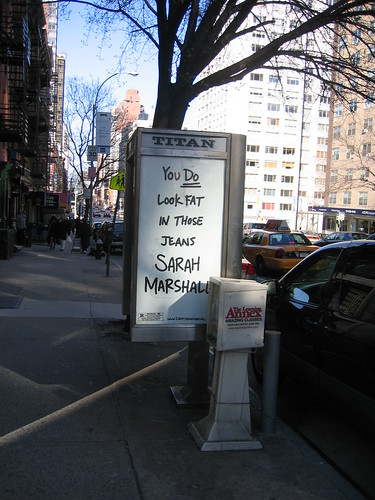
Hope people have been seeing the billboards that I have put up around town. I think its important everyone knows how much Sarah Marshall SUCKS! How she does look fat in those jeans! How my mom never liked her! How over her I am!
So, I used the money that I spent on her engagement ring to buy every available billboard around town. (That’s right Sarah I was going to propose to you. I was just waiting for the right time. I guess that time is never O’clock in the month of Nev-ruary).
Sarah, I really hope you are un-happy for the rest of your life – that you understand how totally over you I am.
That said, you should call me if you want to talk, I can have these things taken down.
While driving home I saw a billboard that read “You Suck Sarah Marshall”. At the bottom of the message I saw the URL www.ihatesarahmarshall.com so when I got home I jumped on my computer and checked out the website. [It’s] a blog that is currently being written by a loved obsessed 26 year old guy who is YouTubing videos about how infatuated he is with his hot TV star girlfriend.
Well, as it turns out this website is the launch of a new marketing campaign for a movie “Forgetting Sarah Marshall“. I have no idea if this movie is any good although it is brought to us by the guys who gave us the 40 Year Old Virgin. On a quick side note I can not recall seeing the R rated warning on the billboard but if I had I would have known right away it was a movie.
The point of this post is to point out the way this movie is being marketed. They are utilizing a combination of vague yet somewhat shocking billboard ads to drive people to a Google Blog thats incorporating YouTube videos as a way to create buzz. It should be interesting to see how it works out.
And answer #3 goes like this:
At OMMA a few weeks ago the theme was “Welcome to the Machine.” All the panels and presentations were framed around the question: How to prepare for the kind of dubious advertising that would be in store in the “Machine”-mediated future? (At least that’s what I think the theme was supposed to mean.)
The model for creating advertising has, in general, been pretty conglomerative. The media department buys the adspace, the creative department puts stuff in the adspace, the “new media” department does….who knows what, and the whole process is as compartmentalized as an assembly line. You know, it’s funny. There’s now hypersonic sound technology, which can be used to literally beam audio ads DIRECTLY at individuals in its path, yet we still insist on referring to the internet as “new media.” And that kind of segregated perspective may be part of the problem.
In strict media buy terms all that’s going on in the IHSM campaign is a grip of outdoor and a domain name, you could even say that ihatesarahmarshall.com is a kind of “microsite” I suppose, or maybe an “adverblog,” but are any of those elements individually responsible for the effectiveness of the campaign? While there’s certainly no shortage of ads out there that make a play on our curiosity, the IHSM billboards are the first that immediately struck me as possesing a deliberate, blatant, “What the hell is that about? Oh, I’ll just check it out on my iPhone,” quality.
There’s now more and more people carrying the internet around in their pocket. What does that mean in terms of how we approach Mobile, Online, Experiential, Outdoor, or Out-of-home media–all together! Then multiply all of that by the coefficient of search.
Cabel Maxfield Sasser recently went to Japan and noticed an interesting trend in advertising there: search boxes have replaced URLs.
Within minutes of riding on the first trains in Japan, I notice a significant change in advertising, from train to television. The trend? No more printed URL’s. The replacement? Search boxes! With recommended search terms!
An ARG–which stands for Alternate Reality Game–is defined as:“An interactive narrative that uses the real world as a platform, often involving multiple media and game elements, to tell a story that may be affected by participants’ ideas or actions.” Which could also serve as both a philosophical definition for marketing in general, and a more advanced version of what the I Hate Sarah Marshall campaign has started to touch on in a very basic, accessible way. The opportunity is now there to create advertising that works not by managing to take our attention hostage for an instant, but because it’s able to move between media the same way that our attention does.
“Integration” may be getting primed to become the next “viral” when it comes to overabused industry buzzwords, but it’s more than just a trendy new widget. The next phase is not about defeating some monolithic “Machine.” It’s about figuring out: How do we create messages that cater to the way technology lets us interact with all different media? Meanwhile, the paint-by-numbers, assembly-line approach is still trying to figure out which department’s responsibility it is to come up with the answer.
in retrospect, it’s not so surprising that while i was studying film in college i was also producing art and music events as an extra-curricular activity. i joke that producing a movie and producing an event are pretty much exactly the same process, except with events you only get one take. in both cases what you’re producing is a story and an experience, so the transition, post-college, from film to festivals was, in a sense, really just the transition between one medium of story/experience creation to another.
whether written, filmed, experiential, or any other kind, i think stories in general appeal to us for the same reasons, yet we experience and appreciate them in different ways depending on the medium. just because the book might have been better than the movie, doesn’t mean it would make a better movie to film the pages of the book, dig?
Scripts by Marshall Herskovitz, the Emmy award-winning writer and producer, have drawn millions of viewers to movie theaters and television sets over the past two decades.
But on the Internet, where his 36-part series “Quarterlife” is unfolding on social networking sites like MySpace, the audience metrics are starkly different.
Some episodes of “Quarterlife,” a drama about a group of good-looking people in their 20s, have yet to attract 100,000 video views, according to combined view counts from MySpace’s video site and YouTube.
The low traffic numbers are significant because the series has been touted as the first television-quality production for the Web, as well as the first to be introduced online as a warm-up for its network debut. NBC will broadcast “Quarterlife” in one-hour increments beginning in February, and the Web-to-broadcast process is being closely watched as a potential business model for television on the Internet.
i wrote about quarterlife a few months back, before any of the episodes had come out. the prospect of what an “online series” could mean in terms of a new format for creating stories was really exciting to me. i even thought it was pretty neat that the show came with an accompanying online social network app aimed at being a resource for those going through their quarterlife crisis. (at least in theory. i’m not a member on quarterlife.com so i don’t really know for sure, but the impression i got is that the site seeks to facilitate collaborations among the nascent members of the creative class, and if that goal is actually being fulfilled then i sincerely applaud the effort.) that there was no indication at the time about the online series simply being a “warm-up” to a network debut is an interesting aspect unto itself, but there are more interesting things i’d like to talk about, in particular:
The Folly of a “Web-To-Broadcast” Model,
and the Tragically Misguided Concept of “Television on the Internet”
according to the NYTimes article, quarterlife’s sponsors, which include toyota, paid well above standard rates to appear with the series on the web. and perhaps the folks involved with quarterlife may want to consider why it is that they might have been willing to do that.
the same day as the NYTimes asked, “Can Web ventures like “Quarterlife” turn a profit? The answer is unclear,” online media daily reported:
CONSUMERS ARE 47% MORE ENGAGED in ads that run with television programs that they view online than those watched on a TV set, according to new research findings. A cross-media study by Simmons, a unit of Experian Research Services, also found that viewers are 25% more engaged in the content of TV shows that they watch online than on a TV.
as a marketer, one of my favorite things about quarterlife is that the brand integration is so seamless it makes the traditional concept of “product placement” look like cave drawings in comparison. two of the characters on quarterlife, aspiring filmmakers–the pragmatic producer and the visionary director, of course–pitch a local toyota dealership to shoot a commercial for the business. of course when they deliver the ad to the client, the owner of the dealership, says he can’t see his cars enough in the ad. how are people supposed to buy his cars if they can’t see them? so the duo then has to recut the ad to make it less high concept and more car-y, they screen the revised version for their friends, after which one of the other characters–the typically self-righteous activist stereotype who’s being positioned to become the lead character’s love interest–gives them shit for selling out and making a commercial in the first place, and bashes the “corporate hegemony” in the second. after which they deliver the revised ad only to be told it’s STILL not car-y enough, and then get scolded by the dealership owner for not being serious about their business–which is supposed to be helping HIS business sell cars. oh he also tells them that they don’t know what they’re talking about when they insist that the ad is supposed to be selling “the experience” of the car, which i thought was a particularly interesting touch. then after that other things happen, but my point is that this whole time that you’re watching several key plot points and delving into various bits of character and theme development–and this stretches out over several episodes–you’re watching toyota in the show.
it may not be subtle, but then neither was carrie bradshaw’s love for manolo blahniks. that’s the thing about authentic character development now, you and i express ourselves through the brands we buy, so why should it be different for the characters on our favorite shows? in fact, can we even identify with a completely brandless persona in a character-driven series enough to keep watching week after week?
well, to be honest, i don’t know. i haven’t really watched TV since i started college, (except for netflixing the whole run of sex and the city, and going on a 24 bender last year, and 2005 when i lived with some roommates who had a TV set, and i got all into the sopranos) but, i HAVE watched all 14 episodes of quarterlife out as of now. and if i was watching this on TV (well, if i owned a TV and was watching this on it) i think i would love it. i’d be telling my friends to watch it too, it would be significant that a television network had had the vision (or nerve) to create a show about our generation–a generation which is watching less and less TV though, and hence less and less incentive to make content for it, but regardless–if this was on TV, it’d be great!
except it’s not on TV, is it? while we allow a certain suspension of disbelief for the contrived nature of scripted programming on TV we have a dramatically different relationship with online content. we may not expect it to be TRUE, but we don’t expect it to feel artificial either. here TV’s forced quality feels almost…invasive, like getting a friend request from your mom or dad on facebook (or if you prefer: walking into your room to discover your mom or dad already in it). like, TV! what are you DOING in here?
the whole time i was watching those 14 episodes i felt like i was waiting for something to happen. some subtle yet hugely important aspect in the very nature of the show to change. i mean, great, it’s “television-quality” production for the web, but who exactly was lamenting its lack here in the first place? i’ve seen ipod billboards that felt more real and compelling than quarterlife. (and that’s coming from someone who really wanted to like the show!)
to be fair, i think the internet community too is just barely scratching the surface of the possibilities for online video content, but writing a TV script for the web is about as powerful a use of these possibilities as writing a TV script for a feature film, and given the results of that Simmons report, a “web-to-broadcast” strategy seems rather pointless considering that consumers are practically 50% more engaged with content the medium you’re starting out on. we’re by no means all looking for the same kind of content on the web, but we are not looking for the same old same old, either. i can’t wait for something to really take advantage of all the medium’s potential and uncover whole new ways of creating stories.
what do i think looks like it could be one such possibility?
just saw a great bit by sarah dopp about the trend of an established company’s new community site campaign that involves an outdoor advertising strategy to drive traffic–case in point: reebok’s goruneasy.com that i already wrote about glowingly HERE.
what i find particularly interesting about this approach that’s being adopted not just by reebok, but starbucks as well (letsmeetatstarbucks.com), among what’s sure to be a coming slew of others, are the kind of pre-web 2.0 strategies–and their benefits–that are getting incorporated in this technique.
Billboard-to-web community-oriented marketing is being adapted with high visibility.
By sending people to a campaign-specific website, they can monitor their campaign’s site traffic ROI without any confusion.
we’ve been employing this tactic in concert promotion for ages. the simplest way to determine the effectiveness of any ad is to isolate an offer, for example, letting radio station X promote a particular kind of discount offer that no other outlet is pushing.
it’s incredibly interesting also to consider the significance of using outdoor media to promote a web 2.0 site of a consumer goods brand. this is the multi-platform kind of “meta-strategy” that i think is going to become the standard for a new kind of campaign. one that fuses the best of the old (it don’t get much older than billboards, yo) with the new, and in the processfuses engagement WITH awareness instead of relegating the two to their own separate ghettos.