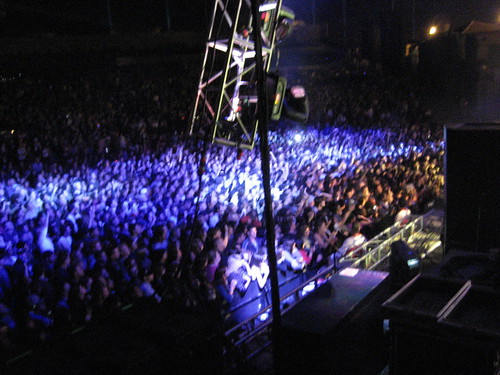
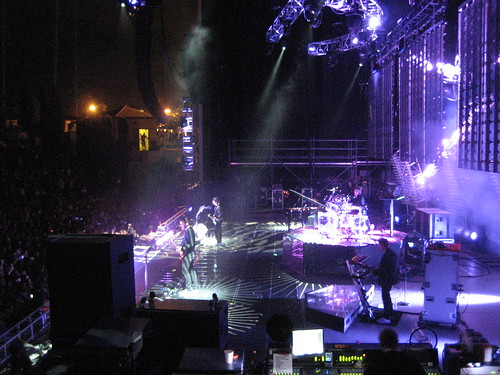
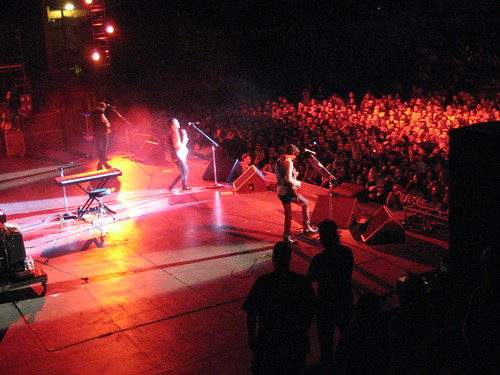
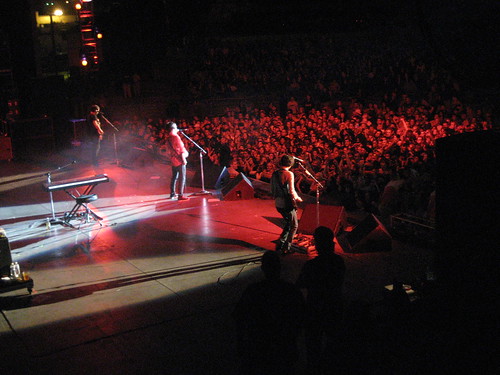
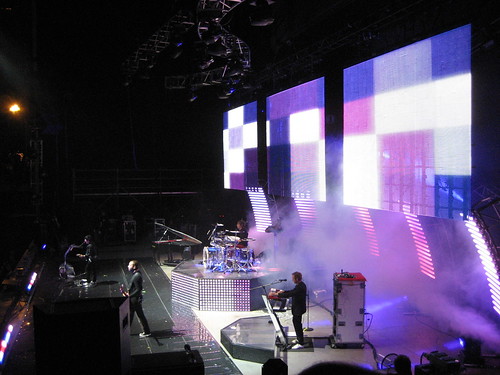
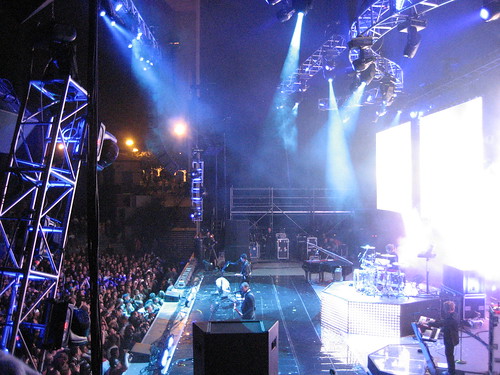
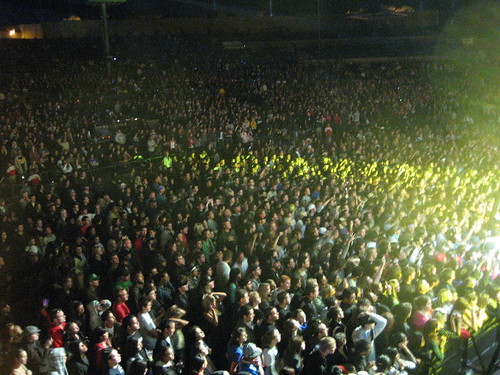
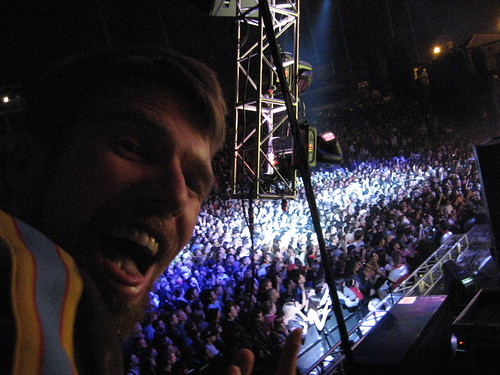
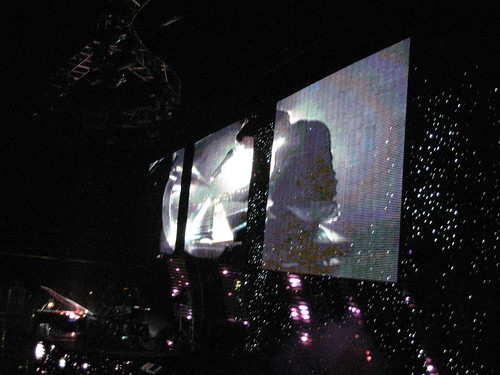
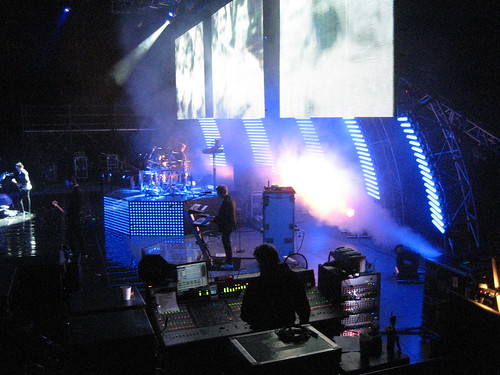
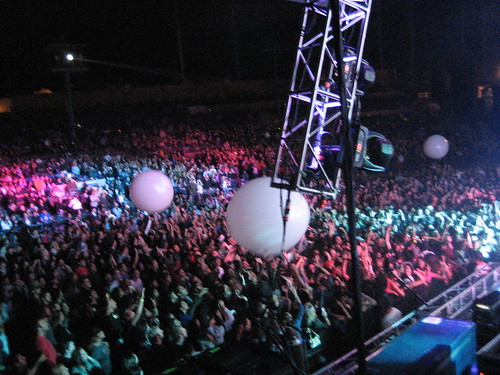
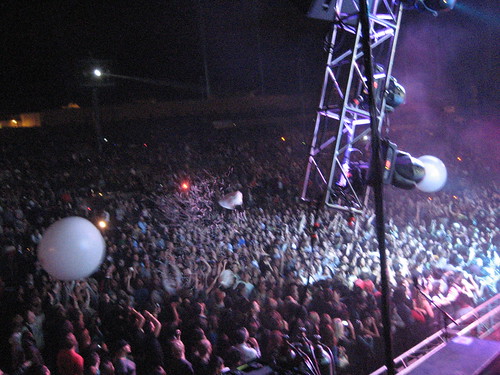
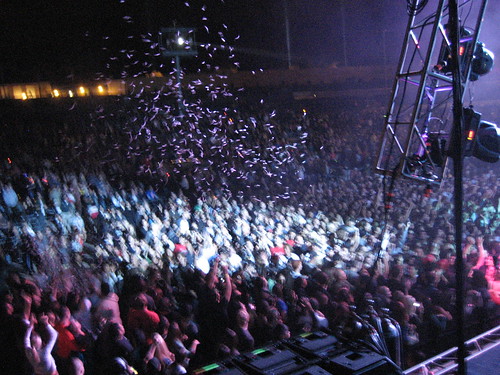
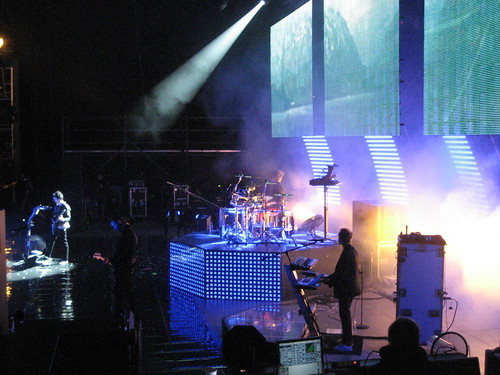
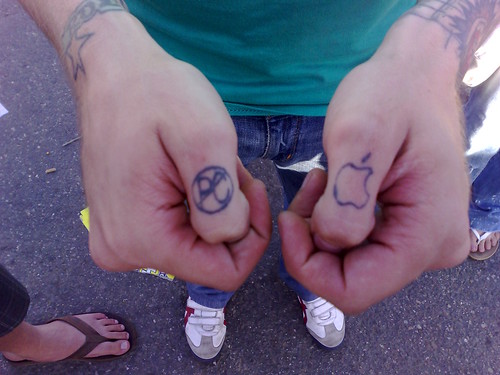
after months of work on street scene 2007, the festival kicked off last night with muse headlining. these photos were taken from what the industry refers to, technically, as the “poser decks.” (i’m 100% serious; should you happen to ever find yourself there, you now know what you will have become). it’s a pretty epic view though, and kind of endemic of a marketer’s perspective in a sense. this is pretty much the view you have to maintain throughout the whole process of marketing a festival, so it’s a pretty fitting vantage point from which to finally see it come to fruition.
among the many highlight moments was getting to see panic! at the disco perform i write sins not tragedies live, which is a song that still manages to elicit excitement every time i hear the track’s opening pizzicato notes since its music video not only features lucent dossier, but it’s also the reason behind how lucent ended up going on tour with panic! in 06–the precursor to their “nothing rhymes with circus” tour.
oh, and i’d like to give a little shoutout othe folks at imeem, for running our battle of the bands contest–which is actually always one of my favorite parts of a music festival promotion strategy. the winning band was monte battalion, but there were so many genuinely talented musicians and bands that participated in the contest, it was actually really hard to chose. imeem should be really proud of the caliber of the creative community they’ve got.
1 2 3
That’s the speed of the seed
A B C
That’s the speed of the need
You can dream a little dream
Or you can live a little dream
I’d rather live it
Cuz dreamers always chase
But never get it
– Aesop Rock: “No Regrets”
there is some kind of undeniable human fascination with child prodigies. is it perhaps because it’s the most exact way we have of cutting out all the middling aspects of “training,” and being able to see skill condensed into its purest form–talent? that freaky supernatural phenomenon that at its most intense is on par with, like, massive natural disasters for the sheer humbling awe and dread it manages to elicit? an unbridled, unsolvable riddle of nature as brute and mysterious as an earthquake, and as morbidly compelling as its aftermath.
…it’s one guess, anyway.
one possible explanation for why we find superhuman precociousness quite so captivating. for reference, go to youtube and just type “connie” in the search field. just see what happens. there’s also a documentary coming out called My Kid Could Paint That about marla, a 4-year old abstract painter genius, and the resultant controversy that such a feat arouses in our adult sensibilities–unable as we are to conceive of the preternatural just as much as of the nature of the universe itself.
so, of course, the first thing i could think to say when i watched this video my friend siouxzen sent me of two little kids scratching records was:
“is this real?”
as it is, undoubtedly, the first thing you’ll wonder once you watch it as well.
the second thing you have to wonder at though, is that these kids, at 8 and 5 years old didn’t just achieve an astonishing level of proficiency over their singing voice, or the wielding of a paintbrush, or even the mastery of a piano. they just showed a pair of turntables what’s up in a way that’d make afrika bambaataa himself blush.
so what’s the difference?
the difference is that the very act of putting two turntables together side by side–originally to mix the end of one track into the beginning of another to create a seamless uninterrupted beat–was a critical component of the very origin of hiphop. hiphop, a genre of music and an subculture aesthetic that eventually went on to become a global cultural movement that has perhaps only ever been superceded in the breadth of its reach by jesus and the internet. hiphop, one of whose four defining elements is DJing.
a five year old just managed to master this element to a degree that most people who ARE old enough to read spend the rest of their lives chasing. and while, of course, these kids are no doubt astonishing anomalies, it does make you wonder about the degree to which the waves of cultural transmissions and innovations are speeding up in general.
in sociobiology there is a theory that the lifespan of the members of a particular species is determined in part by how mature they are at the time they are born. horses, for instance, who pop out ready to gallop more or less, are a lot more mature at birth than human babies, who are completely helpless. horses thus have shorter lifespans in comparison, and so it goes for the rest of animal kingdom. the reason for this is that the longer it takes an organism to mature, the longer it takes it to senesce (to get old, or, put another way: to die).
the piano’s been churning out prodigies since mozart, but 300 years later, how much more rapid is the turnover rate of culture now? how long can a movement be sustained before it’s run its course and been reinvented by the next species of mutant five year olds? in our accelerated global culture, do we end up shortening the lifespans of cultural movements themselves?
“THEORY ENDS HERE”
– sign on the door to the production office at Boston University’s film department
working with so many music festivals i’ve come to see the pattern in their ticket sales to be a kind of concentrated tour through all the major factors involved in driving adoption.
like the type of excursion that shuttles travellers to all the major european cities in the course of 6 days, from the moment a pre-sale begins till the gates close a music festival’s on-sale period exposes a landscape of distinct adopter personas within the kind of condensed time-frame that could double for an academic experiment on diffusion dynamics. while the details vary from one type of music event to another, in general certain things hold true. a huge amount of tickets–often-times the vast majority–are sold late. yet most people attending a major music festival have known about it, and have actually been considering going for some time before finally making their decision. this despite the fact that a ticket at the end of the on-sale period is considerably more expensive than it is at the beginning, since tickets scale in price as lower-priced tiers sell out.
inevitably this raises the question: WHY are the vast majority of folks waiting till the ticket is at its most expensive to commit to making a purchase?
the answer to this is not only about the dynamics of adoption for music festivals, but sheds light on the factors that drive adoption in a much broader sense. a couple of months ago i wrote a post comparing various music festival websites and mentioned that:
essentially there are three things that a festival is selling:
1. the event lineup
2. the event brand
3. the event community
like toilet paper, tissues, and paper towels, they’re all made up of the same stuff, and to a certain degree serve an interchangeable function, but at the end of the day, you do buy each for different reasons.
to broaden the application of what i’m talking about, lets consider that every time i mention “the lineup” what i am essentially referring to is the “product.” features, design elements, utility, whatever. think of “the lineup” as the thing with the actual bar-code on it–unless you too happen to be in the business of selling tickets.
what that ticket is actually SELLING–the cumulative representation of lineup, brand, and community–is differentat different stages throughout the course of an event’s on-sale period. the point at which someone buys a ticket (aka where on the adoption chart they fit in) tends to be a result of the relevance that that particular combination of lineup, brand, and community has for them. these three elements are distinct adoption-drivers whose impact and interplay it is essential to understand in order to develop an effective marketing strategy–whether for a music festival or anything else really.
1. EARLY ADOPTERS BUY ON BRAND
unlike selling tangible goods, where the product and brand are generally simultaneous and thus difficult to separate and examine independently, selling an “experience” makes it much easier. when we initially launched the pre-sale for the Do LaB’s Lightning in a Bottle music festival we did not announce a lineup.
with the “product” an unknown, and the community still solely theoretical (sure, you may know who’s LIKELY to go, but the first week of a pre-sale you’re not likely to know too many people that actually ARE going) the most overt selling point was inevitably the brand.
the do lab had been creating events for seven years at that point, establishing a reputation for consistently spectacular, jaw-dropping creations, and the people who bought tickets that first week before either the lineup or community of LIB was a viable element, bought on the basis of the identification they had with the brand.
that bold stuff is the common denominator that i believe drives early adopters in general. whether you’re nike coming out with a new type of shoe, or lexus with a new model of car, or mac with a new sort of i-something, the people at the very front of the line buy on the basis of the identification they feel with the brand.
the first tier of lowest-priced tickets was sold out before we announced the lineup, having gone to the do’s most ardent early supporters. i imagine to a lot of people reading this (due to the nature of this medium’s demo) the logic in that kind of arrangement is self-evident, however, because i have seen this group be treated with the most extreme disregard, i’m going to go off on a little tangent here.
the folks who would buy a ticket without even knowing who’s playing, in a more traditional marketing model have generally been regarded as the most easily conned. the cheapest date who evidently requires the least amount of wooing. in the do lab world however, and in a world of brands that actually care about their consumers, a world that is being more and more empowered by social media, that kind of take-the-money-and-run mentality is going to fly less and less.
early adopters buy on brand, and yours better be the kind of brand that understands the necessity of rewarding them for this devotion as opposed to taking advantage of them for it, otherwise you’re going to LOSE them.
2. EARLY MAJORITY BUYS ON BRAND + PRODUCT & DRIVES COMMUNITY
the conventional assumption has been that it is the early adopters who steer a product to eventual popularity, but as the prior article on late adopter strategy pointed out, that is not necessarily the case. i’m of the opinion that it is actually the early majority that is responsible for pushing adoption against gravity, up the slope of the s-curve. in the case of LIB, an easy way to define the early majority is everyone who bought a ticket from the point when the lineup was announced, up until two and a half months later when the online sales officially ended the night before doors opened.
in the marketing bible malcolm gladwell splits the burden of causing cultural epidemics to “tip” between three types of culprits: connectors, mavens, and salesmen. gladwell gives an example of one such a maven: a man who after getting taken to a new japanese restaurant by his daughter and liking the food, comes home and sends an email to all his acquaintances who live near the restaurant recommending that they check it out. mavens, i would say, are the folks that comprise the early majority in general, and they make or break “critical mass” for adoption by generating what is technically referred to as, uh…. buzz. if you understand the impact of this, you’ll do everything you can to give them the tools and the content they’re looking for to help them do just that.
3. LATE MAJORITY – BUYS ON COMMUNITY
the late majority of a music festival is likewise easy to identify: it’s all the people who bought tickets at the door. in the case of LIB07 this turned out to be approximately 2/3 of the total purchasers. since this was a weekend-long camping event, it’s not exactly the kind of thing that had a spur-of-the-moment appeal. pretty much all of the late majority had known about this festival for a while. they knew the lineup, they knew the brand, but did not make their purchase until the last minute. why?
they were waiting on the community aspect to build. for the late majority, it is the community–a factor that is nonexistent when the tickets are inexpensive–that makes the higher price of the ticket worth it. when the buzz gets loud enough is when the late majority starts to realize that they don’t want to miss out on getting to share an experience with all their friends. in the same way that brand functions as the major motivator for the early adopters, community fills that role for the late majority.
in the conversation that is going on right now about how to measure the success of social engagement, an interesting factor to throw into the equation is that the “late majority” gets the thing once all their friends have it and won’t shut up about it–and this applies to whether we’re talking about a ticket to a festival, a pair of sneakers, an mp3-player, whatever. the better a brand’s social engagement strategy (and this transcends simply online social engagement, by the way), the easier it is for the early majority to build that buzz. the “effectiveness” of social engagement can thus be seen as directly correlated to the size of a product’s “late majority” purchasers. (tho it sure don’t hurt the other categories none either).
in the end, it comes down to developing a strategy that addresses what is relevant to the different personas on the adoption curve (in the broadest sense: brand, product, and community), and likewise is then able to proactively anticipate and deliver on these elements in ways which will help expand the adoption to the next phase.
improv everywhere is a NY-based outfit dedicated to causing “scenes of chaos and joy in public places.” while similar to “flash mob” style escapades–large numbers of people appearing in a public place and then disappearing suddenly–improv everywhere’s goals for its “missions” extend beyond just organizing fun for the participants, but also focus deliberately outward to all the various bystanders caught along the way:
“We bring excitement to otherwise unexciting locales and give strangers a story they can tell for the rest of their lives. We’re out to prove that a prank doesn’t have to involve humiliation or embarrassment; it can simply be about making someone laugh, smile, or stop to notice the world around them.”
i just watched a video of their latest mission, the MP3 Experiment Four, in which participants all downloaded an MP3 of an “omniscient voice,” all convened in a park in lower manhattan, pressed play at the same time, and were all simultaneously guided through something like a cross between a game of simon says and a scavenger hunt.
what i found most fascinating about the whole process was the relationship that develops between the people “in” the game, and the unsuspecting random strangers who get caught up in it by accident. at one point everyone listening to the mp3 was instructed to point to the tallest building they could see. below is a picture from improveverywhere.com where someone not part of the experiment decided to join in and point as well, presumably without any idea as to why or at way exactly he was pointing, simply playing along with what everyone else around him was suddenly doing. (perhaps he wanted to see what the point of pointing was all about? maybe there would be a prize? or maybe it was just a case of monkey-see-monkey-do?)
during another part of the experiment participants were instructed to see if they could give a stranger a high five as the group walked from one location to another. anyone on an NYC-street knows what a high-five is all about, although it’s definitely not the kind of thing one expects to get from a random passerby. yet when so many people are doing it it becomes apparent that it’s not just some weird isolated incident, but that there is some kind of underlying code going on for this group that you are not aware of.
living in a polyglot, globalized world we’re prepared for the constant encounter with cultures and behaviors unlike our own, to the point that these different cultures around us have become almost like exhibits in a museum. vividly on display to us, but not to be touched by the tourists. in the same way we tend to just tune out the advertising that is not specifically directed at us and our culture. but is there a way for a message to manage to catch the attention and the interest of people outside of the group for whom it was specifically intended? like the way that the results of the instructions in this MP3 experiment swirled strangers up in a kind of cultural dust devil as it passed by. for a moment all the “tuning-out”–especially necessary in a place like new york–couldn’t stop an unexpected bit of strange behavior from compelling you to interact with it.
interesting stuff to consider especially in terms of how it applies to marketing messaging. how are the people on the “outside” interacting with a message targeted to a specific group? and even if they are passing it by without so much as a high-five, what are they hearing in it about the community for whom it is intended (and the brand)?