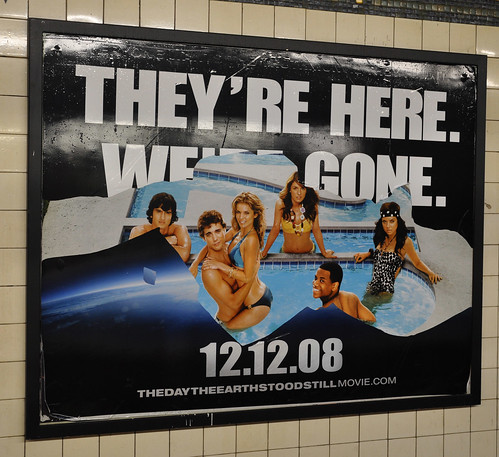
This is tripping me out. I was just going to write a quick post about how terrifically lame I think the outdoor ads for The Day The Earth Stood Still are. It’s basically just a stock-photo image of the Earth’s curvature, against a black outer-space backdrop, with big, block-y, white letters that read: “THEY’RE HERE. WE’RE GONE.”
I keep envisioning some situation where it’s like, they actually had some really kick-ass, slick-style design, and a tag-line that wasn’t written by Tarzan, but it was so high-concept and mind-blowing that it got stuck in endless rounds of focus groups, and approvals and whatnot, and as everyone was scrambling around, the deadline to get the final ad design to wherever it is that billboards and bus-wraps get printed was fast approaching, until it was only, like, minutes away, and finally some executive at 20th Century Fox got some assistant to open up MS-Paint and just slap the thing together, and clicked “Send.”
It’s so unimaginative and uninspired, and so blatant its sheer simplicity actually makes it totally meaningless. 1996 called, it wants its rejected Independence Day poster design back. In fact, so do I Robot, I am Legend, and a bunch of other future/apocalypse Will Smith movies. For that matter, every aliens/robots/zombies/mutants/monsters movie, ever, does too. At a time when our options for global crisis threats could not feel any less extra-terrestrial or non man-made, this just seems so irrelevant. Especially for a movie where the alien looks and talks exactly like Keanu Reeves, and says totally climate-crisis-compliant stuff like, “If the Earth dies, you die. If you die, the Earth survives.”
There! Look! That could have been such a better tag-line. I mean, anything could, really.
This ad is such a boring disaster that no one has even bothered to take a photo of it, or scan it or upload it or anything. It’s actually almost impossible to find any image of its lameness online anywhere.
“There are two kinds of people in the world: those who divide the world into two kinds of people, and those who don’t.” – Robert Benchley
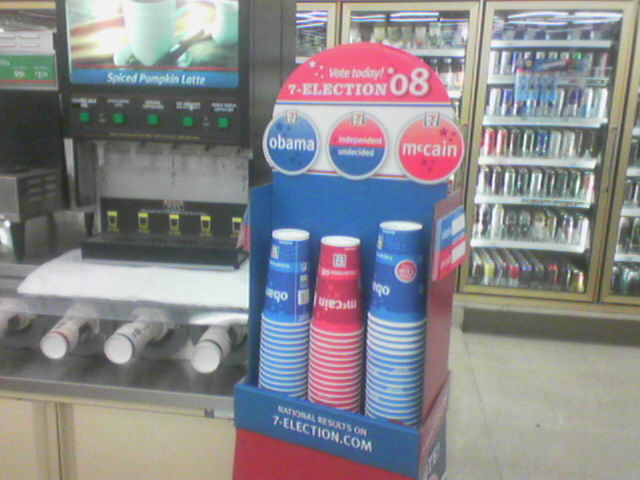
This election process is driving me crazy. I wish we could just pick someone already, and get the fuck on with it. I mean, yes, I do hope a particular someone gets picked, but the longer that keeps not happening, the more disturbing this whole having to root for “my” side, and having to hate the other side, and having to bear witness to an ever increasing enmity widening the divide between the two sides, thing is becoming. Is anyone else feeling worn out, here? And it’s no longer relegated just to the 24-hour news cycle anymore. It’s in, like, everything. Video games, porn, pumpkins! Tried choosing a cup at 7-11 lately?
It’s like Bloods vs. Crips gone wild out there!
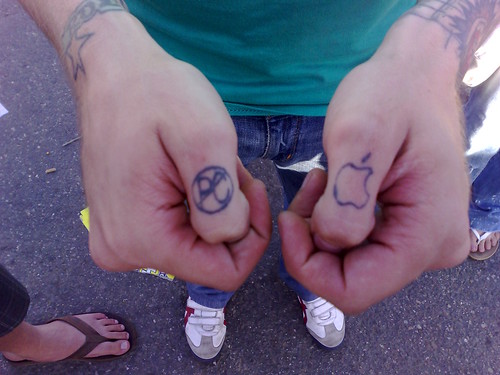
Binary battle lines are permeating the atmosphere, and they’ve been seeping into everything I seem to be writing recently, too. From the “sluts” vs. “virgins” pop-culture war, to the schism in conservative vs. liberal moral psychology, to PCs vs. Macs even. That’s all within the past month. It feels like everything is being forced to become a dichotomy. Which is a really dangerous kind of trap to get stuck in, and it’s prompted me to take a step back, and examine this phenomenon itself, rather than end up writing yet another post that would inadvertently fall into the same pattern. What I’ve realized is–surprise surprise!–I have two very powerfully conflicting reactions to this polarization that will be holding our reality hostage officially for 3 more weeks, but whose legacy will linger much, much longer.
Wait, before I get in to that, I just want to say that I realize that it’s not like this election invented the social/cultural/psychological divide between liberals and conservatives that politics has been exploiting since who knows when, but I really do think this particular election season has galvanized it to a degree that’s like nothing I’ve ever seen in the United States in my lifetime. A few weeks ago on the Daily Show, Jon Stewart suggested to guest, Bill Clinton, that “This election has apparently taken us all the way back to 1968 and the Nixonian and McGovern culture divide.” So it’s clearly not new, what’s going on today, but its degree of vehemence is not particularly familiar to anyone under 40, either.
Watching the preceding two elections go down, it had become increasingly clear that the left simply wasn’t getting it. It was like the nature of the electoral playing field had changed in some very crucial way, and the Democrats hadn’t gotten the memo. Which is why it feels like Barack Obama has offered a total departure from the kind of democratic nominees we’d gotten used to. People aren’t for Obama just because he’s the non-republican option. They are actually for what HE represents (which is, amazingly, a myriad of things to a broad spectrum of people, which he has, nonetheless, managed to bring together into a miraculously unified concept, and that unto itself is yet another aspect to his appeal), and they are for him in a fervent, decisive way that for the past 8 years has seemed to be the sole province of Republican candidates. So yeah, on the one hand, I can definitely say it’s been pretty gratifying to all of us who’d gotten tired of losing during that time, to watch the Democrats pull their shit together, and run a seriously strategized, legitimately competitive campaign. Booya. Bring it on. Go, team, go!
But here is what I personally find incredibly dismaying–even more than the right’s recent effort to cast Obama as a Muslim terrorist (I’m kind of surprised it took them this long), even more than the prospect of Sarah Palin possibly getting to make decisions about…. anything whatsoever (well, ok, dismaying on par with that)–is it’s precisely because Obama has been so successful at mobilizing the left, and the right has been forced to stake out even more desperately polarizing territory in response, that we’ve now gotten to a point where the cost of an election involves tearing the country limb from limb, first.
I said that this kind of social division that makes the air itself feel dense with tension is like nothing I’ve ever experienced in the U.S., but I have felt it somewhere else before: Jerusalem. There is a word in Hebrew that’s used for how Jerusalem feels–“Lachatz.” It literally translates to “pressure.” And in that city, that’s had contention in the air for millennia, that is, indeed, the right word. Like something intensely volatile, tenuously bottled up. In Jerusalem the binary conflict is ingrained, literally, into the walls, and it demands a constant vigilance of one’s affiliation. There are certain sections of the city where you are not allowed to go if you are Jewish, and others you cannot go to if you are Arab. Making sure you’re staying on your team’s side is not just a matter of politics, it’s how everyday life plays out. That’s what this election season, which has turned even regular, every-day actions into declarations of allegiance, is reminding me of. There’s this incessant perpetuation from all directions, whether it’s the media, or our friends, or slushie cups, of an us-vs.-them mentality, and I feel like it’s affecting how we think about everything right now, political or not.
Obviously, this is more or less inevitable when you’ve got a two-party election, and while it’s not like there’s anything that can be done about that situation now, I think it’s important to be aware, while we’re cheering our team on, of the underlying hazard in enjoying the polarization too much. Our human proclivity for this kind of binary divide is one of the most dangerous social situations that we can–and perpetually do–get ourselves into, and the massive eagerness with which both sides are relishing this particular battle is a little bit freaking me out.
Maybe it’s making me lose my sense of humor, too, cuz I totally can’t seem to find stuff like “McCain Be Old” to be funny… Or useful, for that matter. On that same episode of the Daily Show, Clinton said, “I’m glad [Obama]’s got people that love him that much. But those are not the people that hold this election.The people that hold this election are the people that think that he is on their side, and he loves them.” In other words, is it really necessary to incite alienation of people who could hold the swing vote, like, oh… you know… old people? Why not take a cue from Sarah Silverman instead, and shlep over to see your grandparents down in make-or-break-an-election state Florida? As Silverman says, “There’s nobody more important or influential over their grandparents than their grand-kids. You. If they vote for Barack Obama, they’re gonna get another visit this year. If not….”
As a marketer, I think one of the most crucial things to understand about people is just how diverse and nuanced the spectrum of identity and culture and personality is. In this long-tailed, custom-tailored, niched-up world we’re living in now, understanding the importance of approaching different groups on their own terms is the difference between success and irrelevance. Less than a month out from what I fully admit is the most important presidential race of my lifetime, may not be the time to start preaching plurality or diversity, or anything that could be undermining to in-group solidarity, but I think even through this process we do need to remember that with people things are not just black and white, or blue and red, or binary at all. One of the things that makes Barack Obama so appealing for me is that, as he himself acknowledges, as the product a Kenyan father, and an American mom, who was born in Hawaii, grew up in Indonesia, and became a Senator in Chicago, his mixed heritage has given him an understanding of America that is informed by a global, and uniquely modern perspective. That’s the kind of perspective that makes sense for the president of the United States when I think about the 21st century future not just of America, but the world.
Now, if we could just get through this election already…..
Do you favor variety, novelty, diversity, new ideas, travel? Or do you prefer sticking to things that are familiar, safe, and dependable?
If you answered yes to the first question, then you are higher on a major personality trait called Openness To Experience (OTE). As psychologist Jonathan Haidt says in his TED talk, “If you know about this trait, you can understand a lot of puzzles about human behavior. You can understand why artists are so different from accountants. You can actually predict what kinds of books they like to read, what kinds of places they like to travel to, and what kinds of foods they like to eat.” Based on this trait you can also predict people’s political leanings. Robert McCrae, the main researcher of this trait, writes, “Open individuals have an affinity for liberal, progressive, left-wing political views, whereas closed individuals prefer conservative, traditional, right wing views.” If you cross check this information with your answers to the questions at the top, no doubt you’ll find that this holds true for you.
I think it’s a popular perspective among the liberal folk to assume that people who vote for republicans are “blinded,” or “asleep” or something. If only they could just “wake up,” then they’d realize the errors of their ways. (Much like many conservatives think about liberals as well.) Haidt refers to this kind of thinking as a “moral matrix.” A kind of group-psychology framework that makes it hard for either side to really be able to understand why the people over there are making the decisions they are. According to Haidt, what it inevitably comes down to is morals.
Haidt has been studying morality from the perspective of evolutionary psychology, investigating common denominators in what cultures all across the world value as right and wrong in order to uncomver what may be the innate moral predispositions “built in” to the the human exeprience. Thus, his definition of morality is “Any system of interlocking values, practices, institutions, and psychological mechanisms that work together to suppress or regulate selfishness and make social life possible.” According to his research, there are five distinct moral predispositions, which Haidt calls the Foundations of Morality:
1) Harm/care, related to our long evolution as mammals with attachment systems and an ability to feel (and dislike) the pain of others. This foundation underlies virtues of kindness, gentleness, and nurturance.
2) Fairness/reciprocity, related to the evolutionary process of reciprocal altruism. This foundation generates ideas of justice, rights, and autonomy.
3) Ingroup/loyalty, related to our long history as tribal creatures able to form shifting coalitions. This foundation underlies virtues of patriotism and self-sacrifice for the group. It is active anytime people feel that it’s “one for all, and all for one.”
4) Authority/respect, shaped by our long primate history of hierarchical social interactions. This foundaiton underlies virtues of leadership and followership, including deference to legitimate authority and respect for traditions.
5) Purity/sanctity, shaped by the psychology of disgust and contamination. This foundation underlies religious notions of striving to live in an elevated, less carnal, more noble way. It underlies the widespread idea that the body is a temple which can be desecrated by immoral activities and contaminants (an idea not unique to religious traditions).
Haidt’s analogy for how these five foundations work to create our personal moral frameworks is that of an audio equalizer. Each foundation is like a kind of “channel” that we can adjust to our own personal levels, according to how meaningful each one is for us. Both liberals and conservatives agree that the first two foundations are critical components of morality, and they set those channels way up high, with liberals tending to set them a little bit higher than conservatives. However, the big divergence point where liberal and conservative viewpoints drastically split apart is on the last three moral channels. Namely, conservatives value Ingroup/loyalty, Authority/respect, and Purity/sanctity as significant foundations of morality, bringing the levels up, and liberals view these three aspects as having nothing to do with morality, and bring them way down.
This phenomenon, by the way, is not specific just to the U.S. It applies to liberals and conservatives in regions that Haidt and his team studied all across the world, Canada, The UK, Australia, Western Europe, Eastern Europe, Latin America, the Middle East, East Asia, South Asia–this split is not a national phenomenon, it’s a human phenomenon. “Liberals,” as Haidt says, “Speak for the weak and oppressed. They want change and justice even at the risk of chaos. If you’re high on openness to experience, revolution is good, it’s change, it’s fun. Conservatives, on the other hand, speak for institutions and traditions. They want order even at some cost to those at the bottom. The great conservative insight is that order is really hard to achieve. It’s really precious. And it’s really easy to lose.”
The reality here, then, is that people who vote for republicans are not “asleep” or “unconscious,” and can potentially be “woken up,” or something, as liberals are fond of saying, but that they actually have a totally different sense of morality, and vision of society. In both metaphoric and demographic terms, liberals and conservatives want to listen to different music. Which poses a bit of a problem. Since they can only elect one DJ at a time.
“It’s a striking fact of modern American life that rural white conservatives have become smarter, better organized and more militant, and that they now largely vote as a bloc. But the notion that there is some sort of equivalent or larger political grouping that opposes them in some coherent way is pure fiction. (See also: Democratic Party, recent history of.) Mann’s supposed metro majority simply does not exist — it’s a welter of races, social classes and economic strata, from the urban poor to the bicoastal intelligentsia to the security-obsessed suburban moms of demographic lore. Being non-rural, non-born-again and non-right-wing does not constitute an identity.”
This lack of a “unified liberal identity”–a concept that’s practically an oxymoron–has left them at a disadvantage, which has been expertly exploited by the united conservative front in recent years. As O’Heir writes, “These days, [conservatives] will support, with impressive solidarity, political leaders and public figures who share their backgrounds and their values, and whom they trust to reverse, or at least slow down, the pace of social change.”
Which makes me wonder–considering what Haidt and McCrae’s findings have revealed about the common affinity for change that liberal, Open-To-Experience personality types possess, perhaps Change itself is the one constant that could finally unite all their disparate identities.
Have you ever been in a meeting where everyone in the room is using a Mac except one person? Ever notice what happens when suddenly everyone starts to get on that person’s case about the fact that he’s the only one not on a Mac?
I have, and it kinda looked a little bit like this…
That’s a still from the latest ads developed by Crispin Porter & Bogusky in Microsoft’s new campaign to–essentially–regain control of their identity, and it’s a pretty accurate depiction of how I’ve seen that PC-in-a-room-full-of-Macs situation play out. (Clearly, it must not be an isolated incident). In the ad, when the diver flips the white board over, the other side reads, “And I’m Kinda Scared.”
Now, I’m a Mac now, but the computer I had before this one was a PC. I’m just as comfortable using either, and I’ve got Microsoft programs running on this computer right now. I could even get a Mac that comes with the option of running Windows, anyway, if I want, so even though I’m a Mac user, I clearly don’t see my identification with the brand in terms like this–
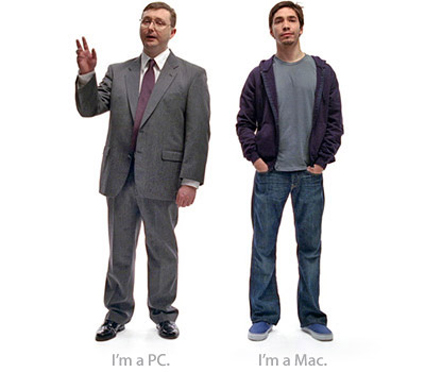
But many clearly do. And perhaps nothing has helped to articulate the contemporary Mac superiority complex quite like those Mac Vs. PC ads. In the iconic spots created by TBWA/Media Arts Lab, which began in 2006 and new iterations are still being developed now, a casually-dressed, attractive, 20-something guy introduces himself as “Hello, I’m a Mac…” while an older, slightly overweight guy, wearing glasses and a cheap lookin’ suit-and-tie combo introduces himself as “… And I’m a PC.” The two then act out little vignettes against a stark white background in which the capabilities and attributes of “Mac” and “PC” are compared. Often the spots end up presenting various legitimate PC shortcomings in an entertaining, glib way, but just as often the focus is on the two machine-characters’ personalities, and the feature comparison ends up being almost beside the point. Mac is always self-assured and easy-going. PC is resentful and awkward. The great success of these ads,
The subtext of these ads, which has also become the subtext of the Mac user community, is that this isn’t just a tool for enabling a certain kind of lifestyle, it’s a badge of it. A Mac isn’t just about helping you BE creative, it MEANS you are creative. A PC, on the other hand, means you are a stiff, unimaginative, frustrated tool, overly concerned with work, and incapable of doing anything interesting. At least not as good as a Mac can. Oh, and furthermore, if you’re a PC user, then you may as well know that this is what other people are thinking about you, too.
Personally, I’ve always been completely impressed that Mac has been able to brand a conformist white box into a symbol of creative and individual expression. But the idea is that your white box gives you entry into a whole network of other creative individuals, (just like you), and it’s that community association that bestows identity. A good friend of mine, who is a fashion designer, belly-dancer, serial entrepreneur, and has more tattoos and crazy hairstyles than the majority of the creative class, is a dedicated PC, and one of the major reasons for her choice is that she finds the idea inherent in a Mac–that you need this thing in order to express that you’re “hip”–to be a huge turnoff. A Mac doesn’t just bestow hipness to its users, it kind of subsumes it from them too. Perhaps she’s wary of this kind of accessory watering down or co-opting her own particular kind of hip. Either way, she says she feels like no one else has this line of thinking. It’s a turnoff “Only only to me,” She says, “I think PCs are just fine, and a lot more bang for your buck,” but everyone else she knows seems to have no problem with this aspect of their Macs.
It’s to let people like her know that there’s more of their kind out there, and to establish that their computers can, in fact, represent their creative, dynamic, interesting identities, that CPB took the direction they did with the new Microsoft ads.
Here’s one. You should watch it before reading further:
I think what’s really interesting here is that the ads say NOTHING about the product, or the features, or anything technical whatsoever. The sole purpose of the ad is to explore the diversity of PC users. I’m trying to think of another example of an entity trying to redefine its own identity by working to undo the stereotype of its “fans,” and I can’t think of one. (Anyone got one?) It’s pretty intense.
Those Microsoft commercials aren’t particularly engaging, and they don’t make me want to go out and buy a copy of Vista. But what they do is show lots of fascinating people saying that they use PCs. They highlight the fact that many people may be somewhat offended by the idea that they can’t be interesting or cool if they don’t use a Mac.
Suddenly, Apple looks a little elitist. I mean, they were elitist before, but in a way that made you want to be a part of the club. Now, they just seem a little snobby.
If that’s what Microsoft and their pushing clients to the edge advertising agency Crispin Porter + Bogusky were aiming for, it’s brilliant.
According to the New York Times, CPB “Relishes efforts to transform perceived negatives into positives.” (See also announcing the onset of an “SUV Backlash” to help promote the US launch of the Mini Cooper–before any such backlash had yet begun at all, positioning the Mini’s uber-compactness as an alternative to the gas-guzzling hegemony.)
More from the New York Times:
Apple executives have been “using a lot of their money to de-position our brand and tell people what we stand for,” said David Webster, general manager for brand marketing at Microsoft in Redmond, Wash.
“They’ve made a caricature out of the PC,” he added, which was unacceptable because “you always want to own your own story.”
The campaign illustrates “a strong desire” among Microsoft managers “to take back that narrative,” Mr. Webster said, and “have a conversation about the real PC.”
The celebration of PC users is intended to show them “connected to this community,” added [Rob Reilly, partner and co-executive creative director at Crispin Porter], “of people who are creative, who are passionate.”
Every single person featured in this ad is somehow compelling and enigmatic. Perhaps it’s because they’re all so different. You have no idea who is coming next. They challenge not only the expectations of who a PC is, but the assumption that you’re supposed know everything about who someone is just based on the kind of computer brand they use. (Talk about “Think Different,” huh?) If the Mac community is “alternative,” the one depicted in the Microsoft ad is global. If the Mac community is elitist, this one is accepting. Beyond “creative and passionate,” this community has a real sense humanity. It’s worldly and smart and open-minded and profoundly diverse. It’s approachable and philosophical. A community that’s out to change the world, and enjoy the world; a community that’s what the world might look like if everyone in it got along. And regardless of whether you’re a Mac or a PC…what kind of progressive human being (not a human doing, or a human thinking) wouldn’t want to be a part of a community like that?
The next time I need a new computer, maybe it’ll be a Mac, and maybe it’ll be a PC, but either way, I find it comforting and heartening to know that this is the kind of community a company like Microsoft sees–and wants the rest of us to see–as its own ideal.
It’s pretty interesting that at this year’s MTV Video Music awards the biggest controversy came from Brit comedian, host Russell Brand messing with the Disney-sponsored teen pop boy-band the Jonas Brothers for wearing Purity Rings.
Purity rings, or chastity rings/promise rings originated in the U.S. in the 1990s among Christian affiliated sexual abstinence groups. The rings are sold to adolescents, or to parents so that the rings may be given to their adolescent children as gifts.
It is intended that wearing a purity ring is accompanied by a religious vow to practice celibacy until marriage. The ring is usually worn on the left ring finger with the implication that the wearer will remain abstinent until it is replaced with a wedding ring. Although the ring is worn on the hand, where others can see, its main purpose is to serve as a constant reminder to the wearer of their commitment between themselves and God to remain pure until marriage. There is no particular style for purity rings; however, many worn by Christians have a cross in their design. Some rings contain a diamond chip or other gemstone and/or “True Love Waits”, “One Life, One Love”, or another similar saying embossed somewhere on the ring.
“It’s a little bit ungrateful,” joked Brand, “Because they could literally have sex with any woman that they want, and they’re just not gonna do it. They’re like Superman deciding not to fly, and just going everyhwere on a bus.” The joke became a running theme throughout the night, and at one point Brand even pretended he’d stolen a Jonas Brother’s virginity, holding up a ring in his hand. This, I should mention, got people more riled up than Brand calling George Bush a “retarded cowboy” after pleading, as a citizen of the world, for the US to elect Barack Obama. Eventually, however, he was compelled to apologize. “I’ve gotta say sorry because I said those things about promise rings; that was bad of me. I didn’t mean to take it lightly. I love Jonas Brothers, I think it’s (purity) really good. I don’t want to piss off teenage fans… Promise rings, I’m well up for it, well done everyone…It’s just, a bit of sex occasionally never hurt anybody.”
Coming from Europe, Brand clearly underestimated the dire seriousness with which Americans take their sex. Sure, comedians are supposed to poke fun at people, that’s what they do, but Brand’s delivery had seemed to imply, “Well, surely everyone else must agree this whole purity ring business is silly, right? After all, this is MTV. We’re all groovy Rock ‘n Rollers here, are we not?”
Before Brand issued his apology, American Idol winner Jordin Sparks, herself flossing some finger jewelry, deviated from the telepromptered script at the live telecast declaring, “I just want to say, it’s not bad to wear a promise ring because not everybody–guy or girl–wants to be a slut.” And for an 18 year-old, Sparks nevertheless managed to articulate the American perception of teenage sexuality with an astuteness that I would say is beyond her years: Either you’re a virgin or a slut. There is nothing in between.
Under the influence of the Bush administration’s Abstinence-Only approach to sex education, it’s not particularly surprising that there would be such a drastically reduced understanding of sexuality. Even the idea inherent in the whole Purity Ring concept implies that sex is a contamination, exposure to which makes you unpure. In this kind of oversimplified paradigm there’s obviously no room for complex ideas like being sexually responsible, or emotionally prepared, for instance. Of course, it’s not like rockstars have ever been society’s role models for moderation either, but in the past they’ve generally tended to err on the side of hedonism. So what’s happened that the newest generation of pop sensations is suddenly bringing non-sexy back?
Britney Spears was probably the turning point. Not that it’s exactly her fault that 16 years ago New Kid on the Block, Marky Mark was all about letting Kate Moss come between him and his Calvins while pimping underwear, and in 2008 teen stars are sporting accessories for vows of chastity, but she marked the crossroads. Back when she and Christina Aguilera were vying for individual identities to distinguish themselves (“Hit me baby, one ore time,” vs. “I’m a genie in a bottle, you gotta rub me the right way,” anyone?) and Christina went all Dirrty, Britney’s positioning strategy became about branding the singer as virginal as nebulously possible. (And look which one ended up the nutcase!) Even now, as L.A. Times pop music critic Ann Powers writes, Britney’s “still dealing with questions about exactly when she lost her innocence, even after bearing two children.” Before Britney was singing ballads like, “I’m not a girl, not yet a woman,” I think the last time anyone would have really cared this much about the status of a pop star’s virginity was back when you couldn’t show Elvis below the waist on TV. Even if there were still any expectations about the issue, you’d figure it would have gotten cleared up, once and for all, by Madonna. But a couple of things have changed in the two and a half decades since Like a Virgin (“That’s like a virgin. Not actually a virgin,” as Brand pointed out at the VMAs) came out.
Alan Ball–who’s no stranger to commentary on contemporary American sexuality, having written American Beauty, and the just-released Towelhead–explained in a recent NPR interview, “In our culture now everything is saturated with sex. Just watching mainstream TV, or going to the movies, or turning on your computer and looking at the images that are on your welcome page, it’s just sex, sex, sex….I think it’s much more in the faces of children now than it was when I was a kid.” And it doesn’t stop at mainstream entertainment. A 2007 study conducted by the University of New Hampshire found that more than 40% of kids have come across porn online. Two thirds of them weren’t even trying to look for it. By contrast, in a similar study conducted 8 years ago, just 25 percent of all kids interviewed said they’d had unwanted exposure to online pornography.
This past September [2005], when the National Center for Health Statistics released its first survey in which teens were questioned about their sexual behavior, 11 percent of American girls polled in the 15-to-19 demographic claimed to have had same-sex encounters—the same percentage of all women ages 15 to 44 who reported same-sex experiences, even though the teenagers have much shorter sexual histories. It doesn’t take a Stuyvesant education to see what this means: More girls are experimenting with each other, and they’re starting younger. And this is a conservative estimate, according to Ritch Savin-Williams, a professor of human development at Cornell who has been conducting research on same-sex-attracted adolescents for over twenty years. Depending on how you phrase the questions and how you define sex between women, he believes that “it’s possible to get up to 20 percent of teenage girls.”
Of course, what can’t be expressed in statistical terms is how teenagers think about their same-sex interactions. Go to the schools, talk to the kids, and you’ll see that somewhere along the line this generation has started to conceive of sexuality differently. Ten years ago in the halls of Stuyvesant you might have found a few goth girls kissing goth girls, kids on the fringes defiantly bucking the system. Now you find a group of vaguely progressive but generally mainstream kids for whom same-sex intimacy is standard operating procedure. These teenagers don’t feel as though their sexuality has to define them, or that they have to define it, which has led some psychologists and child-development specialists to label them the “post-gay” generation. But kids like Alair and her friends are in the process of working up their own language to describe their behavior. Along with gay, straight, and bisexual, they’ll drop in new words, some of which they’ve coined themselves: polysexual, ambisexual, pansexual, pansensual, polyfide, bi-curious, bi-queer, fluid, metroflexible, heteroflexible, heterosexual with lesbian tendencies—or, as Alair puts it, “just sexual.” The terms are designed less to achieve specificity than to leave all options open.
So if all the options for defining your sexual identity are left open, but taking advantage of any of them makes you–as Sparks schooled us–a slut, and at the same time the pervasive sexualization of mainstream entertainment, and contemporary culture in general, has made sluttiness a pretty much expected default–dude, how the hell are the latest crop of teen pop stars supposed to rebel?
On a quiet Friday morning in a dressing room at Madison Square Garden, the Jonas Brothers hold out their hands to show off their purity rings. Kevin, Joe, and Nick Jonas—the teen-pop trio who stand, at this very moment, on the brink of hugeness—wear the metal bands on their fingers to symbolize, as Joe puts it, “promises to ourselves and to God that we’ll stay pure till marriage.” Joe is 18. His ring is silver and adorned with a cross. “It actually ripped apart a little bit, just on the bottom, here, but I didn’t want to get a new one, because this one means so much to me,” he says. Nick, who is 15, says, “I got mine made at Disney World. It’s pretty awesome.” Kevin, at 20, is the oldest of the three, and while a punk-rock purity ring from Tiffany might represent the ultimate oxymoron, that’s exactly what he’s going for. His silver vow of abstinence is covered with studs. “It’s pretty rock and roll,” Kevin says. “It’s getting banged up a little bit because of the guitar.”
For any parent reading this, suddenly getting wildly excited about getting their teenager bling from god, this would probably be a good time to mention that virginity pledges are basically as much a sham as Brand assumed everyone would figure they are. A recent review of a number of independent American studies concluded that abstinence programs “show little evidence of sustained impact on attitudes and intentions,” and furthermore “show some negative impacts on youth’s willingness to use contraception, including condoms, to prevent negative sexual health outcomes related to sexual intercourse” Which is how Sarah Palin’s 17-year old daughter ended up 7 months pregnant, and how yours might too if the republicans have anything to say about it.
All this stuff we’re leaving kids to figure out on their own can be pretty damn charged and confusing and overwhelming. In an environment where the policy on sex ed exemplifies “don’t ask don’t tell,” where 40% of kids are being “educated” about sex through porn–whether they’re looking to be or not, and where the process of defining your sexuality is like a whole new kind of multiple choice exam, it’s actually not all that surprising that some kids might find the concept of a virginity pledge appealing. (At least in theory, if not 100% in practice). In the absence of information or substantive guideance to help them better understand what they’re dealing with, a purity ring offers teenagers a way to simply sublimate the insecurity and pressure that it’s completely normal–basically mandatory–to feel about sex at that age, with a token of self-righteousnessconfidence for simply avoiding it.
Denny Pattyn, an evangelical Christian youth minister, and founder of Silver Ring Thing, which runs more than 70 programs a year for teens, spreading a message of abstinence until marriage, and offering a ring to those who complete the course, appeared on the Today show following the VMAs, and according to MTV News:
Pattyn said he’s been getting quite a few requests from media organizations in the United States and England to discuss the issue. But more important, he ran into John McCain’s daughter Meghan backstage at the show, and the two had a talk that he hopes will soon connect him to Republican vice-presidential candidate Sarah Palin. “We had a long talk about Sarah Palin and her daughter’s pregnancy and them maybe getting more involved when they come to Pennsylvania where I live,” Pattyn said.
“This is a big, big to-do,” Pattyn said of the flap in his community over the Jonas Brothers/ Brand issue. “It’s fantastic for an organization like ours, and we think this will open up some major things.” Pattyn said he gave Meghan McCain one of his group’s rings to give to Governor Palin for her daughter “to let her know we’re supporting her and praying for her.”
(Hey, Trojan, have you considered maybe getting involved with the VMA’s for 2009? Might be a good time to think about that.)
Kinsey is probably rolling over in his grave, and so are a bunch of musicians. As Powers writes, “Nobody seems to remember when rockers were supposed to rattle the jewelry of the folks who attend glittery galas. But then, MTV has long trafficked in turning rebelliousness into a commodity. Brand, saying uncontainable things, upset the apple cart. That made him the most old-fashioned presence in a program full of young, aggressively commercial self-packagers, for whom any statement — political or otherwise — is best judged by the number of units sold.”