“i’m a PC. and a human being.”

Have you ever been in a meeting where everyone in the room is using a Mac except one person? Ever notice what happens when suddenly everyone starts to get on that person’s case about the fact that he’s the only one not on a Mac?

I have, and it kinda looked a little bit like this…

http://graphics8.nytimes.com/images/2008/09/18/business/18adco2.600.jpg

That’s a still from the latest ads developed by Crispin Porter & Bogusky in Microsoft’s new campaign to–essentially–regain control of their identity, and it’s a pretty accurate depiction of how I’ve seen that PC-in-a-room-full-of-Macs situation play out. (Clearly, it must not be an isolated incident). In the ad, when the diver flips the white board over, the other side reads, “And I’m Kinda Scared.”

Now, I’m a Mac now, but the computer I had before this one was a PC. I’m just as comfortable using either, and I’ve got Microsoft programs running on this computer right now. I could even get a Mac that comes with the option of running Windows, anyway, if I want, so even though I’m a Mac user, I clearly don’t see my identification with the brand in terms like this–
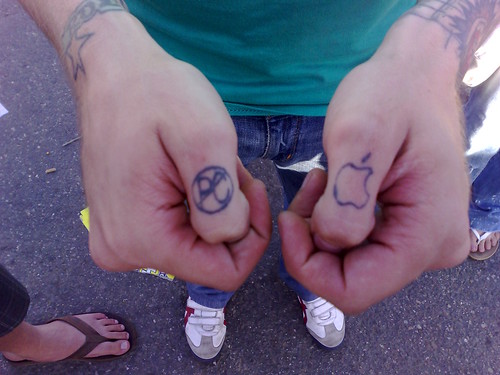
But many clearly do. And perhaps nothing has helped to articulate the contemporary Mac superiority complex quite like those Mac Vs. PC ads. In the iconic spots created by TBWA/Media Arts Lab, which began in 2006 and new iterations are still being developed now, a casually-dressed, attractive, 20-something guy introduces himself as “Hello, I’m a Mac…” while an older, slightly overweight guy, wearing glasses and a cheap lookin’ suit-and-tie combo introduces himself as “… And I’m a PC.” The two then act out little vignettes against a stark white background in which the capabilities and attributes of “Mac” and “PC” are compared. Often the spots end up presenting various legitimate PC shortcomings in an entertaining, glib way, but just as often the focus is on the two machine-characters’ personalities, and the feature comparison ends up being almost beside the point. Mac is always self-assured and easy-going. PC is resentful and awkward. The great success of these ads,
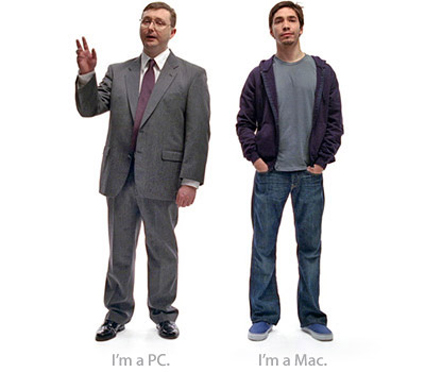
Mac vs PC

The subtext of these ads, which has also become the subtext of the Mac user community, is that this isn’t just a tool for enabling a certain kind of lifestyle, it’s a badge of it. A Mac isn’t just about helping you BE creative, it MEANS you are creative. A PC, on the other hand, means you are a stiff, unimaginative, frustrated tool, overly concerned with work, and incapable of doing anything interesting. At least not as good as a Mac can. Oh, and furthermore, if you’re  a PC user, then you may as well know that this is what other people are thinking about you, too.

Personally, I’ve always been completely impressed that Mac has been able to brand a conformist white box into a symbol of creative and individual expression. But the idea is that your white box gives you entry into a whole network of other creative individuals, (just like you), and it’s that community association that bestows identity. A good friend of mine, who is a fashion designer, belly-dancer, serial entrepreneur, and has more tattoos and crazy hairstyles than the majority of the creative class, is a dedicated PC, and one of the major reasons for her choice is that she finds the idea inherent in a Mac–that you need this thing in order to express that you’re “hip”–to be a huge turnoff. A Mac doesn’t just bestow hipness to its users, it kind of subsumes it from them too. Perhaps she’s wary of this kind of  accessory watering down or co-opting her own particular kind of hip. Either way, she says she feels like no one else has this line of thinking. It’s a turnoff  “Only only to me,” She says, “I think PCs are just fine, and a lot more bang for your buck,” but everyone else she knows seems to have no problem with this aspect of their Macs.

It’s to let people like her know that there’s more of their kind out there, and to establish that their computers can, in fact, represent their creative, dynamic, interesting identities, that CPB took the direction they did with the new Microsoft ads.

Here’s one. You should watch it before reading further:

I think what’s really interesting here is that the ads say NOTHING about the product, or the features, or anything technical whatsoever. The sole purpose of the ad is to explore the diversity of PC users. I’m trying to think of another example of an entity trying to redefine its own identity by working to undo the stereotype of its “fans,” and I can’t think of one. (Anyone got one?) It’s pretty intense.

In a post titled, “Huh. Those Mac Ads Aren’t As Funny Any More,” Michael Arrington wrote:

Those Microsoft commercials aren’t particularly engaging, and they don’t make me want to go out and buy a copy of Vista. But what they do is show lots of fascinating people saying that they use PCs. They highlight the fact that many people may be somewhat offended by the idea that they can’t be interesting or cool if they don’t use a Mac.

Suddenly, Apple looks a little elitist. I mean, they were elitist before, but in a way that made you want to be a part of the club. Now, they just seem a little snobby.

If that’s what Microsoft and their pushing clients to the edge advertising agency Crispin Porter + Bogusky were aiming for, it’s brilliant.

According to the New York Times, CPB “Relishes efforts to transform perceived negatives into positives.” (See also announcing the onset of an “SUV Backlash” to help promote the US launch of the Mini Cooper–before any such backlash had yet begun at all, positioning the Mini’s uber-compactness as an alternative to the gas-guzzling hegemony.)

More from the New York Times:

Apple executives have been “using a lot of their money to de-position our brand and tell people what we stand for,” said David Webster, general manager for brand marketing at Microsoft in Redmond, Wash.

“They’ve made a caricature out of the PC,” he added, which was unacceptable because “you always want to own your own story.”

The campaign illustrates “a strong desire” among Microsoft managers “to take back that narrative,” Mr. Webster said, and “have a conversation about the real PC.”

The celebration of PC users is intended to show them “connected to this community,” added [Rob Reilly, partner and co-executive creative director at Crispin Porter], “of people who are creative, who are passionate.”

Every single person featured in this ad is somehow compelling and enigmatic. Perhaps it’s because they’re all so different. You have no idea who is coming next. They challenge not only the expectations of who a PC is, but the assumption that you’re supposed know everything about who someone is just based on the kind of computer brand they use. (Talk about “Think Different,” huh?) If the Mac community is “alternative,” the one depicted in the Microsoft ad is global. If the Mac community is elitist, this one is accepting. Beyond “creative and passionate,” this community has a real sense humanity. It’s worldly and smart and open-minded and profoundly diverse. It’s approachable and philosophical. A community that’s out to change the world, and enjoy the world; a community that’s what the world might look like if everyone in it got along. And regardless of whether you’re a Mac or a PC…what kind of progressive human being (not a human doing, or a human thinking) wouldn’t want to be a part of a community like that?

The next time I need a new computer, maybe it’ll be a Mac, and maybe it’ll be a PC, but either way, I find it comforting and heartening to know that this is the kind of community a company like Microsoft sees–and wants the rest of us to see–as its own ideal.



Subscribe for more like this.


celibacy is so hot right now

It’s pretty interesting that at this year’s MTV Video Music awards the biggest controversy came from Brit comedian, host Russell Brand messing with the Disney-sponsored teen pop boy-band the Jonas Brothers for wearing Purity Rings.

Purity rings, or chastity rings/promise rings originated in the U.S. in the 1990s among Christian affiliated sexual abstinence groups. The rings are sold to adolescents, or to parents so that the rings may be given to their adolescent children as gifts.

It is intended that wearing a purity ring is accompanied by a religious vow to practice celibacy until marriage. The ring is usually worn on the left ring finger with the implication that the wearer will remain abstinent until it is replaced with a wedding ring. Although the ring is worn on the hand, where others can see, its main purpose is to serve as a constant reminder to the wearer of their commitment between themselves and God to remain pure until marriage. There is no particular style for purity rings; however, many worn by Christians have a cross in their design. Some rings contain a diamond chip or other gemstone and/or “True Love Waits”, “One Life, One Love”, or another similar saying embossed somewhere on the ring.

“It’s a little bit ungrateful,” joked Brand, “Because they could literally have sex with any woman that they want, and they’re just not gonna do it. They’re like Superman deciding not to fly, and just going everyhwere on a bus.” The joke became a running theme throughout the night, and at one point Brand even pretended he’d stolen a Jonas Brother’s virginity, holding up a ring in his hand. This, I should mention, got people more riled up than Brand calling George Bush a “retarded cowboy” after pleading, as a citizen of the world, for the US to elect Barack Obama. Eventually, however, he was compelled to apologize. “I’ve gotta say sorry because I said those things about promise rings; that was bad of me. I didn’t mean to take it lightly. I love Jonas Brothers, I think it’s (purity) really good. I don’t want to piss off teenage fans… Promise rings, I’m well up for it, well done everyone…It’s just, a bit of sex occasionally never hurt anybody.”

Coming from Europe, Brand clearly underestimated the dire seriousness with which Americans take their sex. Sure, comedians are supposed to poke fun at people, that’s what they do, but Brand’s delivery had seemed to imply, “Well, surely everyone else must agree this whole purity ring business is silly, right? After all, this is MTV. We’re all groovy Rock ‘n Rollers here, are we not?”

Before Brand issued his apology, American Idol winner Jordin Sparks, herself flossing some finger jewelry, deviated from the telepromptered script at the live telecast declaring, “I just want to say, it’s not bad to wear a promise ring because not everybody–guy or girl–wants to be a slut.” And for an 18 year-old, Sparks nevertheless managed to articulate the American perception of teenage sexuality with an astuteness that I would say is beyond her years: Either you’re a virgin or a slut. There is nothing in between.

Under the influence of the Bush administration’s Abstinence-Only approach to sex education, it’s not particularly surprising that there would be such a drastically reduced understanding of sexuality. Even the idea inherent in the whole Purity Ring concept implies that sex is a contamination, exposure to which makes you unpure. In this kind of oversimplified paradigm there’s obviously no room for complex ideas like being sexually responsible, or emotionally prepared, for instance. Of course, it’s not like rockstars have ever been society’s role models for moderation either, but in the past they’ve generally tended to err on the side of hedonism. So what’s happened that the newest generation of pop sensations is suddenly bringing non-sexy back?

Britney Spears was probably the turning point. Not that it’s exactly her fault that 16 years ago New Kid on the Block, Marky Mark was all about letting Kate Moss come between him and his Calvins while pimping underwear, and in 2008 teen stars are sporting accessories for vows of chastity, but she marked the crossroads. Back when she and Christina Aguilera were vying for individual identities to distinguish themselves (“Hit me baby, one ore time,” vs. “I’m a genie in a bottle, you gotta rub me the right way,” anyone?) and Christina went all Dirrty, Britney’s positioning strategy became about branding the singer as virginal as nebulously possible. (And look which one ended up the nutcase!) Even now, as L.A. Times pop music critic Ann Powers writes, Britney’s “still dealing with questions about exactly when she lost her innocence, even after bearing two children.” Before Britney was singing ballads like, “I’m not a girl, not yet a woman,” I think the last time anyone would have really cared this much about the status of a pop star’s virginity was back when you couldn’t show Elvis below the waist on TV. Even if there were still any expectations about the issue, you’d figure it would have gotten cleared up, once and for all, by Madonna. But a couple of things have changed in the two and a half decades since Like a Virgin (“That’s like a virgin. Not actually a virgin,” as Brand pointed out at the VMAs) came out.

Alan Ball–who’s no stranger to commentary on contemporary American sexuality, having written American Beauty, and the just-released Towelhead–explained in a recent NPR interview, “In our culture now everything is saturated with sex. Just watching mainstream TV, or going to the movies, or turning on your computer and looking at the images that are on your welcome page, it’s just sex, sex, sex….I think it’s much more in the faces of children now than it was when I was a kid.”  And it doesn’t stop at mainstream entertainment. A 2007 study conducted by the University of New Hampshire found that more than 40% of kids have come across porn online. Two thirds of them weren’t even trying to look for it. By contrast, in a similar study conducted 8 years ago, just 25 percent of all kids interviewed said they’d had unwanted exposure to online pornography.

Meanwhile, in the era of Katy Perry ditties like “I kissed a girl and I liked it. (Hope my boyfriend don’t mind it.)” and “Ur so gay and you don’t even like boys,” teenagers are now also faced with an unprecedented array of options for how to define their sexual identities. In a New York Magazine article called “The Cuddle Puddle of Stuyvesant High School” Alex Morris wrote:

This past September [2005], when the National Center for Health Statistics released its first survey in which teens were questioned about their sexual behavior, 11 percent of American girls polled in the 15-to-19 demographic claimed to have had same-sex encounters—the same percentage of all women ages 15 to 44 who reported same-sex experiences, even though the teenagers have much shorter sexual histories. It doesn’t take a Stuyvesant education to see what this means: More girls are experimenting with each other, and they’re starting younger. And this is a conservative estimate, according to Ritch Savin-Williams, a professor of human development at Cornell who has been conducting research on same-sex-attracted adolescents for over twenty years. Depending on how you phrase the questions and how you define sex between women, he believes that “it’s possible to get up to 20 percent of teenage girls.”

Of course, what can’t be expressed in statistical terms is how teenagers think about their same-sex interactions. Go to the schools, talk to the kids, and you’ll see that somewhere along the line this generation has started to conceive of sexuality differently. Ten years ago in the halls of Stuyvesant you might have found a few goth girls kissing goth girls, kids on the fringes defiantly bucking the system. Now you find a group of vaguely progressive but generally mainstream kids for whom same-sex intimacy is standard operating procedure. These teenagers don’t feel as though their sexuality has to define them, or that they have to define it, which has led some psychologists and child-development specialists to label them the “post-gay” generation. But kids like Alair and her friends are in the process of working up their own language to describe their behavior. Along with gay, straight, and bisexual, they’ll drop in new words, some of which they’ve coined themselves: polysexual, ambisexual, pansexual, pansensual, polyfide, bi-curious, bi-queer, fluid, metroflexible, heteroflexible, heterosexual with lesbian tendencies—or, as Alair puts it, “just sexual.” The terms are designed less to achieve specificity than to leave all options open.

So if all the options for defining your sexual identity are left open, but taking advantage of any of them makes you–as Sparks schooled us–a slut, and at the same time the pervasive sexualization of mainstream  entertainment, and contemporary culture in general, has made sluttiness a pretty much expected default–dude, how the hell are the latest crop of teen pop stars supposed to rebel?

From Details’ The Total Awesomeness of Being the Jonas Brothers:

On a quiet Friday morning in a dressing room at Madison Square Garden, the Jonas Brothers hold out their hands to show off their purity rings. Kevin, Joe, and Nick Jonas—the teen-pop trio who stand, at this very moment, on the brink of hugeness—wear the metal bands on their fingers to symbolize, as Joe puts it, “promises to ourselves and to God that we’ll stay pure till marriage.” Joe is 18. His ring is silver and adorned with a cross. “It actually ripped apart a little bit, just on the bottom, here, but I didn’t want to get a new one, because this one means so much to me,” he says. Nick, who is 15, says, “I got mine made at Disney World. It’s pretty awesome.” Kevin, at 20, is the oldest of the three, and while a punk-rock purity ring from Tiffany might represent the ultimate oxymoron, that’s exactly what he’s going for. His silver vow of abstinence is covered with studs. “It’s pretty rock and roll,” Kevin says. “It’s getting banged up a little bit because of the guitar.”

For any parent reading this, suddenly getting wildly excited about getting their teenager bling from god, this would probably be a good time to mention that virginity pledges are basically as much a sham as Brand assumed everyone would figure they are. A recent review of a number of independent American studies concluded that abstinence programs “show little evidence of sustained impact on attitudes and intentions,” and furthermore “show some negative impacts on youth’s willingness to use contraception, including condoms, to prevent negative sexual health outcomes related to sexual intercourse” Which is how Sarah Palin’s 17-year old daughter ended up 7 months pregnant, and how yours might too if the republicans have anything to say about it.

All this stuff we’re leaving kids to figure out on their own can be pretty damn charged and confusing and overwhelming. In an environment where the policy on sex ed exemplifies “don’t ask don’t tell,” where 40% of kids are being “educated” about sex through porn–whether they’re looking to be or not, and where the process of defining your sexuality is like a whole new kind of multiple choice exam, it’s actually not all that surprising that some kids might find the concept of a virginity pledge appealing. (At least in theory, if not 100% in practice). In the absence of information or substantive guideance to help them better understand what they’re dealing with, a purity ring offers teenagers a way to simply sublimate the insecurity and pressure that it’s completely normal–basically mandatory–to feel about sex at that age, with a token of self-righteousnessconfidence for simply avoiding it.

Denny Pattyn, an evangelical Christian youth minister, and founder of Silver Ring Thing, which runs more than 70 programs a year for teens, spreading a message of abstinence until marriage, and offering a ring to those who complete the course, appeared on the Today show following the VMAs, and according to MTV News:

Pattyn said he’s been getting quite a few requests from media organizations in the United States and England to discuss the issue. But more important, he ran into John McCain’s daughter Meghan backstage at the show, and the two had a talk that he hopes will soon connect him to Republican vice-presidential candidate Sarah Palin. “We had a long talk about Sarah Palin and her daughter’s pregnancy and them maybe getting more involved when they come to Pennsylvania where I live,” Pattyn said.

“This is a big, big to-do,” Pattyn said of the flap in his community over the Jonas Brothers/ Brand issue. “It’s fantastic for an organization like ours, and we think this will open up some major things.” Pattyn said he gave Meghan McCain one of his group’s rings to give to Governor Palin for her daughter “to let her know we’re supporting her and praying for her.”

I don’t know which is more suspect, that just two years after the ACLU settlement with the Department of Health and Human Services (HHS) in a case challenging federal funding of more than $1 million for Silver Ring Thing (which seeing as it is a subsidiary of an Evangelical Church, giving it govt. funding did kinda constitute a major violation of that whole separation of church and state thing) Pattyn’s back innit again as if that never happened, or what exactly this guy was doing hangin’ backstage at the MTV Video Music Awards in the first place?

(Hey, Trojan, have you considered maybe getting involved with the VMA’s for 2009? Might be a good time to think about that.)

Kinsey is probably rolling over in his grave, and so are a bunch of musicians. As Powers writes, “Nobody seems to remember when rockers were supposed to rattle the jewelry of the folks who attend glittery galas. But then, MTV has long trafficked in turning rebelliousness into a commodity. Brand, saying uncontainable things, upset the apple cart. That made him the most old-fashioned presence in a program full of young, aggressively commercial self-packagers, for whom any statement — political or otherwise — is best judged by the number of units sold.”


Subscribe for more like this.


does good matter?

Companies: How to Make Millions By Switching to A Green-Colored Logo
– Headline in The Onion’s “Obligatory Green Issue”

I’ve been thinking about this, the third in what’s evidently become a series of posts inspired by Buying In: The Secret Dialogue Between Who We Are and What We Buy, by Rob Walker, since I read the section in the book (it’s also been reprinted as a Fast Company article) where Walker writes about American Apparel changing its brand messaging. Initially the company’s identity hinged on its “Sweatshop Free” production, but sex, surprise surprise, turned out to be a much better sell than good labor practices. Walker writes:

American Apparel seemed to me to be a marquee example of a business that had positioned itself to respond to a rising tide of ethical, antibrand consumers. At a moment when practically every clothes maker was offshoring to cut costs, American Apparel made its wares at a U.S. factory in which the average industrial worker (usually a Latino immigrant) was paid between $12 and $13 an hour and got medical benefits. The company had taken out ads in little arty magazines, noting that it was “sweatshop free.”

[But] Another self-consciously ethical clothing brand, SweatX, had just gone out of business. The lesson of SweatX, [American Apparel CEO Dov] Charney said, was that building a brand solely around a company’s ethical practices was not a good strategy for reaching masses of consumers. The ethical sell was too limiting. It was a niche strategy, at best. Which was why American Apparel was moving away from the ethical sell to something very different.

Charney pulled out a copy of a book called The 48 Laws of Power and read me No. 13, which suggested that to get what you want, you must appeal to people’s self-interest, not to their mercy. “That’s the problem with the anti-sweatshop movement. You’re not going to get customers walking into stores by asking for mercy and gratitude.” If you want to sell something, ethical or otherwise, he said, snapping the book closed, “appeal to people’s self-interest.”

By the time I visited American Apparel’s headquarters and factory in Los Angeles to meet with Charney a second time, the company had transitioned to an image soaked in youth and sex. This was apparent in its stores — where the decor often included things such as Penthouse covers — and in its print ads. Yes, some of these ads mentioned quality and the sweatshop-free angle, but usually in small type, under a photograph of a half-naked young woman.

The company was producing 32,000 pieces a day and struggling to keep up with orders. In months, [the company’s] system was churning out 90,000 pieces a day and would eventually reach 250,000. While the company was projecting an air of almost reckless decadence in its ads, it was quietly building a thriving made-in-America business model.

All of which, of course, made me wonder–and perhaps might make you wonder, too: Does good matter?

Good itself, I mean, without a gloss of sex covering it over, does it matter as a selling point to us as consumers?

Researchers Remi Trudel and June Cotte were trying to figure out the same thing in their studies for the May 2008 Wall Street Journal piece Does Being Ethical Pay?

For corporations, social responsibility has become a big business. Companies spend billions of dollars doing good works — everything from boosting diversity in their ranks to developing eco-friendly technology — and then trumpeting those efforts to the public.

But does it pay off?

To find out, we conducted a series of experiments. We showed consumers the same products — coffee and T-shirts — but told one group the items had been made using high ethical standards and another group that low standards had been used. A control group got no information.

In all of our tests, consumers were willing to pay a slight premium for the ethically made goods. But they went much further in the other direction: They would buy unethically made products only at a steep discount.

Our first experiment asked two questions. How much more will people pay for an ethically produced product? And how much less are they willing to spend for one they think is unethical?

To test these questions, we gathered a random group of 97 adult coffee drinkers and asked them how much they would pay for a pound of beans from a certain company. We used a brand that’s not available in North America, so none of the participants would be familiar with it.

But before the people answered, we asked them to read some information about the company’s production standards. One group got positive ethical information, and one group negative; the control group got neutral information, similar to what shoppers would typically know in a store.

After reading about the company and its coffee, the people told us the price they were willing to pay on an 11-point scale, from $5 to $15. The results? The mean price for the ethical group ($9.71 per pound) was significantly higher than that of the control group ($8.31) or the unethical group ($5.89).

Meanwhile, as the numbers show, the unethical group was demanding to pay significantly less for the product than the control group. In fact, the unethical group punished the coffee company’s bad behavior more than the ethical group rewarded its good behavior. The unethical group’s mean price was $2.42 below the control group’s, while the ethical group’s mean price was $1.40 above. So, negative information had almost twice the impact of positive information on the participants’ willingness to pay.

Trudel and Cotte also researched just how ethical companies really need to be in order to reap marketplace rewards, that is, are consumers willing to pay more for a product that is 100% ethically produced versus one that is 50% or 25% ethically produced? Their findings showed that there is a certain “ethical threshold” beyond which any ethical acts might reinforce the company’s image, but don’t induce people to pay more. And lastly, they examined the effect of pre-existing consumer attitudes, and found that people with high expectations about how companies should behave doled out bigger rewards and punishments than those with low expectations.

For companies, the implications of this study — albeit limited — are apparent. Efforts to move toward ethical production, and promote that behavior, appear to be a wise investment. In other words, if you act in a socially responsible manner, and advertise that fact, you may be able to charge slightly more for your products.

Not an overwhelming rallying cry to assert that good is here, it matters, and we should get used to it, exactly, but clearly an opportunity to explore a new ethical “market segment.” As Walker writes:

Perhaps this is why many big companies and brands are not so much changing their products as adding new alternatives to their existing product mixes, or carving a small donation to charity out of their profit margins. Pepsi-Cola is testing an all-natural version of its flagship drink called Pepsi Raw, and Clorox has launched an eco-friendly line of cleaning products. The Bono-promoted (Product) Red initiative brands existing products that dedicate a portion of the purchase price to the Global Fund to Fight AIDS, Tuberculosis, and Malaria. There’s even a (Product) Red version of the iPod.

A whopping majority of American shoppers may consider themselves environmentalists, but, according to the Journal of Industrial Ecology, only 10% to 12% “actually go out of their way to purchase environmentally sound products.” Similarly, Brandweek reported on a survey that found that even among consumers who called themselves “environmentally conscious,” more than half could not name a single green brand.

Ask most people whether they care about the environment, and it’s not particularly surprising that many would say yes. Ask whether they would back that up by “buying green” if they had the chance, and again, it’s likely that very few would admit to being hypocrites by saying no. What we do in the marketplace is another matter.

There is a real-world overload of factors that confront consumers in the marketplace — price, quality, convenience, pleasure, plus the countless number of symbols that provide us with rationales to buy. The Yale Center for Customer Insights designed an experiment to test this phenomenon. It divided 108 subjects into two groups. Members of one group were presented with a straightforward consumer choice. Would they prefer to buy a vacuum cleaner (a utilitarian object) or a pair of jeans (a bit of a luxury), each of which was assigned the same price, $50? About 72% chose the vacuum cleaner. Members of the other group were told to imagine they had volunteered to spend three hours a week either teaching children in a homeless shelter or “improving the environment.” They were asked to explain their choice, a process meant to prod them into engaging with the idea. Then they faced the vacuum-cleaner-or-jeans choice. In this group, a majority (57%) opted for the jeans.

Although very few of the subjects made the connection, the researchers concluded that “the opportunity to appear altruistic by committing to a charitable act in a prior task” gives us license to choose a luxury item. A similar set of studies indicates that subjects are more likely to splurge on fancier sunglasses or pricier concert tickets after giving to charity. If you buy ecological or green products or consume alternative health care or practice yoga, it’s easy to conclude, “Hey, I’ve done my part.”

These efforts [by big companies] add just enough options to the miles of retail shelves to give us all an ethical fix — to do our one good shopping deed. Then we can push our basket a little farther down the aisle, letting other rationales take over: Here’s a bargain, here’s a great product, here’s something that I could probably get cheaper elsewhere, but as long as I’m here, I’ll just get it — and here, yes, here is something ethical. I’ll take one of those, too.

Trudel and Cotte concluded at the end of their research: “The lessons are clear. Companies should segment their market and make a particular effort to reach out to buyers with high ethical standards, because those are the customers who can deliver the biggest potential profits on ethically produced goods.”

Rather than marketing ethical products to a mainstream audience, big companies can simply create a separate ethical brand or product line, repackage it as a luxury “good,” and sell it at a premium to the niche, conscientious consumer demographic–which may be willing to pay more for ethical products, but couldn’t scale to support a company like SweatX, or to motivate the big companies to change their practices overall.

Is that the fate of good, then? Is the extent of it’s significance as a selling point simply the justification for a reverse “ethical tax”?

At the PSFK conference in San Francisco last week, GOOD Magazine co-founder Max Schorr’s presentation, “Aligning Interests,” (echoing that 13th law of power) was subtitled: “When cynical people admit they’re idealistic you might be on to something.” At the beginning of his presentation Schorr asked a room full of marketers how many of us wanted to make a positive impact. Pretty much everyone raised their hands. When he asked how many of us wanted to make money, the same hands shot up. The idea then is that to effect real positive change these kinds of interests have to align. Doing good has to be separated from the bleak, unprofitable, un-fun, self-righteous, and ultimately ineffectual idea lf altruism, and the “triple bottom line” of sustainability, profit, and positive impact, needs to become a single bottom line. Schorr’s presentation was the most loudly applauded of the whole day, and thereafter the most frequently referenced. There is no doubt that marketers–well, those of us that raised our hands anyway–we WANT good to matter. We WANT consumer demand for ethics and sustainability to affect the substance of what the market supplies. We want good to succeed.

But does it have to matter as a selling point to do that?

In his presentation, Schorr talked about how the magazine has stopped using the word “Green.” The reason behind this move being to stop presenting sustainable practices as some kind of distinct “alternative” from what should simply be the default standard. In a sense, this is what American Apparel did as well when they stopped trumpeting their ethical practices to distinguish their brand identity.

Maybe it’s all about thinking ahead. We shouldn’t confuse current consumer attitudes with what they’re likely to be in the future. No doubt a company’s environmental friendliness matters more now to the average consumer than it would have before the release of An Inconvenient Truth. And I’d be willing to bet that ethical production practices in general matter more to us now than they did before the wave of mass internet adoption hit, and access to information about a company’s practices became easily accessible to the average web surfer. Trudel and Cotte even acknowledged that if 100% ethically produced products become the expected norm, anything less may be punished by consumers. So perhaps good actually WILL matter quite a bit more in the future than it does now.

But will it ever matter more than sex?

Maybe that gloss on top won’t hurt anyway. Just…. you know….. in case.


Subscribe for more like this.


hipster screamo southern rap

I got an email a few days back that read:

fromjustin boreta
subjectif the glitch mob went screamo
dateWed, Jul 16, 2008 at 11:35 AM

http://profile.myspace.com/brokencyde

prepare yourself

But I was getting ready to head out to San Francisco for the PSFK conference, (and to be perfectly honest, was kind of scared by the whole idea being proposed in the email’s subject line) so I didn’t get around to actually checking it out until today…..

And oh man, these guys are friggin awesome and hilarious. I couldn’t listen to a single track without totally cracking up. And I’m sure these tunes ain’t no slouches on the dancefloor neither. (Do yourself a favor, and go check them out. It might not be your cup of tea, but you gotta at least be entertained that this exists at all.)

Ps. Gotta love the complete blatant disregard for all music genre rules and regulations. Sounds like the future.


Subscribe for more like this.