when katie k brought me in to stage manage her fashion show at lucent l’amour 2005 is how this all began. i say the do lab treats experience itself as an artform. 3 years later, it will be a pleasure to experience tomorrow night’s masterpiece.
“Is The Tipping Point Toast?” asks the recent FastCompany article in which researcher duncan watts talks about his findings (and their less than exuberant reception) that expose the billion dollars a year marketers spend targeting “influentials” as a waste of money.
i am constantly repeating the phrase that “we buy the brands and products that we feel express aspects of our identity,” and this applies to ideas as well. we buy into and espouse the ideas that express aspects of who we are. our “intuition” in that sense, could be seen not so much a kind of internal tuning fork dinging to the tone of the universe, but rather an insidiously partial filter which evaluates the validity of information based on its compliance with our ingrained personal predispositions. for marketers–an avocation that calls for a particular breed of identity, of course–it’s no doubt easy to latch on to the idea that a select few influential individuals wield the capacity to push trends over the tipping point simply by their involvement in the process. after all, considering what we do it’s pretty “intuitive” for us, isn’t it?
from the fastcompany article:
Marketing has always relied heavily on instinct and intuition. Admen like to believe they’re creative geniuses, gifted at truffling out social trends (which is why, they hasten to point out, they’re irreplaceable). Joe Pilotta, research VP for a firm called Big Research, suspects marketers cling to their belief in Influentials partly because they’re lazy. They love the idea of needing to reach only a small group of people to “tip” a product, he says with a laugh. Plus, it strokes their egos: “Think about it. You’re saying, ‘I am in control–I am the biggest influencer, because I am going to influence the influencers!’ It’s an arrogance that only the corporate world could enjoy.”
which certainly makes ME wonder to what extent what we know–or believe we know–about the nature of how marketing is supposed to work is actually based on the the egos of CMOs as opposed to on actual social theory. how about you?
see, i think all of coolhunting is a ridiculous waste of time. there is no universal “cool” that exists out of context, and while i do believe strongly that marketers themselves are NEVER the demo, i also think that all of us are subject to the context of the cultures or communities of which we are a part. translation: cool matters not because it’s “cool” but because–and only if–it’s culturally relevant. and while relevance sounds a lot less sexy than its mistaken-identity doppelganger, cool, it’s relevance that “trends” are really about.
Watts decided to put the whole idea to the test by building another Sims-like computer simulation. He programmed a group of 10,000 people, all governed by a few simple interpersonal rules. Each was able to communicate with anyone nearby. With every contact, each had a small probability of “infecting” another. And each person also paid attention to what was happening around him: If lots of other people were adopting a trend, he would be more likely to join, and vice versa. The “people” in the virtual society had varying amounts of sociability–some were more connected than others. Watts designated the top 10% most-connected as Influentials; they could affect four times as many people as the average Joe. In essence, it was a virtual society run–in a very crude fashion–according to the rules laid out by thinkers like Gladwell and Keller.
Watts set the test in motion by randomly picking one person as a trendsetter, then sat back to see if the trend would spread. He did so thousands of times in a row.
The results were deeply counterintuitive. The experiment did produce several hundred societywide infections. But in the large majority of cases, the cascade began with an average Joe (although in cases where an Influential touched off the trend, it spread much further). To stack the deck in favor of Influentials, Watts changed the simulation, making them 10 times more connected. Now they could infect 40 times more people than the average citizen (and again, when they kicked off a cascade, it was substantially larger). But the rank-and-file citizen was still far more likely to start a contagion.
Why didn’t the Influentials wield more power? With 40 times the reach of a normal person, why couldn’t they kick-start a trend every time? Watts believes this is because a trend’s success depends not on the person who starts it, but on how susceptible the society is overall to the trend–not how persuasive the early adopter is, but whether everyone else is easily persuaded. And in fact, when Watts tweaked his model to increase everyone’s odds of being infected, the number of trends skyrocketed.
i really like that phrase, so i’ll write it again: A trend’s success depends not on the person who starts it, but on how susceptible the society is overall to the trend–not how persuasive the early adopter is, but whether everyone else is easily persuaded.
we buy the brands, products, ideas, political candidates, etc., etc., we feel express aspects of our identities. a trend’s success depends not on how COOL it is, but on how effectively it manages to express a common-enough identity aspect. in other words, one way to look at the success of the trend that is “The Tipping Point” itself is that it has managed to express an identity aspect shared by a whole lot of marketers. not because it was cool, perhaps not even because it was RIGHT, but simply because it resonated with a particular–and particularly widespread–identity.
perhaps instead of building databases of “trend-spotters,” “brand evangelists,” “influencers” or whatever else those agencies that are so proud of themselves for getting to sit at the “cool kids” table want to call them, a more useful application of money would be to research the dynamics of our ability to BE influenced. and when i say “our” i mean all of us, marketers included. because, after all, being human helps in the process of figuring out how to communicate to other humans.
and maybe i read it wrong, but to me gladwell’s book wasn’t ever really about some people being blessed with the ability to start trends better than others, but rather some people being more curious, and thereby simply ending up in the way of more trends. consider how many more things an “early adopter” tries out that NEVER take off than the average person? they don’t necessarily help more stuff tip, they just try more shit out. what? were you expecting a different model? if so, maybe you should stop saying the word “viral” so much. that might aid a perspective shift:
Perhaps the problem with viral marketing is that the disease metaphor is misleading. Watts thinks trends are more like forest fires: There are thousands a year, but only a few become roaring monsters. That’s because in those rare situations, the landscape was ripe: sparse rain, dry woods, badly equipped fire departments. If these conditions exist, any old match will do. “And nobody,” Watts says wryly, “will go around talking about the exceptional properties of the spark that started the fire.”
so… “If influentials cannot tip a trend into existence–and if success in a networked society is quite random–what’s a poor marketer to do?” The article suggests that, “Since you can never know which person is going to spark the fire, you should aim the ad at as broad a market as possible–and not waste money chasing “important” people.” and while i agree with this, I think the “ultimate irony” proposed at the end of the article is misleading:
“If you really buy [Watts’s research], the most effective way to pitch your idea is … mass marketing. And that is precisely what the wizards of Madison Avenue, presiding over our zillion-channel microniche market, have rejected as obsolete. “
cultural relevance–especially in a networked society–is not entirely as random as watts’s algorithmic computer simulations, and simply broadcasting a message doesn’t make it more relevant, but there is no special group of cultural gate-keepers that get to decide what’s going to be relevant and what’s not.
“I think that all books like The Tipping Point or articles by academics can ever do is uncover a little piece of the bigger picture, and one day–when we put all those pieces together–maybe we’ll have a shot at the truth.”
– Malcom Gladwell
now that new year’s eve is over, you’re thinking about what you’re doing with the first weekend of 2008.
i’ll tell you what….
Purchase Presale Tickets HERE
UPDATE: PRESALE TICKETS ARE NOW SOLD OUT!!
COME EARLY TO MAKE SURE YOU CAN STILL GET TIX AT THE DOOR!
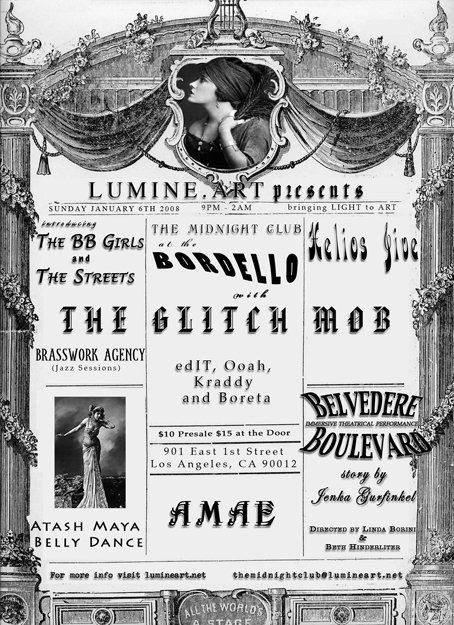
Sunday, January 6, 2008
Lumine.Art presents The Midnight Club
at Bordello Bar
901 East. 1st St.
Los Angeles CA. 90012.
The Midnight Club is an immersive theatrical experience where every patron becomes a participant in the night’s drama.
With Music & Performances by: The Glitch Mob (Ooah, edIT, Kraddy, and Boreta)
Helios Jive
Belvedere Boulevard…….Introducing The BB Girls and The Streets
Amae
Brasswork Agency (Jazz Sessions)
Atash Maya Belly Dance
(and story by me–that’s right, this party comes with a story!)
Set among the prohibition-era’s vaudeville underground, 1920’s attire is requested for the occasion.
The mobsters have class,
The women are fast,
And the liquor will last,
So while the night’s young come raise your glass…
at The Midnight Club!
in retrospect, it’s not so surprising that while i was studying film in college i was also producing art and music events as an extra-curricular activity. i joke that producing a movie and producing an event are pretty much exactly the same process, except with events you only get one take. in both cases what you’re producing is a story and an experience, so the transition, post-college, from film to festivals was, in a sense, really just the transition between one medium of story/experience creation to another.
whether written, filmed, experiential, or any other kind, i think stories in general appeal to us for the same reasons, yet we experience and appreciate them in different ways depending on the medium. just because the book might have been better than the movie, doesn’t mean it would make a better movie to film the pages of the book, dig?
Scripts by Marshall Herskovitz, the Emmy award-winning writer and producer, have drawn millions of viewers to movie theaters and television sets over the past two decades.
But on the Internet, where his 36-part series “Quarterlife” is unfolding on social networking sites like MySpace, the audience metrics are starkly different.
Some episodes of “Quarterlife,” a drama about a group of good-looking people in their 20s, have yet to attract 100,000 video views, according to combined view counts from MySpace’s video site and YouTube.
The low traffic numbers are significant because the series has been touted as the first television-quality production for the Web, as well as the first to be introduced online as a warm-up for its network debut. NBC will broadcast “Quarterlife” in one-hour increments beginning in February, and the Web-to-broadcast process is being closely watched as a potential business model for television on the Internet.
i wrote about quarterlife a few months back, before any of the episodes had come out. the prospect of what an “online series” could mean in terms of a new format for creating stories was really exciting to me. i even thought it was pretty neat that the show came with an accompanying online social network app aimed at being a resource for those going through their quarterlife crisis. (at least in theory. i’m not a member on quarterlife.com so i don’t really know for sure, but the impression i got is that the site seeks to facilitate collaborations among the nascent members of the creative class, and if that goal is actually being fulfilled then i sincerely applaud the effort.) that there was no indication at the time about the online series simply being a “warm-up” to a network debut is an interesting aspect unto itself, but there are more interesting things i’d like to talk about, in particular:
The Folly of a “Web-To-Broadcast” Model,
and the Tragically Misguided Concept of “Television on the Internet”
according to the NYTimes article, quarterlife’s sponsors, which include toyota, paid well above standard rates to appear with the series on the web. and perhaps the folks involved with quarterlife may want to consider why it is that they might have been willing to do that.
the same day as the NYTimes asked, “Can Web ventures like “Quarterlife” turn a profit? The answer is unclear,” online media daily reported:
CONSUMERS ARE 47% MORE ENGAGED in ads that run with television programs that they view online than those watched on a TV set, according to new research findings. A cross-media study by Simmons, a unit of Experian Research Services, also found that viewers are 25% more engaged in the content of TV shows that they watch online than on a TV.
as a marketer, one of my favorite things about quarterlife is that the brand integration is so seamless it makes the traditional concept of “product placement” look like cave drawings in comparison. two of the characters on quarterlife, aspiring filmmakers–the pragmatic producer and the visionary director, of course–pitch a local toyota dealership to shoot a commercial for the business. of course when they deliver the ad to the client, the owner of the dealership, says he can’t see his cars enough in the ad. how are people supposed to buy his cars if they can’t see them? so the duo then has to recut the ad to make it less high concept and more car-y, they screen the revised version for their friends, after which one of the other characters–the typically self-righteous activist stereotype who’s being positioned to become the lead character’s love interest–gives them shit for selling out and making a commercial in the first place, and bashes the “corporate hegemony” in the second. after which they deliver the revised ad only to be told it’s STILL not car-y enough, and then get scolded by the dealership owner for not being serious about their business–which is supposed to be helping HIS business sell cars. oh he also tells them that they don’t know what they’re talking about when they insist that the ad is supposed to be selling “the experience” of the car, which i thought was a particularly interesting touch. then after that other things happen, but my point is that this whole time that you’re watching several key plot points and delving into various bits of character and theme development–and this stretches out over several episodes–you’re watching toyota in the show.
it may not be subtle, but then neither was carrie bradshaw’s love for manolo blahniks. that’s the thing about authentic character development now, you and i express ourselves through the brands we buy, so why should it be different for the characters on our favorite shows? in fact, can we even identify with a completely brandless persona in a character-driven series enough to keep watching week after week?
well, to be honest, i don’t know. i haven’t really watched TV since i started college, (except for netflixing the whole run of sex and the city, and going on a 24 bender last year, and 2005 when i lived with some roommates who had a TV set, and i got all into the sopranos) but, i HAVE watched all 14 episodes of quarterlife out as of now. and if i was watching this on TV (well, if i owned a TV and was watching this on it) i think i would love it. i’d be telling my friends to watch it too, it would be significant that a television network had had the vision (or nerve) to create a show about our generation–a generation which is watching less and less TV though, and hence less and less incentive to make content for it, but regardless–if this was on TV, it’d be great!
except it’s not on TV, is it? while we allow a certain suspension of disbelief for the contrived nature of scripted programming on TV we have a dramatically different relationship with online content. we may not expect it to be TRUE, but we don’t expect it to feel artificial either. here TV’s forced quality feels almost…invasive, like getting a friend request from your mom or dad on facebook (or if you prefer: walking into your room to discover your mom or dad already in it). like, TV! what are you DOING in here?
the whole time i was watching those 14 episodes i felt like i was waiting for something to happen. some subtle yet hugely important aspect in the very nature of the show to change. i mean, great, it’s “television-quality” production for the web, but who exactly was lamenting its lack here in the first place? i’ve seen ipod billboards that felt more real and compelling than quarterlife. (and that’s coming from someone who really wanted to like the show!)
to be fair, i think the internet community too is just barely scratching the surface of the possibilities for online video content, but writing a TV script for the web is about as powerful a use of these possibilities as writing a TV script for a feature film, and given the results of that Simmons report, a “web-to-broadcast” strategy seems rather pointless considering that consumers are practically 50% more engaged with content the medium you’re starting out on. we’re by no means all looking for the same kind of content on the web, but we are not looking for the same old same old, either. i can’t wait for something to really take advantage of all the medium’s potential and uncover whole new ways of creating stories.
what do i think looks like it could be one such possibility?