

just found this photo in the icecreamman.com archives.
just found this photo in the icecreamman.com archives.
first, you need to watch the trailer for sony pictures’ across the universe: here. if you cannot be trusted to come back here afterwards, however, you can just watch the shittier-quality youtube version:
ok then. now that you have been adequately briefed, we can begin.
i first saw the trailer for across the universe on quicktime.com in march and was not only blown away by how stunningly imaginative the visuals looked, but actually–i swear!–brought to tears by the drama of 60’s-era youth struggle depicted in just 2.5 minutes of preview footage! needless to say, i saw the movie opening weekend, six months later, and left the theater feeling beyond satisfied. the movie was so visually innovative and different it was like i’d just witnessed julie taymor–the director-slash-visionary best known for broadway’s “the lion king”– reinvent the very concept of movie a little bit.
i then proceeded to tell all my friends they should check it out, and even posted the preview on facebook. i was somewhat startled to discover the incongruent presence on the movie’s otherwise fairly unimaginative site of a special link that allows for easy one-stop posting of the preview directly to facebook. either this was incredibly nuanced forethought, or obviously tacked-on afterthought, i figured.
last friday, the LATimes weighed in on that debate, asking: Is this the next cult sensation? as you may have noticed, across the universe is a musical about teenagers. and while the plot-line is punctuated by beatles’ tunes, the fact that this coming-of-age movie didn’t find an audience with middle-aged boomers, who were part of the original “beatlemania,” apparently came as a marketing newsfalsh:
To judge by “Universe’s” trailer, which began screening in front of “Spider-Man 3” in May, it wasn’t immediately clear which genre “Universe” belongs to. Is it a coming-of-age story? A rock opera á la “Moulin Rouge”? A surrealistic period piece? (Answer: all the above.) Worse for marketers at Sony, the film’s distributor, contractual obligations bound them from hitting home with “Universe’s” primary selling point.
“Yoko Ono, Paul [McCartney], Ringo [Starr] and [George’s widow] Olivia Harrison were all supportive of the film, but I couldn’t use the Beatles name in any advertising,” Taymor recalled. “That didn’t make things easy. And you can’t advertise that you have Bono, Eddie Izzard and Joe Cocker in cameo roles. We didn’t have a real big push from Sony; they were stumped by it. So nobody was really sure who the film’s audience was.”
i’m ten years older than the median teen-movie demo–but on the tail end of recovery from the quarterlife crisis the concept of trying to figure out life in a conflicted, confusing, “changing world” still feels totally relevant–and that’s, i think, the cutoff point for the audience to be marketing coming-of-age tales to.
After an uninspiring opening last month… help arrived in the form of an audience whose parents were their age when the first wave of Beatlemania hit. After three weeks in theaters, the PG-13 movie finally penetrated the top 10 by connecting with a zealous core constituency: teenage girls.
….According to Paul Dergarabedian, president of the box-office tracking firm Media by Numbers, audiences are now finding their way to “Universe” thanks to Sony’s textbook execution of what is known in the industry as a “platform release.”
“Expectations were unknown. But Sony has handled it perfectly. They got big initial interest in limited release, then they’ve been capitalizing on that every week.”
“They’re taking their time. On a movie like this, that’s what you have to do.”
so… like, besides the fact that the movie’s supercute cast is totally perfect bedroom-wall poster material, and that this “60’s story” is retold with acutely contemporary (and boomer-anachronistic) sensibilities…. did, um, no one at sony bother to check if maybe teenagers might not actually totally dig the beatles, at some point before they released the movie?
three and a half years ago (maybe somewhere around the time taymor got this funny idea for a musical) USA today reported:
Beatles historian Martin Lewis began spotting a young wave of Fab Four fanaticism as emcee of Beatlefan conventions the past 14 years. Boomers constituted half of the audience in 1990. Now 75% of attendees are under 30, and many barely in their teens.
As marketing consultant for The Beatles Anthology, he met with label execs plotting campaigns targeting fans 45 and up. “I’ve got news for you,” Lewis told them. “I’m the oldest guy at Beatlefan conventions.”
Sure enough, a marketing survey showed that the under-30 constituency scooped up 40% of the first Anthology run. “I’ve interviewed those kids,” Lewis says. “I’ve said, ‘Surely you’d rather listen to Justin Timberlake. Why are you here? Were you forced by your parents?’ But they chose to be there.”
the relative “drought” in contemporary rock (“Kids don’t come in and say, ‘I want to play like John Mayer,'” says a manhattan producer and guitar teacher quoted in a feb. 2006 article in rolling stone called “teens save classic rock“), multiplied by the internet’s universal ease of access to music of all decades, means you better do your homework about whom to target with your alleged “primary selling point,” yo. (even hiphop’s got love for the fab four as evidenced by wu-tang’s becoming the very first group EVER to legally sample the Beatles (!!?!)–sooooo… THAT happened.)
…anyway:
While Dergarabedian heaps praise on the marketing plan, Taymor feels the movie has benefited from a kind of benign studio neglect. “In a funny way, young people found the movie because it wasn’t marketed huge,” she said. “Young people don’t want to be dictated to about what’s the new cool thing.”
…. “We gave people the sense that they’d discovered it for themselves,” said Valerie Van Galder [the division’s president of domestic marketing].
i am sure that beyond classic rock’s sheer novelty or vintage cred, for the current crop of teenagers, its appeal likewise stems from the satisfaction in the personal discovery. this is a sense that is simply not possible to generate through mainstream teen-targeted music options. (wait… did classic rock just turn into alternative rock? wow. bizarre.)
i’ve written before about how valuable sustaining a sense of mystery can be for a brand, and it applies to the process of its initial discovery as well. whether sony was just hedging their marketing dollars on this weirdo bet of a movie, or whether they actually had the temperamental teen psyche aaaaall figured out reverse-psychology stylie when they eschewed spending money on any TV commercials, billboards, or PR, i think there’s something to be learned from across the universe’s model–accidental or not–that can be applied to a more deliberate kind of “discovery strategy”:
and in case you’re wondering, this is NOT a “viral campaign.” the difference is between a ploy to abuse some unfortunate loophole inherent in ADD for an attention-spike, and a strategy to enable the creation of a meaningful, personally-compelling discovery that leads to a lasting (consumer) relationship.
from the LATimes:
Nicole Sacharow, 15, from Culver City, for one, ranks “Universe” among her “favorite movies ever.” She’s seen it twice and would already have notched up several more viewings were it not for scheduling conflicts with her friends.
“You go up to a group of people and say, ‘Who wants to see “Across the Universe” this weekend?’ ” Sacharow explained. “The songs are addicting. Everyone who goes to see it has the soundtrack. I listen to it every day. I hear people singing the songs around school.”
i’d say the movie has the potential to become this decade’s RENT (the war allegory standing in for the 90’s AIDS nemesis.) with wu-tang paving the way on beatle’s rights clearance, i could easily see a broadway version of across the universe in the future. but where could they find a visionary, multi-Tony award-winning director to–oh!
uh… never mind.
following up on the smash success of its award-winning “evolution” ad, dove unleashes “onslaught“:
much like the evolution ad, which shows the intense makeup and photoshop augmentation of an image of an average woman and at the end offers, “no wonder our perception of beauty is distorted,” while directing viewers to take part in dove’s Real Beauty workshop for girls, the new ad–aimed at the same north american audience–warns viewers (ostensibly parents, but perhaps every woman’s inner child) to “talk to your daughter before the beauty industry does.” the spot likewise ends with a plug for dove’s self esteem fund:
“The Dove Self-Esteem Fund is a national resource established as a link to Dove’s Campaign for Real Beauty, a program aimed at changing the current, narrow definition of beauty. We believe that to make a real difference, we must take action and contribute in ways that will help women and girls celebrate their individual beauty.”
uh-huh…
of course when dove claims to “change the current narrow definition of beauty” they only aim to do so….narrowly. unilever, which is responsible for dove, also sells the fair and lovely “skin whitening” product to areas of the world where a dark complexion means you’re not getting invited to the “individual beauty” celebration:
and see, what you think you’re seeing here is a contradiction….but the reality is you’re not. although, no doubt, it’s easy to get confused about how that could be.
the same way that light skin is now a beauty ideal in india, being–as the national youth anti-drug media campaign would call it–“above the influence” of the beauty industry is the new beauty ideal in north america. the new unattainable beauty standard is the transcendent personal victory over the distorted beauty ideal itself. as viable an achievement as a victory in the war on drugs or giselle’s body.
unilever is, in fact, selling just as equally an unrealistic standard in both messages. considering that dove is about as much a “beauty” (or is it “nonbeauty” now?) product as fair and lovey–which is essentially just sunscreen, more or less–is a “skin whitener” it makes perfect sense that the messaging likewise would actually be so consistent. and in the case of the north american version, unsettlingly prescient.
as someone who’s worked in fashion PR, i can verily attest that ain’t no one hates the folks in the fashion and beauty industry more than they hate themselves. will all that self-loathing one day be enough to launch a whole “war on beauty?”
if it is, i’m sure dove films will be winning awards for its PSAs.
a play about cross-cultural communication:
burner – played by someone who is part of the burningman community.
non-burner: played by someone who is not.
– – –
burner: OMG! the man burnt early!
non-burner: what?
burner: have you ever heard of burningman?
non-burner: hmm… looks like some crazy festival in the desert?
B: yeah. they also burn a statue of a man. that’s why they call it burningman.
NB: well, i don’t really get the point of that but…ok….
B: so someone set it on fire last night. and now everyone’s all upset.
NB: i thought you said they’re supposed to burn it.
B: no… this was arson!
NB: what’s the difference?
B: well, first of all, it’s not supposed to get burnt until saturday night.
NB: what do you do with it before then?
B: nothing, really, you look at it, and ride by it and stuff.
NB: can you climb on it?
B: not recently.
NB: so it’s just a decoration basically?
B: well, i mean, it’s someoen’s ART.
NB: oh damn! who’s the artist?
B: the burningman organization.
NB: so it’s kinda like… corporate art? dude, i don’t know… there’s some tacky shit up in the lobby i wouldn’t mind…
B: hey! just because it’s produced by the burningman organization doesn’t mean it’s not someone’s creation.
NB: you’re right… that’s true. it is pretty crummy that someone burnt it.
B: yeah at least they caught the guy… you wanna see a mugshot?
NB: oh my god! that guy looks CRAZY!
B: well….
NB: what?
B: well, he kind of… a lot of people wear crazy outfits and makeup and stuff there.
NB: so this guy, he… fits in there?
B: well…i mean… yeah….
NB: i dunno…. if there’s a bunch of crazy tattooed people all running around in war paint and stuff–
B: hey! this whole thing is ABOUT “radical self expression!” that’s the whole idea…
NB: but… doesn’t what he did then… doesn’t that kinda count as pretty radical expression?
B: what? NO! look, radically self expressing means like… like… i spend the whole time there wearing a tutu and a cowboy hat simultaneously. ok? i don’t take away something from everybody who comes to the event just to see the man burn. that waits for this all year long.
NB: but they destroy the thing anyway!
B: you can’t destroy it until they say so!
NB: you know… all these rules sound really complicated and confusing.
B: it’s really not. it’s really all just about art. you know, people spend so much time and energy creating amazing art to bring out there and share with everyone, and this guy just–
NB: wait…you think maybe this was his art?
B: what?
NB: well, i bet this took a good deal of planning beforehand, and it’s certainly a statement–
B: what the hell kind of statement does it have?
NB: i don’t know… maybe something like, about culture jamming or somethig? it seems like there’s a message it’s trying to get across maybe, and it–
B: that is ridiculous. that isn’t art with a message! THIS is art with a message:
NB: oh. hm…. how much fuel you think it took to trasnport and construct atll tha?
B: ok. you know what…. i have to go finish packing now.
NB: ok. see ya. have fun!
B: thanks!
“To be nobody but yourself in a world which is doing its best day and night to make you like everybody else means to fight the hardest battle which any human being can fight and never stop fighting.”
— e.e. cummings
which is all quite noble and good, but the thing of it is, e.e., is that it’s very difficult, not to mention psychologically debilitating, to exist entirely out of cultural context. not only do human beings (and enough sad, shaky little monkeys that we don’t need to conduct this experiment anymore, please) suffer severe emotional and no doubt neurological damage when left in isolation, but in practical reality, whether it’s cultural heritage, gender, skin color, family education level, economic class, or whatever, the sum influence on “who we are” of certain variables of culture-caste is a bit tricky to evade. and in the end, even those that do manage to escape this influence in its entirety still don’t earn their own individual place in society anyway, cuz we just lump them into one big group called “crazy.”
that’s not to say that the rest of us aren’t, in fact, embroiled in a kind of nonstop battle like what e.e. was refering to, but it’s not exactly about the struggle to be nobody but ourselves in a world that is trying to make us like everyone else. rather it is about the anxiety of having to figure out how to EXPRESS who we want to be seen as in a world where the options keep expanding.
which is why “THE OFFICIAL GUIDE TO OFFICIAL HANDBOOKS” by andy selsberg, is a great bit of humorous salve on the battle wounds of that anxiety. by pitting the various Official This-Or-That (Preppy, Yuppie, JAP, BAP, Bobo Hipster–it’s like the star wars cantina, but real) handbooks against one another, it exposes, for a moment, the inevitable ridiculousness of the entire “we’re all different… in the same way” con game.
We tend to think our standards for the beautiful and good are natural and eternal. They aren’t. And you know who needs this analysis?…. Marketers. If business is about knowing how your customer thinks, then [these are] business book[s]. [They] tell you exactly how to jack all those fat baby-boomer wallets—whether you’re selling ice cream, a university, a book, a religion, or a company. When I see suits on planes reading business best sellers, I think: Wrong! Get some books that explain how groups try to reconcile their dreams of who they want to be with the social and economic realities of their world through the stuff they buy. Then get down to business. That’s what J. Crew did.
….dude! that’s what i’m talking about! i mean…like, literally.
you should totally check out selsberg’s fucking awesome article (and you may never take the cultural significance of a disproportionate use of such superlatives as “fucking awesome” for granted ever again once you do, dear reader).
here’s a fun timeline of all the Official handbooks referenced in his article.
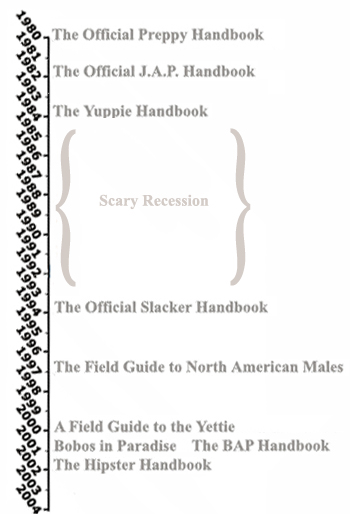
1980 – The Official Preppy Handbook
“Prep Sex: A Contradiction in Terms”
1982 – The Official J.A.P. Handbook
(that stands for Jewish American Princess, by the way)
“At the very core of the female Born JAP aesthetic are two guiding principles: 1) I am terrific; 2) Daddy will pay.”
1984 – The Yuppie Handbook
“Thou shalt have no other gods before thyself.”
1994 – The Official Slacker Handbook
“Part old-fashioned bohemianism and part fin de siècle exhaustion, placed against the backdrop of a crappy recession and intolerable suburban irony.”
1997 – The Field Guide to North American Males
“Wanna come over and watch The Simpsons?”
2000 – A Field Guide to the Yettie
Yettie = Young Entrepreneurial Technocrat
2001 – Bobos in Paradise
Bobo = BOurgeois BOhemian.
2001 – The BAP Handbook
(BAP = Black American Princess)
“Any name beginning with ‘La’ or ‘Sh’ and ending in -ima, -ika, -isha, and -ita is never considered by BAParents.”
2002 – The Hipster Handbook
This old vocabulary? I’ve had it since I was twelve.
and while you and i wonder what’s up with the delay on the Official G Handbook, the Official Cholo Handbook, and the Official ABC handbook, we can at least entertain ourselves with the hipster olympics in the meantime: