
Just… WOW! such great creativity and innovation with this. really freakin’ awesome.
CLICK THE SCREENSHOT BELOW TO EXPERIENCE IT >>>

Just… WOW! such great creativity and innovation with this. really freakin’ awesome.
CLICK THE SCREENSHOT BELOW TO EXPERIENCE IT >>>
Pop quiz:
Do you favor variety, novelty, diversity, new ideas, travel? Or do you prefer sticking to things that are familiar, safe, and dependable?
If you answered yes to the first question, then you are higher on a major personality trait called Openness To Experience (OTE). As psychologist Jonathan Haidt says in his TED talk, “If you know about this trait, you can understand a lot of puzzles about human behavior. You can understand why artists are so different from accountants. You can actually predict what kinds of books they like to read, what kinds of places they like to travel to, and what kinds of foods they like to eat.” Based on this trait you can also predict people’s political leanings. Robert McCrae, the main researcher of this trait, writes, “Open individuals have an affinity for liberal, progressive, left-wing political views, whereas closed individuals prefer conservative, traditional, right wing views.” If you cross check this information with your answers to the questions at the top, no doubt you’ll find that this holds true for you.
I think it’s a popular perspective among the liberal folk to assume that people who vote for republicans are “blinded,” or “asleep” or something. If only they could just “wake up,” then they’d realize the errors of their ways. (Much like many conservatives think about liberals as well.) Haidt refers to this kind of thinking as a “moral matrix.” A kind of group-psychology framework that makes it hard for either side to really be able to understand why the people over there are making the decisions they are. According to Haidt, what it inevitably comes down to is morals.
Haidt has been studying morality from the perspective of evolutionary psychology, investigating common denominators in what cultures all across the world value as right and wrong in order to uncomver what may be the innate moral predispositions “built in” to the the human exeprience. Thus, his definition of morality is “Any system of interlocking values, practices, institutions, and psychological mechanisms that work together to suppress or regulate selfishness and make social life possible.” According to his research, there are five distinct moral predispositions, which Haidt calls the Foundations of Morality:
1) Harm/care, related to our long evolution as mammals with attachment systems and an ability to feel (and dislike) the pain of others. This foundation underlies virtues of kindness, gentleness, and nurturance.
2) Fairness/reciprocity, related to the evolutionary process of reciprocal altruism. This foundation generates ideas of justice, rights, and autonomy.
3) Ingroup/loyalty, related to our long history as tribal creatures able to form shifting coalitions. This foundation underlies virtues of patriotism and self-sacrifice for the group. It is active anytime people feel that it’s “one for all, and all for one.”
4) Authority/respect, shaped by our long primate history of hierarchical social interactions. This foundaiton underlies virtues of leadership and followership, including deference to legitimate authority and respect for traditions.
5) Purity/sanctity, shaped by the psychology of disgust and contamination. This foundation underlies religious notions of striving to live in an elevated, less carnal, more noble way. It underlies the widespread idea that the body is a temple which can be desecrated by immoral activities and contaminants (an idea not unique to religious traditions).
Haidt’s analogy for how these five foundations work to create our personal moral frameworks is that of an audio equalizer. Each foundation is like a kind of “channel” that we can adjust to our own personal levels, according to how meaningful each one is for us. Both liberals and conservatives agree that the first two foundations are critical components of morality, and they set those channels way up high, with liberals tending to set them a little bit higher than conservatives. However, the big divergence point where liberal and conservative viewpoints drastically split apart is on the last three moral channels. Namely, conservatives value Ingroup/loyalty, Authority/respect, and Purity/sanctity as significant foundations of morality, bringing the levels up, and liberals view these three aspects as having nothing to do with morality, and bring them way down.
This phenomenon, by the way, is not specific just to the U.S. It applies to liberals and conservatives in regions that Haidt and his team studied all across the world, Canada, The UK, Australia, Western Europe, Eastern Europe, Latin America, the Middle East, East Asia, South Asia–this split is not a national phenomenon, it’s a human phenomenon. “Liberals,” as Haidt says, “Speak for the weak and oppressed. They want change and justice even at the risk of chaos. If you’re high on openness to experience, revolution is good, it’s change, it’s fun. Conservatives, on the other hand, speak for institutions and traditions. They want order even at some cost to those at the bottom. The great conservative insight is that order is really hard to achieve. It’s really precious. And it’s really easy to lose.”
The reality here, then, is that people who vote for republicans are not “asleep” or “unconscious,” and can potentially be “woken up,” or something, as liberals are fond of saying, but that they actually have a totally different sense of morality, and vision of society. In both metaphoric and demographic terms, liberals and conservatives want to listen to different music. Which poses a bit of a problem. Since they can only elect one DJ at a time.
In a 2006 Salon article, Andrew O’Heir wrote:
“It’s a striking fact of modern American life that rural white conservatives have become smarter, better organized and more militant, and that they now largely vote as a bloc. But the notion that there is some sort of equivalent or larger political grouping that opposes them in some coherent way is pure fiction. (See also: Democratic Party, recent history of.) Mann’s supposed metro majority simply does not exist — it’s a welter of races, social classes and economic strata, from the urban poor to the bicoastal intelligentsia to the security-obsessed suburban moms of demographic lore. Being non-rural, non-born-again and non-right-wing does not constitute an identity.”
This lack of a “unified liberal identity”–a concept that’s practically an oxymoron–has left them at a disadvantage, which has been expertly exploited by the united conservative front in recent years. As O’Heir writes, “These days, [conservatives] will support, with impressive solidarity, political leaders and public figures who share their backgrounds and their values, and whom they trust to reverse, or at least slow down, the pace of social change.”
Which makes me wonder–considering what Haidt and McCrae’s findings have revealed about the common affinity for change that liberal, Open-To-Experience personality types possess, perhaps Change itself is the one constant that could finally unite all their disparate identities.

Levi’s “unbuttoned” billboard. Fairfax Ave. @ 3rd St. Across the street from the Farmer’s Market.


Big news in Mobsterville this week. My favorite boy-band ever (and also friends, and clients) have officially signed with Windish as their new agency. As their original booking agent, Arin Ingraham, a.k.a The Ringleader Herself, says of this big move: “Watch out world The Glitch Mob has gained access to your sound systems.”
Could not be happier for these fellas. Congrats!
More big capers are afoot!
Have you ever been in a meeting where everyone in the room is using a Mac except one person? Ever notice what happens when suddenly everyone starts to get on that person’s case about the fact that he’s the only one not on a Mac?
I have, and it kinda looked a little bit like this…

That’s a still from the latest ads developed by Crispin Porter & Bogusky in Microsoft’s new campaign to–essentially–regain control of their identity, and it’s a pretty accurate depiction of how I’ve seen that PC-in-a-room-full-of-Macs situation play out. (Clearly, it must not be an isolated incident). In the ad, when the diver flips the white board over, the other side reads, “And I’m Kinda Scared.”
Now, I’m a Mac now, but the computer I had before this one was a PC. I’m just as comfortable using either, and I’ve got Microsoft programs running on this computer right now. I could even get a Mac that comes with the option of running Windows, anyway, if I want, so even though I’m a Mac user, I clearly don’t see my identification with the brand in terms like this–
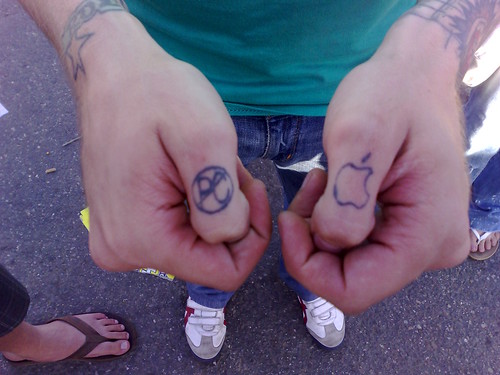
But many clearly do. And perhaps nothing has helped to articulate the contemporary Mac superiority complex quite like those Mac Vs. PC ads. In the iconic spots created by TBWA/Media Arts Lab, which began in 2006 and new iterations are still being developed now, a casually-dressed, attractive, 20-something guy introduces himself as “Hello, I’m a Mac…” while an older, slightly overweight guy, wearing glasses and a cheap lookin’ suit-and-tie combo introduces himself as “… And I’m a PC.” The two then act out little vignettes against a stark white background in which the capabilities and attributes of “Mac” and “PC” are compared. Often the spots end up presenting various legitimate PC shortcomings in an entertaining, glib way, but just as often the focus is on the two machine-characters’ personalities, and the feature comparison ends up being almost beside the point. Mac is always self-assured and easy-going. PC is resentful and awkward. The great success of these ads,
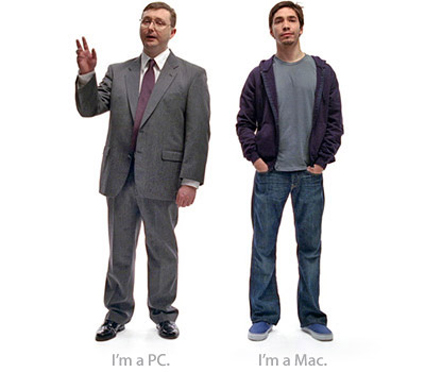
The subtext of these ads, which has also become the subtext of the Mac user community, is that this isn’t just a tool for enabling a certain kind of lifestyle, it’s a badge of it. A Mac isn’t just about helping you BE creative, it MEANS you are creative. A PC, on the other hand, means you are a stiff, unimaginative, frustrated tool, overly concerned with work, and incapable of doing anything interesting. At least not as good as a Mac can. Oh, and furthermore, if you’re a PC user, then you may as well know that this is what other people are thinking about you, too.
Personally, I’ve always been completely impressed that Mac has been able to brand a conformist white box into a symbol of creative and individual expression. But the idea is that your white box gives you entry into a whole network of other creative individuals, (just like you), and it’s that community association that bestows identity. A good friend of mine, who is a fashion designer, belly-dancer, serial entrepreneur, and has more tattoos and crazy hairstyles than the majority of the creative class, is a dedicated PC, and one of the major reasons for her choice is that she finds the idea inherent in a Mac–that you need this thing in order to express that you’re “hip”–to be a huge turnoff. A Mac doesn’t just bestow hipness to its users, it kind of subsumes it from them too. Perhaps she’s wary of this kind of accessory watering down or co-opting her own particular kind of hip. Either way, she says she feels like no one else has this line of thinking. It’s a turnoff “Only only to me,” She says, “I think PCs are just fine, and a lot more bang for your buck,” but everyone else she knows seems to have no problem with this aspect of their Macs.
It’s to let people like her know that there’s more of their kind out there, and to establish that their computers can, in fact, represent their creative, dynamic, interesting identities, that CPB took the direction they did with the new Microsoft ads.
Here’s one. You should watch it before reading further:
I think what’s really interesting here is that the ads say NOTHING about the product, or the features, or anything technical whatsoever. The sole purpose of the ad is to explore the diversity of PC users. I’m trying to think of another example of an entity trying to redefine its own identity by working to undo the stereotype of its “fans,” and I can’t think of one. (Anyone got one?) It’s pretty intense.
In a post titled, “Huh. Those Mac Ads Aren’t As Funny Any More,” Michael Arrington wrote:
Those Microsoft commercials aren’t particularly engaging, and they don’t make me want to go out and buy a copy of Vista. But what they do is show lots of fascinating people saying that they use PCs. They highlight the fact that many people may be somewhat offended by the idea that they can’t be interesting or cool if they don’t use a Mac.
Suddenly, Apple looks a little elitist. I mean, they were elitist before, but in a way that made you want to be a part of the club. Now, they just seem a little snobby.
If that’s what Microsoft and their pushing clients to the edge advertising agency Crispin Porter + Bogusky were aiming for, it’s brilliant.
According to the New York Times, CPB “Relishes efforts to transform perceived negatives into positives.” (See also announcing the onset of an “SUV Backlash” to help promote the US launch of the Mini Cooper–before any such backlash had yet begun at all, positioning the Mini’s uber-compactness as an alternative to the gas-guzzling hegemony.)
More from the New York Times:
Apple executives have been “using a lot of their money to de-position our brand and tell people what we stand for,” said David Webster, general manager for brand marketing at Microsoft in Redmond, Wash.
“They’ve made a caricature out of the PC,” he added, which was unacceptable because “you always want to own your own story.”
The campaign illustrates “a strong desire” among Microsoft managers “to take back that narrative,” Mr. Webster said, and “have a conversation about the real PC.”
The celebration of PC users is intended to show them “connected to this community,” added [Rob Reilly, partner and co-executive creative director at Crispin Porter], “of people who are creative, who are passionate.”
Every single person featured in this ad is somehow compelling and enigmatic. Perhaps it’s because they’re all so different. You have no idea who is coming next. They challenge not only the expectations of who a PC is, but the assumption that you’re supposed know everything about who someone is just based on the kind of computer brand they use. (Talk about “Think Different,” huh?) If the Mac community is “alternative,” the one depicted in the Microsoft ad is global. If the Mac community is elitist, this one is accepting. Beyond “creative and passionate,” this community has a real sense humanity. It’s worldly and smart and open-minded and profoundly diverse. It’s approachable and philosophical. A community that’s out to change the world, and enjoy the world; a community that’s what the world might look like if everyone in it got along. And regardless of whether you’re a Mac or a PC…what kind of progressive human being (not a human doing, or a human thinking) wouldn’t want to be a part of a community like that?
The next time I need a new computer, maybe it’ll be a Mac, and maybe it’ll be a PC, but either way, I find it comforting and heartening to know that this is the kind of community a company like Microsoft sees–and wants the rest of us to see–as its own ideal.