late-adopter strategy

like a true teenage product of the 90’s i blame video games.

last week i caught the tail end of an npr bit about the nintendo wii which mentioned that the console was currently outselling both sony’s playstation and microsoft’s xbox combined. the explanation for this seems to be that because of its uniquely simple controller the wii is able to appeal to a much broader audience than the other more complicated consoles. the implications of that on the dynamics of adoption is what’s inspired this recent investigation on the subject.

about a year and a half ago i was busily dashing all over L.A. on a quest for sneakerheads. while scouring undefeated, kicks, sportieLA, kendo, greyone, and generally cruising melrose ave. like a freakin pimp (in the traditional sense of the word), i was actually on a black ops consumer insight mission. i was working with an agency that was preparing to pitch pony, and so we wanted to glean from these kicks connoisseurs info on the current state of shoedom. now, sneakerheads are folks with an average of like, oh…. say 80-180 pairs of sneakers (i don’t know if maybe you do, but i don’t think i own 180 pairs of anything), and i was on a quest to find these experts and offer them the opportunity to get to talk about their #1 favorite subject: shoez.

yet uniquely suited to aiding and abetting the process of marketing research with their undisputed ability to distill meaningful patterns out of that which to the layperson is just chaos, though they may be, these kinds of experts hanging out on the knuckles of the s-curve arm have a very obvious shortcoming. that very same expertise skews their particular perspective. these VERY early adopters, who get up while all the rest of us are still sleeping, typically represent a demographic whose expectations and predispositions are colored by the standards of what kathy sierra calls the “higher resolution experience,” an experience that by its very eliteness does not translate to the majority.

from sierra’s keynote speech at sxsw this year:

“For example, some of you may be going to the music festival [portion of sxsw]. There may be some of you who are going to get laid or for beer. Some of you may actually understand something about the kind of music, and you may have some deep appreciation for some aspects of the music. You’ll hear different notes; you’ll hear more notes; you’ll hear things the rest of us don’t hear. I’m not a music expert, but I have a little bit of experience with mixing boards, so it kinda sucks, because I’ll go to a concert, and I’ll be like, “Oh, if I could just get my hands on those faders”– so it’s a little bit of a higher-resolution experience for me.”

the funny thing is that only an expert would even TALK about the “higher resolution experience.” everyone else doesn’t have any clue that such a concept even exists or what the hell it means. so think about what that implies about the resonance of a campaign (or product) that stringently emphasizes the “higher resolution experience.” there is a whole population of people that aren’t simply “not going to get it,” but rather what they ARE going to get is the message that “this here is not for me.”

which brings us back to the subject of the wii.

before the wii, the video game industry had become mired in a sort of stagnation. newer consoles were coming out, but there was nothing actually new emerging at all (guitar-hero not withstanding for the moment). as each iteration seemed to only up the complexity (i.e “resolution”), of the same sort of staid video game experience, their appeal was becoming more and more narrowed.

from an article in TIME last may on the eve of the wii release:

“The one topic we’ve considered and debated at Nintendo for a very long time is, Why do people who don’t play video games not play them?” [Nintendo president Satoru] Iwata has been asking himself, and his employees, that question for the past five years. And what Iwata has noticed is something that most gamers have long ago forgotten: to nongamers, video games are really hard. Like hard as in homework.

not only were novice users turned off by the intimidating (read: not fun) learning curve, but this wasn’t so good even for the people who could see the hi-res stuff, as many hardcore gamers were getting bored by the substitution of complicatedness for innovativeness.

and then along comes the wii to breathe simple, accessible, fun, new life into the world of the video game console.

Nintendo has grasped [an] important notion that [has] eluded its competitors. Don’t listen to your customers. The hard-core gaming community is extremely vocal–they blog a lot–but if Nintendo kept listening to them, hard-core gamers would be the only audience it ever had. “[Wii] was unimaginable for them,” Iwata says. “And because it was unimaginable, they could not say that they wanted it. If you are simply listening to requests from the customer, you can satisfy their needs, but you can never surprise them.”

and you also can’t necessarily rely on them to show you how to appeal to new KINDS of customers. particularly, customers at a different point on the adoption curve. a year after that time article came out, advertising age reports that the wii’s popularity is “part of a growing phenomenon that’s overhauling the video-gaming industry…. Video gaming is beginning to transcend the solitary boy-in-the-basement stereotype with a new generation of gamers including women, older people and younger children who want to play in a more social atmosphere.” (like, who knew, right?)

by deliberately pursuing a strategy to appeal to the majority, nintendo not only managed to bypass the bottleneck at the left elbow of the gamer bell-curve, but, in fact, to actually expand the very scope of what is a “gamer” identity.

another great example of this is what lexus did in the process of developing the strategy for their certified pre-owned (CPO) car program. CPO cars offer an array of late model, low-mileage vehicles, passing or meeting stringent manufacturer’s inspections, and backed by manufacturers’ warranties.

initially the auto industry lumped CPO customers in with the used car buyers, until a whole lot of research revealed that CPO vehicles actually appeal to their own unique kind of luxury car consumer, a demo that exists in a distinct category between “new” and “used.”

from the book Using Market Research to Create Effective Advertising:
(das what the man said)

The auto industry approach to marketing CPO vehicles was completely discordant with the consumers’ real needs and shopping patterns…..

People interested in a CPO vehicle begin with a consideration of what brands and models are right for them. Status, image, and the more emotional elements of a car purchase are at play. Pricing and budgeting decisions, which drive the used-car buyers’ purchase process from the beginning, do not factor into the CPO car buyers’ process until much later.

These findings were critical in leading Lexus and Team-One to the conclusion that CPO buyers actually mirror new car buyers’ shopping patterns and behaviors, rather than used car ones.

much like nintendo’s strategy with the wii, by focusing on the particular needs of consumers that exist beyond the early adopters Lexus’s CPO strategy expanded not only their understanding of their own brand’s adoption, but the scope of the entire class of luxury car consumers.

an interesting thing to also mention here is that while the wii has gained huge popularity in the majority, it has likewise engaged the curiosity and the desire for something new and fresh from seasoned gamers. likewise the success of lexus’s CPO campaign is no doubt an added incentive to the new car purchasers’ in the sense of increased security about the car’s resale value.

rather than a strategy developed to appeal to early adopters with the expectation that it will eventually transcend to everyone else, these are two examples that represent an approach that appeals directly to groups situated further along the adoption curve. distinct and viable markets do indeed exist beyond the early adopter, and not every strategy can or needs to be designed to specifically suit that one first group. understanding the differing needs and tastes of consumers along the various stages of the adoption curve, and developing strategies to address these groups’ expectations in targeted, relevant ways is key.



Subscribe for more like this.


on rating adoption

“If you don’t love everybody, you can’t sell anybody!’
Jerry Maguire’s mentor “Dicky Fox”

ok, enough with the fun and games. heave a sigh of relief to not be breathing playa dust anymore, put away your white clothing, let’s get serious, and talk about marketing.

one of the things that i haven’t given too much attention here yet, but consider hugely significant in the development of any marketing strategy is the dynamics of trend diffusion–that is, the process(es) by which trends, products, and ideas spread, and become adopted by and across cultures/markets. as with everything else i do, my particular perspective on the workings of these processes is colored by the lens of identity. people buy those products and brands that they identify with in some fashion, and this likewise affects the point at which they buy them. my approach to diffusion then, is something akin to the scientific process of pouring the active ingredients of adoption patterns into the identity solution and seeing what poofs out.

various theories have been developed to explain how diffusion works. there’s the dancey sounding two-step flow model developed by paul lazarsfeld and elihu katz, in which mass media information is channeled through “opinion leaders” (step 1) to the “masses” (step 2). whether or not this was ever so simply the case outside of the catholic church deali-o, in the current cyclical context of the age of conversation it certainly is no longer. there’s also the politically reminiscent trickle-down effect which says that as products become more affordable they sell better, the coefficient of diffusion thereby being nothing more complicated than price point. as reaganomically limited in its scope of the overall situation as the theory’s name would imply.

in the 60’s everett rogers broke the adoption bell curve down into different types of adopter personas in his diffusion of innovation theory:

and a bit later on frank bass came along with a lot of terrifying math stuff that looks like this:

frac{f(t)}{1-F(t)} = p + {q}F(t)

Where:

 f(t)  is the rate of change of the installed base fraction
 F(t)  is the installed base fraction

 m  is the ultimate market potential

 p  is the coefficient of innovation

 q  is the coefficient of imitation

Sales \ S(t) is the rate of change of installed base (i.e. adoption) \ f(t) multiplied by the ultimate market potential \ m :

\ S(t)=mf(t)

 S(t)=m{ frac{(p+q)^2}{p}} frac{e^{-(p+q)t}}{(1+frac{q}{p}e^{-(p+q)t})^2} 

The time of peak sales \ t^* : t^*=frac{Ln frac{q}{p}}{(p+q)}

but all he was really trying to do was name a subwoofer after himself, i.e. the bass diffusion model, which presents a relatively more nuanced perspective for understanding the adoption process:

image:Bass new adopters.gif

the bass diffusion model at least reflects a deeper insight onto what’s going on in this messy process than what the other fellows had to offer with their minimalist s-curves and bell curves and whatnot, but there is one consistent problem with all these graphs, and it’s exactly what you’d expect the problem WOULD be with the creative output of mathematicians:

the words.

“laggards”? “imitators”? mathematicians can maybe claim social ineptness and get away with labelling people in this kind of tactlessly condescending way, but what excuse do marketers have? the implication in the labels for the different adoption categories is not only the assumption that consumers must be striving to catch up to the left side of the graph at all times, but leaves nothing to the imagination about how much respect the folks relegated to sitting on the “back of the bus” deserve.

these are the people we are counting on to BUY our shit at some point, and this is what we call them? see, it seems like it’d be easier if everyone could just be bulldozed leftwards as soon as possible, (where they will be treated as the cheap dat–wait, no errr– as the first-class citizens we want them to feel they are), but in reality i don’t think that’s true were it even possible. not only would early adopters have no way of distinguishing themselves (bye-bye prized adopter category), but if everyone was huddled over on the left, brands would not have the opportunity to recalibrate their strategy; it would just be a one-shot chance to succeed or, what’s more likely, fail.

since it may appear that we might actually NEED the right side of the curve to even out the stakes a bit, perhaps we ought to consider that there are benefits in being able to understand it better. in fact, instead of just blindly inflating the egos of the prodigal “early adopters,” like parents worrying about our kids’ “self-esteem,” there may be benefits in understanding the nature of what is actually going on along the entire curve in greater detail.

the first step is to acknowledge that we shouldn’t assume the various stages on the adoption bell curve are just phases people are going to grow out of or hoping to level up through. the second is that thinking of the categories as their own self-contained identity segments is useless.

think about someone you met relatively recently asking you what kind of music you like. unless it’s within several days of your birthday or christmas, that question is not actually strictly about sonic preferences. people can easily admit such things as “i like british indie rock” or “i like southern rap” or “i like dirty sexy glitchy breaks,” and because musical taste can often translate to much bigger things about a person’s lifestyle, aesthetic sensibilities, community, perhaps even their values, asking what kind of music someone likes is basically just a much more efficient–not to mention pallatable–way of asking them to explain some fundamental aspects of their fragile identity. music preference easily establishes a common language for particular kinds of consumer identities and therefore is a relatively useful way to define market segments.

thinking of an adoption category as a useful means for defining consumer identity unto itself is about as effective as using latin to communicate in modern-day europe–it might be related, but it will not actually get your message across.

there is such an enormous variety of factors that affect not only why someone (or a certain kind of someone, or certain groups of kinds of someones) would make a particular purchase at a particular point, but also why they’d make different purchase decisions at differing points in the diffusion timeline, that whether someone is an “early adopter” or a (eeuggh) “laggard” in itself, tells you practically NOTHING about their identity or how to communicate with them. a friend of mine got an iphone on the first day but still doesn’t have power windows in his car–does this make him an early adopter, or not?

there’s a lot more to say on this topic and i’m not going to bother shoving it all into one post. this one’s enough to set the scene for where the action’s headed, i think. the main point to take away–in case you got frightened by the scary math stuff, and haven’t bothered to read anything since then up till now–being:

suspending the value judgement from adoption categories, and instead developing a more nuanced understanding of their intricacies and functioning, and the particular needs of the individuals within them, will result in more effective strategy.


Subscribe for more like this.


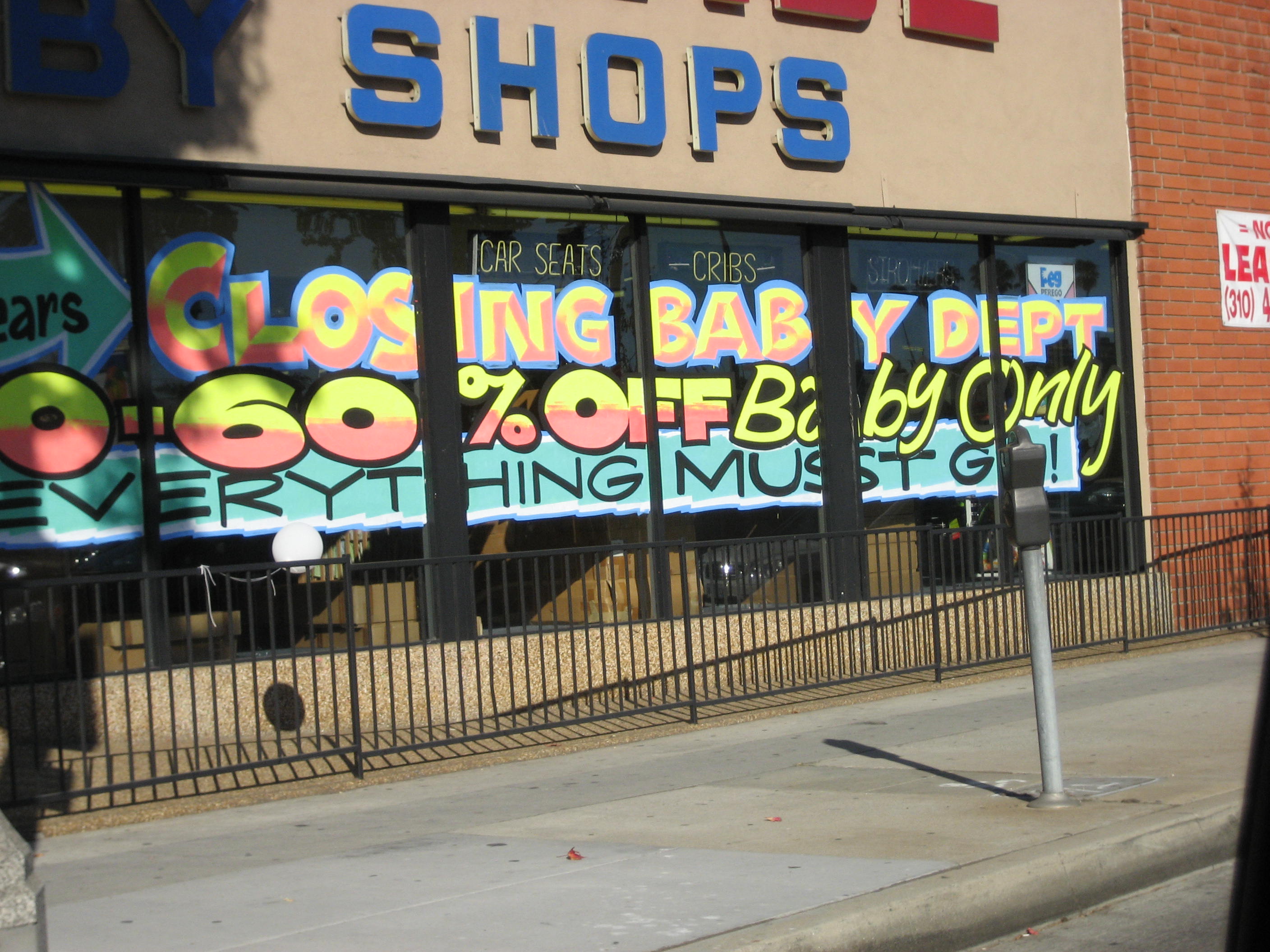
babies no longer buying furniture

img_3744.JPG

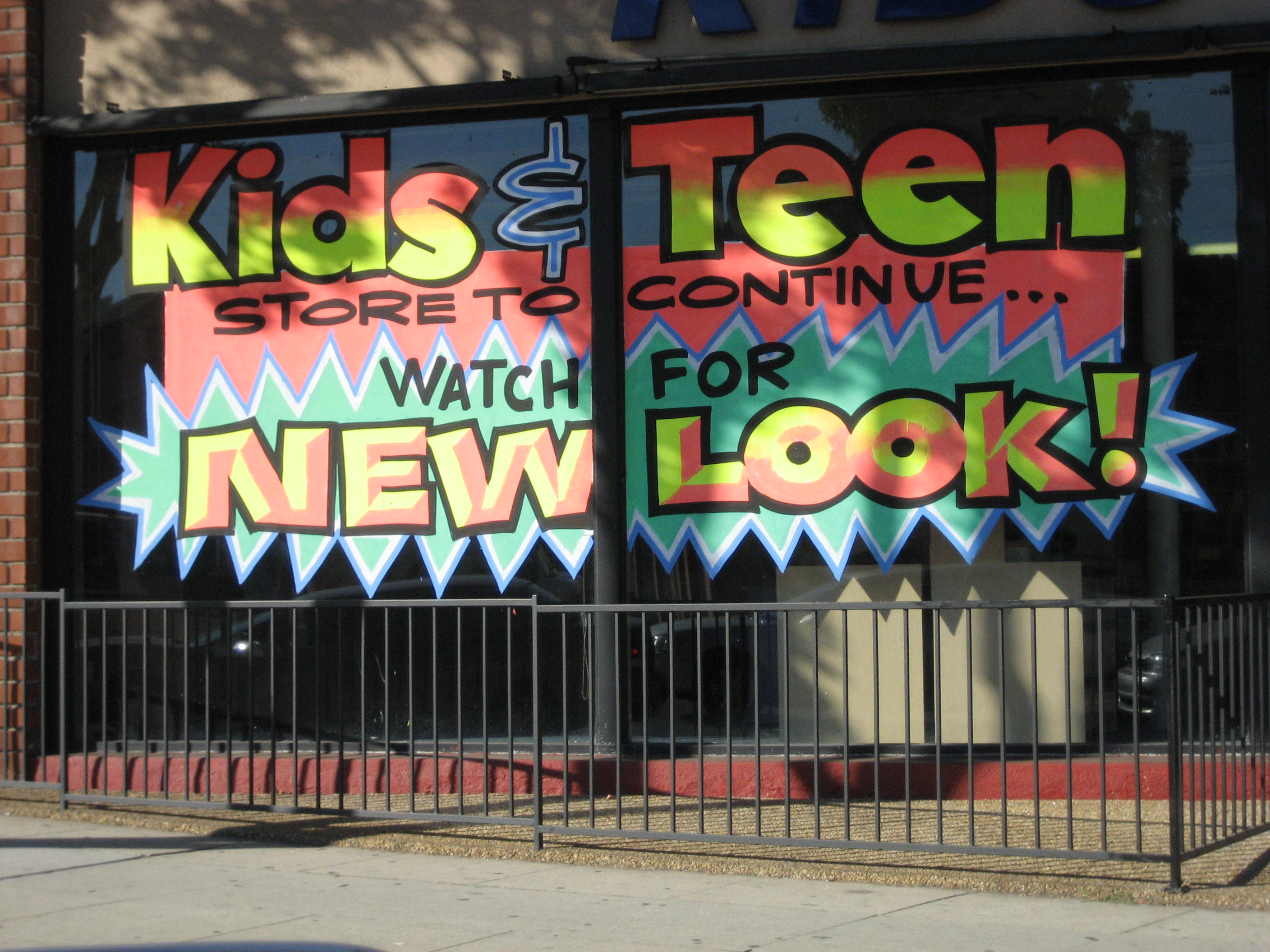
teen spending, however, remains stable.

img_3745.JPG

or maybe new parents are increasingly just buying all this stuff online.


Subscribe for more like this.


what does a web entrepreneur have in common with a fashion designer?

http://www.smejtese.cz/smejtese/images/obrazky/reklama/Benetton5.jpg

when i worked at house of blues, every so often we’d have social events with all the other people working in l.a.’s concert marketing industry. people from goldenvoice, livenation (at the time this was a separate company from house of blues), nederlander, etc. lots of people in attendance had even worked at one of the other companies prior to their current position, so to a great extent the people showing up already knew one another well anyway. the real benefit of attending such an event thus wasn’t even really to meet people from whom to gain new insight so much as to validate your own membership in the industry. i think this quintessential misunderstanding leads a great deal of “networking events” to confuse the goals they are trying to fulfill by focusing their outreach inward vs. extending it out. (intra-industry vs. intER-industry).

last week i went to twiistup, an event for “mingling with other techies in a lively atmosphere of tunes, videos and inspiration.” i am not a techie by any stretch of the imagination, and i actually hate mingling (mingling is like the thing cows do in the holding pens on the way to the slaughterhouse. they… mingle.) so mostly i was going for the “inspiration.”

in an interview with entrepreneur.com, john c. head III dean of MIT’s sloan school of management, and david s. evans, vice chairman of LECG europe and visiting professor at the university college in london, co-authors of the Catalyst Code, talk about one of the most profitable business models in today’s economy, the “catalyst business”:

You ask yourself, Are there two groups you can profit from getting together? A catalyst business serves two or more distinct groups of people who benefit from interacting with each other, but need help to do so efficiently.

this kind of perspective for hybridity and creative collaborations speaks very much to the kinds of opportunities that all the inward-focused networking events are missing. as a marketer, what piqued my interest in twiistup wasn’t about the latest, most obscure, soon to be hip, “underground” apps or widgets or whatevers, but rather the reasoning behind their creation. what, exactly, about this particular app or widget or whatever did the creator consider relevant enough to the current social climate to warrant all the time invested into its creation? you don’t need to be a techie to appreciate that question, but what i discovered is that unlike “what does this do?” or “how does this work?” in an environment teeming with people creating products that beg the question, the answers are in notoriously short supply to “why does it matter?”

schmalensee says:

I don’t want to put down technology guys, because somebody has to make the idea work, but at the end of the day, the creativity comes not in writing the code, it comes in seeing the business model and thinking it through from a business point of view.

The key is not that you have to be an expert in the technology, but you have to not be afraid of it. You have to not say “Oh, I’ll never understand that”….Where you make the money [is] not in the new “gee whiz,” but what the new “gee whiz” can do for people.

part of the problem is that it’s not always so simple to see the forest in the context of an outside perspective when you’re in the thick of the overgrowth. being so mired in the details makes articulating the thing’s overall relevance much more difficult. this is then ever more reason why “networking” events should reach out to a broader range of industries. it’s not simply that non-technologists can benefit from overcoming the tech-phobia, it’s that everyone can benefit–that is, catalyst strategies are born—from overcoming industry xenophobia.

evans says there are probably more opportunities to start catalyst businesses now than ever before and proposes the reason for this is that many of the elements that you need to start a catalyst business (i.e. communications technology) have become easier to get. but i would argue there is another, just as powerful force involved here: culture.

in the rise of the creative class richard florida presents the idea that there is a distinct demographic segment, comprised of knowledge workers, intellectuals and various types of artists, with its own particular predispositions and proclivities. beyond just the nature of their occupations, this “creative class” is also defined through commonalities in many of its members’ lifestyles and values. i think there are two particular ways in which the attributes of this expanding cohort relate–not coincidentally–to the kind of business model evans and schmalensee see expanding as well:

1. the creative class grows through the very processes that catalyst-businesses enable. the creative field of technology merged with the creative field of music, develops whole new fields within music/audio technology. likewise with technology and art, and so on.

2. this group (which fills about 12% of all U.S. jobs) is disproportionately responsible for the development of the contemporary cultural landscape, passing on the very values of hybridity that fuel the catalyst-business model to industries and fields beyond just the creative class itself.

evans and schmalensee might say that what connects a fashion designer and a web entrepreneur, is that, for instance, the former would need the latter to stay competitive in their online presence, but that’s just scratching the tip of the iceberg.

what industries of all creative flavors have in common is the necessity to take the significance of cultural trends into consideration. whether you are working in technology, music, design, marketing, entertainment, business, or really anything else where what’s going on in the greater culture matters, then being able to accurately distill, develop, and disseminate cultural relevance can mean the difference between success and failure. literally. is there anything successful that WASN’T relevant to its time?

(….ok, van gogh is coming to mind…. but i’m telling you: it’s a short–posthumous–list.)

it seems then that a good way to avoid a fate of irrelevance would be to explore the directions that the industries driving culture in tandem with yours are leading culture. a great forum for jus such an exploration (on any scale) is a “networking” event.

for the creative class, culture is the raw material ALL of us work with, and all of us have a hand in shaping different aspects of it. it’s why the answers to the “why does it matter?” question are so important to me, and should probably be to you too. one of the goals for any significant networking event aiming to provide value to this particular yet disparate demographic segment then, should be to apply this approach towards a greater industry hybridity.


Subscribe for more like this.