what ad agencies can learn from indie brands

In Buying In: The Secret Dialogue Between Who We Are and What We Buy, Rob Walker talks about “underground brands”–lifestyle symbols created by independent entrepreneurs. In fact, I actually think it’s easier to think of underground brands as “independent brands,” (cuz what does “underground” really mean, anyway?) much like independent music:

In popular music, independent music, often abbreviated as indie, is a term used to describe independence from major commercial record labels and an autonomous, do-it-yourself approach to recording and publishing.

Similarly then, indie brands are independent from major publicly-traded companies, and reflective of a do-it-yourself approach to lifestyle symbol creation. Both indie and major brands appeal to consumers for the same reasons–as expressions of identity, and community belonging–but the indie side functions very differently. Indie brands can often take risks that the major ones wouldn’t know how to were they even interested, they are able to maneuver more deftly in a rapidly changing consumer landscape, take advantage of new opportunities more swiftly, and now more than ever before, they are blazing the trails and creating the models that many major brands are starting to emulate.

As someone who’s been intimately involved in the development of several independent brands I thought I would share some suggestions both from my own experience, as well as from insights synthesized with various examples from Buying In, of what ad agencies (and major brands) can learn from the indies about staying competitive in contemporary culture.

1. INTEGRATE DEPARTMENTS
Agencies talk of integration like it’s the latest buzzword since “viral,” (which, incidentally, before it was a buzzword, was also first tested by independent brands) but most are still set up to approach marketing in a compartmentalized, paint-by-numbers way that doesn’t fit with how any of us in the digital era actually interact with media and messaging. In a time when we update our facebook status while watching TV online, and google something we’ve just seen on a billboard we drove past, all media overlaps. As natives of this environment, indie brand creators don’t think “Print” vs. “New Media” or “Creative” vs. “Media Buying.” Of course, a variety of skill sets is necessary, but when a “media channel” can now basically exist anywhere that people are playing attention, it’s counterproductive to continue enforcing separation between all the various departments of messaging development and dissemination. Without the imposition of this bureaucratically segregated setup, indie brands approach marketing as an inherently integrated process, dealing with the way the different channels at their disposal feed into one another as part of an interconnected system.

2. HIRE DIFFERENTLY
None of the indie brand creators I’ve ever worked with majored in marketing–and that goes for me, too. Marketing majors end up at ad agencies, indie brand creators, on the other hand, end up creating culture. Music, fashion, publications, events, blogs, graffiti, whatever. If it’s a genre of DIY expression, that’s where indie brand creators can be found, and it’s where strategies that take on new marketing options are going to be developed. I’ll admit, I did take one Marketing 101 class, though, and it’s probably because marketing is taught as a segregated process that its students are primed to continue thinking within the same kind of box once they graduate. Indie brand creators think outside the marketing box because 1. They were never taught there was a box to begin with, and 2. They couldn’t afford to try out the box anyway, so developing “alternatives” is their default. This is who you want to be hiring to help develop progressive marketing strategies.

3. INVEST IN CULTURE NOT MEDIA
In a consumer landscape niched up into various lifestyles, “mass marketing” is becoming increasingly irrelevant. Indie brands have never had the luxury of a mass marketing budget, so they’ve instead focused on building and sustaining meaningful relationships with the communities that nurture them. In Buying In, Walker talks about Pabst Blue Ribbon’s strategy after discovering that their brand, whose history was essentially as a staid Midwestern working class beer, was experiencing an unexpected popularity surge among the pierced, tattooed, bike messenger alterna kids in Portland Oregon. Clearly this was not a demographic that PBR had sought deliberately (the brand just happened to become quite eagerly adopted by a young culture in need of a cheap beer), but once they noticed what was going on instead of buying up a ton of media targeting this demo, PBR began sponsoring community events such as “bike polo” matches. In fact, a particularly ardent PBR fan that Walker talks to specifically noted he appreciates that he’s never seen a PBR ad of any sort. It shows that “they’re not insulting you,” he says. If advertising AT a community can be perceived as an insult, supporting it can make a brand an integral part of the community’s culture.

4. A BLANK SLATE IS THE BIG IDEA
Ad folks think it’s their job to create advertising. Indie brand folks think it’s their job to make sure their product sells. The disconnect between these two perspectives is perhaps nowhere more blatant than in the ad agency reticence towards “user generated content.” This is not to say that ad agencies shouldn’t create branded content, by any means, but rather to point out, as Walker does, that some of the most potent brands are ones that have allowed people to project their own meanings onto them. His two biggest examples of this are Hello Kitty and the Live Strong bracelet. One benefited from an inscrutable expression, the other from a statement that allowed innumerable personal interpretations. Neither sought to define what specifically it was supposed to mean or stand for, and thereby each allowed people to cast their own relevance onto the brand. Unequivocally cementing a brand into a “big idea” couldn’t accommodate that. Creating a brand that functions as a “platform” for consumers to create their own meaning (whether it’s as literal as UGC or as ephemeral as a personal projection) is now just as crucial as messaging.

5. COMMUNITY FIRST, BRAND SECOND
It is tempting to think that a brand creates a community. In fact, many brands, realizing the power of community as a resource, strive to create their own, and brands such as Apple definitely have a cult-like following. But the reality is that brands do not create communities from scratch, they become symbols of communities. Brands can reflect a community’s values and lifestyle, but I don’t think it’s possible to brand a lifestyle before it actually already exists. Was Apple as hot before the rise of the creative class? (The trend itself, I mean, not just the book about it.) Of course, the Apple technology certainly helped facilitate the expansion of the creative class, but the bottom line is that the societal predisposition that can come to constitute a community has to be there, and a brand does not invent it, it reflects it. Indie brands are spawned out of the very communities that they represent, so it’s not like they need to conduct massive amounts of consumer insight research, and their understanding of this community first, brand second dynamic is deeply intimate. For many major brands, however, the focus shouldn’t be on fabricating their own “community” but on developing a more significant understanding of the needs of the communities that buy and endorse them. (Then, see #3).

6. THINK BEYOND THE QUARTER
The relationship between a culture and a brand, like any kind of relationship, takes time. That it can’t always be statistically documented after three months does not necessarily make the relationship unsuccessful. My favorite example of a brand thinking “beyond the quarter” is Scion integrating it’s cars into Whyville, an online community for tweens. Pretty much the coolest thing you can buy in Whyville is a Scion, and its added bonus is that then you can drive all your other friends around in it in the game. They start at 15,000 “clams” (Whyville dollars), but for 20,000 you can get it all customized. The most fascinating thing about this whole strategy, however, is that the Tween demographic is between 8-12 years old. It’s gonna be a while before they even have a driver’s license at all, let alone be in a position to be buying a car in the real world, but when they are, owning that virtual Scion will no doubt be an experience they draw on when making the purchase decision. This is thinking five, ten, fifteen years beyond the quarter, and it’s how indie brands think. Ok, maybe they don’t necessarily have the forethought to think that far ahead, but they do have the luxury to not have to think of success as based on proving something to shareholders every season. After all, just ask Starbucks about how rampant growth can even undermine success in the long-run.

The trend of more and more kinds of facilities cropping up to support DIY creative endeavors means that more and more kinds of indie brands are getting created. The evolution of marketing that doesn’t look anything like what it has before is only going to continue. Might as well take a cue or two from the side that’s plowing head-first into the changing the landscape.



Subscribe for more like this.


the evolution of the LIB music player

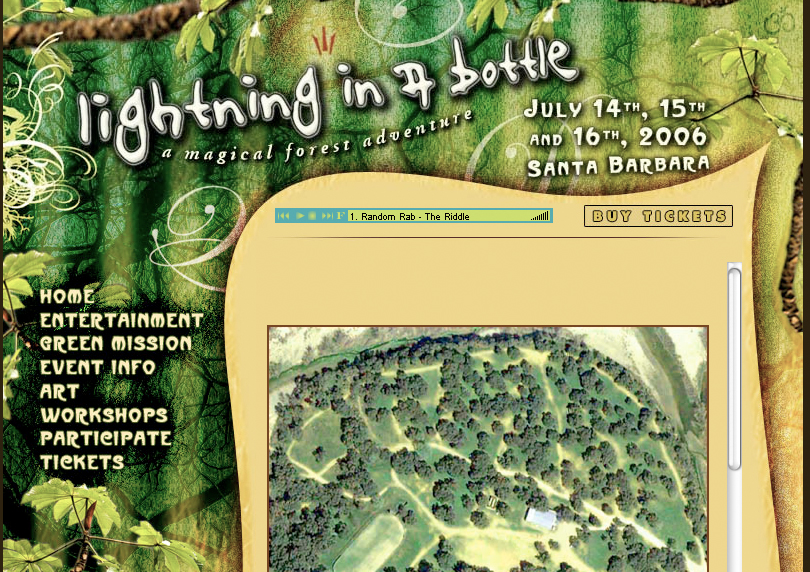
LIB06:

an immobile little flash dookiy embedded in the site:

http://social-creature.com/wp-content/uploads/2008/04/lib06.jpg

up close it looked like this:

http://social-creature.com/wp-content/uploads/2008/04/lib061.jpg

at the time we thought it was quite the snazz.

LIB07:

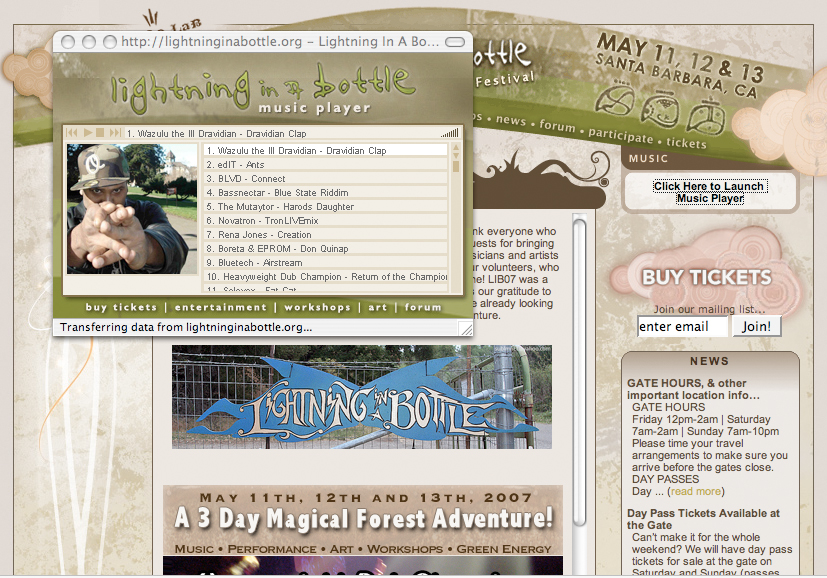
we figured this kind of media thingie shouldn’t be trapped on our site, so we created a “portable” popup player that you could launch on our site, and then take along with you on your web travels:

http://social-creature.com/wp-content/uploads/2008/04/lib071.jpg

the other cool thing about this portable online player is that it linked back to the LIB site, allowing peolpe to return with one click at any time.

and that was fine and dandy until…

LIB08:

we made the music player embeddable! now not only does it move (it still comes in popup form, that you can grab on the site), but it also rolls over, fetches, and sits wherever you tell it to:

Buy Tickets Line Up Workshops Art Forum

oh yeah, and it also let’s people passs it on too :). (tho if you happen to be seeing this in a feedreader, you prolly won’t see it. to see–or rather, hear what i’m talking about click HERE.)

(thanks to brian shaw and y2 for making this fancy thing happen! our widget don’t mess!)


Subscribe for more like this.


a trend’s success

Is The Tipping Point Toast?” asks the recent FastCompany article in which researcher duncan watts talks about his findings (and their less than exuberant reception) that expose the billion dollars a year marketers spend targeting “influentials” as a waste of money.

i am constantly repeating the phrase that “we buy the brands and products that we feel express aspects of our identity,” and this applies to ideas as well. we buy into and espouse the ideas that express aspects of who we are. our “intuition” in that sense, could be seen not so much a kind of internal tuning fork dinging to the tone of the universe, but rather an insidiously partial filter which evaluates the validity of information based on its compliance with our ingrained personal predispositions. for marketers–an avocation that calls for a particular breed of identity, of course–it’s no doubt easy to latch on to the idea that a select few influential individuals wield the capacity to push trends over the tipping point simply by their involvement in the process. after all, considering what we do it’s pretty “intuitive” for us, isn’t it?

from the fastcompany article:

Marketing has always relied heavily on instinct and intuition. Admen like to believe they’re creative geniuses, gifted at truffling out social trends (which is why, they hasten to point out, they’re irreplaceable). Joe Pilotta, research VP for a firm called Big Research, suspects marketers cling to their belief in Influentials partly because they’re lazy. They love the idea of needing to reach only a small group of people to “tip” a product, he says with a laugh. Plus, it strokes their egos: “Think about it. You’re saying, ‘I am in control–I am the biggest influencer, because I am going to influence the influencers!’ It’s an arrogance that only the corporate world could enjoy.”

which certainly makes ME wonder to what extent what we know–or believe we know–about the nature of how marketing is supposed to work is actually based on the the egos of CMOs as opposed to on actual social theory. how about you?

see, i think all of coolhunting is a ridiculous waste of time. there is no universal “cool” that exists out of context, and while i do believe strongly that marketers themselves are NEVER the demo, i also think that all of us are subject to the context of the cultures or communities of which we are a part. translation: cool matters not because it’s “cool” but because–and only if–it’s culturally relevant. and while relevance sounds a lot less sexy than its mistaken-identity doppelganger, cool, it’s relevance that “trends” are really about.

Watts decided to put the whole idea to the test by building another Sims-like computer simulation. He programmed a group of 10,000 people, all governed by a few simple interpersonal rules. Each was able to communicate with anyone nearby. With every contact, each had a small probability of “infecting” another. And each person also paid attention to what was happening around him: If lots of other people were adopting a trend, he would be more likely to join, and vice versa. The “people” in the virtual society had varying amounts of sociability–some were more connected than others. Watts designated the top 10% most-connected as Influentials; they could affect four times as many people as the average Joe. In essence, it was a virtual society run–in a very crude fashion–according to the rules laid out by thinkers like Gladwell and Keller.

Watts set the test in motion by randomly picking one person as a trendsetter, then sat back to see if the trend would spread. He did so thousands of times in a row.

The results were deeply counterintuitive. The experiment did produce several hundred societywide infections. But in the large majority of cases, the cascade began with an average Joe (although in cases where an Influential touched off the trend, it spread much further). To stack the deck in favor of Influentials, Watts changed the simulation, making them 10 times more connected. Now they could infect 40 times more people than the average citizen (and again, when they kicked off a cascade, it was substantially larger). But the rank-and-file citizen was still far more likely to start a contagion.

Why didn’t the Influentials wield more power? With 40 times the reach of a normal person, why couldn’t they kick-start a trend every time? Watts believes this is because a trend’s success depends not on the person who starts it, but on how susceptible the society is overall to the trend–not how persuasive the early adopter is, but whether everyone else is easily persuaded. And in fact, when Watts tweaked his model to increase everyone’s odds of being infected, the number of trends skyrocketed.

i really like that phrase, so i’ll write it again: A trend’s success depends not on the person who starts it, but on how susceptible the society is overall to the trend–not how persuasive the early adopter is, but whether everyone else is easily persuaded.

we buy the brands, products, ideas, political candidates, etc., etc., we feel express aspects of our identities. a trend’s success depends not on how COOL it is, but on how effectively it manages to express a common-enough identity aspect. in other words, one way to look at the success of the trend that is “The Tipping Point” itself is that it has managed to express an identity aspect shared by a whole lot of marketers. not because it was cool, perhaps not even because it was RIGHT, but simply because it resonated with a particular–and particularly widespread–identity.

perhaps instead of building databases of “trend-spotters,” “brand evangelists,” “influencers” or whatever else those agencies that are so proud of themselves for getting to sit at the “cool kids” table want to call them, a more useful application of money would be to research the dynamics of our ability to BE influenced. and when i say “our” i mean all of us, marketers included. because, after all, being human helps in the process of figuring out how to communicate to other humans.

and maybe i read it wrong, but to me gladwell’s book wasn’t ever really about some people being blessed with the ability to start trends better than others, but rather some people being more curious, and thereby simply ending up in the way of more trends. consider how many more things an “early adopter” tries out that NEVER take off than the average person? they don’t necessarily help more stuff tip, they just try more shit out. what? were you expecting a different model? if so, maybe you should stop saying the word “viral” so much. that might aid a perspective shift:

Perhaps the problem with viral marketing is that the disease metaphor is misleading. Watts thinks trends are more like forest fires: There are thousands a year, but only a few become roaring monsters. That’s because in those rare situations, the landscape was ripe: sparse rain, dry woods, badly equipped fire departments. If these conditions exist, any old match will do. “And nobody,” Watts says wryly, “will go around talking about the exceptional properties of the spark that started the fire.”

so… “If influentials cannot tip a trend into existence–and if success in a networked society is quite random–what’s a poor marketer to do?” The article suggests that, “Since you can never know which person is going to spark the fire, you should aim the ad at as broad a market as possible–and not waste money chasing “important” people.” and while i agree with this, I think the “ultimate irony” proposed at the end of the article is misleading:

“If you really buy [Watts’s research], the most effective way to pitch your idea is … mass marketing. And that is precisely what the wizards of Madison Avenue, presiding over our zillion-channel microniche market, have rejected as obsolete. “

cultural relevance–especially in a networked society–is not entirely as random as watts’s algorithmic computer simulations, and simply broadcasting a message doesn’t make it more relevant, but there is no special group of cultural gate-keepers that get to decide what’s going to be relevant and what’s not.

“I think that all books like The Tipping Point or articles by academics can ever do is uncover a little piece of the bigger picture, and one day–when we put all those pieces together–maybe we’ll have a shot at the truth.”
– Malcom Gladwell


Subscribe for more like this.


today’s awesome ad award goes to:


…AOL news? yeah. apparently. way to make an ad that speaks to a demographic that’s been writing you off for a minute.


thanks (ariel)


Subscribe for more like this.