culture seeks its level

The image “http://z.about.com/d/altreligion/1/0/W/N/2/ouroboros.jpg” cannot be displayed, because it contains errors.

In Nation of Rebels: Why Counterculture Became Consumer Culture, Joseph Heath and Andrew Potter explain that really, there was never any conflict between the two to begin with. Counterculture hinges on, and consumer culture consists of, the expression of your lifestyle/identity. Whether you’re choosing to wear Nikes, Doc Martens, or some crazy obscure Japanese brand that doesn’t even exist in the US, you’re deliberately saying something about yourself with the fashion choice. And regardless of how “counter” whatever culture you think you are, getting to express that about yourself requires buying something.

Yet the concept of a strict divide between the “mainstream” and “counter”–or “alternative”–cultures persists, and the distinction between these “affiliations” is now defined not by whether we consume, but by what. Identities hinge on particular expressions and symbols, such as music or fashion for instance. In a very simple sense, you are “mainstream” or “alternative” based on whether the way you choose to express your identity, your taste, is shared by a big group/culture, or a small one. Yet the trouble is that these expressions are given meaning precisely through their common significance within a group, if the group size changes, then so too does the meaning.

Last summer Danah Boyd wrote about the idea of “Pointer Remix“:

One way to think about remix is as the production of a new artifact through the artistic interweaving of other artifacts…. With this in mind, think about an average MySpace profile. What should come to mind is a multimedia collage: music, videos, images, text, etc. This collage is created through a practice known as “copy/paste” where teens (and adults) copy layout codes that they find on the web and paste it into the right place in the right forms to produce a profile collage. One can easily argue that this is remix: a remix of multimedia to produce a digital representation of self. Yet, the difference between this and say a hip-hop track is that the producer of a MySpace typically does not “hold” the content that they are using. Inevitably, the “img src=” code points to an image hosted by someone somewhere on the web; rarely is that owner the person posting said code to MySpace. The profile artist is remixing pointers, not content.

I kind of think of all culture creation/expression as a process of “Pointer Remix”— and when I say culture creation, I mean brand creation too. There’s a paragraph in Pattern Recognition where William Gibson lapses into fashion historian momentarily:

My God, don’t they know? This stuff is simulacra of simulacra of simulacra. A diluted tincture of Ralph Lauren, who had himself diluted the glory days of Brooks Brothers, who themselves had stepped on the product of Jermyn Street and Savile Row, flavoring their ready-to-wear with liberal lashings of polo knit and regimental stripes. But Tommy surely is the null point, the black hole. There must be some Tommy Hilfiger event horizon, beyond which it is impossible to be more derivative, more removed from the source, more devoid of soul.

And just as much as all labels are creating pointers, that’s exactly what we are buying. In fact, looking TO buy. Now, more than ever before, the possession of an “original” source is either impossible, pointless, or even irrelevant. In postmodernism’s revenge, even an “original” becomes a reference. A vintage dress is all about what it “points” to.

Yet as Boyd points out:

If the content to which s/he is pointing changes, the remix changes…. Say that my profile is filled with pictures of cats from all over the world. The owners of said cat pictures get cranky that I’m using up their bandwidth (or thieving) so they decide to replace the pictures of cats with pictures of cat shit. Thus, my profile is now comprised of pictures of cat shit (not exactly the image I’m trying to convey). This is what happened to Steve-O.

One of the most high profile cases of such content replacement came from John McCain’s run-in with MySpace profile creation. His staff failed to use images from their own servers. When the owner of the image McCain used realized that the bandwidth hog was McCain, he decided to replace the image. All of a sudden, McCain’s MySpace profile informed supporters that he was going to support gay marriage. Needless to say, this got cleaned up pretty fast.

Cleaning it up on myspace is easy. You can just go and find another image and use that, or, of course, you can host your own images, and that way be sure that the content being pointed to will not change without you knowing about it–but that defeats this metaphor, so pretend you didn’t just read it.

Cause what’s interesting to me is when this same phenomenon happens in a non-html-based context. Like, for example, if a priest gets outed as a pedophile. This kind of “content change” happens to real-life “pointers” all the time. Pointers that happen to be used as elements in the construction of identity.

Check this out, below is the ad campaign for the 2008 season of America’s Next Top Model:
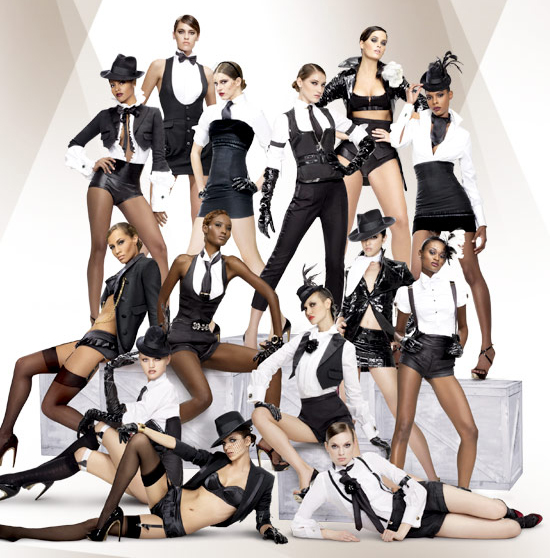
(For the record, seeing this billboard is what inspired this whole post.)

There’s a few particular aesthetic elements to note here for the purpose at hand, and I’ll tell you what they are. The hats with the feathers, the general 1920’s and 40’s infusion with the high waists and cropped tops, and the whole cabaret/vaudeville overtone.

These are all elements of a style that’s been rocked in the scene around me for years.

If you’re interested in some history you might want to click here, but the quick version is it became a part of the aesthetic expression of a particular subculture with a significant presence all up along the West Coast. And then last week, at the intersection of Sunset and Vine a bus rolls past me carrying a whole tableau along its side of girls sporting this style. It was pretty startling to see it so out of context, since up until then I hadn’t seen this look used in any mainstream media or setting–anyone who can find links to other examples, post it in the comments, I’d love to see it.

While I personally have no idea exactly how the stylist team for ANTM got the idea for the particular creative direction in the ad, I think the possibility that this burgeoning aesthetic, with a major base of operations in LA, might have somehow made it directly onto their radar is hardly a long shot.

Boyd asks, “What happens when a culture exists that rests on pointer remix for identity construction?” Well, at least one side effect is that meanings of cultural expressions–and hence what they say about our identities–change.

One pretty consistent way this “content change” in the meaning of a cultural expression happens is in the process of becoming more exposed. It’s been going on ever since the first small local band blew up and became huge. Everything else about the music and the act might have stayed the same but the obscurity, and it’s the very “alternative”-ness itself that was a part of its meaning all along. The difference between being a fan of something intimate and distinctive vs. something mainstream and egalitarian could be kinda like waking up to discover your kitten pictures have turned into kitten poo.

Here’s another approach. In October of 2007, Sasha Frere-Jones wrote an article in the New Yorker about “How Indie Rock Lost Its Soul.” The premise of the piece is that in the 1990’s rock and roll, a genre that evolved out of a tremendous black musical influence on white performers, and became the most miscegenated popular music ever to have existed, underwent a kind of racial re-segregation in its style:

Why did so many white rock bands retreat from the ecstatic singing and intense, voicelike guitar tones of the blues, the heavy African downbeat, and the elaborate showmanship that characterized black music of the mid-twentieth century? These are the volatile elements that launched rock and roll, in the nineteen-fifties, when Elvis Presley stole the world away from Pat Boone and moved popular music from the head to the hips.

…It’s difficult to talk about the racial pedigree of American pop music without being accused of reductionism, essentialism, or worse, and such suspicion is often warranted. In the case of many popular genres, the respective contributions of white and black musical traditions are nearly impossible to measure. In the nineteen-twenties, folk music was being recorded for the first time, and it was not always clear where the songs—passed from generation to generation and place to place—had come from.

…Yet there are also moments in the history of pop music when it’s not difficult to figure out whose chocolate got in whose peanut butter. In 1960, on a train between Dartford and London, Mick Jagger and Keith Richards, then teen-agers, bonded over a shared affinity for obscure blues records. (Jagger lent Richards an LP by Muddy Waters.) “Twist and Shout,” a song that will forever be associated with the Beatles, is in fact a fairly faithful rendition of a 1962 R. & B. cover by the Isley Brothers. In sum, as has been widely noted, the music that inspired some of the most commercially successful rock bands of the sixties and seventies—among them Led Zeppelin, Cream, and Grand Funk Railroad—was American blues and soul.

… In the mid- and late eighties, as MTV began granting equal airtime to videos by black musicians, academia was developing a doctrine of racial sensitivity that also had a sobering effect on white musicians: political correctness. Dabbling in black song forms, new or old, could now be seen as an act of appropriation, minstrelsy, or co-optation. A political reading of art took root, ending an age of innocent—or, at least, guilt-free—pilfering.

Himself a white musician/vocalist, Frere-Jones notes that adopting a black singing style even in his own band “seemed insulting.”

By the mid-nineties black influences had begun to recede, sometimes drastically, and the term “indie rock” came implicitly to mean white rock.

….How did rhythm come to be discounted in an art form that was born as a celebration of rhythm’s possibilities? Where is the impulse to reach out to an audience—to entertain? I can imagine James Brown writing dull material. I can even imagine the Meters wearing out their fans by playing a little too long. But I can’t imagine any of these musicians retreating inward and settling for the lassitude and monotony that so many indie acts seem to confuse with authenticity and significance.

While the article is specifically focused on the indie rock side, he readily admits that the segregation went both ways. Just as indie rock became “white rock,” “Black” music too began to occupy a space that may be more inaccessible and irrelevant to an outside audience now than it was during the 50’s. In an audio interview accompanying the article, Frere-Jones talks more about the results of the musical re-segregation from both angles. “Why is this a hit?” He jokes, about the absurdity of “Soulja Boy’s” success. “It’s just rapping over a ring-tone.”

Social and (after a series of lawsuits involving sampling) legislative forces gradually changed the sound of the music itself, and also of the “content” in the meaning of these musical pointers. As in: what does liking Indie Rock or Rock and Roll, and even Hip Hop at this point, convey about your identity now vs. what it would have 20 year ago? 40 years ago? Lose miscegenation and something that could once be relevant to a mixed audience becomes divisive.

Just as “Nation of Rebels” points out that there is no conflict between the counter and over-the-counter culture, I likewise see alternative and mainstream culture as just parts of a greater continuum, which ultimately, despite all the obstacles that societies, politics, economics, religions, and even individual personalities may put in its path, seeks its level at the greatest hybridity. “Content change” in the meaning of its expressions is as inevitable as the remixing of the expressions themselves.

In the meantime though, I’m gonna enjoy this kitten while it lasts.


Subscribe for more like this.


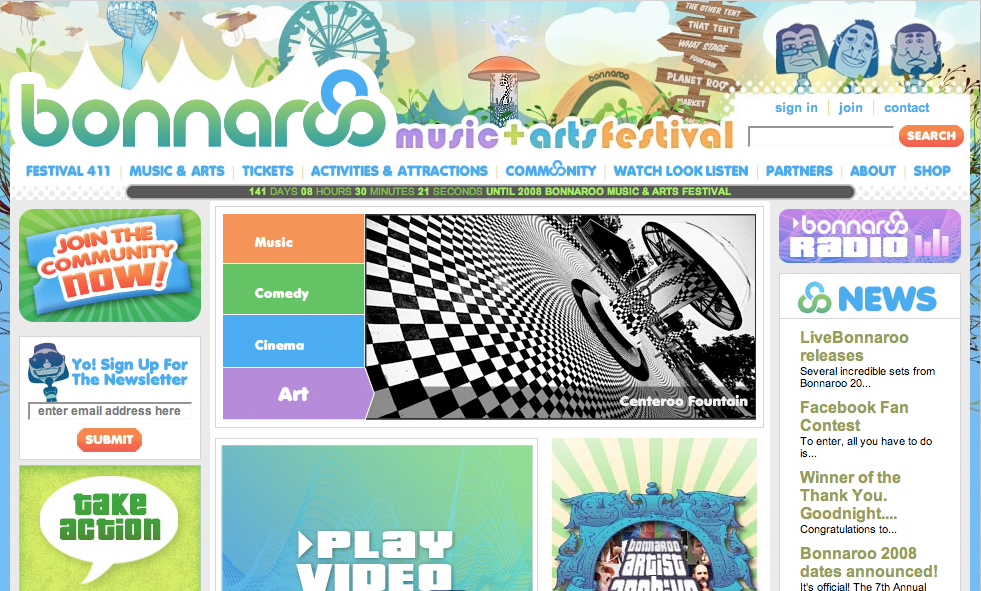
bonnaroo 2008 site launches

just a quick note to announce that the new bonnaroo site i consulted on for threshold just launched yesterday.

it ain’t just your regular music festival website, that’s for sure.

check it out:

bonnaroo.jpg


Subscribe for more like this.


lucent l’amour ~ february 16th, 2008

LA…. it’s been too long…. we shouldn’t have left you without a dope beat to step to….

and so, after an absence of over a year (our last LA event was in october of 2006!) the do lab returns once again to throw down in epic style with Lucent L’amour 2008:

all the info & tickets are at:
http://lucentlamour.thedolab.com

(oh! and there’s a nifty little music player there too.)
check out the welder track! it’s rad.

here’s a slideshow of the images from the last lucent l’amour event we did in february of ’06 (i really wanted to use it on the site, but it didn’t really fit, then i wanted to use it on the do’s myspace page, but we all know how myspace luuuurves code for outside apps, so i’m including it here, cuz it’s just so darn pretty it needs to go somewhere!):


Subscribe for more like this.


the medium of stories

p1220200.JPG

“We read to know we are not alone.”
– C.S. Lewis

in retrospect, it’s not so surprising that while i was studying film in college i was also producing art and music events as an extra-curricular activity. i joke that producing a movie and producing an event are pretty much exactly the same process, except with events you only get one take. in both cases what you’re producing is a story and an experience, so the transition, post-college, from film to festivals was, in a sense, really just the transition between one medium of story/experience creation to another.

whether written, filmed, experiential, or any other kind, i think stories in general appeal to us for the same reasons, yet we experience and appreciate them in different ways depending on the medium. just because the book might have been better than the movie, doesn’t mean it would make a better movie to film the pages of the book, dig?

which is the kind of analogy i think about as i read the NYTimes’ recent bit on Quarterlife, “Can NBC Do for ‘Quarterlife’ What YouTube Could Not?”:

Scripts by Marshall Herskovitz, the Emmy award-winning writer and producer, have drawn millions of viewers to movie theaters and television sets over the past two decades.

But on the Internet, where his 36-part series “Quarterlife” is unfolding on social networking sites like MySpace, the audience metrics are starkly different.

Some episodes of “Quarterlife,” a drama about a group of good-looking people in their 20s, have yet to attract 100,000 video views, according to combined view counts from MySpace’s video site and YouTube.

The low traffic numbers are significant because the series has been touted as the first television-quality production for the Web, as well as the first to be introduced online as a warm-up for its network debut. NBC will broadcast “Quarterlife” in one-hour increments beginning in February, and the Web-to-broadcast process is being closely watched as a potential business model for television on the Internet.

i wrote about quarterlife a few months back, before any of the episodes had come out. the prospect of what an “online series” could mean in terms of a new format for creating stories was really exciting to me. i even thought it was pretty neat that the show came with an accompanying online social network app aimed at being a resource for those going through their quarterlife crisis. (at least in theory. i’m not a member on quarterlife.com so i don’t really know for sure, but the impression i got is that the site seeks to facilitate collaborations among the nascent members of the creative class, and if that goal is actually being fulfilled then i sincerely applaud the effort.) that there was no indication at the time about the online series simply being a “warm-up” to a network debut is an interesting aspect unto itself, but there are more interesting things i’d like to talk about, in particular:

The Folly of a “Web-To-Broadcast” Model,
and the Tragically Misguided Concept of “Television on the Internet”

according to the NYTimes article, quarterlife’s sponsors, which include toyota, paid well above standard rates to appear with the series on the web. and perhaps the folks involved with quarterlife may want to consider why it is that they might have been willing to do that.

the same day as the NYTimes asked, “Can Web ventures like “Quarterlife” turn a profit? The answer is unclear,” online media daily reported:

CONSUMERS ARE 47% MORE ENGAGED in ads that run with television programs that they view online than those watched on a TV set, according to new research findings. A cross-media study by Simmons, a unit of Experian Research Services, also found that viewers are 25% more engaged in the content of TV shows that they watch online than on a TV.

what are the chances that toyota, what with their experience with integrating the scion brand into whyville’s online tween world, would have some understanding of the benefits of being on a medium with a much more elevated engagement rate?

as a marketer, one of my favorite things about quarterlife is that the brand integration is so seamless it makes the traditional concept of “product placement” look like cave drawings in comparison. two of the characters on quarterlife, aspiring filmmakers–the pragmatic producer and the visionary director, of course–pitch a local toyota dealership to shoot a commercial for the business. of course when they deliver the ad to the client, the owner of the dealership, says he can’t see his cars enough in the ad. how are people supposed to buy his cars if they can’t see them? so the duo then has to recut the ad to make it less high concept and more car-y, they screen the revised version for their friends, after which one of the other characters–the typically self-righteous activist stereotype who’s being positioned to become the lead character’s love interest–gives them shit for selling out and making a commercial in the first place, and bashes the “corporate hegemony” in the second. after which they deliver the revised ad only to be told it’s STILL not car-y enough, and then get scolded by the dealership owner for not being serious about their business–which is supposed to be helping HIS business sell cars. oh he also tells them that they don’t know what they’re talking about when they insist that the ad is supposed to be selling “the experience” of the car, which i thought was a particularly interesting touch. then after that other things happen, but my point is that this whole time that you’re watching several key plot points and delving into various bits of character and theme development–and this stretches out over several episodes–you’re watching toyota in the show.

it may not be subtle, but then neither was carrie bradshaw’s love for manolo blahniks. that’s the thing about authentic character development now, you and i express ourselves through the brands we buy, so why should it be different for the characters on our favorite shows? in fact, can we even identify with a completely brandless persona in a character-driven series enough to keep watching week after week?

well, to be honest, i don’t know. i haven’t really watched TV since i started college, (except for netflixing the whole run of sex and the city, and going on a 24 bender last year, and 2005 when i lived with some roommates who had a TV set, and i got all into the sopranos) but, i HAVE watched all 14 episodes of quarterlife out as of now. and if i was watching this on TV (well, if i owned a TV and was watching this on it) i think i would love it. i’d be telling my friends to watch it too, it would be significant that a television network had had the vision (or nerve) to create a show about our generation–a generation which is watching less and less TV though, and hence less and less incentive to make content for it, but regardless–if this was on TV, it’d be great!

except it’s not on TV, is it? while we allow a certain suspension of disbelief for the contrived nature of scripted programming on TV we have a dramatically different relationship with online content. we may not expect it to be TRUE, but we don’t expect it to feel artificial either. here TV’s forced quality feels almost…invasive, like getting a friend request from your mom or dad on facebook (or if you prefer: walking into your room to discover your mom or dad already in it). like, TV! what are you DOING in here?

the whole time i was watching those 14 episodes i felt like i was waiting for something to happen. some subtle yet hugely important aspect in the very nature of the show to change. i mean, great, it’s “television-quality” production for the web, but who exactly was lamenting its lack here in the first place? i’ve seen ipod billboards that felt more real and compelling than quarterlife. (and that’s coming from someone who really wanted to like the show!)

to be fair, i think the internet community too is just barely scratching the surface of the possibilities for online video content, but writing a TV script for the web is about as powerful a use of these possibilities as writing a TV script for a feature film, and given the results of that Simmons report, a “web-to-broadcast” strategy seems rather pointless considering that consumers are practically 50% more engaged with content the medium you’re starting out on. we’re by no means all looking for the same kind of content on the web, but we are not looking for the same old same old, either. i can’t wait for something to really take advantage of all the medium’s potential and uncover whole new ways of creating stories.

what do i think looks like it could be one such possibility?


Subscribe for more like this.


“cake or death?” and other user experience design options to consider

after mentioning him in the previous post, i ended up going on what can only be described as an eddie izzard bender.

a self-identified “male lesbian,” and “action transvestite” (you know… “running, jumping, climbing trees… putting on makeup while you’re up there”: action transvestite), izzard is also fluent enough in english and french to do standup in both. so clearly the man understands a thing or two about the intricacies of hybridity and cross-cultural communication–phenomena that likewise are pretty fascinating for me.

i first saw dress to kill in 2002, and what forever earned my respect for izzard’s genius is when, during the encore, he actually performs a bit in french and manages to get everyone in the audience–and me watching–laughing hysterically. i don’t know french. neither does most of the rest of the english-speaking, san francisco audience where the show was recorded. yet in a feat of linguistic alchemy he somehow is able to completely pull it off. we’re watching him in a different language, and we totally get it. it’s such a bewildering display of how little a language barrier might actually matter in the process of understanding people who are unlike us that it feels like you’ve just witnessed a magician perform rather than a comic.

so somewhere in the course of the haze induced by binge consumption of every glorious, sexie, eddie izzard clip on youtube last weekend, i stumbled onto his website. i’m not entirely sure i remember how i got there, but i do remember flashes of what happened after. (note: this will be way funnier if you’ve actually seen eddie’s shows. since i had just watched several years of them before i arrived at the site, it was completely hilarious to me.)

when i went to sign up for eddie’s email list, i was faced with the following options:

Send me news and info about Eddie via Email

Only send me gig & appearance emails for my chosen country
Cake OR Death

when was the last time you were asked THAT before joining a mailing list?

and furthermore, what’s a nav. section called Thingie Things gonna lead you to?

click on it and an audio clip of izzard’s voice admits, “well, it was the pressy-makey-doey-things page…but that didn’t really fit it.”

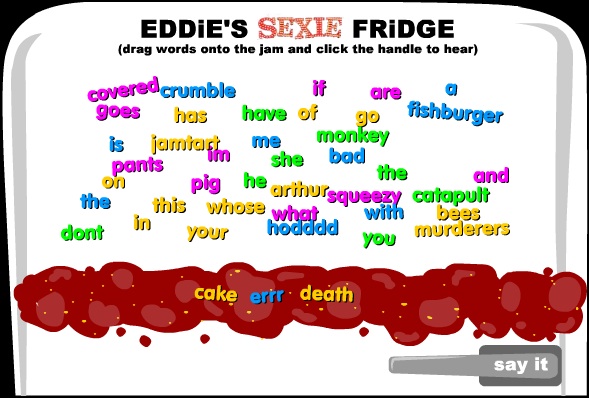
maybe you might want to pressy-makey-doey up on eddie’s sexie fridge

eddiesfridge.jpg

…where you drag words eddie utters during his show onto the jam smear on the fridge and then play them back to hear him say customized nonsense. (“jamtart arthur squeezy fishburger murderers catapult” is a good one).

but let’s back up for a second. maybe you’ve never seen eddie’s standup. maybe you came here because you’ve seen eddie in a movie, or on his TV show, the riches, and you’re trying to find out more about that. then you want the Eddie's ACTiNG page. and when you click on it, eddie’s relentless, adlibbing audio which follows you around–as in real life so on the internet–announces in a tone of sophistication, “this is the acting page. it is a very serious page.” it, in fact, does look very serious. with a vogue-y black and white glamour shot of izzard. but when you look in the corner there’s a little purple beehive just below eddie’s face with bees buzzing all around it. drag your cursor over to it to find out what the hell that’s all about, and your mouse gets covered in bees!

you may have seen glorious. you may not. you may think that’s hilarious. you may not. but either way, at least there’s something different going on here. something unexpected. and it’s not some kind of slick design-gasm. it’s not trying to wow you with unprecedented feats of programming. no. the site actually comes off as a pretty uncomplicated bit of online real estate, but with these absurd little pressy makey doey game-y bits. and it’s great!

i think the most important question for anyone creating a website to answer has to be “what do you want the website to do?” and at the basic level this question is pretty easy to answer. sure you want it to provide information, to sell something, to connect people, to encourage participation, whatever. all that’s well and good, but as soon as it gets beyond the level of “what do you want it to do beyond simply function,” the vision for what’s possible becomes kind of polarized and discordant.

on one side of this mania there’s:

make more features!
make it slicker!
make it cleaner!
make it cooler!
make it bigger…


and on the other side is something my friend jesse shannon calls the “myspacification of websites,” where content management systems are churning out the online equivalent of cookie-cutter suburban tract homes. sure it might be super intuitive and user-friendly, and you might know where your neighbor’s bathroom is located when you come to visit without anyone ever having to tell you, but….isn’t there anything else to an online experience beyond features or navigability? beyond flash or content management?

how about “i want the website to entertain people.” or “i want it to make people laugh.” creating a FUN experience is just as valid as an easily-navigable, informative one, but between the designer, the developer, the information architect, and everyone else…. whose job is it to make sure a site is FUN?

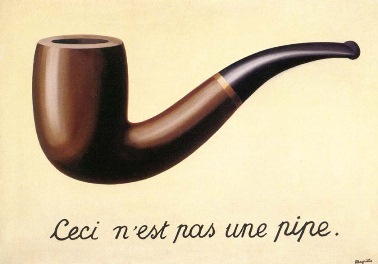
i once got asked if the “this is not a trend” in masthead image on this site is supposed to be a reference to magritte’s “this is not a pipe.”

Image:MagrittePipe.jpg

and while we may not all be looking for subliminal surrealist messages in our online experience, i think we are definitely looking for that kind of element of surprise, for unexpected juxtapositions, and even for non sequiturs sometimes, the same qualities that made the surrealist movement’s artistic expression so different from what had come before it. check out whateverlife.com on that note. the whole thing was originally created by a teenage girl who taught herself all the necessary design skills. not surprisingly, since there was no formal training which could instill upon her what a website SHOULD look or operate like, it looks completely different from any typical site.

perhaps it’s because we’ve always thought of the online experience as “browsing” that all we’ve been doing so far has just been making different versions of that one experience. maybe it’s time to re-imagine the whole thing. to integrate fun into its very functioning (as opposed to relying solely on the content), to reclaim it from its current humorless condition–and i mean, beyond just with LOLcats or cute hipster tech geek colloquialisms in dialogue boxes and error messages. if you’re looking at whateverlife and thinking, oh, so does this signify the next stage of a website experience?

instead think: maybe it just seemed like it would be fun.

http://lukaret.com/kusina/images/chocolate-cake.jpg


Subscribe for more like this.