HBO has created a monster with the promotional campaign for True Blood, a new TV series from the creator of Six Feet Under, set to premiere September 7th.
AdAge (which has a nice little video about the campaign here, but no way to embed it elsewhere) explains:
While they’re only one part of the larger campaign launching HBO’s “True Blood,” viral promotions by New York’s Campfire agency for the vampire series are a real stand out. Among other things, a message written in ancient language symbols was mailed to prominent bloggers and science fiction geeks known to be interested in vampires. When a few with language degrees cracked the code, they found an address for a vampire website.
That would have been kinda neat on it’s own, and whatnot, but things have progressed far beyond that one vampire website now. If you start following the True Blood trail, it becomes a bottomless pool of content.
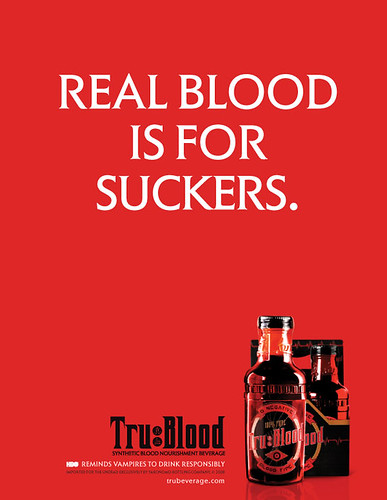
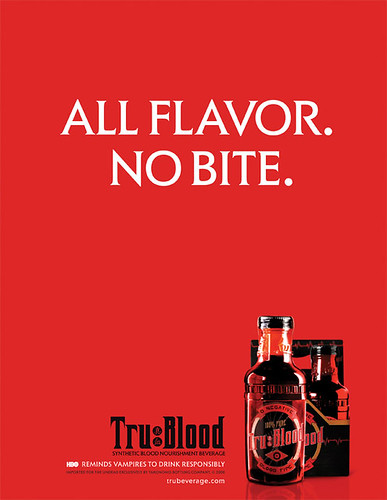
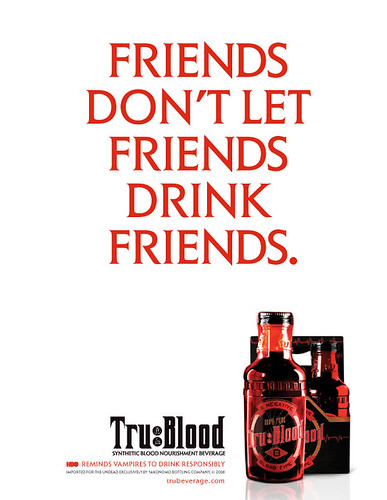
You’re more likely than not gonna see a billboard for Tru:Blood, “Synthetic Blood Nourishment Beverage” somewhere. It’s gonna look something like this:
or this:
and by the time you’ll have come to this one:
you might have started thinking that perhaps this is just the latest niche energy drink to hit the market, targeting a demographic with some sort of really spectacularly alternative lifestyle . Which is precisely the point. HBO’s particular vision of the dead-end of mass culture involves the undead too, apparently. Just another niche in our united niche culture, with their own kind of lifestyle needs. According to HBO’s official website for the True Blood show:
Thanks to a Japanese scientist’s invention of synthetic blood, vampires have progressed from legendary monsters to fellow citizens overnight. And while humans have been safely removed from the menu, many remain apprehensive about these creatures “coming out of the coffin.” Religious leaders and government officials around the world have chosen their sides, but in the small Louisiana town of Bon Temps, the jury is still out.
Local waitress Sookie Stackhouse (Anna Paquin), however, knows how it feels to be an outcast. “Cursed” with the ability to listen in on people’s thoughts, she’s also open-minded about the integration of vampires — particularly when it comes to Bill Compton (Stephen Moyer), a handsome 173-year-old living up th–
Uh-huh. Whatever.
Cuz at this point, how could any storyline the show’s creators might concoct compete with the multi-dimensional online world that’s been developed around the premise of the first paragraph? (Unless they know something Lost doesn’t, maybe.)
So, there’s the True:Blood beverage site. There’s BloodCopy, a news blog which “chronicles the amazing days we live in as vampires attempt to integrate with humans.” There’s the American Vampire League, an advocacy group “Leading the fight for equal rights for vampires,” cuz guess what? “Vampires were people too.” As you’d expect, there’s obviously a religious opposition group, Fellowship of the Sun. And, of course, no party to which politics and religion are invited would be complete without sex. Which you can now find, with a vampire, at Love Bitten, “The world’s best Human/Vampire dating site,” Are there runner-up Human/Vampire dating sites? Considering that half the merch on the Tru:Blood site is already sold out, there ought to be.
Meanwhile, the series hasn’t even premiered yet!
What people are buying and participating in has pretty much nothing to do with a TV show, and to look at it as just a “viral marketing” campaign is a complete misunderstanding of what’s going on here. This is a full-on Alternate Reality Game:
An interactive narrative that uses the real world as a platform, often involving multiple media and game elements, to tell a story that may be affected by participants’ ideas or actions.
Notable prior forays into the ARG world have included promotions for A.I., HALO 2, and Nine Inch Nails’ latest album, Year Zero. But why stop at a campaign, when you can create a culture? In a sense, this kind of “narrative” that takes place in the “real world,” and involves various media to tell a story–which the actions of “participants” certainly do affect–is probably an effective way to think about the contemporary fate of any brand. Every brand. This just happens to be an opportunity to turn the brand itself, and its narrative, into a new form of 21st Century-compliant entertainment.
HBO could be the first network to take the leap. Even the TV series itself could really just function as part of a larger narrative. Perhaps they’re already planning something that prescient. Who knows? If not HBO, then no doubt that line will be crossed by someone eventually. And when it is, there’s no going back.
While trying to track down a quote from Bret Easton Ellis’s The Rules of Attraction, I came across a LinkedIn profile for Sean Bateman. In case you’re not acquainted with Sean Bateman, one of the main protagonists of the Rules of Attraction, here’s his LinkedIn profile:
SeanBateman
Student at Bennington College
Albany, New York Area
Education
Bennington College
Connections
2 connections
Industry
Music
Sean Bateman’s Summary
I’m a Senior at Bennington College, though we mostly refer to it as Camden and pretend that it’s in New Hampshire. I live at Booth house, with a Frog roommate and a House Pigs house band. Sheer sensations.
My brother demanded I sign-up to “explore business opportunities”, but I’m not into that. I have ulterior motives, and her name is Lauren Hynde. I’m in the Computing Center, where Lauren once hung out, but she’s left, gone, history, vapor. The only problem is I still dream about her, and she’s all blue. It always ends up this way. No Big Surprise.
Every time I looked at at her I was struck by great-looking she is. And standing close to her, even if it was only for something like a millisecond, I overloaded on how great-looking that girl is. She looked at me in what seemed like slow motion. I could rarely meet her blue-eyed gaze back. She’s a little too gorgeous. Her perfect, full lips locked in on that sexy uncaring smile. She’s constructed perfectly. She used to smile when she noticed me staring and I smiled back. I’m still thinking, I want to know this girl. Being around her was sort of.. I don’t know what sort of is.
I’ll take all this down if she wants. I’ll deal with it. Show must go on. Rock’n’Roll.
Sean Bateman’s Specialties:
I plug in my Fender and play girls songs I’ve written myself and then segue into “You’re Too Good to Be True” and I play it quietly and sing the lyrics slowly and softly and they’re often so moved that they start to cry and
Sean Bateman’s Education
Bennington College
Music, Rock’n’Roll, 2004 — 2008
Majoring in Rock’n’Roll (before I was a Lit major, before I became a Ceramics major, before I become a Social Science major). I may switch to Computers. Whatever.
There some things that I will never do: I will never buy cheese popcorn in The Pub. I will never tell a video game to &@#$ off. I will never erase graffiti about myself that I happen to catch in bathrooms around campus. I will never play “Burning Down the House” on a jukebox. I will never be one of the last people hanging out at a Camden party. Those people remind me of kids being picked last for teams in high school. It’s weak. Really improves one’s sense of self-worth.
Activities and Societies:
Hanging out (The Carousel, Commons, The Pub, The Brasserie, Burger King, Dining Hall, Ann Arbour is where it’s at).
Additional Information
Sean Bateman’s Interests:
Coffee without cream (to feed my impending ulcer), girls (classy yet sexy), smoking, riding my motorcycle into town, watching people argue about Nazis, Planet of the Apes (I recently signed into Netflix), watching TV in the commons, playing my Fender for girls, music (Velvet Underground, Hendrix, Bob Dylan, Iron Butterfly, Zep, The Animals)
Sean Bateman’s Groups:
Sometimes I check out the AA meetings in Bingham
Netflix is absolutely an anachronism to 1987, when the book was published and one of the most important activities of the day was returning videotapes, plus the Sean Bateman of Ellis’s book was definitely not in college between 2004-2008, as this Sean Bateman appears to be. But who cares? The overall character tone, and many major and minor details are completely true to the original–not to mention hilarious in the context of LinkedIn–and even to the story behind the book. The college the characters in The Rules Of Attraction attend, Camden, is, in fact, based on Bennington (which is Ellis’s Alma Mater), and Sean is totally into Lauren Hynde. I’m even positive there’s a chapter in the book that Ellis straight up just ends on the word “and” like “Sean Bateman’s Specialties” section does above, so this Sean Bateman, who supposedly graduated Camden this year, nevertheless still even comes across like Ellis’s Sean Bateman who graduated 20 years ago, and if you dig a character, isn’t that all that really matters?
As soon as I got over how amusing it was that Sean Bateman had a LinkedIn profile I remembered that the character in Ellis’s American Psycho is Patrick Bateman, Sean’s older brother, and since Sean mentions his brother demanded he join LinkedIn, it came as no surprise, that–check this out!–Patrick Bateman, the protagonist of American Psycho is on LinkedIn. His profile actually is a lot more serious, and not as funny as Sean’s, so I won’t bother re-posting it, but if you happen to be a huge American Psycho nut, go over there and knock yourself out. He’s interested in “getting back in touch” evidently.
Social media as a platform for “characters” is as ancient as Friendster (man, whoever was responsible for the unbearably hilarious “San Francisco” profile back in like 2002, you were a complete riot!) and with the arrival of Lonelygirl15 and cewebrities like Jeffree Star, web 2.0, is veritably rife with “characters,” fictional and stranger-than-fictional. And, of course, there is the widespread social media “fan-fiction” of sorts, where people create unofficial profiles for characters they love, like the aforementioned LinkedIn profiles. But I’m thinking about something different from all this. I’m thinking of characters from character-driven stories on traditional media (books, movies, TV) living on in social media. I mean, really living there. Inhabiting the social media space with the same seamless familiarity that characters from novels cross over to the big screen. Communicating with us in their own voices, and with their own personalities that we have come to know and love, but in a new medium.
Michael Patrick King, director of the Sex and the City TV show and movie, would often talk about how great it was that they could really make the show authentically of New York because they could shoot scenes in actual existing restaurants and venues around the city (yes, I did watch the director’s commentary on a bunch of episodes, so?) The result was, indeed, a world that felt unmistakably New York, and establishments that no doubt were only too happy to reap the benefits of publicity in exchange. As an example of what’s possible with creating a living profile for a fictional character, an official Carrie Bradshaw profile, one written in her voice, that would generate content which would comply with the show’s bible and story arcs, could, for instance, feature a blog post mentioning a new restaurant she’d been to as a supplement to the show’s narrative. Suddenly the profile becomes not just promotion for the show, but, in fact, it’s own kind of channel. Creates the opportunity to start thinking about stories and character development in a completely new, almost infinite dimension that, of all the prior formats, perhaps only comic books came anywhere close too before, but this medium comes with something absolutely unbeatable: the opportunity to interact with these characters as well! If we are down to be friends with bands we love on Myspace, I’d bet we’d be into keeping up with characters we love too. Say, Bruce Wayne on Twitter? Or… Zoolander on Facebook? James Bond on BrightKite? Juno on Xanga?
Not that I’ve looked too far into this, I mean, maybe there are already plenty of major fictional characters out there living their daily lives on social networking sites, (I won’t be surprised if they’re Hannah Montana or iCarly or something) but I’m now totally fascinated by this whole idea. If anyone does know of examples of this actually being implemented: Fictional characters from stories in traditional media being (officially) brought to life with their true voice and personality, living and digitally breathing alongside us on social media, let me know.
Once you ‘got’ Pop, you could never see a sign again the same way again. And once you thought Pop, you could never see America the same way again.
– Andy Warhol
It is totally disconcerting to discover a book that pretty much compiles your insights and articulates them back to you. Buying In: The Secret Dialogue Between What We Buy & Who We Are, by Rob Walker, delves into many of the exact same observations as I have witnessed amid the ecosystem of contemporary culture, marketing, and identity. Reading it feels something like discovering America’s Next Top Model is biting your personal fashion style, I would imagine. Sure, it’s incredibly validating to see your own insights coming at you from a New York Times Magazine writer, but it’s sorta frustrating to have to know that they’re not just yours anymore.
In social science there is probably nothing as revelatory as a contradiction exposed. That the emperor is not wearing any clothes is much more stunning a revelation than any critique of the fashion aesthetic. And it’s contradictions that Walker is interested in:
There was one specific incident that finally made me reconsider what I thought I knew about consumers, marketers, and even myself. This was the news that Nike had bought Converse.
To me, Nike’s famous swoosh logo had long been the mark of the manipulated, a symbol for suckers who take its “Just Do It” bullying at face value. It’s long been, in my view, a brand for followers. On the other hand, the Converse Chuck Taylor All Star had been a mainstay sneaker for me since I was a teenager back in the 1980’s, and I stuck with it well into my thirties. Converse was the no-bullshit yin to Nike’s all-style-and-image yang. It’s what my outsider heroes from Joey Ramone to Kurt Combain wore. So I found the buyout disheartening…. but why, really, did I feel so strongly about a brand of sneaker–any brand of sneaker?
As a consumer behavior columnist, Walker had observed as “the steady march of progress that had been reshaping media and technology for years broke into a sprint, through the rapid rise of devices and innovations like TiVo, the iPod, increasingly sophisticated cell phones, YouTube, Facebook, and so on.” He notes that according to many marketing experts and consumer-culture observers, this new landscape had created a “New Consumer:”
A clever creature armed with all kinds of dazzling technology, from ad-blocking gizmos to alternative, grassroots media. This added up to what professional zeitgeist watchers–
–and i’d like to add, none too few self-congratulatory alternative cultures–
like to call “a paradigm shift.” “Consumers don’t march in lockstep anymore,” one celebrated trend master declared. “We are immune to advertising,” other experts announced. The mindless “mass market” had been shouldered aside by thinking individuals: “Consumers are fleeing the mainstream.” Somehow we had all become more or less impervious to marketing and brands and logos; we could see through commercial persuasion.
The trade, business and mainstream press–
–as well as no shortage of idealistic social media folks–
have seconded this judgement. Thanks to “the explosion in information available to shoppers,” The New Yorker argued, “brand loyalty is in fast decline,” and “the customer is king.” The Economist, too, pointed to super-informed shoppers who have acquired “unprecedented strength” in their dealings with commercial persuaders and approvingly quoted a famous ad executive announcing: “For the first time the consumer is boss.” Advertising Age soberly informed its readers that because of “the power of the public,” consumers have lately obtained “increasing sway … over any product’s success”–in fact, the consumer is in control.
The only problem with this was that it did not match up particularly well with the realities of the marketplace that I was writing about every week in The Times Magazine.
It’s one thing to conclude that the advertising business is evolving with the new media landscape. But these giddy claims go well beyond that….
Meanwhile the number of brand messages we are exposed to goes up, and so does the amount of trash we produce. And on a more personal level: Have you noticed any decrease in the number of times you buy something you were sure you would love, only to regret it later or simply forget about in the back of a closet? There you are, contemplating the limitless and ever shifting choices in what to drink, what to wear, what to drive, what to buy. It is literally impossible to try everything for yourself. Be honest: As you navigate this brand-soaked world, do you feel in control?
Sure, we tell pollsters and friends that we’re sick of being bombarded with advertising, we’re indifferent to silly logos, we’re fed up with rampant materialism. In reality, one of the most significant changes I’ve observed over the years that consumer behavior has been my primary beat is something that goes well beyond the long-standing human tendency to enjoy acquiring things.
The change is particularly noticeable among many of the younger people I’ve met. Frequently, these smart and creative young people were quite happy to inform me that, yes, they were immune to commercial persuasion–that they saw right through it, as the experts liked to say. Meanwhile, they were playing key, active roles in helping certain products and brands succeed.
They were in the vanguard of what looks an awful lot like an increasingly widespread consumer embrace of branded, commercial, culture. The modern relationship between consumer and consumed is defined not by rejection at all, but rather by frank complicity.
This goes against what we’d want to think of ourselves, and of individuality. We want to think that our highly-attuned “seeing through”ness, and our distinctive tastes have set us apart, granted us superiority over the tastelessness of lowly label whores. We want to think that expressing our identities, and asserting our belonging within a particular cultural community is unrelated to, and, in fact, an escape from brand-consciousness. We want to think we are–as 77% of the respondents in a formal poll mentioned by Walker considered themselves to be–far smarter and savvier than most consumers. Which is a mathematical impossibility.
The truth of the matter is that actually we don’t really know ourselves that well at all. That’s the “Secret” in “The Secret Dialogue Between What We Buy and Who We Are.” We have come up with enough misconceptions about the relationship between, as Walker calls it, the consumer and the consumed, that the real mechanics of this interchange are happening beyond our consciousness. We’re not aware we’re naked beneath our fancy new clothes.
“Symbols matter to us,” Walker says:
Meaningful symbols (logos included) get created–and even when we claim to be immune from such things, we often participate in that meaning-creation ourselves….In the 21st century we still grapple with the eternal dilemma of wanting to feel like individuals and to feel as though we’re apart of something bigger than ourselves–and that, most of all we all seek ways to resolve this fundamental tension of modern life.
In Nation of Rebels: Why Counterculture Became Consumer Culture Joseph Heath and Andrew Potter delve into the social psychology history of individuality, excavating its modern beginnings from the wreckage of the post-WWII distrust of “mass culture.” They propose that witnessing how conformity had devastated Europe as enforced by the Nazis, plus the results of the Milgram experiment, which exposed some nasty realities about our human relationship to authority, “led conformity to become the new cardinal sin in our society.” By the time Walker gets around to weighing in on it, this manifest individualist destiny has become an American right.
Enter “The Pretty Good” problem, as Walker calls it. Or as Alex Bogusky says: “All products are excellent.” It’s no longer about what’s better than what, or what’s more reliable, or what’s more effective. It all works, it’s all really good. The way you choose between all this totally dependable functioning stuff is, essentially, based on what expresses you.
“Buying a $5,000 handbag just because it’s a status symbol is a sign of weakness,” Walker quotes a particular “keen observer of branded culture”: Miuccia Prada. “Presumably” Walker suggests, “buying a $5,000 Prada bag is okay, if you’re doing it for the right reasons–quality for instance.” But I don’t see anything ironic in Prada’s remark. It’s probably the way anorexics think about the eating habits of the obese. In between those extremes though, weakness or not, we all have to eat. And we all feel we have to express ourselves, define ourselves, locate ourselves, even, on the cultural spectrum. How do we do that in our modern world?
Well, like, take the gutterpunk bike messenger dude Walker comes across while investigating the resurgence of Pabst Blue Ribbon’s popularity, getting a PBR logo brand–that’s skin brand–the size of his back. This may seem a bit excessive, but “Pabst is part of my subculture,” he says. More specifically, it can function as a symbol of a subculture, and skin branding as a means of expressing both a personal commitment and community loyalty is actually not at all uncommon among fraternities. In the absence of a Greek letter, endorsing a brand–that’s logo brand–can, and often does, become adopted as a symbol of belonging to a culture or community. You might not have gotten a skin brand or bought a $5,000 handbag, but all of us have purchased things not just for our own “personal narrative,” as Walker suggest, but because they represented our culture, our context, where we belong.
This is actually the part in the book where Walker’s assessments start to fall apart, I think. Unlike his research on the consumer adoption of corporate brands, in chronicling “underground brands”–by which he means, essentially, lifestyle symbols developed by independent entrepreneurs–he doesn’t mention any research from talking directly to the adopters of these brands, and thus fails to convey that the adoption of both kinds of brands happens basically for the same reasons.
He gets part of it right. Many underground brand creators:
Clearly see what they are doing as not only non-corporate, but somehow anticorporate: making statements against the materlistic mainstream–but doing it with different forms of materialism.
Take a minute to get acclimated to the irony if you need to, but that’s not the real contradiction here. This is:
Perhaps the threat that brand-smart young people really pose to commercial persuaders is not that they have stopped buying symbols of rebellion. It is that they have figured out that they can sell those symbols, too.
What the exact definition of an “underground brand” is–beyond being created by “brand-smart young people”–is never actually defined, and that may be the root of the oversight. Walker’s case studies for underground brands are pretty much exclusively clothing, or even more precisely, t-shirt labels, but I’ve seen the same phenomenon play out with underground music brands bands, and events. A community, weather it’s mass or niche, Greek or gutterpunk, needs symbols, and the difference between how an “independent” maker of symbols behaves vs. a “corporate” one, is that the corporate one answers to Wall Street.
You can argue that size matters. That somewhere along the slippery slope a brand is either big or small, but I would imagine even small Wall Street-beholden brands would behave the same way big ones do. And conversely, as Walker himself talks about, though doesn’t quite process to it’s logical conclusion: to stay competitive, Wall-Street brands are starting to behave like indie ones. Scion’s success via alternative marketing, which Walker calls “murketing,” happened not because it invented its own grassroots community from scratch, but because it leveraged the communities around existing independent brands in much the same way a concert venue leverages the community around a music act.
Talking to independent brand creators, Walker says, “Made me realize that it wasn’t just commercial culture that the brand underground was co-opting–it was the most exclusive and elevated form of it.”
Which is kind of like saying that an indie-rock band “co-opts” Elton John. I think music fans are only too happy to have more options.
It’s not culture that’s being co-opted, it’s industry. An indie band “co-opts” the music industry, and indie brands “co-opt” the industry of commercial persuasion itself. This isn’t a “threat” to commercial persuasion, as Walker suggests, but an expansion, an upgrade. Commercial persuasion, v. 2.0.
Or whatever.
“It’s time to set aside the old conspicuous consumption argument that consumer behavior is all about status–all about badges,” Walker writes. “If the underground logo is a badge, it’s one that is most noteworthy for how few people can see it.”
Uh-huh…
The average underground logo–just like many corporate ones–may be more subdued than, say, the narcissistic in-your-face mania of Louis Vuitton’s logo, but the underground brand is a badge, and it’s one that is most notable for how meaningfully it expresses a community. (By the way, that requires visibility). It may not be all about “status” but it IS all about identity.
Suddenly, the book is not so disconcerting after all.
To make remixing easy, the separate ‘stems’ from the song are available to purchase from iTunes. The ‘stems’ available are bass, voice, guitar, strings/fx and drums. You can mix them in any way you like, either by adding your own beats and instrumentation, or just remixing the original parts.
The public will listen and vote for their favourite remix (voting ends May 1st). You can also create a widget allowing votes from your own website, Facebook or MySpace page to be counted as ‘mix votes’ back on radioheadremix.com. Radiohead will listen to the best remixes.
Once upon a time the product and the ad for the product were completely separate entities. Then content itself began to do double duty as the promotional unit. Now it’s the direct personalexperiencewith the content that can become its own promotion. It’s not just Radiohead pushing their song anymore. Everyone who creates a remix of the song, creates their own personal experience with it, is now involved in generating more exposure for it.
Culture no longer fits all that well into the role of a packaged good (if it ever did). Now there is more and more opportunity–and reason–to approach cultural content as a raw material, one used in the construction of expression.
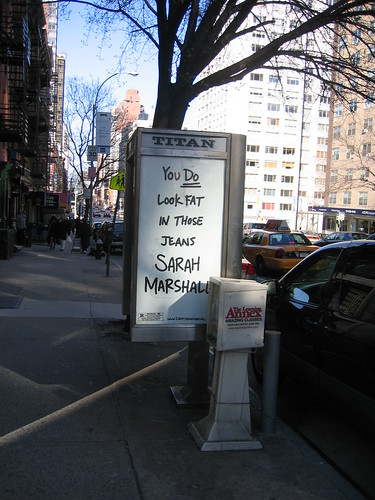
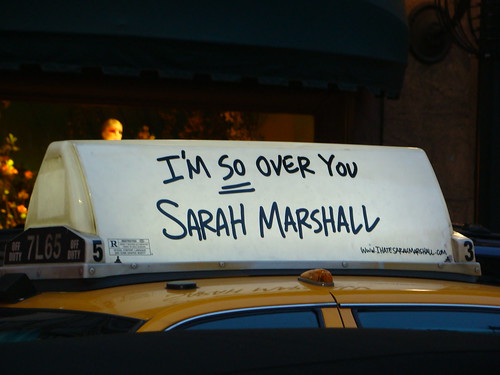
Hope people have been seeing the billboards that I have put up around town. I think its important everyone knows how much Sarah Marshall SUCKS! How she does look fat in those jeans! How my mom never liked her! How over her I am!
So, I used the money that I spent on her engagement ring to buy every available billboard around town. (That’s right Sarah I was going to propose to you. I was just waiting for the right time. I guess that time is never O’clock in the month of Nev-ruary).
Sarah, I really hope you are un-happy for the rest of your life – that you understand how totally over you I am.
That said, you should call me if you want to talk, I can have these things taken down.
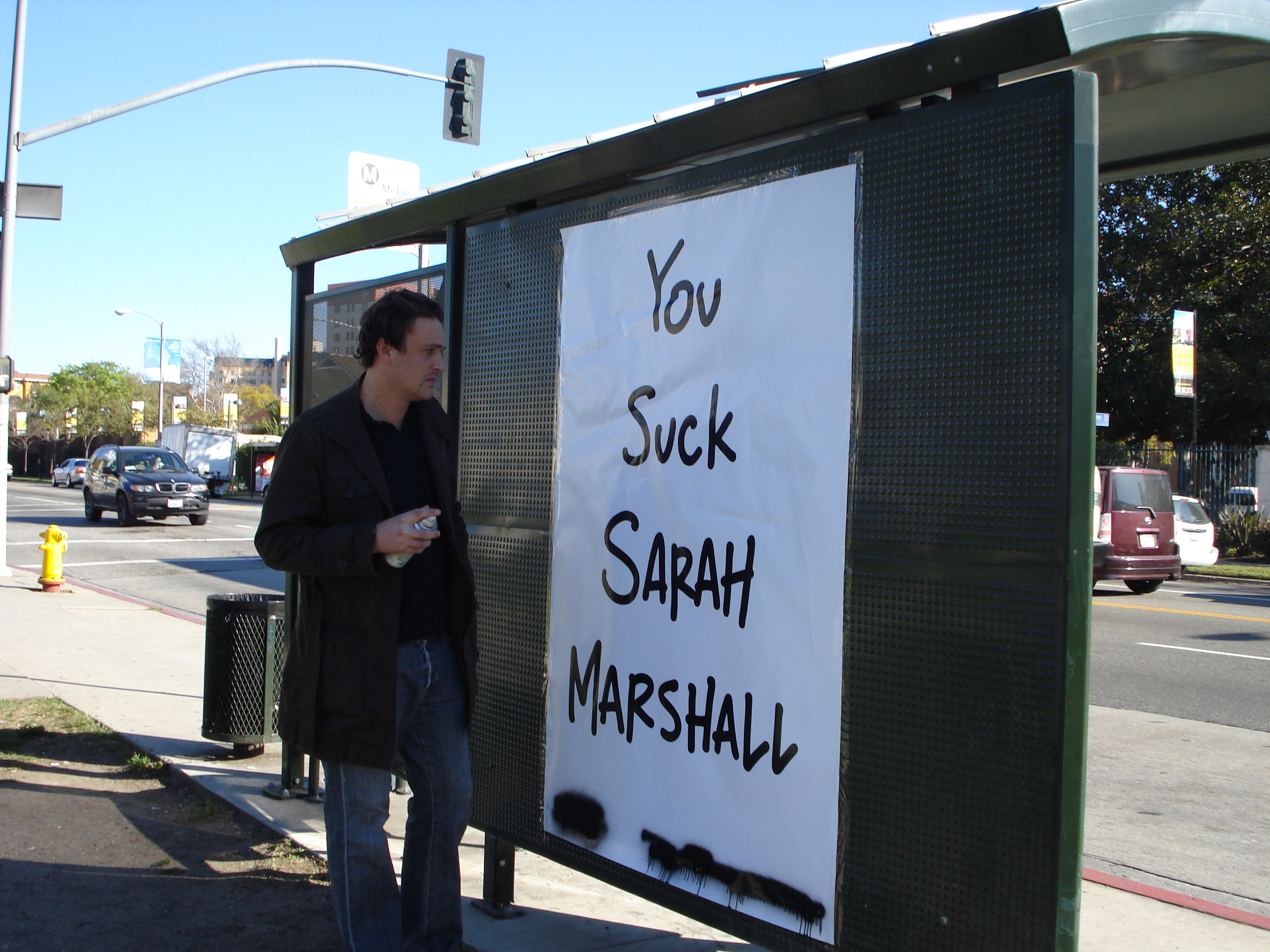
While driving home I saw a billboard that read “You Suck Sarah Marshall”. At the bottom of the message I saw the URL www.ihatesarahmarshall.com so when I got home I jumped on my computer and checked out the website. [It’s] a blog that is currently being written by a loved obsessed 26 year old guy who is YouTubing videos about how infatuated he is with his hot TV star girlfriend.
Well, as it turns out this website is the launch of a new marketing campaign for a movie “Forgetting Sarah Marshall“. I have no idea if this movie is any good although it is brought to us by the guys who gave us the 40 Year Old Virgin. On a quick side note I can not recall seeing the R rated warning on the billboard but if I had I would have known right away it was a movie.
The point of this post is to point out the way this movie is being marketed. They are utilizing a combination of vague yet somewhat shocking billboard ads to drive people to a Google Blog thats incorporating YouTube videos as a way to create buzz. It should be interesting to see how it works out.
And answer #3 goes like this:
At OMMA a few weeks ago the theme was “Welcome to the Machine.” All the panels and presentations were framed around the question: How to prepare for the kind of dubious advertising that would be in store in the “Machine”-mediated future? (At least that’s what I think the theme was supposed to mean.)
The model for creating advertising has, in general, been pretty conglomerative. The media department buys the adspace, the creative department puts stuff in the adspace, the “new media” department does….who knows what, and the whole process is as compartmentalized as an assembly line. You know, it’s funny. There’s now hypersonic sound technology, which can be used to literally beam audio ads DIRECTLY at individuals in its path, yet we still insist on referring to the internet as “new media.” And that kind of segregated perspective may be part of the problem.
In strict media buy terms all that’s going on in the IHSM campaign is a grip of outdoor and a domain name, you could even say that ihatesarahmarshall.com is a kind of “microsite” I suppose, or maybe an “adverblog,” but are any of those elements individually responsible for the effectiveness of the campaign? While there’s certainly no shortage of ads out there that make a play on our curiosity, the IHSM billboards are the first that immediately struck me as possesing a deliberate, blatant, “What the hell is that about? Oh, I’ll just check it out on my iPhone,” quality.
There’s now more and more people carrying the internet around in their pocket. What does that mean in terms of how we approach Mobile, Online, Experiential, Outdoor, or Out-of-home media–all together! Then multiply all of that by the coefficient of search.
Cabel Maxfield Sasser recently went to Japan and noticed an interesting trend in advertising there: search boxes have replaced URLs.
Within minutes of riding on the first trains in Japan, I notice a significant change in advertising, from train to television. The trend? No more printed URL’s. The replacement? Search boxes! With recommended search terms!
An ARG–which stands for Alternate Reality Game–is defined as:“An interactive narrative that uses the real world as a platform, often involving multiple media and game elements, to tell a story that may be affected by participants’ ideas or actions.” Which could also serve as both a philosophical definition for marketing in general, and a more advanced version of what the I Hate Sarah Marshall campaign has started to touch on in a very basic, accessible way. The opportunity is now there to create advertising that works not by managing to take our attention hostage for an instant, but because it’s able to move between media the same way that our attention does.
“Integration” may be getting primed to become the next “viral” when it comes to overabused industry buzzwords, but it’s more than just a trendy new widget. The next phase is not about defeating some monolithic “Machine.” It’s about figuring out: How do we create messages that cater to the way technology lets us interact with all different media? Meanwhile, the paint-by-numbers, assembly-line approach is still trying to figure out which department’s responsibility it is to come up with the answer.



 2 connections