the empire’s new clothes

Once you ‘got’ Pop, you could never see a sign again the same way again. And once you thought Pop, you could never see America the same way again.

– Andy Warhol

It is totally disconcerting to discover a book that pretty much compiles your insights and articulates them back to you. Buying In: The Secret Dialogue Between What We Buy & Who We Are, by Rob Walker, delves into many of the exact same observations as I have witnessed amid the ecosystem of contemporary culture, marketing, and identity. Reading it feels something like discovering America’s Next Top Model is biting your personal fashion style, I would imagine. Sure, it’s incredibly validating to see your own insights coming at you from a New York Times Magazine writer, but it’s sorta frustrating to have to know that they’re not just yours anymore.

In social science there is probably nothing as revelatory as a contradiction exposed. That the emperor is not wearing any clothes is much more stunning a revelation than any critique of the fashion aesthetic. And it’s contradictions that Walker is interested in:

There was one specific incident that finally made me reconsider what I thought I knew about consumers, marketers, and even myself. This was the news that Nike had bought Converse.

To me, Nike’s famous swoosh logo had long been the mark of the manipulated, a symbol for suckers who take its “Just Do It” bullying at face value. It’s long been, in my view, a brand for followers. On the other hand, the Converse Chuck Taylor All Star had been a mainstay sneaker for me since I was a teenager back in the 1980’s, and I stuck with it well into my thirties. Converse was the no-bullshit yin to Nike’s all-style-and-image yang. It’s what my outsider heroes from Joey Ramone to Kurt Combain wore. So I found the buyout disheartening…. but why, really, did I feel so strongly about a brand of sneaker–any brand of sneaker?

As a consumer behavior columnist, Walker had observed as “the steady march of progress that had been reshaping media and technology for years broke into a sprint, through the rapid rise of devices and innovations like TiVo, the iPod, increasingly sophisticated cell phones, YouTube, Facebook, and so on.” He notes that according to many marketing experts and consumer-culture observers, this new landscape had created a “New Consumer:”

A clever creature armed with all kinds of dazzling technology, from ad-blocking gizmos to alternative, grassroots media. This added up to what professional zeitgeist watchers–

–and i’d like to add, none too few self-congratulatory alternative cultures–

like to call “a paradigm shift.” “Consumers don’t march in lockstep anymore,” one celebrated trend master declared. “We are immune to advertising,” other experts announced. The mindless “mass market” had been shouldered aside by thinking individuals: “Consumers are fleeing the mainstream.” Somehow we had all become more or less impervious to marketing and brands and logos; we could see through commercial persuasion.

The trade, business and mainstream press–

–as well as no shortage of idealistic social media folks–

have seconded this judgement. Thanks to “the explosion in information available to shoppers,” The New Yorker argued, “brand loyalty is in fast decline,” and “the customer is king.” The Economist, too, pointed to super-informed shoppers who have acquired “unprecedented strength” in their dealings with commercial persuaders and approvingly quoted a famous ad executive announcing: “For the first time the consumer is boss.” Advertising Age soberly informed its readers that because of “the power of the public,” consumers have lately obtained “increasing sway … over any product’s success”–in fact, the consumer is in control.

The only problem with this was that it did not match up particularly well with the realities of the marketplace that I was writing about every week in The Times Magazine.

It’s one thing to conclude that the advertising business is evolving with the new media landscape. But these giddy claims go well beyond that….

Meanwhile the number of brand messages we are exposed to goes up, and so does the amount of trash we produce. And on a more personal level: Have you noticed any decrease in the number of times you buy something you were sure you would love, only to regret it later or simply forget about in the back of a closet? There you are, contemplating the limitless and ever shifting choices in what to drink, what to wear, what to drive, what to buy. It is literally impossible to try everything for yourself. Be honest: As you navigate this brand-soaked world, do you feel in control?

Sure, we tell pollsters and friends that we’re sick of being bombarded with advertising, we’re indifferent to silly logos, we’re fed up with rampant materialism. In reality, one of the most significant changes I’ve observed over the years that consumer behavior has been my primary beat is something that goes well beyond the long-standing human tendency to enjoy acquiring things.

The change is particularly noticeable among many of the younger people I’ve met. Frequently, these smart and creative young people were quite happy to inform me that, yes, they were immune to commercial persuasion–that they saw right through it, as the experts liked to say. Meanwhile, they were playing key, active roles in helping certain products and brands succeed.

They were in the vanguard of what looks an awful lot like an increasingly widespread consumer embrace of branded, commercial, culture. The modern relationship between consumer and consumed is defined not by rejection at all, but rather by frank complicity.

This goes against what we’d want to think of ourselves, and of individuality. We want to think that our highly-attuned “seeing through”ness, and our distinctive tastes have set us apart, granted us superiority over the tastelessness of lowly label whores. We want to think that expressing our identities, and asserting our belonging within a particular cultural community is unrelated to, and, in fact, an escape from brand-consciousness. We want to think we are–as 77% of the respondents in a formal poll mentioned by Walker considered themselves to be–far smarter and savvier than most consumers. Which is a mathematical impossibility.

The truth of the matter is that actually we don’t really know ourselves that well at all. That’s the “Secret” in “The Secret Dialogue Between What We Buy and Who We Are.” We have come up with enough misconceptions about the relationship between, as Walker calls it, the consumer and the consumed, that the real mechanics of this interchange are happening beyond our consciousness. We’re not aware we’re naked beneath our fancy new clothes.

“Symbols matter to us,” Walker says:

Meaningful symbols (logos included) get created–and even when we claim to be immune from such things, we often participate in that meaning-creation ourselves….In the 21st century we still grapple with the eternal dilemma of wanting to feel like individuals and to feel as though we’re apart of something bigger than ourselves–and that, most of all we all seek ways to resolve this fundamental tension of modern life.

In Nation of Rebels: Why Counterculture Became Consumer Culture Joseph Heath and Andrew Potter delve into the social psychology history of individuality, excavating its modern beginnings from the wreckage of the post-WWII distrust of “mass culture.” They propose that witnessing how conformity had devastated Europe as enforced by the Nazis, plus the results of the Milgram experiment, which exposed some nasty realities about our human relationship to authority, “led conformity to become the new cardinal sin in our society.” By the time Walker gets around to weighing in on it, this manifest individualist destiny has become an American right.

Enter “The Pretty Good” problem, as Walker calls it. Or as Alex Bogusky says: “All products are excellent.” It’s no longer about what’s better than what, or what’s more reliable, or what’s more effective. It all works, it’s all really good. The way you choose between all this totally dependable functioning stuff is, essentially, based on what expresses you.

“Buying a $5,000 handbag just because it’s a status symbol is a sign of weakness,” Walker quotes a particular “keen observer of branded culture”: Miuccia Prada. “Presumably” Walker suggests, “buying a $5,000 Prada bag is okay, if you’re doing it for the right reasons–quality for instance.” But I don’t see anything ironic in Prada’s remark. It’s probably the way anorexics think about the eating habits of the obese. In between those extremes though, weakness or not, we all have to eat. And we all feel we have to express ourselves, define ourselves, locate ourselves, even, on the cultural spectrum. How do we do that in our modern world?

Well, like, take the gutterpunk bike messenger dude Walker comes across while investigating the resurgence of Pabst Blue Ribbon’s popularity, getting a PBR logo brand–that’s skin brand–the size of his back. This may seem a bit excessive, but “Pabst is part of my subculture,” he says. More specifically, it can function as a symbol of a subculture, and skin branding as a means of expressing both a personal commitment and community loyalty is actually not at all uncommon among fraternities. In the absence of a Greek letter, endorsing a brand–that’s logo brand–can, and often does, become adopted as a symbol of belonging to a culture or community. You might not have gotten a skin brand or bought a $5,000 handbag, but all of us have purchased things not just for our own “personal narrative,” as Walker suggest, but because they represented our culture, our context, where we belong.

This is actually the part in the book where Walker’s assessments start to fall apart, I think. Unlike his research on the consumer adoption of corporate brands, in chronicling “underground brands”–by which he means, essentially, lifestyle symbols developed by independent entrepreneurs–he doesn’t mention any research from talking directly to the adopters of these brands, and thus fails to convey that the adoption of both kinds of brands happens basically for the same reasons.

He gets part of it right. Many underground brand creators:

Clearly see what they are doing as not only non-corporate, but somehow anticorporate: making statements against the materlistic mainstream–but doing it with different forms of materialism.

Take a minute to get acclimated to the irony if you need to, but that’s not the real contradiction here. This is:

Perhaps the threat that brand-smart young people really pose to commercial persuaders is not that they have stopped buying symbols of rebellion. It is that they have figured out that they can sell those symbols, too.

What the exact definition of an “underground brand” is–beyond being created by “brand-smart young people”–is never actually defined, and that may be the root of the oversight. Walker’s case studies for underground brands are pretty much exclusively clothing, or even more precisely, t-shirt labels, but I’ve seen the same phenomenon play out with underground music brands bands, and events. A community, weather it’s mass or niche, Greek or gutterpunk, needs symbols, and the difference between how an “independent” maker of symbols behaves vs. a “corporate” one, is that the corporate one answers to Wall Street.

You can argue that size matters. That somewhere along the slippery slope a brand is either big or small, but I would imagine even small Wall Street-beholden brands would behave the same way big ones do. And conversely, as Walker himself talks about, though doesn’t quite process to it’s logical conclusion: to stay competitive, Wall-Street brands are starting to behave like indie ones. Scion’s success via alternative marketing, which Walker calls “murketing,” happened not because it invented its own grassroots community from scratch, but because it leveraged the communities around existing independent brands in much the same way a concert venue leverages the community around a music act.

Talking to independent brand creators, Walker says, “Made me realize that it wasn’t just commercial culture that the brand underground was co-opting–it was the most exclusive and elevated form of it.”

Which is kind of like saying that an indie-rock band “co-opts” Elton John. I think music fans are only too happy to have more options.

It’s not culture that’s being co-opted, it’s industry. An indie band “co-opts” the music industry, and indie brands “co-opt” the industry of commercial persuasion itself. This isn’t a “threat” to commercial persuasion, as Walker suggests, but an expansion, an upgrade. Commercial persuasion, v. 2.0.

Or whatever.

“It’s time to set aside the old conspicuous consumption argument that consumer behavior is all about status–all about badges,” Walker writes. “If the underground logo is a badge, it’s one that is most noteworthy for how few people can see it.”

Uh-huh…

The average underground logo–just like many corporate ones–may be more subdued than, say, the narcissistic in-your-face mania of Louis Vuitton’s logo, but the underground brand is a badge, and it’s one that is most notable for how meaningfully it expresses a community. (By the way, that requires visibility). It may not be all about “status” but it IS all about identity.

Suddenly, the book is not so disconcerting after all.


Subscribe for more like this.


the integration is the message

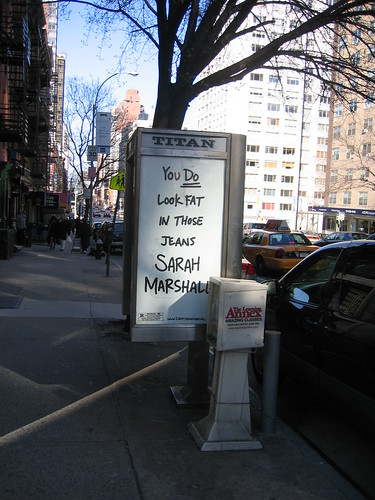
Have you seen these billboards?

They’re all over the place:

Been wondering what the hell that’s all about, maybe?

Well, answer #1 goes like this:

Hope people have been seeing the billboards that I have put up around town. I think its important everyone knows how much Sarah Marshall SUCKS! How she does look fat in those jeans! How my mom never liked her! How over her I am!

So, I used the money that I spent on her engagement ring to buy every available billboard around town. (That’s right Sarah I was going to propose to you. I was just waiting for the right time. I guess that time is never O’clock in the month of Nev-ruary).

Sarah, I really hope you are un-happy for the rest of your life – that you understand how totally over you I am.

That said, you should call me if you want to talk, I can have these things taken down.

Answer #2 goes like this:

While driving home I saw a billboard that read “You Suck Sarah Marshall”. At the bottom of the message I saw the URL www.ihatesarahmarshall.com so when I got home I jumped on my computer and checked out the website. [It’s] a blog that is currently being written by a loved obsessed 26 year old guy who is YouTubing videos about how infatuated he is with his hot TV star girlfriend.

Well, as it turns out this website is the launch of a new marketing campaign for a movie “Forgetting Sarah Marshall“. I have no idea if this movie is any good although it is brought to us by the guys who gave us the 40 Year Old Virgin. On a quick side note I can not recall seeing the R rated warning on the billboard but if I had I would have known right away it was a movie.

The point of this post is to point out the way this movie is being marketed. They are utilizing a combination of vague yet somewhat shocking billboard ads to drive people to a Google Blog thats incorporating YouTube videos as a way to create buzz. It should be interesting to see how it works out.

And answer #3 goes like this:

At OMMA a few weeks ago the theme was “Welcome to the Machine.” All the panels and presentations were framed around the question: How to prepare for the kind of dubious advertising that would be in store in the “Machine”-mediated future? (At least that’s what I think the theme was supposed to mean.)

The model for creating advertising has, in general, been pretty conglomerative. The media department buys the adspace, the creative department puts stuff in the adspace, the “new media” department does….who knows what, and the whole process is as compartmentalized as an assembly line. You know, it’s funny. There’s now hypersonic sound technology, which can be used to literally beam audio ads DIRECTLY at individuals in its path, yet we still insist on referring to the internet as “new media.” And that kind of segregated perspective may be part of the problem.

In strict media buy terms all that’s going on in the IHSM campaign is a grip of outdoor and a domain name, you could even say that ihatesarahmarshall.com is a kind of “microsite” I suppose, or maybe an “adverblog,” but are any of those elements individually responsible for the effectiveness of the campaign? While there’s certainly no shortage of ads out there that make a play on our curiosity, the IHSM billboards are the first that immediately struck me as possesing a deliberate, blatant, “What the hell is that about? Oh, I’ll just check it out on my iPhone,” quality.

There’s now more and more people carrying the internet around in their pocket. What does that mean in terms of how we approach Mobile, Online, Experiential, Outdoor, or Out-of-home media–all together! Then multiply all of that by the coefficient of search.

From Boinboing:

Cabel Maxfield Sasser recently went to Japan and noticed an interesting trend in advertising there: search boxes have replaced URLs. Picture 1-160

Within minutes of riding on the first trains in Japan, I notice a significant change in advertising, from train to television. The trend? No more printed URL’s. The replacement? Search boxes! With recommended search terms!

An ARG–which stands for Alternate Reality Game–is defined as: An interactive narrative that uses the real world as a platform, often involving multiple media and game elements, to tell a story that may be affected by participants’ ideas or actions.” Which could also serve as both a philosophical definition for marketing in general, and a more advanced version of what the I Hate Sarah Marshall campaign has started to touch on in a very basic, accessible way. The opportunity is now there to create advertising that works not by managing to take our attention hostage for an instant, but because it’s able to move between media the same way that our attention does.

“Integration” may be getting primed to become the next “viral” when it comes to overabused industry buzzwords, but it’s more than just a trendy new widget. The next phase is not about defeating some monolithic “Machine.” It’s about figuring out: How do we create messages that cater to the way technology lets us interact with all different media? Meanwhile, the paint-by-numbers, assembly-line approach is still trying to figure out which department’s responsibility it is to come up with the answer.


Subscribe for more like this.


“Every day is another day starring you.”

“The idea that whoever appeared onstage would play not me but a character was central to imagining how to make the narrative: I would need to see myself from outside.”
~ Joan Didion

In the midst of the quicksand hazard posed by every single episode of Lost available online, and in high def, I saw an ad for Celebrity Cruise lines with a slogan at the end that i thought was fantastic:

according to a NYTimes article published last spring, “This Is Your Life (and How You Tell It),” research shows that the human brain apparently has a natural affinity for narrative construction, which not only explains why Lost is so amazingly addictive, but why but we are continually updating a treatment of our own life in our heads.

Short of offering “run from the paparazzi” adventure travel excursions and rehab amusement parks, the cruise line has taken a very resonant approach with the “every day is another day starring you” slogan. “Seeing oneself as acting in a movie or a play is not merely fantasy or indulgence;” according the the NYTimes, “it is fundamental to how people work out who it is they are, and may become.” In the era of TMZ, thinking about that personal narrative in the format of a celebrity tabloid seems only natural.

For further commentary on the subject, here’s Rolling Stone’s top celebrity for representing “America in Decline”:


Subscribe for more like this.


consumer insight is funny

“You’re just perpetuating the stereotype by acting all stereotypical.”
– deleted line from tony scott’s domino

The image “http://stuffwhitepeoplelike.files.wordpress.com/2008/02/banner1.jpg” cannot be displayed, because it contains errors.

i have no idea about the racial background of the individual(s) that publish stuff white people like, but does it even matter?

as lenny bruce said, it’s not the word itself, but the censorship of the word that gives it its power, so it’s not necessarily the people that buy a brand or product, but the perceived people who buy it that defines its identity.

as in, you may happen to LOVE rocking out to justin timberlake on your ipod, but would NEVER under ANY circumstances go to his concert (and subject yourself to dealing with the kind of people that would buy tickets to a justin timberlake concert.) i think this kind of disconnect is also what undermines a whole lot of consumer insight research. expecting people to consciously recognize what influences their purchase decisions is like expecting them to recognize, admit to, deny, not deny, accept, not accept, a whole lot of pressures and social expectations that masquerade as personal preference. as far as most people are concerned, all they’re really aware of is looking for a way to express themselves, not of the incessant negotiation of their compliance with and/or rebellion against barrage of cultural stereotypes.

we may buy the products or brands that express aspects of who we are, but in most cases the options we’re choosing from in the fist place have already been pre-selected for us by the purchase decisions of other people like ourselves. the question then isn’t, why did i make the choice to buy this or that, but rather does this or that seem like the kind of thing that someone like me would buy? the “why” is: because people like me buy it.

after all, god knows i love sushi, irony, and sarah silverman, and apparently, that’s no accident.


Subscribe for more like this.


a trend’s success

Is The Tipping Point Toast?” asks the recent FastCompany article in which researcher duncan watts talks about his findings (and their less than exuberant reception) that expose the billion dollars a year marketers spend targeting “influentials” as a waste of money.

i am constantly repeating the phrase that “we buy the brands and products that we feel express aspects of our identity,” and this applies to ideas as well. we buy into and espouse the ideas that express aspects of who we are. our “intuition” in that sense, could be seen not so much a kind of internal tuning fork dinging to the tone of the universe, but rather an insidiously partial filter which evaluates the validity of information based on its compliance with our ingrained personal predispositions. for marketers–an avocation that calls for a particular breed of identity, of course–it’s no doubt easy to latch on to the idea that a select few influential individuals wield the capacity to push trends over the tipping point simply by their involvement in the process. after all, considering what we do it’s pretty “intuitive” for us, isn’t it?

from the fastcompany article:

Marketing has always relied heavily on instinct and intuition. Admen like to believe they’re creative geniuses, gifted at truffling out social trends (which is why, they hasten to point out, they’re irreplaceable). Joe Pilotta, research VP for a firm called Big Research, suspects marketers cling to their belief in Influentials partly because they’re lazy. They love the idea of needing to reach only a small group of people to “tip” a product, he says with a laugh. Plus, it strokes their egos: “Think about it. You’re saying, ‘I am in control–I am the biggest influencer, because I am going to influence the influencers!’ It’s an arrogance that only the corporate world could enjoy.”

which certainly makes ME wonder to what extent what we know–or believe we know–about the nature of how marketing is supposed to work is actually based on the the egos of CMOs as opposed to on actual social theory. how about you?

see, i think all of coolhunting is a ridiculous waste of time. there is no universal “cool” that exists out of context, and while i do believe strongly that marketers themselves are NEVER the demo, i also think that all of us are subject to the context of the cultures or communities of which we are a part. translation: cool matters not because it’s “cool” but because–and only if–it’s culturally relevant. and while relevance sounds a lot less sexy than its mistaken-identity doppelganger, cool, it’s relevance that “trends” are really about.

Watts decided to put the whole idea to the test by building another Sims-like computer simulation. He programmed a group of 10,000 people, all governed by a few simple interpersonal rules. Each was able to communicate with anyone nearby. With every contact, each had a small probability of “infecting” another. And each person also paid attention to what was happening around him: If lots of other people were adopting a trend, he would be more likely to join, and vice versa. The “people” in the virtual society had varying amounts of sociability–some were more connected than others. Watts designated the top 10% most-connected as Influentials; they could affect four times as many people as the average Joe. In essence, it was a virtual society run–in a very crude fashion–according to the rules laid out by thinkers like Gladwell and Keller.

Watts set the test in motion by randomly picking one person as a trendsetter, then sat back to see if the trend would spread. He did so thousands of times in a row.

The results were deeply counterintuitive. The experiment did produce several hundred societywide infections. But in the large majority of cases, the cascade began with an average Joe (although in cases where an Influential touched off the trend, it spread much further). To stack the deck in favor of Influentials, Watts changed the simulation, making them 10 times more connected. Now they could infect 40 times more people than the average citizen (and again, when they kicked off a cascade, it was substantially larger). But the rank-and-file citizen was still far more likely to start a contagion.

Why didn’t the Influentials wield more power? With 40 times the reach of a normal person, why couldn’t they kick-start a trend every time? Watts believes this is because a trend’s success depends not on the person who starts it, but on how susceptible the society is overall to the trend–not how persuasive the early adopter is, but whether everyone else is easily persuaded. And in fact, when Watts tweaked his model to increase everyone’s odds of being infected, the number of trends skyrocketed.

i really like that phrase, so i’ll write it again: A trend’s success depends not on the person who starts it, but on how susceptible the society is overall to the trend–not how persuasive the early adopter is, but whether everyone else is easily persuaded.

we buy the brands, products, ideas, political candidates, etc., etc., we feel express aspects of our identities. a trend’s success depends not on how COOL it is, but on how effectively it manages to express a common-enough identity aspect. in other words, one way to look at the success of the trend that is “The Tipping Point” itself is that it has managed to express an identity aspect shared by a whole lot of marketers. not because it was cool, perhaps not even because it was RIGHT, but simply because it resonated with a particular–and particularly widespread–identity.

perhaps instead of building databases of “trend-spotters,” “brand evangelists,” “influencers” or whatever else those agencies that are so proud of themselves for getting to sit at the “cool kids” table want to call them, a more useful application of money would be to research the dynamics of our ability to BE influenced. and when i say “our” i mean all of us, marketers included. because, after all, being human helps in the process of figuring out how to communicate to other humans.

and maybe i read it wrong, but to me gladwell’s book wasn’t ever really about some people being blessed with the ability to start trends better than others, but rather some people being more curious, and thereby simply ending up in the way of more trends. consider how many more things an “early adopter” tries out that NEVER take off than the average person? they don’t necessarily help more stuff tip, they just try more shit out. what? were you expecting a different model? if so, maybe you should stop saying the word “viral” so much. that might aid a perspective shift:

Perhaps the problem with viral marketing is that the disease metaphor is misleading. Watts thinks trends are more like forest fires: There are thousands a year, but only a few become roaring monsters. That’s because in those rare situations, the landscape was ripe: sparse rain, dry woods, badly equipped fire departments. If these conditions exist, any old match will do. “And nobody,” Watts says wryly, “will go around talking about the exceptional properties of the spark that started the fire.”

so… “If influentials cannot tip a trend into existence–and if success in a networked society is quite random–what’s a poor marketer to do?” The article suggests that, “Since you can never know which person is going to spark the fire, you should aim the ad at as broad a market as possible–and not waste money chasing “important” people.” and while i agree with this, I think the “ultimate irony” proposed at the end of the article is misleading:

“If you really buy [Watts’s research], the most effective way to pitch your idea is … mass marketing. And that is precisely what the wizards of Madison Avenue, presiding over our zillion-channel microniche market, have rejected as obsolete. “

cultural relevance–especially in a networked society–is not entirely as random as watts’s algorithmic computer simulations, and simply broadcasting a message doesn’t make it more relevant, but there is no special group of cultural gate-keepers that get to decide what’s going to be relevant and what’s not.

“I think that all books like The Tipping Point or articles by academics can ever do is uncover a little piece of the bigger picture, and one day–when we put all those pieces together–maybe we’ll have a shot at the truth.”
– Malcom Gladwell


Subscribe for more like this.