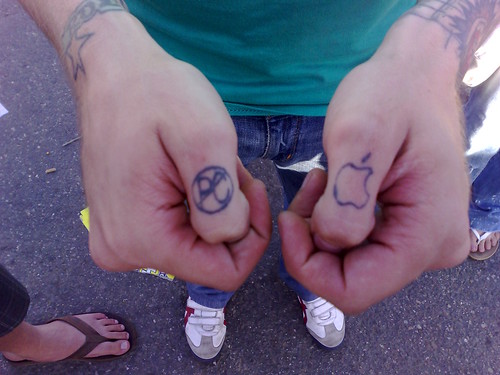
two kinds of people

“There are two kinds of people in the world: those who divide the world into two kinds of people, and those who don’t.”
– Robert Benchley

This election process is driving me crazy. I wish we could just pick someone already, and get the fuck on with it. I mean, yes, I do hope a particular someone gets picked, but the longer that keeps not happening, the more disturbing this whole having to root for “my” side, and having to hate the other side, and having to bear witness to an ever increasing enmity widening the divide between the two sides, thing is becoming. Is anyone else feeling worn out, here? And it’s no longer relegated just to the 24-hour news cycle anymore. It’s in, like, everything. Video games, porn, pumpkins! Tried choosing a cup at 7-11 lately?
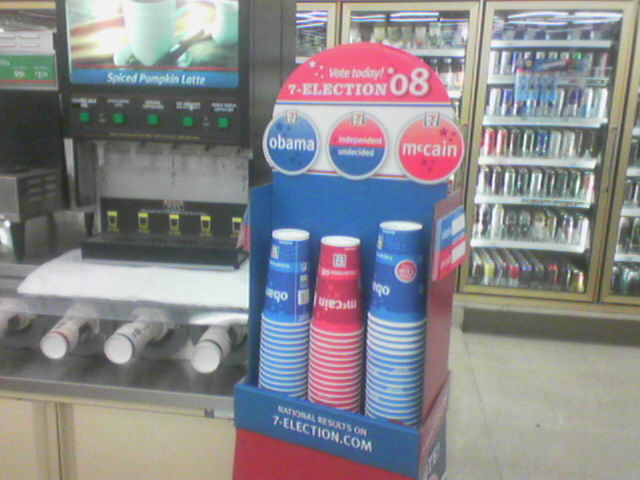
It’s like Bloods vs. Crips gone wild out there!

Binary battle lines are permeating the atmosphere, and they’ve been seeping into everything I seem to be writing recently, too. From the “sluts” vs. “virgins” pop-culture war, to the schism in conservative vs. liberal moral psychology, to PCs vs. Macs even. That’s all within the past month. It feels like everything is being forced to become a dichotomy. Which is a really dangerous kind of trap to get stuck in, and it’s prompted me to take a step back, and examine this phenomenon itself, rather than end up writing yet another post that would inadvertently fall into the same pattern. What I’ve realized is–surprise surprise!–I have two very powerfully conflicting reactions to this polarization that will be holding our reality hostage officially for 3 more weeks, but whose legacy will linger much, much longer.

Wait, before I get in to that, I just want to say that I realize that it’s not like this election invented the social/cultural/psychological divide between liberals and conservatives that politics has been exploiting since who knows when, but I really do think this particular election season has galvanized it to a degree that’s like nothing I’ve ever seen in the United States in my lifetime. A few weeks ago on the Daily Show, Jon Stewart suggested to guest, Bill Clinton, that “This election has apparently taken us all the way back to 1968 and the Nixonian and McGovern culture divide.” So it’s clearly not new, what’s going on today, but its degree of vehemence is not particularly familiar to anyone under 40, either.

Watching the preceding two elections go down, it had become increasingly clear that the left simply wasn’t getting it. It was like the nature of the electoral playing field had changed in some very crucial way, and the Democrats hadn’t gotten the memo. Which is why it feels like Barack Obama has offered a total departure from the kind of democratic nominees we’d gotten used to. People aren’t for Obama just because he’s the non-republican option. They are actually for what HE represents (which is, amazingly, a myriad of things to a broad spectrum of people, which he has, nonetheless, managed to bring together into a miraculously unified concept, and that unto itself is yet another aspect to his appeal), and they are for him in a fervent, decisive way that for the past 8 years has seemed to be the sole province of Republican candidates. So yeah, on the one hand, I can definitely say it’s been pretty gratifying to all of us who’d gotten tired of losing during that time, to watch the Democrats pull their shit together, and run a seriously strategized, legitimately competitive campaign. Booya. Bring it on. Go, team, go!

But here is what I personally find incredibly dismaying–even more than the right’s recent effort to cast Obama as a Muslim terrorist (I’m kind of surprised it took them this long), even more than the prospect of Sarah Palin possibly getting to make decisions about…. anything whatsoever (well, ok, dismaying on par with that)–is it’s precisely because Obama has been so successful at mobilizing the left, and the right has been forced to stake out even more desperately polarizing territory in response, that we’ve now gotten to a point where the cost of an election involves tearing the country limb from limb, first.

I said that this kind of social division that makes the air itself feel dense with tension is like nothing I’ve ever experienced in the U.S., but I have felt it somewhere else before: Jerusalem. There is a word in Hebrew that’s used for how Jerusalem feels–“Lachatz.” It literally translates to “pressure.” And in that city, that’s had contention in the air for millennia, that is, indeed, the right word. Like something intensely volatile, tenuously bottled up. In Jerusalem the binary conflict is ingrained, literally, into the walls, and it demands a constant vigilance of one’s affiliation. There are certain sections of the city where you are not allowed to go if you are Jewish, and others you cannot go to if you are Arab. Making sure you’re staying on your team’s side is not just a matter of politics, it’s how everyday life plays out. That’s what this election season, which has turned even regular, every-day actions into declarations of allegiance, is reminding me of. There’s this incessant perpetuation from all directions, whether it’s the media, or our friends, or slushie cups, of an us-vs.-them mentality, and I feel like it’s affecting how we think about everything right now, political or not.

Obviously, this is more or less inevitable when you’ve got a two-party election, and while it’s not like there’s anything that can be done about that situation now, I think it’s important to be aware, while we’re cheering our team on, of the underlying hazard in enjoying the polarization too much. Our human proclivity for this kind of binary divide is one of the most dangerous social situations that we can–and perpetually do–get ourselves into, and the massive eagerness with which both sides are relishing this particular battle is a little bit freaking me out.

Maybe it’s making me lose my sense of humor, too, cuz I totally can’t seem to find stuff like “McCain Be Old” to be funny… Or useful, for that matter. On that same episode of the Daily Show, Clinton said, “I’m glad [Obama]’s got people that love him that much. But those are not the people that hold this election.The people that hold this election are the people that think that he is on their side, and he loves them.” In other words, is it really necessary to incite alienation of people who could hold the swing vote, like, oh… you know… old people? Why not take a cue from Sarah Silverman instead, and shlep over to see your grandparents down in make-or-break-an-election state Florida? As Silverman says, “There’s nobody more important or influential over their grandparents than their grand-kids. You. If they vote for Barack Obama, they’re gonna get another visit this year. If not….”

As a marketer, I think one of the most crucial things to understand about people is just how diverse and nuanced the spectrum of identity and culture and personality is. In this long-tailed, custom-tailored, niched-up world we’re living in now, understanding the importance of approaching different groups on their own terms is the difference between success and irrelevance. Less than a month out from what I fully admit is the most important presidential race of my lifetime, may not be the time to start preaching plurality or diversity, or anything that could be undermining to in-group solidarity, but I think even through this process we do need to remember that with people things are not just black and white, or blue and red, or binary at all. One of the things that makes Barack Obama so appealing for me is that, as he himself acknowledges, as the product a Kenyan father, and an American mom, who was born in Hawaii, grew up in Indonesia, and became a Senator in Chicago, his mixed heritage has given him an understanding of America that is informed by a global, and uniquely modern perspective. That’s the kind of perspective that makes sense for the president of the United States when I think about the 21st century future not just of America, but the world.

Now, if we could just get through this election already…..


Subscribe for more like this.


“i’m a PC. and a human being.”

Have you ever been in a meeting where everyone in the room is using a Mac except one person? Ever notice what happens when suddenly everyone starts to get on that person’s case about the fact that he’s the only one not on a Mac?

I have, and it kinda looked a little bit like this…

http://graphics8.nytimes.com/images/2008/09/18/business/18adco2.600.jpg

That’s a still from the latest ads developed by Crispin Porter & Bogusky in Microsoft’s new campaign to–essentially–regain control of their identity, and it’s a pretty accurate depiction of how I’ve seen that PC-in-a-room-full-of-Macs situation play out. (Clearly, it must not be an isolated incident). In the ad, when the diver flips the white board over, the other side reads, “And I’m Kinda Scared.”

Now, I’m a Mac now, but the computer I had before this one was a PC. I’m just as comfortable using either, and I’ve got Microsoft programs running on this computer right now. I could even get a Mac that comes with the option of running Windows, anyway, if I want, so even though I’m a Mac user, I clearly don’t see my identification with the brand in terms like this–

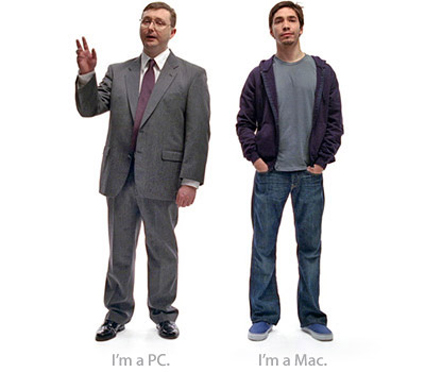
But many clearly do. And perhaps nothing has helped to articulate the contemporary Mac superiority complex quite like those Mac Vs. PC ads. In the iconic spots created by TBWA/Media Arts Lab, which began in 2006 and new iterations are still being developed now, a casually-dressed, attractive, 20-something guy introduces himself as “Hello, I’m a Mac…” while an older, slightly overweight guy, wearing glasses and a cheap lookin’ suit-and-tie combo introduces himself as “… And I’m a PC.” The two then act out little vignettes against a stark white background in which the capabilities and attributes of “Mac” and “PC” are compared. Often the spots end up presenting various legitimate PC shortcomings in an entertaining, glib way, but just as often the focus is on the two machine-characters’ personalities, and the feature comparison ends up being almost beside the point. Mac is always self-assured and easy-going. PC is resentful and awkward. The great success of these ads,

Mac vs PC

The subtext of these ads, which has also become the subtext of the Mac user community, is that this isn’t just a tool for enabling a certain kind of lifestyle, it’s a badge of it. A Mac isn’t just about helping you BE creative, it MEANS you are creative. A PC, on the other hand, means you are a stiff, unimaginative, frustrated tool, overly concerned with work, and incapable of doing anything interesting. At least not as good as a Mac can. Oh, and furthermore, if you’re  a PC user, then you may as well know that this is what other people are thinking about you, too.

Personally, I’ve always been completely impressed that Mac has been able to brand a conformist white box into a symbol of creative and individual expression. But the idea is that your white box gives you entry into a whole network of other creative individuals, (just like you), and it’s that community association that bestows identity. A good friend of mine, who is a fashion designer, belly-dancer, serial entrepreneur, and has more tattoos and crazy hairstyles than the majority of the creative class, is a dedicated PC, and one of the major reasons for her choice is that she finds the idea inherent in a Mac–that you need this thing in order to express that you’re “hip”–to be a huge turnoff. A Mac doesn’t just bestow hipness to its users, it kind of subsumes it from them too. Perhaps she’s wary of this kind of  accessory watering down or co-opting her own particular kind of hip. Either way, she says she feels like no one else has this line of thinking. It’s a turnoff  “Only only to me,” She says, “I think PCs are just fine, and a lot more bang for your buck,” but everyone else she knows seems to have no problem with this aspect of their Macs.

It’s to let people like her know that there’s more of their kind out there, and to establish that their computers can, in fact, represent their creative, dynamic, interesting identities, that CPB took the direction they did with the new Microsoft ads.

Here’s one. You should watch it before reading further:

I think what’s really interesting here is that the ads say NOTHING about the product, or the features, or anything technical whatsoever. The sole purpose of the ad is to explore the diversity of PC users. I’m trying to think of another example of an entity trying to redefine its own identity by working to undo the stereotype of its “fans,” and I can’t think of one. (Anyone got one?) It’s pretty intense.

In a post titled, “Huh. Those Mac Ads Aren’t As Funny Any More,” Michael Arrington wrote:

Those Microsoft commercials aren’t particularly engaging, and they don’t make me want to go out and buy a copy of Vista. But what they do is show lots of fascinating people saying that they use PCs. They highlight the fact that many people may be somewhat offended by the idea that they can’t be interesting or cool if they don’t use a Mac.

Suddenly, Apple looks a little elitist. I mean, they were elitist before, but in a way that made you want to be a part of the club. Now, they just seem a little snobby.

If that’s what Microsoft and their pushing clients to the edge advertising agency Crispin Porter + Bogusky were aiming for, it’s brilliant.

According to the New York Times, CPB “Relishes efforts to transform perceived negatives into positives.” (See also announcing the onset of an “SUV Backlash” to help promote the US launch of the Mini Cooper–before any such backlash had yet begun at all, positioning the Mini’s uber-compactness as an alternative to the gas-guzzling hegemony.)

More from the New York Times:

Apple executives have been “using a lot of their money to de-position our brand and tell people what we stand for,” said David Webster, general manager for brand marketing at Microsoft in Redmond, Wash.

“They’ve made a caricature out of the PC,” he added, which was unacceptable because “you always want to own your own story.”

The campaign illustrates “a strong desire” among Microsoft managers “to take back that narrative,” Mr. Webster said, and “have a conversation about the real PC.”

The celebration of PC users is intended to show them “connected to this community,” added [Rob Reilly, partner and co-executive creative director at Crispin Porter], “of people who are creative, who are passionate.”

Every single person featured in this ad is somehow compelling and enigmatic. Perhaps it’s because they’re all so different. You have no idea who is coming next. They challenge not only the expectations of who a PC is, but the assumption that you’re supposed know everything about who someone is just based on the kind of computer brand they use. (Talk about “Think Different,” huh?) If the Mac community is “alternative,” the one depicted in the Microsoft ad is global. If the Mac community is elitist, this one is accepting. Beyond “creative and passionate,” this community has a real sense humanity. It’s worldly and smart and open-minded and profoundly diverse. It’s approachable and philosophical. A community that’s out to change the world, and enjoy the world; a community that’s what the world might look like if everyone in it got along. And regardless of whether you’re a Mac or a PC…what kind of progressive human being (not a human doing, or a human thinking) wouldn’t want to be a part of a community like that?

The next time I need a new computer, maybe it’ll be a Mac, and maybe it’ll be a PC, but either way, I find it comforting and heartening to know that this is the kind of community a company like Microsoft sees–and wants the rest of us to see–as its own ideal.


Subscribe for more like this.


does good matter?

Companies: How to Make Millions By Switching to A Green-Colored Logo
– Headline in The Onion’s “Obligatory Green Issue”

I’ve been thinking about this, the third in what’s evidently become a series of posts inspired by Buying In: The Secret Dialogue Between Who We Are and What We Buy, by Rob Walker, since I read the section in the book (it’s also been reprinted as a Fast Company article) where Walker writes about American Apparel changing its brand messaging. Initially the company’s identity hinged on its “Sweatshop Free” production, but sex, surprise surprise, turned out to be a much better sell than good labor practices. Walker writes:

American Apparel seemed to me to be a marquee example of a business that had positioned itself to respond to a rising tide of ethical, antibrand consumers. At a moment when practically every clothes maker was offshoring to cut costs, American Apparel made its wares at a U.S. factory in which the average industrial worker (usually a Latino immigrant) was paid between $12 and $13 an hour and got medical benefits. The company had taken out ads in little arty magazines, noting that it was “sweatshop free.”

[But] Another self-consciously ethical clothing brand, SweatX, had just gone out of business. The lesson of SweatX, [American Apparel CEO Dov] Charney said, was that building a brand solely around a company’s ethical practices was not a good strategy for reaching masses of consumers. The ethical sell was too limiting. It was a niche strategy, at best. Which was why American Apparel was moving away from the ethical sell to something very different.

Charney pulled out a copy of a book called The 48 Laws of Power and read me No. 13, which suggested that to get what you want, you must appeal to people’s self-interest, not to their mercy. “That’s the problem with the anti-sweatshop movement. You’re not going to get customers walking into stores by asking for mercy and gratitude.” If you want to sell something, ethical or otherwise, he said, snapping the book closed, “appeal to people’s self-interest.”

By the time I visited American Apparel’s headquarters and factory in Los Angeles to meet with Charney a second time, the company had transitioned to an image soaked in youth and sex. This was apparent in its stores — where the decor often included things such as Penthouse covers — and in its print ads. Yes, some of these ads mentioned quality and the sweatshop-free angle, but usually in small type, under a photograph of a half-naked young woman.

The company was producing 32,000 pieces a day and struggling to keep up with orders. In months, [the company’s] system was churning out 90,000 pieces a day and would eventually reach 250,000. While the company was projecting an air of almost reckless decadence in its ads, it was quietly building a thriving made-in-America business model.

All of which, of course, made me wonder–and perhaps might make you wonder, too: Does good matter?

Good itself, I mean, without a gloss of sex covering it over, does it matter as a selling point to us as consumers?

Researchers Remi Trudel and June Cotte were trying to figure out the same thing in their studies for the May 2008 Wall Street Journal piece Does Being Ethical Pay?

For corporations, social responsibility has become a big business. Companies spend billions of dollars doing good works — everything from boosting diversity in their ranks to developing eco-friendly technology — and then trumpeting those efforts to the public.

But does it pay off?

To find out, we conducted a series of experiments. We showed consumers the same products — coffee and T-shirts — but told one group the items had been made using high ethical standards and another group that low standards had been used. A control group got no information.

In all of our tests, consumers were willing to pay a slight premium for the ethically made goods. But they went much further in the other direction: They would buy unethically made products only at a steep discount.

Our first experiment asked two questions. How much more will people pay for an ethically produced product? And how much less are they willing to spend for one they think is unethical?

To test these questions, we gathered a random group of 97 adult coffee drinkers and asked them how much they would pay for a pound of beans from a certain company. We used a brand that’s not available in North America, so none of the participants would be familiar with it.

But before the people answered, we asked them to read some information about the company’s production standards. One group got positive ethical information, and one group negative; the control group got neutral information, similar to what shoppers would typically know in a store.

After reading about the company and its coffee, the people told us the price they were willing to pay on an 11-point scale, from $5 to $15. The results? The mean price for the ethical group ($9.71 per pound) was significantly higher than that of the control group ($8.31) or the unethical group ($5.89).

Meanwhile, as the numbers show, the unethical group was demanding to pay significantly less for the product than the control group. In fact, the unethical group punished the coffee company’s bad behavior more than the ethical group rewarded its good behavior. The unethical group’s mean price was $2.42 below the control group’s, while the ethical group’s mean price was $1.40 above. So, negative information had almost twice the impact of positive information on the participants’ willingness to pay.

Trudel and Cotte also researched just how ethical companies really need to be in order to reap marketplace rewards, that is, are consumers willing to pay more for a product that is 100% ethically produced versus one that is 50% or 25% ethically produced? Their findings showed that there is a certain “ethical threshold” beyond which any ethical acts might reinforce the company’s image, but don’t induce people to pay more. And lastly, they examined the effect of pre-existing consumer attitudes, and found that people with high expectations about how companies should behave doled out bigger rewards and punishments than those with low expectations.

For companies, the implications of this study — albeit limited — are apparent. Efforts to move toward ethical production, and promote that behavior, appear to be a wise investment. In other words, if you act in a socially responsible manner, and advertise that fact, you may be able to charge slightly more for your products.

Not an overwhelming rallying cry to assert that good is here, it matters, and we should get used to it, exactly, but clearly an opportunity to explore a new ethical “market segment.” As Walker writes:

Perhaps this is why many big companies and brands are not so much changing their products as adding new alternatives to their existing product mixes, or carving a small donation to charity out of their profit margins. Pepsi-Cola is testing an all-natural version of its flagship drink called Pepsi Raw, and Clorox has launched an eco-friendly line of cleaning products. The Bono-promoted (Product) Red initiative brands existing products that dedicate a portion of the purchase price to the Global Fund to Fight AIDS, Tuberculosis, and Malaria. There’s even a (Product) Red version of the iPod.

A whopping majority of American shoppers may consider themselves environmentalists, but, according to the Journal of Industrial Ecology, only 10% to 12% “actually go out of their way to purchase environmentally sound products.” Similarly, Brandweek reported on a survey that found that even among consumers who called themselves “environmentally conscious,” more than half could not name a single green brand.

Ask most people whether they care about the environment, and it’s not particularly surprising that many would say yes. Ask whether they would back that up by “buying green” if they had the chance, and again, it’s likely that very few would admit to being hypocrites by saying no. What we do in the marketplace is another matter.

There is a real-world overload of factors that confront consumers in the marketplace — price, quality, convenience, pleasure, plus the countless number of symbols that provide us with rationales to buy. The Yale Center for Customer Insights designed an experiment to test this phenomenon. It divided 108 subjects into two groups. Members of one group were presented with a straightforward consumer choice. Would they prefer to buy a vacuum cleaner (a utilitarian object) or a pair of jeans (a bit of a luxury), each of which was assigned the same price, $50? About 72% chose the vacuum cleaner. Members of the other group were told to imagine they had volunteered to spend three hours a week either teaching children in a homeless shelter or “improving the environment.” They were asked to explain their choice, a process meant to prod them into engaging with the idea. Then they faced the vacuum-cleaner-or-jeans choice. In this group, a majority (57%) opted for the jeans.

Although very few of the subjects made the connection, the researchers concluded that “the opportunity to appear altruistic by committing to a charitable act in a prior task” gives us license to choose a luxury item. A similar set of studies indicates that subjects are more likely to splurge on fancier sunglasses or pricier concert tickets after giving to charity. If you buy ecological or green products or consume alternative health care or practice yoga, it’s easy to conclude, “Hey, I’ve done my part.”

These efforts [by big companies] add just enough options to the miles of retail shelves to give us all an ethical fix — to do our one good shopping deed. Then we can push our basket a little farther down the aisle, letting other rationales take over: Here’s a bargain, here’s a great product, here’s something that I could probably get cheaper elsewhere, but as long as I’m here, I’ll just get it — and here, yes, here is something ethical. I’ll take one of those, too.

Trudel and Cotte concluded at the end of their research: “The lessons are clear. Companies should segment their market and make a particular effort to reach out to buyers with high ethical standards, because those are the customers who can deliver the biggest potential profits on ethically produced goods.”

Rather than marketing ethical products to a mainstream audience, big companies can simply create a separate ethical brand or product line, repackage it as a luxury “good,” and sell it at a premium to the niche, conscientious consumer demographic–which may be willing to pay more for ethical products, but couldn’t scale to support a company like SweatX, or to motivate the big companies to change their practices overall.

Is that the fate of good, then? Is the extent of it’s significance as a selling point simply the justification for a reverse “ethical tax”?

At the PSFK conference in San Francisco last week, GOOD Magazine co-founder Max Schorr’s presentation, “Aligning Interests,” (echoing that 13th law of power) was subtitled: “When cynical people admit they’re idealistic you might be on to something.” At the beginning of his presentation Schorr asked a room full of marketers how many of us wanted to make a positive impact. Pretty much everyone raised their hands. When he asked how many of us wanted to make money, the same hands shot up. The idea then is that to effect real positive change these kinds of interests have to align. Doing good has to be separated from the bleak, unprofitable, un-fun, self-righteous, and ultimately ineffectual idea lf altruism, and the “triple bottom line” of sustainability, profit, and positive impact, needs to become a single bottom line. Schorr’s presentation was the most loudly applauded of the whole day, and thereafter the most frequently referenced. There is no doubt that marketers–well, those of us that raised our hands anyway–we WANT good to matter. We WANT consumer demand for ethics and sustainability to affect the substance of what the market supplies. We want good to succeed.

But does it have to matter as a selling point to do that?

In his presentation, Schorr talked about how the magazine has stopped using the word “Green.” The reason behind this move being to stop presenting sustainable practices as some kind of distinct “alternative” from what should simply be the default standard. In a sense, this is what American Apparel did as well when they stopped trumpeting their ethical practices to distinguish their brand identity.

Maybe it’s all about thinking ahead. We shouldn’t confuse current consumer attitudes with what they’re likely to be in the future. No doubt a company’s environmental friendliness matters more now to the average consumer than it would have before the release of An Inconvenient Truth. And I’d be willing to bet that ethical production practices in general matter more to us now than they did before the wave of mass internet adoption hit, and access to information about a company’s practices became easily accessible to the average web surfer. Trudel and Cotte even acknowledged that if 100% ethically produced products become the expected norm, anything less may be punished by consumers. So perhaps good actually WILL matter quite a bit more in the future than it does now.

But will it ever matter more than sex?

Maybe that gloss on top won’t hurt anyway. Just…. you know….. in case.


Subscribe for more like this.


hipster screamo southern rap

I got an email a few days back that read:

fromjustin boreta
subjectif the glitch mob went screamo
dateWed, Jul 16, 2008 at 11:35 AM

http://profile.myspace.com/brokencyde

prepare yourself

But I was getting ready to head out to San Francisco for the PSFK conference, (and to be perfectly honest, was kind of scared by the whole idea being proposed in the email’s subject line) so I didn’t get around to actually checking it out until today…..

And oh man, these guys are friggin awesome and hilarious. I couldn’t listen to a single track without totally cracking up. And I’m sure these tunes ain’t no slouches on the dancefloor neither. (Do yourself a favor, and go check them out. It might not be your cup of tea, but you gotta at least be entertained that this exists at all.)

Ps. Gotta love the complete blatant disregard for all music genre rules and regulations. Sounds like the future.


Subscribe for more like this.


what ad agencies can learn from indie brands

In Buying In: The Secret Dialogue Between Who We Are and What We Buy, Rob Walker talks about “underground brands”–lifestyle symbols created by independent entrepreneurs. In fact, I actually think it’s easier to think of underground brands as “independent brands,” (cuz what does “underground” really mean, anyway?) much like independent music:

In popular music, independent music, often abbreviated as indie, is a term used to describe independence from major commercial record labels and an autonomous, do-it-yourself approach to recording and publishing.

Similarly then, indie brands are independent from major publicly-traded companies, and reflective of a do-it-yourself approach to lifestyle symbol creation. Both indie and major brands appeal to consumers for the same reasons–as expressions of identity, and community belonging–but the indie side functions very differently. Indie brands can often take risks that the major ones wouldn’t know how to were they even interested, they are able to maneuver more deftly in a rapidly changing consumer landscape, take advantage of new opportunities more swiftly, and now more than ever before, they are blazing the trails and creating the models that many major brands are starting to emulate.

As someone who’s been intimately involved in the development of several independent brands I thought I would share some suggestions both from my own experience, as well as from insights synthesized with various examples from Buying In, of what ad agencies (and major brands) can learn from the indies about staying competitive in contemporary culture.

1. INTEGRATE DEPARTMENTS
Agencies talk of integration like it’s the latest buzzword since “viral,” (which, incidentally, before it was a buzzword, was also first tested by independent brands) but most are still set up to approach marketing in a compartmentalized, paint-by-numbers way that doesn’t fit with how any of us in the digital era actually interact with media and messaging. In a time when we update our facebook status while watching TV online, and google something we’ve just seen on a billboard we drove past, all media overlaps. As natives of this environment, indie brand creators don’t think “Print” vs. “New Media” or “Creative” vs. “Media Buying.” Of course, a variety of skill sets is necessary, but when a “media channel” can now basically exist anywhere that people are playing attention, it’s counterproductive to continue enforcing separation between all the various departments of messaging development and dissemination. Without the imposition of this bureaucratically segregated setup, indie brands approach marketing as an inherently integrated process, dealing with the way the different channels at their disposal feed into one another as part of an interconnected system.

2. HIRE DIFFERENTLY
None of the indie brand creators I’ve ever worked with majored in marketing–and that goes for me, too. Marketing majors end up at ad agencies, indie brand creators, on the other hand, end up creating culture. Music, fashion, publications, events, blogs, graffiti, whatever. If it’s a genre of DIY expression, that’s where indie brand creators can be found, and it’s where strategies that take on new marketing options are going to be developed. I’ll admit, I did take one Marketing 101 class, though, and it’s probably because marketing is taught as a segregated process that its students are primed to continue thinking within the same kind of box once they graduate. Indie brand creators think outside the marketing box because 1. They were never taught there was a box to begin with, and 2. They couldn’t afford to try out the box anyway, so developing “alternatives” is their default. This is who you want to be hiring to help develop progressive marketing strategies.

3. INVEST IN CULTURE NOT MEDIA
In a consumer landscape niched up into various lifestyles, “mass marketing” is becoming increasingly irrelevant. Indie brands have never had the luxury of a mass marketing budget, so they’ve instead focused on building and sustaining meaningful relationships with the communities that nurture them. In Buying In, Walker talks about Pabst Blue Ribbon’s strategy after discovering that their brand, whose history was essentially as a staid Midwestern working class beer, was experiencing an unexpected popularity surge among the pierced, tattooed, bike messenger alterna kids in Portland Oregon. Clearly this was not a demographic that PBR had sought deliberately (the brand just happened to become quite eagerly adopted by a young culture in need of a cheap beer), but once they noticed what was going on instead of buying up a ton of media targeting this demo, PBR began sponsoring community events such as “bike polo” matches. In fact, a particularly ardent PBR fan that Walker talks to specifically noted he appreciates that he’s never seen a PBR ad of any sort. It shows that “they’re not insulting you,” he says. If advertising AT a community can be perceived as an insult, supporting it can make a brand an integral part of the community’s culture.

4. A BLANK SLATE IS THE BIG IDEA
Ad folks think it’s their job to create advertising. Indie brand folks think it’s their job to make sure their product sells. The disconnect between these two perspectives is perhaps nowhere more blatant than in the ad agency reticence towards “user generated content.” This is not to say that ad agencies shouldn’t create branded content, by any means, but rather to point out, as Walker does, that some of the most potent brands are ones that have allowed people to project their own meanings onto them. His two biggest examples of this are Hello Kitty and the Live Strong bracelet. One benefited from an inscrutable expression, the other from a statement that allowed innumerable personal interpretations. Neither sought to define what specifically it was supposed to mean or stand for, and thereby each allowed people to cast their own relevance onto the brand. Unequivocally cementing a brand into a “big idea” couldn’t accommodate that. Creating a brand that functions as a “platform” for consumers to create their own meaning (whether it’s as literal as UGC or as ephemeral as a personal projection) is now just as crucial as messaging.

5. COMMUNITY FIRST, BRAND SECOND
It is tempting to think that a brand creates a community. In fact, many brands, realizing the power of community as a resource, strive to create their own, and brands such as Apple definitely have a cult-like following. But the reality is that brands do not create communities from scratch, they become symbols of communities. Brands can reflect a community’s values and lifestyle, but I don’t think it’s possible to brand a lifestyle before it actually already exists. Was Apple as hot before the rise of the creative class? (The trend itself, I mean, not just the book about it.) Of course, the Apple technology certainly helped facilitate the expansion of the creative class, but the bottom line is that the societal predisposition that can come to constitute a community has to be there, and a brand does not invent it, it reflects it. Indie brands are spawned out of the very communities that they represent, so it’s not like they need to conduct massive amounts of consumer insight research, and their understanding of this community first, brand second dynamic is deeply intimate. For many major brands, however, the focus shouldn’t be on fabricating their own “community” but on developing a more significant understanding of the needs of the communities that buy and endorse them. (Then, see #3).

6. THINK BEYOND THE QUARTER
The relationship between a culture and a brand, like any kind of relationship, takes time. That it can’t always be statistically documented after three months does not necessarily make the relationship unsuccessful. My favorite example of a brand thinking “beyond the quarter” is Scion integrating it’s cars into Whyville, an online community for tweens. Pretty much the coolest thing you can buy in Whyville is a Scion, and its added bonus is that then you can drive all your other friends around in it in the game. They start at 15,000 “clams” (Whyville dollars), but for 20,000 you can get it all customized. The most fascinating thing about this whole strategy, however, is that the Tween demographic is between 8-12 years old. It’s gonna be a while before they even have a driver’s license at all, let alone be in a position to be buying a car in the real world, but when they are, owning that virtual Scion will no doubt be an experience they draw on when making the purchase decision. This is thinking five, ten, fifteen years beyond the quarter, and it’s how indie brands think. Ok, maybe they don’t necessarily have the forethought to think that far ahead, but they do have the luxury to not have to think of success as based on proving something to shareholders every season. After all, just ask Starbucks about how rampant growth can even undermine success in the long-run.

The trend of more and more kinds of facilities cropping up to support DIY creative endeavors means that more and more kinds of indie brands are getting created. The evolution of marketing that doesn’t look anything like what it has before is only going to continue. Might as well take a cue or two from the side that’s plowing head-first into the changing the landscape.


Subscribe for more like this.