
Why Iron Man Is The First 21st Century Superhero

iron-man-downey-jr

In 1938, on the eve of the Second World War, a relatively new medium called the comic book unleashed a new kind of character into the consciousness of American youth. Created by writer Jerry Siegel and illustrator Joe Shuster, this character possessed superhuman powers and a dedication to using those powers for the benefit of humanity. Often battling and defeating evil as hyperbolic as his own goodness, his iconic name would become the source of the term for this all-American archetype, the “superhero.” In the decades since Superman‘s arrival, innumerable variations on this theme have emerged, but always these characters have struggled under the weight of a concept about who they must be that was invented before television. For the past 70 years we have been living with a 20th century version of the superhero. Until now. Though the Iron Man character was originally created in the early 60s, his most recent incarnation, as played by Robert Downey Jr., and directed by Jon Favreau in the just released Iron Man 2, is really the first Millennial superhero.

The original Superman prototype possessed a key characteristic, one that his creators, first generation American sons of Eastern European Jewish immigrants, would have known something about, one that this “Man of Tomorrow” would pass on as part of his legacy to future generations of masked heroes: a secret identity. This trait would become an intractable part of the very definition of a superhero, as much a prerequisite for his mythology as extraordinary powers, or at least a flamboyant getup. And yet, in a press conference at the end of 2008’s first installment of the Iron Man franchise, Tony Stark announces to the world that he is Iron Man. This is where the sequel starts off. The need for a secret identity is gone. The entire world knows — and not because some tabloid uncovered the mystery man behind the mask, but because he just straight up told everyone. In the comic books, it took Stark 40 years to make this move. For Superman or Spiderman or Batman or virtually any other superhero from the prior century (save some like the X-Men) their secret identities were their most sacred possessions, the keys to their undoings, and they fought as hard to protect them as to save humanity itself. But in the 21st century, Tony Stark’s approach to privacy reflects how Millennials now think of the concept.

These days, the kind of stuff kids choose to reveal about themselves online is almost beyond comprehension. The latest social platform eroding the boundary between what was once strictly private and is now exposed to the world is Formspring.me, which the New York Times calls, “the online version of the bathroom wall in school“:

While Formspring is still under the radar of many parents and guidance counselors, over the last two months it has become an obsession for thousands of teenagers nationwide, a place to trade comments and questions like: Are you still friends with julia? Why wasn’t sam invited to lauren’s party? You’re not as hot as u think u are. Do you wear a d cup? You talk too much. You look stupid when you laugh.

Comments and questions go into a private mailbox, where the user can ignore, delete or answer them. Only the answered ones are posted publicly — leading parents and guidance counselors to wonder why so many young people make public so many nasty comments about their looks, friends and sexual habits.

Social media researcher danah boyd asked a similar question a couple of weeks ago:

This [behavior] has become so pervasive on Formspring so as to define what participation there means.  More startlingly, teens are answering self-humiliating questions and posting their answers to a publicly visible page that is commonly associated with their real name. Why? What’s going on?

While this particular trend is definitely a bit baffling, those of us that have grown up in the digital age have pretty much come to expect that the privacy arc of the internet is perpetually bending more and more towards greater disclosure. Privacy, as Facebook’s Millennial founder Mark Zuckerberg insists, is dead:

People have really gotten comfortable not only sharing more information and different kinds, but more openly and with more people. That social norm is just something that has evolved over time… But we viewed that as a really important thing, to always keep a beginner’s mind and what would we do if we were starting [Facebook] now and we decided that these would be the social norms now and we just went for it.

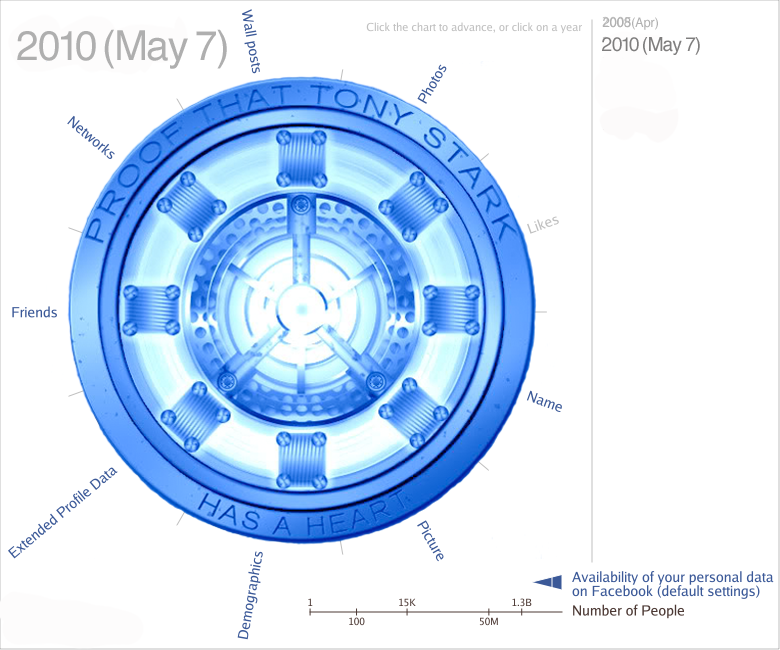
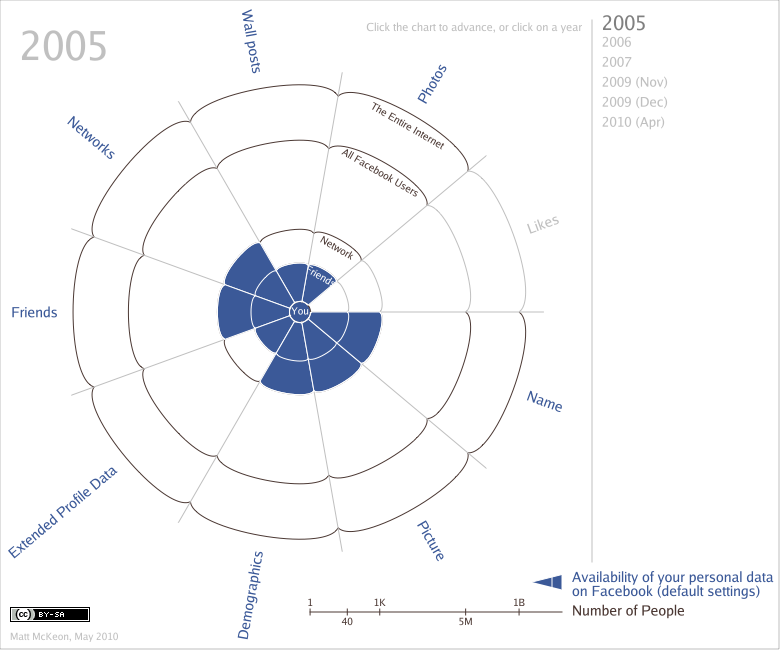
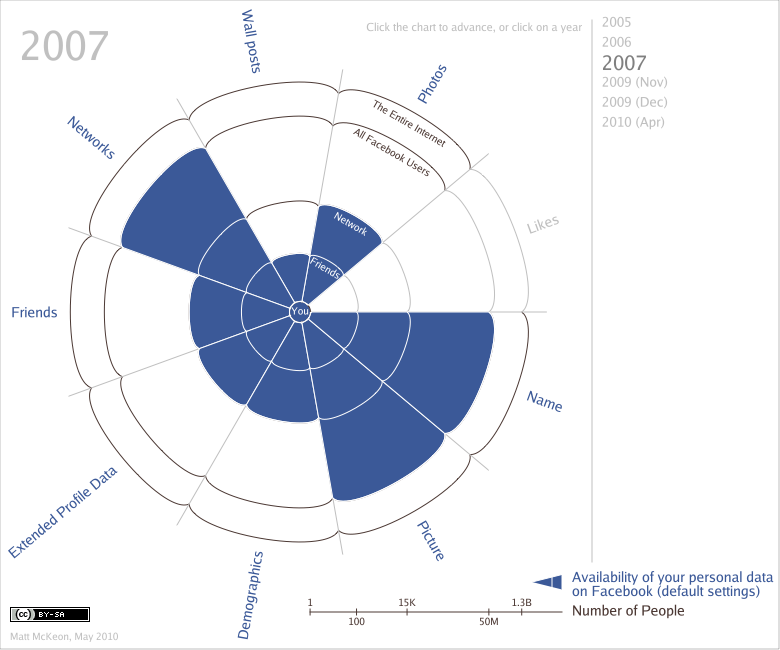
Here’s an interesting visualization of the Evolution of Privacy on Facebook, indicating how the website has let ever more of our information become increasingly public over the years:
bf05

fb07

fb10

starkarc

Oh… wait a second, no, that last one is actually the arc reactor implant that’s keeping Tony Stark alive. But, no doubt, Skynet… err.. Facebook is intent on catching up to the full-pie version of the chart soon.

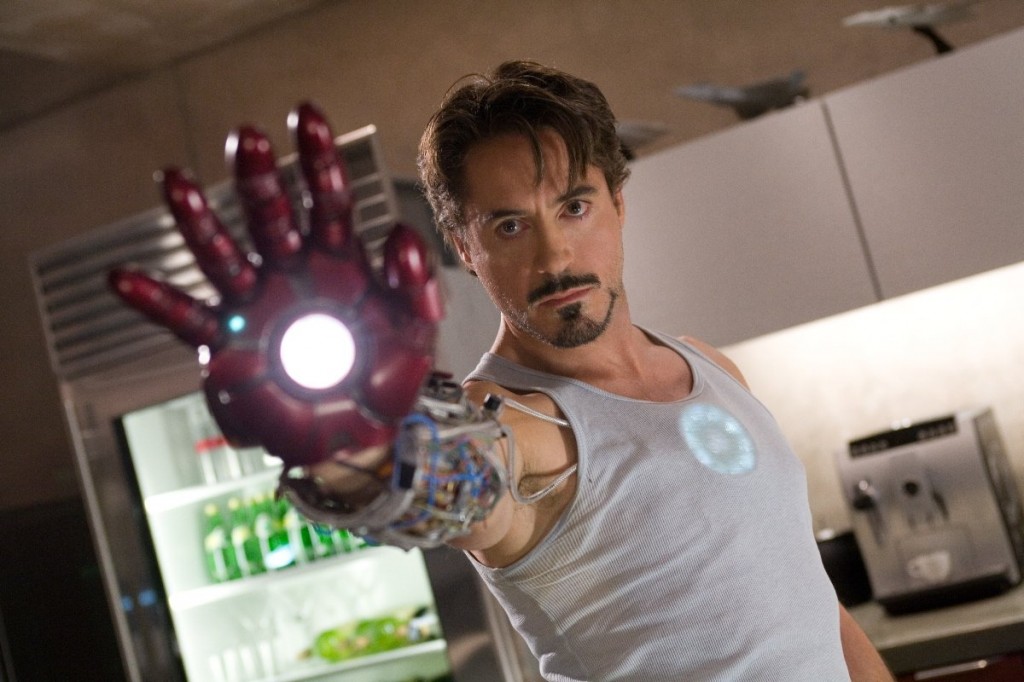
Anyway, Bruce Wayne, Clark Kent, Peter Parker, they were never prepared for this brave new networked world. Their entire way of being simply doesn’t fit anymore. Neither with Facebook and its social network platform ilk, nor the (*cough* relative) sensibilities of the Millennial youth who use it. For Tony Stark, transparency isn’t just relegated to the subject of his super-powered “alter ego,” it’s a pervasive part of his total personality, his way of being in the world. Stark is as blatant as his id, his mobile touch-screen device is actually, literally, transparent, allowing others to see everything he’s doing on it, every surface in his house seems to be equipped with touch-screen capabilities, his browsing activities public to anyone sitting nearby who cares to look. Zuckerberg himself likely couldn’t have dreamed up a more post-Privacy kind of superhero, one less conflicted about the disparate parts of his identity. With the death of privacy, you cannot be one thing in one context, and something different in another. You cannot be Clark Kent at the Daily Planet desk job, and then Superman on the night shift. You are exactly who you are to everyone at all times. Like no other superhero, Tony Stark’s identity isn’t conflicted. It’s absolute.

In her book Generation Me: Why Today’s Young Americans Are More Confident, Assertive, Entitled–and More Miserable Than Ever Before, psychology professor Jean Twenge writes:

It has always been normal for kids to have big dreams, but the dreams of kids today are bigger than ever. By the time kids figure out they’re not going to be celebrities or sports figures, they’re well into adolescence, or even their twenties.

High expectations can be the stuff of inspiration, but more often they set GenMe up for bitter disappointment. [The book] Quarterlife Crisis concludes that twenty-somethings often take a while to realize that the “be whatever you want to be, do whatever you want to do,” mantra of their childhoods is not attainable.

In the late 90’s, Tyler Durden, himself a sort of Gen X superhero — a transitional alpha version precursor to the Gen Y launch model, if you will — said it like:

We have no Great War. No Great Depression. Our Great War’s a spiritual war… our Great Depression is our lives. We’ve all been raised on television to believe that one day we’d all be millionaires, and movie gods, and rock stars. But we won’t. And we’re slowly learning that fact. And we’re very, very pissed off.”

Even in the throes of the economic crisis, my generation hasn’t really had a Great Depression either — though we did come this close. And even after 9/11 my generation hasn’t had a Great War. The world is now far too mind-numbingly complicated and complex to even have a clear concept of a single, monolithic Evil to fight. The “heroes” of my generation, the ideals that kids look up to and wish to be like, haven’t been men of steel battling evil for a long time, they are now, like Durden says, millionaires and rock stars. And that is precisely what 21st Century Tony Stark is. After he comes out of the closet (or, more accurately, the basement science lab) as Iron Man, he becomes a worldwide celebrity, a household name. Even the migrant worker he stops to buy strawberries from on the Pacific Coast Highway asks, “Are you Iron Man?” like he’s recognized a movie star.

And unlike Superman or SpiderMan or Batman or any other major superhero before him whose truth the world was not yet ready to handle, Tony Stark answers casually, “Sometimes.”

Perhaps that’s the other side of what allows a 21st century superhero to be transparent. The modern world can accept him as such. Gen Y is a lot more tolerant of lifestyle differences than prior generations, after all. The X-Men didn’t hide that they were different, either, but then again, they COULDN’T hide it — looking like Beast or Nightcrawler, or having Rogue or Cycolps’ particular mutations, you couldn’t just “pass” in normal society — and the humans the X-Men fought to protect could never accept them for being what they are. Not so in the world of Tony Stark. He’s no mutant. No outcast. He’s the most popular kid in school. The late DJ AM even spins at his birthday bash. The 21st century Tony Stark reveals to the world he is Iron Man, and the 21st century world says…. Awesome!

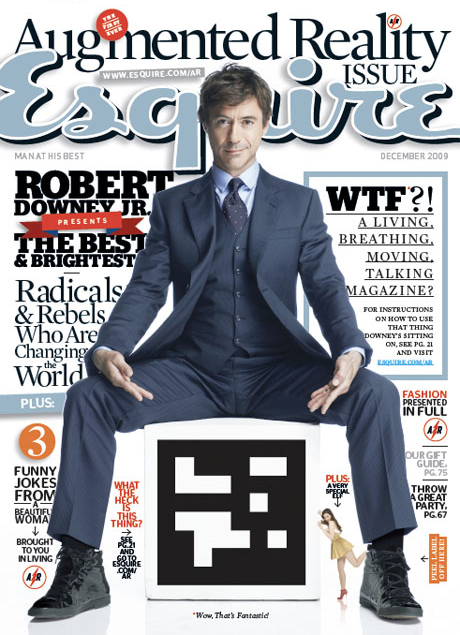
In the past, being a tech entrepreneur-slash-engineer, as Tony Stark is, would have made him a nerd, or otherwise Bruce Wayne, still stuck in the previous millennium, putting on a show of  irresponsible playboy-ness to deflect attention from both his morbidly serious crime-fighting alter ego and his humorless tech geek underbelly. Like, remember when no one would have wanted to sit at the lunch table with kids who talked about stuff like “augmented reality”?
esquire-augmented-reality-cover-robert-downey-1209-lg

Yeah, not so much, anymore. In the  21st century, being a tech geek no longer detracts from the image of a bad-ass or a dilettante. James Bond and Q have combined into one seamless character. It’s 2010, and geeks are cool! Hell, we’ve even got one as President.

While both Wayne and Stark are surrounded by high tech everything, for the 20th century hero all the gadgetry is just a means to an end. Even the Batmobile is ultimately just a flashy tool. Same could technically be said about the iPhone, but who would? In the post-iPod era we have a very different relationship with our technology. Our favorite tech objects aren’t just for utilitarian application, they’re obsessed over, fetishized, loved. It’s why Gizmodo would pay $10,000 for an exclusive scoop on an in-production, “lost” 4g iPhone, and why an enormous global audience would give a crap. When Stark says in the movie that the Iron Man suit is a part of him, that he and it are one, we all intimately understand exactly what he means even if the rest of us don’t actually literally plug our gadgets into our chest cavities.

After a raucous birthday party in which we see Stark, in full Iron Man gear, getting shitfaced and acting the fool, (he’s dying at the time, and feeling a bit of the nothing-really-matters mortality blues — being dissolute and apathetic, itself, unusually postmodern behavior for a superhero), S.H.I.E.L.D. agency director Nick Fury (played by Samuel L. Jackson) “grounds” the hungover superhero by sequestering him in his house with all access to communication with the outside world cut off until he solves a theoretical physics problem. This superhero’s punishment is having his phone and internet privileges revoked and being sent up to his room to finish his math homework. There isn’t a single one of the 60 million American Millennials that doesn’t relate to this.

When Favreau was looking for a 21st century industrialist corporate executive to use as a model for his and Robert Downey Jr’s interpretation of Tony Stark, he sought out Elon Musk, co-founder of paypal. Musk even has a cameo in the movie, chatting Tony up about an electric rocket, a concept referencing Musk’s current endeavors, Tesla Motors, which produces fully electric sports cars that rival Porsche in performance, and SpaceX, a private aerospace company working to invent the first reusable rockets, which would dramatically reduce costs and eventually lead to affordable space-travel. This dude is the inspiration for the 21st century version of Stark.

So what’s Tony Stak’s inspiration? Why does he do what he does? There was no childhood trauma that drove him to caped crusading. He wasn’t raised by adoptive Earth parents who imbued him with a strong moral compass during his formative years on a farm in the American Heartland. Sure, ok, he underwent a certain crisis of conscience in his 40s after escaping from a terrorist hostage situation in Afghanistan, shutting down the weapons manufacturing division of Stark Industries and all, but still, why does he take it so much further, going so far as to “privatize world peace.” …. For the thrill of it! As he himself says, he keeps up the good fight at his own pleasure, adding, “and I like to pleasure myself often.” Unlike the prior century’s superhero, this new version saves the world not out of any overwhelming sense of obligation or indentured servitude to duty, but because he can do what he wants, when he wants, because he wants to, and most importantly, he GETS what he wants. Sure he has to work for it, but unlike with, say, Peter Parker and Mary Jane or Clark Kent and Lois Lane or even Buffy and Angel, what he wants isn’t perpetually out of his grasp just because he is who he is. Being Iron Man isn’t a burden, it’s an epic thrill-ride.

The first 21st century superhero is a hedonistic, narcissistic, even nihilistic, adrenaline junkie, billionaire entrepreneur do-gooder. If Peter Parker’s life lesson is that “with great power comes great responsibility,” Tony Stark’s is that with great power comes a shit-ton of fun.

You can’t get any more Gen Y than that.

Welcome, 21st Century superhero, my generation has been waiting for you.



Subscribe for more like this.


Microsoft gets aKin to Circus

While everyone else is busy speculating about the potential significance of Microsoft’s new mobile contender, the Kin, I just discovered last night that I am much more interested in the content of their new ads, namely Portland’s March Fourth Marching Band, who’ve been repping it for the Northwest Contingent of the 1-5 Circus Scene since 2003, and who performed at an independent music festival I helped produce back in 07 (pictured above doing just that, and below, adding some cool for Microsoft):

.

Interestingly enough, the ad is called “Day in The Life.” And for a certain subculture, this pretty much is. Haven’t written too much about the Circus scene’s influence in the pop landscape since Britney’s last album a couple years ago. By no means surprised to see Oops! It’s doing it again.


Subscribe for more like this.


Dewing it right

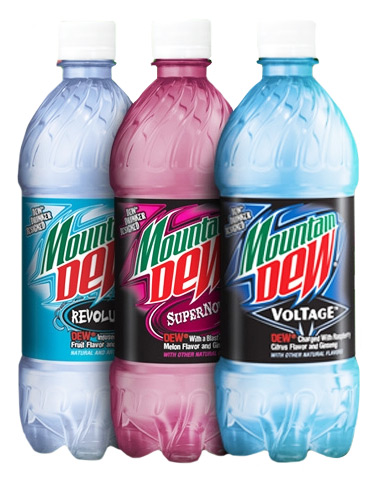
Writing about the aftermath of the public outcry against Tropicana’s packaging redesign earlier this year, which ultimately led to the OJ cartons reverting back to the original art, I mentioned Mountain Dew’s “Dewmocracy” campaign — an interactive, story-based online game which resulted in 3 new Dew flavors designed and developed virtually entirely by fans.

http://popsop.ru/wp-content/uploads/dew_dewmocracy.jpg

Tropicana, I suggested, was in a position to do something likewise as innovative with orange juice:

Now that there’s a buzz about Tropicana’s openness to fan-feedback in general, and about its packaging design in particular, why not create a platform for people to submit their design ideas? How might Tropicana lovers re-envision what that OJ carton could look like given the chance? In fact, why pick just one new design? How about different winning carton designs printed in “limited editions”? Why not deliberately set out to discover and promote emerging artists, giving them their first break of mass exposure through orange juice cartons in grocery stores across the country? If it’s art, suddenly there’s a whole new reason for choosing one OJ brand over another. It’s not just about a “campaign,” it’s an opportunity to create culture.

Mountain Dew, it seems, has already been putting this exact idea to work, (of course). Similar to Evian’s partnership with famed designers like Christian Lacroix, Jean Paul Gaultier, and Paul Smith, Mountain Dew has rolled out the third installment of their limited edition artist bottles under the Green Label Art series.

http://social-creature.com/wp-content/uploads/2009/11/dew.jpg

With these aluminum canvases, Mountain Dew not only taps into the urban indie art culture by supporting artists Claw Money (NY), Jeff McMillan (LBC), Nathan Cabrera (LA), Pushead (SF), Stephen Bliss (NY), UPSO (Toledo!), and Evan Coburn (LA), it also moves the Pepsi beverage deeper into lifestyle brand territory. There is also more artwork to check out, as well as computer wallpapers from each artist to download on the Green Label Art site. Plus, I’ve seen these new bottles over the weekend, and they’re pretty damn cool-looking, for only slightly (less than a dollar) more than a regular soda bottle. Super smart.


Subscribe for more like this.


Your Lifestyle Is An Alternate Reality Game

http://farm1.static.flickr.com/145/410701165_750694a76d.jpg

I had already joined the Circus scene when, in early 2006, I was consulting at Wong Doody and heard about a clothing company client they were working with called Edoc Laundry. The clothes had an intriguing concept: there were secret codes in the garments, which, if deciphered, would reveal clues to a mystery story. The wearers of Edoc Laundry clothing would thus become players in an “Alternate Reality Game” — a new form of interactive entertainment that uses the real world as a platform for creating an ever-evolving narrative. Now, I had grown up in subculture, gone on to produce nightlife events and music festivals, and ultimately ended up in marketing. So the concept of a secret “code” embedded in clothes — of hidden meanings conveyed in the way people dressed — it all made perfect sense to me. This was already a game all of us in the modern world were playing. It was called Lifestyle.

A year later, in the Spring of 2007, I heard about an Alternate Reality Game that Trent Reznor was developing for the release of the Nine Inch Nails album, “Year Zero.” In Wired’s December 2007 article on “The New World of Immersive Games,” Frank Rose wrote:

Years earlier, Reznor had heard about a complex game played out over many months, both online and in the real world, in which millions of people across the planet had collectively solved a cascading series of puzzles, riddles, and treasure hunts that ultimately tied into the Steven Spielberg movie AI: Artificial Intelligence. Developed by Jordan Weisman, then a Microsoft exec, it was the first of what came to be called alternate reality games — ARGs for short. After leaving Redmond, Weisman founded a company called 42 Entertainment, which made ARGs for products ranging from Windows Vista to Pirates of the Caribbean: Dead Man’s Chest. Reznor wanted to give his fans a taste of life in a massively dysfunctional theocratic police state, and he decided that a game involving millions of players worldwide would help him do that in a big way.

Reznor was stepping into a new kind of interactive fiction. These narratives unfold in fragments, in all sorts of media, from Web sites to phone calls to live events, and the audience pieces together the story from shards of information. The task is too complicated for any one person, but the Web enables a collective intelligence to emerge to assemble the pieces, solve the mysteries, and in the process, tell and retell the story online. The narrative is shaped — and ultimately owned — by the audience in ways that other forms of storytelling cannot match. No longer passive consumers, the players live out the story. Eight years ago, this kind of entertainment didn’t exist; now dozens of such games are launched every year, many of them attracting millions of followers on every continent.

When I was in high school I started going to raves. This was way before anyone would say the words “social” and “media” next to one another, when us kids still did shit like go to the library, and AOL was the only way to instant message. But if you were, let’s say, looking for an underground party to dance at all night, where no one was gonna care if you weren’t 21, you could definitely find it online. In Boston, where I grew up, there was NE-Raves, an online mailing list for electronic music events in the Northeast, originally hosted out of MIT. According to the “Cobbled-Together History of Hyperreal,” as far back as 1992, NE-Raves was one of the very first rave email lists in the US, along with SFraves on the West Coast. By the time I got into the Rave Scene (ahem *ARG*), both of these regional lists, and others, had been subsumed into hyperreal.org. In fact, by that point there were actually various other newsgroups and listservs and websites and whatnot created by and for the rave community, but in a sense, all roads would lead back to Hyperreal, which had become a kind of online clearinghouse of information on “Rave Culture, Chemistry, and Music.” In ARG parlance, Hyperreal could be considered the “Rabbithole” — the trailhead that marks the first website, contact, or puzzle that starts off the ARG. When Hyperreal first began, now almost two decades ago, as creator Mike Brown writes:

The majority of people with internet access back then were college students involved in computer-oriented studies, employees of well-funded technology companies like AT&T, and a smattering of U.S. government and military agencies. Consumer-oriented services like Compuserve, Genie, Prodigy and AOL, as well as most dialup bbs ‘networks’ were not on the internet, or had very limited gateways for mail and news that no one knew about. There was no spam, and since you weren’t interacting with a true cross-section of the general public, the entire net had a different character than it does today, socially.

So as the rave scene started to blow up nationwide, we’d tell each other online about the flyers we found and the records we bought and the parties we went to. You’d have people in the Midwest who were driving 9-12 hours to get to raves in New York and D.C., and to hang out with the friends we made through these online forums. A lot of information sharing was going on in this subculture’s subculture.

Sean Stewart, the award-winning science-fiction novelist and ARG writer, whose seminal work includes “The Beast” (for A.I.), as well as the genre-defining “I Love Bees” and “Last Call Poker” games, describes ARG participants behaving in precisely this same way:

They are collective and talking and engaged, both with the project and with each other. They’re having a collective experience in which they literally bring different pieces, one to the next, swap them back and forth, gossip about them. They have an element of cocreation and a collaborative nature that doesn’t really have an analog that I’ve been able to think of in the arts, although it does in another place. This behavior—this sort of creative, collaborative, enthusiastic scavengering behavior—is something that we call by another name when we direct it, not to entertainment, but to the physical world. We call it science, as it’s been constructed since Newton and the Royal Society, and that’s worked out pretty well for us as a species.

I would argue it has a direct analog in culture as well. The term “Alternate Reality Game,” after all, was never actually what the creators of The Beast used to describe what they were doing. It was a phrase that came from the players themselves, to refer to this idea of a self-styled world that proposed an alternative vision of reality hidden under the “mainstream” surface. In Tara Mcall’s book This Is Not A Rave (“This Is Not A Game” anyone?) she writes about the way early ravers deliberately positioned themselves against the status quo and the mainstream club crowd:

They saw a need to maintain their scene’s underground status. To be part of an underground culture meant that you stood apart from the norm. It indicated that you belonged to a secret community. If you were part of the underground you were part of a chosen group. Set apart from the mainstream, these early ravers bonded with one another by exhibiting small signs such as specific articles of clothing that could be “read” by those in the know, signaling that they belonged.

Signals embedded in attire, containing meaningful (cultural) codes decipherable by others in the know? Sounds pretty much like what Edoc Laundry had in mind. While the expression of identity — whether alternative or not — is a function of all lifestyle apparel, there are numerous other rave/ARG parallels that come to mind. For instance, back in the day the actual location of a party (especially if it was unpermitted) would be kept under wraps until the very last minute, with only an “info line” phone number disseminated. To find out where to go you’d have to call the number on the night of the event, and oftentimes the directions you’d get wouldn’t lead you directly to the location but to a designated “map point” where you’d either receive further instructions on where to go, or park your car and be shuttled to the event location. At the time all of this was done in order to avoid “outside” attention — after all, it’s harder for law enforcement to bust up a party if they don’t exactly know where it is — but now it’s par for the course in ARG “experience design.” From Wired’s description of the Year Zero ARG culmination:

On April 13 [2007], all the players who had signed up at a subversive site called Open Source Resistance were invited to gather beneath a mural in Hollywood. Some of those who showed up were given cell phones and told to keep them on at all times. Five days later, the phones rang. The players were told to report to a parking lot, where they were loaded onto a ram-shackle bus with blacked-out windows.

The bus delivered them at twilight to what appeared to be an abandoned warehouse near some railroad tracks. Armed men patrolled the roof. The 50-odd players were led up a ramp and into a large, dark room where the leader of Open Source Resistance (actually an actor) gave a speech about the importance of making themselves heard. Then they were led through a maze of rooms and deposited in front of — a row of amps?

With the sudden crack of a drumbeat, Nine Inch Nails materialized onstage and broke into “The Beginning of the End,” a song they had never before played in the US. “This is the beginning,” Reznor intoned, as guitar chords strafed the room. He got out one, two, three, four more songs before the SWAT team arrived. Then, as flashing lights and flash bombs filled the room, men in riot gear stormed the stage. “Run for the bus!” someone yelled, and the players started sprinting. The bus sped them back to the parking lot and the cars that would take them safely home. But before they drove away, they were told they’d be contacted again.

If you were a party kid in the 90’s, there’s no way that this doesn’t sound like an exaggerated version of something straight out of the old raver playbook, but I’m not suggesting that the ARG form takes its cues strictly from rave culture. Whereas in a deliberately produced ARG the key elements of the game’s narrative are painstakingly planned out and scripted, the narrative of any Lifestyle ARG becomes the evolving story that its own culture tells about itself. Hip Hop, for instance, originally defined the foundation of its culture (it’s “narrative”) through The Four Elements of Hip Hop: MCing (rapping), DJing, graffiti, and breakdancing — though later there evolved as many as 9 elements, including beatboxing, hip hop fashion, and slang. Not every lifestyle necessarily outlines the elements of its narrative as explicitly, but every lifestyle indeed has them. Whether it’s a certain type of music, a fashion aesthetic, an ethos or set of values, specific kinds of community-reinforcing events and experiences, or a particular cultural mythology, these all become indelible components of any Lifestyle ARG “narrative.”

Having been the Marketing Director for a Lifestyle-driven music festival over the past three years, I’ve thought about Alternate Reality Games in this framework for a while, but the idea resurfaced when I heard about the recent tumult caused by the True Blood campaign. Originally developed last year by Campfire Agency to promote the premiere of HBO’s True Blood series, the ARG, which won ad:tech’s Best Integrated Campaign award for 2008, hinges on the same premise as the show — that Vampires are real, and thanks to the development of a synthetic blood beverage they are now finally able to ascend from the “underground,” as it were, and become functioning members of society, albeit still a uniquely particular minority within society, with their own “Alternative Lifestyle.” Initially, a network of online destinations had emerged addressing the various inevitabilities of True Blood’s parallel universe. For instance, there’s the Human/Vampire dating site, Lovebitten, there’s the American Vampire League advocacy group (“Because Vampires were people too”), and there’s also Blood Copy: “Once a human’s attempt to understand the vampire phenomenon, now the leading source for vampire news (and proud member of The Gawker Media Network).” It’s that parenthetical which has generated quite a brouhaha.

From Business Insider’s “How HBO And Gawker Tricked Us Into Reporting An Ad Campaign As News” post:

Yesterday morning, we reported that Gawker Media had acquired a blog called BloodCopy. This “news” turned out to be false, part of a viral ad campaign for an HBO show called “True Blood.”

We apologize for the error.  We’d also like to explain how it happened, because we imagine others came to the same conclusion we did.  We also think that HBO, Gawker, and the marketing agency crossed a line, and we’re not surprised that they are now withdrawing parts of the campaign.

First, we received an email from a marketing firm announcing that “BloodCopy has joined the Gawker Media Network.”  The email was an invitation to a party to celebrate this event.  

Here’s the email:

At the time, the front page of Bloodcopy.com read:

Last week Gawker Media realized they simply could not live (so to speak) without having BloodCopy.com on their roster of websites. As of next week, we will officially be under the Gawker umbrella, joining sites such as Gakwer, Gizmodo, Kotaku, Jalopnik, Lifehacker, Deadspin, Jezebel and io9. Hope they can handle us.

I’ve said it before, and I’ll say it again, there are more things about vampires than are dreamt of in your philosophy. But I know a lot of them. And I’m finding out about more. And I’m willing to share with the class. So stick to BloodCopy – and Gawker – and we’ll bring you all the news that’s fit to print (and some that’s not) about vampires.

There has been discussion in the fallout, of Gawker’s advertising department “Undermin[ing] the credibility of Gawker Editorial to promote an ad campaign,” and while, by that same token, I think there hasn’t been quite as much discussion on the subject of reporters actually checking facts before simply rehashing press releases…. I’ll leave that particular debate to the journalists. What’s interesting to me in this whole situation is that despite Blood Copy’s open proclamation that it is A BLOG ABOUT VAMPIRES, the idea that Gawker Media would have bought it, seemed, somehow….. plausible enough to publish!

Why?

Well, consider the other properties under the Gawker Media umbrella:

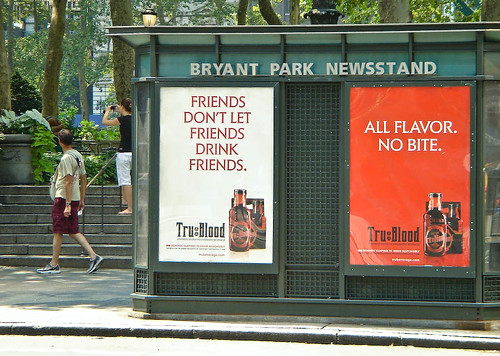
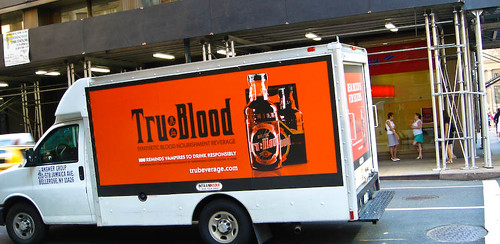
Essentially, Gawker owns a network of Lifestyle Blogs. If, let’s say, Vampires were real (which they’re not) but if they were, and there was a news blog for that Lifestyle… it’s completely plausible Gawker would, indeed, buy it. Playing with the idea of superimposing True Blood’s reality onto actual reality has been a goal of the ARG all along. Last year it was about how reality might look if a new synthetic-blood beverage brand had, in fact, just been introduced to the market:

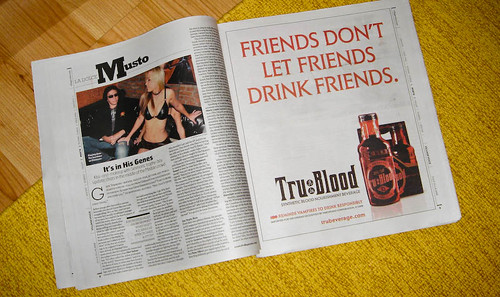
True Blood Ad Campaign by Codispodi.

True Blood Ad Campaign by Codispodi.

True Blood Ad Campaign by Codispodi.

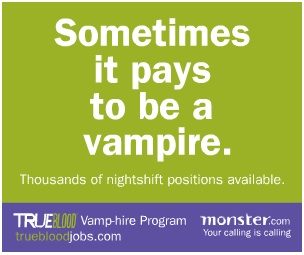
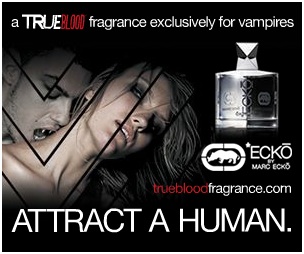
This time around, it’s about what reality might look like if the Vampire Lifestyle indeed became, as Blood Copy proposes, “a more visible and influential part of the mainstream:”

tbmonstertbmini

tbharley tbecko

http://www.hbo.com/trueblood/images/homepage/geico_728x90.jpg

In the era of the Long Tail we have an ever-expanding array of choices for defining our identities, and brands now play an integral part in expressing these definitions. We may not all necessarily consider ourselves to be members of an alternative subculture, but we are all aware of making deliberate “Lifestyle” choices in how we dress, what we drive, the music we listen to, what we do for fun, and on and on. Even between relatively mainstream choices there are always conscious decisions being made. Whether we’re buying American Apparel or American Eagle, the choice of one vs the other is not accidental. By deliberately making these different Lifestyle choices we are all defining own particular realities — we are ALL participating in a Lifestyle ARG. 


Subscribe for more like this.