The Post-Empire’s New Shoes

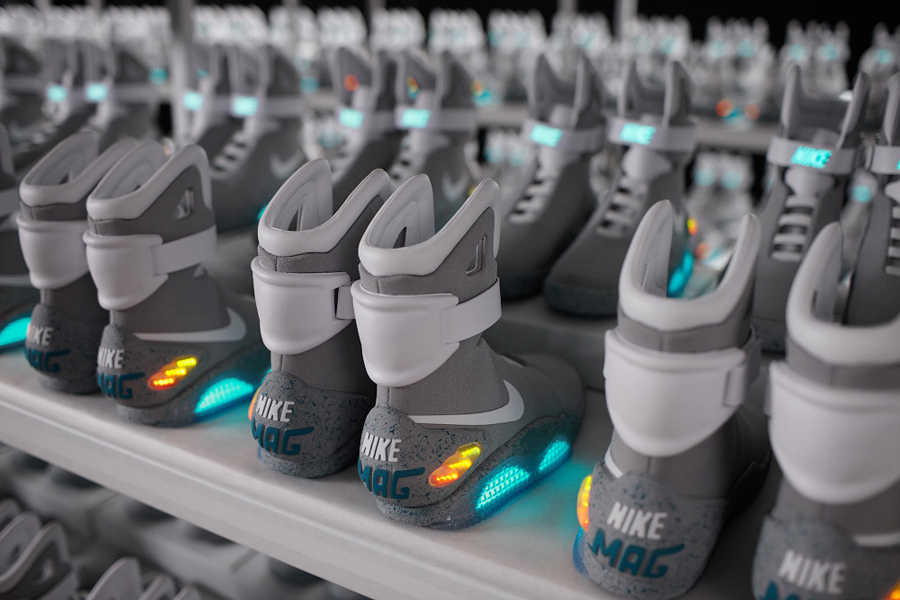
On September 8,2011, Nike announced they would be releasing a limited number of pairs of a new product. As the shoe’s official site explains:

In 1989, Nike designer Tinker Hatfield was asked to design a shoe for the second chapter in the Back to the Future series. He created the power-lacing, self-illuminating, Nike MAG. Riding on a pink hoverboard, Michael J. Fox made them the most famous shoe never made.

Over 15 years later in 2005, Tinker’s attention was caught by an online petition asking that the shoes come back. With no mold and nothing but an original prop shoe from the film, Tinker and footwear innovator Tiffany Beers began rebuilding the MAG from scratch. It would take six years, three restarts and many thousands of hours. But when it was all said and done, the shoe was a perfect replication of the original and the true predecessor to the 2015 power-lacing Nike MAG.

It would only make sense that the shoes be auctioned to benefit the foundation of the man who made them famous.

And with your help, the proceeds of these shoes will help erase Parkinson’s from existence.”

As Fox himself adds:

That something which has previously only existed in the realm of fiction is becoming real, that Nike is actually making a shoe it predicted would exist in the future, that a franchise about a time traveler is being leveraged towards changing the future both by and for the actor who embodied him, as well as for others who suffer from Parkinson’s disease…. basically everything about this is totally fucking awesome in a uniquely 21st century kind of way.

Back in March I wrote about another celebrity who came up in the 80’s and has recently been doing his part to blur the lines between “real” and “not real.” Charlie Sheen has gone a long way towards making that distinction irrelevant by transforming his life into an existential performance. In a Daily Beast article titled, “Notes on Charlie Sheen and the End of Empire,” author Bret Easton Ellis (also a pop culture staple spawned from the same decade as Sheen, Fox, and McFly), called Sheen, “The most fascinating person wandering through the culture.” Ellis’s concept of “Empire” and “Post-Empire,” is based on Gore Vidal’s definition of global American hegemony, a period Ellis dates from 1945 until 2005: the era that defined the 20th century. As Ellis sees it, Empire was a lie, a self delusion the global west lived for 60 years while it kept up appearances and didn’t think about the future; post-Empire, on the other hand, is where we are now, a world 10 years after 9/11, seeming to teeter perpetually on the verge of economic collapse and endless other global crises. If Empire was binary (truth vs. lie; real vs. counterfeit), then post-Empire is meta. As Sheen has shown, he is both real and not real at once. And so are the Nike MAGs, sneakerheads’ long unattainable holy grail, “the most famous shoes never made”…. until they were.

These kicks haven’t just crossed over from fiction, they’ve arrived from the future. Right on schedule.

“It’s like in Terminator when John Connor sends Kyle Reese back in time so that he can be his father,” says Simon, from the British TV show Misfits, a character who sends himself back in time to die so that he can live in the future. (Side note: Five years before Marty McFly, Kyle Reese also wore Nikes in 1984’s Terminator. Hopefully those don’t come back to the future.)

“In 1981, I was a futurist,” said William Gibson, author of the seminal cyberpunk novel, Neuromancer, in an interview with New York Magazine’s, The Vulture Blog last year, “Or at least I was a guy who put on a futurist hat occasionally and I wrote about the 21st century. Now I’m here in the 21st century and if I write about it, I think it makes me a literary naturalist.” Gibson’s three latest books have all been set not in a dystopic, sci-fi future world but contemporaneously with the one we all inhabit. A recurring character throughout this trilogy is Hubertus Bigend, the charismatic founder of an alternative marketing agency, whom Gibson describes like a 21st-century Cheshire Cat as CEO (“He smiles, a version of Tom Cruise with too many teeth, and longer, but still very white;” “An overly wealthy, dangerously curious fiddler with the world’s hidden architectures.”) So fitting is Bigend as an antihero for a post-binary, meta reality, this fictional character’s actual Wikipedia entry cites a passage from his fictional Wikipedia entry. (Your head hurt yet?)

In an interview for the release of his 2007 book, Spook Country, the second of his 21st century-published novels, Gibson said:

I thought that writing about the world today as I perceive it would probably be more challenging, in the real sense of science fiction, than continuing just to make things up. And I found that to absolutely be the case. If I’m going to write fiction set in an imaginary future now, I’m going to need a yardstick that gives me some accurate sense of how weird things are now. ‘Cause I’m going to have to go beyond that. In the ’80s and ’90s–as strange as it may seem to say this–we had such luxury of stability. Things weren’t changing quite so quickly in the ’80s and ’90s. And when things are changing too quickly you don’t have any place to stand from which to imagine a very elaborate future.

Case in point: Gibson’s most recent book, Zero History, which came out last year, has characters using silent, hovering, iPhone-controlled surveillance drones. Less than a year after Gibson wrote it into his book, it’s a thing that’s now on the market. In fact, it’s a toy:

Pattern Recognition is the first of Gibson’s “present tense” trilogy, and the first of his books I ever read. It was given to me by an acquaintance in 2004. The book follows Cayce Pollard, a marketing consultant with an intuitive sensitivity for branding so acute its anaphylactic. Her clients hire her to research street culture in search of the next new trend. “She’s met the very Mexican who first wore his baseball cap backward,” Gibson writes. “She’s that good.” The person who gave me the book told me, “This is you.” At the time, barely a year out of college, where I’d been a film major, I’d never really considered I’d be working in marketing. And yet, it’s where I ended up. Two novels and seven years later, Cayce Pollard makes an anonymous cameo near the end of Zero History. Her name is never mentioned, but if you’ve been following along, you know it’s her even before she says, “I’d been a sort of coolhunter, before that had a name, but now it’s difficult to find anyone who isn’t.”

The Nike MAG exists now not because it’s where 21st century sneaker trends were naturally headed but because a vision of footwear future (which Nike itself created) 20 years ago predicted it would. If Charlie Sheen’s contribution to Post-Empire has been to embody the now indistinguishable nature of real and fictional, Nike has taken it one step further and shown us that the future is no longer strictly linear. In our new century the future is recursive. It is a future we have sent back in time, to become itself.


Subscribe for more like this.


Announcing: MirrorLAnd!

In addition to writing here at Social-Creature, I’ve been working on a fiction project, and am excited to announce it is finally ready to launch! (Click the image below to go to the website…)

MirrorLAnd is an adaptation of Lewis Carroll’s Alice’s Adventures in Wonderland, except Alice is now in her 20s, just out of college, and falling down the rabbit-hole working as an assistant in the film industry. Until she lands in the wonderland of LA’s underground circus. Plus, there’s free music, and lots of fashion and art. This is a project I’ve been working on for years and am thrilled to finally share it with you!

Get to MirrorLAnd….


Subscribe for more like this.


Your Life Is A Transmedia Experience — Now With Pictures!

Last year, I wrote a post called “Your Life Is A Transmedia Experience.” In October, the post became the basis for a panel discussion event at the FutureM conference in Boston with me, Marta Kagan and Jan Libby. I have updated the deck from that panel, and am sharing here for your viewing pleasure. Enjoy!


Subscribe for more like this.


The Top 5 Social Creature Posts Of 2010

If you’re just joining us, here’s the top 5 things that happened here this year:

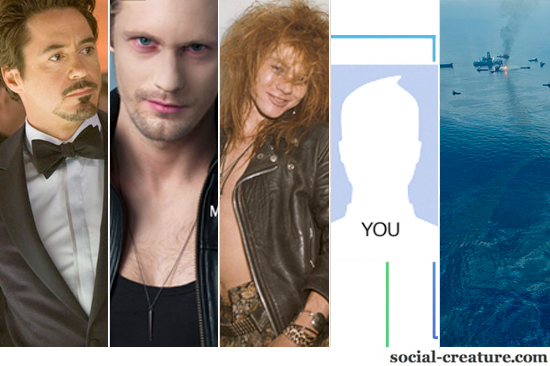
1. Why Iron Man Is The First 21st Century Superhero
For the past 70 years we have been living with a 20th century version of the superhero. Until now. Though the Iron Man character was originally created in the early 60s, his most recent incarnation is really the first Millennial superhero. (Then Jon Favreau, the director of Iron Man, retweeted it!! Craziness!)

2. The First 21st Century Vampires
Just as the new Iron Man has broken the mould constricting the superhero archetype, True Blood’s vampires offer a compelling commentary on our rapidly changing present through their own, archly extrahuman relationship to it. (MetaFilter gave it love, too.)

3. How The Internet Killed The Rock Star (…Not The Way You Think)
At this point, to say the Internet’s done away with anything else when it comes to music is, admittedly, a cliché, but, nevertheless, there’s one more, less-publicized casualty: the rock star. Zoe Keating agreed.

4. Your Life Is A Transmedia Experience
“Transmedia” has become the new buzzword for multi-platform narratives, but in the digital age, transmedia isn’t just how we consume entertainment narratives, it’s how we experience the narrative of our lives. This post later became the basis for a panel with me, Marta Kagan, and Jan Libby, at the FutureM conference in Boston.

5. How To Stand In the Face of Powerlessness For A New Generation
As a generation, mine has not known powerlessness. We’ve had so little practice at facing situations where we couldn’t just do something; at fighting them, at living through them. The Deepwater Horizon oil spill is my generation’s unfortunate turn to figure out how to stand in the face of powerlessness.

Honorable mention:

The Glitch Mob Drops The New-Tron Bomb
This happened so late in the year that it didn’t quite have time to catch up, but my idea for a Tron:Legacy remix video scored to The Glitch Mob’s music and edited by Khameleon808 is still the 7th most popular thing that happened on Social-Creature in 2010. (It even got into Wired.com.)

Ps. Thanks to Boston Innovation for naming me one of “Five Fresh Faces Leading Boston’s Creative Revolution.” Though I seem to be splitting my time between Boston and LA the past couple of years, (I wish Facebook would let you put “It’s complicated” under “Current city”), it is, of course, an honor to play even a little part in any Boston-based revolution.

See you next year!!


Subscribe for more like this.


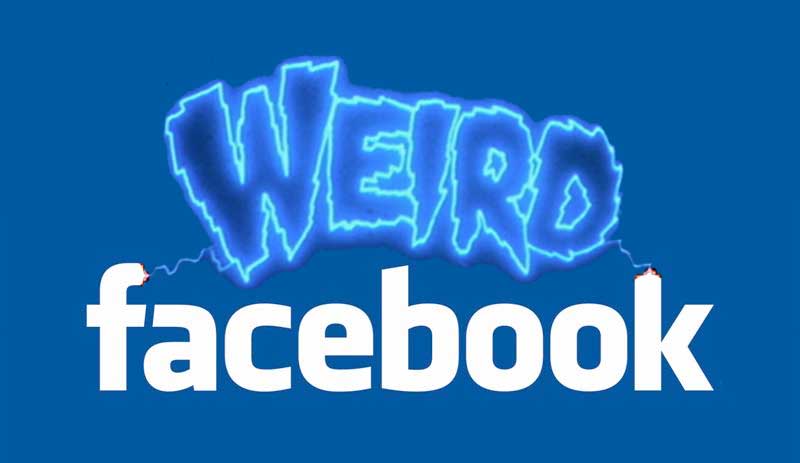
Weird Social Science: The Facebook Movie

weirdfacebook

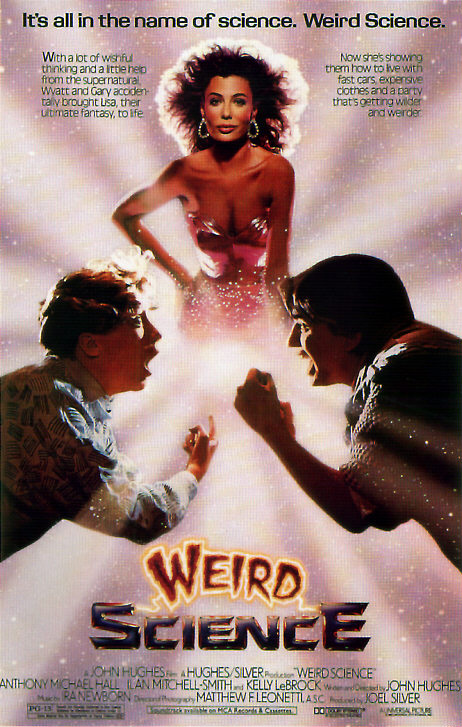
Remember a time when it seemed like the power of the new technologies suddenly at our fingertips was limitless? When lasers and floppy disks and modems were cutting-edge, and a whole slew of movies which took on the subject matter insisted that teenagers, especially, were capable of using these incomprehensible, futuristic phenomena to do things no one could even imagine? There’s 1982’s Tron, in which Jeff Bridges is a computer genius who hacks into an evil video game corporation and gets zapped inside the computer world, where he’s forced to participate in gladiatorial games; 1983’s War Games, in which Matthew Broderick is a high school kid who nearly starts World War III by hacking into a military computer; 1985’s Real Genius, in which Val Kilmer is a brilliant teenager who develops a laser for a class project and then has to stop it from being used as a government weapon, and another 1985 flick, John Hughes’s Weird Science, in which Anthony Michael Hall and Ilan Mitchell-Smith are two geeks desperately seeking popularity, who use a Memotech MTX 512 to create their ticket to the in-crowd: the perfect woman.

weird_science_1985

The consistent, underlying premise of all these movies was that technology is a new, unexplored frontier, and no one could really say for sure what it could — or couldn’t — do. There was the pervading sense that the new wave of personal computing had put the power to create monsters right at teenagers’ fingertips.

Now, the Internet, iPhones, the rise of “digital natives,” and nearly 30 years later, it seems our conception of the unpredictability of new technology still hasn’t really changed all that much, and neither has the sense that, inevitably, teenage geeks will use it to create preposterous monsters. Case in point: The Social Network.

.

The movie is based on Ben Mezrich’s book, The Accidental Billionaires: The Founding Of Facebook, A Tale of Sex, Money, Genius, and Betrayal. In an interview on Amazon.com, Mezrich describes how the origin of the world’s largest social networking site (if Facebook were a country, it’d be the third most populous, just after China and India) began with a typically adolescent prank:

Facemash is really where it all started. It was late at night. Mark was having a few drinks….He was a master hacker and he hacked into all of the computers at Harvard and took all of the pictures of all the girls on campus and created a “hot or not” website where you could judge which was the hottest girl at Harvard. And this ended up [getting] 20,000 hits in about an hour. It froze the computer systems at Harvard. And he nearly got kicked out of school. That really was the genesis of Facebook, because for the next couple of days he thought about it, and thought, you know, “What if girls could put their own pictures up, and then we’d go and say ‘Hi’ to them, or whatever,” and that’s where Facebook started.

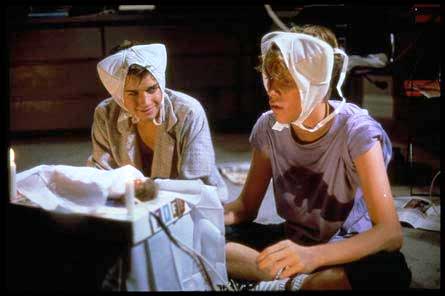
If this story sounds familiar it’s because you’ve seen it before. 25 years before, in fact, as Gary and Wyatt hack into the Pentagon mainframe, create a computer program that synthesizes images, “input” a bunch of photos of girls, and the result is a runaway creation that takes on a life of its own and very quickly alters the course of its creators’ lives as well.

.

Cut to 2010, and the question in the Oingo Boingo song, “Weird Science,” which asks, “It’s my creation; is it real?” is no longer rhetorical. Computers are no longer the premise for teen science-fantasy farce, they are serious business.

Now, back to Mezrich, discussing his book on MSNBC:

It is about nerds. The kids who founded it — Mark Zuckerberg and his friend — were geeky, gawky kids, who were essentially trying to get laid…. And basically, these genius kids created the next generation in technology while trying to become part of the in-crowd.

Now, look at Gary and Wyatt:

WS

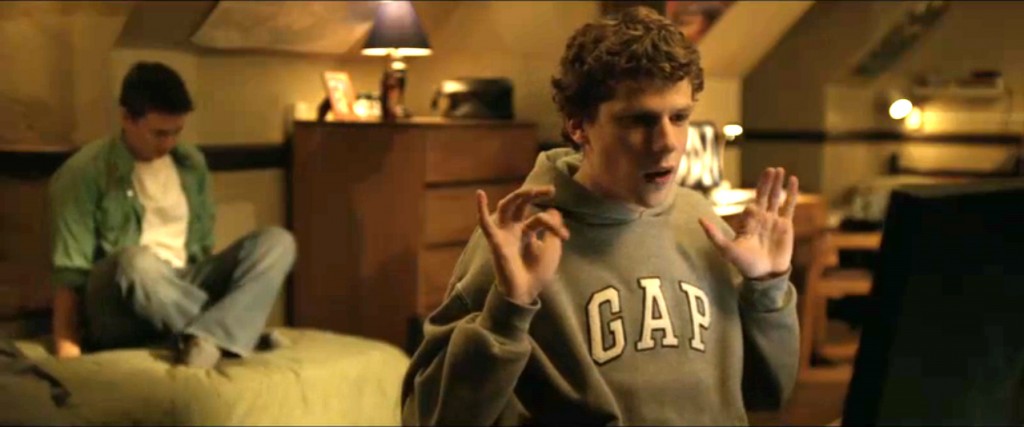
Now, back to The Social Network:

thesocialnetwork

In 1985, the most incredible thing anyone could conceive of a teenager creating on his computer was a woman. In 2010, it’s a billion-dollar company.

Though much of the history of Facebook is well documented, some of it in blog posts by Zuckerberg himself, the thing to keep in mind in the course of Mezrich’s book, and The Social Network movie, written by Aaron Sorkin, is that while many of the backstory’s supporting cast were interviewed, and directly participated in the recounting of this sordid tale of “sex, money, genius, and betrayal” that Facebook apparently is, the main character, Mark Zuckerberg, very deliberately, declined to be involved in any way. Mezrich himself freely acknowledges that it’s perfectly Zuckerberg’s right not to speak to someone that he doesn’t know, and, in the end, what really happened in some of the scenes he wrote in the story, only Mark really knows. Inevitably, some creative liberties had to be taken in the process of creating a book, and then a film, so, who’s to say where history ends and the weird science begins? Either way, we’re still telling the same story three decades later.

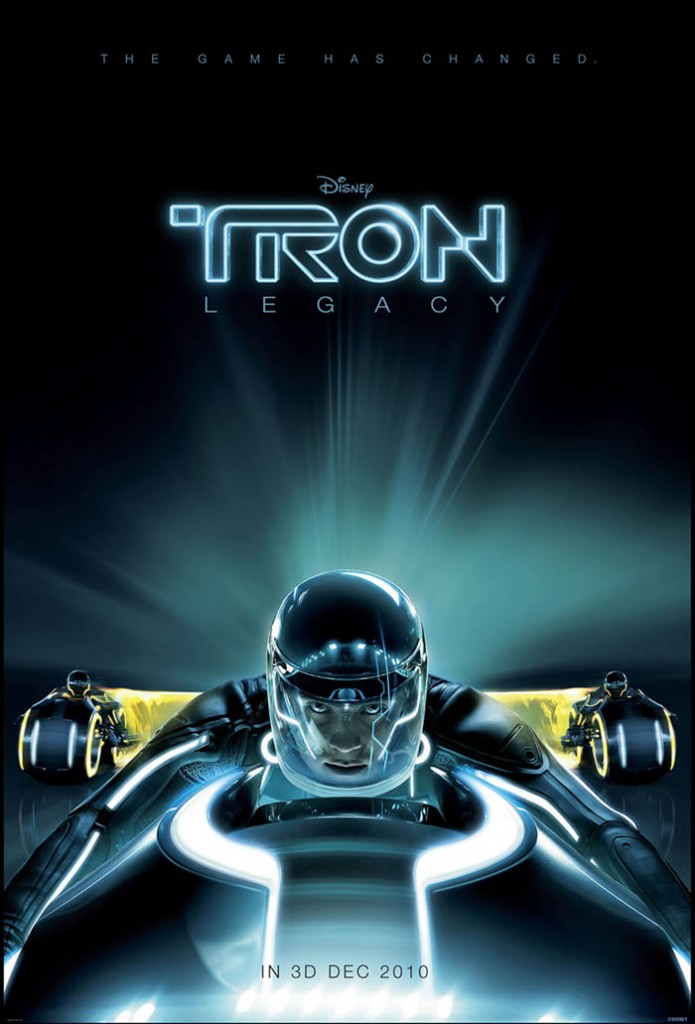
In related news, there’s a Real Genius remake currently in the works, and a 3D sequel to Tron coming out this December.

AW_Title w-Disney_w

The tagline insists, “The Game Has Changed,” but you know what?

Not really.


Subscribe for more like this.