First of all, do yourself a favor and watch this 2 minutes and 44 seconds of utter awesomeness above.
Then recall the ending of Iron Man 3. In fact, recall the entire 130 minutes of its insulting, technology guilt-laden self-hatred.
Or better yet, don’t do that.
If you’ve been here since 2010, you know that I have had a special place in my heart for the character I called “The First 21st Century Superhero.” Tony Stark — as reimagined by Jon Favreau, and reincarnated by Robert Downey Jr. — and I have had an unexpectedly personal relationship these past 3 years. Ever since Favreau retweeted my post and it took on a life of its own and became the most popular thing I’d ever written. From the intimacy of Tony Stark’s relationship with his gadgets, to his eschew of a secret identity in favor of that uniquely post-digital virtue of radical transparency, to his narcissism, Favreau’s Iron Man reflected a radical departure from the tropes that defined the 20th century superhero.
I could tell you about how Shane Black, who directed this third installment in the Iron Man franchise tried his best to undo all that. How deliberately he went after the things that not only made Tony Stark so brilliantly modern, but also lay at the very heart of his character. I could tell you about the relentless “techno fear” that ran like an electromagnetic current through the entire movie from start — on New Year’s Eve 1999, ground zero of the Y2k paranoia — to finish — with Stark throwing his arc reactor heart into the ocean like the he’s an old lady, letting go of a luminescent, blue burden at the end of fucking Titanic. Or some shit.
I could tell you how this conflicted, 20th century relationship to technology, wielded with all the subtlety of Catholic guilt, bashed all of us over the head like a blunt instrument the first time we saw Pepper and Tony on screen together — but wait! That’s not actually Tony. It’s a Siri-powered autonomous-driving Iron Man suit, and it’s just asked Pepper to, quote, “Kiss me on my mouth slit.”
(I seriously feel like I need to go wash my hands with soap now after typing those words.)
And yet, under Favreau’s direction, Pepper kissing Tony’s helmet in Iron Man 2 was most likely one of the sexiest moments Gwyneth Paltrow has ever had on film:
I could tell you how Black drove Tony Stark into hiding (while Favreau celebrated his coming out) and stripped him of his suit and access to his technology, making him fight his battles in the flesh for most of the film. We’re to believe Stark built a more advanced suit while a POW in a cave in fucking Afghanistan than he could on his credit limit in Tennessee??
I could tell you how the thing I was thinking about the most as I walked out of the theater — even more than that Black got thisclose to turning Pepper into a legitimate superhero in her own right, which would have been practically the only 21st-century compliant move he’d have made in the whole movie, but then, of course Tony had to “fix” her back to normal — was:
THANK GOD STEVE JOBS DID NOT LIVE TO SEE TONY STARK THROW HIS HEART INTO THE FUCKING OCEAN.
Do you remember the love that the first Iron Man movie, and the Tony Stark in it, had for his first suit? The one he made in captivity. The painstaking, terrifying labor that birthed this child of necessity? The metal manifestation of the power of ingenuity and creativity and talent that won him his freedom? Remember his second suit? The one he built once he got back home. The hotter, cooler, younger sibling of the scrap heap he’d left in the desert. The first real Iron Man suit. How much fun he had making it, tweaking it, perfecting it, and how much fun we had going along on the joyride? Tony Stark fought a custody battle against the American government for the suit in Iron Man 2. He said no one else could have it. He said the suit he created was a part of him, that he and it were one. And we all intimately understood exactly what he meant. Because even if the rest of us don’t actually literally plug our gadgets into our chest cavities, 80% of us go t0 sleep with our phone by our bedside.
I could tell you how Shane Black changed all that for Tony, replaced his passion for innovation with a 20th century irreconcilability. His suits, once so precious the greatest military superpower in the world couldn’t force him to part with just one, have been rendered as meaningless as disposable cups. For Black’s Iron Man, technology still has friction. He can “disconnect,” can “unplug.” This feels like a “real” thing to do. As if there is still a world that isn’t part of the digital world. It’s not just an anachronistic, Gen X misunderstanding of the Millennial reality, it kills what makes Tony Stark, Tony Stark.
“We create our own demons” are the first words we hear as the movie begins. Stark is speaking in voiceover, and this becomes his ongoing refrain throughout the movie. We create our own demons. We create our own demons. By the end, when Stark destroys all of his dozens of indistinguishable suits — because they are “distractions” (the actual word he uses, twice), because we create our own demons and these are his creations, because (and this is the most fucked up part of all) he thinks this is what will make Pepper happy — it is the moment that Black destroys the soul of this character.
Imagine Steve Jobs throwing the iPhone prototype into the ocean and walking away.
Speaking to an audience at Standford in the wake of the Social Network, Mark Zuckerberg said, “The framing [of the movie] is that the whole reason for making Facebook is because I wanted to get girls, or wanted to get into clubs…. They just can’t wrap their head around the idea that someone might build something because they like building things.”
This is why Tony Stark builds things. Because he likes building things. Technology is not a “distraction” from something realer, it is a part of what IS real. The digital and the analog worlds aren’t binary. They are inextricably intertwined. Technology is as much a part of us now as it has always been for Tony Stark — corporeally and philosophically. And there is no going back. Texting is not a distraction from the “realness” of the telephone — itself, a completely unnatural, manufactured, awkward medium that we all learned to take communication through for granted. Electricity is not a distraction from the “realness” of candle-light. Driving a car is not a distraction from the “realness” of riding a horse.
Which brings us back to this impeccably clever Audi commercial.
Featuring the two actors who’ve played Spock, himself an embodiment of hybridity, in a battle that starts out via iPad chess, doubles down over the phone, escalates by car, and culminates with the finishing touch of a Vulcan nerve pinch. It makes the depiction of the permeable membrane between the digital and the analog, of the seamless absorption of a “fictional” personality into the “real” self, and of unapologetic techno-joy look effortlessly cool.
The first 21st century superhero is a hedonistic, narcissistic, even nihilistic, adrenaline junkie, billionaire entrepreneur do-gooder. If Peter Parker’s life lesson is that “with great power comes great responsibility,” Tony Stark’s is that with great power comes a shit-ton of fun.
You can’t get any more Gen Y than that.
Three Mays later, Tony Stark has changed. He’s entirely forgotten how to have fun. He doesn’t even get joy out of building things anymore — hell, he was having a better time when he had a terminal illness, back when Favreau was at the helm. Under Black’s direction, Stark doesn’t seem excited about anything. He’s on Xanax for his panic attacks — I’m assuming. Since there isn’t a single thing that fills him with anywhere near the kind of fascination Leonard Nimoy and Zachary Quinto express as they watch a self-driving Audi pull out of a golf club driveway. As Black sees it, to embrace the technological innovation that is in Tony Stark’s blood — both figuratively and literally — to create something that isn’t a demon, to want to build things because he likes building things, all of that would somehow make Stark less human.
But as the mixed-race Spock always knew — what makes us human can’t be measured in degrees.
Remember back when I used to be a social media strategist?
I started before that term was even being used, and as late as this October the L.A. Times still hadn’t gotten the memo that I had move on, calling me a “social media expert” for my crimes (among them: 1, 2, 3).
So you’d be forgiven if you hadn’t realized that I’d become a product strategist. (Social media, it’s not you, it’s me. Well, it’s kind of you. But mostly, it’s me. Anyway, at this point everything is social, so let’s call it even.)
While 2012 has been the quietest year on Social-Creature since I started the site, elsewhere it’s been quite prolific. So as the year comes to a close, I thought I’d take a break to share some of what’s been going on.
MIRRORGRAM:
This Fall I led the launch strategy for a new iOS photo app, called Mirrorgram. In its first week, the app, created by Justin Boreta, of the Glitch Mob, and StageBloc, had over 165,000 users (!!!), gotten selected as the top “New & Noteworthy” app on the App Store:
reached #1 paid app in the photo and video category:
and #11 paid app overall:
Less than 2 months in, Mirrorgram now has over 300,000 users, there are nearly 45,000 images in the #mirrorgram feed on Instagram, and mirroring has become a cultural aesthetic trend:
You’re welcome / We’re sorry.
Anyway, watching hundreds of thousands of people use the product has offered visibility into some really fascinating behavioral insights around iPhone creativity, the mechanics of digital art creation, and the white space on the photo sharing landscape. More about what we’ve learned, and how these insights are informing further product strategy, including a truly exciting new direction in the app’s evolution — hint: what’s Instagram NOT for? (porn, aside) — in the new year, so stay tuned!
GATHER:
Gather began as a hip, little boutique, beloved by Racked LA and LA Weekly for carrying all local L.A. designers. Now this idea has evolved into what I, and my partner, Katie Kay Mead, see as the future of hyper-local design discovery and retail.
While shopping has moved online, the discovery of locally-created design is still trapped by brick-and-mortar, and coincidence. The new Gather site, relaunched this Fall, is designed address this gap, allowing visitors to easily discover cutting-edge design just around the corner. As the L.A. Times put it in their recent Sunday feature on Gather:
More to come on the arising cultural behaviors and beliefs that have laid the foundation for Gather’s new direction — including why flash sale leaders are desperate to reposition themselves as purveyors of special (rather than discounted) things, and the emerging local trend, bolstered by campaigns like AmEx’s “Small Business Saturday” and Millennials’ proclivities.
In the meantime:
And there’s other bright news as well, but I’ll tell you when I see you in 2013!
For anyone who knew WTF social media was before they got a Facebook account in 2007 when everyone else they knew was doing it — you may understand.
Myspace was built on music. When Friendster, which preceded Myspace by a year, started shutting down accounts created for non-real person, individual entities, Myspace opened its doors to bands. As these acts brought, and built, their fanbases online, Myspace grew, until, without understanding its full meaning or potential Myspace sold its hockey-stick growth curve to News Corp for $580 million back before you started paying attention, in 2006. From there, its fate was sealed. Myspace should have become THE online destination for music fans, the interactive MTV of my generation — but it wouldn’t. With Fox as its new parent, Myspace was doomed to creating an ever clunkier product in the name of increasing ad space — which is all News Corp could really understand about the medium, anyway. It opened up an ever widening gap which a “cleaner,” “simpler” competitor was perfectly poised to exploit.
But something strange happened on the way Myspace’s 10-year-long journey to become what it always should have been. Facebook bloated up, IPOed, fizzled. I cant imagine referring to Facebook as “clean” and “simple” now. Can you? I’m not sure I even really fully understand all the profile and content settings, let alone the endless apps and features. I use Facebook for a much more reduced function, essentially in deliberate spite of all its bells and whistles — I use it to keep up with people I already know. This was always what it was intended for. The musicians I know who use Facebook as a channel to engage their fans are the first to admit that for their needs they’ve basically had to hack the platform, contorting it around what it was natively designed to accommodate. Connecting fans with the music and musicians they love is something that was backed in on top of the original Facebook idea. It’s not part of Facebook’s DNA. It was Myspace’s.
We shall see if, under new management (which includes a musician), the new Myspace product itself lives up to the hype and the promise, but in the meantime, what we have is this video, which is perhaps the most elegant strategic execution I’ve seen all year.
Who am I to say I want you back?
When you were never mine to give away.
I was waiting for a long, long time for you to feel the same.
Who are you to look at me like that?
Is there something more you need to say?
I haven’t loved you in a long, long time,
so why do I feel this way?
Can you hear my heartbeat?
Please don’t stand so close to me.
Can you hear my heartbeat still beating strong?
Maybe I’m ashamed to want you back.
Maybe I’m afraid you’ll never stay.
Thought I hated you a long, long time.
There was my mistake.
I just can’t pretend that nothing’s changed.
Can you comprehend just what to say?
If you break my heart a second time,
I might never be the same.
Can you hear my heartbeat?
Please don’t stand so close to me.
Can you hear my heartbeat still beating strong?
If you’ve been in the social game a long, long time, you understand. There is an explicit double meaning in the lyrics of love lost about our relationship with Myspace; about Myspace’s relationship with us. We aren’t just watching a product demo, we are suddenly thrust into something else. We’re in on something with Myspace. It’s INTIMATE. And EMOTIONAL.
And if the soundtrack can do that, then it means something else too, something even more powerful. If the music in this video could get you to understand all this, to know all this, to feel all this, then the video is a statement about the very power of music itself. About what music can do, how it can affect us, what it’s capable of.
In the decade since Myspace first launched and then declined into spammy, irrelevant obsolescence, record stores closed and the music industry shrank and a gazillion new social music apps and platforms came and went and pivoted and the internet killed the rock star and turned every band into a startup and nothing arrived to fill the gap left behind by what Myspace should have been. There has always been something missing, and this video makes it clear that its creators know what that black magic element is. What has been missing is an experience that can support, that can reflect, and that’s built for why it is we love music in the first place. THAT is what Myspace was always supposed to have become. And I hope it still does.
On September 8,2011, Nike announced they would be releasing a limited number of pairs of a new product. As the shoe’s official site explains:
In 1989, Nike designer Tinker Hatfield was asked to design a shoe for the second chapter in the Back to the Future series. He created the power-lacing, self-illuminating, Nike MAG. Riding on a pink hoverboard, Michael J. Fox made them the most famous shoe never made.
Over 15 years later in 2005, Tinker’s attention was caught by an online petition asking that the shoes come back. With no mold and nothing but an original prop shoe from the film, Tinker and footwear innovator Tiffany Beers began rebuilding the MAG from scratch. It would take six years, three restarts and many thousands of hours. But when it was all said and done, the shoe was a perfect replication of the original and the true predecessor to the 2015 power-lacing Nike MAG.
It would only make sense that the shoes be auctioned to benefit the foundation of the man who made them famous.
And with your help, the proceeds of these shoes will help erase Parkinson’s from existence.”
As Fox himself adds:
That something which has previously only existed in the realm of fiction is becoming real, that Nike is actually making a shoe it predicted would exist in the future, that a franchise about a time traveler is being leveraged towards changing the future both by and for the actor who embodied him, as well as for others who suffer from Parkinson’s disease…. basically everything about this is totally fucking awesome in a uniquely 21st century kind of way.
Back in March I wrote about another celebrity who came up in the 80’s and has recently been doing his part to blur the lines between “real” and “not real.” Charlie Sheen has gone a long way towards making that distinction irrelevant by transforming his life into an existential performance. In a Daily Beast article titled, “Notes on Charlie Sheen and the End of Empire,” author Bret Easton Ellis (also a pop culture staple spawned from the same decade as Sheen, Fox, and McFly), called Sheen, “The most fascinating person wandering through the culture.” Ellis’s concept of “Empire” and “Post-Empire,” is based on Gore Vidal’s definition of global American hegemony, a period Ellis dates from 1945 until 2005: the era that defined the 20th century. As Ellis sees it, Empire was a lie, a self delusion the global west lived for 60 years while it kept up appearances and didn’t think about the future; post-Empire, on the other hand, is where we are now, a world 10 years after 9/11, seeming to teeter perpetually on the verge of economic collapse and endless other global crises. If Empire was binary (truth vs. lie; real vs. counterfeit), then post-Empire is meta. As Sheen has shown, he is both real and not real at once. And so are the Nike MAGs, sneakerheads’ long unattainable holy grail, “the most famous shoes never made”…. until they were.
These kicks haven’t just crossed over from fiction, they’ve arrived from the future. Right on schedule.
“It’s like in Terminator when John Connor sends Kyle Reese back in time so that he can be his father,” says Simon, from the British TV show Misfits, a character who sends himself back in time to die so that he can live in the future. (Side note: Five years before Marty McFly, Kyle Reese also wore Nikes in 1984’s Terminator. Hopefully those don’t come back to the future.)
“In 1981, I was a futurist,” said William Gibson, author of the seminal cyberpunk novel, Neuromancer, in an interview with New York Magazine’s, The Vulture Blog last year, “Or at least I was a guy who put on a futurist hat occasionally and I wrote about the 21st century. Now I’m here in the 21st century and if I write about it, I think it makes me a literary naturalist.” Gibson’s three latest books have all been set not in a dystopic, sci-fi future world but contemporaneously with the one we all inhabit. A recurring character throughout this trilogy is Hubertus Bigend, the charismatic founder of an alternative marketing agency, whom Gibson describes like a 21st-century Cheshire Cat as CEO (“He smiles, a version of Tom Cruise with too many teeth, and longer, but still very white;” “An overly wealthy, dangerously curious fiddler with the world’s hidden architectures.”) So fitting is Bigend as an antihero for a post-binary, meta reality, this fictional character’s actual Wikipedia entry cites a passage from his fictional Wikipedia entry. (Your head hurt yet?)
I thought that writing about the world today as I perceive it would probably be more challenging, in the real sense of science fiction, than continuing just to make things up. And I found that to absolutely be the case. If I’m going to write fiction set in an imaginary future now, I’m going to need a yardstick that gives me some accurate sense of how weird things are now. ‘Cause I’m going to have to go beyond that. In the ’80s and ’90s–as strange as it may seem to say this–we had such luxury of stability. Things weren’t changing quite so quickly in the ’80s and ’90s. And when things are changing too quickly you don’t have any place to stand from which to imagine a very elaborate future.
Case in point: Gibson’s most recent book, Zero History, which came out last year, has characters using silent, hovering, iPhone-controlled surveillance drones. Less than a year after Gibson wrote it into his book, it’s a thing that’s now on the market. In fact, it’s a toy:
Pattern Recognition is the first of Gibson’s “present tense” trilogy, and the first of his books I ever read. It was given to me by an acquaintance in 2004. The book follows Cayce Pollard, a marketing consultant with an intuitive sensitivity for branding so acute its anaphylactic. Her clients hire her to research street culture in search of the next new trend. “She’s met the very Mexican who first wore his baseball cap backward,” Gibson writes. “She’s that good.” The person who gave me the book told me, “This is you.” At the time, barely a year out of college, where I’d been a film major, I’d never really considered I’d be working in marketing. And yet, it’s where I ended up. Two novels and seven years later, Cayce Pollard makes an anonymous cameo near the end of Zero History. Her name is never mentioned, but if you’ve been following along, you know it’s her even before she says, “I’d been a sort of coolhunter, before that had a name, but now it’s difficult to find anyone who isn’t.”
The Nike MAG exists now not because it’s where 21st century sneaker trends were naturally headed but because a vision of footwear future (which Nike itself created) 20 years ago predicted it would. If Charlie Sheen’s contribution to Post-Empire has been to embody the now indistinguishable nature of real and fictional, Nike has taken it one step further and shown us that the future is no longer strictly linear. In our new century the future is recursive. It is a future we have sent back in time, to become itself.
Charlie Sheen is not crazy. Or, at least, he’s not crazy the way you think he is. Charlie Sheen may finally be admitting that he’s lost his mind — exclusively to Life&Style, of all places, if we are to believe it — but that’s something that would have already been a long, long time in the making. What’s been happening over the past few weeks is not Charlie Sheen going crazy. Although it’s certainly easy to get confused. No doubt, Charlie Sheen wants you to think he’s crazy. After all, the boring recovering-addict Charlie Sheen Show — or the boring functioning-addict Charlie Sheen Show, depending on your preference — is much less interesting to watch than the “Crazy” one. And we are still watching….
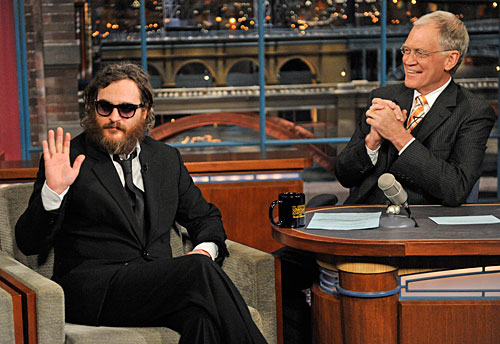
In the course of this production it’s hard not to think about the film I’m Still Here, the cinéma vérité chronicling of Joaquin Phoenix’s “retirement from acting.”
.
For a year and a half, the twice Oscar-nominated Phoenix gained weight, stopped shaving, and tried to start a career as a rapper while his brother-in-law and fledgling filmmaker, Casey Affleck, came along for the ride to document this seeming descent into madness. Phoenix even famously came on Letterman in the course of I’m Still Here‘s production, disheveled and incoherent — an appearance that, by the end, prompted Letterman to say he owes an apology to Farrah Fawcett, til then considered his most disastrous guest of all time.
Of course, in the end it turned out this was not just another overindulged celebrity losing his mind. Nor, even after it was revealed that Phoenix’s “retirement” and subsequent actions weren’t exactly the plot of a straight “documentary,” was it all just simply a hoax. Back on the Late Show a year and a half later, now clean-shaven, and charming as usual, Phoenix explained:
We wanted to do a film that explored celebrity, and explored the relationship between the media and the consumers and the celebrities themselves. We wanted something that would feel really authentic. I’d started watching a lot of reality shows and I was amazed that people believed them; that they called them, like, ‘reality.’ I thought the only reason why is because it’s billed as being ‘real’ and the people use their real names. But the acting is terrible. I thought I could handle that. Because you don’t have to be very good. You just use your name, and people think that it’s real.
For a year and a half, Joaquin Phoenix lived the life of a character who shared his name and history and circumstances, both in private scenes and in the public eye. What then, truly, is the difference between what’s “real” and what isn’t? What does “hoax” even mean in the age of “reality TV?” I’m Still Here, along with the context around it, is a philosophical exploration of these questions.
“The world’s first street art disaster movie” tells the story of Thierry Guetta, an eccentric French-born shop-keeper living in L.A. whose compulsive need to record every waking moment, and a cousin who happens to be the street artist Space Invader, combined to lead Guetta to become the de facto documentarian of the street art scene, tagging along on late-night art missions with its luminaries, including L.A.’s Shepard Fairey and, ultimately, the elusive reigning godfather of street art himself, Banksy. About two thirds of the way through the movie, Guetta, who had never previously edited any of the mountains of footage he’d been obsessively recording, goes to the U.K. to present a first draft of his “street art documentary” to Banksy for feedback. Deflecting his true opinion of the unwatchable film, Banksy suggests that perhaps Guetta should consider becoming a street artist himself and sends him back to L.A. with the idea of putting on a small show. Banksy also requests Guetta send him his raw video footage so that he can reedit it himself. And this is where the movie becomes something like an Andy Warhol adaptation of the Blair Witch Project.
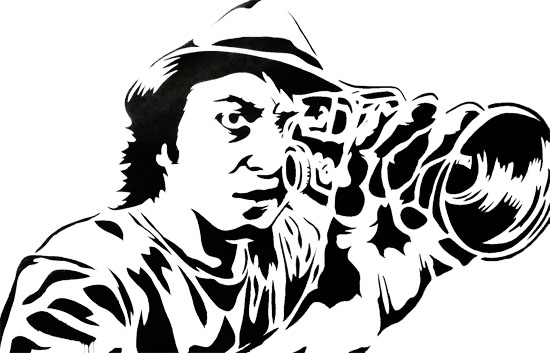
A few months before Joaquin Phoenix would be announcing his acting “retirement,” Guetta’s artist persona, Mr. Brainwash, or MBW, had moved from plastering L.A. with his own likeness — an image of a guy holding a video camera — straight to mounting a massive “street art” show, called “Life Is Beautiful,” in a 15,000 square-foot venue. Seemingly overnight, Mr. Brainwash was being positioned as an up-and-comer with the oeuvre of a Shepard Fairey or a Banksy — by then both artists, as well as many other leading names in the street art world, had begun having their art on display inside galleries as opposed to on the exterior of walls — except unlike these artists with years, even decades of creative evolution and refinement, Guetta had no experience. He’d hired an army of sculptors and designers to manufacture the pieces for his show, ripped straight from bookmarks in art books — even the illustration of Guetta holding the camera had been created by someone else.
The day of the show the line to get in stretched for blocks. Four thousand people attended the opening. By the end of the day nearly a million dollars worth of Mr. Brainwash art had been sold.
The story, at face value, seems so preposterous that the question of whether it could truly be real has dogged the film, as well as created the suspense that’s made it even more of a phenomenon. Could an amateur who’d never actually made art himself succeed at pulling off a show that so blatantly counterfeited and so quickly eclipsed those of the art form’s recognized heavyweights? And would they really release a movie about it happening? Or is all of it — the movie, Life is Beautiful, Mr. Brainwash — simply Banksy’s greatest prank yet? Theories abound. The New York Times labeled it as a harbinger of a new cinematic subgenre: The Prankumentary. “The whole thing, it’s clear now,” Fast Company insisted, “Was an intricate prank being pulled on all of us by Banksy, who has never publicly revealed his identity, with Fairey as his accomplice.” Their conjecture about what really happened: “Banksy… convinced Guetta to pose as a budding graffiti artist wannabe so he and Fairey could ‘direct’ him in real life — manufacturing a brand new persona.” Yet when asked at the end of the film how he feels knowing that he is in part responsible for Mr. Brainwash, Shepard Fairey laughs ruefully, “I had the best intentions. But sometimes even when you have the best intentions things can go awry…. The phenomenon of Thierry becoming a street artist, and a lot of suckers buying into his show and him selling a lot of expensive art very quickly, anthropologically, sociologically, it’s a fascinating thing to observe. And maybe there’s some things to be learned from it.” For his part, Banksy, even as his voice is scrambled beyond recognition, conveys unmistakable melancholy as he says, “I used to encourage everyone I met to make art. I used to think that everyone should do it….. I don’t really do that so much anymore.”
“This brutal and revealing account of what happens when fame, money and vandalism collide” could just be an L.A. story simply too bizarre to have been made up, and just as easily, it could all be a fabricated fable about what happens to an artistic movement when it becomes commercialized. From “selling out” to “cashing in” the concept is so mundane it’s a cliché, but Exit Through The Gift Shop‘s treatment is primarily to emphasize the absurdity of the progression of events rather than to make any concrete statement about them. As Banksy’s art dealer says at the end of the film, “I think the joke is on… I don’t know who the joke is on, really. I don’t even know if there is a joke.”
Which brings us back to Charlie Sheen. Not that what Sheen’s doing is any kind of joke or “prank.” This is all very much for real for him. And it is also a very deliberate performance. How did we get here? February 28, Charlie Sheen goes on Good Morning America, The Today Show, TMZ, Radar, Piers Morgan on CNN, 20/20 — basically, every celebrity interview news show he possibly can, and attracts a tsunami of flabbergasted attention for bein’ all ka-raaaazy. The next day he launches a social media empire.
which received over 74 THOUSAND! submissions in 5 days. Arguably no other celebrity has “gotten” the way social media works as fast. Even Conan had a slower uptake, though he’s undeniably provided a template for Sheen to work off of. (After getting canned from his TV job, Sheen did like MBW to Conan’s Banksy and announced he’s going on tour — the “Violent Torpedo of Truth/Defeat is Not An Option” Tour — just like Conan’s Banned From Television Tour last year in the wake of his own network debacle.) And, obviously, Sheen’s not doing it all on his own.
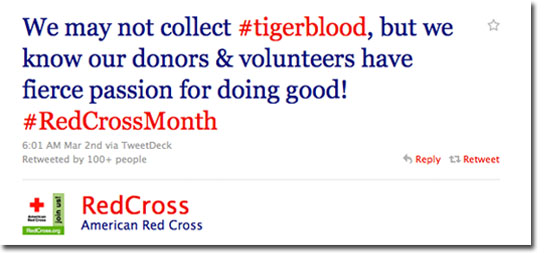
In Sheen’s 11-minute livestream episode, titled, “Torpedeos of Truth Part 2,” recorded on March 7th, 2011 — a week after his “old media” blitzkrieg — a terribly lit, grossly contrasted video in which a curmudgeonly, borderline belligerent Sheen looks like he might not have showered for days prior then rolled out of bed that morning, turned on his lap top, and started recording through the built-in camera above the screen, at 6 minutes, 40 seconds, when he ducks “below the frame line,” the camera moves. This is a recording made to look like it’s being done through a shitty built-in computer camera, but when it moves to follow Sheen as he ducks it’s suddenly clear there may be a camera person involved. If there is someone behind the camera, there could just as easily have been a lighting guy, a makeup person, but No! “Make me look as crazy as possible,” was clearly the direction here. By episode four it’d been announced that Sheen had officially been fired from his sitcom. The ante was upped. Suddenly Sheen, well-lit, made-up, looking as healthy as a marathoner — if not for the chain-smoking — in his sweat-wicking Nike shirt, was performing a soliloquy sounding like some misplaced Hunter S. Thompson diatribe. Clearly some writing talent may have been called in — if it hadn’t been already: consider that basically everything coming out of Charlie Sheen’s mouth becomes a meme — it’s been impossible to escape hearing someone say #winning (a hashtag in Charlie Sheen’s very first tweet) for weeks; then there’s #tigerblood, which is so meme-able it can’t even be summarized properly:
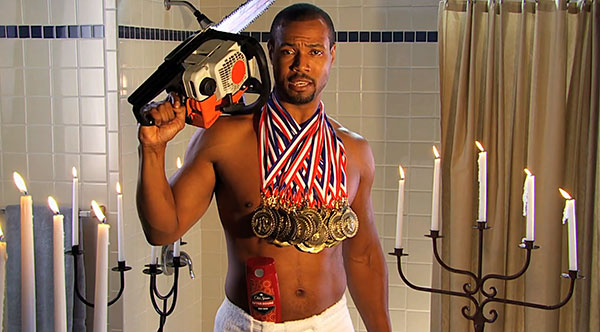
Right now 4Chan, the primordial ooze that has spawned everything from lolcats to Rickrolling to SadKeanu to every other Internet meme you’ve ever heard of, is looking at Charlie Sheen like Woh. The last guy anywhere near this unstoppably memetastic was the Old Spice Guy–
Something else you might notice — Charlie Sheen almost never swears. You have never heard him bleeped in any of the interviews he’s done on TV. There are no R-rated words on his Twitter stream. Every so often there’s some sprinkled in his livestreams, but for the most part The Charlie Sheen Show is all-ages. Where he could say “assholes” or “douchebags,” he says “silly fools” or “trolls.” These Playskool insults are unexpected, amusing, almost benign, yet nostalgically cruel. This is not the syntax of a man out of control.
“I don’t know,” he rolled his eyes, “They’re just words that sound cool together. Stuff just comes out and it’s entertaining and it’s fun and it sounds different from all the other garbage people are spewing, you know?”
Charlie Sheen doesn’t have Tourettes. He is deliberately saying these things to entertain and be funny and unique. And he’s good at it. Bret Easton Ellis — the author of Less Than Zero and American Psycho, as well as Lunar Park, a haunted house story in which the main character is a writer named Bret Easton Ellis who’s lived the same history as his eponymous creator (“It was always the A booth. It was always the front seat of the roller coaster. It was never ‘Let’s not get the bottle of Cristal’ … It was the beginning of a time when it was almost as if the novel itself didn’t matter anymore — publishing a shiny booklike object was simply an excuse for parties and glamour.”) or is it, rather, the life he was expected to have been leading? (“What was I doing hanging out with gangbangers and diamond smugglers? What was I doing buying kilos? My apartment reeked of marijuana and freebase. One afternoon I woke up and realized I didn’t know how anything worked anymore. Which button turned the espresso machine on? Who was paying my mortgage? Where did the stars come from? After a while you learn that everything stops.“) — writing in an article titled, “Notes on Charlie Sheen and the End of Empire,” calls Sheen, “the most fascinating person wandering through the culture:”
You’re completely missing the point if you think the Charlie Sheen moment is really a story about drugs. Yeah, they play a part, but they aren’t at the core of what’s happening—or why this particular Sheen moment is so fascinating…. This privileged child of the media’s sprawling entertainment Empire has now become its most gifted ridiculer. Sheen has embraced post-Empire, making his bid to explain to all of us what celebrity now means. Whether you like it or not is beside the point. It’s where we are, babe. We’re learning something. Rock and roll. Deal with it.
Post-Empire isn’t just about admitting doing “illicit” things publicly and coming clean—it’s a (for now) radical attitude that says the Empire lie doesn’t exist anymore, you friggin’ Empire trolls. For my younger friends, it’s no longer rare; it’s now the norm. To Empire gatekeepers, Charlie Sheen seems dangerous and in need of help because he’s destroying (and confirming) illusions about the nature of celebrity.
It’s thrilling watching someone call out the solemnity of the celebrity interview, and Sheen is loudly calling it out as the sham it is. He’s raw and lucid and intense…. We’re not used to these kinds of interviews. It’s coming off almost as performance art and we’ve never seen anything like it—because he’s not apologizing. It’s an irresistible spectacle. We’ve never seen a celebrity more nakedly revealing.
It’s the contradiction we could never quite reconcile in I’m Still Here or Exit Through The Gift Shop; one we can accept in Lady Gaga because she’s not using her real name and we’re sort of OK with it when it’s just a “character.” Charlie Sheen is real and not real at once: a spectacle and a revelation. It’s meta-postmodernism. It’s existential performance art. Minutes before Charlie Sheen’s first livestream was set to start, the audio feed came on. You could hear Sheen rehearsing the rant he would perform that night, prompting the question: is this all an act? Of course it is! He’s an acTOR. From a family of actors, who’s spent his entire life performing. There’s no way he’d go on camera ever without rehearsing. Charlie Sheen’s whole life has been a performance, and this now is not so much different, just with a bigger audience and, as we say in the 21st century music business, cutting out the middleman. As far as Charlie Sheen knows, this is what real is. And as far a we know that’s what it is, too.
Ellis writes:
If you can’t accept the fact that we’re at the height of an exhibitionistic display culture and that you’re going to be blindsided by TMZ (and humiliated by Harvey Levin, or Chelsea Handler—princess of post-Empire) while stumbling out of a club on Sunset Boulevard at 2 in the morning, then you should be a travel agent instead of a movie star. Being publicly mocked is part of the game, and you’re a fool if you don’t play along. This is why Sheen seems saner and funnier than any other celebrity right now. He also makes better jokes about his situation than most worried editorialists or late-night comedians.
What does shame mean anymore? my friends in their 20s ask. Why in the hell did your boyfriend post a song called “Suck My Ballz” on Facebook last night? my mom asks. But nothing yet compares to the transparency that Sheen has unleashed in the past two weeks—contempt about celebrity, his profession, the old Empire world order.
Ellis’s “Empire” is a reference to Gore Vidal’s definition of global American hegemony, which Ellis dates from 1945 until 2005: the era that defined the 20th century. Post-Empire is where we are now. For Ellis, Empire is the lie, the having to hide who you really are, the keeping up appearances; post-Empire, on the other hand, is what Ellis calls, “aggressive transparency.” But his perspective has one flaw: for Ellis, both Empire and post-Empire are binary. It’s one or the other. It’s true or it’s a lie; it’s real or its counterfeit. The post-Empire reality, however, is not the end of the lie, it’s the end of the binary. Sure, “radical transparency” has become a 21st century marketing buzzword. Sure, Mark Zuckerberg believes that Privacy is Dead and has remade Facebook in that image. Sure, I wrote last year, what makes Iron Man the first 21st century superhero? His lack of alter ego; his unconflicted, absolute identity. But that all is only part of the Millennial story.
There’s an assumption that teens don’t care about privacy but this is completely inaccurate. Teens care deeply about privacy, but their conceptualization of what this means may not make sense in a setting where privacy settings are a binary. What teens care about is the ability to control information as it flows and to have the information necessary to adjust to a situation when information flows too far or in unexpected ways.
Just because teens choose to share some content widely does not mean that they wish all content could be universally accessible. What they want is a sense of control.
I’d argue this is, in fact, true of all of us now in the post-Empire. Not just teens. “What Sheen has exemplified and has clarified,” writes Ellis, “Is the moment in the culture when not caring what the public thinks about you or your personal life is what matters most—and what makes the public love you even more (if not exactly CBS or the creator of the show that has made you so wealthy).” Except that Charlie Sheen still very much DOES care. And so do all the rest of us in the 21st century. It’s there in every Facebook photo you’ve untagged yourself from. You had your reasons. It’s there in every location you pulled out your phone to check in at, and then decided not to. It’s there every time you hovered over, and then didn’t click the “Like” button. As tech blogger, Robert Scoble, writes:
The other day I found myself over at Yelp.com clicking “like” on a bunch of Half Moon Bay restaurants. After a while I noticed that I was only clicking “like” on restaurants that were cool, hip, high end, or had extraordinary experiences.
That’s cool. I’m sure you’re doing the same thing.
But then I started noticing that…. What I was presenting to you wasn’t reality.
See, I like McDonalds and Subway. But I wasn’t clicking like on those. Why not?
Because we want to present ourselves to other people the way we would like to have other people perceive us as.
I’d rather be seen as someone who eats salad at Pasta Moon than someone who eats a Big Mac at McDonalds.
This is the problem with likes and other explicit sharing systems. We lie and we lie our asses off.
This is the hyper-real version of Charlie Sheen. It is a role that Charlie Sheen is performing. And it is also who he actually is. Because how could he not be? Whatever Charlie Sheen does, that is who he is. This is the only way he has to take control over the flow of his information. For a celebrity in particular, as Ellis points out, that control is virtually non-existent. So how did Charlie Sheen wrest it back? By outdoing TMZ and the news shows and the magazines at their own game. He is no longer just a commodity of the tabloid industrial complex. He is the creator and star of his own show, the Crazy Charlie Sheen Show, and all the press is simply promotion.
Then again, it could be something much more simple. At Coachella 2008, Prince, headlining, kept demanding over and over, “Say my name, Coachella! Say my name, Coachella! Say my name, Coachella!” And like some epic call-and-response an ocean of 150,000 voices roared back: “Prince! Prince! Prince!” And I realized that if you’re Prince, there’s probably no way you can even get off anymore without 150,000 people screaming your name. Perhaps, if you’re Charlie Sheen, you can’t stay sober unless two million people are following your every move — just over two weeks after his first Tweet, it’s now closing in on 3 million.
“We’ve come a long way in the last two weeks,” Ellis concludes. “Sheen is the new reality, bitch, and anyone who’s a hater can go back and hang out with the rest of the trolls in the graveyard of Empire.” Like I’m Still Here and Exit Through The Gift Shop, what Charlie Sheen is doing is part of a continuum exposing the now inherent unreliability of the markers we’d previously depended on to tell the difference between what’s real and what isn’t. In some ways it’s as basic as the shift from the 20th century to the 21st; from analog to digital, from binary to exponential complexity. What, truly, does reality mean when it’s photoshopable? Or just another marketing campaign for some new movie? Not that reality doesn’t exist. Things are, out in the world; you can touch them. Earthquakes happen; nuclear reactors break; nations perch perilously on the verge of catastrophe. Reality exists, but it is no different from not reality. From the inscrutably contradictory government statements about radiation levels, from the fake Nuclear Fallout maps that spread like wildfire. Reality and not reality exist in the same plane now. It’s enough to make you go crazy. Unless you’re Charlie Sheen. In which case you’re not crazy. You simply are as your world is.





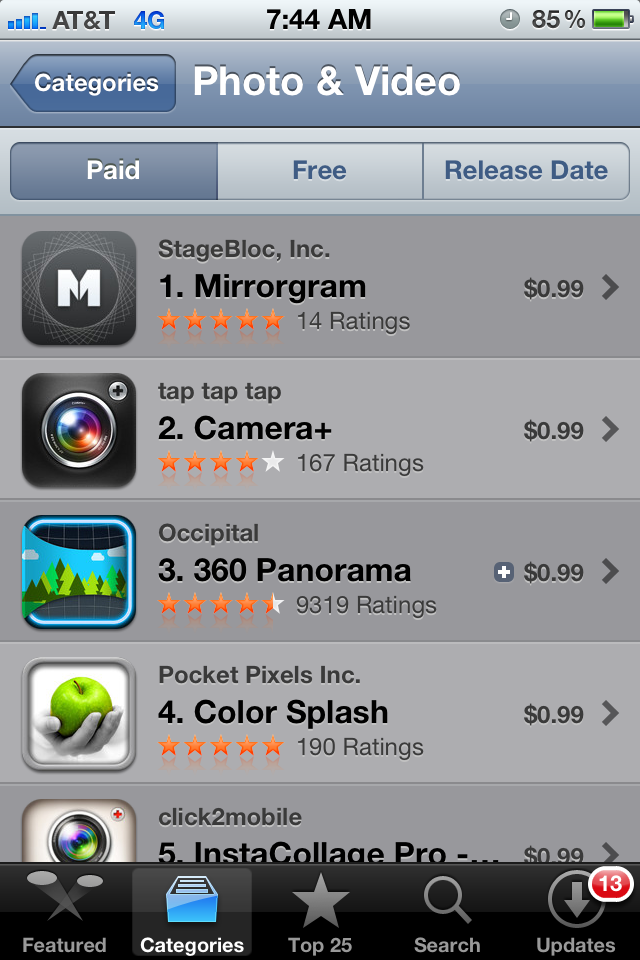
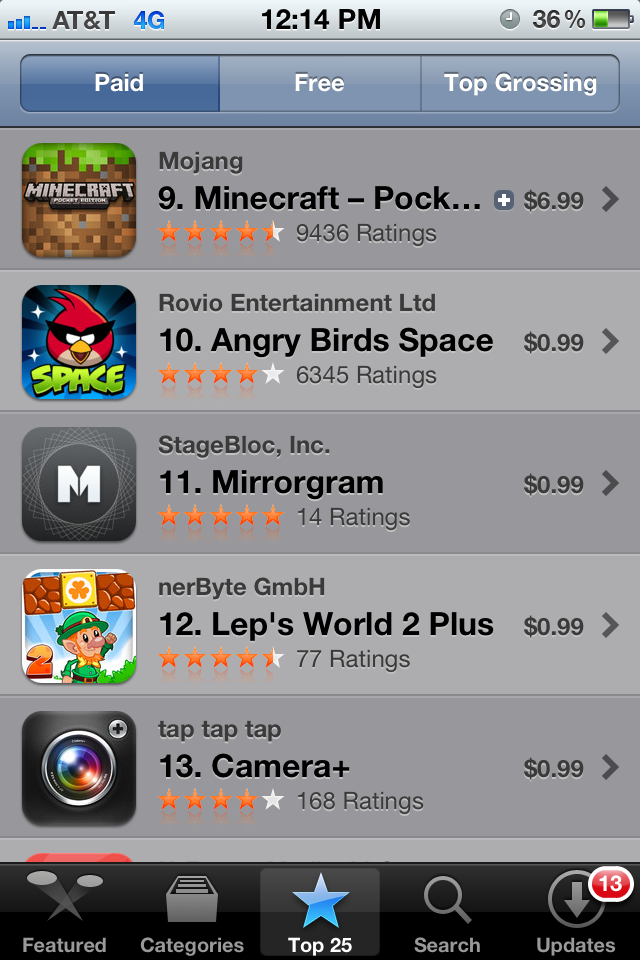
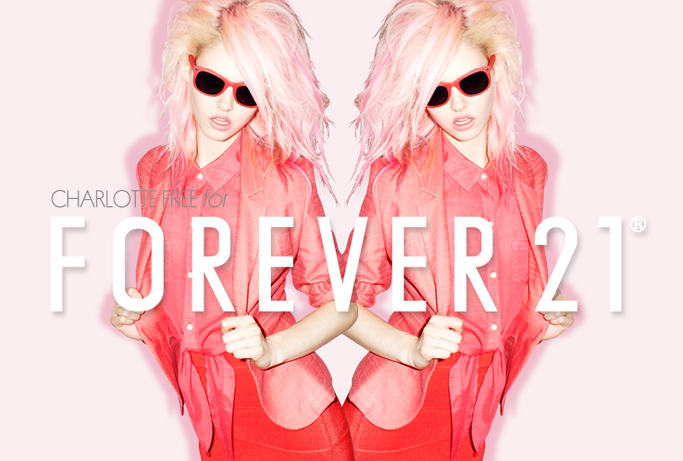
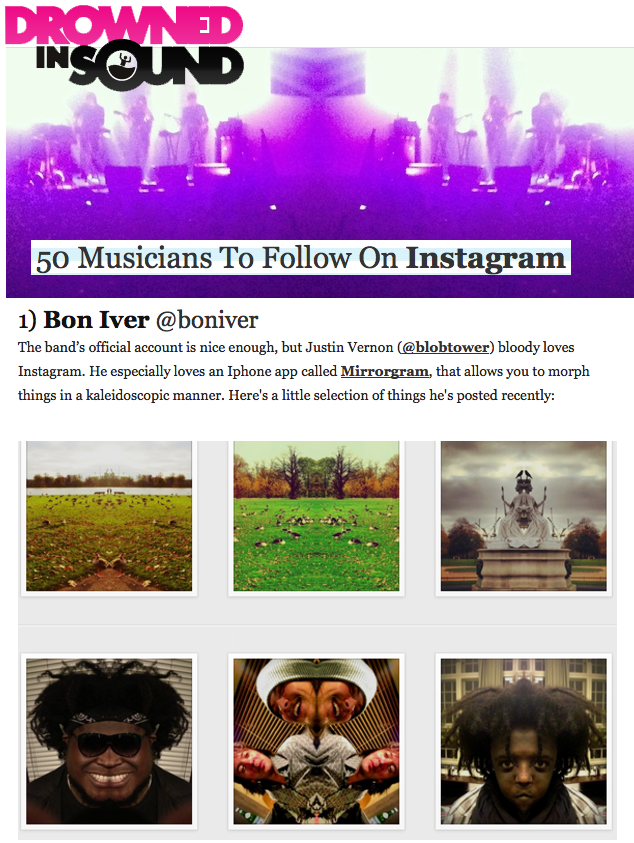
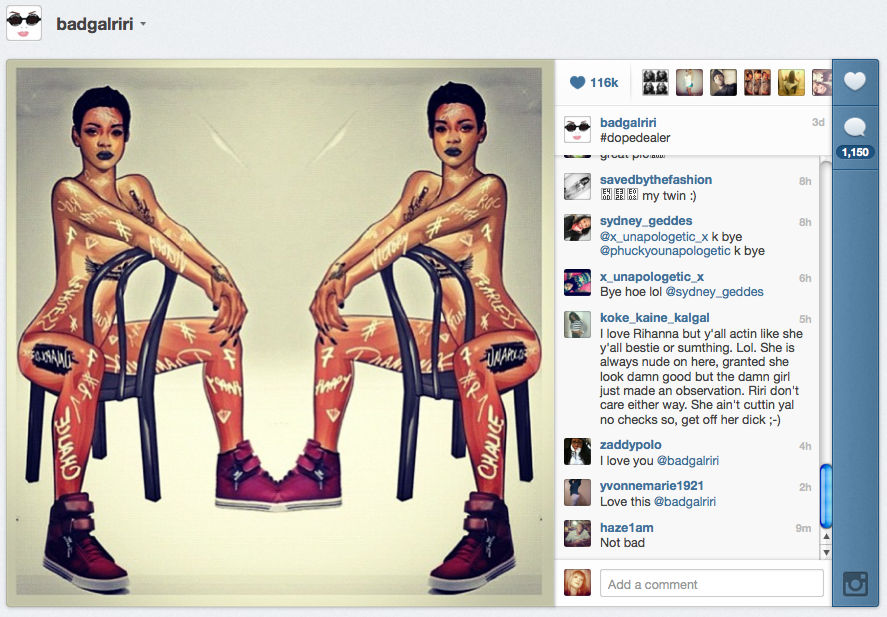

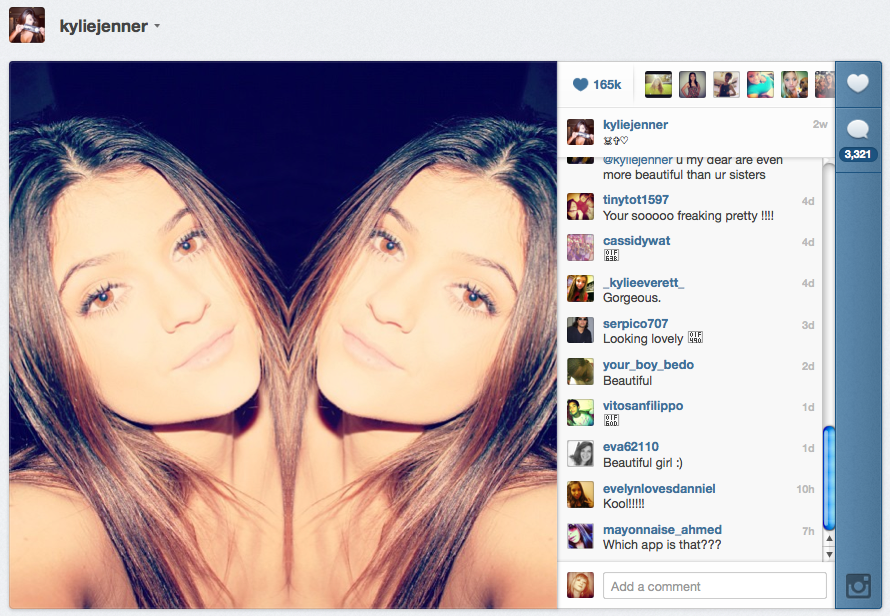

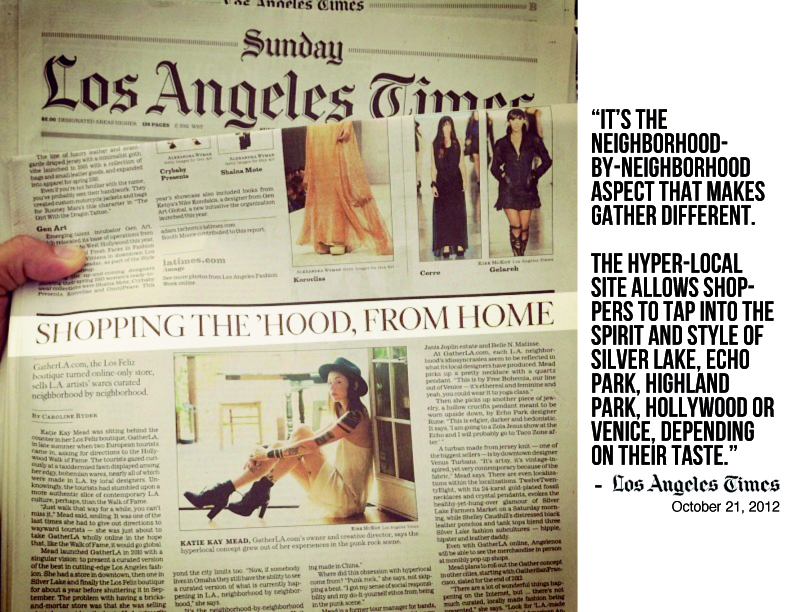


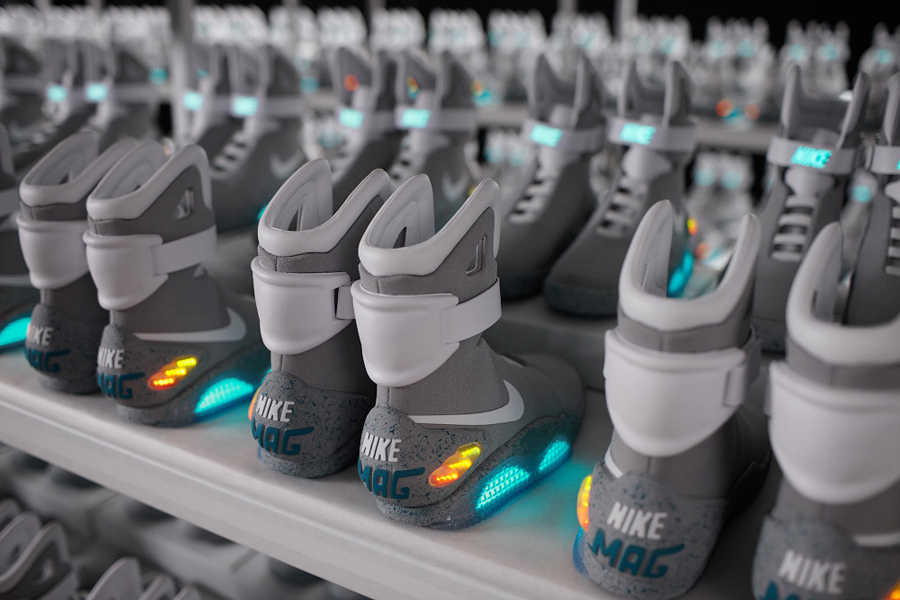
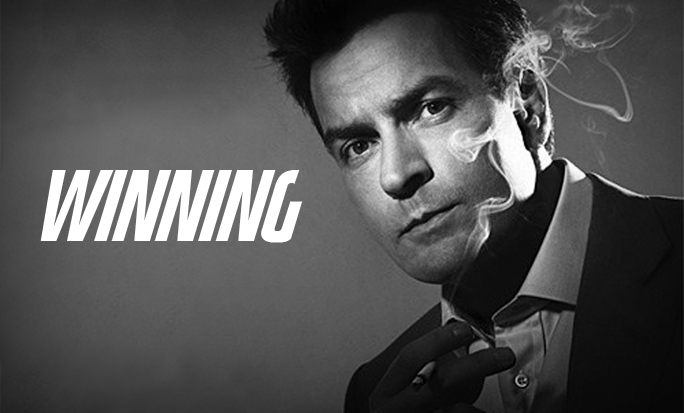 Image: Culture Wins