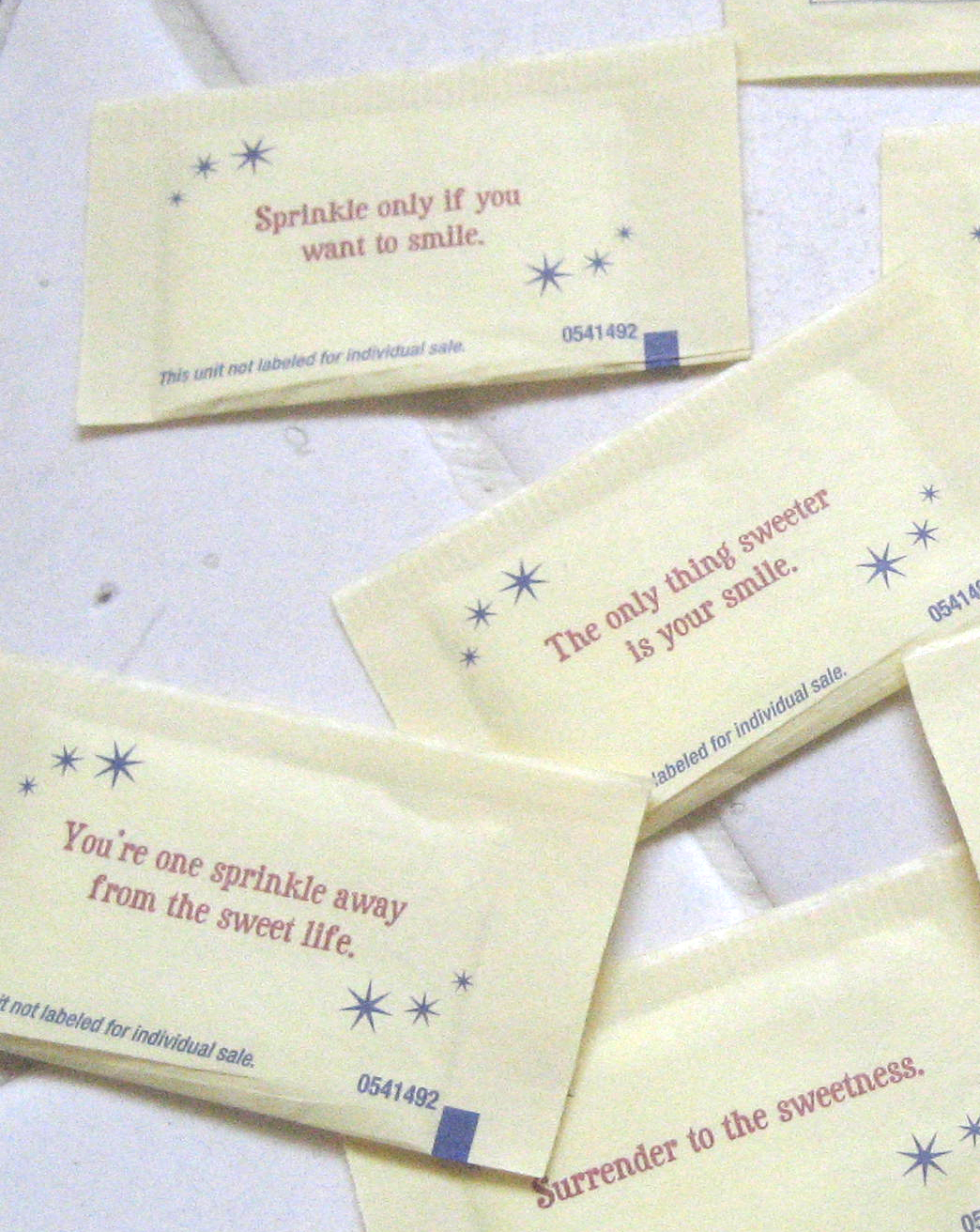
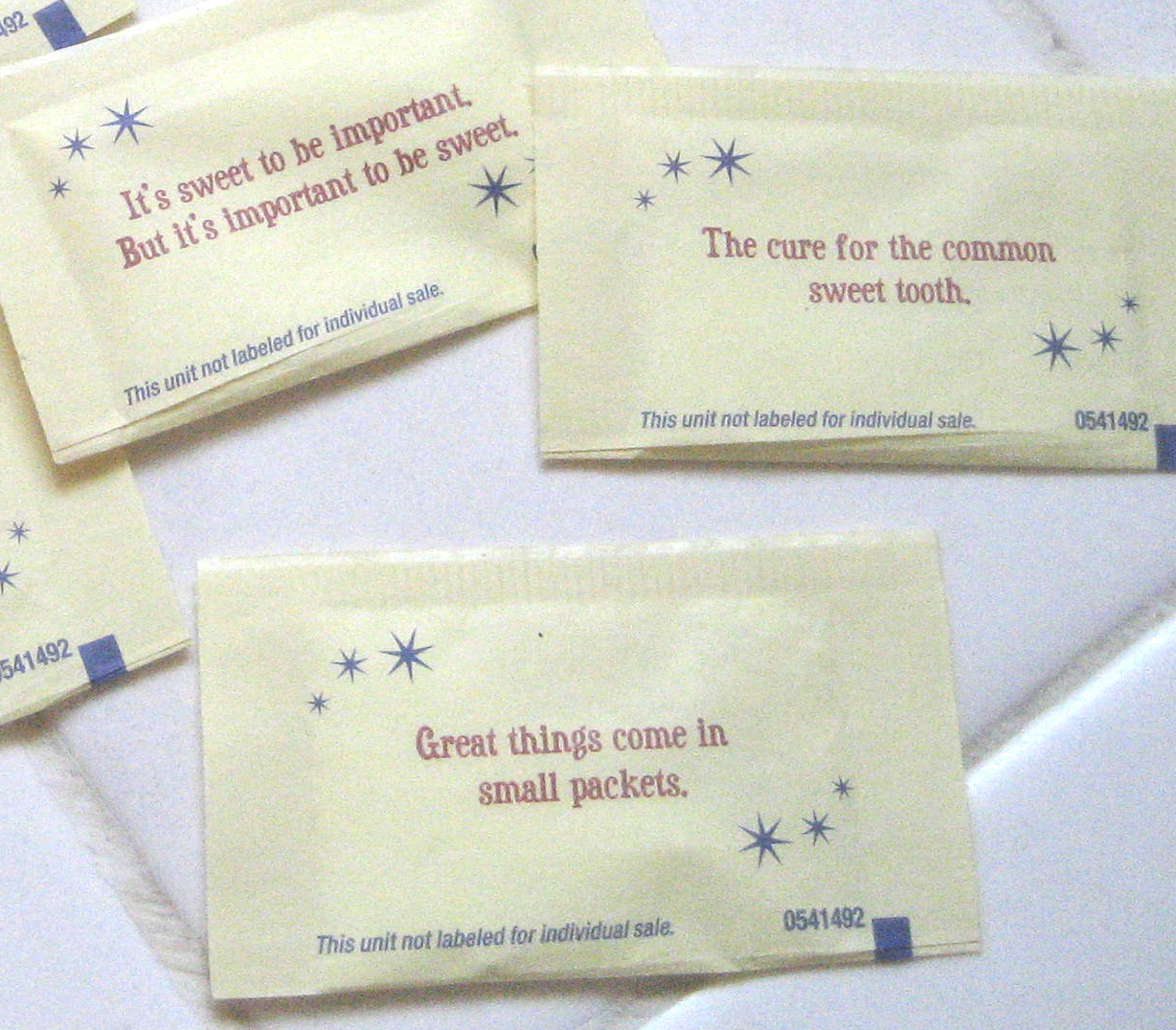
just came across the mixed chicks line of hair products, and thought it was awesome. kind of like the same way that i find my best friend (whose mom is white and dad black) ordering a half vanilla half chocolate milkshake at a diner awesome. (i’m telling you, should hear HOW she orders it. that shit NEVER gets old!) kind of like the way i find products and messages that speak to people with complex identities awesome.
we all want to feel that our particular problems and unique desires are genuinely understood–whether it’s about hair, a sweet tooth, or anything else, really.
after all, you realize the big secret is that EVERYONE feels they have a complex identity, right?
in light of the previous post, a friend suggested i redevelop the ad for the enlightenment card to make it more relevant to a consumer identity that would actually find the product appealing.
i only had five minutes tho, so here’s the best i can do:
as a marketer you realize that it’s not so much that you’re really setting anything up for sale, it’s that everything already IS for sale, and you’re just helping it along. so it’s not so much that i’m bothered by the selling of “enlightenment,” (there’s been buddha statues on-sale for millennia, and what are THOSE selling?) but rather it’s that i find the whole “enlightenment lifestyle,” kinda… icky.
today on the website for the san francisco green festival conference i discovered a publication called what is enlightenment magazine, published by enligntennext, which is “defining the contours of a new revolution in human consciousness and culture.” (it’s essentially not doing anything different than any punk band or public enemy-era hiphop act professed to be doing. it’s just targeting a different audience.)
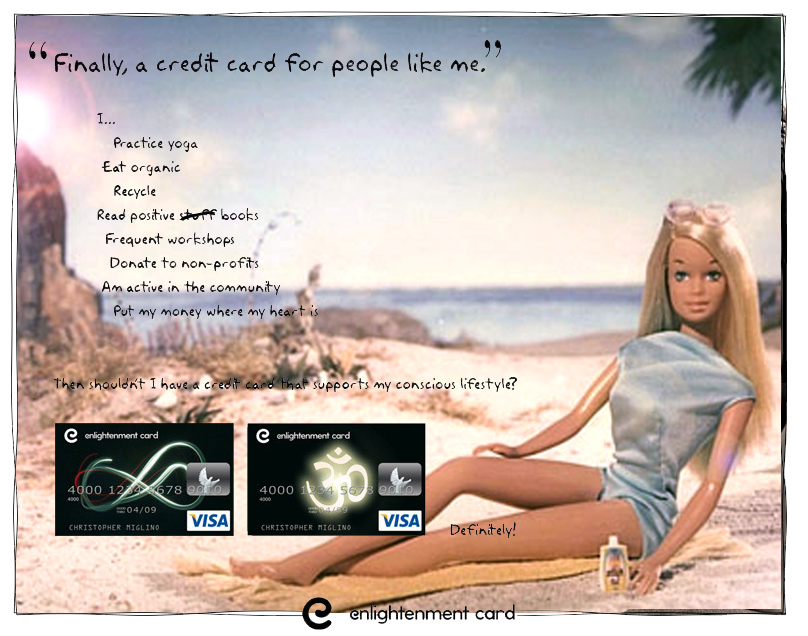
my first encounter with companies targeting this demo was when we were soliciting sponsors for LIB and were approached by the “enlightenment card”:
(in case you’re wondering, yes, the card IS real, no that ad is NOT a joke, and we said “no, thank you” to the offer.)
while on the one hand, i’m trying to think of where else do sheltered caucasian people get to evangelize a brand of appropriated cultural imperialism with such tactless self-righteousness and get away with it, on the other hand, from a technical standpoint, i’m completely impressed.
this is everything i preach about identity marketing in action.
The hypothesis states that as a robot is made more humanlike in its appearance and motion, the emotional response from a human being to the robot will become increasingly positive and empathic, until a point is reached beyond which the response quickly becomes that of strong repulsion. However, as the appearance and motion continue to become less distinguishable from a human being’s, the emotional response becomes positive once more and approaches human-to-human empathy levels.
This area of repulsive response aroused by a robot with appearance and motion between a “barely-human” and “fully human” entity is called the Uncanny Valley. The name captures the idea that a robot which is “almost human” will seem overly “strange” to a human being and thus will fail to evoke the empathetic response required for productive human-robot interaction.
maybe there is an uncanny valley in the process of identity expression as well. the more a brand or a product makes it easier for people to express their identity the more palatable it is, until maybe it hits a certain point where it becomes so blatant that its appeal suddenly drops off. however, as this brand’s identity-expressing qualities continue to become more innate and nuanced, and less overt it once again becomes appealing. maybe it could be called the uncanny “wannabe valley,” the place in brand authenticity/relevance that will likewise “fail to evoke the empathetic response required for productive human-brand interaction.” (cuz brands are robo–i mean, people too.)
one of the explanations for the uncanny valley phenomenon is that the robots stuck in no-man’s land elicit revulsion because they look “dead,” and biologically we’re wired to have an aversion to corpses, cuz stickin around doesn’t bode so well for the immune system. (makes you wonder tho if necrophiliacs collect weird lookin robots). but when it comes to identity, the brands (and people) stuck in the uncanny wannabe valley turn us off because they’re “fake.” in a similar sort of way, biology may have led us to respond with distaste to “fake” people (and by proxy brands now) because they are untrustworthy. from a social selection standpoint, they may even be community saboteurs.
the funny thing in all of this is that there’s nothing actually WRONG with the enlightenment card except its name. if you have to have a credit card, why NOT get one that’s gonna let you earn points towards, like, trips to spas in costa rican rain forests, right?
while no doubt one person’s fake is another person’s orgasm, it just feels like confusing a lifestyle for an expression of “enlightenment,” is kinda, um, you know…. BOGUS!
nature decided to run an experiment in its whimsical way, and cast a bunch of birds adrift on an island called new guinea, essentially without any predators to worry about and a perpetual abundance of food, and then sat around for several million years to see what might happen.
what did happen is the evolution of an obscenely flamboyant species of birds called the birds of paradise.
No other birds on Earth go about the business of breeding quite like these. To dazzle choosy females, males strut in costumes worthy of the stage: cropped capes, shiny breast shields, head ribbons, bonnets, beards, neck wattles, and wiry feathers that curl like handlebar mustaches. Their vivid reds, yellows, and blues blaze against the relentless green of the rain forest. What makes for the sexiest mix of costume and choreography is a mystery, but it seems the more extreme the better.
unlike their less exotic distant cousins with actual problems to worry about, the 38 species of birds of paradise had no need to waste their time protecting resources or camouflagely avoiding predators. the lack of struggle for sheer survival having made natural selection a non-issue, the new standard of ‘fitness” became style.
cut to 1st-world post-industrial human society. unlike birds, of course, we have more issues to deal with than just courting rituals–tho they are inevitably involved. our obsession with style is not soley about, as the kottonmouth kings say, “something to poke on,” but also very much about somewhere to fit in. the desire to belong to a community may be hardwired in, but then so, it seems, is our need to express that belonging in our identity–our lifestyle.
Adaptations that help an individual survive can sometimes play themselves out through the group. Consider religious rituals.
Rituals are a way of signaling a sincere commitment to the religion’s core beliefs, thereby earning loyalty from others in the group. “By donning several layers of clothing and standing out in the midday sun,” Sosis wrote, “ultraorthodox Jewish men are signaling to others: ‘Hey! Look, I’m a haredi’ — or extremely pious — ‘Jew. If you are also a member of this group, you can trust me because why else would I be dressed like this?’ ”
These “signaling” rituals can grant the individual a sense of belonging and grant the group some freedom from constant and costly monitoring to ensure that their members are loyal and committed. The rituals are harsh enough to weed out the infidels, and both the group and the individual believers benefit.
that quote above comes from a really fascinating new york times article about the evolution of religion (as in, sociobiology stylie) which proposes a set of key psychological factors that could combine to create an intrinsic, biological human predisposition to believe in a higher power. but while spiritual belief may be inherent, if nature is all there was to it we’d be content to experience these beliefs in a personal way. for the truly religious, however, a personal relationship with god isn’t really enough. nurture puts the pressure on to show up at church every sunday so that all the other religious folks can witness this expression of our identity in our attendance.
there is some kind of security we crave that is just as much a drive as anything spiritual, a security that comes from feeling we are being seen for “who we are.” cuz identity without expression is consciousness. it’s the stuff you know about the world and yourself that it’s ok if no one else knows you know. you know. and that’s enough. identity is the shit you feel the need to for the world to see, the stuff you hang a billboard for around your neck.
…and speaking of brands. oh, what? you thought we weren’t? “branding” as we know it today, came from consumer goods factories realizing that they needed a way for their generically-packaged mass-produced products to compete for a market base familiar only with local goods. what initially was just a matter of packaging and insignias then evolved past image, past hype, past essence, past the product itself, to a point where a “brand” is now its consumer identity.
when my purse was stolen my credit card company knew before i did. still under the impression that it had just been misplaced at a friend’s party, and would be discovered after the post-party cleanup, i got a call from mbna about some unusual charges: at jack in the box. i joke that had the thieves gone to whole foods no one would have been the wiser, since the last time i purchased fast food i think i was in high school. it’s beyond just that it’s “unhealthy” and all the other things, it’s that, as my credit card company so effectively pointed out, it’s “not me.”
that’s an essential part of what brands are now: signifiers of what is or is not us. and to a greater extent than ever we are now constantly looking for ways to get “ourselves” across..
it’s like the story about those funny birds, you know…. self-obsession becomes the tradeoff for paradise.