For the past two years, Espresso has taken a stab at answering a simple, compelling question: “What The F**k Is Social Media?” The answer has turned into a series of presentations that have been viewed over 750,000 times, translated into about 10 languages (including Russian, so I’ve finally been able to explain to my parents what it is I “do”), and proclaimed “a social media hit for its wit and its very convincing case for the raw power of social media,” by Mashable.
This year, I’m proud to say I helped research and cowrite the third installment in Espresso’s “blockbuster summer franchise.” Check it out!
.
If you’d perfer a non-“parental advisory” rendition, the “radio version” is here.
This is not typically the kind of stuff I write about here, but it is something I feel quite strongly about, and, if nothing else, it makes for a case study in cross-cultural communication — not to mention some interesting neuroscience.
Last week, as the New York Times reported, French President Nicolas Sarkozy addressed the Parliament at Versailles with a withering critique of the burqa as an unacceptable symbol of “enslavement.”
“The issue of the burqa is not a religious issue. It is a question of freedom and of women’s dignity,” Mr. Sarkozy said. “The burqa is not a religious sign. It is a sign of the subjugation, of the submission, of women…. I want to say solemnly that it will not be welcome on our territory.”
Now, I got the link to this article from my cousin, who, it should be pointed out, shares the same history I do. We were not born in the United States, and growing up as first-generation immigrants in America we have spent our whole lives reconciling mixed, often contradictory, cultures. The fact that our families were able to leave the giant labor camp / prison that was the Soviet Union at all, is the result of one of the most successful human rights campaigns in history. So it’s no surprise that our reactions to the news of this French move were resoundingly positive. It was, however, quite surprising (though it retrospect, it shouldn’t have been) to discover many of my American-born friends expressing outright disapproval. I heard everything from straight up calling Sarkozy a “moron,” to the derisive cynicism that “Nothing says freedom like banning the burqa.”
I should hasten to point out here, it’s not that my American-born (liberal) friends are burqa-lovers, by any means, it’s just that freedom of religious expression is a sacrosanct American principle — as well it should be — and messing with it immediately inspires a profound distaste. It would, no doubt, be easier to have the issue of religious expressions be capable of being soblack and white, so absolute, so all or nothing. It would certainly be much simpler, clearer, less offensive or culturally insensitive, if the idea that banning anything could actually bolster freedom wasn’t so contradictory. The reality, however, is that pretty much all freedom depends on the banning of something, and that something is the myriad efforts to deny human rights.
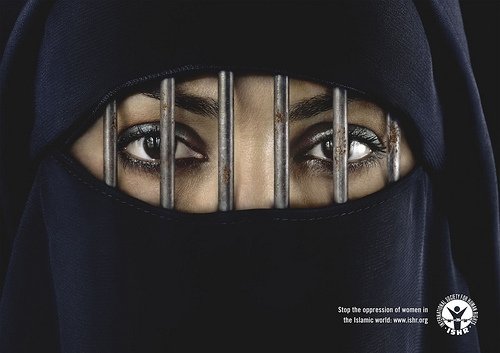
Which is precisely the spectrum that the burqa finds itself on. To clear up any confusion — since, in the predisposition for pursuing starkly-defined edges between black and white, it might seem effective to assume I’m just roundly including ALL kinds of modesty coverings, like headscarves, for instance, in this indictment, I’d like to state that I’m definitely not. A headscarf isn’t anywhere in the same vicinity as this:
The burqa is a full-body ghost-like sheet that covers a woman from head to toe, which Sarkozy, in no way inaccurately, likened to an “imprisonment.” The International Society For Human Rights seems to have drawn the very same analogy in the PSA at the top of this post. There is a good deal that has already been said about the legitimate impediments to health and physical safety that come along with these trappings (apt word, indeed, in this instance), but what makes the burqa an outright violation of human rights in my view is the fact that when a group of people is denied the freedom simply have their face be visible, they are deprived of the most fundamental, basic, human capacity to elicit empathy.
In his book, Social Intelligence: The New Science of Human Relationships, Daniel Goleman writes, “Suppressing our natural inclination to feel with another allows us to treat the other as an It…. Empathy is the prime inhibitor of human cruelty.”
Conveniently for us, then, human brains are actually hard-wired for empathy. In fact, damage or malfunction in the neural systems instrumental in allowing us to understand and resonate with someone else’s emotional state happens to be a basic requirement for psychopathic behavior. Clinical psychopaths are actually incapable of reading emotions; their brains simply do not register the meaning of expressions of fear or anguish, for example. Normal, healthy, functioning brains not only understand others’ emotions, they are actually designed in such a way as to induce the witness to internally experience the same emotional state that he or she is witnessing.
For instance, take a look at this face for, like, two-hundredth of a second:
As you do, Goleman explains:
The amygdala instantly reacts, and the stronger the emotion displayed, the more intense the amygdala’s reaction. When people looked at such pictures while undergoing an fMRI, their own brains looked like they were the frightened ones, though in a more muted range.
When two people interact face to face, [emotional] contagion spreads via multiple neural circuits operating in parallel within each other’s brains. These systems for emotional contagion traffic in the entire range of feeling, from sadness to joy.
Moments of [emotional] contagion represent a remarkable event: the formation between two brains of a functional link, a feedback loop that crosses the skin-and-skull barrier between bodies. In systems terms, during this linkup brains “couple,” with the output of one becoming the input to drive the workings of the other, forming what amounts to an interbrain circuit.
Brains loop outside of our awareness, with no special attention or intention demanded. [This] automaticity allows for rapidity. For instance, the amygdala spots signs of fear in someone’s face with remarkable speed, picking it up in a glimpse as quick as 22 milliseconds, and in some people in a mere 17 milliseconds (less than two-hundredth of a second). This [happens] so fast that the conscious mind remains oblivious to that perception.
We may not consciously realize how we are syncrhonizing, yet we mesh with remarkable ease.
Giacomo Rizzolatti, the Italian neuroscientist who discovered mirror neurons, the special class of neurons responsible for this kind of social duet, explains that our innate capacity for empathy allows us “to grasp the minds of others not through conceptual reasoning but through direct simulation; by feeling, not thinking.”
If you really stop to consider the significance of this, it’s pretty astounding. Our capacity to communicate through emotions happens entirely outside the realm of conceptual communication i.e. words. We don’t even need to speak the same language, or be able to TALK at all, for that matter, in order to simply look at someone’s face and personally understand what that person is feeling. As Goleman writes, “Mirror neurons ensure that the moment someone sees an emotion expressed on your face, they will at once sense that same feeling within themselves.” Through seeing another person’s face we experience, as instantly as a reflex, a mutually reverberating state that neuroscientists call “empathic resonance.” And empathy, I’ll write it again: is the prime inhibitor of human cruelty.
Sarkozy talked about the burqa as a tool for “depriv[ing women] of identity.” I see it as something more profoundly sinister. It deprives them not just of individual identity, but of shared Humanity. Our fundamental, human neurobiology depends on others to be able to see our face in order to elicit empathy. It is not the only way, of course, and it’s obviously not tamper-resistant, but it is the most instinctive, moreso even than language. Making someone hide their face is, literally, the oldest trick in the book for denying them empathy. When you can’t empathize, as any psychopath case study will show, you quite literally can’t recognize the other person’s Humanity. When you can’t recognize another person’s Humanity, it becomes a lot easier to be cruel. And when an entire population (oh, say, you know, women) is systematically denied their Humanity, their widespread oppression is inevitable. Thus whether or not your cultural sensitivity allows you to consider the burqa a means of oppression unto itself, it is absolutely part of the cycle that breeds it.
Human rights and religious freedom don’t always go hand in hand as neatly as we would like. Perhaps we might all live in a much better world if the two would just coordinate their priorities, but all too often religion seems to like endorsing things like female genital mutilation or child brides (notice a trend here on whom religion likes to shit on?) When the two don’t go hand in hand, the question that comes up for each of us is, how will we navigate the ensuing grayness? From my own experience, as a beneficiary of people around the world having fought against the oppression of others, there is nothing “moronic” or cynical about standing up for those who are being denied a basic human right, especially when it’s the right to empathy.
NOTE: These two items are actually unrelated, I just figured I’d kill two fashion birds with one post.
Stargate Outfits:
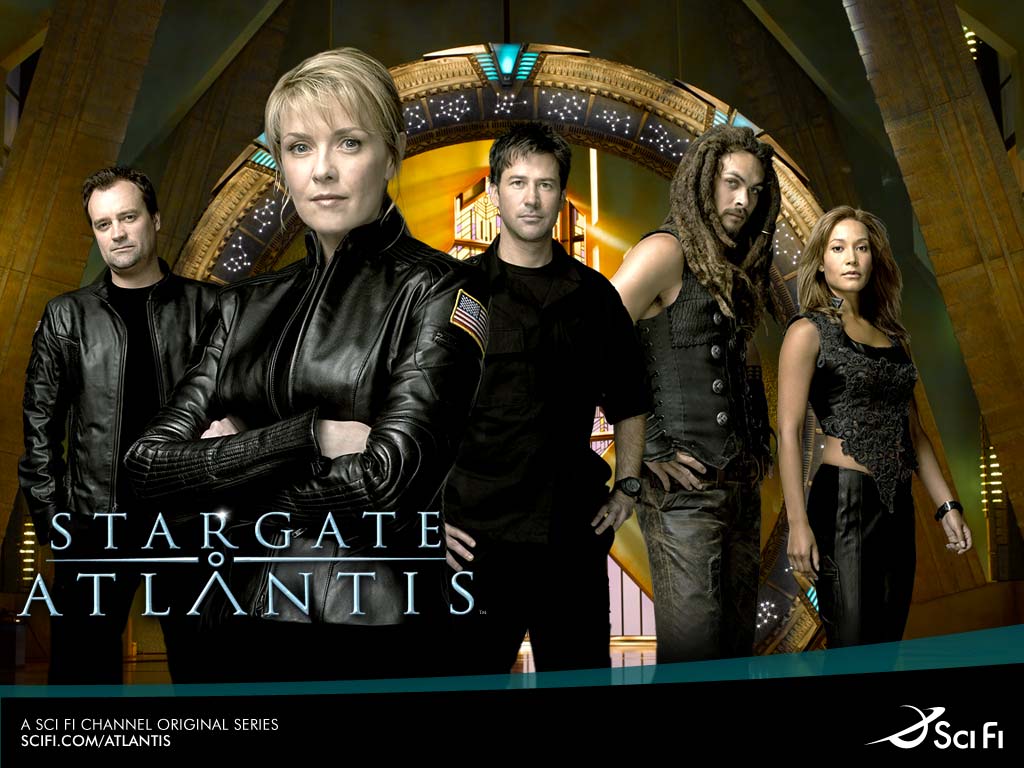
Watching Hulu’s recommended shows scroll by, it suddenly dawned on me that the outfits that the cast of Startgate: Atlantis are wearing in the promo shot look incredibly familiar:
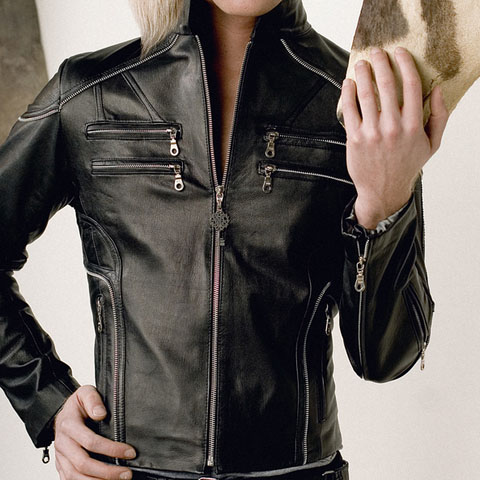
Particularly the leather jacket, second from left…
Reminded me a lot of a design my friends at Skin.Graft made a few years back, called the Darrah jacket:
Checking out other Stargate outfits…
…the jackets look a lot like designs from the newer Skin.Graft collection:
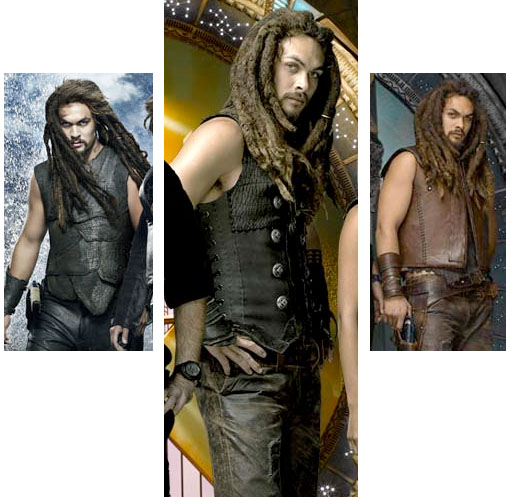
Oh, and then, of course, there’s the dreddy dude…
Who’s, like, a look-book unto himself of the de rigeur, reconstructed, burningman aesthetic…
I first noticed this last Summer, in a spread in Vogue’s 2008 Supplement, “Fashion Rocks,” featuring Dhani Harrison and Sasha Pivovarova:
It’s not every day you come across an Alexander McQueen-ed version of the particular kind of hat that is one of the hallmarks of your childhood, so it definitely stood out. But Summer is not exactly fox-fur hat season, so I had to wait till winter hit to see this trend in full swing. At Lucent L’amour, a couple of weekends ago, I must have seen a dozen people sporting Russian hats. Since it was an outdoor music festival in the middle of February, it was definitely a practical accessory. Cavalli has been making Russian “folk”-inspired Jackets for years. These below are from Fall 2005:
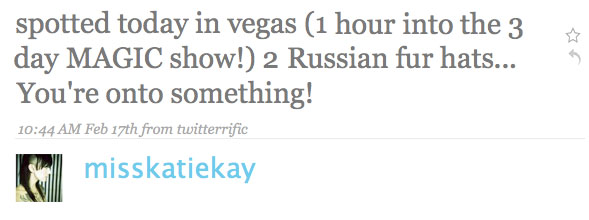
By last Summer, it seems fashion designers from Dolce & Gabbana, to Anna Sui, to Temperley London had all taken their inspiration from traditional Russian costumes, and military Cossack outfits. In response to my joking that “Russian hats are the new Fedoras,” Katie Kay, one of the partners at Skin.Graft, who was just at the fashion trade-show, MAGIC, this past week, tweeted:
I’m wondering if this might be the beginning of a larger trend of Western adoption of traditional Russian styles. Perhaps it’s been long enough now since the collapse of the Soviet Union that the younger generations have been able to rediscover an authentic cultural heritage that was pretty much erased from the social radar during the USSR era. Now, as individual expression and fashionability supplant the last remnants of communist conformity, Russian folk styles may offer a hidden trove of aesthetic inspiration.
Will Russian Orthodox iconography, or traditional Finift Jewelry will be next?
before i tell you what i do, i’ll tell you about who i am, and you’ll understand where my sensibilities for marketing come from….
i was born in the former ussr to a jewish family. by the time i was six my parents had been “refuseniks” for nine years. the ussr government claimed that my father, an engineer in the russian space program, had highly valuable government secrets because of his job, and possession of such secrets would, of course, never allow him to leave the country. (funny to consider i’m now writing about this out on the open range of the internet 20 years later). in the fall of 1987 we were finally allowed to leave. i think it was probably the first time either of my parents left the country.
in the ussr the jewish population was generally very highly educated. education was free and the opportunities it allowed were seen as one of the only hopes of defense against the country’s rampant antisemitism. the jewish community’s educated reputation lent a great deal of pride to one’s jewish identity, and at the same time made it incredibly resented by the less educated non-jews. this struggle was never mine, but i understand it as it informed the experience of the people who raised me.
we arrived in the US with ‘fugee visas, and my parents changed my name. at home and with family i was jenya, but to all the new americans i met, teachers, friends, bosses, boyfriends, i was jane. before i was old enough to analyze such things as context and identity critically, navigating between them became an inescapable part of my daily experience.
as an immigrant, you are on a constant quest for assimilation and acceptance. yet simultaneously you are instilled with a deep-seated pride for your history. much deeper than would be necessary were it a history that could be taken for granted. refugees from communist, or otherwise oppressive regimes have it even worse, as they carry with them a long history of distrust and secrecy. thus the pressure is always on not only to become americanized while retaining your heritage, but on top of that, to hide as much of this identity-juggling as you can possibly get away with.
growing up in the states, however, it becomes apparent by the time you’re in elementary school that the american ideal is, of course, a direct contradiction to the immigrant worldview. if you want to be cool you’re supposed to rebel, not fit in. you should aspire to stand out, be different, not assimilate. and above all, you’ve got to “be yourself.” a schizophrenic task for any teenager, even if you’re not a cultural hyphenate whose background is heavy on encouraging hiding who you are.
the summer between high school and college i spent in israel. by 1999 pretty much all of my family had relocated there from russia. from the 50+ cousins, aunts, and uncles, to my half-sister and her family, my relatives are spread out all over the country, and i spent every weekend i was there visiting various people who shared some portion of my DNA–lots of whom i’d never met before.
if toggling between two completely conflicting cultural influences in the united states hadn’t been enough to make me question the nature of what drives “identity,” the time i spent in israel drove the point home.
once the ussr government stopped refusing people from leaving the country, jews emigrated to israel in a staggering exodus. (there’s a russian–jewish joke that goes, “what did the second to last jew in russia say to the last jew? ‘don’t forget to turn the lights off at sheremetyevo airport.'”)
in israel the language barrier between russian and hebrew meant that even people with ph.d.’s became janitors, dishwashers, and taxi drivers. it didn’t matter who they’d been in russia, as far as israelis were concered, russians were all lower class.
americans on the other hand are considered VIPs in israel. they’re served first, deferred to, let in the front of the line, and generally treated by bartenders, bus drivers, store clerks, and all manner of other attendants like welcome guests. yet most american tourists don’t speak hebrew, of course. they don’t have to. all the signs are also written english, and practically all israelis in the service industry speak english to some degree that allows for more or less easy communication even if you don’t know a single word beyond “shalom.” hebrew is for israelis. it’s where the native-born sabras talk about the americans behind their unsuspecting backs.
being a former russian immigrant, turned american resident, living in israel, and speaking russian, english, and hebrew fluently would consistently disorient people’s understanding of what my “identity” was and how they were supposed to be treating me.
my perfect english could get the university to fix the refrigerator in our dorm even before my roommates’ perfect hebrew could. most people wouldn’t imagine i was anything but american until my russian uncle would show up, unable to speak a word of hebrew to save his life, and then suddenly what did that mean about my VIP status? and if i knew enough hebrew to laugh at the inside jokes, did that mean i was savvy as a sabra?
in israel i was faced with a very concentrated experience of what had been diluted all throughout the solution of my life: people constantly trying to decipher where i fit in, getting lost in the convoluted spectrum of all my different “identities.”
this experience in israel is, in retrospect, where my understanding of identity comes from: just how mutable it really is, how much of it is a constructed performance, how important a role context plays in that performance, and how the process of choosing who to be is just that.
sometimes more consciously than others, but always a constructed choice.
the deconstruction of a mixed identity is not any kind of revelation, but i offer this history as an introduction to what drives my work in marketing. now more than ever, for a message to be effective it has to be relevant, authentic, and it has to approach people on their own terms. the construction of communication is governed by the same rules that dictate the construction of identity. the two go hand in hand. making a message that has to fit in, has to rebel, has to speak to the VIPs, to the underdogs, to the clever ones playing all sides, and is keepin‘ it real the whole time is a practice i’ve been working on my whole life.
it’s now also one i consider my work.
so now that we’ve got the first date out of the way….let’s get on with the action.