
attention deficit distorter

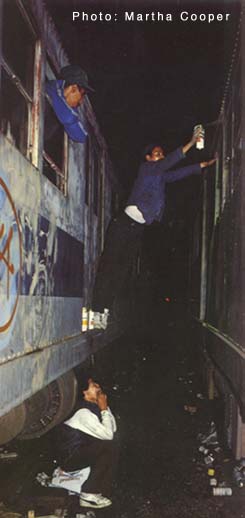
according to Can’t Stop Won’t Stop: A History of the Hip Hop Generation, afrika bambaataa defined the four elements of hip hop as djing, emceeing, breakdancing, and graffiti. of the four, only graffiti makes a case that its conception was a little more immaculate. in truth, it’s the only element that can actually even pursue any kind of truth with such a claim, as the origin of modern graffiti can be traced back not to the bronx, but to philly, as far back as 1965.

from Can’t Stop Won’t Stop:

Aerosolist and activist Steve “Espo” Powers says that the Black teenager, CORNBREAD, who is credited with popularizing the tagging of the Philly subways was only trying to attract the attention of a beauty named Cynthia. by 1968 the movement had spread to New York City.

but destiny is forged not of details, but from convergences:

….When a Greek American named TAKI 183 told the New York Times in the summer of 1971 why he tagged his name on ice cream trucks and subway cars–“I don’t feel like a celebrity normally, but the guys make me feel like one when they introduce me to someone”–thousands of New York youngsters picked up fat markers and spray paint to make their own name.

….Writing your name was like locating the edge of civil society and planting a flag there. In Greg Tate’s words, it was “reverse colonization.”

…. But these writers weren’t like the revolutionaries, or even the philosopher-activist wall-writers in Lima, Mexico City, Paris, and Algiers. Theirs were not political statements. They were just what they were, a strike against their generation’s invisibility…

They held no illusions about power. No graffiti writer ever hoped to run for mayor. And unlike the gang bangers, none would submerge his of her name to the collective. They were doing it to be known amongst their peers, to be recognized….

Normal Mailer, one of the first to write seriously about graffiti, got it instantly: the writers were composing advertisements for themselves.

graffiti was the megaphone that amplified the identities of those who knew they could never expect any other kind of recognition. a kleptomania of attention by those suffering from the original sort of attention deficit. by the time graffiti evolved from simply tagging, to “piecing” train-big creations, it was like stealing “rolling billboards for the self.”

but this kind of exposure came at a price. first of all, it was illegal. then after that it was time-consuming, a huge health hazard, incredibly dangerous, and of course, fiercely competitive. that was how much it cost to earn that moment of recognition. these kids were not raised on any illusion that they would ever be famous, be recognized, even be noticed. graffiti thus became a weapon with which to fend off the extreme alienation experienced by a generation of neglect victims.

thirty years later, here we are:

the most well known graffiti artists have either become corporate brands (obey, ecko) or are icons of anonymity (banksy). and everyone else has become, as the colloquialism goes, an attention whore.

to the invisible, writes jeff chang, fame itself was wealth.

funny that the same currency should be the lucre for those indulged with access to the fastest and easier methods for widespread expression ever developed. myspace and facebook and twitter and flickr and on and on, all mean that there’s no longer need to risk running from the police, inhaling noxious aerosol fumes, or life and limb to get your name out. “tagging” has literally never been easier. thirty years ago tagging was an illicit activity, branding one an outlaw for branding their name upon the gaze of others. now all of social media has become a “tagging-approved” zone. like a giant graffiti skate-park: a designated safe area where anyone can perform what was once a struggle to express.

modern society’s indulgence of its youngest children has led us to more craving, as shows like american idol inflict an even more profound deficit between the attention we want and the attention we get. the tools and opportunities we seem to seek are no longer an offense against society’s neglect, but a defense against our own narcissism’s resentment.

the old way at least made the commute more colofrul.


Subscribe for more like this.


the history of modern culture on the back of a butterfly’s wings

i find the synchronicity of elements that shape the development of culture as fascinating as its effects. like the random mutations of evolution that become brilliant adaptive advantages, there’s almost a kind of magic to these whimsical convergences of what retrospect makes appear like fate. a butterfly flaps its wings in the concrete jungle, and eventually the world world shifts on its axis.

i’m about a third of the way through Can’t Stop Won’t Stop: A History of the Hip Hop Generation. we’re circa 1979 now, when rapper’s delight gets released. the first hiphop 12-inch single ever pressed, the best-selling 12-inch single pressed–EVER.

but it’s not the bith of the hiphop industry that’s the exciting part. hiphop, the music meme of global dominating proportions, was incubated within the confines of a seven mile stretch of the bronx ghetto, and you best believe there wadn’t no tentalce of the recording industry naturally springing up in that desolate radius.

by the time rapper’s delight was recorded it was just a natural progression of the amplification of this butterfly’s roar that had already been underway. what’s really fascinating is what happened JUST before that step, what facilitated that next step, the first moves that hiphop rocked to break out of the gangland dance floor.

the fortunate cultural phenomenon that happened to have ended up at the right place at the right time, hiphop came of age parallel to the casette tape.

before that there was simply no way to record, redistribute, and replay recorded music as easily and cheaply ( waaait a second… that… sounds familiar for some reason?)

the first way that anyone outside of the bronx EVER discovered hiphop was, according to jeff chang, through:

“The live bootleg caseette tapes of Kool Herc, Afrika Bambaataa, Flash, etc….. [that] were the sound of the OJ Cabs that took folks accross the city. The tapes passed hand-to-hand in the Black and Latino neighborhoods of Brooklyn, the Lower East Side, Queens and Long Island’s Black Belt. Kids in the boroughs were building sound systems and holding rap battles with the same fervor the Bronx one possessed all to itself.”

makes you wonder how many other musical and cultural styles must have come and gone, disappearing forever into the dust of disintegrating, discontinued vinyl, the momentum to expand them never able to get fulfilled, held back by the constraints of antiquated music technology, don’t it?

* * *
more reaction to can’t stop won’t stop:
HERE


Subscribe for more like this.


future de ja vu

The image “http://www.dehora.net/journal/metropolis.jpg” cannot be displayed, because it contains errors.

you ever have that feeling that you’re living in the future? like you’re driving on these strange elevated chutes, and whether or not to have kids is now a choice, and you have no need to think about WHERE food comes from, it just generally appears at the beckoning of a shopping cart.

it’s pretty strange, all this is.

all this that you take for granted because you’ve just never known any different, but every so often something will jolt you out of this haze of taking-for-grantability. it happened to me the other day in the checkout line at bed bath and beyond. there were a couple of people in front of me, so i had time to actually notice what was going on as i waited. standing on the checkout counter, just to the left of the cashier was was a 12-inch flat plasma-screen TV, and it was playing a scene from one of those “relaxing” dvd compilations that were on sale in the impulse-buy section of the store right below the counter. it was a scene of tropical fish swimming around a reef. it was uncanny how much the 2-d fish looked like they could be real life, non-pixel based lifeforms just swimming around inside the frame of this plasma fishtank as cashiers made change, and customers sighed in line.

the thought ocurred to me: this is what the future looks like. or rather… this is what the future was going to look like. it was as if i’d experienced a vision of this moment in the past, before it happened, and was now living through its fulfillment. like…future de ja vu.

i think about that as i watch these crazy videos my friends keep shoving at me:

like:
http://www.popularmechanics.com/technology/industry/4217348.html
or
http://www.devilducky.com/media/62817

looking backwards, from the future where every surface has become a computer, and every photo anyone has ever taken is part of wiki-map of the universe, on today’s present, it already feels like we’re living through the dark ages right now.

which, of course, raises that inevitable question as old as the concept of time itself: when the future arrives, are you going to be glad you made it through, or not so much?

i mean, for the people born then it won’t matter. they won’t know any different. like how my generation doesn’t know a concept of sex without aids being attached to it somehow. i bet the older generations pity how much worse it is for us, but since we don’t really have anything else to compare it to, it’s just all we know.

i feel like i’m already starting to pity younger generations.

like…. how for kids that were too young to be in high school when tupac was shot, they don’t really have the same understanding when you say “hip hop” to them that older generations do. and that already includes mine!

explaining to them what hiphop used to be like is like explaining how michael jackson used to be black. which is, of course, another big one all unto itself.

i think porn is probably the biggest point of lament. like what’s happened in the course of porn going from hidden and inaccessible to mainstream and expected. i remember reading a statistic somewhere that it’s like 7 out of 10 elementary school kids have already seen graphic porn on the internet when they weren’t even looking for it. whatever that must mean in terms of the kind of inescapable message that’s being passed along to kids about the expected standard for sexual behavior is kinda disheartening.

food is a huge one too. from obesity to anorexia we have more disorders around food now than ever before. either we don’t think about what we’re eating enough, or we obsessively overthink it–is this the consequence of not having to think about getting it in the first place?

and while we’re on the topic of overthinking things, there’s of course that little narcissism epidemic thing. the rise of the creative class is, of course, not doing any of us any favors here, since narcissism is a side effect of self expression, unfortunately.

there’s openmindedness, i guess. we’re definitely getting exposed to a greater assortment of lifestyles than an average person would have been able to encounter before, and it’s making us more tolerant as we come to realize that our default, may not be the universal default we thought it was. a none too shabby outcome of the world getting all smaller and way too crowded like.

but it’s interesting, you know… we’re openminded…. yet no more empathic than ever before.

i wonder how that happened…

maybe openmindedness is a “nurture” thing…. but empathy is a nature one? requiring actual genetic change vs. cultural? we “know” we shouldn’t do bad stuff to people over there, but it’s not like we are more prone to feel bad if we do. (in fact, all these horrifyingly gruesome movies about torture and mutilation oozing out of hollywood these days only seem to indicate we may be getting a greater kick out of it than ever). the real issue is that the proximity of “over there” is getting increasingly closer and closer to us, so in effect, our restraint is still just us thinking about OUR own asses.

jeez… this is making me depressed…

the only good change i can even think of is in terms of sustainability. here’s a concept that was barely even in the common dialogue just a few years ago, and now it’s on the tip of everyone’s tongue. finally, environmental consciousness has been emancipated from the hippie ball-and-chain, so now it can actually be hip for EVERYONE to care about sustainability instead of just the counterculturals.

but this one good bit of future de ja vu, isn’t enough. i’m still pretty heartbroken about the whole michael jackson becoming white thing.

and don’t get me started about hip hop.

there’s gotta me something more, right?

anyone got any bright future forecasts?


Subscribe for more like this.


the first, the last, the ONLY hip hop

i just read the preface to Can’t Stop Won’t Stop: A History of the Hip Hop Generation, by jeff chang, and it has put me in a much less sarcastic mood than i am usually in when i sit down to write here.

i joke that “circus is the next hip hop,” i joke that there’s anything could be the next hip hop, but let me make one thing clear: it’s a joke.

it’s referring to the kind of “hip hop” that’s a trend. the kind of “hip hop” that’s a marketing buzzword that’s been abused since vanity fair, in all seriousness, labeled paris and nicky hilton, the hip hop debutantes.

that “hip hop” is a farce.

but there is another kind of hip hop. a hip hop that cannot be replicated, cannot be commodified, and cannot ever be rebranded, and it is hiphop as a force.

a force concieved in a mess of poverty, devastation, neglect, and chaos. a force that grew out of racism, plagiarism, jimcrowism, indifference, censorship, white kids burning black records proudly declaring that “disco sucks,” denial, globalization and in the end, appropriation. it grew where nothing else would grow. like the rose that grew from concrete, hip hop grew.

and this force became big. this force just would not get along. it refused to fit in, refused to be discounted, refused to be ignored. hiphop refused to sit in the back of the bus, and left its mark as big as metro train bombs, because it would not go unseen.

hiphop was mad! it roared with anger! it was angry of envy, angry of hunger, angry of despair, degredation, angry of all the other voices that got to sing. hiphop raged until it could not be ignored! destroyed itself over and over with the madness of the surf, and spread as far accross the world as the oceans. there is no “next” for a force like that.

if you grew up in the projects, went to a public, urban high school in the 90’s, and liked to dance, it didn’t matter what color your skin was, hiphop would be the music you listened to. hip hop would be the frequency you vibrated to. hip hop would be the history that spoke to your present, and if you started to develop a curiosity about this history, then you’d hope that one day, a hip hop journalist like jeff chang would write a book like “can’t stop won’t stop,” and it would start like this:

“Generations are fictions.

The act of determining a group of people by placing a beginning and ending date around them is a way to impose a narrative. They are interesting and necessary fictions because they allow claims to be staked around ideas. But generations are fictions nonetheless, often created simply to suit the needs of demographers, journalists, futurists, and marketers.

In 1990, Neil Howe and William Strauss–both baby boomers and self-described social forecasters–set forth a neatly parsed theory of American generations in their book, Generations: The History of America’s Future, 1584 to 22069. They named their own generation “Prophets,” idealists who came of age during a period of “Awakening,” and their children’s generation “Heroes, who, nurtured by their spiritually attuned parents, would restore America to a “High” era. In between were “Nomads” inhabiting a present they described as an “Unraveling.” What Howe and Strauss’s self-flattering theory lacked in explanatory power, it made up for with the luck of good timing. The release of Generations intersected with the media’s discovery of “Generation X,” a name taken from the title of a book by Douglas Coupland that seemed to sum up for boomers the mystery of the emerging cohort.

Howe and Strauss’s book was pitched as a peek into the future. Cycles of history, they argued, proceed from generational cycles, giving them the power to prophesize the future. Certainly history loops. But generations are fictions used in larger struggles over power.

There is nothing more ancient than telling stories about generational difference. A generation is usually named and framed first by the one immediately preceding it. The story is written in the words of shock and outrage that accompany two revelations: “Whoa, I’m getting old,” and “Damn, who are these kids?”

Boomers seem to have great difficulty imagining what could come after themselves. It was a boomer who invented the unfortunate formulation: “the end of history.” By comparison, everything that came after would appear as a decline, a simplification, a corruption.

Up until recently, our generation has mainly been defined by the prefix “post-.” We have been post-civil rights, postmodern, poststructural, postfeminist, post-Black, post-soul. We’re the poster children of “post-,” the leftovers in the dirty kitchen of yesterday’s feast. We have been the Baby Boom Echo. (Is Baby Boom Narcissus in the house?) We have been Generation X. Now they even talk about Generation Y. And why? Probably because Y comes after X.

And so, by the mid-1990’s, many young writers–sick of what Howe and Strauss and their peers had wrought–took to calling themselves “the Hip-Hop Generation.” In 2002, in an important book, The Hip-Hop Generation: Young Blacks and the Crisis in African American Culture, Bakari Kitwana forged a narrow definition–African Americans born between 1965 and 1984–a period bracketed by the passage of the Civil Rights Act and the assasination of Malcolm X on one end and hip-hop’s global takeover during the peak of the Reagan/Bush era at the other.

Kitwana grappled with the implications of the gap between Blacks who came of age during the Civil Rights and Black Power movements and those who came of age with hip-hop. His point was simple: a community cannot have a useful discussion about racial progress without first taking account of the facts of change.

Folks got bogged down once again in the details. How could one accept a definition of a Hip-Hop Generation which excluded the culture’s pioneers, like Kool Herc, and Afrika Banbaataa, for being born too early? Or one that excluded those who had come to claim and transform hip-hop culture, but were not Black of born in America? Exactly when a Hip-Hop Generation began and whom it includes remains, quite appropriately, a contested question.

My own feeling is that the idea of the Hip-Hop generation brings together time and race, place and polyculturalism, hot beats and hybridity. It describes the turn from politics to culture, the process of entropy and reconstruction. It captures the collective hopes and nightmares, ambitions and failures of those who would otherwise be described as “post-this” or “post-that.”

So, you ask, when does the Hip-Hop generation begin? After DJ Kool Herc and Afrika Bambaataa. Whom does it include? Anyone who is down. When does it end? When the next generation tells us it’s over.

This is a nonfiction history of a fiction–a history, some mystery, and certainly no prophecy. It’s but one version, this dub history–a gift from those who have illuminated and inspired, all defects of which are my own.

There are many more versions to be heard. May they all be.

Jeff Chang
Brooklyn and Berkeley
January 1998 to March 2004

i’m sure i’ll be writing more about this book as i tackle everything that comes after these first 3 pages…


Subscribe for more like this.