
irony
that thing in the desert
To all my peeps heading out to Straight Pride next week, just wanted to say… don’t forget to hydarte.
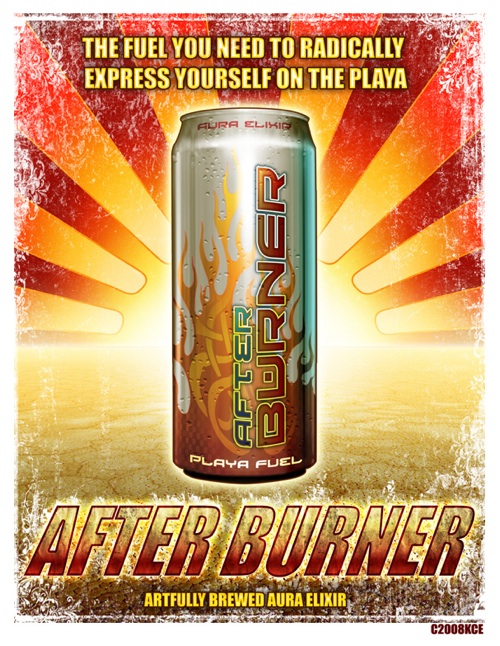
the end of counterculture
While I was in New York a couple of weeks ago, it came to my attention that hipsters had managed to really piss Adbusters off. In his article, Hipster: The Dead End of Western Civilization,” Dougals Haddow writes:
Take a stroll down the street in any major North American or European city and you’ll be sure to see a speckle of fashion-conscious twentysomethings hanging about and sporting a number of predictable stylistic trademarks: skinny jeans, cotton spandex leggings, fixed-gear bikes, vintage flannel, fake eyeglasses and a keffiyeh – initially sported by Jewish students and Western protesters to express solidarity with Palestinians, the keffiyeh has become a completely meaningless hipster cliché fashion accessory.
The American Apparel V-neck shirt, Pabst Blue Ribbon beer and Parliament cigarettes are symbols and icons of working or revolutionary classes that have been appropriated by hipsterdom and drained of meaning. Ten years ago, a man wearing a plain V-neck tee and drinking a Pabst would never be accused of being a trend-follower. But in 2008, such things have become shameless clichés of a class of individuals that seek to escape their own wealth and privilege by immersing themselves in the aesthetic of the working class.
Lovers of apathy and irony, hipsters are connected through a global network of blogs and shops that push forth a global vision of fashion-informed aesthetics. Loosely associated with some form of creative output, they attend art parties, take lo-fi pictures with analog cameras, ride their bikes to night clubs and sweat it up at nouveau disco-coke parties. The hipster tends to religiously blog about their daily exploits, usually while leafing through generation-defining magazines like Vice, Another Magazine and Wallpaper.
Ever since the Allies bombed the Axis into submission, Western civilization has had a succession of counter-culture movements that have energetically challenged the status quo. Each successive decade of the post-war era has seen it smash social standards, riot and fight to revolutionize every aspect of music, art, government and civil society.
But after punk was plasticized and hip hop lost its impetus for social change, all of the formerly dominant streams of “counter-culture” have merged together. Now, one mutating, trans-Atlantic melting pot of styles, tastes and behavior has come to define the generally indefinable idea of the “Hipster.”
Haddow’s thesis is that “We’ve reached a point in our civilization where counterculture has mutated into a self-obsessed aesthetic vacuum,” and hipsterdom, “the end product of all prior countercultures,” represents nothing short of “the end of Western civilization.”
In a certain way, he’s right.
In chapter 11 of The Long Tail, titled, “Niche Culture,” Chris Anderson quotes the writing of media analyst Vin Crosbie to help explain the origins of this phenomenon:
Each individual listener, viewer, or reader is, and has always been, a unique mix of generic interests and specific interests. Although many of these individuals might share some generic interest, such as the weather, most, if not all of them, have very different specific interests. And each individual is truly a unique mix of generic and specific interests.
As of 30 years ago, Crosbie writes, with the improvements in offset lithography that led to a boom in specialty magazines (the 1970s saw newsstand offerings explode from a couple dozen magazines to hundreds, and most about specific topics), media technologies began to evolve in ways that could satisfy individuals’ specific interests:
The result of this is that more and more individuals, who had been using only the (generic) mass medium because that’s all they had, have gravitated to specialty publications, channels, or websites. More and more use the mass media less and less. And more and more will soon be most. The individuals haven’t changed; they’ve always been fragmented. What’s changing is their media habits. They’re now simply satisfying the fragmented interests that they’ve always had.
Anderson adds: “The shift from the generic to the specific is a rebalancing of the equation, an evolution from an ‘Or’ era of hits or niches (mainstream culture vs. subcultures) to an ‘AND’ era. Mass culture will not fall, it will simply get less mass. And niche culture will get less obscure.”
What this means then is that “counterculture,” as the construct we, and Adbusters, have known it to be, is disappearing. Maybe gone. If mass and niche culture can meet each other in the middle and make room for both sides, what is there to be “counter” to?
This dead end of “mass culture” seems like a concept Adbusters should have been rejoicing, no? Unless they were confused as to what the end of “mass culture” might look like.
“When mass culture breaks apart,” Anderson writes, “it doesn’t re-form into a different mass. Instead it turns into millions of microcultures, which coexist and interact in a baffling array of ways.” In this landscape of, as Anderson calls it, “massively parallel culture,” there’s not really a place for “mass rebellion.” Instead, we have specific, niche rebellions.
Haddow writes: “This cursory and stylized lifestyle has made the hipster almost universally loathed.” So much so, in fact, that, “It is rare, if not impossible, to find an individual who will proclaim themself a proud hipster. It’s an odd dance of self-identity – adamantly denying your existence while wearing clearly defined symbols that proclaim it.” Perhaps one of the specific rebellions of niche culture might be against the labels of stereotypical identity definition themselves. No doubt, especially if that definition is being used as a lifestyle slur. In the article, Gavin McInnes, one of the founders of Vice Magazine explains: “I’ve always found that word [“hipster”] is used with such disdain. [It] always smell of an agenda.”
At the end of the Adbusters piece Haddow writes, “If only we carried rocks instead of cameras, we’d look like revolutionaries.” In the conclusion of The Pirate’s Dillema (which presents an exuberant, revolutionary potential for youth culture’s future that is in stark opposition to Adbusters’ depiction of its “dead-end” present by a journalist from, ironically the same publication Adbusters claims defines the doomed hipster generaion, Vice Magazine) Matt Mason writes: “Youth movements become successful when social change is desperately needed. They gain traction if they express society’s collective desire for change.”
Is this something that really applies to the West’s united niche culture so much these days?
On the other hand, as Mason writes:
The source of future youth movements will just as likely be the rage, desperation, and hope transmitted from the medinas, favelas, and shanty cities of the southern hemisphere. According to a 2005 report commissioned by the National Research Council and the Institute of Medicine on trends affecting youth in developing countries, there are currently 1.5 billion ten- to twenty-four-year-olds on Earth, and 86 percent of them live in a developing country. In many places in Asia and Africa, this generation is the first generation of teenagers their countries have known. As their economic and political power grows, new sounds, movements, and ideas will grow, too.
This is where the new youth cultures will be.
does good matter?
“Companies: How to Make Millions By Switching to A Green-Colored Logo”
– Headline in The Onion’s “Obligatory Green Issue”

I’ve been thinking about this, the third in what’s evidently become a series of posts inspired by Buying In: The Secret Dialogue Between Who We Are and What We Buy, by Rob Walker, since I read the section in the book (it’s also been reprinted as a Fast Company article) where Walker writes about American Apparel changing its brand messaging. Initially the company’s identity hinged on its “Sweatshop Free” production, but sex, surprise surprise, turned out to be a much better sell than good labor practices. Walker writes:
American Apparel seemed to me to be a marquee example of a business that had positioned itself to respond to a rising tide of ethical, antibrand consumers. At a moment when practically every clothes maker was offshoring to cut costs, American Apparel made its wares at a U.S. factory in which the average industrial worker (usually a Latino immigrant) was paid between $12 and $13 an hour and got medical benefits. The company had taken out ads in little arty magazines, noting that it was “sweatshop free.”
[But] Another self-consciously ethical clothing brand, SweatX, had just gone out of business. The lesson of SweatX, [American Apparel CEO Dov] Charney said, was that building a brand solely around a company’s ethical practices was not a good strategy for reaching masses of consumers. The ethical sell was too limiting. It was a niche strategy, at best. Which was why American Apparel was moving away from the ethical sell to something very different.
Charney pulled out a copy of a book called The 48 Laws of Power and read me No. 13, which suggested that to get what you want, you must appeal to people’s self-interest, not to their mercy. “That’s the problem with the anti-sweatshop movement. You’re not going to get customers walking into stores by asking for mercy and gratitude.” If you want to sell something, ethical or otherwise, he said, snapping the book closed, “appeal to people’s self-interest.”
By the time I visited American Apparel’s headquarters and factory in Los Angeles to meet with Charney a second time, the company had transitioned to an image soaked in youth and sex. This was apparent in its stores — where the decor often included things such as Penthouse covers — and in its print ads. Yes, some of these ads mentioned quality and the sweatshop-free angle, but usually in small type, under a photograph of a half-naked young woman.
The company was producing 32,000 pieces a day and struggling to keep up with orders. In months, [the company’s] system was churning out 90,000 pieces a day and would eventually reach 250,000. While the company was projecting an air of almost reckless decadence in its ads, it was quietly building a thriving made-in-America business model.
All of which, of course, made me wonder–and perhaps might make you wonder, too: Does good matter?
Good itself, I mean, without a gloss of sex covering it over, does it matter as a selling point to us as consumers?
Researchers Remi Trudel and June Cotte were trying to figure out the same thing in their studies for the May 2008 Wall Street Journal piece Does Being Ethical Pay?
For corporations, social responsibility has become a big business. Companies spend billions of dollars doing good works — everything from boosting diversity in their ranks to developing eco-friendly technology — and then trumpeting those efforts to the public.
But does it pay off?
To find out, we conducted a series of experiments. We showed consumers the same products — coffee and T-shirts — but told one group the items had been made using high ethical standards and another group that low standards had been used. A control group got no information.
In all of our tests, consumers were willing to pay a slight premium for the ethically made goods. But they went much further in the other direction: They would buy unethically made products only at a steep discount.
Our first experiment asked two questions. How much more will people pay for an ethically produced product? And how much less are they willing to spend for one they think is unethical?
To test these questions, we gathered a random group of 97 adult coffee drinkers and asked them how much they would pay for a pound of beans from a certain company. We used a brand that’s not available in North America, so none of the participants would be familiar with it.
But before the people answered, we asked them to read some information about the company’s production standards. One group got positive ethical information, and one group negative; the control group got neutral information, similar to what shoppers would typically know in a store.
After reading about the company and its coffee, the people told us the price they were willing to pay on an 11-point scale, from $5 to $15. The results? The mean price for the ethical group ($9.71 per pound) was significantly higher than that of the control group ($8.31) or the unethical group ($5.89).
Meanwhile, as the numbers show, the unethical group was demanding to pay significantly less for the product than the control group. In fact, the unethical group punished the coffee company’s bad behavior more than the ethical group rewarded its good behavior. The unethical group’s mean price was $2.42 below the control group’s, while the ethical group’s mean price was $1.40 above. So, negative information had almost twice the impact of positive information on the participants’ willingness to pay.
Trudel and Cotte also researched just how ethical companies really need to be in order to reap marketplace rewards, that is, are consumers willing to pay more for a product that is 100% ethically produced versus one that is 50% or 25% ethically produced? Their findings showed that there is a certain “ethical threshold” beyond which any ethical acts might reinforce the company’s image, but don’t induce people to pay more. And lastly, they examined the effect of pre-existing consumer attitudes, and found that people with high expectations about how companies should behave doled out bigger rewards and punishments than those with low expectations.
For companies, the implications of this study — albeit limited — are apparent. Efforts to move toward ethical production, and promote that behavior, appear to be a wise investment. In other words, if you act in a socially responsible manner, and advertise that fact, you may be able to charge slightly more for your products.
Not an overwhelming rallying cry to assert that good is here, it matters, and we should get used to it, exactly, but clearly an opportunity to explore a new ethical “market segment.” As Walker writes:
Perhaps this is why many big companies and brands are not so much changing their products as adding new alternatives to their existing product mixes, or carving a small donation to charity out of their profit margins. Pepsi-Cola is testing an all-natural version of its flagship drink called Pepsi Raw, and Clorox has launched an eco-friendly line of cleaning products. The Bono-promoted (Product) Red initiative brands existing products that dedicate a portion of the purchase price to the Global Fund to Fight AIDS, Tuberculosis, and Malaria. There’s even a (Product) Red version of the iPod.
A whopping majority of American shoppers may consider themselves environmentalists, but, according to the Journal of Industrial Ecology, only 10% to 12% “actually go out of their way to purchase environmentally sound products.” Similarly, Brandweek reported on a survey that found that even among consumers who called themselves “environmentally conscious,” more than half could not name a single green brand.
Ask most people whether they care about the environment, and it’s not particularly surprising that many would say yes. Ask whether they would back that up by “buying green” if they had the chance, and again, it’s likely that very few would admit to being hypocrites by saying no. What we do in the marketplace is another matter.
There is a real-world overload of factors that confront consumers in the marketplace — price, quality, convenience, pleasure, plus the countless number of symbols that provide us with rationales to buy. The Yale Center for Customer Insights designed an experiment to test this phenomenon. It divided 108 subjects into two groups. Members of one group were presented with a straightforward consumer choice. Would they prefer to buy a vacuum cleaner (a utilitarian object) or a pair of jeans (a bit of a luxury), each of which was assigned the same price, $50? About 72% chose the vacuum cleaner. Members of the other group were told to imagine they had volunteered to spend three hours a week either teaching children in a homeless shelter or “improving the environment.” They were asked to explain their choice, a process meant to prod them into engaging with the idea. Then they faced the vacuum-cleaner-or-jeans choice. In this group, a majority (57%) opted for the jeans.
Although very few of the subjects made the connection, the researchers concluded that “the opportunity to appear altruistic by committing to a charitable act in a prior task” gives us license to choose a luxury item. A similar set of studies indicates that subjects are more likely to splurge on fancier sunglasses or pricier concert tickets after giving to charity. If you buy ecological or green products or consume alternative health care or practice yoga, it’s easy to conclude, “Hey, I’ve done my part.”
These efforts [by big companies] add just enough options to the miles of retail shelves to give us all an ethical fix — to do our one good shopping deed. Then we can push our basket a little farther down the aisle, letting other rationales take over: Here’s a bargain, here’s a great product, here’s something that I could probably get cheaper elsewhere, but as long as I’m here, I’ll just get it — and here, yes, here is something ethical. I’ll take one of those, too.
Trudel and Cotte concluded at the end of their research: “The lessons are clear. Companies should segment their market and make a particular effort to reach out to buyers with high ethical standards, because those are the customers who can deliver the biggest potential profits on ethically produced goods.”
Rather than marketing ethical products to a mainstream audience, big companies can simply create a separate ethical brand or product line, repackage it as a luxury “good,” and sell it at a premium to the niche, conscientious consumer demographic–which may be willing to pay more for ethical products, but couldn’t scale to support a company like SweatX, or to motivate the big companies to change their practices overall.
Is that the fate of good, then? Is the extent of it’s significance as a selling point simply the justification for a reverse “ethical tax”?
At the PSFK conference in San Francisco last week, GOOD Magazine co-founder Max Schorr’s presentation, “Aligning Interests,” (echoing that 13th law of power) was subtitled: “When cynical people admit they’re idealistic you might be on to something.” At the beginning of his presentation Schorr asked a room full of marketers how many of us wanted to make a positive impact. Pretty much everyone raised their hands. When he asked how many of us wanted to make money, the same hands shot up. The idea then is that to effect real positive change these kinds of interests have to align. Doing good has to be separated from the bleak, unprofitable, un-fun, self-righteous, and ultimately ineffectual idea lf altruism, and the “triple bottom line” of sustainability, profit, and positive impact, needs to become a single bottom line. Schorr’s presentation was the most loudly applauded of the whole day, and thereafter the most frequently referenced. There is no doubt that marketers–well, those of us that raised our hands anyway–we WANT good to matter. We WANT consumer demand for ethics and sustainability to affect the substance of what the market supplies. We want good to succeed.
But does it have to matter as a selling point to do that?
In his presentation, Schorr talked about how the magazine has stopped using the word “Green.” The reason behind this move being to stop presenting sustainable practices as some kind of distinct “alternative” from what should simply be the default standard. In a sense, this is what American Apparel did as well when they stopped trumpeting their ethical practices to distinguish their brand identity.
Maybe it’s all about thinking ahead. We shouldn’t confuse current consumer attitudes with what they’re likely to be in the future. No doubt a company’s environmental friendliness matters more now to the average consumer than it would have before the release of An Inconvenient Truth. And I’d be willing to bet that ethical production practices in general matter more to us now than they did before the wave of mass internet adoption hit, and access to information about a company’s practices became easily accessible to the average web surfer. Trudel and Cotte even acknowledged that if 100% ethically produced products become the expected norm, anything less may be punished by consumers. So perhaps good actually WILL matter quite a bit more in the future than it does now.
But will it ever matter more than sex?
Maybe that gloss on top won’t hurt anyway. Just…. you know….. in case.
hipster screamo southern rap
I got an email a few days back that read:
from
justin boreta
subject
datehttp://profile.myspace.com/brokencyde
prepare yourself
But I was getting ready to head out to San Francisco for the PSFK conference, (and to be perfectly honest, was kind of scared by the whole idea being proposed in the email’s subject line) so I didn’t get around to actually checking it out until today…..
And oh man, these guys are friggin awesome and hilarious. I couldn’t listen to a single track without totally cracking up. And I’m sure these tunes ain’t no slouches on the dancefloor neither. (Do yourself a favor, and go check them out. It might not be your cup of tea, but you gotta at least be entertained that this exists at all.)

Ps. Gotta love the complete blatant disregard for all music genre rules and regulations. Sounds like the future.